

Inside Nokia’s new AI Networking Innovation Lab
- Silicon & Compute: Collaborating with AMD to optimize enterprise AI workloads alongside Nokia data center switches.
- Testing & Infrastructure: Partnering with Keysight Technologies to emulate workloads across Ultra Ethernet Consortium (UEC) and RoCEv2 transports.
- Hardware & Servers: Integrating high-performance platforms from Lenovo and Supermicro.
- Data Storage & Cloud: Working with Weka and cloud builders like Nscale to eliminate storage bottlenecks during heavy computational training.
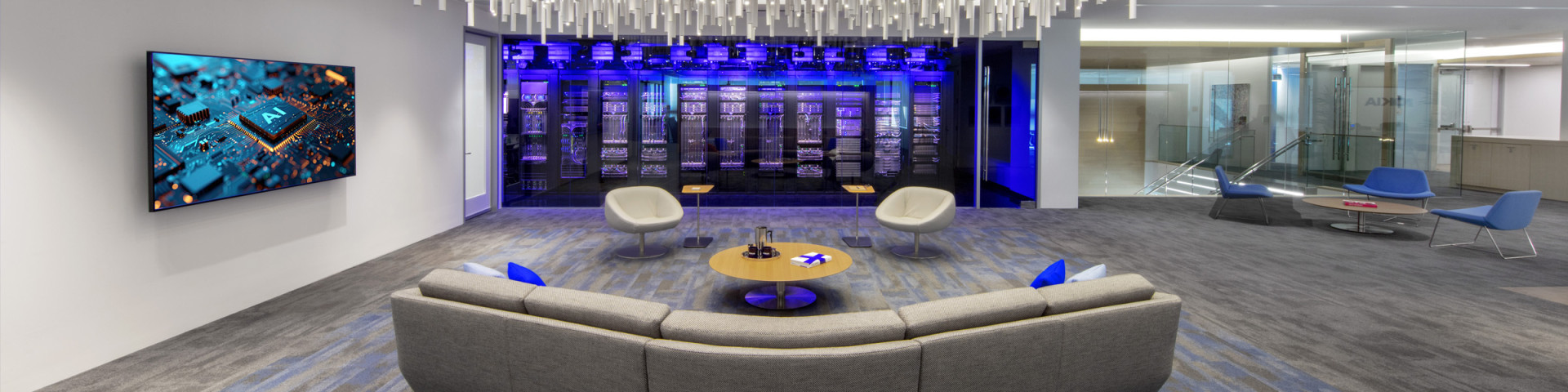
Nokia’s AI Networking Innovation Lab is built upon three fundamental pillars: Technology Innovation, Ecosystem Collaboration, and Validation. Image credit: Nokia
………………………………………………………………………………………………………………….
Technology Innovation: The lab provides a dedicated space for AI partners to experiment with next-gen solutions across the entire networking stack – driving emerging standards forward with pioneering approaches to new protocols, switching silicon, congestion control, real-time telemetry, and automation.
“Partnering with Nokia in the AI Networking Innovation Lab has enabled us to benchmark and optimize AI networks under real-world conditions…Together, we are helping accelerate AI network adoption by giving operators and hyperscalers the validated insights needed for confident, large-scale deployment.”
Ecosystem Collaboration: True progress depends on a strong ecosystem of technology providers – silicon manufacturers, GPU developers, system, storage and test vendors, and cloud platforms – that work together to create highly-compatible AI-ready solutions. This facilitates joint testing for interoperability, improves integration, and ensures roadmaps are aligned across different hardware, software, and orchestration layers.
Travis Karr, Corporate Vice President, HPC and Sovereign AI at AMD believes customer collaboration and an open ecosystem are fundamental to accelerating AI innovation:
“By co-developing solutions with partners, such as Nokia in their AI networking innovation lab, we ensure our AMD enterprise AI solutions are tested with Nokia data center switches on real-world workloads and network demands. An open, standards-driven approach empowers customers to integrate seamlessly across heterogeneous environments, avoiding lock-in and fostering industry-wide advancement in AI.”
Validation: This positions the lab as the testing ground for Nokia Validated Designs, where customers and partners rigorously validate multi-vendor data center architectures under authentic AI training and inference workloads. By testing failure scenarios, congestion behavior, and operational automation, the lab turns NVDs into proven, deployable solutions — enabling predictable performance, faster deployment, and reduced operational complexity and risk for organizations navigating the AI era.
Arno van Huyssteen, Vice President of Global Telecommunications for Nscale:
“Nokia is a strategic networking partner for Nscale as we build towards AI Grid, and the engineering rigour behind their Validated Designs reflects the kind of innovation needed to enable next-generation AI infrastructure. The depth of hardware, software and failure testing behind those blueprints is what will give operators the confidence to deploy complex AI environments faster, with fewer integration risks and less operational disruption. We’re excited to collaborate in the AI Networking Innovation Lab to help push the boundaries of AI-native networking and validate the next generation of solutions before they reach production.”
A primary focal point inside the lab is managing data center congestion. Unlike traditional cloud traffic, back-end AI networks feature high-density data synchronization across massive GPU clusters. The lab uses advanced automation, AIOps, and lossless Ethernet solutions—such as the Nokia 7220 IXR-H6 switches—to handle these intense uplink and synchronization demands safely.
The AI Networking Innovation Lab supports Nokia’s broader strategy to accelerate the next era of AI-driven connectivity. As demand for AI infrastructure continues to grow, data center networking has become one of the most critical foundations of the global AI ecosystem. Through this investment, Nokia is strengthening its capabilities in AI and cloud infrastructure while advancing its vision of AI-native networking.
Rudy Hoebeke, Vice President of Software Product Management at Nokia:
“The launch of Nokia’s AI Networking Innovation Lab marks a major milestone in our commitment to drive the next era of AI-native connectivity. As the industry continues to evolve with solutions like scale-across and AI-Grid, this lab is poised to accelerate AI networking technology that will not only support but optimize these emerging industry offerings. This center gives our customers and partners early access to new technologies, deeper collaboration with the world’s leading AI ecosystem players, and the confidence that their networks are validated under more realistic AI conditions. By accelerating innovation and reducing deployment risks, we’re enabling the industry to deliver faster, more reliable, and more sustainable AI experiences to people and businesses everywhere.”
………………………………………………………………………………………………………………………
References:
Analysis: Nokia’s strong growth in Optical Networks and AI network infrastructure
Orange, Nokia, Nvidia, and Intel debate: ASICs vs. GPUs vs. General-Purpose CPUs for RAN Baseband Processing
Nokia’s AI Applications Study: “Physical AI” may require RAN redesign to support high‑volume, low‑latency uplink traffic
Australia’s NBN and Nokia demonstrate multi-generation optical technologies concurrently over existing FTTP infrastructure
Nokia to showcase agentic AI network slicing; Ericsson partners with Ookla to measure 5G network slicing performance
Tampnet to expand 5G offshore connectivity in the Gulf of Mexico using Nokia AirScale 5G radios
Dell’Oro: Analysis of the Nokia-NVIDIA-partnership on AI RAN
One thought on “Inside Nokia’s new AI Networking Innovation Lab”
Leave a Reply

On June 16, 2026, Nokia announced a $30 million investment to expand its chips manufacturing facility in Lehigh Valley, Pennsylvania. Over the next five years, officials estimate the project will make a $500 million economic impact and bring more than 250 jobs to the Lehigh Valley region.
The announcement builds on Lehigh Valley’s continued growth as a hub of technological innovation, fueled by more than 35 semiconductor and related businesses in the region, including global brands such as Broadcom, Coherent and Intel.
The announcement also bolsters the region’s role in the top 15% of U.S. manufacturing markets by gross domestic product, driven by over 700 manufacturers that produce an annual output of $9 billion, representing 16% of the region’s GDP, compared to 11% nationally.
“Semiconductor and optoelectronics development have long been an important part of the Lehigh Valley economy,” said Don Cunningham, President & CEO of the Lehigh Valley Economic Development Corporation (LVEDC). “Nokia’s investment and expansion here with the support of Gov. Shapiro and the Commonwealth showcase the continued growth and importance of this critical technology sector here in the Lehigh Valley.”