

Brooklyn AI-Native 6G Summit Highlights: Verizon’s 7 GHz Field Tests with Ericsson, AI-RAN Demonstrations and Wireless AI Interop
Disclaimer: ChatGPT was used extensively to research the Brooklyn AI-Native 6G Summit, review technical presentations and company announcements, analyze the technologies and demonstrations discussed, and assist with drafting this article. The author reviewed, fact-checked, and edited the material and is 100% responsible for its content.
Introduction:
Verizon’s 7 GHz 6G field testing:
- China’s DeepSig demonstrated an over-the-air AI-RAN system using the open-source OCUDU RAN ecosystem and NVIDIA DGX Spark. Its demonstrations included neural receiver processing, ray-traced channel emulation and AI-based spectrum sensing. This was a meaningful integration demonstration, but publicly available information did not provide independent quantitative results for throughput, latency, spectral efficiency, power consumption or performance against conventional receivers. It therefore should not be interpreted as evidence of commercial readiness.
- InterDigital and Arizona State University (ASU) demonstrated research on interoperable AI-based channel-state-information (CSI) feedback. Their approach uses independently trained encoder and decoder models designed to interoperate without exchanging model parameters or requiring identical architectures. The prototype used an OpenAirInterface-based testbed. The researchers reported performance approaching jointly trained models.
–>This is a potentially important research direction: future wireless systems may need AI models from different suppliers to work together. However, the work remains limited in scope and does not establish a standardized interface or universal multi-vendor interoperability.
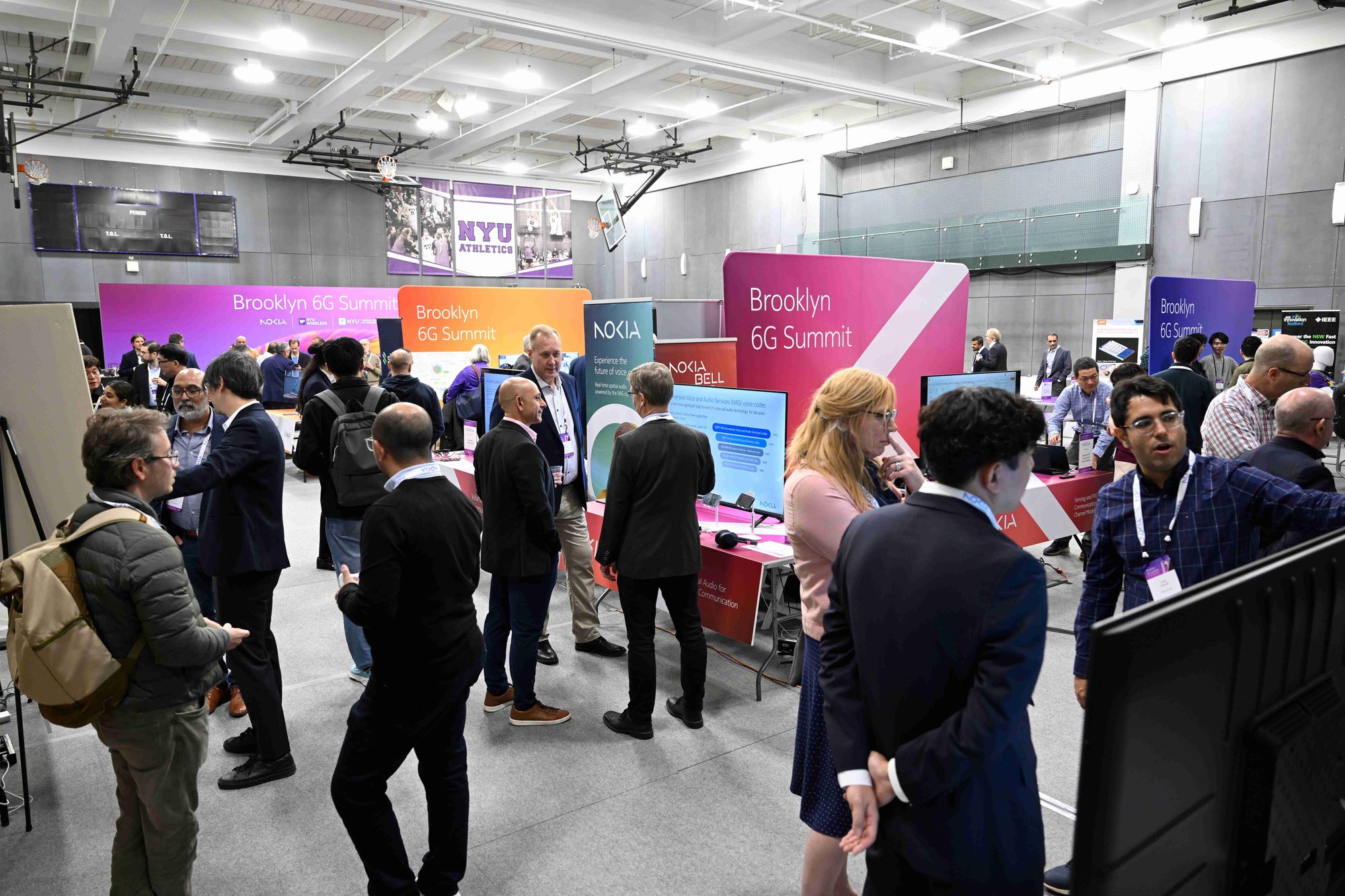
…………………………………………………………………………………………………………………………………………………………………………………………………………………………………………….
Expanding on AI model interoperability (InterDigital / Arizona State University)
The InterDigital–ASU demonstration on interoperable AI-native Channel State Information (CSI) feedback deserves greater attention than it typically receives at such events. Their live prototype (“From Conventional CSI to Interoperable AI-Native Latent Feedback”) showed that an encoder and decoder trained completely independently—by different parties, without exchanging model parameters or requiring identical architectures—can still achieve performance approaching that of jointly trained models. The work was realized on an OpenAirInterface-based testbed, providing a concrete, over-the-air proof point rather than a purely simulation-based claim.
This matters because CSI feedback is inherently a two-sided AI/ML use case: the UE-side encoder and the gNB-side decoder will frequently come from different vendors in any realistic multi-vendor RAN. 3GPP’s ongoing AI/ML air-interface studies (beginning in Release 18) have already identified CSI compression/enhancement as one of the primary candidates for standardization precisely because of this cross-node dependency. Without well-characterized interfaces for the latent representation, model versioning, performance monitoring, and fallback behavior, operators risk recreating proprietary silos inside an otherwise open or disaggregated RAN architecture.
The technical problem is not merely “can AI compress CSI better?” A more important question if AI models from independent vendors interoperate reliably at scale? The InterDigital/ASU result is an early, encouraging data point that such interoperability is feasible. However, it remains limited in scope: it does not yet define a standardized latent-space interface, multi-vendor conformance testing methodology, or lifecycle management procedures. Those are the harder, longer-term questions that will determine whether AI-native features can actually be deployed across heterogeneous networks rather than remaining confined to single-vendor islands.
As AI-RAN concepts mature, progress on model interoperability—starting with CSI feedback and extending to other two-sided functions such as beam management or positioning—will likely prove as important as advances in model accuracy itself.
Physical AI and distributed infrastructure:
Another demonstration connected humanoid robots in Singapore with synchronized digital twins in Brooklyn. The project brought together Singapore’s Future Communications Program, NeuroRAN, Qualcomm Technologies, NVIDIA and MediaTek. Its workflow combined AI model selection, action generation, digital-twin validation and execution over a 5G/AI-RAN connection.
The demonstration illustrated how wireless connectivity, edge computing and AI orchestration could support remotely coordinated physical systems. However, the public description did not provide detailed measurements of end-to-end latency, synchronization accuracy, packet loss or operational reliability.
More broadly, the Brooklyn 6G Summit emphasized that AI-native networks will require coordination across mobile networks, cloud and edge computing, data-center switching, IP and optical transport. These infrastructure requirements are important, but the event did not establish a proven commercial business model for AI-RAN or AI-native 6G services.
Conclusions:
The Summit’s most useful contribution was to highlight both the opportunities and the engineering challenges facing AI-native 6G. Verizon’s 7 GHz trials exposed the propagation and coverage trade-offs associated with higher-frequency spectrum, emphasizing that future hardware architectures must evolve to overcome severe indoor building penetration limitations. DeepSig demonstrated an integrated AI-RAN research system, while InterDigital and Arizona State University explored a potentially important approach to interoperability between independently trained wireless AI models.
The Physical AI demonstration illustrated how wireless connectivity and distributed computing could support connected robotic systems. Ultimately, this 6G event underscored that scaling these technologies relies heavily on navigating broader, systemic bottlenecks. Chief among these is a shared sense of urgency regarding infrastructure power constraints, which threaten to restrict high-capacity AI-RAN and edge deployment at scale.
True commercial realization will not come from advancing computing, AI, or networking in isolation, but through their absolute, cross-layer convergence into a workload-aware, distributed infrastructure. These developments are worth watching, but they should not be confused with standardized, commercially deployable 6G technology. Significant work remains in radio performance, spectrum availability, AI model interoperability, network architecture, and deployment economics.
…………………………………………………………………………………………………………………………………………………………………….
Editor’s Note: This summary is based on publicly available Summit announcements, demonstration descriptions, the published agenda and post-event reporting. Presentation slides and full session recordings were not publicly available at the time of writing. Where detailed performance data were unavailable, claims are attributed to the participating organizations.
…………………………………………………………………………………………………………………………………………………………………….
References:
IEEE.tv — Brooklyn AI-Native 6G Summit
https://www.lightreading.com/6g/verizon-cto-assesses-7ghz-band-for-6g-after-first-call-in-the-field
Nokia: https://www.youtube.com/watch?v=og3f2v_WTSk
Highlights and Summary of the 2025 Brooklyn 6G Summit
ATIS Proposes Wireless Physical-Layer Foundation Models for AI-Native 6G Networks
6G Architecture and Economics: Core Network Evolution, AI Integration and Business Case
IMT-2030/6G Spectrum Sharing: The Roles of WRC-27, NTIA and ITU-R WP 5D
Perspective & Analysis of ITU-R Workshop on IMT-2030 (6G) terrestrial radio interfaces: February 10, 2027 in Geneva, Switzerland
AI-Native 6G RAN in Practice: Research and Validation Insights from 6G-MIRAI-HARMONY
Warning: 6G core network must not repeat the 5G SA 3GPP architecture specs vs lack of interoperable standards
Sept 2026 3GPP meeting updates for 5G Advanced and 6G planning (with timeline for submisson to ITU-R WP 5D via ATIS)
FCC plans 6G spectrum auctions before IMT 2030 frequencies have been identified and without a 6G frequency arrangement standard
How NTIA “Call to Action for 6G Leadership and Security” might influence 6G/IMT-2030 standards and 3GPP specifications
Autonomous customer experience required for AI-Native 6G and distributed intelligence at the network edge
2 thoughts on “Brooklyn AI-Native 6G Summit Highlights: Verizon’s 7 GHz Field Tests with Ericsson, AI-RAN Demonstrations and Wireless AI Interop”
Leave a Reply

From Grok AI:
Strong, measured summary of the Brooklyn AI-Native 6G Summit. You did a clean job separating genuine technical progress from the usual early-stage hype. The piece stays grounded: these are interesting trials and research demos, not production-ready 6G.
What worked especially well:
-Verizon & Ericsson 7 GHz field tests: Highlighting the real coverage/penetration trade-offs at higher frequencies (especially indoor/building penetration) is exactly the right emphasis. Wide channels sound great for rate and sensing resolution, but the economics and deployment density questions remain wide open. Your note that these are pre-standard proof-of-concept trials is important.
-InterDigital / ASU interoperable CSI feedback: This is one of the more interesting research threads. Independently trained encoder/decoder models that still interoperate without sharing parameters or identical architectures is a practical step toward multi-vendor AI-RAN. You correctly flag that it is still limited in scope and does not yet constitute a standardized interface.
-DeepSig AI-RAN demo: Fair treatment. Integration of neural receiver processing, ray-traced channel emulation, and AI spectrum sensing on an open-source stack is noteworthy, but the absence of independent quantitative comparisons (throughput, latency, spectral efficiency, power, vs. conventional receivers) means it should not be read as commercial readiness.
-Physical AI / humanoid robot & digital twin demo: Nice illustration of the cross-layer story (wireless + edge + AI orchestration + digital twins). Again, you correctly noted the missing latency, synchronization, and reliability numbers.
-Closing emphasis on systemic bottlenecks: The power-consumption constraint for high-capacity AI-RAN and edge deployment, plus the need for true cross-layer convergence (radio + compute + transport), is the right high-level takeaway. Isolated advances in any one domain will not be enough.
-The Editor’s Note is excellent and transparent. Given that slides and full recordings were not yet public, the caution about attributing claims to the organizers is well placed.
…………………………………………………………………………………………………………………………………..
It would be interesting in a future post to dig deeper into the specific propagation results from the Concord, CA 7 GHz trial (LOS vs NLOS, foliage, building penetration numbers if any become available) and how they compare with earlier mid-band and mmWave experience.
…………………………………………………………………………………………………………………………………..
Overall, this is a useful, level-headed snapshot of where the industry actually is in late 2026: promising research threads and early field work, still a long way from standardized, commercially deployable AI-native 6G. Looking forward to the archived videos when they appear.
Terrific article! The InterDigital–ASU demonstration of independently trained CSI encoder and decoder models is particularly interesting. The article correctly distinguishes that research result from standardized, multi-vendor interoperability.
A useful next test would be lifecycle interoperability: what happens when one vendor updates its model while the other does not? Can the network detect a mismatched pair, quantify the performance loss, and fall back gracefully without requiring coordinated upgrades?
I would like to see evaluations that combine those model-update scenarios with unfamiliar radio environments and report not only feedback accuracy, but also throughput, latency, and total processing energy against a conventional baseline. That would help distinguish an impressive demonstration from a capability operators could confidently deploy.
The broader question is whether AI-native interfaces can remain interoperable as their models evolve—not merely whether two models can work together at one point in time.