

Cisco report: Agentic AI to reshape WAN traffic, AI inference will be ~25% of total traffic by 2035
Executive Summary:
Consumer-driven AI traffic [1.] currently represents a marginal share of aggregate Internet traffic. However, accelerating adoption of agentic AI is expected to materially reshape traffic composition over the next decade. In its “AI Impact on Wide Area Networks” report, Cisco projects that AI will emerge as the dominant driver of network traffic growth. As consumer AI adoption approaches “near-universal usage,” AI and agentic AI are forecast to increase consumer-driven network traffic by approximately 6.6× by the mid-2030s (see chart below).
Cisco estimates that this AI expansion will account for roughly 63% of incremental traffic growth relative to non-AI scenarios. The study focuses specifically on WAN implications, rather than data center or GPU infrastructure, and provides guidance on network design and capacity planning. Methodologically, the report integrates real-world traffic observations (via Cisco Crosswork Assurance User Experience), third-party industry datasets, and controlled laboratory evaluations of AI agents to characterize how AI-generated traffic diverges from conventional web traffic patterns.
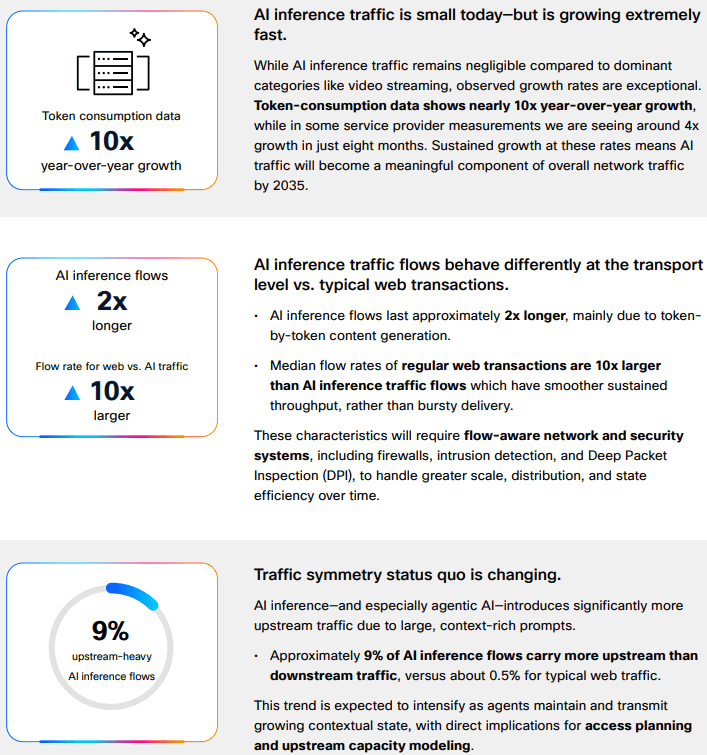
Token-consumption data shows nearly 10x year-over-year growth, while in some service provider measurements Cisco is seeing ~4x growth in just eight months. Sustained growth at these rates means AI traffic will become a meaningful component of overall network traffic by 2035.
Note 1. Consumer AI traffic has a few defining technical traits: it is still dominated by short text-based exchanges, but it is becoming more stateful, more upstream-heavy, and more latency-sensitive as users move from simple prompts to agentic workflows and multimodal interactions. Today’s consumer AI traffic is still overwhelmingly text-oriented, which is one reason the aggregate bandwidth impact remains modest despite rapid adoption. Comcast’s network observation is a useful real-world proxy: 97.1% of AI traffic was text-based, while images accounted for 2.6% and video only 0.3%. The key technical implication is that current traffic volumes are often limited more by conversation frequency and session behavior than by very large payloads, though that changes quickly as users adopt image, audio, and video generation.
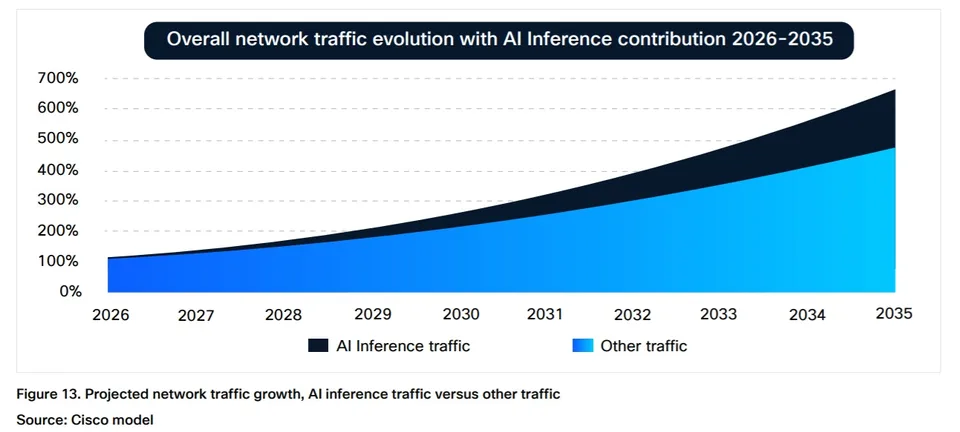
Although AI inference traffic is currently “negligible” relative to dominant categories such as video streaming, Cisco projects it will comprise approximately 25% of total network traffic by 2035 (see chart below). At that point, AI traffic is expected to represent a “meaningful component” of overall network load. Importantly, AI-generated traffic exhibits distinct characteristics: inference flows are approximately twice the duration of typical web transactions, demonstrate higher upstream bandwidth demand, and operate at “software speed” rather than human interaction rates.
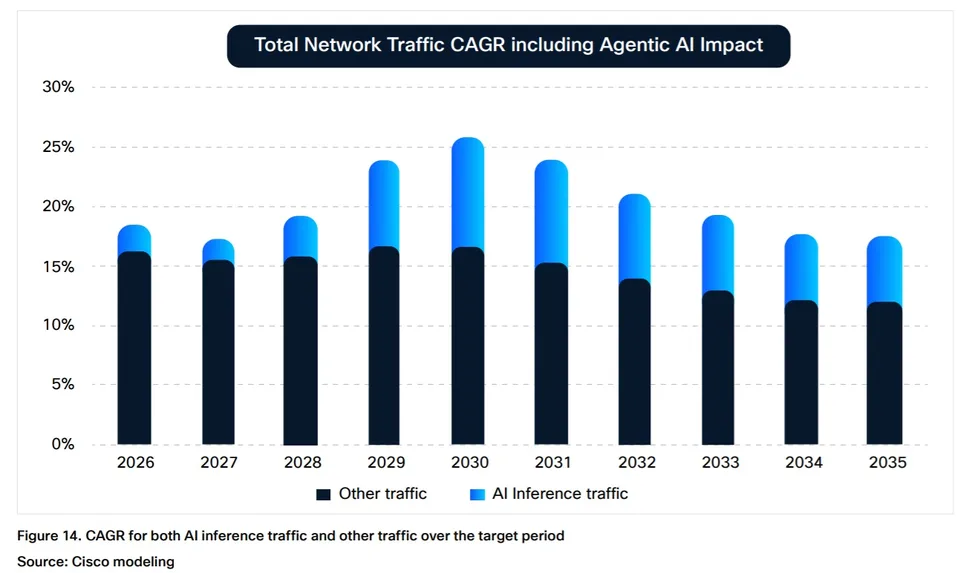
The emergence of AI agents as “power users” further amplifies these dynamics. Cisco notes that agent-executed tasks can generate up to 450% more traffic per task compared to human-driven interactions. This shift is expected to drive operator adoption of “flow-aware network and security systems” as traffic patterns become increasingly machine-driven and less predictable.
Cisco’s broader framing is that AI traffic “isn’t just adding traffic,” but is changing the shape of traffic, with inference flows running about twice as long as typical web transactions and, in some cases, generating up to 450% more traffic per task when an agent executes the workload. AI inference sessions tend to hold resources longer, create more sustained flows, and push operators to think in terms of flow-aware behavior rather than only peak-throughput sizing. Cisco also notes that about 9% of AI inference flows carry more upstream than downstream traffic, versus about 0.5% for typical web traffic, which is a meaningful shift for access and broadband networks. Cisco reports that approximately 9% of AI inference flows are upstream-dominant, compared to roughly 0.5% for traditional web traffic, with this divergence expected to widen alongside increased agentic AI utilization. In parallel, latency sensitivity is anticipated to become a more critical performance parameter for AI-driven applications.
Latency and symmetry:
AI traffic is also more sensitive to latency than many ordinary consumer web transactions because the user experience is often conversational and interactive, with the expectation of near-immediate turn-taking. Cisco describes AI inference as operating at “software speed” rather than human speed, which means small delays can be more noticeable and operationally important. At the same time, upstream demand becomes more significant because prompts, context, attachments, and agent-generated actions can increase return-path traffic, especially as multimodal inputs and agentic tool use expand.
Multimodal growth:
The biggest step-up in technical impact comes when consumer AI shifts from text-only prompting to multimodal generation and agent-driven workflows. In those cases, each task can involve multiple model calls, retrieval steps, tool invocations, and richer media payloads, which expands both flow count and bytes per session. Cisco’s study suggests that this is why AI traffic will increasingly require “flow-aware network and security systems,” because the traffic profile is not just larger, but structurally different from conventional browsing.
Infrastructure Implications:
Telecom infrastructure is becoming “increasingly intertwined with hyperscale infrastructure, not because operators are leading AI investment, but because they are becoming part of the ecosystem that supports it,” analyst firm MTN Consulting said in an April 27th research note. “Demand for optical transport, data-center interconnect, and edge infrastructure is rising as telecom networks carry growing volumes of cloud and AI-driven traffic,” the firm said.
“AI network traffic is already reshaping infrastructure needs. What we are seeing is clear: AI isn’t just adding traffic. It’s changing the shape of traffic,” Javier Antich, principal product management engineer in the CTO office of Cisco’s provider connectivity group, and Gurudatt Shenoy, SVP, product management, provider connectivity, explained in this blog post.
These shifts are beginning to influence access network evolution. Fiber networks already provide relatively symmetric throughput and low latency, while cable operators are advancing similar capabilities through DOCSIS upgrades. Mid-split and high-split architectures increase upstream spectrum allocation, enabling more balanced capacity profiles. Concurrently, Tier 1 operators such as Comcast and Charter Communications are introducing low-latency enhancements within DOCSIS networks.
Operational data reflects early-stage impacts. Comcast Chief Network Officer Elad Nafshi noted at the Cable Next-Gen event in March that approximately 97.1% of AI traffic on Comcast’s network remains text-based, with images accounting for 2.6% and video just 0.3%, indicating that bandwidth-intensive multimodal AI traffic has yet to scale materially.
Network design impact:
For broadband and access networks, the immediate engineering issues are upstream traffic capacity, queue behavior, and latency consistency rather than raw total throughput alone. Symmetry upgrades (such as DOCSIS mid-split and high-split for MSOs), along with low-latency capabilities, are relevant because consumer AI creates more return-path pressure and more time-sensitive sessions. In other words, the challenge is not simply to carry more bytes; it is to carry more interactive sessions with predictable performance, especially as multimodal and agentic usage scales.
………………………………………………………………………………………………………………………………………………………………………………………………………….
References:
Will the wave of AI generated user-to/from-network traffic increase spectacularly as Cisco and Nokia predict?
Telecom operators investing in Agentic AI while Self Organizing Network AI market set for rapid growth
Analysis: Cisco, HPE/Juniper, and Nvidia network equipment for AI data centers
Cisco CEO sees great potential in AI data center connectivity, silicon, optics, and optical systems
The Financial Trap of Autonomous Networks: Scaling Agentic AI in the Telecom Core
Ericsson integrates Agentic AI into its NetCloud platform for self healing and autonomous 5G private networks
STL Partners webinar: Agentic AI needed for RAN autonomy & efficiency
Nokia to showcase agentic AI network slicing; Ericsson partners with Ookla to measure 5G network slicing performance
Agentic AI and the Future of Communications for Autonomous Vehicles (V2X)
Telecom data centers must be redesigned for the AI era with rack scale architectures, enhanced power & cooling requirements
Is the “far edge” a bridge to far to cross for AI inferencing? What about “Distributed AI Grids”?
T-Mobile US announces new broadband wireless and fiber targets, 5G-A with agentic AI and live voice call translation
Intel and AI chip startup SambaNova partner; SN50 AI inferencing chip max speed said to be 5X faster than competitive AI chips
CES 2025: Intel announces edge compute processors with AI inferencing capabilities
2 thoughts on “Cisco report: Agentic AI to reshape WAN traffic, AI inference will be ~25% of total traffic by 2035”
Leave a Reply

As you point out Alan, technologies like L4S to reduce/guarantee latency will be critical. At the same time, it will be interesting to see how local, on-device AI inference will impact traffic demands and flows.
AI Has Surpassed Human Traffic-Telcos Are Not Ready for What Comes Next as machines take over the internet, by Sebastian Barros Aug 10, 2026
Machines are starting to generate more Internet requests than people. They will not use the network the way people do. Their payloads will often be smaller, but they will generate far more transactions, put greater pressure on uplinks, communicate constantly across clouds and data centers, and increasingly depend on the network for identity, latency, security, and reliability. Telcos need to prepare for a different Internet, not simply a bigger one.
Machines will dominate the Internet without dominating the bytes:
Cloudflare has reported an important shift in Internet traffic. Automated systems now generate more requests than humans across the web activity it measures, and Cloudflare CFO Thomas Seifert recently suggested that nonhuman traffic could eventually exceed human traffic by a factor of 1,000 within five years.
It is a spectacular headline, but it is also very easy to misunderstand. Cloudflare is not saying that global telecom networks will suddenly carry one thousand times more petabytes. Its bot-versus-human measure is based on HTTP requests to HTML content, not total Internet bytes. A crawler can request ten thousand web pages and create ten thousand separate interactions while still moving less data than one person watching a few hours of 4K video. For the past two decades, network evolution has been shaped mainly by humans consuming content. Smartphones arrived, video moved to mobile, social media exploded, and streaming pushed traffic relentlessly upward. The engineering response followed a familiar and expensive recipe: more spectrum, more radio capacity, more backhaul, more caching, and larger transport networks.
Machines and software agents introduce a different traffic pattern. A wearable, robot, camera, vehicle, industrial controller, or AI agent does not use connectivity like someone watching Netflix. Much of its traffic may consist of relatively small payloads, but the number of interactions can be enormous. Some of those interactions originate from physical devices. A growing share will also be generated inside smartphones, enterprise systems, cloud platforms, and data centers, where agents continuously call models, databases, APIs, and other agents.
The coming shift is therefore not simply from humans to machines. It is from a network dominated by content consumption to one increasingly dominated by automated actions.
Machine activity can therefore grow far faster than traffic volume. The number of autonomous actors, requests, API calls, authentication events, and machine transactions can increase by orders of magnitude while total network traffic continues growing at rates that look relatively familiar to a telecom planner.
Telcos may not face one thousand times more bytes. They may face one thousand times more transactions, decisions, and network events behind those bytes.
https://sebastianbarros.substack.com/p/ai-has-surpassed-human-traffic