

Verizon and Ericsson Advance AI-Native RAN Operations with Nationwide EIC Rollout
Executive Summary:
Verizon and Ericsson are expanding their longstanding collaboration to introduce AI-native automation into Radio Access Network (RAN) operations. The companies plan a nationwide deployment of Ericsson Intelligent Controller (EIC) [1.], a software platform for running RAN applications (rApps) co-developed by Ericsson and Verizon.
The initiative is intended to improve mobile network performance, automate network optimization and advance Verizon’s longer-term objective of achieving Level 4 (L4) network autonomy. The companies have demonstrated EIC and associated rApps in a live network environment, using AI-based cell shaping and traffic steering to optimize Massive Multiple-Input Multiple-Output (Massive MIMO) antenna operation.
According to Ericsson and Verizon, field deployment of the Advanced Antenna System (AAS) Cell Shaper rApp produced throughput gains of up to 8.9% in downlink data radio bearer (DRB) throughput and up to 8% in uplink user equipment (UE) throughput.
The collaboration has three principal objectives:
- RAN autonomy: Building on open, programmable interfaces to automate network operations and optimization.
- AI-based optimization: Deploying rApps to improve radio performance, traffic distribution and operational efficiency.
- Operator-controlled innovation: Enabling Verizon to develop and deploy its own rApps alongside Ericsson applications rather than relying exclusively on vendor-developed network optimization software.
Note 1. “Ericsson Intelligent Controller (EIC) is a new product part of the Ericsson Intelligent Automation Platform (EIAP) which is Ericsson’s Open RAN aligned service management and orchestration (SMO) solution. EIAP provides multivendor RAN automation, management, and orchestration of Cloud and Open Radio access networks. Ericsson differentiator is the extended support to purpose-built radio access networks.” SOURCE: Ericsson
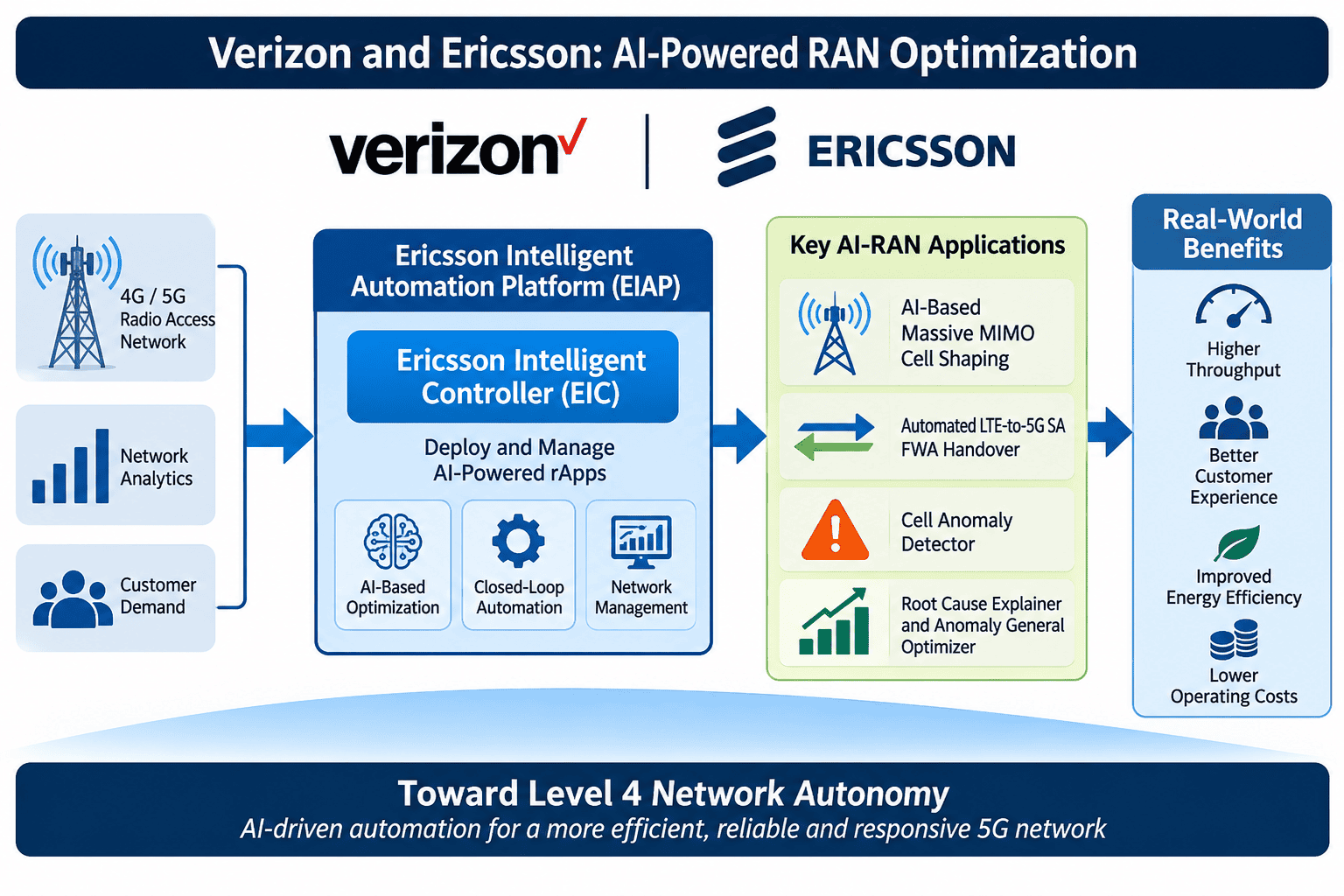
Image generated by ChatGPT which was also used for research and writing this article.
………………………………………………………………………………………………………………………………………………………………………………………………………….
AI-Native RAN Automation and Massive MIMO Optimization:
A central component of the collaboration is the application of AI to Massive MIMO antenna systems. Massive MIMO uses large antenna arrays at 5G base stations to transmit and receive multiple spatially separated data streams. Through beamforming, the radio system can concentrate transmitted energy toward individual users or groups of users rather than radiating power uniformly in all directions. Combined with spatial multiplexing, this can improve spectral efficiency, increase network capacity and extend coverage.
However, optimizing Massive MIMO performance across a large mobile network is complex. Radio propagation conditions, user locations, traffic demand, interference, antenna configuration and mobility patterns change continuously. A configuration that improves performance in one cell or at a particular time of day may not be optimal under different network conditions.
Ericsson’s Advanced Antenna System (AAS) Cell Shaper rApp applies AI-based optimization to antenna operation and cell coverage. Its purpose is to adjust radio coverage characteristics and traffic distribution to better match changing network conditions.
Cell shaping and traffic steering are particularly important in densely populated areas where neighboring cells may experience significantly different traffic loads. Intelligent adjustment of antenna coverage and traffic distribution can help balance demand, reduce congestion and improve utilization of available radio resources.
These reported throughput improvements demonstrate the potential to improve the utilization of existing radio infrastructure through software-based optimization. However, the companies have not disclosed the geographic scope, test duration, baseline conditions, radio configurations or measurement methodology underlying the maximum reported gains. Consequently, the results should not be interpreted as nationwide average improvements or as evidence that equivalent gains will be achieved throughout Verizon’s network.
Automating Fixed Wireless Access Mobility:
Another application demonstrated by Verizon addresses mobility problems affecting Fixed Wireless Access (FWA) devices transitioning between LTE and 5G Standalone (SA) networks.
Verizon implemented a Connected Mode Inter-Radio Access Technology (Inter-RAT) handover methodology to address failed transitions from LTE to 5G SA for FWA devices. According to the companies, the automated methodology eliminates the need for manual intervention when these handover failures occur.
In this scenario, Inter-RAT mobility involves transitioning a device between different radio access technologies: 4G LTE and 5G NR.
Conventional 5G Non-Standalone (NSA) deployments use an LTE anchor, with 5G NR added as a secondary radio access technology (5G NSA is essentially 4G LTE with a 5GNR RAN interface). It relies on the LTE/Evolved Packet Core (EPC) architecture. By contrast, 5G SA uses a 5G NR radio access network connected directly to a 5G Core (5GC), without requiring an LTE anchor. Only 5G SA can realize the 5G features and functions defined by 3GPP’s 5G Architecture specs.
–>A successful 5G NSA to 5G SA transition therefore requires appropriate mobility procedures, network configuration and coordination between the LTE and 5G SA environments.
This application illustrates how programmable RAN automation can address specific operational problems through targeted software applications rather than relying exclusively on conventional network-management procedures and manual troubleshooting. It also demonstrates that RAN automation can address mobility management, network reliability and operational efficiency beyond radio-throughput optimization
Expanding the rApp Ecosystem and Network Autonomy:
Verizon plans to deploy EIC nationally during 2026 and introduce additional rApps developed both internally and by Ericsson. Planned applications include:
- Cell Anomaly Detector: Identifies abnormal cell behavior that may affect network performance.
- Root Cause Explainer: Helps identify potential causes of network problems, supporting more efficient troubleshooting and service restoration.
- Anomaly General Optimizer: Supports network optimization in response to detected anomalies.
The names of these applications suggest different stages of the network assurance and optimization lifecycle. Anomaly detection identifies departures from expected network behavior; root-cause analysis helps determine potential underlying problems; and optimization applications can initiate corrective actions.
When integrated into a coordinated automation framework, these functions can form a closed-loop operational process:
- Monitor: Collect network performance measurements, alarms, configuration data and other operational information.
- Detect: Identify abnormal conditions or performance degradation using analytics and AI/ML models.
- Diagnose: Analyze network data to identify potential root causes.
- Optimize: Determine appropriate corrective actions based on network policies and operating constraints.
- Actuate: Apply approved changes to network configuration or operating parameters.
- Verify: Monitor subsequent network performance to determine whether the corrective action achieved the intended result.
This feedback process is fundamental to autonomous network operations. It allows network optimization to continue without requiring human intervention for every individual adjustment, while retaining appropriate operator oversight and control.
The companies have not provided detailed technical specifications for the three planned applications, so their precise functions, interfaces and degrees of automation remain to be established.
Ericsson Intelligent Automation Platform and Open Interfaces:
The Ericsson Intelligent Controller is a component of the Ericsson Intelligent Automation Platform (EIAP), Ericsson’s open network management and automation environment designed for multivendor, multi-technology networks.
Key platform capabilities include:
- Support for 4G and 5G Radio Access Networks and Ericsson core networks.
- A Non-RT RIC execution environment for rApps.
- Standardized interfaces, including the O-RAN R1 interface.
- Application lifecycle management and deployment.
- Network data collection, analytics and AI/ML workflow capabilities.
- Policy management and coordination of network optimization activities.
- Controlled application execution and network actuation.
Ericsson reports that EIAP’s ecosystem includes more than 100 available rApps from over 100 ecosystem members, supporting different stages of the network automation lifecycle.
The ability for Verizon to develop its own rApps is particularly important. It gives the operator an opportunity to create network-specific optimization functions based on its traffic patterns, spectrum holdings, radio configurations and operational requirements, while also drawing on Ericsson’s broader rApp ecosystem.
An open application environment can reduce dependence on proprietary, vendor-specific optimization functions and encourage third-party application development.
However, the availability of open interfaces and a broad rApp ecosystem should not be confused with a fully interoperable multivendor RAN deployment. Ericsson describes EIAP as supporting multivendor networks, including purpose-built radio access networks. This means that deploying EIC and using O-RAN-aligned interfaces does not, by itself, establish that Verizon is replacing its existing RAN equipment with Open RAN equipment.
The distinction is important: Open RAN automation interfaces and an open application ecosystem can be deployed alongside conventional, purpose-built radio infrastructure.
The Road to Level 4 Network Autonomy:
The nationwide EIC deployment represents another step toward more autonomous RAN operations. Verizon’s longer-term objective is Level 4 (L4) network autonomy, in which network functions can perform increasingly complex operational and optimization tasks with minimal human intervention.
The TM Forum’s Autonomous Networks framework defines L4 as a highly autonomous network capability involving predictive decision-making and active closed-loop management of service-driven and customer-experience-driven networks, supported by AI modeling and continuous learning.
Achieving L4 autonomy requires considerably more than deploying AI applications. It requires:
- Reliable, continuous monitoring of network conditions and performance.
- Accurate AI/ML models that can operate under changing radio and traffic conditions.
- Closed-loop optimization with measurable performance verification.
- Coordination among multiple applications and network domains.
- Policy enforcement, security controls and safeguards against unintended network changes.
- Appropriate human oversight and the ability to intervene when automated actions produce unexpected results.
The distinction between automating individual network functions and achieving end-to-end autonomous network operations is important. An operator may successfully deploy several autonomous rApps without having achieved L4 autonomy across its entire RAN.
Furthermore, the TM Forum autonomy levels are assessed against specific network scenarios and operational domains. Achieving L4 in one function or network domain does not necessarily mean that the entire nationwide network has reached that level.
Verizon’s collaboration with Ericsson provides a programmable software platform and an expanding application ecosystem to support that transition. Whether it ultimately delivers L4 autonomy will depend on the scope of automation, the reliability of closed-loop operations and the integration of these capabilities across Verizon’s network.
Conclusions:
The Verizon-Ericsson initiative illustrates how AI-based software applications, open interfaces and closed-loop control can improve the operation of existing 4G and 5G radio access networks. The reported Massive MIMO throughput improvements and automated LTE-to-5G SA FWA handover demonstrate practical applications beyond AI experimentation. The EIC deployment also provides Verizon with a platform for developing proprietary rApps while leveraging Ericsson’s broader application ecosystem.
The larger challenge will be scaling these capabilities across a nationwide network while maintaining interoperability, reliability, security and measurable improvements in customer experience and network economics. Ultimately, the success of AI-native RAN automation should be judged by sustained improvements in network performance, spectral efficiency, energy consumption and operating costs—not simply by the number of AI applications deployed.
……………………………………………………………………………………………
References:
Verizon and Ericsson Partner to Transform AI-Native Autonomous Networks — November 3, 2026
https://www.ericsson.com/en/portfolio/cross-portfolio/rapp-directory
Autonomous Networks Mission and Levels Taxonomy — TM Forum
About Ericsson Intelligent Controller
About Ericsson Intelligent Automation Platform
AI-RAN and Agentic AI get real: Ericsson, Nokia, Verizon & other operators enter into a new network automation era
Private 5G’s Business Model Shifts: Ericsson’s Move Signals a Market Reset
Ericsson signs MoU’s with Murata and Sumitomo to progress next-gen mobile network infrastructure
4.8 GHz to 4.9 GHz frequency band uses & Verizon Wireless experimental license for testing ISAC with Ericsson
Ericsson leads SK Telecom AI RAN vs. NVIDIA’s GPU centric AI RAN Alliance
Dell’Oro: Private Wireless Revenue Growth Prospects and Challenges
One thought on “Verizon and Ericsson Advance AI-Native RAN Operations with Nationwide EIC Rollout”
Leave a Reply

From Google Gemini (not used to research or write this article):
This nationwide deployment of the Ericsson Intelligent Controller (EIC) is a significant milestone for carrier automation, but it is important to separate open automation interfaces from a fully open, multivendor hardware rollout. By deploying an O-RAN aligned Service Management and Orchestration (SMO) layer on top of existing, purpose-built infrastructure, Verizon demonstrates that operators can reap the programmatic benefits of an open application ecosystem (rApps) without requiring a complete rip-and-replace of their underlying RAN hardware.
The true test for Level 4 network autonomy will lie in managing the complex “closed-loop” feedback process across a vast, dynamic nationwide footprint. While the initial 8.9% downlink throughput gains are impressive, scaling predictive AI models so that applications like the Anomaly General Optimizer and Root Cause Explainer can seamlessly arbitrate and resolve issues without human intervention—or worse, conflicting with one another—remains the major engineering hurdle ahead. Sustained operational efficiency and real-world network economics will ultimately dictate whether this moves the needle toward true network self-healing.