

IMT above 100 GHz
Roles of 3GPP and ITU-R WP 5D in the IMT 2030/6G standards process
Setting the Record Straight: Many pundits and tech media outlets have been buzzing about 6G. One of many examples is today’s featured Light Reading post titled, “Looking ahead: Ready or not, here comes 6G.” There are also a plethora of 6G alliances and consortiums that are working on proposed 6G technologies — long before the 3GPP specifications or ITU-R IMT 2030/6G standards have been completed. We endeavor to provide an accurate summary of the standardization work in this article, including the delineation of activates between ITU-R and 3GPP.
Executive Summary:
As we’ve explained in numerous IEEE Techblog posts (see References below), ITU-R establishes the technical requirements and minimal performance objectives for IMT 2030 (6G) Radio Interface Technologies (RITs), and Sets of RITs (SRITs). As in IMT 2020 (5G RITs/SRITs), 3GPP develops the actual RIT/SRIT specifications, which are then contributed to ITU-R WP 5D (via ATIS) where they are discussed and agreed upon as a candidate ITU-R IMT 2030 RIT/SRIT for the forthcoming recommendation (i.e. standard). Other IMT 20230 RIT/SRITs might also be considered by 5D.
Author’s Note on IMT 2020: In addition to the 3GPP 5G-NR specs included in IMT 2020 standard (ITU-R M.2150), there were also two others (5Gi/LMLC and ETSI/DECT 5G-SRIT) which have not been widely deployed (ETSI/DECT 5G-SRIT) or deployed at all (5Gi/LMLC). The ITU-R standard for IMT 2020 Frequency Arrangements is ITU-R M.1036, which provides templates and guidelines for implementing IMT in the WRC identified bands, while Recommendation ITU-R M.2150 details the radio interfaces.
5G and 6G Frequency Bands and Arrangements: In addition to IMT 2020/5G and IMT 2030/6G RIT/SRITs, ITU-R WP5D develops the associated 5G and 6G Frequency Arrangements, based on the inputs received from the most recent ITU-R World Radio Communications (WRC) conference. The most recent WRC (#23) was held Dec 2023 in Dubai, UAE which did not definitively identify specific frequency bands for IMT-2030 (6G) deployment, but rather agreed on frequency bands to be studied as potential candidates for WRC-27 (in 2027) and beyond. So we don’t even know which frequencies will be used for IMT 2030/6G at this time.
5G and 6G Non-Radio Specifications: As with IMT 2020, 3GPP will develop all the non-radio specifications for IMT 2030/6G but will not likely send them to ITU-T for standardization as 3GPP did not do that for IMT 2020. Those non-radio specs include: mobile core network (and the role AI will play), signaling, security (including cryptography), network management (including AI), integrated sensing and communications, distributed access points, digital models for network optimization and planning, extending MEC, etc.
3GPP 6G Status: 3GPP’s specification work on 6G is currently in the early stages, focusing on requirements, architecture, and key technology enablers with a projected timeline that targets initial 6G specifications by 2028–2030 for commercial systems. The work is organized through 3GPP’s releases:
- Release 19 initiating 6G requirement studies in 2024.
- Release 20 expanding on 6G architecture and technology exploration in 2025 in parallel with 5G advanced.
- Release 21 delivering the first concrete 6G specifications, and subsequent releases refining features and interoperability toward mass deployment around 2030. The timeline for the actual spec work for this release is to be decided by June 2026.
The overall plan aligns with ITU’s timeline for 6G ecosystem readiness and commercial availability by roughly 2030, though exact finish dates depend on evolving technical, regulatory, and market conditions.
3GPP Release 20 concurrent work on 5G Advanced and 6G: This approach reflects a general view that 6G should be more of an evolution rather than a revolution. The big three equipment vendors Ericsson, Huawei and Nokia see 5G Advanced as a foundation for 6G, but in their own specific ways. “This dual focus on both 5G Advanced and 6G we needed to ensure that there is a continuity and to create a framework that allows the two tracks to complement but not compete with each other,” said Puneet Jain, Chair of 3GPP’s Service and Systems Aspects working group and senior principal engineer for technical standards at Intel, in a video interview.
Examples of 5G Advanced capabilities that are expected to be further developed in 6G include: the integration of machine learning into the RAN and core networks, energy efficiency, low latency, advanced MIMO techniques and satellite integration, according to 5G Americas. The latest 5G Advanced specs also address integrated sensing and communication (ISAC), which is considered to be an important new capability for 6G.
……………………………………………………………………………………………………………………………………………………….
Here’s a concise technical summary of the 6G standardization work in both ITU-R and 3GPP:
-
Scope and objectives
-
Establish 6G service requirements and use cases, including extreme data rates, ultra-low latency, high reliability, and enhanced AI-driven network management, while ensuring backward compatibility where feasible.
-
Define a scalable, flexible air interface and spectrum strategy to support wide bandwidths (including frequencies above 7 GHz and potential THz considerations) and diverse deployment scenarios.
-
-
Core architectural themes
-
Enhanced cloud-native, end-to-end network architecture with distributed computing, edge capabilities, and AI/ML-driven orchestration for dynamic resource management.
-
Native support for integrated space-air-ground networks and network slicing to enable heterogeneous service delivery and global coverage.
-
-
Air interface and radio aspects
-
Investigations into wider channel bandwidths, robust channel coding hybrids (LDPC and Polar codes as baselines with extensions), and numerology that can span multiple bands while maintaining scalable, energy-efficient designs.
-
Emphasis on robust coverage, especially at cell edges, and efficient use of mid-band and higher-frequency spectrum to balance performance and practical deployment considerations.
-
-
Mobility and latency
-
Aiming for lower end-to-end latency, improved reliability, and advanced mobility support to enable new immersive and industrial applications, while ensuring interoperability with 5G and future network layers.
-
-
Security and privacy
-
Early attention to security-by-design within the 6G architecture, including native protection of data planes and resilient identity/authentication mechanisms across heterogeneous networks.
-
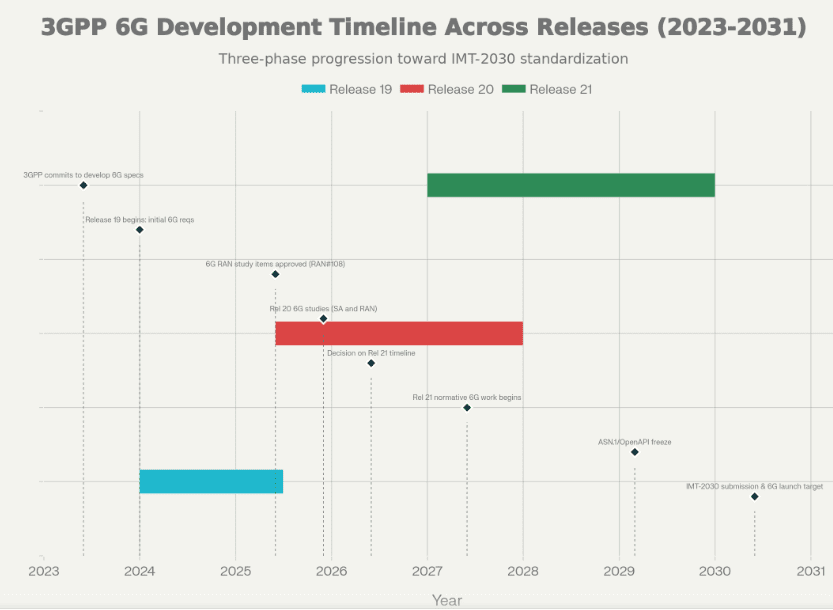
Timeline and milestones (progress up to projected completion dates):
-
2024: Initiation of 6G work in Release 19, focused on requirements and initial study items for 6G SA1 service requirements.
-
2025–2026: Continued refinement of use cases, service requirements, and architectural concepts; preparatory work for Release 20 items.
-
2027–2028: First concrete 6G specifications anticipated in Release 21, with core radio and network framework definitions, and initial protocol stack extensions.
-
2029–2030: Further releases (Release 22 onward) expand interoperability, optimization, and ecosystem compatibility, moving toward commercial deployment and early trials.
-
Target commercial availability: Roughly 2030, with initial systems expected to appear earlier in some pilots or regional deployments depending on market and regulatory readiness.
-
Public summaries and industry analyses triangulate the timeline and major themes from 3GPP plenaries and RAN/SA/WG discussions, with dates anchored to 2024–2028 planning and the stated aim of Release 21 delivering the first 6G specifications.
-
Draft documents and WG SID proposals provide insight into technical directions (coding, bandwidth, channel modeling, and spectrum considerations), though these are interim and subject to change as the standardization process evolves.
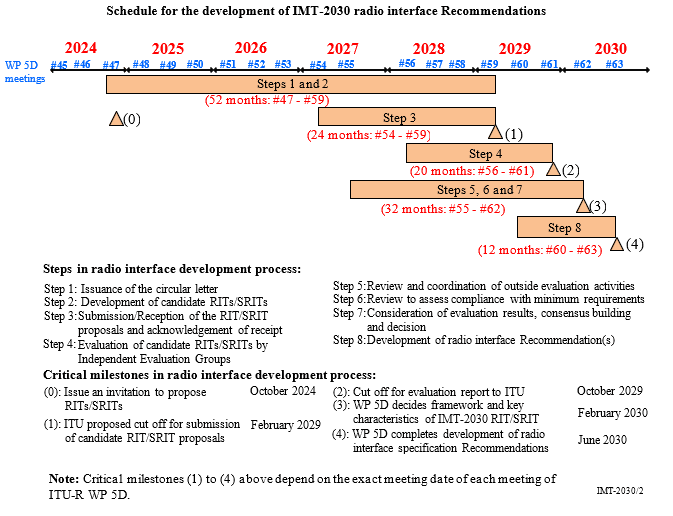
Submission of IMT 2030 RIT/SRIT proposals may begin at 54th meeting of ITU-R WP 5D, currently planned for February 2027. The final deadline for submissions is 16:00 hours UTC, 12 calendar days prior to the start of the 59th meeting of WP 5D in February 2029.
The evaluation of the proposed RITs/SRITs by the independent evaluation groups and the consensus-building process will be performed throughout this time period and thereafter. Subsequent calendar schedules will be decided according to the submissions of proposals.
After ITU-R WP 5D approves a recommendation (e.g for IMT 2030) it then goes through a formal approval process before it becomes a standard. It is sent to ITU-R SG 5 for approval, then all ITU member states review the draft and if there is near unanimous approval it is adopted as an official ITU-R recommendation or standard. That ITU-R recommendation approval process takes ~3 or 4 months. Therefore, we expect the ITU-R IMT 2030 RIT/SRIT standard to be approved in late 2030 to early 2031 with early 6G deployments to begin at that time.
………………………………………………………………………………………………………………………………………..
References:
https://www.itu.int/en/ITU-R/study-groups/rsg5/rwp5d/imt-2030/Pages/default.aspx
https://www.lightreading.com/6g/looking-ahead-ready-or-not-here-comes-6g
https://www.3gpp.org/specifications-technologies/releases/release-20
https://www.5gamericas.org/5g-advanced-overview/
ITU-R WP5D IMT 2030 Submission & Evaluation Guidelines vs 6G specs in 3GPP Release 20 & 21
ITU-R WP 5D Timeline for submission, evaluation process & consensus building for IMT-2030 (6G) RITs/SRITs
ITU-R WP 5D reports on: IMT-2030 (“6G”) Minimum Technology Performance Requirements; Evaluation Criteria & Methodology
AI wireless and fiber optic network technologies; IMT 2030 “native AI” concept
Highlights of 3GPP Stage 1 Workshop on IMT 2030 (6G) Use Cases
Should Peak Data Rates be specified for 5G (IMT 2020) and 6G (IMT 2030) networks?
GSMA Vision 2040 study identifies spectrum needs during the peak 6G era of 2035–2040
Highlights and Summary of the 2025 Brooklyn 6G Summit
NGMN: 6G Key Messages from a network operator point of view
Nokia and Rohde & Schwarz collaborate on AI-powered 6G receiver years before IMT 2030 RIT submissions to ITU-R WP5D
Verizon’s 6G Innovation Forum joins a crowded list of 6G efforts that may conflict with 3GPP and ITU-R IMT-2030 work
Nokia Bell Labs and KDDI Research partner for 6G energy efficiency and network resiliency
Deutsche Telekom: successful completion of the 6G-TakeOff project with “3D networks”
Market research firms Omdia and Dell’Oro: impact of 6G and AI investments on telcos
Qualcomm CEO: expect “pre-commercial” 6G devices by 2028
Ericsson and e& (UAE) sign MoU for 6G collaboration vs ITU-R IMT-2030 framework
KT and LG Electronics to cooperate on 6G technologies and standards, especially full-duplex communications
Highlights of Nokia’s Smart Factory in Oulu, Finland for 5G and 6G innovation
Nokia sees new types of 6G connected devices facilitated by a “3 layer technology stack”
Rakuten Symphony exec: “5G is a failure; breaking the bank; to the extent 6G may not be affordable”
India’s TRAI releases Recommendations on use of Tera Hertz Spectrum for 6G
New ITU report in progress: Technical feasibility of IMT in bands above 100 GHz (92 GHz and 400 GHz)
New ITU report in progress: Technical feasibility of IMT in bands above 100 GHz (92 GHz and 400 GHz)
Introduction:
ITU-R Report R M.2376 contains studies of frequency ranges (6-100 GHz) for International Mobile Telecommunications (IMT) technologies. It is envisioned that future IMT systems will need to support very high throughput data links to cope with the growth of the data traffic, new extremely bandwidth demanding use cases, as well as new capabilities of integrated sensing and communication (ISAC). There has been academic and industry research and development ongoing related to suitability of mobile broadband systems in frequency bands above 92 GHz to enable services requiring tera-bit per second speeds. This has prompted researchers to consider the technical feasibility of higher frequency bands in IMT.
Overview:
This ITU-R preliminary draft new report in progress provides information on the technical feasibility of IMT in bands between 92 GHz and 400 GHz. This Report complements the studies carried in Report ITU-R M.2376. This technical feasibility Report includes information on propagation mechanisms and channel models, as well as newly developed technology enablers such as active and passive components, antenna techniques, deployment architectures, and the results of simulations and performance tests. Aspects of coexistence with incumbent radiocommunications services above 92 GHz are outside the scope of this document, and this report does not presuppose the inclusion of any item on a future World Radio Conference (WRC) agenda nor the decisions of a future WRC.
ITU-R WP5D emphasizes that the further development of the draft new Report ITU-R M.[IMT.ABOVE 100GHz] does not contain propagation prediction methods. It contains only results contributed by industry and academia of propagation measurements and simulation campaigns.
…………………………………………………………………………………………………………………………
From: Experiments bring hope for 6G above 100 GHz:
Channel models for 4G and 5G cannot simply be extended above 100 GHz; engineers must verify and fine-tune knowledge to correctly reflect the impact of the environment for various use cases. We must, for example, understand outdoor scenarios and indoor industrial scenarios where human bodies, vehicles, and environmental conditions such as rain propagation strongly influence signal propagation.
5G pioneered the use of millimeter wave frequencies with bandwidths up to 400 MHz per component carrier to enable transmission rates necessary for demanding real-time applications such as wireless factory automation. 6G technology is aiming at significantly higher transmission rates and lower latencies. Large contiguous frequency ranges for ultra-high data rates with bandwidths of several GHz are only available above 100 GHz.
With sonar, the transmitter and receiver are in the same place. As for channel sounding of electromagnetic waves, the transmitter and receiver are spatially separated. In time domain channel sounding, a modulated pulse signal with excellent autocorrelation properties, such as a Frank-Zadoff-Chu (FZC) sequence [1], serves as a “ping” whose channel impulse response (CIR) is recorded. This propagation-time measurement is very similar to the time-delay measurements performed in a GPS receiver in reference to the GPS satellites (and subsequently inferring the position information), where each satellite transmits its specific correlation sequence. The CIR includes both the direct propagation components (line of sight, LOS) and all reflection and scattering components (non-line-of-sight, NLOS) from objects in the environment (Figure 1). We can derive channel-model parameters and their values from the results.

Figure 1. Operating principle of time domain channel sounding: The channel impulse response (CIR) is measured by emitting an electromagnetic “ping” at the frequency of interest and capturing all returning signal components.
……………………………………………………………………………………………………………………………………………………………….
References:
https://www.itu.int/md/R19-WP5D-C-0679/en (RESTRICTED TO ITU TIES USERS)
https://www.itu.int/md/R1-WP5D-C-1654/en (RESTRICTED TO ITU TIES USERS)
ITU-R WP5D: Studies on technical feasibility of IMT in bands above 100 GHz
IMT Vision – Framework and overall objectives of the future development of IMT for 2030 and beyond
This ITU-R recommendation in progress will be the main focus of next week’s ITU-R WP5D meeting #43 in Geneva. It defines the framework and overall objectives for the development of International Mobile Telecommunications (IMT) for 2030 and beyond. There are contributions related to this recommendation from: Apple, Nokia, Ericsson, Wireless World Research Forum, Motorola Mobility, Orange, United Kingdom of Great Britain and Northern Ireland, Finland, Germany, GSOA, China, Qualcomm, Electronics and Telecommunications Research Institute (ETRI), Brazil, Samsung, ZTE, Huawei, InterDigital, Intel and India, with several being multi-company contributions.
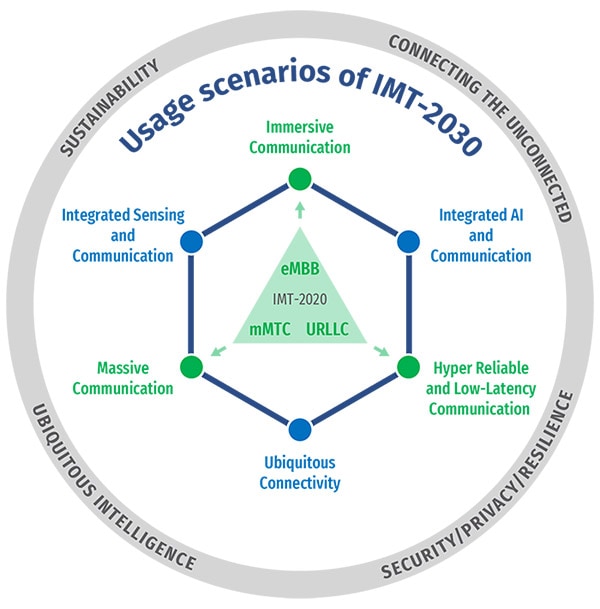
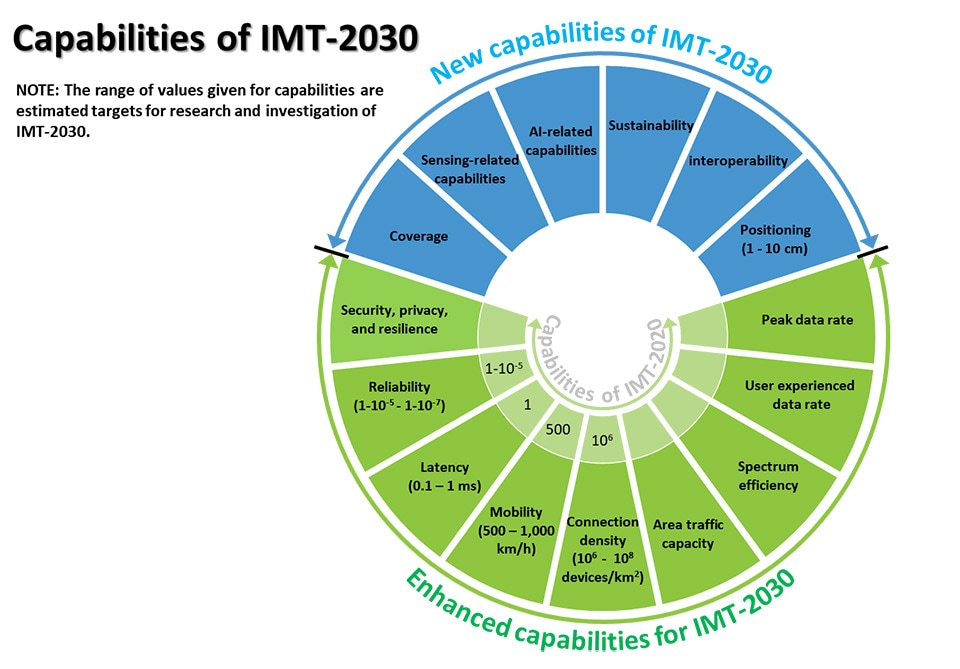
The objective is to reach a consensus on the global vision for IMT-2030 (aka 6G), including identifying the potential user application trends and emerging technology trends, defining enhanced and brand-new usage scenarios and corresponding capabilities, as well as understanding the new spectrum needs.
IMT will continue to better serve the needs of the networked society, for both developed and developing countries in the future and this Recommendation outlines how that will be accomplished. This Recommendation also intends to drive the industries and administrations for encouraging further development of IMT for 2030 and beyond.
The framework of the development of IMT for 2030 and beyond, including a broad variety of capabilities associated with envisaged usage scenarios, is described in detail in this Recommendation.
In June 2022, ITU-R decided on the overall timeline for 6G with three major stages:
- Stage 1 – vision definition to be completed in June 2023 before the World Radiocommunication Conference 2023 (WRC-23),
- Stage 2 – requirements and evaluation methodology to be completed in 2026, and
- Stage 3 – specifications to be completed in 2030. The 3-stage timeline and the tasks for each stage are summarized in Figure below.
Scope: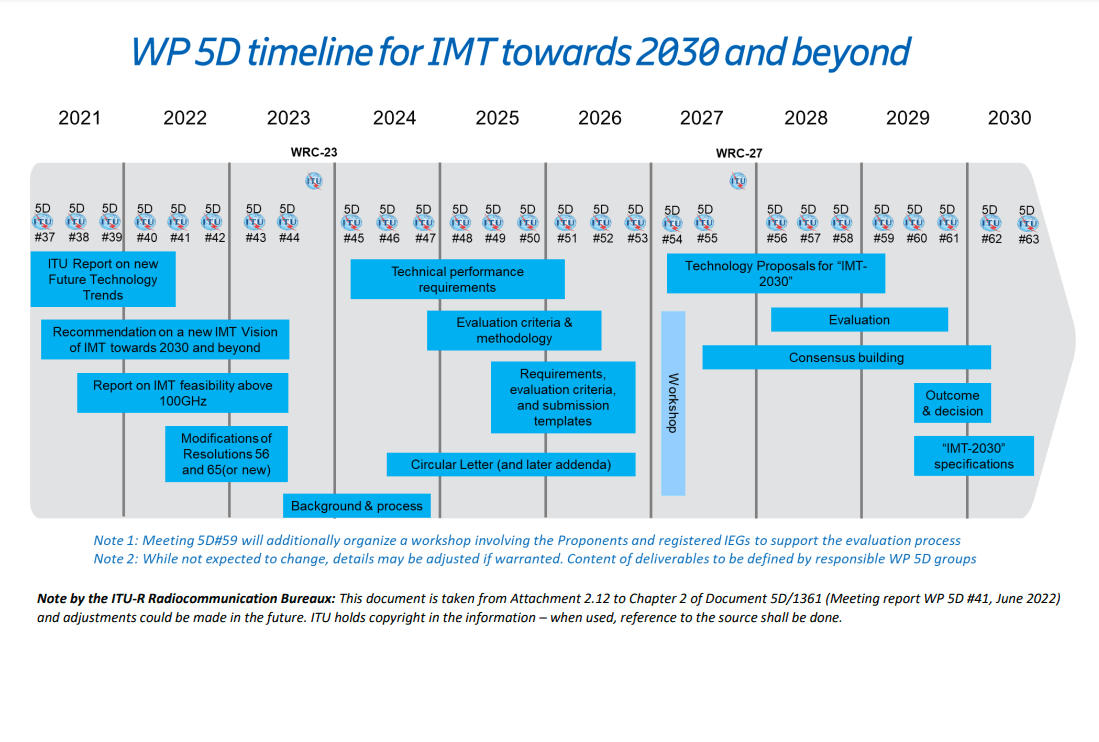
This draft Recommendation defines a [potential] framework and overall objectives for the development of the terrestrial component of International Mobile Telecommunications (IMT) for 2030 and beyond. IMT will continue to better serve the needs of the [networked] society, for both developed and developing countries in the future and this [Recommendation/document] outlines how [possibly] that could be accomplished. This [Recommendation/document] also intends to encourage further development of IMT-2030. In this [Recommendation/document], the [potential] framework of the development of IMT-2030, including a broad variety of capabilities associated with [some possible] envisaged usage scenarios[, and those yet to be developed and] described in detail. Furthermore, this [Recommendation/document] addresses the objectives for the development of IMT-2030, which includes further enhancement and evolution of existing IMT and the development of IMT-2030.
It should be noted that this Recommendation is defined considering the development of IMT to date based on Recommendation ITU-R M.2083 (approved in September 2015).
Technology Trends:
Report ITU-R M.2516 provides a broad view of future technical aspects of terrestrial IMT systems considering the timeframe up to 2030 and beyond, characterized with respect to key emerging services, applications trends, and relevant driving factors. It comprises a toolbox of technological enablers for terrestrial IMT systems, including the evolution of IMT through advances in technology, and their deployment. In the following sections a brief overview of emerging technology trends, technologies to enhance the radio interface, and technologies to enhance the radio network are presented.
An important breakthrough in 3GPP Rel-17, Technical Specifications for Non-Terrestrial Networks (NTN) were established & defined for satellite direct access to device for both 5G and IoT services. This development reflects a trend that satellite & space technologies can offer many benefits for development & operation of future IMT-2030 networks, to enable 5G & 6G available everywhere, accessible to enterprises and citizens across the globe.
IMT-2030 will consider an AI-native new air interface that refers to the use of AI to enhance radio interface performance such as symbol detection/decoding, channel estimation etc. An AI-native radio network will enable automated and intelligent networking services such as intelligent data perception, supply of on-demand capability etc. Radio network to support AI services is the design of IMT technologies to serve various AI applications, and the proposed directions include on-demand uplink/sidelink-centric, deep edge and distributed machine learning. The integration of sensing and communication functions in future wireless systems will provide beyond-communication capabilities by utilizing wireless communication systems more effectively resulting in mutual benefit to both functions. Integrated sensing and communication (ISAC) systems will also enable innovative services and applications such as intelligent transportation, gesture and sign language recognition, automatic security, healthcare, air quality monitoring, and solutions with higher degree of accuracy. Combined with technologies such as AI, network cooperation and multi-nodes cooperative sensing, the ISAC system will lead to benefits in enhanced mutual performance, overall cost, size and power consumption of the whole system.
Computing services and data services are expected to become an integral component of the future IMT system. Emerging technology trends include processing data at the network edge close to the data source for real-time response, low data transport costs, energy efficiency and privacy protection, as well as scaling out device computing capability for advanced application computing workloads.
Device-to-device (D2D) wireless communication with extremely high throughput, ultra-accuracy positioning and low latency will be an important communication paradigm for the future IMT. Technologies such as THz technology, ultra-accuracy sidelink positioning and enhance terminal power reduction technology can be considered to satisfy requirements of new applications.
Energy efficiency and low power consumption comprises both the user device and the network’s perspectives. The promising technologies include energy harvesting, backscattering communications, on-demand access technologies, etc.
To achieve real-time communications with extremely low latency communications, two essential technology components are considered: accurate time and frequency information shared in the network and fine-grained and proactive just-in-time radio access.
There is a need to ensure security, privacy, and resilient solutions allowing for the legitimate exchange of sensitive information through network entities. Potential technologies to enhance trustworthiness include those for RAN privacy, such as distributed ledger technologies, differential privacy and federated learning, quantum technology with respect to the RAN and physical-layer security technologies.
UPDATE: https://techblog.comsoc.org/2023/07/09/draft-new-itu-r-recommendation-not-yet-approved-m-imt-framework-for-2030-and-beyond/
References:
Summary of ITU-R Workshop on “IMT for 2030 and beyond” (aka “6G”)
https://www.itu.int/en/ITU-R/study-groups/rsg5/rwp5d/Pages/wsp-imt-vision-2030-and-beyond.aspx
Excerpts of ITU-R preliminary draft new Report: FUTURE TECHNOLOGY TRENDS OF TERRESTRIAL IMT SYSTEMS TOWARDS 2030 AND BEYOND
Development of “IMT Vision for 2030 and beyond” from ITU-R WP 5D
ITU-R: Future Technology Trends for the evolution of IMT towards 2030 and beyond (including 6G)
China’s MIIT to prioritize 6G project, accelerate 5G and gigabit optical network deployments in 2023
ITU-R WP5D: Studies on technical feasibility of IMT in bands above 100 GHz
https://www.itu.int/rec/R-REC-M.2083 (Sept 2015)
ITU-R WP5D: Studies on technical feasibility of IMT in bands above 100 GHz
The development of IMT for 2030 and beyond is expected to enable new use cases and applications with extremely high data rate and low latency, which will benefit from large contiguous bandwidth spectrum resource with around tens of GHz. This suggests the need to consider spectrum in higher frequency ranges above 92 GHz as a complementary of the lower bands.
Report ITU-R M.[IMT.ABOVE 100 GHz] investigates technical feasibility of IMT in bands above 92 GHz including propagation characteristics, potential new enabling IMT technologies, which could be appropriate for operation in these bands, and relevant deployment scenarios.
The Report describes a series of propagation measurement activities carried out by academia and industry aiming at investigating the propagation characteristics in these bands under several different environments (such as outdoor urban and indoor office). It also includes a summary of the measurement activities collected for these bands, noting that bands of interest are more concentrated in 100, 140-160, 220-240, and around 300 GHz. Characteristics of IMT technologies in bands above 92 GHz, including coverage, link budget, mobility, impact of bandwidth and needed capabilities to support new use cases, have been presented in this Report.
To overcome major challenges of operating in bands above 92 GHz such as limited transmission power, the obstructed propagation environment due to high propagation losses and blockage, it describes enabling antenna and semiconductor technologies, material technologies including reconfigurable intelligent surfaces and MIMO and beamforming technologies as potential solutions.
Given the large bandwidth and high attenuation characteristics of bands above 92 GHz, some typical use cases are also envisaged in this Report, such as indoor/outdoor hot spots, integrated sensing and communication, super-sidelink, flexible wireless backhaul and fronthaul.
The radio wave propagation assessment, measurements, technology development and prototyping described in the Report indicate that utilizing the bands above 92 GHz is feasible for studied IMT deployment scenarios, and could be considered for the development of IMT for 2030 and beyond.
This ITU-R report is expected to be completed and approved in 2023.
References:
ITU-R Report in Progress: Use of IMT (likely 5G and 6G) above 100 GHz (even >800 GHz)
ITU-R Report in Progress: Use of IMT (likely 5G and 6G) above 100 GHz (even >800 GHz)
Introduction:
In July 2015, ITU-R published Report M-2376: Technical feasibility of IMT in bands above 6 GHz Since then, there has been academic and industry research and development ongoing related to suitability of mobile broadband systems in frequency bands above 100GHz. As a result, a new ITU-R Report ITU-R M.[IMT.ABOVE 100 GHz] was started at the August 2021 meeting of ITU-R WP5D (#38) to study the technical feasibility of IMT in bands above 100 GHz. That report will be a complement to the previous studies documented in Report M-2376.
Discussion:
Compared with the 3GPP 5G NR FR2 frequency band (24250 MHz – 52600 MHz), the terahertz frequency band above 100 GHz can provide a larger usable bandwidth, but it also suffers from greater path loss/signal attenuation. Fortunately, it is possible to overcome certain path attenuation by improving the directivity and gain of the antenna and using beamforming technology to increase the coverage of the cell. IMT technologies adopted for bands above 100 GHz can be used in indoor/outdoor hotspot environments, integrated sensing and communication and ultra-short-range environments to provide ultra-high data rate services.
Some possible use cases for IMT above 100 GHZ are:
Indoor hotspot in an large meeting room – small cell base stations operating at bands above 100 GHz may solve the needs of applications with extremely high data rates, such as Holographic displays. Considering the large path attenuation of bands above 100GHz, high-gain directional antennas or large-scale antenna arrays that can provide higher gains could be used to flexibly establish wireless fronthaul /backhaul links with outdoor base stations or core networks.
Integrated sensing and communication – A typical use case is the use of sensing technology to assist communication, such as using sensing technology to predict the user’s trajectory to assist the base station in beam tracking of the user, or using sensing technology to sense the user’s location for rapid beamforming. Using bands above 100 GHz can achieve better imaging and achieve higher positioning accuracy.
Secure Imaging and Infrared Thermal Cameras are other potential use cases depicted below:

In preparation for a contribution on this topic for the October 2021 WP5D meeting, the Republic of China conducted channel measurement campaigns in indoor scenarios at 140 GHz and 220 GHz. The measured indoor scenarios include a meeting room, and office area, and hallway in office room. Pathloss models for the investigated bands were derived based on the channel measurement campaigns conducted in a meeting room and an office room and presented in their contribution.
Reference 4. notes recent regulatory and standard body rulings that are anticipating wireless products and services above 100 GHz and illustrates the viability of wireless cognition, hyper-accurate position location, sensing, and imaging. It also presents approaches and results that show how long distance mobile communications will be supported to above 800 GHz since the antenna gains are able to overcome air-induced attenuation, and present methods that reduce the computational complexity and simplify the signal processing used in adaptive antenna arrays, by exploiting the Special Theory of Relativity to create a cone of silence in over-sampled antenna arrays that improve performance for digital phased array antennas.
References:
- W. Tong, P. Zhu, “6G: The Next Horizon, From Connected People and Things to Connected Intelligence”, Cambridge University Press, 2021.
- 5GCM, “5G channel model for bands up to 100 GHz,” Tech. Rep., Sep. 2016, Available online at http://www.5gworkshops.com/5GCM.html.
- 3GPP TR 38.901, “Study on channel model for frequencies from 0.5 to 100 GHz,” v. 16.1.0, Dec. 2019. [4]. ITU-R M.2412, “Guidelines for evaluation of radio interface technologies for IMT-2020,” Sep. 2017.
- Wireless Communications and Applications Above 100 GHz: Opportunities and Challenges for 6G and Beyond. IEEE Xplore