

Optical Transceivers
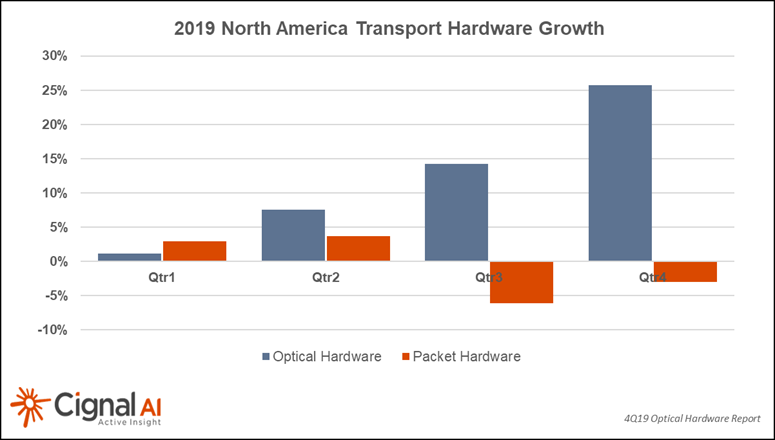
Cignal AI: North American Optical Sales Rebound In 2019
|
||||
 |
||||
Additional 4Q19 Transport Hardware Report Findings:
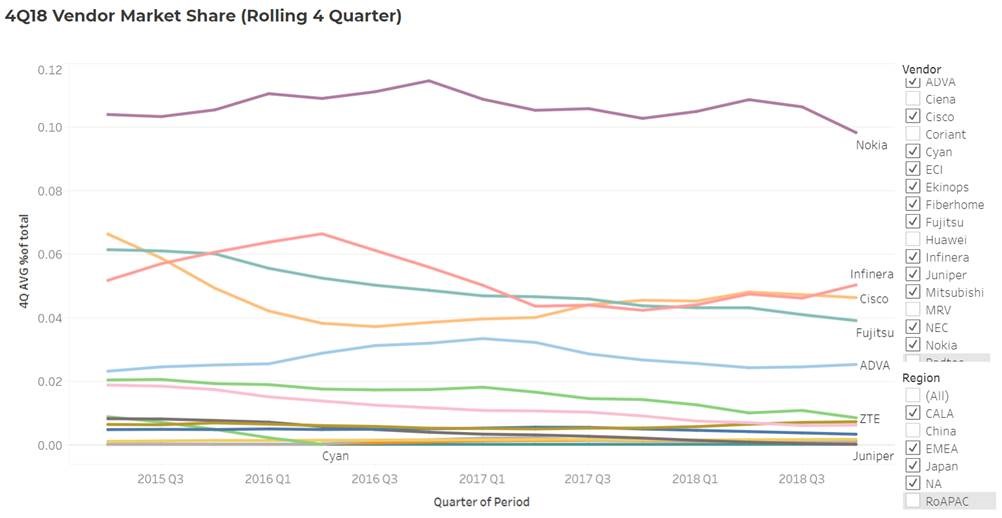
Transport Hardware Superdashboard:
|
||||
 |
||||
About the Transport Hardware Report
About Cignal AI:
Contact Cignal AI/Purchase Report:
|
CoBank: Secular Tailwinds Support Current Fiber Optic Company Valuations
Fiber network consolidation has driven up the value of fiber optic networks for strategic buyers and infrastructure funds, says rural communications infrastructure financing company CoBank in a new report. As CoBank notes, the number of fiber networks available for acquisition has declined, causing the report authors to speculate that investors will turn their attention next to regional cable operators and potentially to rural local exchange carriers (RLECs).
Driving fiber consolidation and fiber network values is Americans’ growing demand for bandwidth, the report states. The authors cite research from Deloitte that forecasts the need for an estimated $130 billion to $150 billion in fiber infrastructure investment over the next five to seven years. Key demand drivers include broadband competition, rural coverage and wireless densification.
Building fiber networks takes a long time and as operators race to meet the expected surge in demand, a build/lease hybrid model will likely continue to play out over the next several years. Institutional investor interest in the fiber market should continue given the underlying demand drivers and predictable revenue streams these networks offer.
Given the relatively high entry barriers in the fiber market and consumers’ insatiable demand for data, there do not appear to be many glaring risks to fiber valuations. Oversupply is the most obvious one, but this is more region-specific than any kind of systemic risk, particularly given the proliferation of data usage.
Considering the amount of industry consolidation and scarcity of acquisition candidates, fiber-rich cable operators could become attractive assets for both institutional investors and strategic buyers. All of these factors paint a positive picture for future fiber valuations.
According to CoBank, fiber valuations have increased approximately 30% over the last 12 months, and some buyers have paid multiples above 20 times earnings before interest, taxes, depreciation and amortization (EBITDA).
The authors caution that “there is clearly a disconnect between public (e.g. fiber operator Zayo) and private fiber valuations.” The report attributes this disparity to “volatility in equity markets and waning investor confidence that have resulted in public valuations coming in much lower than private valuations.”
CoBank doesn’t see lower public company valuations negatively impacting those of private companies, however.
“Infrastructure funds have a much longer time horizon, and strategic buyers enjoy synergies that will allow them to pay a higher multiple versus myopically focused public equity investors,” the authors wrote.
Fiber Network Consolidation
The CoBank report references several key fiber network acquisitions by strategic buyers and foreign infrastructure funds, including:
- Macquarie Infrastructure’s plan to purchase Bluebird Network in conjunction with Uniti Group
- European-based EQT purchasing a majority stake in Spirit Communications and EQT’s plan to combine those operations with Lumos
- Antin Infrastructure Partners purchase of FirstLight Fiber
- Crown Castle’s purchase of Lightower, Wilcon Holdings and Fibernet Holdings
With so many deals in the rear-view mirror, CoBank noted that FiberLight, which has 14,000 route miles of fiber, is one of few remaining privately held fiber network operators that has yet to be acquired.
As a result, CoBank argues that strategic buyers and infrastructure funds are likely to begin taking a closer look at those regional cable operators that have been investing in fiber and at “progressive RLECs” that have been investing in fiber to offset their declining regulated revenues.
Although CoBank didn’t specifically identify the category, it would seem that statewide and regional fiber networks owned by RLEC consortia might be a particularly attractive category for such investors.
………………………………………………………………………………………………………………………………………………………..
References:
https://www.cobank.com/knowledge-exchange/communications/fiber-valuations
https://www.youtube.com/watch?v=GDqOw3jfsMshttps://www.youtube.com/watch?v=GDqOw3jfsMs

LightCounting: Optical Transceiver Sales Increased in 2Q-2018 despite ZTE shutdown
Sales of optical transceivers rose sequentially and held their own year-on-year, according to LightCounting. The market research firm’s “September 2018 Quarterly Market Update Report” states that strong demand for Ethernet optics for data center and enterprise applications, as well as improvements in worldwide wireless front haul and FTTx optics interest, provided a boost for fiber optic transceiver sales in 2Q-2018. That’s despite demand for DWDM transceivers hit a multiyear low due to the temporary shutdown of Chinese vendor ZTE.
LightCounting reported that shipments of 100GbE SR4 and CWDM4 modules in the first half of the year exceeded their expectations. The opposite was true of all other 100GbE transceivers, with several suppliers citing excess inventory at Amazon as a drag on 100GbE PSM4 sales. However, demand for 10GbE transceivers was very strong in the first six months of this year; unit shipments grew by more than 20%, according to the new report. The majority of these modules went to applications in enterprise networks. Cisco reported a 42% increase in the number of 10GbE ports shipped into this market in 1H18. And even 1GbE transceiver sales grew slightly in Q2 2018, LightCounting added.

Sales of optical transceivers picked up sequentially during the second quarter of 2018. (Source: LightCounting)
………………………………………………………………………………………………………………………………………………………………………………………………………………………………………………………………………………………………………………….
Looking at the market from a fiber optic transceiver customer perspective, Internet Content Providers (ICPs) spent 80% more on their optical infrastructures in the first half of 2018 than during the same time in 2017. Communications Service Providers (CSPs) also increased their spending during this year’s first half versus 2017, although by only 2.6%.
The LightCounting 2Q-2018 report was more positive than either IHS-Markit or Cignal AI which both found the optical hardware market struggling in this year’s second quarter.
Looking ahead, LightCounting expects DWDM module sales to pick up now that ZTE is back in business. The company cited the fact that Acacia Communications executives anticipate a nearly 40% sequential increase in third quarter 2018 sales, with ZTE responsible for 60% of that.
The new “Quarterly Market Update” includes data and commentary on the Q2 2018 financial results of CSPs, ICPs, networking hardware, optical components, modules, and semiconductor chip makers. It also includes shipment data through Q2 2018 for more than 100 optical transceiver and wavelength selective switch (WSS) products.
LightCounting Contact Info: Tel: 408.962.4851 Email: [email protected]
Press Release for this report: https://www.lightcounting.com/News_091818.cfm