

SEPs
Huawei–Qualcomm Patent Deal: a reset for 5G, AI, and Networked Computing IP
Executive Summary:
On October 5th, Huawei and Qualcomm announced a multi-year, broad patent-license agreement spanning 5G, computing, artificial intelligence, and networking. The agreement provides cross-licenses to the two companies’ patent portfolios and includes Qualcomm’s purchase of certain Huawei U.S. patents in computing, AI, networking, and unspecified additional technical fields. Closing remains subject to required regulatory approvals, and neither company disclosed the financial value, patents transferred, geographic scope, royalty structure, term, or product-specific rights.
The companies framed the arrangement as consistent with fair, reasonable and non-discriminatory licensing principles. That language matters. FRAND commitments normally attach to standard-essential patents, or SEPs, whose use is unavoidable when implementing a technical standard. Yet the stated scope reaches beyond conventional cellular SEP licensing into computing, AI, and networking—areas likely to include a mixture of SEP and non-SEP implementation, architecture, semiconductor, and systems patents.
For the telecom sector, the central significance is not that Huawei and Qualcomm have suddenly become commercial partners. The companies did not announce a chip supply agreement, joint product development effort, network-equipment integration program, or relaxation of U.S. technology controls. Rather, they have reduced one category of strategic uncertainty: reciprocal exposure to patent claims across a widening set of overlapping technology markets.
At a glance:
-
The agreement includes Qualcomm’s purchase of certain Huawei US patents related to computing, AI and networking, Huawei said in a statement.
-
It is Huawei’s first patent licensing deal with Qualcomm that covers 5G technologies.
-
Huawei said the deal is expected to push the total value of its patent licensing agreements to more than $6.9 billion once completed.
-
The company said its intellectual property licensing business has generated positive revenue since 2021, reflecting years of heavy investment in research and development.
-
Huawei ramped up R&D spending in recent years, as US trade restrictions since 2019 have limited its ability to buy advanced chips and crucial software.
-
Huawei made its first licensing payment to Qualcomm in 2001, while it received its first licensing income in 2011 from Motorola.
-
The Qualcomm agreement follows a licensing deal with HP Inc announced by Huawei in August 2026.

Why the patent licensing scope matters:
The announced scope—5G, compute, AI, and networking—tracks the technological convergence reshaping telecom infrastructure.
This is the practical backdrop to the agreement. The industry is moving from a model in which cellular patent licensing could be discussed principally in terms of handsets and modem technology to one in which radios, accelerators, devices, private networks, edge systems, AI infrastructure, and enterprise networking increasingly interact.
A future 5G-Advanced or 6G deployment may incorporate AI-based radio-resource management, cloud-native network functions, edge inference, high-speed fronthaul and backhaul, specialized processors, and new interconnect architectures. Patent boundaries do not necessarily follow clean organizational boundaries between a handset modem supplier, a network-equipment vendor, a data-center platform provider, and an AI-compute company.
The Huawei–Qualcomm accord reflects that reality. It addresses IP access across the technical layers rather than treating 5G as a self-contained radio-standard licensing category.
A significant shift in Huawei’s licensing posture:
Huawei’s intellectual-property licensing business has become strategically more visible as U.S. export restrictions have constrained the company’s access to advanced chips, design tools, and other technology inputs. Reuters reported that Huawei said the Qualcomm agreement, once complete, is expected to bring the total value of its patent-licensing agreements above $6.9 billion. Huawei also said that its IP licensing business has generated positive revenue since 2021.
That does not disclose the value of the Qualcomm transaction itself. It does, however, demonstrate that Huawei views patent licensing as more than a defensive function. The company is using its accumulated R&D output as a commercial asset, especially in markets and technology segments where product sales are shaped by geopolitical restrictions or procurement barriers.
Huawei has long argued that it has made substantial standards contributions in cellular technology. In the joint announcement, Huawei highlighted its work in 4G and 5G, including polar codes, while Qualcomm emphasized its own foundational wireless technologies and the global acceptance of its 5G SEP licensing program.qualcomm+1
The mutual recognition is revealing. Qualcomm’s licensing organization, Qualcomm Technology Licensing, has historically been one of the industry’s most important SEP licensors. Huawei, meanwhile, has worked to establish itself as a major technology contributor and licensor rather than solely as a licensee of Western-originated communications IP. The new agreement positions both companies as holders and users of strategically valuable portfolios across the broader compute-network-AI stack.
The 5G dimension:
Reuters described the transaction as Huawei’s first patent licensing deal with Qualcomm that covers 5G technologies. That point is more material than it may initially appear. 5G licensing is not simply a continuation of earlier 3G and 4G licensing arrangements. It encompasses a more diverse implementation landscape:
-
Massive-MIMO and advanced antenna systems.
-
Flexible numerology and broader spectrum support.
-
Ultra-reliable and low-latency communications features.
-
Network slicing and service-based core architectures.
-
Virtualized and cloud-native RAN and core implementations.
-
Private-network and industrial deployments.
-
Fixed wireless access, integrated access and backhaul, and increasingly AI-assisted optimization.
The licensing challenge is therefore expanding in parallel with the market. In earlier cellular generations, the primary commercial unit was often a phone or modem-equipped device. In 5G, relevant implementation questions can also arise in enterprise gateways, fixed-wireless equipment, industrial modules, routers, private-network infrastructure, distributed RAN systems, and cloud-hosted network functions.
The agreement could reduce licensing friction in technology areas where both companies have extensive engineering programs and potential freedom-to-operate concerns. It does not establish a universal industry royalty benchmark, nor does it reveal either company’s licensing terms. But it removes the prospect of bilateral patent disputes becoming another source of uncertainty in 5G infrastructure and connected-computing markets.
AI and wireless networking are strategic markets:
The inclusion of AI and wireless networking should not be treated as decorative language appended to a cellular patent deal. It signals that both companies see IP value moving into the architecture around wireless connectivity.
For Qualcomm, the expansion aligns with its effort to participate more broadly in AI-enabled computing, industrial systems, edge platforms, and infrastructure—not only smartphone application processors and cellular modems. Qualcomm characterized itself in the announcement as a computing company operating across personal devices and large-scale infrastructure.
For Huawei, AI and networking patent rights are strategically important because the company remains active across telecom equipment, enterprise networking, cloud, data centers, AI hardware and software, and edge infrastructure. Its IP portfolio is therefore likely to span elements relevant to AI-enabled networks, high-performance networking, acceleration, orchestration, and systems integration.
The agreement does not specify the assets involved, making it impossible to assess whether the transferred U.S. patents concern AI accelerators, interconnect technologies, network control, edge architectures, processor design, or software implementation. It would be premature to infer a specific product strategy from the deal.
Still, Qualcomm’s decision to purchase Huawei U.S. patents indicates that it identifies value in owning—not merely licensing—selected IP assets. In practical terms, acquired patents can strengthen a company’s defensive position, broaden its licensing portfolio, support cross-licensing negotiations, or provide potential enforcement rights in relevant markets. The transaction is subject to regulatory approvals, so even this aspect remains incomplete.
Huawei R&D and Patent Policy:
According to its annual report, Huawei invested 192.3 billion yuan (US$28.7 billion) into research and development in 2025, equal to nearly 22 per cent of its total revenue. One of the world’s largest patent holders, Huawei held 165,000 active granted patents worldwide as of 2025.
In 2022, Huawei founder Ren Zhengfei urged the company’s intellectual property team to step up efforts to turn its vast pool of patents into revenue via “reasonable pricing” and to “generate an appropriate return” on its investments.
In June 2026, Huawei announced that it would start charging royalties for its Wi‑Fi 7 [aka IEEE 802.11be Extremely High Throughput (EHT)] technologies, the newest wireless standard, with the rate set at 50 US cents per unit. A key player in Wi-fi licensing, Huawei’s patent licensing deals covered 1.6 billion devices globally by the end of 2025, the firm said.
Executive Quotes:
“Qualcomm has invested in foundational wireless technologies that have enabled successive generations of mobile innovation and earned broad recognition across the global wireless industry. This agreement reaffirms industry recognition of Qualcomm’s 5G technology leadership and the success of Qualcomm’s 5G SEP licensing program,” said John Han, Executive Vice President and General Manager of Qualcomm Technology Licensing. “This agreement likewise reflects Qualcomm’s recognition of Huawei’s continued innovation and intellectual property in 5G and other technology fields.”
“Huawei’s decades of sustained investment in fundamental R&D have driven innovation and progress in mobile communications and other technology fields. Huawei’s broad contributions to the 4G/5G standards, such as the near-physical-limit signal transmission technology using polar codes, have established Huawei’s leadership in the mobile communications industry, and continuously transformed the way people communicate and live,” said Alan Fan, Huawei’s Chief Intellectual Property Officer. “This agreement not only demonstrates the value of Huawei’s innovations, but also recognizes Qualcomm’s foundational contributions to modern communication technologies.”
Conclusions:
The Huawei–Qualcomm agreement is best viewed as a strategic IP normalization deal at the intersection of 5G, AI, compute, and networking. It recognizes that the center of gravity in communications technology is shifting from isolated wireless functions toward integrated systems that combine radios, processors, AI workloads, cloud software, and high-speed networks.
Its most important immediate effect is to reduce uncertainty between two major patent holders. Its most important broader message is that the next phase of telecom innovation—and of telecom IP licensing—will not be confined to the air interface.
The deal also underscores a practical reality for 5G-Advanced and emerging 6G ecosystems: the relevant IP stack increasingly extends from spectrum-efficient radio techniques and network protocols to AI inference, accelerator architectures, cloud-native control systems, edge platforms, and data-center interconnect. Companies that treat these as separate legal, technical, or commercial domains may be working from an outdated map.
……………………………………………………………………………………………………………………………
References:
https://www.huawei.com/en/news/2026/10/qualcomm-broad-patent-agreement
Huawei, Qualcomm, Samsung, and Ericsson Leading Patent Race in $15 Billion 5G Licensing Market
Huawei and Ericsson renew global patent cross-licensing agreement
5G Specifications (3GPP), 5G Radio Standard (IMT 2020) and Standard Essential Patents
Huawei or Samsung: Leader in 5G declared Standard Essential Patents (SEPs)?
Huawei or Samsung: Leader in 5G declared Standard Essential Patents (SEPs)?
A new report, jointly released by IP consulting and analysis companies, Amplified and GreyB, disclosed that the top 6 companies (Huawei, Samsung, LG, Nokia, Ericsson, Qualcomm) account for 64.9% in 18,887 declared patent families. In granted 10,763 declared patent families, 2,893 families have been identified as core SEPs where top 6 companies account for 72.5%.
Huawei was first with 530 patent families and a ratio 18.3%. Nokia and Samsung were ranked No. 2 and No. 3 with 14.6% and 12.9%. respectively.
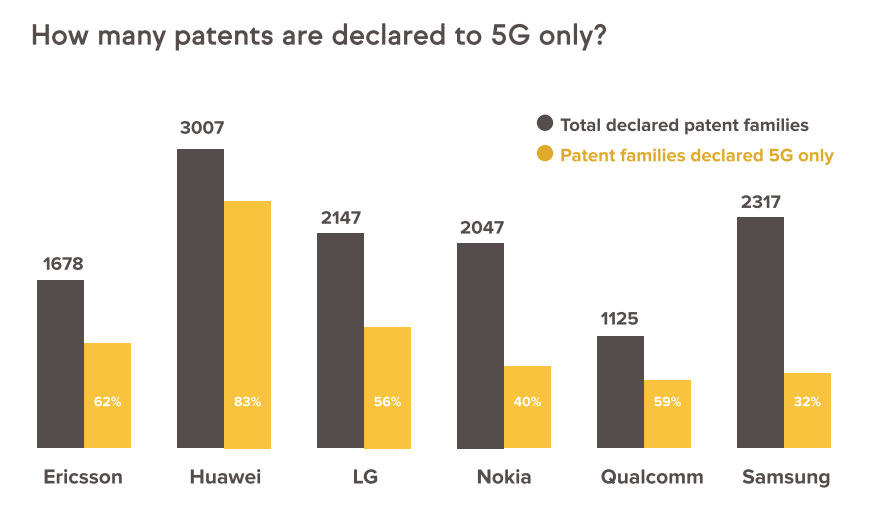
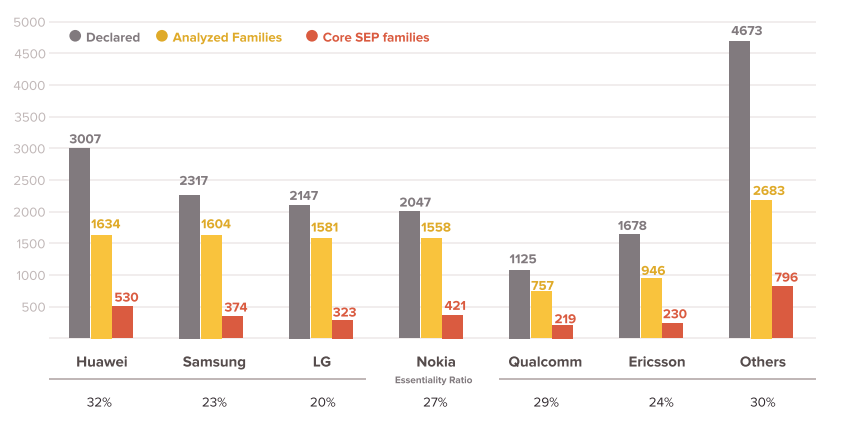
The report is an update of the previous report “Exploration of 5G Standards and Preliminary Findings on Essentiality” released on May 26, 2020.
………………………………………………………………………………………………………………………………
Separately, Samsung Electronics Co., Ltd. announced on March 10th that it has ranked first in 5G Standard Essential Patent (SEP)¹ shares according to a patent essentiality study conducted by IPlytics2, a Berlin-based market intelligence firm comprised of economists, scientists and engineers. The findings were published in IPlytics’ recent report: “Who is leading the 5G patent race? A patent landscape analysis on declared SEPs and standards contributions.”

Samsung also ranked second in two other categories: share of 5G granted3 and active patent4 families5, and share of 5G granted and active patent families with at least one of them granted by the EPO (European Patent Office) or USPTO (United States Patent and Trademark Office).
Last year, Samsung also led in 5G patents as a result of its research and development of 5G standards and technologies.
the top 10 companies own more than 80% of all granted 5G patent families, while the top 20 own more than 93% of all 5G granted patent families. These numbers confirm that there are only a few major large 5G patent owners, but looking at overall 5G declarations, the IPlytics Platform database identified more than 100 independent companies, which have declared ownership of at least one 5G patent.
The 5G patent family statistics presented in Table 1 are not based on verified SEP families. Neither ETSI nor the declaring companies have published independent assessments of the essentiality or validity of the declared 5G patents. Thus, the 5G patent families presented are only potentially essential. Many well-known SEP studies estimate that between 20% and 30% of all declared patents are essential. However, the essentiality rate differs across patent portfolios. To better understand the essentiality rate across portfolios, IPlytics created a data set of 1,000 5G-declared patent families (EPO/USPTO granted), which independent experts have mapped to 5G specifications. Here, the experts mapped the patents for six hours in a first check and then EPO/USPTO patent attorneys double-checked the mapping for a further three hours.
Table 1. Top 5G patent declaring companies (with >1% share)
| Current Assignee | 5G families | 5G granted and active families | 5G EPO/USPTO granted and active families | 5G EPO/USPTO granted and active families not declared to other generations |
| Huawei (CN) | 15.39% | 15.38% | 13.96% | 17.57% |
| Qualcomm (US) | 11.24% | 12.91% | 14.93% | 16.36% |
| ZTE (CN) | 9.81% | 5.64% | 3.44% | 2.54% |
| Samsung Electronics (KR) | 9.67% | 13.28% | 15.10% | 14.72% |
| Nokia (FN) | 9.01% | 13.23% | 15.29% | 11.85% |
| LG Electronics (KR) | 7.01% | 8.7% | 10.3% | 11.48% |
| Ericsson (SE) | 4.35% | 4.59% | 5.25% | 3.79% |
| Sharp (JP) | 3.65% | 4.62% | 4.66% | 5.50% |
| Oppo (CN) | 3.47% | 0.95% | 0.64% | 1% |
| CATT Datang Mobile (CN) | 3.44% | 0.85% | 0.46% | 0.68% |
| Apple (US) | 3.21% | 1.46% | 1.66% | 2.15% |
| NTT Docomo (JP) | 3.18% | 1.98% | 2.25% | 1.9% |
Source: IPlytics
………………………………………………………………………………………………………………………………..
Superscript Notes:
[1] “A patent that protects technology essential to a standard”, European Commission report – “Setting out the EU approach to Standard Essential Patents”, p1, November 2017.
[2] “IPlytics derived the “essential rate” by creating a random data set of 1,000 5G-declared patent families (EPO/USPTO granted) and mapping it to 5G specifications.” . Available : https://www.iam-media.com/who-leading-the-5g-patent-race-patent-landscape-analysis-declared-seps-and-standards-contributions
[3] “a patent that is granted by at least one of patent offices”, IPlytics report – “who is leading the 5G patent race”, p5, November 2019.
[4] “in active status, which means it has not lapsed, been revoked or expired”, IPlytics report – “who is leading the 5G patent race”, p3, November 2019.
[5] “a collection of patent applications covering the same or similar technical content”, . Available: https://www.epo.org/searching-for-patents/helpful-resources/first-time-here/patent-families.html
…………………………………………………………………………………………………………………………………………….
References:
https://www.amplified.ai/news/
https://www.greyb.com/5g-patents/
https://news.samsung.com/us/samsung-extends-leadership-5g-patents/