

AI Debt Wave Implications: Higher interest rates with enormous AI sales required for ROI
Executive Summary:
Artificial Intelligence (AI) debt fueled infrastructure buildouts have become a broad fixed-income-market supply shock. The Wall Street Journal reports that 49% of new investment-grade bond issuance year to date in 2026 has been AI-linked—a figure that underscores how the financing of data centers, compute infrastructure and supporting power systems is reshaping bond market fundamentals and technical factors. As the supply of long-dated bonds rises, prices fall and yields rise until investors are compensated enough to absorb them. The AI buildout is adding enormous corporate debt from hyperscalers, data-center developers, semiconductor and networking suppliers, and utilities—while also driving public borrowing for grid, power, water and transportation infrastructure. This is putting upward pressure on yields across Treasuries, corporate bonds and municipal debt. This heavy concentration of long-dated supply creates a crowding-out effect that forces non-AI issuers to compete against elevated benchmark yields and potentially stifles broader economic growth, especially for companies not involved in circular AI funding deals (see References).
AI is capital intensive (see Table 1. below). Building data-center capacity requires cash not only for GPUs and servers, but also for land, buildings, fiber, networking, cooling, power procurement, backup generation, substations, transmission and water systems. The major hyperscalers can fund part of that investment from cash flow, but they are also issuing lots of new bonds and notes to preserve liquidity and accelerate buildouts. Their suppliers, data-center partners and power providers are doing the same. Much of this borrowing is long dated—exactly where the Treasury is issuing heavily to finance federal deficits.
The result is an expanding pool of long-duration debt competing for the same institutional buyers: insurers, pension funds, mutual funds, banks, foreign investors and asset managers. When those buyers do not increase their allocations at the same pace as supply, issuers must offer higher yields. Here’s the flow chart that loops around indefinitely until there is an AI crash!:
More AI related bond supply→lower prices→higher yields→higher term premium for U.S. Treasuries→higher budget deficits to finance the increased debt→more bond supply→etc.
……………………………………………………………………………………………………………………………………………………………………………………………………………………………………………………………………………….
- 2026 Debt Issuance: Projected between $220 billion and $250+ billion for major US hyperscalers (Alphabet / Google, Amazon, Meta, Microsoft, and Oracle), with broader AI-related market debt reaching up to $570 billion.
- 2027 Forecast: Goldman Sachs projects direct hyperscaler debt issuance to nearly double to around $400 billion (Jeff Pu estimates $419 billion) as companies finance over a third of their infrastructure needs.
- Aggregate Capex: Combined capital expenditures are expected to hit roughly $940 billion in 2026 and scale past $1.3 trillion in 2027.
- Market Share: Hyperscaler investment-grade bond sales have jumped from roughly 2% of total US supply (2022–2024) to roughly 9% in 2026.
- Credit Impact: Credit spreads on a 10-year hyperscaler credit basket have widened from historical 40–75bp ranges toward 90bp+, driven by leverage concerns.
- Cash Flow Outlook: S&P Global Ratings expects all major hyperscalers to run negative free operating cash flow through 2026 and 2027, with a cash-flow inflection point not projected until 2028–2029.
Hyperscaler Funding Boom: Debt vs. Capex Projections (2026–2027):
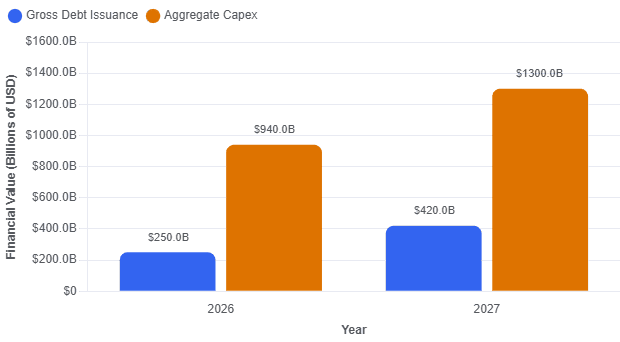
Source: Google Gemini
……………………………………………………………………………………………………………………………………………………………………………………………………………………………………
Corporate Borrowing Negatively Impacted by AI Debt Financing:
Corporate bonds face the most direct effect. When hyperscalers, data-center operators, chip suppliers and utilities all enter the fixed income market at once, they compete for investor capital and dealer balance sheets.
The bond market adjusts through the following mechanisms:
- Larger new-issue concessions, meaning issuers must offer higher yields than comparable bonds already trading.
- Lower prices for outstanding corporate bonds as investors sell them to make room for new issues.
- Wider credit spreads, particularly for lower-rated investment-grade borrowers.
- Higher borrowing costs for non-AI companies that must compete with AI-linked supply for investor allocations.
The pressure is not limited to companies directly building AI agents or systems. A telecom operator, industrial firm, REIT or consumer company will likely pay more to borrow because investors can buy a new, liquid, highly rated hyperscaler bond at a potentially higher and attractive yield. That discourages non-AI corporate borrowing and leads to slower economic growth.
………………………………………………………………………………………………………………………………………………………………………………………………………………………………………………………………………………………
AI Pain Points Personified:
1. Ares reports, “We documented well more than 100 digital-infrastructure financings from just the past twelve months… Despite different issuers, different structures, different rating agencies and different credit markets, all of the risk converges on just eight (AI tech) names: Meta, Oracle, Microsoft, Amazon, Google, Nvidia, and, on a look-through basis, OpenAI and Anthropic.”
2. Analysts at Goldman Sachs Group and elsewhere have calculated that more than $1 trillion has already been spent on the data center build-out since the launch of ChatGPT in late 2022. Presumably, other large American businesses would need to pay for AI tools to justify all of this investment. That money needs to come from somewhere. but who’s going to pay for those AI tools?
3. From Greg Ip of the WSJ: “Will America Spend 9% of Its GDP on AI? The Industry Is Counting on It“:
“Is it plausible that Americans will spend as much of their income on this one technology as they do on food? Roughly twice what the nation pays for all forms of energy or all computers and software? Seven times what consumers spend on phone, streaming, and internet services combined?”
“You should be skeptical. Even the most transformative inventions eventually run into the law of diminishing returns: each additional dollar a user spends yields less additional productivity (or enjoyment) than the last. That imposes a natural ceiling. The question, of course, is where that ceiling is. Whether or not you think 9% of GDP is right, you have to care, because this figure isn’t some fever dream: it is implicit in the dollars that investors and companies are committing right now.”
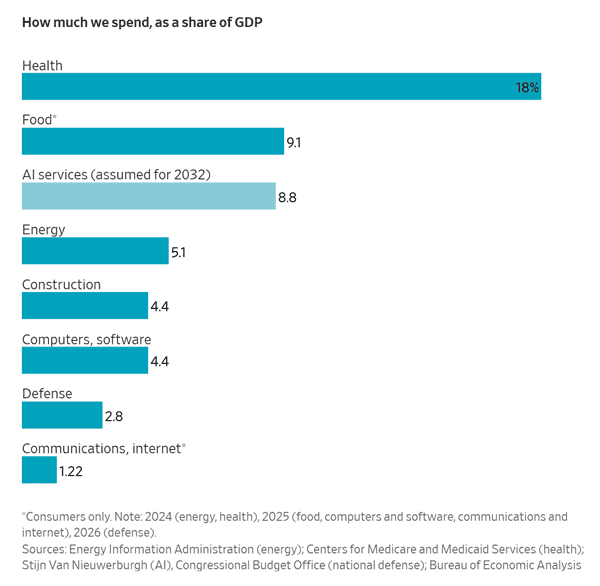
Chart Credit: Greg Ip, Wall Street Journal
………………………………………………………………………………………………………………..
Dire Warnings:
Nobel laureate Daron Acemoglu writes about “Distorted Intelligence at the AI Frontier” (emphasis added):
“The real problem for the frontier AI labs is not that their models are too powerful and already “misaligned” with the goals their creators set for them. Rather, it is that the models are being trained in ways that may be leading to a type of intelligence that will become less predictable. AI frontier labs are training their models in ways that may be leading to a type of distorted intelligence.
“This is what I mean by distorted intelligence. If my suspicion is correct, what we are dealing with is not a model racing toward superintelligence, but a brittle house of cards that becomes more and more likely to malfunction and collapse as we demand more from it.”
Conclusions:
The above analysis outlines critical structural risks and concerns directly related to the AI infrastructure (capex) spending boom. It references several articles which highlight the risks of circular financing loops where hardware suppliers (like Nvidia and Broadcom) fund their buyers (like Anthropic and Open AI). Additionally, hyperscalers face structural cash deficits with negative free operating cash flows projected through 2027, alongside rising sovereign risk and potential conflicts of interest from intertwined debt and leasing arrangements. This table balances the author’s views with a counter-perspective:
| IEEE Techblog Warning | The Nuanced Counter-Perspective |
|---|---|
| Circular Funding Risk: Massive vendor lending deals (like Broadcom lending Anthropic $42 billion) are artificially inflating revenue and building a brittle house of cards. | Balance Sheet Cushion: Unlike the 2000 Dot-Com crash where telecom infrastructure was built on speculative, junk-rated leverage, 2026 hyperscalers possess massive cash-generative core businesses (search, cloud, e-commerce) to subsidize their debt service even if AI returns are delayed. |
| Diminishing Returns: Society cannot plausibly spend 9% of GDP on AI, meaning demand will hit a hard ceiling and spark a debt bust. | Productivity Deflation: AI infrastructure spending may not need to justify itself through direct “software sales.” If the technology lowers the baseline operating costs of the global services economy, the ROI manifests as structural corporate margin expansion rather than retail sales. |
…………………………………………………………………………………………………………………………………………………………………………………………………………………………………………………………
References:
Curmudgeon: Caveat Emptor: Huge Debt and Circular Financing Deals Dominate AI Build-Outs (07/23)
Broadcom lending Anthropic up to $42 billion in yet another AI circular financing deal
Bain & Co: AI Infrastructure Buildout Will Require $6 Trillion Revenue by 2031 to Support Massive CAPEX
The AI Infrastructure Build-Out: A $10 Trillion Bet on Compute, Power, and Networks
Nvidia CEO Huang: AI is the largest infrastructure buildout in human history; AI Data Center CAPEX will generate new revenue streams for operators
AI risks and backlash increase; Recap of the circular loop of fake AI profits and hyperscaler markups of private AI companies
China vs U.S.: Race to Generate Power for AI Data Centers as Electricity Demand Soars
How will fiber and equipment vendors meet the increased demand for fiber optics in 2026 due to AI data center buildouts?
Expose: AI is more than a bubble; it’s a data center debt bomb
Will billions of dollars big tech is spending on Gen AI data centers produce a decent ROI?
Huge Risks for the proposed $500B AI Investments from Giant Wall Street firms
Can the debt fueling the new wave of AI infrastructure buildouts ever be repaid?
3 thoughts on “AI Debt Wave Implications: Higher interest rates with enormous AI sales required for ROI”
Leave a Reply

This IEEE Techblog post provides a highly accurate and realistic warning about the systemic risks facing the fixed-income markets from the AI debt binge. Stripping away any narrative spin, the post correctly identifies a fundamental law of economics: an unprecedented, multi-sector supply shock cannot occur without moving the price of capital for everyone. Here’s my assessment:
• The Supply Deluge is Systemic: The article rightly points out that this is not just about a few tech giants. By looping in data-center developers, semiconductor firms, networking suppliers, and heavily burdened utilities, the AI wave is consuming 49% of all primary investment-grade capital year-to-date. That concentration level makes it a macroeconomic force that dictates benchmark yields, not a localized tech anomaly.
• Duration Collision with the U.S. Treasury: The article correctly flags that much of this AI-linked corporate borrowing is long-dated. These corporate bonds are directly competing against the historic long-duration issuance needed to fund U.S. federal budget deficits. This forces institutional buyers (like insurers and pension funds) to demand a structurally higher term premium to absorb the papers.
• True Crowding Out Exists: The article’s assertion that a telecom operator, industrial firm, or REIT pays more for debt simply because they are competing with liquid, highly-rated hyperscaler bonds is structurally sound. Even if non-tech credit spreads remain tight, the all-in cost of capital (Base Rate + Spread) has risen across the entire corporate landscape due to this supply pressure, which inevitably acts as a brake on non-AI business borrowing
This article is an excellent, sober assessment that exposes the hidden financial plumber’s view of the AI boom. It correctly proves that the AI wave has permanently altered bond market technicals, pushed up global capital costs, and created a real crowding-out effect for traditional borrowers.
Author’s thesis: The author explicitly identifies a dangerous feedback loop with U.S. government debt. Because the massive wave of long-dated AI bonds competes directly with heavy Treasury issuance, it drives up the term premium. This structurally increases the government’s borrowing costs, directly leading to higher federal budget deficits just to finance existing national debt. Weissberger focuses heavily on the macro-bond market mechanics—specifically how 49% of investment-grade debt issuance is AI-linked which is driving up long-duration supply, widening credit spreads, and flattening the bond market.
External Citations: The author curates outside viewpoints at the end of the post to show compounding pressures, using the Wall Street Journal to question the GDP scale of AI, and Acemoglu to question the fundamental reliability of the software being built on this debt.
Conclusions: Weissberger concludes that the financial strain on hyperscalers will last for years. Citing S&P Global Ratings, the post notes that all major hyperscalers are projected to run negative free operating cash flow through 2026 and 2027. A true cash-flow inflection point where these investments finally start paying for themselves is not expected until 2028 or 2029. He concludes that market analysts severely underestimate the breadth of the infrastructure bill. The capital-intensive nature of the wave isn’t just driven by high-profile GPUs and servers, but by massive, forced public/private investments into physical utilities—including water systems, power procurement, backup generation, substations, and transmission networks.
From Perplexity.ai:
This is a forceful and timely credit-cycle critique of the AI infrastructure boom, and its central proposition is directionally right: debt-financed AI capacity is becoming large enough to influence marginal fixed-income pricing and to expose a yawning gap between infrastructure spending and demonstrated end-user AI revenue. But the post overstates causal certainty, insufficiently separates different parts of the credit market, and needs more rigorous sourcing and modeling to meet the standard implied by its strongest claims.
Bottom-line assessment:
The article succeeds best as a skeptical warning against the narrative that hyperscaler AI capex is self-validating. It correctly argues that the buildout is not merely a semiconductor story: it is a coupled investment cycle spanning accelerated compute, data-center buildings, optical and electrical interconnect, grid transmission, substations, backup generation, water and cooling systems, and increasingly long-dated debt. That systems perspective is particularly important for telecommunications and infrastructure readers.
Its key analytical insight is this: if AI-related issuers materially increase the supply of long-duration corporate, project and public-infrastructure debt faster than institutional investors expand their allocations, capital costs must rise at the margin. That affects not only the hyperscalers, but utilities, data-center developers, suppliers and unrelated corporate borrowers competing for investor capacity. The post’s cited claim that AI-linked borrowers account for 49% of year-to-date 2026 U.S. investment-grade issuance, if correctly defined and verified, would indeed be an extraordinary technical factor for the corporate-bond market. The article:
-Clearly explains that AI infrastructure is capital intensive and increasingly debt funded.
-Connects the debt buildout to the physical technology stack: GPUs and other accelerators, servers, switching and optical interconnect, data-center facilities, electrical distribution, cooling, transmission and generation capacity.
-Uses enough credible financial-market evidence to support its argument that financing conditions can affect the pace, cost and geographical distribution of technology deployment.
-Distinguishes reported facts from forecasts and financial commentary.
-Avoids overstating causality between AI borrowing and broad interest-rate movements.
What it gets right:
The ROI hurdle is the real issue. The article rightly turns attention away from AI spending headlines and toward the revenue required to earn adequate returns on a capital base that is becoming extraordinarily large. Its use of the Wall Street Journal’s 9%-of-GDP framing makes the required demand concrete: the question is not whether AI is useful, but whether firms and consumers will pay enough, consistently enough, to support the present infrastructure trajectory.
It identifies the capital-intensity stack correctly. GPUs are only one component. High-density AI clusters also require networking, optical links, storage, power delivery, thermal management, grid interconnection and physical facilities. The post’s inclusion of fiber, networking, power and cooling is sound and makes it more credible than commentary that treats AI capex as synonymous with Nvidia purchases.
It focuses on duration and investor absorption. The point that hyperscaler and AI-adjacent debt must compete with heavy Treasury issuance for the same broad buyer base—insurers, pension funds, mutual funds, banks, foreign institutions and asset managers—is analytically useful. In a supply-heavy environment, higher coupon levels, wider new-issue concessions and softer prices for existing bonds are ordinary clearing mechanisms.
It recognizes concentration risk. The Ares observation that many nominally separate digital-infrastructure financings can converge economically on a small group of technology counterparties is one of the post’s strongest points. In credit analysis, the relevant question is not simply how many special-purpose vehicles, private-credit funds or data-center projects exist; it is where ultimate revenue, capacity commitments, guarantees and residual-value exposure reside.
It challenges circular financing. The article is right to be concerned when AI vendors, cloud platforms, model developers, equipment providers, financiers and capacity purchasers effectively reinforce one another’s valuations and demand forecasts. Circularity does not automatically mean fraud or inevitable collapse, but it can obscure independent end-market demand and make the system vulnerable to a synchronized retrenchment.
…………………………………………………………………………………………………………………….
The weakness is that the article sometimes shifts from a plausible contributing factor to an assertion of broad, near-mechanical causality for Treasury, municipal and corporate yields. Those markets are related, but not interchangeable.