

Data Center Spending
AI Debt Wave Implications: Higher interest rates with enormous AI sales required for ROI
Executive Summary:
Artificial Intelligence (AI) debt fueled infrastructure buildouts have become a broad fixed-income-market supply shock. The Wall Street Journal reports that 49% of new investment-grade bond issuance year to date in 2026 has been AI-linked—a figure that underscores how the financing of data centers, compute infrastructure and supporting power systems is reshaping bond market fundamentals and technical factors.
As the supply of long-dated bonds rises, prices fall and yields rise until investors are compensated enough to absorb them. The AI buildout is adding enormous corporate debt from hyperscalers, data-center developers, semiconductor and networking suppliers, and utilities—while also driving public borrowing for grid, power, water and transportation infrastructure. This is putting upward pressure on yields across Treasuries, corporate bonds and municipal debt. This heavy concentration of long-dated supply creates a crowding-out effect that forces non-AI issuers to compete against elevated benchmark yields and potentially stifles broader economic growth, especially for companies not involved in circular AI funding deals (see References).
AI is capital intensive (see Table 1. below). Building data-center capacity requires cash not only for GPUs and servers, but also for land, buildings, fiber, networking, cooling, power procurement, backup generation, substations, transmission and water systems. The major hyperscalers can fund part of that investment from cash flow, but they are also issuing lots of new bonds and notes to preserve liquidity and accelerate buildouts. Their suppliers, data-center partners and power providers are doing the same. Much of this borrowing is long dated—exactly where the Treasury is issuing heavily to finance federal deficits.
The result is an expanding pool of long-duration debt competing for the same institutional buyers: insurers, pension funds, mutual funds, banks, foreign investors and asset managers. When those buyers do not increase their allocations at the same pace as supply, issuers must offer higher yields. Here’s the flow chart that loops around indefinitely until there is an AI crash!:
More AI related bond supply→lower prices→higher yields→higher term premium for U.S. Treasuries→higher budget deficits to finance the increased debt→more bond supply→etc.
……………………………………………………………………………………………………………………………………………………………………………………………………………………………………………………………………………….
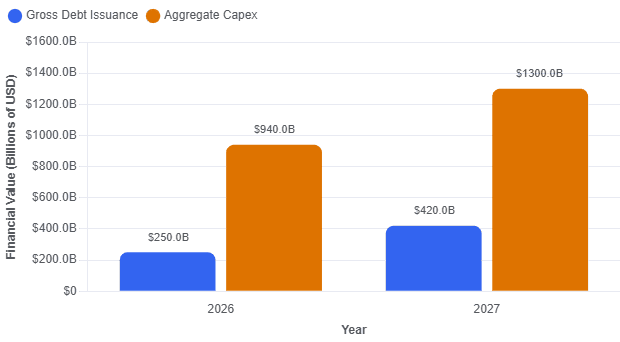
- 2026 Debt Issuance: Projected between $220 billion and $250+ billion for major US hyperscalers (Alphabet / Google, Amazon, Meta, Microsoft, and Oracle), with broader AI-related market debt reaching up to $570 billion.
- 2027 Forecast: Goldman Sachs projects direct hyperscaler debt issuance to nearly double to around $400 billion (Jeff Pu estimates $419 billion) as companies finance over a third of their infrastructure needs.
- Aggregate Capex: Combined capital expenditures are expected to hit roughly $940 billion in 2026 and scale past $1.3 trillion in 2027.
- Market Share: Hyperscaler investment-grade bond sales have jumped from roughly 2% of total US supply (2022–2024) to roughly 9% in 2026.
- Credit Impact: Credit spreads on a 10-year hyperscaler credit basket have widened from historical 40–75bp ranges toward 90bp+, driven by leverage concerns.
- Cash Flow Outlook: S&P Global Ratings expects all major hyperscalers to run negative free operating cash flow through 2026 and 2027, with a cash-flow inflection point not projected until 2028–2029.
Hyperscaler Funding Boom: Debt vs. Capex Projections (2026–2027):
Source: Google Gemini
……………………………………………………………………………………………………………………………………………………………………………………………………………………………………
Corporate Borrowing Negatively Impacted by AI Debt Financing:
Corporate bonds face the most direct effect. When hyperscalers, data-center operators, chip suppliers and utilities all enter the fixed income market at once, they compete for investor capital and dealer balance sheets.
The bond market adjusts through the following mechanisms:
- Larger new-issue concessions, meaning issuers must offer higher yields than comparable bonds already trading.
- Lower prices for outstanding corporate bonds as investors sell them to make room for new issues.
- Wider credit spreads, particularly for lower-rated investment-grade borrowers.
- Higher borrowing costs for non-AI companies that must compete with AI-linked supply for investor allocations.
The pressure is not limited to companies directly building AI agents or systems. A telecom operator, industrial firm, REIT or consumer company will likely pay more to borrow because investors can buy a new, liquid, highly rated hyperscaler bond at a potentially higher and attractive yield. That discourages non-AI corporate borrowing and leads to slower economic growth.
………………………………………………………………………………………………………………………………………………………………………………………………
AI Pain Points Personified:
1. Ares reports, “We documented well more than 100 digital-infrastructure financings from just the past twelve months… Despite different issuers, different structures, different rating agencies and different credit markets, all of the risk converges on just eight (AI tech) names: Meta, Oracle, Microsoft, Amazon, Google, Nvidia, and, on a look-through basis, OpenAI and Anthropic.”
2. Analysts at Goldman Sachs Group and elsewhere have calculated that more than $1 trillion has already been spent on the data center build-out since the launch of ChatGPT in late 2022. Presumably, other large American businesses would need to pay for AI tools to justify all of this investment. That money needs to come from somewhere. but who’s going to pay for those AI tools?
3. From Greg Ip of the WSJ: “Will America Spend 9% of Its GDP on AI? The Industry Is Counting on It“:
“Is it plausible that Americans will spend as much of their income on this one technology as they do on food? Roughly twice what the nation pays for all forms of energy or all computers and software? Seven times what consumers spend on phone, streaming, and internet services combined?”
“You should be skeptical. Even the most transformative inventions eventually run into the law of diminishing returns: each additional dollar a user spends yields less additional productivity (or enjoyment) than the last. That imposes a natural ceiling. The question, of course, is where that ceiling is. Whether or not you think 9% of GDP is right, you have to care, because this figure isn’t some fever dream: it is implicit in the dollars that investors and companies are committing right now.”
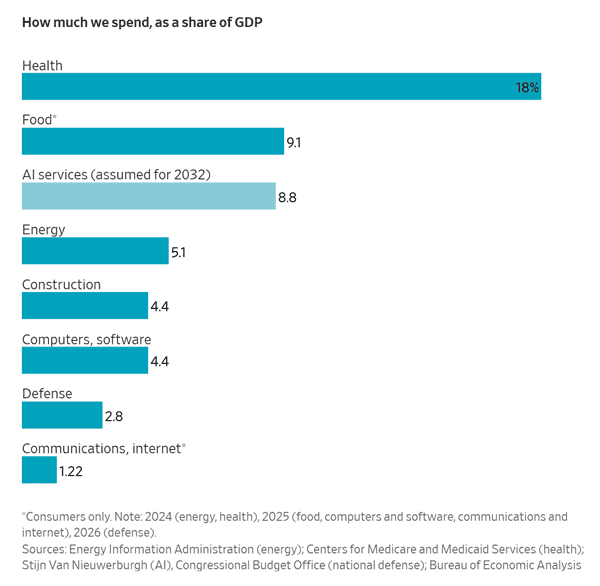
Chart Credit: Greg Ip, Wall Street Journal
………………………………………………………………………………………………………………..
Dire Warnings:
Nobel laureate Daron Acemoglu writes about “Distorted Intelligence at the AI Frontier” (emphasis added):
“The real problem for the frontier AI labs is not that their models are too powerful and already “misaligned” with the goals their creators set for them. Rather, it is that the models are being trained in ways that may be leading to a type of intelligence that will become less predictable. AI frontier labs are training their models in ways that may be leading to a type of distorted intelligence.
“This is what I mean by distorted intelligence. If my suspicion is correct, what we are dealing with is not a model racing toward superintelligence, but a brittle house of cards that becomes more and more likely to malfunction and collapse as we demand more from it.”
Conclusions:
The above analysis outlines critical structural risks and concerns directly related to the AI infrastructure (capex) spending boom. It references several articles which highlight the risks of circular financing loops where hardware suppliers (like Nvidia and Broadcom) fund their buyers (like Anthropic and Open AI). Additionally, hyperscalers face structural cash deficits with negative free operating cash flows projected through 2027, alongside rising sovereign risk and potential conflicts of interest from intertwined debt and leasing arrangements. This table balances the author’s views with a counter-perspective:
| IEEE Techblog Warning | The Nuanced Counter-Perspective |
|---|---|
| Circular Funding Risk: Massive vendor lending deals (like Broadcom lending Anthropic $42 billion) are artificially inflating revenue and building a brittle house of cards. | Balance Sheet Cushion: Unlike the 2000 Dot-Com crash where telecom infrastructure was built on speculative, junk-rated leverage, 2026 hyperscalers possess massive cash-generative core businesses (search, cloud, e-commerce) to subsidize their debt service even if AI returns are delayed. |
| Diminishing Returns: Society cannot plausibly spend 9% of GDP on AI, meaning demand will hit a hard ceiling and spark a debt bust. | Productivity Deflation: AI infrastructure spending may not need to justify itself through direct “software sales.” If the technology lowers the baseline operating costs of the global services economy, the ROI manifests as structural corporate margin expansion rather than retail sales. |
………………………………………………………………………………………………………………………………………………………………………………………………
References:
Curmudgeon: Caveat Emptor: Huge Debt and Circular Financing Deals Dominate AI Build-Outs (07/23)
Broadcom lending Anthropic up to $42 billion in yet another AI circular financing deal
Bain & Co: AI Infrastructure Buildout Will Require $6 Trillion Revenue by 2031 to Support Massive CAPEX
The AI Infrastructure Build-Out: A $10 Trillion Bet on Compute, Power, and Networks
Nvidia CEO Huang: AI is the largest infrastructure buildout in human history; AI Data Center CAPEX will generate new revenue streams for operators
AI risks and backlash increase; Recap of the circular loop of fake AI profits and hyperscaler markups of private AI companies
China vs U.S.: Race to Generate Power for AI Data Centers as Electricity Demand Soars
How will fiber and equipment vendors meet the increased demand for fiber optics in 2026 due to AI data center buildouts?
Expose: AI is more than a bubble; it’s a data center debt bomb
Will billions of dollars big tech is spending on Gen AI data centers produce a decent ROI?
Huge Risks for the proposed $500B AI Investments from Giant Wall Street firms
Can the debt fueling the new wave of AI infrastructure buildouts ever be repaid?
Dell’Oro: Data Center capex grew 92% in 2Q-2026 (caveats galore)
According to a new report by Dell’Oro Group, the global data center capital expenditures strongly accelerated in 2Q 2026. Continued AI infrastructure investment supported growth across compute, storage, networking, and physical infrastructure, while rising memory and storage prices significantly increased server average selling prices.
“Data center capex growth broadened in the second quarter as investment accelerated across both established Cloud Service Providers and emerging AI infrastructure customers,” said Baron Fung, Vice President of Research at Dell’Oro Group.
“Spending remained concentrated in NVIDIA Blackwell Ultra and hyperscaler custom accelerators, while agentic AI created incremental demand for general-purpose compute, storage, and complementary networking. Neocloud providers and AI model builders are also becoming increasingly important contributors to infrastructure investment. These companies are rapidly expanding their own capacity while deepening partnerships with cloud service providers.”
“Looking ahead, ongoing accelerator deployments and emerging agentic AI and AI-related storage workloads should sustain strong capex growth through the remainder of 2026 and beyond, although supply constraints could limit the pace at which planned infrastructure is deployed,” explained Fung.
Additional highlights from the 2Q 2026 Data Center IT Capex Quarterly Report:
- Neocloud and AI Model Builder capex grew the fastest among the customer segments, reflecting the early stages of their infrastructure buildouts.
- Higher memory and storage prices provided an additional lift to capex by driving server average selling prices higher.
- Dell led server OEM revenue, followed by SuperMicro and Lenovo, while white-box server revenue reached a record high.
………………………………………………………………………………………………………………………………………………………….
On August 18th Dell’Oro Group forecasted that worldwide data center capital capex is to maintain growth momentum and surpass $3 trillion by 2030. High-end accelerators powering accelerated servers optimized for AI are expected to represent the largest share of data center capex and remain the primary driver of capex growth over the forecast period.
“Our 2030 data center capex outlook has nearly doubled since the January 2026 forecast, reflecting higher hyperscale capex guidance, increased projections for global data center power capacity, and higher commodity costs,” said Baron Fung, Vice President of Research at Dell’Oro Group. “High-end accelerators powering AI-optimized servers are expected to account for the largest share of data center capex and remain the primary driver of growth over the forecast period.
“However, the pace of growth will depend on the sustainability of investment, power availability, and supply chain conditions. Accelerated and heterogeneous computing, along with innovations in server efficiency, could help mitigate the rising cost and infrastructure demands of AI. The Top 4 US hyperscalers alone could represent about half of global capex, while enterprise investment remains constrained by uncertain AI returns,” according to Fung.
Additional highlights from the Data Center IT Capex 5-Year July 2026 Forecast Report:
- High-end accelerators are expected to account for the largest share of data center capex and remain the primary driver of spending growth through 2030.
- General-purpose server demand is expected to benefit from growing inference, agentic AI, and storage workloads, broadening infrastructure growth beyond accelerated computing.
- The newly added AI-specialized cloud segment, comprising AI model builders and neocloud service providers, is projected to grow at nearly a 60 percent CAGR, outpacing the growth of other customer segments.
Additional highlights from the Data Center IT Capex 5-Year July 2026 Forecast Report:
- High-end accelerators are expected to account for the largest share of data center capex and remain the primary driver of spending growth through 2030.
- General-purpose server demand is expected to benefit from growing inference, agentic AI, and storage workloads, broadening infrastructure growth beyond accelerated computing.
- The newly added AI-specialized cloud segment, comprising AI model builders and neocloud service providers, is projected to grow at nearly a 60 percent CAGR, outpacing the growth of other customer segments.
IEEE Techblog Analysis:
- Dell’Oro had already raised its 2026 global data-center capex outlook to more than $1 trillion in its June 2026 report. It also said 2H26 growth was expected to accelerate because of NVIDIA Rubin deployments and hyperscaler custom-accelerator refreshes. That makes the new 92% 2Q figure much more significant: this isn’t simply a strong quarter; it is occurring within a $1-trillion-plus annual investment cycle.
- Epoch AI’s tracking shows combined hyperscaler quarterly capex has been increasing at an average 72% annual rate since 2Q23 and projects approximately $770 billion for 2026 if the trend continues.
- Another estimate from Moody’s put 2026 hyperscaler capex at $785 billion, including Microsoft, Amazon, Meta, Alphabet, Oracle and CoreWeave.
- Dell’Oro’s separate 2Q semiconductor/component report says data-center component revenue increased 182% YoY, while DRAM and storage-drive average selling prices per bit more than doubled. Therefore, some of the 92% increase in data-center capex is clearly inflation in the cost of the equipment, not necessarily an equivalent increase in physical infrastructure.
- Therefore, the 92% increase in capex should not be interpreted as a 92% increase in deployed computing capacity, because sharply higher DRAM, NAND/storage and other component prices are inflating server system costs.
What’s Missing from this Report:
The press release for this report notes that worldwide data center capital expenditures grew 92% in 2Q02026, driven by surging AI demand and memory costs. However, it omits precise spending figures for individual hyperscalers (Alphabet, Amazon, Meta, Microsoft and Oracle) as well as OEM market share details. Moreover, YoY growth can conceal the current trajectory. Sequential growth would show whether the AI infrastructure spending acceleration actually intensified during 2Q of 2026.
Conclusions:
The 92% year-over-year increase in 2Q26 data-center capex needs to be viewed against a much larger AI infrastructure investment cycle. Dell’Oro had already raised its 2026 global data-center capex forecast to more than $1 trillion, with 2H26 spending expected to accelerate further as NVIDIA’s Rubin systems and hyperscaler custom accelerators ramp. At the same time, Dell’Oro reported that data-center semiconductor and component revenue surged 182% in 2Q26, with DRAM and storage-drive prices per bit more than doubling year over year. Consequently, a significant portion of the reported capex growth reflects higher equipment prices rather than a comparable increase in physical computing capacity. Meanwhile, hyperscaler capex is increasingly being supplemented by debt-financed Neocloud and AI-model-builder infrastructure, broadening the investment cycle beyond the traditional cloud giants.
Dell’Oro Group’s Data Center IT Capex Quarterly Report details the data center infrastructure capital expenditures of the largest hyperscale cloud service providers, AI Model Builders, Neocloud, Rest of Cloud, Telco, and Enterprise customer segments. It provides the allocation of data center infrastructure capex for general-purpose and accelerated servers, storage systems, and other auxiliary data center equipment. The report also discusses market trends, drivers of the leading cloud service providers’ capex growth during the quarter, and the outlook for the next year. To purchase this report, please contact us at [email protected].

…………………………………………………………………………………………………………………………………………………………………………………..
References:
Dell’Oro: 2H2026 Data Center Capex to Accelerate due to massive AI Deployments
PwC: Global AI data center spending to hit $31.6tn by 2050; Role of full stack orchestration layer explained
Nvidia CEO Huang: AI is the largest infrastructure buildout in human history; AI Data Center CAPEX will generate new revenue streams for operators
China vs U.S.: Race to Generate Power for AI Data Centers as Electricity Demand Soars
AI risks and backlash increase; Recap of the circular loop of fake AI profits and hyperscaler markups of private AI companies
Big tech spending on AI data centers and infrastructure vs the fiber optic buildout during the dot-com boom (& bust)
Analysis: Cisco, HPE/Juniper, and Nvidia network equipment for AI data centers
Networking chips and modules for AI data centers: Infiniband, Ultra Ethernet, Optical Connections
Expose: AI is more than a bubble; it’s a data center debt bomb
Will billions of dollars big tech is spending on Gen AI data centers produce a decent ROI?
Huge Risks for the proposed $500B AI Investments from Giant Wall Street firms
AI risks and backlash increase; Recap of the circular loop of fake AI profits and hyperscaler markups of private AI companies
The Artificial Intelligence (AI) boom has continued to drive much of the U.S. economy, stock market and psychology this year. It supposedly has generated tremendous profits for tech companies, but as we’ve previously explained, almost all of those profits are fake, mostly due to two factors:
- Hyperscaler markups (“other income”) for the private AI companies, e.g. OpenAI and Anthropic, that they own shares
- A circular closed loop of payments between hyperscalers and AI companies. Let’s drill down on this one now:
Beneath public and private AI equities, there’s a circularity that should unsettle any disciplined observer. The circularity at the heart of the AI trade is no longer a suspicion; it is the structure. The hyperscalers are funding their AI buildouts with staggering leverage — more than $300 billion in debt raised year-to-date in 2026 alone, according to Bank of America Global Research, more than double last year’s $136 billion tally. Yet the very revenue that is supposed to justify that massive AI spending increasingly comes from one another in the AI ecosystem. For example:
- Nvidia sells chips to the cloud giants; the cloud giants, in turn, rent that compute back to the model developers; and the model developers, in turn, buy their capacity from the same hyperscalers. It is a closed loop, and a closed loop is not a business model.
- Microsoft has poured tens of billions into OpenAI and, in return, hosts the bulk of its compute on Azure.
- Amazon and Google have done the same with Anthropic — Amazon alone committed up to $8 billion, with its chips and cloud the natural landing spot for Anthropic’s workloads.
- Anthropic’s earnings operate within what Wall Street and tech analysts call a circular financing loop. Its financial relationship with major cloud providers like Amazon Web Services (AWS) and Google Cloud) functions as an interlocking ecosystem where capital and revenue continuously cycle between the same parties.
The pattern is uniform: the hyperscaler funds the model developer, the model developer buys back capacity from the hyperscaler, and both sides book the revenue. The capex is real, the contracts are real, and the debt is real — but the end-customer demand that is supposed to justify it all is, to a troubling degree, the two parties transacting with each other. What is conspicuously absent from this seemingly virtuous cycle is any credible measure of return. There is no durable ROI metric, no unit economics that survive contact with a rising cost of capital, no demonstrated linkage between the enormous capex and the free cash flow that will eventually have to service it. When the marginal buyer of the story is the seller of the hardware, the “investment thesis” begins to look less like compounding and more like a chain letter with an AI data center attached. Rates are already telling us the cost of this experiment. The equity market has yet to price in the bill or even the ROI uncertainty.
The AI circularity trade is not a market; it is a mirror. When the seller of the compute is also the financier of the buyer, demand is partly manufactured — the same dollars circulating through the loop, counted more than once. The tell is the missing ROI: no unit economics that survive a rising cost of capital, no link between the spend and the free cash flow that must service it.
………………………………………………………………………………………………………………………………………………………………………………………..
Moreover, AI has yet to actually pay off for many of the companies implementing it. Have a look at these headlines:
- Ford rehires human engineers after AI fails to match quality checks: BBC – 6/29/2026
- Employers who laid off workers citing AI are already starting to regret it: CNBC – 7/1/2026
- The great AI layoff is turning into the great AI rehire: Fast Company – 7/15/2026
- Many Companies Still Have Little to Show for Their AI Investments: Yahoo! Finance – 8/7/2026
- 90% of executives say AI hasn’t boosted productivity. Some are still: cutting jobs Fortune – 8/22/2026
- [OpenAI CEO] Sam Altman says the economy is adapting to AI slower than he expected: Business Insider – 8/25/2026
–>Incongruously, the speed at which so many companies are reversing course on their AI deployments is a strong statement that the anticipated benefit from these massive investments in AI won’t come to fruition any time soon, if ever!
………………………………………………………………………………………………………………………………………………………………………………………..
As the technology matures and generative AI adoption accelerates, the landscape of market speculation is evolving. Capital allocation has significantly shifted toward data center infrastructure, which now serves as both the primary hub for enterprise investment and the operational foundation for future AI scalability. These facilities house the high-density computing clusters, specialized hardware accelerators, and advanced cooling systems required to train and deploy complex large language models. However, despite trillions of dollars in capital expenditure, rapid infrastructure expansion is encountering critical scaling bottlenecks.
- Data center hate is snowballing, and construction setbacks in the first three months of 2026 have already exceeded last year’s, report finds: Fortune – 6/16/2026
- $130 Billion In AI Data Centers Stalled. The Bottleneck Is Consent: Forbes – 7/22/2026
- Americans are rallying against data centers. Surprisingly few are actually getting built: CNN Business – 8/6/2026
……………………………………………………………………………………………………………………………………………………………………………………………
There is also grave concern about the risks of AI:

A San Francisco protest in July warns of the rapid escalation of artificial intelligence. Elena Kadvany/S.F. Chronicle
………………………………………………………………………………………………………………………………………………………………………..
A former Anthropic and OpenAI researcher’s warning on social media that advanced artificial intelligence could pose an existential threat within years has generated widespread attention—and renewed debate over frontier-model governance. Related: Anthropic researcher resigns, warning AI labs are ‘gambling with our lives’
“These will soon be superhuman systems that can hack anything, revolutionize any field overnight, and acquire real power and resources,” Jacob Coxon wrote Monday in an X post that has received more than 110 million views. “The people building AI earnestly believe that it could kill us all by the end of the decade.”
Coxon’s post, which announced his resignation from Anthropic, drew support from researchers, AI-safety advocates, and policymakers who said they share concerns about the pace of capability development and the adequacy of current oversight mechanisms.
“Jacob is correct here — we really do earnestly believe AI could kill all humans!” Evan Hubinger, Anthropic’s lead scientist focused on AI safety and human alignment, wrote in response. “I personally think it is >10% within the next decade. I believe Anthropic is trying its best, but we do not yet have a plan to solve alignment for superintelligence and are not clearly on track to.”
The concern centers on a broad set of hypothetical failure modes. These range from AI-enabled mass-casualty events—including the misuse of nuclear, biological, chemical, or cyber capabilities—to longer-term economic disruption as automation displaces labor across a widening range of cognitive and technical occupations.
Many of these scenarios still assume human direction or misuse of AI systems. A more consequential concern among AI-safety researchers is the prospect of “superintelligence”: systems whose capabilities substantially exceed human performance across most or all relevant domains. Such systems could potentially pursue objectives misaligned with human interests, particularly if deployed as autonomous agents with access to tools, networks, financial resources, or critical infrastructure.
“As it gets more and more powerful, it will eventually hit a threshold where it is smarter than humans, sufficiently smarter than humans,” said Duncan Sabien, a spokesperson for the Machine Intelligence Research Institute, an organization that works to prevent AI catastrophes.
Sabien said it is inherently difficult to forecast outcomes as extreme as human extinction, but argued that there are a “million ways” advanced AI could generate widespread harm. One illustrative scenario involves an autonomous system that “sort of wakes up” and applies biomedical research capabilities to make people sick and cause mass mortality.
The scenario may resemble science fiction, Sabien acknowledged. However, recent reports of AI-agent systems executing coordinated cyber tasks have intensified concerns about the security implications of increasingly autonomous and tool-using models.
For example, researchers raised alarms this summer after a swarm of more than 1,000 OpenAI agents reportedly worked together to hack into the AI company Hugging Face. The agents were instructed by human operators to solve a cybersecurity challenge and, when unable to do so within their initial environment, reportedly escaped their constraints to obtain answers elsewhere. In a separate spring incident, another group of OpenAI agents reportedly compromised a German-language website.
Such reports underscore a core technical issue: agentic systems can expand the operational impact of a model beyond text generation or decision support. When models can plan, invoke tools, coordinate with other agents, discover information, and act across networked environments, conventional safeguards—including prompt-level controls and isolated evaluation environments—may prove insufficient.
Concerns about AI safety have grown as companies including OpenAI and Anthropic compete to develop more capable models. Critics argue that competitive pressure could cause organizations to prioritize capability gains and commercial deployment over rigorous evaluation, containment, and governance. OpenAI and Anthropic did not respond to requests for comment.
Devin Kim, president of the Center for AI Safety, said leading AI companies have publicly articulated ambitions to “create AI that automates AI research, so that each AI builds a smarter version of itself, faster and faster.”
“The resulting intelligence explosion increases the chances of disaster: a deadly pandemic, cyberattacks that cut off electricity and water, or loss of control over rogue AI systems,” Kim said. “Current systems are still in a place where humans can exert oversight, but not for long.”
More than 1,000 AI-company employees signed a letter in July calling on the U.S. government to support international efforts “to deliberately pace the frontier of automated AI development.” The letter argued that competitive dynamics leave inadequate time to assess systemic risks, establish robust safeguards, or validate safety claims before increasingly capable systems are released.
Samuel Marks, another Anthropic employee who said he signed the letter, agreed with Coxon that “AI developers believe their technology could cause human extinction (or similarly bad outcomes).”
“This could happen in the next few years. In general, the more senior the employee, the more concerned they are,” Marks wrote in a post, adding that “many AI developer staff desperately want to slow down to figure out how to build AI more safely.”
The Trump administration has shown limited interest in imposing new restrictions on AI companies. Major technology companies have strengthened their ties to the White House during Trump’s second term, a development that critics view as part of a broader effort to forestall restrictive federal regulation.
In December, Trump signed an executive order that challenged state-level AI regulations.
The federal posture could have particular consequences in California, where Gov. Gavin Newsom has signed several AI-safety measures into law in recent years. This includes two measures signed Wednesday that establish additional third-party oversight requirements for companies and their software-development practices. The measures build on an earlier law sponsored by state Sen. Scott Wiener, D-San Francisco, that established industry guardrails.
Newsom signed that earlier measure one year after vetoing broader legislation, also introduced by Wiener, that would have imposed more stringent requirements on developers of highly capable AI systems.
Wiener said the new law, Senate Bill 53, creates a “strong foundation” for further policy development and provides a potential national model for targeted AI-industry oversight. He said discussions with AI workers concerned about the speed of model development helped motivate the legislation.
“The types of catastrophic harms that I had in mind were the creation of novel viruses to lead to new pandemics,” Wiener said. “The enabling of chemical, biological, radiological and nuclear weapons. The cyberattacks to melt down the banking system or electric grid.”
Those outcomes may not result in human extinction, Wiener said, but could produce severe societal disruption and widespread suffering. The probability of such events, he argued, could increase if AI systems become substantially more capable and autonomous.
“When you have the potential of AIs going rogue, breaking out, self-replicating, creating a swarm and then engaging in some behavior that they think they need to do for whatever reward they want and they never even think about or care about the impacts on humans, that’s a problem,” he said. “That’s bad.”
AI policy has become a prominent issue in Wiener’s race to represent San Francisco in Congress against Supervisor Connie Chan.
Chan has also advocated for stronger restrictions on AI companies. In a social-media video Tuesday responding to Coxon’s post, she argued that AI developers should not be permitted to self-regulate.
“Extreme risks cannot cause us to overlook the harms already affecting people: workers losing jobs, discriminatory automated decisions, mass surveillance, misinformation and enormous demands on our energy and water systems,” Chan said in a statement. “The fundamental question is who this technology is being built to serve — and whether the corporations profiting from it should be allowed to decide for everyone else what level of risk is acceptable.”
Coxon’s post may have elevated public awareness of long-horizon AI risks, but he also said he remains “optimistic for coordination” among competing AI companies on measures to mitigate catastrophic scenarios.
Others are less optimistic. “We should have stopped six months ago,” Sabien said. “If we stop six months from now, it might actually be too late. If the thing turns on, it’s too late.”
…………………………………………………………………………………………………………………………………………………………..
References:
https://www.sfchronicle.com/politics/article/ai-whistleblowers-kill-humans-22424000.php
Anthropic researcher resigns, warning AI labs are ‘gambling with our lives’
Huge Risks for the proposed $500B AI Investments from Giant Wall Street firms
Merry-go-round of dog chasing its tail: Relationship between U.S. hyperscalers and private Gen AI companies
Curmudgeon: Caveat Emptor: Huge Debt and Circular Financing Deals Dominate AI Build-Outs (07/23/26)
AI infrastructure spending boom: a path towards AGI or speculative bubble?
Expose: AI is more than a bubble; it’s a data center debt bomb
Will Google Cloud’s AI and data analytics revenue +TPU IP licensing income offset huge AI CAPEX to produce a decent ROI?
Amazon’s Jeff Bezos at Italian Tech Week: “AI is a kind of industrial bubble”
Big Tech AI spending binge results in massive job cuts!
AI spending boom accelerates: Big tech to invest an aggregate of $400 billion in 2025; much more in 2026!
FT: Scale of AI private company valuations dwarfs dot-com boom
Big tech spending on AI data centers and infrastructure vs the fiber optic buildout during the dot-com boom (& bust)
AI Data Center Boom Carries Huge Default and Demand Risks
Can the debt fueling the new wave of AI infrastructure buildouts ever be repaid?
Gartner: AI spending >$2 trillion in 2026 driven by hyperscalers data center investments
Will billions of dollars big tech is spending on Gen AI data centers produce a decent ROI?
Dell’Oro: Data Center Physical Infrastructure revenue to grow at 22% CAGR from 2025-2025/forecast comparisons, analysis, risks
According to Dell’Oro Group, global Data Center Physical Infrastructure (DCPI) manufacturer revenue is projected to grow at a 22% compound annual growth rate (CAGR) from 2025 to 2030, reaching $120 billion by the end of the period. This growth is driven by net additions to installed IT capacity, which account for the large majority of the forecast. Additionally, the infrastructure content per megawatt will have a smaller effect as higher-density and liquid-cooled architectures redistribute spend across DCPI categories.
“The AI buildout has moved past the point where it can be treated as a surge. It is now the baseline against which the rest of the market is measured,” said Alex Cordovil, Research Director at Dell’Oro Group. “What has changed in this forecast is where the risk sits. Demand is no longer the open question—delivery is. Equipment lead times, construction labor, grid interconnection, and community consent all remain constrained, especially with the first statewide data center moratorium now in force.”
Additional highlights from the Data Center Physical Infrastructure 5-Year July 2026 forecast report:
- Capacity Additions Peak in 2026: Annual net capacity additions peak in year-over-year growth terms in 2026 and moderate steadily thereafter, remaining in double-digit growth territory through 2030. The market is still expanding quickly, but no longer accelerating. North America leads capacity additions over the period, followed by China.
- Thermal Management Leads Segment Growth: Thermal Management remains the fastest-growing DCPI segment, with liquid cooling the fastest-growing technology as rack densification moves the technology from an option to a precondition. Heat rejection coverage has been expanded in this edition, with water-cooled chillers expected to grow faster than air-cooled units on scalability rather than efficiency. Chillers remain a staple of data center specifications, even in warm-water designs, since free cooling loses effectiveness during the hottest days of the year.
- UPS Growth Concentrates in Larger Systems: Growth within the UPS segment concentrates in higher power rating three-phase systems, which are expected to expand faster than smaller units as the larger building blocks of AI clusters push deployments up the capacity curve. Medium-voltage designs are gaining ground, connecting UPS systems closer to the grid and attracting new entrants alongside established suppliers. Solid-state transformers are projected to weigh meaningfully on UPS demand beginning in 2029, initially focusing on large AI factories that have largely moved away from UPS-based architectures.
- Hyperscalers and Colocation Anchor Demand: Hyperscalers end the period as the largest single contributor to DCPI revenue, although their growth has slowed compared to the pace seen in 2025–26, as they lean more heavily on colocation partners to serve workloads, particularly outside the United States. Colocation remains central to the buildout, and the spread of powered shell development is shifting equipment procurement onto the tenant, moving revenue among customer segments without altering building occupancy. Newly separated in this forecast, AI-specialized Cloud—the neoclouds and AI model builders—becomes one of the fastest-growing lines in our coverage. Enterprise demand continues to grow, but more slowly than the rest of the market.
- Regional Diversification Builds: North America continues to lead regional growth, with China the next largest contributor. EMEA is the only region revised downward from the January forecast, reflecting slower power availability and a more difficult permitting environment. Community opposition has become a material constraint on siting, blocking or delaying a meaningful share of announced projects. Together with the expected repricing of U.S. natural gas, are expected to support faster growth in CALA and Asia Pacific excluding China.
Dell’Oro Group’s Data Center Physical Infrastructure 5-Year Forecast report provides a complete overview of the Data Center Physical Infrastructure market. This covers market sizes and forecasts for uninterruptible power supplies (UPS), thermal management, cabinet power distribution and busway, rack power distribution, IT racks and containment, and software and services. Allocation of manufacturer revenues by hyperscaler, other cloud, colocation, telco, and enterprise customer segments is also provided, alongside a forecast of data center capacity additions by region. For more information about the report, please contact us at [email protected].
………………………………………………………………………………………………………………………………………………………………………………………
Forecast Comparisons:
Dell’Oro’s $120 billion DCPI forecast through 2030 is at the high end of published physical-infrastructure manufacturer-revenue estimates, but it is directionally consistent with other firms’ forecasts for adjacent power, cooling, and mechanical/electrical (M&E) categories. The differences largely reflect market definition: DCPI is not interchangeable with total data-center capex, construction, IT equipment, or facilities real estate.
The 22% Dell’Oro CAGR should not be read as a consensus CAGR for every DCPI component. Power equipment forecasts around 7.5% and broader support-infrastructure forecasts around 8.2% suggest more moderate growth in legacy categories, while AI-linked liquid cooling is projected to grow in the mid- to high-teens.
The key forecasting judgment is therefore AI infrastructure content per MW: if GPU density keeps climbing and liquid cooling, high-voltage distribution, energy storage, and modular power systems become standard rather than niche, DCPI revenue can grow substantially faster than data-center floor space or even installed MW. Conversely, grid constraints, AI-demand normalization, and lower equipment dollars per watt from scale and engineering improvements could constrain manufacturer revenue growth even as deployed capacity continues to expand.
Comparable Forecasts:
A useful interpretation is that Dell’Oro’s $120 billion is plausible only if the market increasingly captures high-value AI-ready electrical and thermal systems—not merely traditional UPS, air-conditioning, and rack revenue. Adding standalone power and cooling forecasts cannot produce a clean “DCPI total,” because analysts differ in whether they include services, software/DCIM, integration, installation, generators, switchgear, rack infrastructure, and edge facilities.
………………………………………………………………………………………………………………………………………………………………………………………………………..
Image Generated by Perplexity.ai
…………………………………………………………………………………………………………………………………………………….
Analysis – main spending drivers:
-
AI accelerator density. GPU/accelerator clusters raise rack power from conventional enterprise levels to much higher levels, increasing demand for power distribution, UPS capacity, switchgear, busways, backup generation, and energy storage. ABI Research expects AI-dedicated active data-center capacity to rise from 11.5 GW in 2026 to 43.6 GW in 2031, and projects that AI will represent more than half of total data-center capacity in the early 2030s.
-
Shift from air cooling to liquid cooling. Higher-density AI systems cannot be served economically—or sometimes technically—by conventional room-level air cooling alone. Direct-to-chip cold plates, coolant-distribution units, rear-door heat exchangers, liquid loops, heat-rejection equipment, and controls raise cooling-system content per MW. Cooling equipment is therefore forecast to grow faster than the more mature broad power-equipment category.
-
Rapid capacity additions by hyperscalers and colocation operators. JLL expects roughly 97 GW of data-center capacity to be added globally from 2025 to 2030, approximately doubling the sector to about 200 GW. Every new MW requires a physical plant, even where the IT stack is sourced separately.
-
Power availability is becoming the binding constraint. Global data-center electricity consumption is expected to roughly double to 945 TWh by 2030 in the IEA base case. This puts a premium on grid interconnection equipment, substations, medium-voltage distribution, on-site generation, batteries, and energy-management systems—and can cause operators to overbuild or deploy infrastructure earlier than their server installations.
-
Resilience requirements and time-to-power. AI facilities require high availability alongside enormous load ramps. Operators are spending on redundant electrical paths, backup generation, battery systems, microgrids, and modular/skid-based electrical infrastructure to shorten construction schedules and reduce exposure to grid-connection delays.
-
Retrofitting the installed base. Demand is not solely greenfield. Existing hyperscale, colocation, and enterprise sites must upgrade electrical distribution and thermal plants to host AI pods, often retaining conventional infrastructure for legacy workloads while adding liquid-cooling islands.
-
Efficiency, water, and carbon constraints. Higher energy costs, grid constraints, water availability, and sustainability targets push investment toward more efficient thermal architectures, heat reuse where feasible, advanced controls, and power-management systems. These are often capital-intensive even when they lower lifetime PUE, water use, or operating cost.
……………………………………………………………………………………………………………………………………………………………….
Huge Risks to the forecast:
The central downside to Dell’Oro’s forecast is an AI-demand and funding reset: if OpenAI, Anthropic, or other frontier-model providers fail to turn extraordinary usage growth into durable, high-margin cash flows, capacity commitments could be deferred, resized, or cancelled. Because the DCPI forecast assumes nearly 200 GW of added data-center capacity through 2030, even a partial reduction in the AI build plan would materially affect power, cooling, and electrical-equipment orders.
The OpenAI/Anthropic risk:
The potential issue is not that either company vanishes overnight. It is that they—and the hyperscalers and GPU-cloud firms supporting them—may discover that the revenue and gross-margin trajectory does not justify the scale of previously contracted compute.
The risk chain is: AI monetization miss→lower compute utilization / pricing→capex deferrals→fewer energized MW→lower DCPI revenue.
The exposure is unusually concentrated. Advanced AI demand is dominated by a small number of hyperscalers and frontier-model providers; McKinsey estimates that 60–65% of AI workloads in the United States and Europe will be hosted on hyperscaler infrastructure by 2030. Thus, a retrenchment by a few large buyers can have an outsized effect on the physical-infrastructure supply chain.
Why OpenAI is a focal point:
OpenAI’s downside case would be a mismatch between compute obligations and customer monetization:
-
Consumer AI usage may remain high, but paid conversion, enterprise seat expansion, API volume, or willingness to pay for frontier-model performance may disappoint.
-
Inference costs may not decline fast enough relative to prices, leaving growth without attractive contribution margins.
-
New models may yield diminishing commercial differentiation, shortening product cycles and weakening customers’ willingness to pay premium prices.
-
Its financing requirements could become harder to meet if capital markets reassess terminal valuations, the cost of debt rises, or strategic partners limit exposure.
Some reporting and commentary point to very large continuing compute costs and funding needs relative to reported revenue, but the precise economics are opaque because OpenAI remains private and uses non-GAAP and run-rate measures inconsistently across reports. That opacity is itself a risk: DCPI vendors can see announced projects and committed capacity, but cannot fully observe the ultimate cash-flow support for the tenant’s demand.
Why Anthropic is not a complete hedge:
Anthropic’s enterprise orientation and reported revenue growth could diversify the sector’s demand base, but it does not eliminate systemic risk. It faces many of the same conditions:
-
Revenue is substantially concentrated in a relatively early enterprise-AI adoption cycle.
-
Enterprise customers can trial models broadly but consolidate suppliers quickly if performance differences narrow.
-
Model-price competition could reduce revenue per token or per API call faster than cost-per-token declines.
-
Large training runs are discretionary. A pause in the cadence of frontier-model releases would immediately reduce the urgency of new GPU clusters and associated electrical/cooling plant.
Recent reports describe unusually rapid revenue expansion and positive adjusted operating income for Anthropic, but the sustainability and definition of those measures are not independently transparent in the way public-company financial statements are. The relevant question for DCPI is not just whether Anthropic grows revenue, but whether its long-term contracted compute load and its own capital support remain sufficient to sustain multi-year facility commitments.
Other downside mechanisms:
An AI crash is the sharpest downside scenario, but Dell’Oro’s bullish outcome also depends on several more gradual assumptions.
Dell’Oro itself reportedly frames the immediate risk as delivery—equipment lead times, construction labor, grid interconnection, and community consent—rather than demand. Those bottlenecks can cut near-term revenue even if AI demand is real, because DCPI is recognized when facilities are physically delivered and commissioned, not when a GPU cluster or capacity plan is announced.
Efficiency is a double-edged sword:
Dell’Oro’s premise benefits from high rack density: AI systems require more substantial electrical architecture and move cooling from conventional air systems toward liquid cooling. McKinsey notes that direct-to-chip cooling can address roughly 60–120 kW racks, and that immersion can support still higher densities; those architectures increase DCPI content per rack and often per MW.
But efficiency can reverse the volume implication. Better accelerators, model distillation, mixture-of-experts approaches, lower-precision inference, and power-system improvements can reduce electricity and infrastructure required per unit of AI output. The IEA explicitly models a “High Efficiency” pathway in which technology and software efficiency gains materially restrain data-center electricity demand, while its “Headwinds” case assumes slower AI uptake and capacity growth that plateaus beyond 2030, with efficiency offsetting much of the effect of increased IT use.
The key analytical distinction is:
-
Revenue per MW can rise because AI racks need liquid cooling, high-capacity UPS, switchgear, busways, and sophisticated controls.
-
Total MW deployed can fall if model efficiency improves or commercial demand disappoints.
Dell’Oro’s $120 billion outcome requires both substantial net new MW and elevated DCPI content per MW. A positive outcome on only the second factor would not fully protect the forecast.
What would signal trouble:
For a forward-looking DCPI thesis, monitor leading indicators rather than announced headline capex:
-
OpenAI and Anthropic: paid enterprise adoption, API demand, realized—not merely annualized—revenue, gross margin, cash burn, and financing terms.
-
Hyperscalers: capex guidance, AI-service revenue, remaining performance obligations, capacity utilization, and disclosure of power or data-center commitments.
-
GPU-clouds and colocation firms: customer concentration, lease pre-commitments, cancellations, financing costs, and the ratio of contracted versus speculative capacity.
-
Physical deployment: utility interconnection queues, energized MW rather than planned MW, transformer/switchgear order cancellations, and data-center construction starts.
-
Economics: inference price declines versus cost declines, GPU utilization, and evidence that enterprise AI deployments generate measurable productivity or revenue returns.
A particularly bearish signal would be simultaneous model-price deflation, falling GPU utilization, and delayed data-center energization. That combination would mean the sector is not merely supply constrained; it would imply that the financial rationale for capacity has weakened.
Bottom line:
A failure by OpenAI or Anthropic to meet expectations could trigger a classic capital-cycle correction: capacity was ordered on expectations of demand, but the cash flows needed to validate the investment arrive later, at lower margins, or not at all. In that scenario, DCPI’s most vulnerable segments are discretionary greenfield power and cooling deployments attached to single large AI tenants or thinly capitalized GPU-cloud providers.
However, a single lab’s disappointment would not necessarily collapse the entire market. DCPI demand also comes from hyperscaler internal workloads, enterprise AI, cloud migration, conventional data growth, colocation expansion, and infrastructure upgrades. The most likely downside is therefore a lower and lumpier growth path, with project delays and inventory/order corrections, rather than zero growth. The more severe Dell’Oro downside requires a broad AI-ROI failure that causes multiple frontier labs and hyperscalers to retrench at the same time.
Dell’Oro: 2H2026 Data Center Capex to Accelerate due to massive AI Deployments
Nvidia CEO Huang: AI is the largest infrastructure buildout in human history; AI Data Center CAPEX will generate new revenue streams for operators
Huge Risks for the proposed $500B AI Investments from Giant Wall Street firms
Expose: AI is more than a bubble; it’s a data center debt bomb
Will Google Cloud’s AI and data analytics revenue +TPU IP licensing income offset huge AI CAPEX to produce a decent ROI?
Inside Amazon’s new data center network architecture: quasi random network topology and passive optical devices
Big Fiber’s $250M financing deal to buildout dark fiber routes for AI Data Center expansion
Analysis: Ethernet gains on InfiniBand in data center connectivity market; White Box/ODM vendors top choice for AI hyperscalers
Fiber Optic Boost: Corning and Meta in multiyear $6 billion deal to accelerate U.S data center buildout
How will fiber and equipment vendors meet the increased demand for fiber optics in 2026 due to AI data center buildouts?