

Jensen Huang’s Resignation as CEO Creates Uncertainty for Nvidia and Opportunities for Competing AI Chip Suppliers
Introduction:
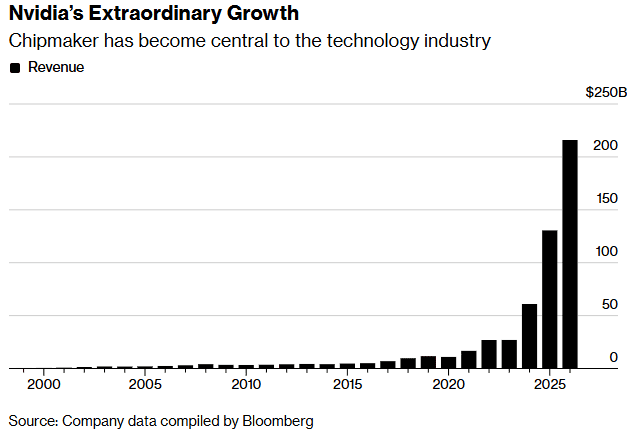
Jensen Huang’s abrupt resignation as Nvidia’s President and CEO on November 12, 2026, creates uncertainty for the world’s leading AI semiconductor company and potentially far-reaching consequences for the artificial intelligence (AI) industry. Huang co-founded Nvidia in 1993 and spent 33 years transforming it from a graphics processor supplier into the dominant provider of accelerated computing platforms powering today’s AI infrastructure buildout. Huang was much more than Nvidia’s CEO. He was the AI industry’s chief cheerleader, dealmaker and ecosystem architect. Through his technological vision, industry relationships, investments and strategic partnerships, he helped establish Nvidia at the center of an extensive network of AI developers, cloud service providers, semiconductor companies and data center operators.
“My management style is what made it possible for the company to grow,” Huang told Bloomberg News’ Emily Chang in a recent interview. “I wanted an organization that was able to adapt to change, both in inventing change for itself and the rest of the industry, as well as reacting to change that’s coming toward us.”
Nvidia’s board appointed longtime CFO Colette Kress as interim CEO while beginning a search for a permanent successor. Although the company says its operations, customer commitments and product roadmap will continue without interruption, the sudden departure of the executive who personally drove much of its strategy raises questions about leadership continuity, customer confidence and the future direction of its AI ecosystem.
Huang’s exit could reverberate across the global tech sector, well past Nvidia’s position as the primary silicon supplier for the AI era. As an active strategic dealmaker, Huang has leveraged the company’s resources to strengthen critical supply chain bottlenecks and back next-generation AI startups. Furthermore, he remains one of the sector’s most visible evangelists, championing accelerated computing and enterprise AI adoption while countering alarmist views on existential safety risks. The most important potential consequence is competitive: uncertainty surrounding Nvidia could encourage customers to accelerate diversification of their AI accelerator suppliers, creating opportunities for AMD, Google’s Tensor Processing Units (TPUs), Broadcom, Cerebras and Huawei’s Ascend AI processors in China.
Nvidia’s Leadership and Ecosystem Advantage:
Nvidia’s competitive position is based on considerably more than the performance of its GPUs. The company has developed an integrated computing platform combining:
- GPU accelerators: High-performance processors designed for parallel computing workloads, including AI model training and inference.
- NVLink and NVSwitch: High-bandwidth interconnect technologies that allow multiple GPUs to operate as tightly coupled computing systems.
- InfiniBand and Spectrum-X Ethernet: Networking platforms connecting large numbers of GPUs across AI data centers via the company’s acquisition of Mellanox (announced March 11, 2019; completed on April 27, 2020).
- CUDA software ecosystem: A programming platform, libraries and development tools that support a large community of AI developers and applications.
- Complete AI computing systems: Integrated combinations of GPUs, CPUs, networking, storage and software designed for large-scale AI infrastructure.
This combination of hardware, networking and software has created substantial customer dependence on Nvidia’s technology. Replacing Nvidia GPUs is not simply a matter of purchasing competing accelerator chips. Customers must also consider software compatibility, application optimization, networking architecture, performance, power consumption and the cost of migrating existing workloads.
Huang was instrumental in building this integrated ecosystem and cultivating the relationships that helped make Nvidia the preferred AI computing platform for many of the industry’s largest customers. His departure raises critical questions about whether the AI industry will continue its unprecedented circular financing deals.
Will Nvidia’s Circular AI Financing Continue Without Jensen Huang?
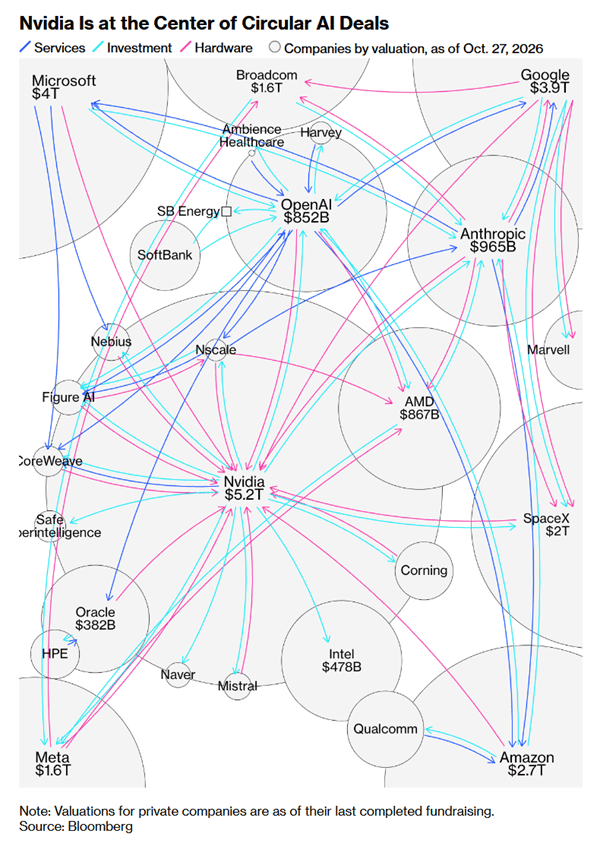
The diagram above shows how Nvidia sits at the center of a complex web of investments, hardware purchases and services relationships. Broadcom is another important participant, but the central question is whether Nvidia’s financing strategy will retain its momentum without Huang, who personally championed the initiative. Nvidia announced in August 2026 that it was partnering with Apollo, BlackRock, Blackstone, Brookfield, Goldman Sachs and KKR to establish financing platforms intended to mobilize more than $500 billion in third-party capital for AI infrastructure. Huang described the initiative as a way to turn AI computing infrastructure into an investable asset class. However, Bloomberg subsequently reported that the initiative had not produced financing deals after months of activity, with some customers and financial partners seeking stronger financial backing from Nvidia. The uncertainty surrounding Huang’s departure therefore raises questions about the initiative’s future.
Will Nvidia’s new leadership maintain Huang’s aggressive approach to financing the AI ecosystem, including investments and financial commitments that help stimulate demand for Nvidia’s own products? Or will the company become more conservative in allocating capital and assuming financial exposure?
The implications extend beyond Nvidia. As the Bloomberg graphic illustrates, AI infrastructure investment increasingly involves interconnected relationships among chip suppliers, cloud providers, AI developers and financial institutions. If Nvidia reduces or restructures its financial commitments, the consequences could affect AI infrastructure deployment, customer purchasing plans and competing semiconductor suppliers. Ultimately, the question is whether the AI industry’s closely interconnected investments and financing model can sustain its momentum without the executive who was its most prominent champion and dealmaker.
…………………………………………………………………………………………………………………………………………………………………………………………………………
Potential Opportunities for Competing AI Chip Suppliers and Platforms:
Jensen’s exit also raises the question if Nvidia can maintain the same pace of technological innovation, strategic deal making and ecosystem development under different leadership? A sudden leadership transition at a company as strategically important as Nvidia could prompt some customers to reassess their dependence on its products. Large cloud providers and AI developers have strong incentives to maintain alternative accelerator platforms, reduce supplier concentration and negotiate more favorable computing costs. Several AI chip competitors warrant particular attention.
1. AMD: Direct Competition in AI GPUs
Advanced Micro Devices (AMD) is Nvidia’s most direct competitor in the market for general-purpose AI GPU accelerators.
AMD’s Instinct accelerator family, supported by its ROCm software ecosystem, offers an alternative platform for AI training and inference. AMD has been working to improve accelerator performance, memory capacity, interconnect capabilities and software compatibility to compete more effectively with Nvidia.
The principal opportunity for AMD is to attract customers seeking a second source of AI accelerators or greater negotiating leverage in purchasing decisions.
However, AMD must demonstrate competitive performance, reliable software support and the ability to deliver complete systems at scale. Nvidia’s established CUDA ecosystem remains a significant competitive advantage.
2. Google: Tensor Processing Units
Google’s Tensor Processing Units are custom-designed application-specific integrated circuits (ASICs) developed to accelerate machine learning workloads.
Unlike general-purpose GPUs, TPUs are designed around Google’s particular AI computing requirements and software environment. They are deployed within Google Cloud and support Google’s own AI models and services, as well as external customers using its cloud infrastructure. Google’s TPU platform provides an alternative to Nvidia GPUs for selected workloads, particularly where customers can optimize their software and applications for Google’s architecture. Google could benefit if customers increasingly seek alternatives to Nvidia’s GPU platform, although its opportunity is primarily tied to its own cloud and AI ecosystem rather than unrestricted sales of standalone accelerators.
4. Broadcom: Custom AI Accelerators and Networking Silicon
Broadcom is arguably one of Nvidia’s most important competitors in the broader AI semiconductor market, although it competes differently from AMD.
Rather than selling general-purpose GPUs, Broadcom specializes in designing custom AI accelerators (ASICs) for hyperscale customers. Its XPU platform combines custom compute silicon, high-speed SerDes, advanced packaging, memory interfaces and networking technologies.
Broadcom’s partnerships with major AI infrastructure customers are particularly significant:
- Google: Broadcom has been a key technology partner in Google’s custom TPU development.
- Meta: Broadcom is collaborating on Meta’s MTIA (Meta Training and Inference Accelerator) custom AI silicon, including a multi-generation deployment roadmap.
- OpenAI: Broadcom and OpenAI announced a collaboration in June 2026 to develop custom AI accelerators optimized for large language model inference, with planned deployment at gigawatt scale.
Broadcom’s competitive significance extends beyond individual chips. Its Ethernet networking and connectivity technologies also support the construction of large-scale AI computing clusters.
As hyperscalers increasingly develop their own AI accelerators to reduce dependence on Nvidia GPUs, Broadcom is positioned to benefit from the shift toward custom silicon.
5. Cerebras Systems: Wafer-Scale AI Computing
Cerebras Systems takes a substantially different architectural approach to AI acceleration.
Its Wafer-Scale Engine (WSE) integrates an exceptionally large number of processing cores, memory and interconnects onto a single silicon wafer. This architecture is designed to reduce communication bottlenecks associated with distributing AI workloads across large numbers of conventional processors.
Cerebras offers integrated AI computing systems rather than simply selling accelerator cards. Its technology targets large-scale AI model training and inference, with particular emphasis on high-throughput, low-latency inference.
Cerebras has attracted significant attention through commercial relationships with major AI developers, including OpenAI.
Although Cerebras does not yet have Nvidia’s breadth of software ecosystem, installed base or general-purpose GPU market presence, its wafer-scale architecture represents a credible alternative for selected AI workloads.
Its potential competitive advantage is architectural differentiation rather than direct replication of Nvidia’s GPU platform.
6. Intel: Gaudi AI Accelerators and Data Center Computing
Intel is another potential competitor, although its position in AI accelerators is less established than AMD’s or Broadcom’s.
Intel’s Gaudi 3 accelerator was designed for generative AI training and inference, featuring high-bandwidth memory and integrated networking capabilities. Intel has promoted Gaudi as an alternative to Nvidia GPUs, emphasizing performance, power efficiency and total cost of ownership.
Intel also brings an extensive data center processor business and established relationships with enterprise customers and server manufacturers.
However, Intel has faced challenges establishing Gaudi as a widely adopted alternative to Nvidia’s dominant GPU platform. Its ability to compete will depend on future accelerator products, software development, customer adoption and execution of its AI semiconductor roadmap.
Intel should therefore be considered a potential challenger rather than an established competitor on the same footing as AMD or Broadcom.
7. Huawei: China’s Domestic AI Accelerator Alternative
Huawei’s Ascend AI processor family is an important alternative for Chinese AI developers and data center operators. U.S. export restrictions have already encouraged China’s domestic semiconductor industry to develop alternatives to advanced Nvidia accelerators. Huawei is positioned to benefit from this trend through its Ascend processors, computing systems and associated software ecosystem.
Huang’s departure could add another element of uncertainty to Nvidia’s long-term position in China. However, Huawei’s opportunity is driven primarily by China’s semiconductor self-sufficiency objectives, domestic procurement policies and U.S. export controls—not simply Nvidia’s leadership transition. Huawei must still address performance, manufacturing capacity, software compatibility and the ability to support large-scale AI deployments.
………………………………………………………………………………………………………………………………………………………………………………
In addition to the above AI chip suppliers, Amazon, Microsoft and Meta hyperscalers are developing their own custom AI accelerators, while Marvell is an important custom-silicon and connectivity supplier.
………………………………………………………………………………………………………………………………………………………………………………
Major AI chip companies and competitive market positioning:
The following table distinguishes companies selling merchant AI accelerators from those developing custom silicon primarily for their own cloud or AI infrastructure.
| Company | AI chip / platform | Niche and technological strengths | Market presence |
|---|---|---|---|
| Nvidia | Blackwell, Rubin GPUs; Grace CPUs | GPU acceleration, CUDA software, NVLink, InfiniBand, Spectrum-X Ethernet; integrated AI factories |
Dominant market leader
Broadest commercial AI accelerator ecosystem |
| AMD | Instinct MI350/MI400; ROCm | General-purpose AI GPUs, HBM, chiplet architecture, open software ecosystem |
Major challenger
Competing for hyperscaler, enterprise and HPC deployments |
| Broadcom | Custom XPUs, networking ASICs | Custom AI accelerators for hyperscalers; high-speed SerDes, Ethernet switching and connectivity |
Major competitor
Important supplier to hyperscalers developing custom AI silicon |
| TPU | Custom ASICs optimized for AI training and inference; tightly integrated with Google Cloud and AI software |
Major alternative
Significant internal deployment and external cloud availability |
|
| Huawei | Ascend processors; Atlas systems | AI accelerators, integrated computing systems and domestic Chinese semiconductor ecosystem |
Major China-market player
Important alternative amid U.S. export restrictions |
| Intel | Gaudi; Xeon | AI accelerators, CPUs, memory and data-center platforms |
Challenger
Established semiconductor presence, but limited AI accelerator traction relative to Nvidia |
| Cerebras Systems | Wafer-Scale Engine (WSE) | Wafer-scale integration, massive on-chip parallelism, high-bandwidth memory and specialized AI inference systems |
Specialist competitor. Differentiated architecture for large AI workloads. Full-year 2026 core revenue outlook of $940 million to $960 million.
|
| Amazon | Trainium, Inferentia | Custom ASICs for AI training and inference; integration with AWS infrastructure |
Significant captive platform
Expanding AWS alternative to Nvidia |
| Microsoft | Maia | Custom AI accelerator architecture for Azure workloads |
Emerging platform
Strategic internal development and deployment |
| Meta | MTIA | Custom accelerators designed for Meta’s recommendation, ranking and generative AI workloads |
Emerging platform
Large internal deployment opportunity |
| Marvell | Custom AI ASICs, optical DSPs, interconnect silicon | Custom compute silicon, high-speed connectivity and optical networking for AI data centers |
Important infrastructure competitor
Benefits from hyperscaler custom silicon investment |
Sources: Frontier Tech Intelligence, ChatGPT
Editor’s Note: Not every company listed above is a direct merchant-chip competitor to Nvidia. Some are building captive platforms, while others supply the technology that enables those platforms.
………………………………………………………………………………………………………………………………………………………………………………
Will Nvidia Customers Diversify Their AI Accelerator Suppliers?
The key question is whether Nvidia’s leadership transition will materially change customer purchasing decisions. Nvidia’s board has expressed confidence in the company’s existing management team and technology roadmap. Colette Kress is an experienced executive who has served as CFO since 2013, and the company has emphasized continuity in its operations and customer commitments. Nevertheless, the loss of Huang’s leadership creates uncertainty that competitors could exploit.
AI infrastructure investments involve long planning cycles, substantial capital expenditures and commitments to particular hardware and software platforms. Customers making multibillion-dollar investments need confidence that their suppliers will maintain technological leadership, product availability, software support and long-term strategic relationships. Consequently, even if Nvidia’s engineering organization and product roadmap remain intact, some customers could accelerate qualification and deployment of competing accelerators.
This would not necessarily mean abandoning Nvidia. A more likely initial response would be supplier diversification, with AMD GPUs, Google TPUs and other specialized accelerators deployed alongside Nvidia systems where technically and economically appropriate. The transition toward multi-vendor AI computing could also increase interest in software portability, open programming frameworks and more interoperable data center architectures.
Conclusions:
Jensen Huang’s resignation does not eliminate Nvidia’s substantial technological advantages, established customer relationships or extensive CUDA software ecosystem. The company retains a strong engineering organization, an experienced executive team and a broad portfolio of AI computing products.
However, Huang’s departure removes the individual who was arguably the most influential executive in the AI infrastructure industry. His combination of technological vision, dealmaking, industry relationships and strategic leadership was central to Nvidia’s rise and its position at the center of the global AI ecosystem. The immediate issue is whether Nvidia’s customers and strategic partners will maintain confidence in the company’s future direction. If uncertainty persists, competitors could benefit as hyperscalers, AI developers and enterprise customers seek greater supplier diversity.
AMD has the clearest opportunity to gain external GPU accelerator business, Google can expand its TPU-based AI computing services, and Huawei has an opportunity to strengthen its position in China’s domestic AI accelerator market.
The ultimate competitive test will not be whether Nvidia can continue selling GPUs without Jensen Huang. It will be whether the company can retain customer confidence, sustain its technology and software leadership, and preserve the strategic ecosystem that he spent 33 years building.
……………………………………………………………………………………………………………………………………………………………………………………………..
Addendum: Two competing approaches to AI-RAN implementation:
1. Nvidia and Nokia: GPU-centric RAN
-
Nvidia and Nokia are promoting GPUs as the computing engine for AI-RAN.
-
Nokia is designing future RAN products around Nvidia GPUs, including execution of demanding Layer 1 (Physical layer) processing functions.
-
The objective is to use accelerated computing for both conventional RAN processing and AI workloads, potentially improving spectral efficiency and enabling shared infrastructure.
- This represents a departure from Nokia’s previous reliance on Marvell custom silicon for Physical layer processing.
2. Ericsson: Custom ASICs and CPU-based vRAN
-
Ericsson favors its own purpose-built ASICs for demanding Layer 1 RAN processing.
-
Its separate virtual RAN strategy uses Intel x86 CPUs for most Layer 1 functions, with hardware acceleration for forward error correction (FEC).
-
Ericsson is also exploring software portability to AMD and Arm-based CPU platforms.
- Ericsson argues that its custom silicon offers cost, performance and technological independence advantages over adopting Nvidia GPUs throughout the RAN.
Marvell deserves particular attention. It was Nokia’s custom silicon partner, and its technology remains relevant to existing Nokia RAN deployments. Even Nokia’s AI-RAN trials with Virgin Media O2 reportedly used Marvell Layer 1 silicon rather than Nvidia GPUs.
Attribution: ChatGPT was used extensively for research, technical analysis, and drafting, including an assessment of competing AI-RAN architectures, Nvidia’s GPU-centric approach with Nokia, and alternative custom-silicon and CPU-based RAN strategies pursued by Ericsson and its technology partners. The author reviewed, revised, and fact-checked all the material and is 100% responsible for its content.
………………………………………………………………………………………………………………………………………………………………………………………………………………………….
References:
https://nvidianews.nvidia.com/news/nvidia-announces-ceo-transition
https://www.sec.gov/Archives/edgar/data/1045810/000104581026000082/nvda-20261111.htm
https://www.reuters.com/business/view-nvidia-ceo-jensen-huang-steps-down-2026-11-12/
https://www.amd.com/en/products/accelerators/instinct/mi350.html
https://rocm.docs.amd.com/en/latest/reference/gpu-arch/mi350.html
https://cloud.google.com/tpu/docs/intro-to-tpu
https://www.broadcom.com/products/ai
https://www.intel.com/content/www/us/en/products/details/processors/ai-accelerators/gaudi.html
https://www.huawei.com/en/technology-insights/industry-insights/outlook/5g
Custom AI Silicon: OpenAI, Anthropic, Hyperscalers, Huawei and the Battle with Nvidia, AMD and Broadcom
Google’s TPU Business Outpaces Rivals as Hyperscalers Accelerate Custom AI Silicon Strategies
2026 OCP Summit: Full-Stack AI Networking Silicon from Nvidia/Cisco and Broadcom; Ethernet vs InfiniBand Interconnects
Huawei’s Ascend Silicon Roadmap Extends From AI Chips to Cluster-Scale Infrastructure
AI-RAN Push: NVIDIA, Nokia, and Operators Drive Towards Distributed Compute Platforms
Cisco’s Silicon One G300 as the dominant AI networking fabric, competing with Broadcom’s Tomahawk 6 series