

Uncategorized
Light Counting: optical transceiver sales surge; IEEE 802.3 and ITU-T optical transport standards explained/UEC addendum
Sales of All Types of Optical Transceivers Set New Records:
Light Counting reports that the sales of optical transceivers, shown in the first figure below, illustrates the new record set in Q2 2026 and estimates for the rest of 2026. Sales of Ethernet transceivers currently account for about 80% of the total market. Shipments of “legacy products”—800G 2xDR4 and 2xFR4, as well as 400ZR/ZR+, were up sharply in Q2, by up to 3x year-over-year in terms of units, well ahead of the market research firm’s expectations. Unit shipments of 100G and 400G Ethernet transceivers also set new records. Even 10G Ethernet was up. Volume shipments of 1.6T Ethernet transceivers and 800ZR/ZR+ are off to a great start this year, but this was less surprising.
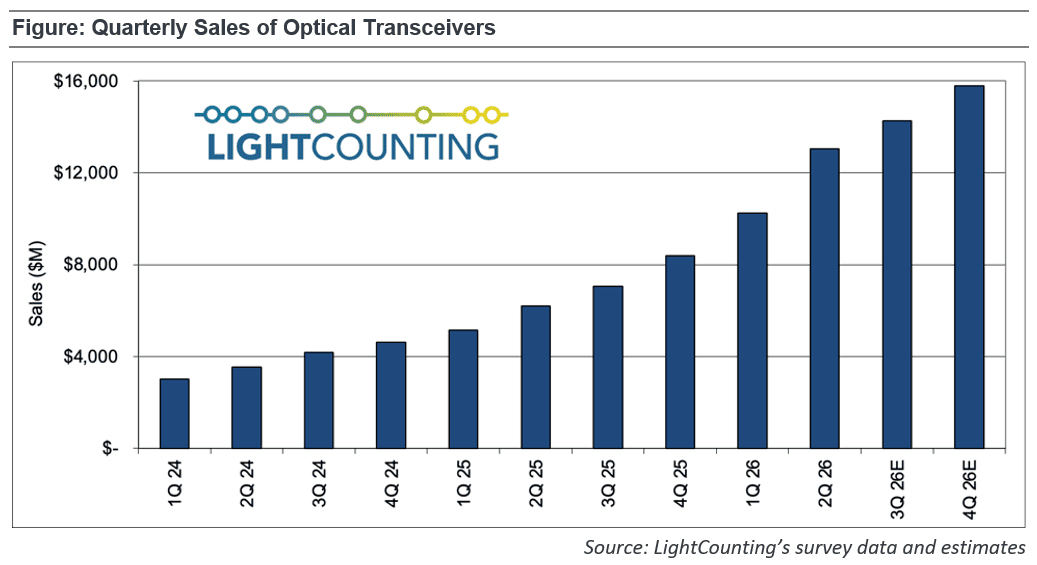
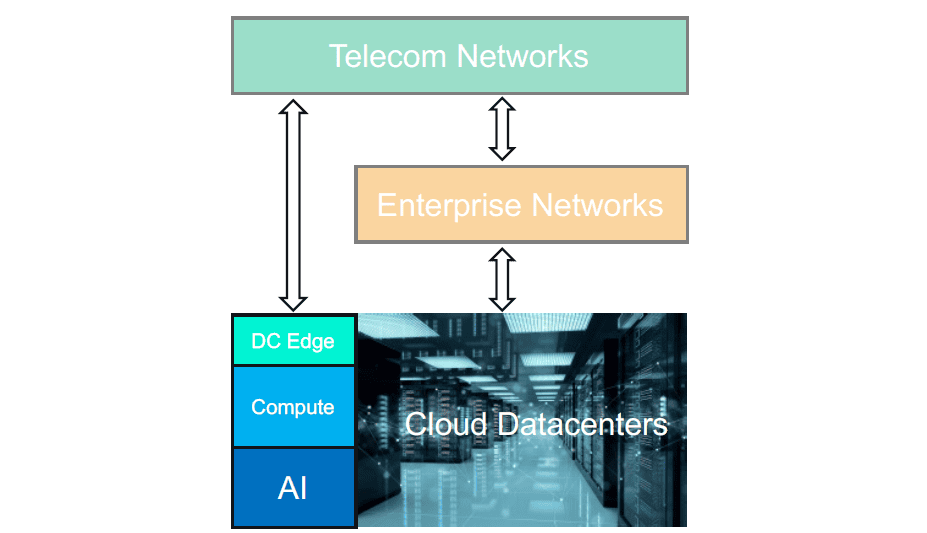
Image Credit: Light Counting
……………………………………………………………………………………………………………………………………………………………………………………………………………………………………………
Leading suppliers of optical transceivers reported record revenues and profits, despite component shortages. Here are Q2-2026 results for the top two suppliers:
- Innolight achieved a record revenue of $3.3 billion in Q2, up 192% year-over-year and up 16% sequentially. The company’s net income was $1.16 billion, up 249% year-over-year and up 40% sequentially. Gross margin increased this quarter, driven by sequential volume growth of 1.6T products.
- Eoptolink reported a record revenue of $1.8 billion in Q2, up 109% year-over-year and up 53% sequentially. The company’s net income was $698 million, up 113% year-over-year and up 74% quarter-over-quarter.
| Supplier | Estimated 2025 Sales / Segment Revenue | Market Context & Performance |
|---|---|---|
| InnoLight Technology | $5.3 Billion | Market Leader (#1); revenue surged 61% year-over-year driven by mass delivery of 800G and 1.6T modules. |
| Eoptolink | $3.5 Billion | Moved to #2 globally; registered an astonishing ~188% segment surge supplying 400G/800G optics to Amazon and Nvidia. |
| Coherent Corp. | ~$4.0 – $4.5 Billion (Data Center & Comm. Segment) | Coherent was overtaken by Eoptolink in pure transceiver rankings, but its broader communications segment generated massive revenues (including a record $1.2 Billion in Q4 2025 alone). |
| Cisco Systems | ~$1.5 – $2.0 Billion (Optical/Acacia) | Cisco captures a massive chunk of the telecom and coherent pluggable market through its internal networking sales and Acacia subsidiary. |
| Lumentum Holdings | ~$1.0 – $1.3 Billion | Reported record revenues and high double-digit growth by the end of 2025, heavily buoyed by their NeoPhotonics integration. |
| Broadcom | ~$800 Million – $1.1 Billion (Modules/Engines) | While Broadcom generates over $18B+ quarterly in overall networking/AI silicon, its specific optical transceiver and co-packaged optical engine sales represent a smaller, premium segment. |
| Accelink Technologies | ~$600 – $800 Million | Maintained a steady footprint setting new shipping records for Chinese domestic cloud providers and 5G operators. |
| Sumitomo Electric | ~$400 – $500 Million | Holds a reliable niche focused primarily on specialized telecom optical components and compact Japanese network infrastructure deployments. |
This demand is being driven primarily by AI data-center build-outs, where the scaling of accelerator clusters requires concurrent investment in compute, switching, optical interconnect, power, and cooling. Ethernet is increasingly central to scale-out fabrics and, in some architectures, to emerging scale-up designs.
The reported growth at leading suppliers illustrates how rapidly demand is propagating through the component supply chain. As note above, Innolight reported nearly 200% year-over-year growth in optical-transceiver sales during the first half of 2026. Such results are consistent with an industry that is simultaneously absorbing high volumes of 800G modules and preparing the supply chain for 1.6T transitions.
Optical Transceiver Standards:
The standards baseline spans both Ethernet and optical transport.
- For intra-data-center connectivity and some point-to-point data-center-interconnect applications, IEEE 802.3df-2024 standardized Ethernet MAC parameters for 800GbE, together with physical-layer and management specifications for 400GbE and 800GbE operation.
- IEEE P802.3dj is developing 200 Gb/s-per-lane electrical and optical interfaces for 200GbE, 400GbE, 800GbE, and 1.6TbE Ethernet operation.
- For carrier optical-transport and WDM applications, ITU-T G.709 defines the OTN digital transport hierarchy and interfaces; ITU-T G.959.1 specifies OTN physical-layer interface application codes; and ITU-T G.698.2 defines single-channel optical-interface parameters for amplified DWDM “black-link” applications.
- A carrier can transport an Ethernet PHY signal directly over a coherent wavelength. The clearest standardized example is OIF 400ZR, which carries a 400GBASE-R host signal transparently over a single coherent DWDM carrier. It is explicitly specified as a 400G BASE-R PHY interface, rather than as a full ITU-T G.709 OTUk line signal.
Optical Ethernet Standards and Product Transition:
The current optical upgrade cycle spans multiple Ethernet (IEEE 802.3) generations:
It is important to distinguish standardized Ethernet interface rates from the broader product roadmap of optical suppliers. IEEE 802.3df standardized 800 GbE, while IEEE P802.3dj addresses 1.6 TbE and the associated 200 Gb/s-per-lane physical-layer ecosystem. By contrast, 2.4T and 3.2T transceiver products may be relevant to future system architectures, but they should not be presented as ratified IEEE Ethernet rates at this stage. Please see the Addendum below for an explanation of he Ultra Ethernet Consortium.
ITU-T OTN and WDM Recommendations:
While IEEE 802.3 specifications define Ethernet MAC and PHY operation, they are not the only standards framework relevant to high-speed optical modules. In optical transport networks, ITU-T Recommendations define the digital transport structure, optical-channel parameters, WDM frequency plans, and interoperable line-side interface requirements. Optical transceivers must meet the requirements of the applicable interface standard (IEEE 802.3 or ITU-T) or implementation agreement for their intended deployment. For intra-data-center Ethernet links, this normally means IEEE 802.3 PHY specifications and applicable MSAs. For OTN, WDM, or carrier interdomain applications, the relevant requirements may additionally include ITU-T G.709, G.959.1, G.698.2, and G.694.1.
- ITU-T G.709 specifies the interfaces and digital hierarchy of the Optical Transport Network (OTN), including optical transport units and associated overhead, forward-error-correction, and multiplexing structures. An Ethernet client signal may therefore be mapped into an OTN container for transport across a metro, regional, long-haul, or subsea optical network.
- ITU-T G.959.1 specifies Optical Transport Network physical-layer interfaces, including interdomain interface requirements for single-channel and multichannel optical systems. Its application codes define parameters such as nominal bit rate, reach class, wavelength range, transmitter characteristics, receiver tolerance, and optical power budgets. The recommendation is intended to enable transverse, or multivendor, compatibility at optical interfaces crossing administrative-domain boundaries; it can also be used for intra-domain interfaces where appropriate. The current G.959.1 edition, issued in 2024 and subsequently amended, includes interfaces relevant to high-speed PAM4-based optical transport applications.
- ITU-T G.698.2 is also relevant where pluggable coherent or direct-detect modules connect into amplified DWDM systems. It specifies single-channel optical-interface parameters for amplified multichannel DWDM applications, using a “black-link” model that defines interoperability at the transmitter-side and receiver-side reference points while allowing the intervening photonic line system to remain implementation-specific. The recommendation addresses metro-oriented amplified DWDM applications and defines channel spacings based on the ITU-T G.694.1 frequency grid. Consequently, an optical transceiver used entirely within a hyperscale data-center Ethernet fabric will typically be specified primarily against IEEE 802.3 PHY requirements and relevant multi-source agreements.
In summary, a coherent pluggable used as a router-to-ROADM, router-to-transponder, or interdomain line-side interface may additionally need to comply with ITU-T OTN and DWDM interface requirements—particularly G.709, G.959.1, G.698.2, and the G.694.1 frequency-grid framework. Compliance depends on the intended application code and reference point, rather than on the module form factor alone.
Standards framing:
A concise way to explain the division of responsibility is as follows:
…………………………………………………………………………………………………………………………………………………………………………………………………………………………………………..
Cloud Capex is Through the Roof:
The magnitude of current cloud capital expenditure is exceptional and is the primary driver for the optical transport market. For example, Oracle, reported $28.5 billion in capital expenditures in its most recent quarter, up 235% year over year, against quarterly revenue of $19.3 billion, up 30%. This illustrates the extent to which an established enterprise-software supplier is being repositioned around AI infrastructure and cloud capacity. See References below for more examples of hyperscaler’s enormous capex.
Chinese hyperscalers are pursuing a similar, if less publicly transparent, investment pattern. Tencent’s capex surged 194% y-o-y in Q2, reaching $7.7 billion, up 68% sequentially. Alibaba’s capex was $9.9 billion for the quarter, up 86% year-over-year and up 156% compared to the previous quarter, used primarily to build AI compute infrastructure. Baidu’s capex for the quarter reached $1.67 billion, surging 219% year‑on‑year and 96% quarter‑on‑quarter. Alibaba and Tencent’s reported capital-expenditure percentage increases greatly exceed their revenue growth, which remained closer to the 15%–20% range. The widening gap between capital intensity and near-term revenue growth is a defining characteristic of the present AI infrastructure cycle.
Nvidia commented that it expects to see another 70% growth in capex of cloud companies for 2027—similar to the growth reported by the TOP 4 Cloud companies in 2026. Nvidia must know this well, since the company is engineering multiple financial projects to support the hyper growth.
Super-cycle, but not in a straight line:
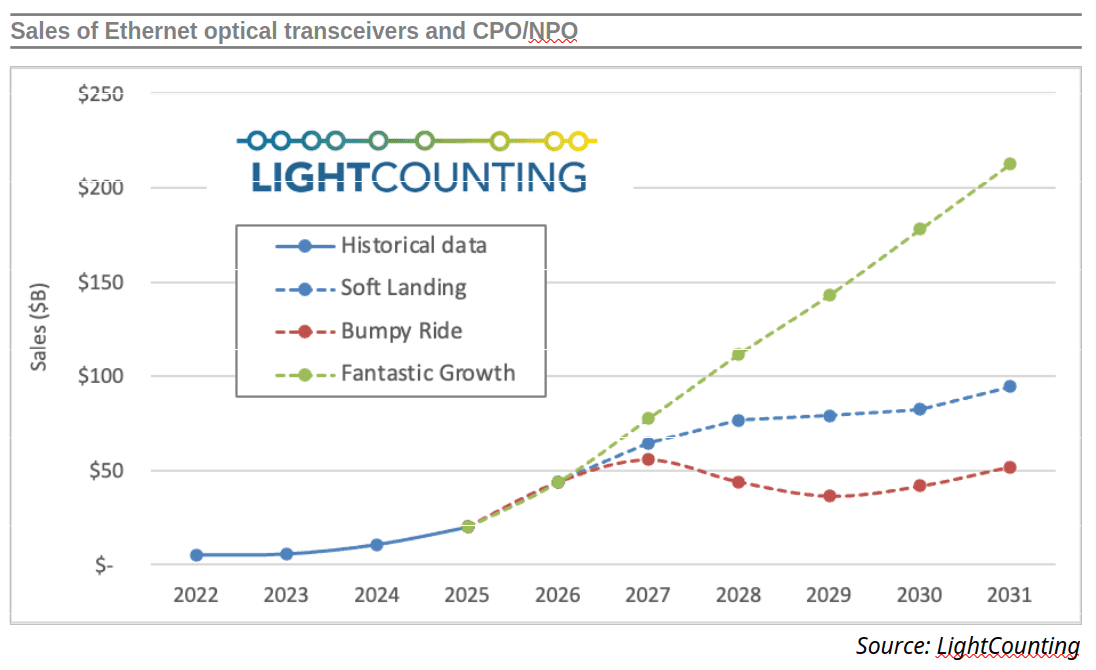
The market is clearly in an optical-interconnect supercycle. However, the present rate of expansion is unlikely to persist indefinitely. Even under a continued high-growth scenario, the forecast assumes that growth moderates from 120% in 2026 to 76% in 2027 and to approximately 20% by 2031.
The base-case forecast adopts a soft-landing assumption: cloud capital expenditure remains strong, but procurement normalizes as the supply chain expands, deployment schedules mature, and customers improve utilization of installed infrastructure. The forecast model assumes a 50% increase in cloud capital expenditure in 2027—below the roughly 70% growth contemplated by the most bullish industry forecasts.
That assumption is deliberately more conservative because optical-component supply chains historically respond aggressively to changes in customer procurement signals. Current conditions already show evidence of this effect: suppliers are expanding capacity and product portfolios rapidly in response to exceptional demand for high-speed pluggable optics.
Historical transceiver sales data from 2004 through 2025 also indicate that the sector is cyclical. Periods of two to three years of strong growth have frequently been followed by flat or declining years as inventory, manufacturing capacity, and end-market deployment plans return to balance. In that context, a soft landing is possible, but a more volatile bumpy-ride scenario—characterized by a supply-chain correction during 2027–2030—remains plausible.
Architecture matters:
The forecast also incorporates a structural counterweight to unit demand: optical-interconnect efficiency is improving. AI-cluster architectures are evolving in ways that can reduce the number of optical transceivers required per accelerator, even as total cluster bandwidth continues to rise.
Several developments are relevant:
-
TPU-based and other tightly integrated accelerator systems can reduce the optical-interconnect requirement per XPU relative to more externally networked cluster designs.
-
Multi-plane network topologies can improve path diversity and bisection bandwidth while reducing the need for redundant interconnect resources in certain deployments.
-
Higher-radix switch silicon enables flatter fabrics, reducing the number of network tiers, hop count, and associated optical interfaces.
-
The transition from 100 Gb/s-per-lane to 200 Gb/s-per-lane signaling—under development in IEEE P802.3dj—raises port density and system bandwidth, but also changes the optics-per-bandwidth relationship.
Accordingly, the relevant demand metric is not simply accelerator count. It is the interaction among accelerator architecture, scale-up versus scale-out topology, switch radix, oversubscription design, optical reach, packaging approach, and the extent to which the deployment uses pluggable optics, linear-drive optics, linear-receive optics, co-packaged optics, or near-packaged optics.
Light Counting Report Scope:
The report covers more than 100 Ethernet optical-interconnect product categories, including:
-
100G, 200G, 400G, 800G, 1.6T, 2.4T, and 3.2T retimed transceivers.
-
Linear pluggable optics and linear-drive/linear-receive optical architectures, including LPO and LRO.
-
Co-packaged optics and near-packaged optics, including CPO and NPO.
-
Products segmented by reach, interface technology, and application.
The market analysis is segmented by end customer into cloud, telecommunications, and enterprise markets. The cloud segment is further divided by customer group—top-five U.S. cloud providers, top-five Chinese cloud providers, and other cloud operators—and by application: conventional cloud and front-end networking, AI scale-out networks, and AI scale-up networks.
Conclusions:
The Ethernet optical transceiver market is benefiting from an AI-driven infrastructure build-out that is materially stronger than expected only six months ago. Yet the same intensity that creates the 2026 upside also increases the risk of a later inventory, capacity, or capital-expenditure correction. The key analytical question for 2027–2031 is no longer whether the market will grow; it is whether the industry can transition from extraordinary demand acceleration to a sustainable deployment cadence without repeating the supply-chain overshoots that have characterized prior optical-networking cycles.
Addendum – The Ultra Ethernet Consortium (UEC):
The UEC is separate from IEEE 802.3, but its work is deliberately built on—and coordinated with—the IEEE Ethernet PHY and MAC ecosystem. UEC is not an IEEE 802.3 task force and does not itself ratify IEEE 802.3 amendments. Instead, it publishes an Ethernet-based AI/HPC networking specification across multiple layers and works with relevant standards-development organizations where changes or formal standardization are needed. UEC uses and extends Ethernet, rather than that UEC defines a separate Ethernet PHY.
Division of responsibility:
How UEC relates to IEEE 802.3:
UEC’s stated premise is an Ethernet-based, open, interoperable stack for AI and HPC. Its work is designed to retain compatibility with the broad Ethernet ecosystem while optimizing behavior above—and in selected optional cases at—the PHY/link boundary. It does not replace IEEE 802.3-defined Ethernet port rates or optical PMDs.ultraethernet+1
That means:
-
IEEE 802.3df supplies the standardized 800GbE Ethernet MAC/PHY foundation.
-
IEEE P802.3dj is developing 200 Gb/s-per-lane electrical and optical interfaces for 200GbE through 1.6TbE operation.
-
UEC defines how AI/HPC systems can use such Ethernet links more effectively: particularly host-to-network interaction, RDMA-oriented transport, congestion control, traffic distribution, reliability behavior, and large-scale fabric operation.ieee802+2
UEC Specification 1.0 was released in June 2025, with Version 1.0.2 published in January 2026. UEC describes the result as a full communications stack, with scope extending from applications and transport through switching, link behavior, optics/cables integration, management, and security. UEC 1.0 is designed to operate with Ethernet-compatible physical-layer technology. It contemplates 100 Gb/s-per-lane and 200 Gb/s-per-lane signaling, which aligns naturally with the industry transitions covered by IEEE 802.3df and P802.3dj. However, UEC does define optional Ethernet PHY and link-layer features, so it is not accurate to say that it has no Layer 1 or Layer 2 relevance whatsoever.
……………………………………………………………………………………………………………………………………………………………………………………………………………..
References:
https://www.lightcounting.com/newsletter/en/september-2026-quarterly-market-update-371
https://www.lightcounting.com/report/september-2026-ethernet-optics-372
Dell’Oro: Data Center capex grew 92% in 2Q-2026 (caveats galore)
Hyperscaler capex > $600 bn in 2026 a 36% increase over 2025 while global spending on cloud infrastructure services skyrockets
Dell’Oro: 2H2026 Data Center Capex to Accelerate due to massive AI Deployments
Alphabet’s 2026 capex forecast soars; Gemini 3 AI model is a huge success
Bain & Co: AI Infrastructure Buildout Will Require $6 Trillion Revenue by 2031 to Support Massive CAPEX
Impact of optical component shortages & bottlenecks explained + Hyperscaler’s CAPEX
Hyperscaler AI Race: Soaring Capex Wipes Out Free Cash Flow; AGI and Digital Gods
How will fiber and equipment vendors meet the increased demand for fiber optics in 2026 due to AI data center buildouts?
Huawei’s Ascend Silicon Roadmap Extends From AI Chips to Cluster-Scale Infrastructure
Note: Perplexity.ai was use to research this article.
……………………………………………………………………………………..
Executive Summary:
Huawei is accelerating development of an indigenous AI-computing platform intended to reduce China’s reliance on U.S.-supplied accelerators, networking technologies, and associated software ecosystems. The effort aligns with the company’s stated strategy of becoming a full-stack supplier of AI-era computing and connectivity infrastructure—rather than primarily a developer of frontier foundation models.
Huawei said it plans to introduce two new Ascend AI accelerators in 2027: the Ascend 960DT in the first quarter and the Ascend 960PR in the third quarter. The company also disclosed a longer product roadmap extending through 2029 and said it has shipped more than 1,000 AI-computing systems to over 370 customers.
A necessary distinction is that Huawei designs its Ascend processors through HiSilicon, its semiconductor-design subsidiary, but does not own or operate leading-edge chip fabrication facilities. Production therefore depends on external foundry, memory, advanced-packaging, and equipment supply chains—areas that remain materially constrained by U.S. export controls and by the capabilities of China’s domestic semiconductor ecosystem. For example, Huawei can’t use TSMC to make its silicon so must rely on Chinese chipmakers.
As per an earlier IEEE Techblog post this week, Guo Ping, chairman of Huawei’s supervisory board, told new employees that Huawei’s objective in computing and communications is to “become Nvidia.” In technical terms, Huawei is not attempting merely to replicate a GPU. It is seeking to assemble an alternative AI-infrastructure stack: Ascend accelerators; Kunpeng general-purpose processors; servers and rack-scale systems; high-speed interconnect; storage; cloud services; and the CANN software environment that must serve, in China, some of the platform role CUDA performs globally for Nvidia.

Visitors tour Huawei’s Ascend AI exhibition booth during a conference last year. Andy Wong/
From accelerator to system architecture:
Huawei’s principal response to a per-device performance gap is system-scale integration. Rather than relying exclusively on the performance of a single accelerator generation, the company is assembling larger clusters of Ascend devices and attempting to improve the efficiency of communication, memory access, workload partitioning, and collective operations across those systems.
This is strategically relevant because training and serving large AI models are increasingly limited not only by floating-point throughput, but also by memory capacity and bandwidth, interconnect latency, bisection bandwidth, power delivery, cooling, and software efficiency. A large accelerator cluster can only approach the behavior of a unified computing resource if its networking and systems software prevent communication overhead from overwhelming the benefits of adding more processors.
Huawei has promoted UnifiedBus as an architectural approach for improving communication among processors, memory, and devices across server and rack boundaries. The underlying objective is familiar to data-center architects: reduce data-movement overhead and make a distributed accelerator cluster behave more like a coherent, programmable system. Whether Huawei can deliver this at scale will depend on achievable latency, bandwidth, congestion control, fault tolerance, topology-aware scheduling, and software maturity—not simply on the number of accelerators installed.
That systems emphasis is consistent with Huawei’s established position in telecom infrastructure. Unlike a pure-play AI-chip supplier, Huawei can combine AI computing with data-center networking, optical transport, IP infrastructure, cloud platforms, mobile networks, and edge-computing systems. The potential differentiator is therefore architectural integration, particularly for AI-RAN, autonomous network operations, edge inference, digital twins, and operator cloud deployments where AI workloads must interact with network telemetry and real-time control functions.
Interconnect and optics matter:
The company is also pursuing near-packaged optics, an approach intended to shorten electrical paths between switching or compute silicon and optical transceivers. In principle, placing optical components close to high-speed silicon can reduce electrical-channel loss and potentially improve energy efficiency as link speeds and port densities rise.
Huawei’s terminology should not be conflated automatically with co-packaged optics. Co-packaged optics generally integrates optical engines and switch or compute ASICs in a common package or closely coupled assembly; near-packaged approaches may retain more physical separation while still reducing copper reach. The key engineering question is not the label, but the extent to which the architecture can deliver lower power per transmitted bit, higher density, manufacturability, serviceability, and operational reliability at scale.
For large AI clusters, the interconnect fabric is increasingly a first-order design constraint. As clusters expand, network performance determines how effectively distributed training workloads can scale. The challenge is particularly acute where a vendor seeks to compensate for lower accelerator performance by deploying more devices: more devices can increase aggregate compute capacity, but they also increase synchronization traffic, power consumption, cabling complexity, failure exposure, and the burden on cluster-management software.
Constraints remain substantial:
Huawei’s roadmap should be assessed as a bid to establish a credible domestic alternative AI platform, not as evidence that it has achieved parity with Nvidia’s highest-end systems. Its Ascend roadmap faces several interdependent constraints:
-
Advanced fabrication remains dependent on external foundry capacity and equipment availability, even though HiSilicon can design sophisticated processors.
-
High-bandwidth memory availability, yield, packaging capability, and supply-chain scale can materially affect system output and performance.
-
Cluster-level competitiveness depends on interconnect bandwidth, latency, memory architecture, power efficiency, and the ability to operate reliably at very large scale.
-
CANN must attract developers, framework integrations, tools, libraries, and application vendors in an ecosystem where CUDA remains deeply embedded.
-
Customer adoption will depend on total cost of ownership, application portability, model performance, support quality, and availability of hardware at predictable volumes.
The strategic rationale is nonetheless clear. Export controls have increased the value of a domestically supplied AI-computing stack, even if individual components or systems lag the frontier in some metrics. As Huawei rotating chairman Eric Xu put it, the company’s concern is not only whether it can access the most advanced technology, but whether it can avoid strategic dependence on supply decisions made elsewhere.
For telecom operators, the central issue is whether Huawei can turn this silicon-and-systems program into deployable AI infrastructure for network operations. A credible offering would require more than Ascend processors. It would require validated reference architectures for AI-RAN and telco cloud, high-performance east-west networking, operational automation, observability, model lifecycle management, security controls, and a software ecosystem that can support carrier-grade availability.
Huawei’s advantage is that it already participates across many of those domains. Its challenge is proving that the integrated stack can deliver competitive performance, efficiency, ecosystem breadth, and supply assurance under sustained technology restrictions. That is the practical test of its ambition to become China’s Nvidia-equivalent in AI infrastructure.
……………………………………………………………………………………………………………………………………………………………..
References:
https://www.wsj.com/tech/ai/huaweis-plan-to-become-chinas-nvidia-8af8d8a1 [paywall]
https://www.wsj.com/tech/chinas-huawei-develops-new-ai-chip-seeking-to-match-nvidia-8166f606 [paywall]
Huawei Chairman: Strategic Focus on AI Computing & Connectivity Infrastructure
Huawei unveils AI Centric Network roadmap, U6 GHz products, 5G Advanced strategy and SuperPoD cluster computing platforms
Key take-aways: “16th Smart City and Intelligent Economy Expo” for Huawei, Alibaba & China’s three state backed carriers
Omdia’s 2025 Mobile Core Network Leaders: Huawei #1 in market share; Nokia #1 for portfolio competitiveness
Analysis: Huawei”s upgraded Xinghe Intelligent Network Solution for South Africa
Huawei’s AI-Centric Network Vision: Six Imperatives for the Next Decade; Critical Questions for IEEE Techblog Community
Huawei FY2025: 2.2% YoY revenue increase; strategic pivot to AI and intelligent automotive solutions
Huawei, Qualcomm, Samsung, and Ericsson Leading Patent Race in $15 Billion 5G Licensing Market
Huawei Cloud Review and Global Sales Partner Policies for 2026
Huawei’s Electric Vehicle Charging Technology & Top 10 Charging Trends
Huawei to Double Output of Ascend AI chips in 2026; OpenAI orders HBM chips from SK Hynix & Samsung for Stargate UAE project
4.8 GHz to 4.9 GHz frequency band uses & Verizon Wireless experimental license for testing ISAC with Ericsson
Introduction:
The 4.8 GHz to 4.9 GHz frequency band is a critical slice of mid-band spectrum located within the larger IEEE C-band (4.0 to 8.0 GHz) and the ITU Ultra High Frequency (UHF)/Super High Frequency (SHF) boundary. It is currently used primarily for public safety operations (especially the 4.9 GHz portion allocated to FirstNet for drone control and crisis response) and select 5G deployments (part of 3GPP 5G NR Sub-6 GHz Band n79 in parts of Asia). It is extensively deployed for commercial 5G networks across Asia (such as China and Japan) and Europe, while in the United States, it is being studied for repurposing and testing advanced 5G/6G integrated sensing and communication (ISAC). Finally, it is actively being studied for future 5G-Advanced and 6G mobile broadband and sensing use cases.
Executive Summary:
| Region / Country | 5G Spectrum Range | Mid-Band Status |
|---|---|---|
| China | 4.8 GHz – 4.9 GHz (and 3.3–3.6 GHz) | Actively deployed for 5G NR Band n79 |
| Japan | 3.6–4.1 GHz & 4.5–4.9 GHz | Allocated to major carriers (e.g., NTT Docomo) |
| United States | 4.4 GHz – 4.94 GHz | Historically Federal/Military; currently under review for commercial 5G/6G |
- Favorable Propagation: It provides a strong balance between coverage area and high data throughput (bandwidth). [1]
- Capacity: This frequency handles heavy data loads—like high-definition real-time video streaming—much better than lower bands (like 700 MHz). [1]
- Indoor Penetration: It experiences higher atmospheric and structural attenuation compared to 2.4 GHz or 3.5 GHz, meaning it requires denser small-cell deployments for deep indoor coverage
Verizon’s Experimental License for the 4.8GHz-4.9GHz Band:
Verizon Wireless (under the company name Cellco Partnership) has applied to the FCC for an experimental license to use the 4.8GHz-4.9GHz band in and around its lab in Los Angeles, California. Verizon Wireless’s request is temporary, expiring one year from grant. The application is pending approval, but the license is expected to be granted soon, according to Steve Crowley.
Verizon said, “this experimental authorization is necessary to test Ericsson software and hardware in a noncommercial environment. Verizon Wireless requests this authorization to demonstrate 5G advanced technology use cases such as object sensing as a precursor to 6G Integrated Sensing and Communication (ISAC). This work will facilitate the adoption of use cases across commercial, public safety, and defense sectors.”
Grant of the experimental authorization will allow Verizon Wireless to set up hardware radiating in 4.8-4.9 GHz as part of a private network not connected to commercial operators. The radios are certified for use under 47 C.F.R. Part 27 and Part 96. The testing will be conducted using varying bandwidths to allow for range, resolution, and confidence assessments. Testing will occur outdoors and all transmissions will be controlled at the locations provided in the application. The fixed base stations will employ directional antennas and will have a maximum antenna elevation as described in the application. The base station antenna has a half-power beam width of approximately 24º vertically and 65º horizontally.
Verizon Wireless is unable to determine the incumbent users in the 4.8-4.9 GHz band. Verizon Wireless will coordinate with the incumbents once the FCC and NTIA have provided the agencies impacted, and prior to commencing testing, to avoid any potential disruptions to their operations. If incumbent licensees experience interference, Verizon Wireless will cease interfering operations.
Verizon is one of the first companies to apply for a test license in 4.4GHz specifically for 6G-related trials, according to Crowley. He noted it is also first time the carrier has requested a test license in any of the frequencies under study, which include 1.6GHz, 2.7GHz, 4.4GHz and 7GHz.
Other Entities Pursuing the 4GHz Band:
Samsung Research America requested an experimental license this month to use 4720MHz-4820MHz in Plano, Texas, but its application did not specify use cases to be tested.
The 4.8GHz-4.9GHz spectrum falls within the so-called 4.4GHz band (4400MHz-4940MHz) that the NTIA has identified for study to repurpose for commercial licensed use as part of the U.S. plan to make more frequencies available for 5G and 6G.
The CTIA refers to the band as 4GHz, rather than 4.4GHz. The group published a report this week to make an economic and technical case for the “prime midband spectrum” and urged policymakers to move quickly on studies this fall. They described 4GHz as the “a cornerstone” of the US spectrum pipeline, along with upper C-band, 2.7GHz and 7GHz, because it offers potential 400MHz of bandwidth and already has some equipment and device support. Further, it is a “compelling alternative” to China’s push for licensed use of the 6GHz band in spectrum negotiations at ITU World Radiocommunication Conference 2027 (ITU WRC-27).
Will It Be Used for 6G?
- International Consideration: The ITU-R and organizations like Nokia are studying the 4.4–4.8 GHz and neighboring ranges as potential mid-band spectrum for future IMT-2030 (6G) services. There are several ongoing compatibility studies in ITU-R WP 5d between terrestrial, maritime and satellite use of this band. They are in preparation for ITU WRC-27 which will specify IMT 2030 (6G) frequencies.
- Industry Support: Industry groups like the CTIA advocate for the broader 4 GHz mid-band range as a prime, lower-risk spectrum for wide-area mobile capacity to bridge 5G-Advanced and early 6G rollouts.
- Global Hurdles: Formal decisions regarding international mobile allocation for this band will be evaluated globally at the ITU-R World Radiocommunication Conference (WRC-27), though support varies by region due to existing incumbent and defense users.
-
Verizon added nine new members to its 6G Innovation Forum this week and signaled intent to test more use cases in the areas of ISAC, digital twins, robotics, AI and wearables. The new members are Amazon Web Services (AWS), Cisco, Intel, Keysight Technologies, MediaTek, Nvidia, Palo Alto Networks, Rohde & Schwarz and Viavi Solutions. They join founding members Ericsson, Samsung, Nokia, Meta and Qualcomm Technologies.
References:
https://x.com/StevenJCrowley/status/2097450891444142433
https://apps.fcc.gov/els/GetAtt.html?id=412698&x=
https://www.lightreading.com/6g/verizon-seeks-fcc-approval-to-test-6g-use-cases-in-4ghz
https://urgentcomm.com/network-tech/an-introduction-to-4-9-ghz
ETSI Integrated Sensing and Communications ISG targets 6G
Key take-aways: “16th Smart City and Intelligent Economy Expo” for Huawei, Alibaba & China’s three state backed carriers
Analysis: Cohere’s $28M U.S. DoD FutureG ISAC contract; OTFS vs OFDM; 6G-NR/IMT 2030 RIT standards outlook
3GPP approves timelines for Release 21 which will specify 6G RAN, Core and 5G Advanced
After Bell Labs: Telecom Industry Funds Only a Fraction of the Innovation Needed
Many telecom analysts have noted former Bell Labs CTO and President Marcus Weldon scathing linkedin post, sharply criticizing deep staff cuts and warnings of “erasure” at the iconic research division. Weldon said he believes Bell Labs staffing has been cut to nearly half of the 1,200 strong workforce that was in place during his tenure (2013-to-2021). While he acknowledged that restructuring could account for some of those changes, he argued a 50% reduction in force in five years “is both shocking and unprecedented.”
An unidentified Nokia spokesperson told Fierce that Bell Labs “remains a deeply important part of Nokia, with a long track record of turning world-class research into technologies that deliver commercial impact and move our industry forward.” However, the company acknowledged that the hundred-year-old Bell Labs is “entering a new chapter.”
It’s important to recognize that Bell Labs is not the only big research house that’s disappeared. There’s also Bellcore/Telcordia, Nortel Networks R&D (Bay Street Labs), Xerox PARC, HP Labs, Telco labs (e.g. Pac Bell/SBC, Ameritech, Bell South, Bell Northern Research, GTE Labs, Sprint Labs, and many more).
Meanwhile, telecom analyst Sebastian Barros states “the $1.3 trillion telecom industry is funding only a fraction of the innovation it will need for whatever comes after 6G.” It appears to us that the industry’s economic model is badly failing to fund future innovation needed for growth.

Image Credit: Sebastian Barros
………………………………………………………………………………………………………………………………………………………………………………………………
Our Analysis:
The core problem — R&D was outsourced and never replaced. After the 1984 Bell System breakup and liberalization in Europe and Asia, operators pivoted to customers, spectrum, deployment, and operations, while Ericsson, Nokia, Huawei, Qualcomm, ZTE, Samsung, and a long tail of suppliers took over most technology development. Operators became buyers of innovation rather than creators of it.
The Bell Labs model that produced the transistor, information theory, Unix, and modern AI is gone. That institution ran on an economic engine that no longer exists: in 1974 AT&T booked about 1.4% of US GDP, with Bell Labs alone spending roughly 2% of revenue on nonmilitary R&D — over four cents of every AT&T dollar. That stable, massive funding let researchers pursue problems that wouldn’t become products for fifteen years. Expecting a vendor like Nokia (€19.9B annual sales) to recreate that under today’s competitive economics ignores the financial logic of modern telecom. The contraction is visible: Marcus Weldon estimates Bell Labs research staff has fallen from over 1,200 to roughly 600 since he left the labs.
The industry is capex-heavy but R&D-light. Telecom invests more in capital expenditures than almost any other sector — over $350 billion per year — yet only the top 10 technology providers collectively spend around $50 billion annually on R&D. The capex money flows into deploying networks, not inventing or researching new technologies.
–>Yet in 2025, Huawei invested $27.5 billion in R&D. That was ~22% of its total revenue for that year.
The next cycle looks even more disciplined. Analysts expect 6G RAN capex to ramp only toward the end of the decade, with cumulative 6G RAN revenue in the first six years projected 10–20% lower than the comparable 5G period. Nearly 400 organizations are investing in 6G R&D, but venture-backed startups barely participate in a material way, leaving innovation concentrated among incumbents.
The takeaway: a $1.3 trillion industry funds only a fraction of the innovation it needs because its institutional R&D engine was dismantled decades ago and never rebuilt — operators spend on capex, vendors own the R&D, and the pipeline of disruptive new entrants is thin. That’s why “whatever comes after 6G” may arrive with far less foundational research behind it than the generations that preceded it.
Telecom Capex vs. AI Hyperscaler Capex:
The headline shift is quite stark. In 2026, the AI hyperscalers alone are on track to outspend the entire global telecom industry on capital investment — roughly doubling their own 2025 figures while telecom capex flattens or edges down. Here are the numbers side by side:
-
Hyperscalers are sprinting. Amazon alone plans ~$200B in 2026 capex (up from ~$125–132B), Alphabet $175–185B, Meta $115–135B, Microsoft $110–120B, and Oracle ~$50B. The vast majority goes to AI compute, data centers, and networking.
-
Telecom is grinding. Analysts see global operator capex edging down slightly by 2026, with spending holding near 20% of sales as fiber completion and 5G Standalone upgrades wind down. US telco capex was $80.5B in 2024.
-
Capital intensity is extreme. 2026 hyperscaler capex runs at roughly 86% of revenue for Oracle, 54% for Meta, and 46–47% for Microsoft and Alphabet.
Why this matters for the Barros argument: This is the flip side of the underinvestment thesis. Hyperscalers are channeling unprecedented capital into AI infrastructure — funded increasingly by debt, with incremental borrowing as a share of hyperscaler capex rising from ~9% in FY-2024 to ~32% by mid-2026 — while telecom operators, the sector that historically built the networks, are cutting back. The investment gravity has shifted from connectivity infrastructure to AI models andcompute, which is exactly why a $1.3 trillion industry funds only a fraction of the innovation it will need after 6G.
References:
https://sebastianbarros.substack.com/p/telecom-is-massively-underinvesting
https://www.fierce-network.com/wireless/nokia-defends-bell-labs-future-after-ex-chief-blasts-cuts
Dell’Oro: 6G RAN Capex to reach $500 billion by 2034 + Counterpoint
Dell’Oro: 2H2026 Data Center Capex to Accelerate due to massive AI Deployments
Hyperscaler AI Race: Soaring Capex Wipes Out Free Cash Flow; AGI and Digital Gods
China’s state owned telcos slash CAPEX to the lowest in decades!
Dell’Oro: Global telecom CAPEX declined 10% YoY in 1st half of 2024
Nvidia CEO Huang: AI is the largest infrastructure buildout in human history; AI Data Center CAPEX will generate new revenue streams for operators
Ericsson and MediaTek Demonstrate 3GPP-Based GNSS RTK Positioning with Sub-30cm Accuracy Over a Commercial 5G Network
Ericsson and MediaTek have completed a world-first end-to-end demonstration of high-precision outdoor positioning over a commercial 5G network, using standardized 3GPP Global Navigation Satellite Systems (GNSS) Real-Time Kinematic (RTK) assistance. The trial achieved stable outdoor positioning accuracy below 30 cm using a handset’s integrated antenna, demonstrating a scalable path to decimeter-level positioning without proprietary positioning infrastructure or dedicated external GNSS hardware.
The demonstration validates how 5G networks can distribute GNSS RTK correction information efficiently to devices for industrial automation, autonomous mobility, drones, robotics, and other applications requiring reliable, mission-critical location awareness.
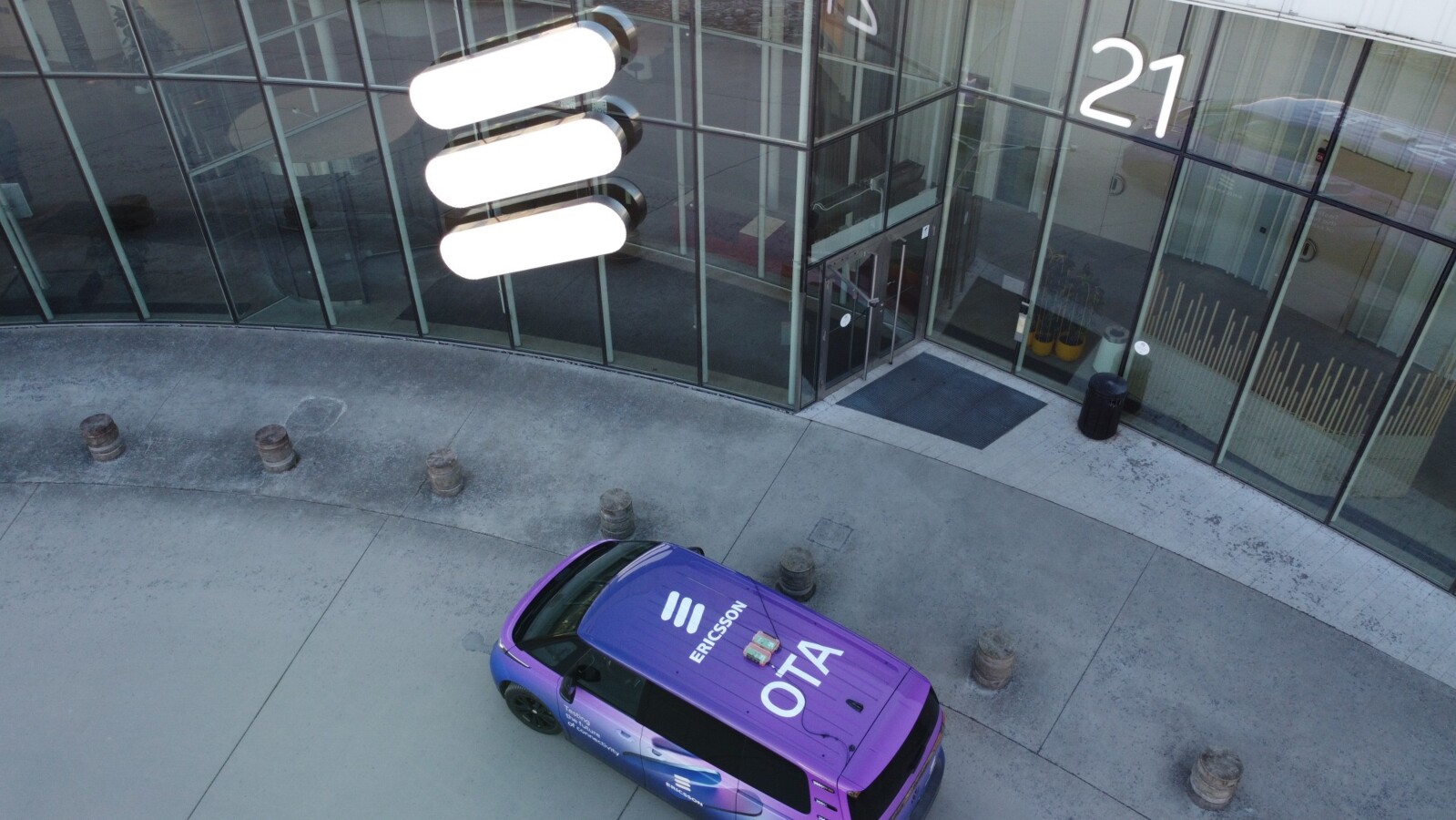
Image courtesy of Ericsson
………………………………………………………………………………………………………………………………………………………………………………………………………………………
Technical highlights:
-
Sub-30 cm positioning performance: The device achieved stable outdoor accuracy below 30 cm with its built-in antenna. With a geodetic-grade GNSS antenna, the same RTK approach can support centimeter-class positioning performance.
-
3GPP-standardized architecture: The solution uses capabilities specified in 3GPP Release 16 for GNSS positioning assistance, enabling an interoperable architecture across compatible networks, positioning servers, chipsets, and devices.
-
End-to-end unicast and broadcast validation: Both delivery modes were demonstrated end to end:
-
Unicast GNSS RTK: LPP assistance messages are delivered through Secure User Plane Location (SUPL) over standard IP connectivity, enabling targeted delivery to individual UEs.
-
Broadcast GNSS RTK: RTK assistance data is transmitted through Positioning System Information Blocks (PosSIBs), allowing common assistance information to be delivered simultaneously to all capable devices within a cell.
-
-
Efficient scaling model: Broadcast delivery can reduce repeated transmission of identical RTK correction data in high-density areas, while unicast can be used for lower-traffic scenarios, individualized service handling, or LTE-connected devices. This supports flexible selection of the most efficient assistance-delivery method based on coverage, device population, and radio-resource conditions.
-
Secured broadcast operation: While broadcast information is radio-accessible to devices in the coverage area, 3GPP mechanisms support encrypted positioning assistance. Authorized subscribers obtain the required decryption material through the 5G Core, including the Access and Mobility Management Function (AMF), protecting access to premium high-precision positioning services.
GNSS correction support:
The trial supports two standardized GNSS correction-data models:
-
Observation State Representation (OSR): Provides corrections derived for a specific receiver or location context, including GNSS observation-related corrections.
-
State Space Representation (SSR): Delivers correction parameters associated with GNSS satellite orbit, clock, bias, and atmospheric error states. SSR is particularly suitable for scalable service delivery because the common state information can be applied by many devices across a service area.
In both cases, the UE applies the received RTK assistance in real time to mitigate satellite, orbital, clock, ionospheric, tropospheric, and other GNSS error sources that limit conventional standalone GNSS accuracy.
Network and device implementation:
The test used Ericsson’s 5G Core, Ericsson Network Location (ENL), Ericsson 5G Advanced Location Services, and Ericsson RAN to generate, manage, and distribute OSR and SSR correction information through the mobile network. MediaTek validated the device side using its latest 5G modem technology with integrated GNSS capability, including real-time processing of advanced GNSS correction data with power-optimized implementation.
“This is a milestone for the 5G ecosystem,” said Johan Hultell, Head of Product RAN Software at Ericsson. “Together with MediaTek, we make high-precision location more accessible to device makers and enterprises, accelerating use in manufacturing, transport and beyond.”
Dr. HC Hwang, General Manager of Wireless Communication Systems and Partnerships at MediaTek, added: “The collaboration with Ericsson demonstrates how 5G Advanced technology can unlock new value for consumers and enterprises alike. Our modems with integrated GNSS are ready to support these advanced positioning services, paving the way for the next generation of intelligent devices.”
Technology backgrounder:
Conventional standalone GNSS typically provides positioning accuracy in the range of several meters. RTK improves this performance by using measurements from accurately surveyed reference stations to generate correction assistance. In the 3GPP architecture, this assistance is delivered through the cellular network using LPP-based positioning procedures and, where applicable, broadcast system information.
By standardizing the delivery of GNSS RTK assistance over 4G and 5G networks, operators can offer high-precision location capabilities at network scale. This creates a standards-based foundation for digitalized industrial operations, autonomous systems, intelligent transportation, asset tracking, and spatially aware consumer devices.
Accuracy to within tens of centimeters is a significant improvement compared to traditional GNSS, which is accurate to within several meters, and therefore paves the way for more advanced use cases. These include the safe operation of autonomous vehicles, drones and industrial robots in complex outdoor environments, Ericsson said. Complex environments encompasses places like factories, logistics hubs, ports, and mines etc.
…………………………………………………………………………………………………………………………………………………………………………………………………………………………………………
References:
https://www.ericsson.com/en/news/2026/8/ericsson-and-mediatek-raise-the-bar-for-location-accuracy
https://www.telecoms.com/5g-6g/ericsson-and-mediatek-put-precise-5g-positioning-through-its-paces
MediaTek overtakes Qualcomm in 5G smartphone chip market
MediaTek will use TSMC to make its Dimensity SoC’s in 2024
AT&T’s 600 MHz Deployment with Ericsson: Turning Low-Band Spectrum Into Coverage and Uplink Capacity
AT&T/Ericsson Demonstrate 5G-Based ISAC for Drone Detection at World Cup Stadium
Ericsson leads SK Telecom AI RAN vs. NVIDIA’s GPU centric AI RAN Alliance
AI-RAN and Agentic AI get real: Ericsson, Nokia, Verizon & other operators enter into a new network automation era
Analysis: Ericsson’s leading role in French INTENTION 6G project
Telefónica incorporates AI for businesses voice communications vs. 3GPP/ITU specifications
Executive Summary:
Telefónica España made an announcement this week which indicates that Voice could be an important AI monetization opportunity for telcos. The Spain based telecom group is positioning its business voice portfolio around a key differentiator: the ability to embed AI-enabled capabilities directly into conventional fixed and mobile telephony, without requiring enterprises to migrate users or workflows to a separate communications platform. It is incorporating generative AI features into its network for things like call transcription and summarization, which it says is will transform “every voice conversation into usable, structured and actionable information,” as week as virtual assistants on fixed-line and mobile.
Targeted at large enterprises, public-sector organizations, and mid-sized businesses, the enhanced portfolio is intended to shorten call-response times, increase the proportion of calls handled, and convert voice interactions into structured, actionable business information. Telefónica reports that the AI-enabled tools can reduce time spent managing calls by an average of 60%, enabling organizations to handle a higher volume of customer interactions.
Telefónica has integrated artificial intelligence across its business voice offerings—from basic mobile services to advanced PBX and cloud-based telephony platforms—as part of its evolution toward intelligent voice communications. The proposal incorporates generative-AI functions within the Telefónica network, including call transcription, automated summarization, and virtual-agent capabilities. These functions are designed to preserve information that might otherwise remain unstructured within voice conversations, while helping organizations reduce missed opportunities and improve operational responsiveness.
Javier Pascual, Director of Product, Pre-sales and Provisioning at Telefónica Spain, said:
“We are the only operator that offers intelligent transcription and summarization of calls over fixed and mobile voice, making us the best way for companies to access digital technologies. This pioneering solution, which integrates generative AI into standard telephony, allows our clients to summarize and transcribe calls, as well as integrate 100% of virtual agents using natural language, thus improving productivity and agility.”

Cross-Portfolio Intelligent Voice:
Telefónica’s approach spans enterprise, public-administration, corporate-mobile, and mid-market customer segments. It applies to traditional and cloud-based voice solutions, including:
-
Centrex IP, Telefónica’s converged fixed-mobile business voice platform.
-
Centrex 365, a Microsoft-based cloud voice offering integrated with collaboration tools.
-
Enterprise mobile voice services.
A core capability is AI-based transcription and summarization of calls. By transforming voice conversations into searchable and structured records, the feature can support knowledge capture, customer-service follow-up, compliance-related documentation, and analytics workflows.
The company is also introducing Centrex AI, a virtual-agent capability based on advanced language models. Centrex AI is designed to support next-generation generative-AI interactions across channels beyond voice and to integrate with customer business applications. The virtual agents are intended to interpret natural-language requests in context, automate repetitive interactions, and provide faster, more consistent responses.
Telefónica states that the platform supports more than 100 languages and can operate continuously, enabling 24/7 multilingual customer engagement.
Operational and Vertical Use Cases:
Telefónica reports that the AI-enabled capabilities can improve agent efficiency by as much as 60% by reducing time devoted to repetitive tasks. The company also cites potential increases of more than 10% in the number of interactions managed, reflecting improved call-handling capacity.
Initial use cases focus on healthcare, public administration, retail, and industrial enterprises:
-
In healthcare, a WhatsApp-based AI agent can schedule appointments, provide immediate confirmations, and support multilingual exchanges.
-
For municipal governments, voice agents can address common citizen queries in multiple languages and route calls to the appropriate department.
-
For automotive dealerships, virtual agents can help manage service appointments and customer inquiries related to vehicle sales.
By integrating generative AI functions into the existing voice network and service portfolio, Telefónica is seeking to extend intelligent automation to established telephony environments rather than treating AI communications as a standalone application layer.
…………………………………………………………………………………………………………………………………….
Editorial Analysis:
Telefónica’s offer as an operator-integrated, proprietary AI overlay on existing fixed/mobile and cloud voice services, rather than as a service defined by 3GPP or ITU. The business voice offering builds on standardized fixed/mobile voice and cloud-telephony foundations, while its generative-AI functions—call transcription, summarization, and virtual-agent integration—appear to be operator- and vendor-implemented capabilities. Current 3GPP work provides enabling mechanisms for AI/ML in 5G systems, whereas ITU-R’s AI-related IMT work addresses radio-network evolution rather than AI-enhanced enterprise telephony.3GPP.
Relevant 3GPP specifications:
3GPP’s AI/ML work is primarily focused on network and RAN optimization, AI/ML model transfer and lifecycle management, data collection, and interoperability. Notably, 3GPP has stated that it does not plan to standardize the AI/ML models themselves; it instead standardizes the supporting mechanisms and controls.3gpp
ITU-R versus ITU-T:
ITU-R: There are no ITU-R Recommendations specifically governing AI-based telephony, generative-AI call summarization, or virtual agents. This is consistent with ITU-R’s mission: spectrum, radio propagation, and IMT radio-interface frameworks. Its IMT-2030/6G work includes integrated AI and communication as a broad capability area, but that concerns wireless-system capabilities such as distributed training and inference—not enterprise voice-service features.
ITU-T: This is the more relevant ITU sector for AI telephony and conversational AI, although its work is still largely horizontal rather than specific to IMS/PSTN calling:
-
ITU-T F.748.46 (2025) specifies requirements and evaluation methods for AI agents based on large-scale pre-trained models. Its scope includes recognition, comprehension, dialogue, generation, and reasoning—capabilities directly relevant to virtual voice agents.
-
ITU-T E.AIQ, Framework for quality evaluation of conversational AI systems, is under study in Study Group 12. It proposes KPIs and an “AI Quotient” approach for assessing AI systems in relation to QoS and QoE.itu
-
ITU-T Y.3178 defines a functional framework for AI-based network-service provisioning in future networks.itu
-
ITU-T Y.3661 (2025) specifies an architecture and mechanisms for customer-oriented intelligent network operation, including AI-supported recognition of user intent; this is adjacent to, but not a telephony-service specification
References:
Telefónica incorpora la IA a todas sus comunicaciones de voz para empresas
https://www.telecoms.com/ai/telef-nica-upgrades-business-voice-services-with-integrated-ai
Vodafone Spain (Zegona), MasOrange and Telefonica in possible RANco joint venture
Telefónica and Nokia partner to boost use of 5G SA network APIs
Ericsson and O2 Telefónica demo Europe’s 1st Cloud RAN 5G mmWave FWA use case
Telefónica launches 5G SA in >700 towns and cities in Spain
Telefónica and Nokia partner to boost use of 5G SA network APIs
Enable-6G: Yet another 6G R&D effort spearheaded by Telefónica de España
Dell’Oro: Enterprise PON Deployments expected to increase 844% year-over-year
According to a new Dell’Oro Group report, “PON in the Data Center and Premise Advanced Research Report“ recently published, total 2026 Data Center PON equipment revenues are expected to increase 844% year-over-year (Y/Y), driven by hyperscalers looking to use the point-to-multipoint technologies to reduce the cabling and power consumption requirements of their out-of-band management networks.
“PON technologies are increasingly moving from traditional residential networks to enterprise and data center applications, providing additional growth opportunities for PON equipment providers,” said Jeff Heynen, Vice President of Broadband Access and Home Networking market research at Dell’Oro Group. “We see hyperscalers and enterprises, both large and small, increasingly deploying PON technologies for passive fiber distribution that is lower cost and that maintains its value far longer than traditional copper infrastructure,” added Heynen.
Additional highlights from the PON in the Data Center and Premise Advanced Research Report:
- Total cumulative spending on data center PON equipment from 2026 to 2030 is expected to exceed $3 billion, as hyperscalers, neocloud providers, and colocation providers all deploy PON for their out-of-band and infrastructure management networks.
- Enterprises are increasingly deploying Passive Optical LAN (POL) as the long-term benefits of increased speeds and lower operational costs outweigh the costs of deploying fiber in the building.
- Chinese operators continue to deploy tens of millions of master and subtended ONTs to deliver fiber-to-the-room (FTTR) services to their residential broadband customers.
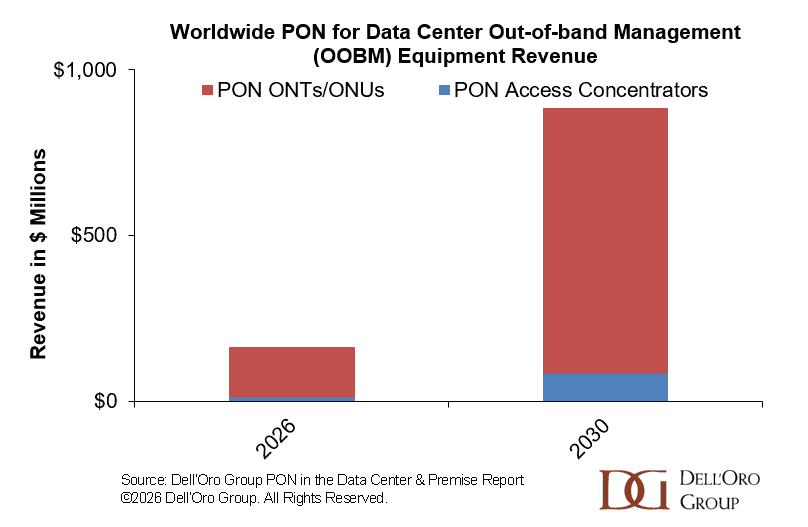
………………………………………………………………………………………………………………………………………………………………………………
Editorial Analysis:
This extremely bullish forecast points to a potentially important new use case for PON: not as a replacement for the high-bandwidth, low-latency Ethernet fabric that interconnects servers and storage, but as an economical physical layer for the separate networks used to monitor, provision, and recover data-center infrastructure. In that role, a passive optical distribution architecture can consolidate fiber runs and avoid electrically powered aggregation equipment in parts of the management network, potentially simplifying expansion and reducing operational overhead.
Dell’Oro’s projected 844% year-over-year revenue increase should be read in the context of an early-stage market: the percentage reflects rapid adoption from a comparatively small base rather than an indication that PON will displace mainstream data-center switching. Nevertheless, the report’s forecast of more than $3 billion in cumulative 2026–2030 spending indicates that hyperscale, neocloud, and colocation operators are sufficiently interested to make data-center PON a material adjacent market for OLT, ONT, and ONU suppliers.
The enterprise opportunity is somewhat different. Passive Optical LAN can extend fiber deeper into commercial buildings, with optical terminals serving end-user areas rather than relying entirely on copper horizontal cabling and access switches. The principal trade-off is front-loaded installation complexity—especially where fiber pathways must be added or upgraded—against the prospect of longer infrastructure life, higher available access speeds, and lower energy use over the building lifecycle. Dell’Oro also includes enterprise/MDU POL and business FTTR applications in its five-year forecast coverage, suggesting that it views these segments as part of the same widening PON equipment ecosystem.
China’s large-scale FTTR deployments provide a useful volume counterweight to these specialized data-center and enterprise applications. Master and subtended ONT architectures enable operators to extend fiber connectivity from the residence gateway to individual rooms, creating another demand source for optical endpoints and related PON equipment. Together, these developments suggest that future PON market growth will depend increasingly on diversification beyond conventional residential FTTH—while also requiring vendors to address application-specific management, installation, and interoperability requirements.
The Dell’Oro Group PON in the Data Center and Premise Advanced Research Report includes 5-year market forecasts for PON Optical Line Terminals (OLTs), and PON Optical Network Terminals (ONTs) and Optical Network Units (ONUs) used in Data Center [Out-of-band management (OOBM), infrastructure management (DCIM)], Enterprise/MDU [Passive Optical LAN (POL), Fiber-to-the-room for business (FTTR-B)] , and Fiber-to-the room (FTTR) applications. To purchase this report, please contact us by email at [email protected].
References:
PON in Data Centers Expected to Grow at 52 Percent CAGR from 2026-2030, According to Dell’Oro Group
Dell’Oro: 2H2026 Data Center Capex to Accelerate due to massive AI Deployments
Analysis: Broadcom’s end-to-end 50G PON Edge AI portfolio with WiFi 8 support
Highlights of FiberConnect 2024: PON-related products dominate
Nokia and Google Fiber trial 50G PON – first in the U.S.
Nokia and Hong Kong Broadband Network Ltd deploy 25G PON
HKT is first to deploy 50G PON technology in Hong Kong
Optus and Nokia’s pre-“6G” Trial in Australia: Upper 6 GHz May Be Widely Deployable
Executive Summary:
Australia’s Optus and Nokia have delivered one of the more credible pre 6G demonstrations yet: a live-field trial in Sydney that paired multi-gigabit speed with good coverage. The most notable result was the 3.5 Gbps peak download rate and the indication that upper 6 GHz could support a macrocell footprint comparable to today’s 5G 3.5 GHz network. The trial suggested the upper 6GHz band can cover roughly the same footprint as Optus’ existing 5G 3.5 GHz layer—an encouraging sign for lower-cost 6G upgrades.
TABLE 1. Optus–Nokia 6G Trial: Editorial Comparison of Technical Takeaways
(Adapted from reported trial results.)
Why this trial stands out:
In early 6G discussions, spectrum, coverage, and deployment economics are inseparable. Higher-frequency bands can offer more capacity, but they often demand denser networks and new site builds; that is precisely why the Sydney result matters.ericsson+1
Optus and Nokia’s trial suggests upper 6 GHz may offer a useful compromise: enough bandwidth for high throughput, yet enough propagation performance—when paired with advanced antenna techniques—to preserve broad-area coverage on existing infrastructure.telconews.com+1
What was tested:
According to the reported trial details, the teams used 200 MHz of upper 6 GHz spectrum, divided into two 100 MHz channels between 6,890 MHz and 7,090 MHz. Nokia’s proof-of-concept AirScale massive MIMO active antenna unit used 768 antenna elements and 128 transceiver chains at an existing Optus site operating alongside a live 5G network.telconews.com+1
That setup matters because it moves the conversation beyond lab conditions. A field trial on a live site is a better indicator of how upper 6 GHz may behave in real deployments, where interference, propagation, and network integration all shape performance.telconews.com+1
The bigger 6G implication:
The strongest signal from the trial is economic, not just technical. If operators can use upper 6 GHz with existing towers and familiar radio footprints, they may be able to introduce early 6G services without rebuilding their networks from scratch.telconews.com+1
That would be a major shift in how the industry thinks about 6G rollout. Instead of requiring an entirely new layer of dense infrastructure, upper 6 GHz could become a practical evolution path from 5G to 6G, especially for operators seeking capacity gains without a full civil-engineering reset.nokia+1
Spectrum policy:
This trial also lands in the middle of a broader spectrum-policy debate. The upper 6 GHz band is widely viewed as strategically important for future mobile networks, and results like this strengthen the case for allocating at least part of the band to licensed mobile use.ericsson+1
At the same time, the band remains attractive for other services, including unlicensed use cases. The Sydney trial does not settle that debate, but it does provide real-world evidence that upper 6 GHz is not merely theoretical: it can deliver both range and capacity under conditions that resemble operational deployment.
Quotes:
According to Sri Amirthalingam, Optus Chief Technology Officer, the achievement forms part of Optus’ ongoing network innovation program and its long-term work to help shape the technologies, standards and spectrum frameworks that will underpin the evolution from 5G to 6G.
“This trial is an important milestone in Optus’ long-term 6G research program and helps us better understand how future mobile networks can be designed to meet Australia’s unique connectivity needs. Achieving 3.5Gbps using upper 6GHz spectrum demonstrates the significant opportunity this band could provide for future networks as demand for data-intensive applications such as AI services, immersive video, cloud applications and connected devices continues to grow.
“As networks become increasingly AI-native, that enhanced capability will unlock a new generation of AI-powered experiences, from smarter digital assistants that can understand their environment, to more immersive education and real-time support for frontline workers. Our focus is on turning these innovations into meaningful benefits for Australians,” he added.
Mark Atkinson, Head of Radio Networks, Mobile Infrastructure at Nokia, says, “This trial with Optus demonstrates the potential of upper 6GHz spectrum to deliver the high capacity and performance that future networks will require, while also validating how existing infrastructure can evolve towards 6G.
“At Nokia, we see AI and connectivity becoming increasingly intertwined, with AI-native networks and AI-RAN enabling operators to deliver greater efficiency, better customer experiences and the platform required for AI-powered applications at scale. Through continued innovation and collaboration with Optus, we are advancing connectivity through AI-driven network innovation, helping shape the future of mobile communications and supporting Australia’s leadership in next-generation digital and AI technologies.”
Conclusions:
The Optus-Nokia result is not a commercial 6G launch, but it is a meaningful milestone. A smartphone-form-factor speed record is eye-catching; the more consequential finding is that upper 6 GHz may be deployable on today’s network footprint with far less infrastructure disruption than many expected. That would significantly improve the business case for upper 6 GHz. If network operators can reuse existing sites and achieve coverage similar to 5G 3.5 GHz, then the transition from trial to deployment could be less capital-intensive than many expected.
For network operators, regulators, and vendors, that is the kind of evidence that can shape both deployment strategy and spectrum decisions. If upper 6 GHz continues to perform this well in additional trials, it could become one of the most important bands in the transition from 5G-Advanced to 6G.
……………………………………………………………………………………………………………………………………………………………………………………………
Frequently Asked Questions:
What is massive MIMO and why does the antenna element count matter for upper 6GHz performance?
Massive MIMO (multiple-input multiple-output) is a technology that uses a large array of antennas at a base station to serve multiple users simultaneously in the same frequency resource, using spatial beamforming to direct signal energy precisely toward each device. Higher frequencies like upper 6GHz experience greater signal loss over distance than lower 5G frequencies — so more antenna elements are needed to compensate through more precise beamforming gain. The Nokia antenna in the Optus trial packs 768 elements into a proof-of-concept unit; commercial 5G radios typically use around 192. That difference in element count is the primary reason the Optus trial reached 3.5Gbps while Vodafone’s October 2025 trial with a less advanced antenna reached 2.5Gbps using the same 200MHz bandwidth.
Will upper 6GHz 6G services actually reach consumers without new towers being built?
The Optus trial’s outdoor coverage result suggests it may be possible — but only if the antenna hardware at existing sites is upgraded. The 768-element Nokia antenna compensates for upper 6GHz’s higher path loss through beamforming, matching the coverage footprint of a 3.5GHz 5G cell. Nokia’s CTO has previously confirmed that a 768-element array at 7GHz can fit in approximately the same physical enclosure as a standard 5G unit, because the higher frequency means each element is smaller. If that holds through production hardware, operators could upgrade existing sites rather than build new ones — a critical factor in the cost and timeline of any 6G rollout.
Why does Australia’s spectrum regulator have to decide about upper 6GHz, and what are the options?
The upper 6GHz band (6,425–7,125MHz) is currently under a spectrum embargo from ACMA, meaning no new licenses can be issued while it evaluates how to use the band. The core decision is whether to allocate upper 6GHz to licensed mobile networks (enabling 6G), to unlicensed Wi-Fi (enabling Wi-Fi 6E/7 at higher outdoor power), or to some sharing framework. Mobile operators argue they need the spectrum for future 6G. The Wi-Fi industry argues the same spectrum would dramatically expand outdoor Wi-Fi capacity. There is no technical path that gives both industries full access to the same frequencies simultaneously — ACMA will need to choose, and the Optus-Nokia trial results are now part of the evidence base it will weigh.
What happens globally if countries allocate upper 6GHz differently — mobile in some, Wi-Fi in others?
This is the central risk that the GSMA and mobile standards bodies have identified since WRC-23. If a significant portion of the world’s population — particularly the US, which has already dedicated the full 6GHz band to unlicensed Wi-Fi — does not align on upper 6GHz for mobile, device manufacturers will face a fragmented market: 6G handsets designed for global use cannot rely on upper 6GHz connectivity in all markets. The result would be regional rather than global 6G ecosystems, with separate equipment lines and higher costs. Australia’s decision, while one country among many, will contribute to the critical-mass calculation for whether the WRC-23 mobile identification becomes commercially viable or remains a regulatory aspiration without a unified device ecosystem behind it.
…………………………………………………………………………………………………………………………………………………………………………………………………………
References:
How NTIA “Call to Action for 6G Leadership and Security” might influence 6G/IMT-2030 standards and 3GPP specifications
3GPP approves timelines for Release 21 which will specify 6G RAN, Core and 5G Advanced
IMT-2030 (“6G”) Minimum Technology Performance Requirements for Radio Interface Technologies
ITU-R M.[IMT-2030.EVAL] & ITU-R M.[IMT-2030.SUBMISSION] reports: Evaluation & Submission Guidelines for 6G RIT/SRITs (6G)
Roles of 3GPP and ITU-R WP 5D in the IMT 2030/6G standards process
Dell’Oro: 6G RAN Capex to reach $500 billion by 2034 + Counterpoint
ABI Research: 6G Radio Installed Base by Region from 2029 to 2034
Analysis: Cohere’s $28M U.S. DoD FutureG ISAC contract; OTFS vs OFDM; 6G-NR/IMT 2030 RIT standards outlook
Analysis: Ericsson’s leading role in French INTENTION 6G project
Analysis: Nvidia’s rumored new 6G AI-RAN – likely features/functions and industry impact
Analysis: Nokia’s new AI-RAN platform and Standalone AI-RAN node with Nvidia GPUs
Ericsson and Intel collaborate to accelerate AI-Native 6G; other AI-Native 6G advancements at MWC 2026
NVIDIA and global telecom leaders to build 6G on open and secure AI-native platforms + Linux Foundation launches OCUDU
Nokia and Rohde & Schwarz collaborate on AI-powered 6G receiver years before IMT 2030 RIT submissions to ITU-R WP5D
AI wireless and fiber optic network technologies; IMT 2030 “native AI” concept
Comparing AI Native mode in 6G (IMT 2030) vs AI Overlay/Add-On status in 5G (IMT 2020)
SKT 6G ATHENA White Paper: a mid-to-long term network evolution strategy for the AI era
Verizon’s 6G Innovation Forum joins a crowded list of 6G efforts that may conflict with 3GPP and ITU-R IMT-2030 work
Highlights of 3GPP Stage 1 Workshop on IMT 2030 (6G) Use Cases
Ericsson and e& (UAE) sign MoU for 6G collaboration vs ITU-R IMT-2030 framework
Analysis: Huawei”s upgraded Xinghe Intelligent Network Solution for South Africa
The Huawei Network Summit 2026 South Africa concluded successfully in Johannesburg, drawing more than 400 industry leaders, technical experts, and ecosystem partners. At the event, Huawei introduced its upgraded Xinghe Intelligent Network Solution for Southern Africa, now positioned under the “Secure and Intelligent Connectivity” framework.
The announcement underscores Huawei’s continued push to enable intelligent transformation across industries in collaboration with customers and partners. As AI agents move from experimental deployments to mission-critical production environments, network requirements are shifting accordingly. Industry attention is increasingly moving beyond token consumption metrics to Daily Active Agents (DAA), reflecting the emergence of large-scale agentic AI adoption and the need for next-generation networks with stronger performance, resilience, and security.
Leon Wang, President of Huawei’s Data Communication Product Line, said: “Real-time AI interaction, multidimensional data flow, core business security, and other scenarios are driving networks to embrace an AI-centric paradigm shift. This marks a transition from ubiquitous ultra-broadband into a new journey defined by lossless computing power, integrated communication and sensing, full-scope security, and network autonomy.”
Powered by a next-generation intelligent network foundation, Southern Africa’s digital and intelligent transformation is entering a new phase, according to Huawei.
“Johannesburg is a vibrant city rich in opportunities, connecting talent, industries and cultures across Africa,” said Vincent Chen, Vice President of Enterprise Business, Southern Africa Region, Huawei. “Today, AI is becoming a key driver of global innovation, and its adoption in Africa is transitioning from pilot exploration to real-world deployment, accelerating intelligent transformation across sectors such as finance, education and public services. For the Southern African market, Huawei’s goal is to advance intelligence across industries by collaborating with industry partners to build intelligent, secure and reliable network infrastructure for the AI era.”
The rapid growth of AI agents is creating new use cases and requirements, placing unprecedented technical demands on network infrastructure.
“Today’s enterprise network infrastructure faces four major challenges on its path to digital and intelligent transformation. These include the ever-widening gap between computing supply and demand; traffic pattern shifts driven by AI agents; surging O&M complexity; and new AI-driven attacks compounding the vulnerabilities of new systems,” said Arthur Wang, Vice President of Huawei’s Data Communication Product Line. “To address these challenges, Huawei has upgraded its Xinghe Intelligent Network Solution under a new paradigm of ‘Secure and Intelligent Connectivity.’ The first is an intelligence upgrade, expanding AI beyond O&M into the entire network. The second is a security upgrade, advancing from single-point defence to end-to-end protection that deeply converges network and security. Through these two key upgrades, we aspire to build a solid connectivity foundation for every enterprise in the Agentic AI era.”
During the event, Huawei also unveiled its upgraded Xinghe Intelligent Network product portfolio and the Xinghe AI Cloud Campus SaaS Service Platform for Southern Africa.
Shi Lei, Vice President of the NCE Data Communication Domain of Huawei’s Data Communication Product Line, said:
“In the past, intelligent O&M was a luxury exclusive to large enterprises. Now, we have deeply integrated AI into the cloud management service platform, enabling SMEs to easily access these capabilities as a cloud service. This is more than tech inclusion; it is about making AI network services genuinely accessible, affordable, and actionable.”
Analysis & Opinion:
Huawei’s upgraded Xinghe Intelligent Network Solution for South Africa reflects a clear shift toward AI-native enterprise networking, with Huawei positioning the platform around “secure intelligent connectivity.” In practical terms, the upgrade extends AI beyond operations and management into the broader network fabric, while also tightening the convergence of networking and security across campus, WAN, data center, and security domains. The announcement also ties the solution to the broader “Agentic AI era,” which suggests Huawei is targeting workloads where connectivity, automation, and security need to operate together.
For South African enterprises, the strategic value is clear: AI adoption is pushing networks to support heavier east-west traffic, lower latency, stronger segmentation, and more autonomous operations. Huawei is effectively arguing that traditional, siloed infrastructure is no longer sufficient for production AI environments. Instead, the network must become a more autonomous, security-aware control layer that can sustain business continuity and scale with intelligent services.
Huawei unveils upgraded Xinghe Intelligent Network for Southern Africa
Huawei’s AI-Centric Network Vision: Six Imperatives for the Next Decade; Critical Questions for IEEE Techblog Community
Huawei FY2025: 2.2% YoY revenue increase; strategic pivot to AI and intelligent automotive solutions
Huawei unveils AI Centric Network roadmap, U6 GHz products, 5G Advanced strategy and SuperPoD cluster computing platforms
Huawei, Qualcomm, Samsung, and Ericsson Leading Patent Race in $15 Billion 5G Licensing Market
Huawei Cloud Review and Global Sales Partner Policies for 2026
Omdia on resurgence of Huawei: #1 RAN vendor in 3 out of 5 regions; RAN market has bottomed
Highlights and Analysis of July 30th U.S. Senate hearing on AI and telecommunications
Disclaimer: Perplexity.ai was used for research used to generate this article.
…………………………………………………………………………………………………………………………………………………………………………………………………………………………………………………..
Introduction:
Today, U.S. Senator Deb Fischer (R-Neb), Chairman of the Senate Commerce Subcommittee on Telecommunications and Media, convened a hearing examining how artificial intelligence (AI) is transforming telecommunications networks and how the technology can enhance services across America. Titled “Intelligent Networks: Powering Artificial Intelligence and Transforming Communications,” the hearing examined the bidirectional relationship between AI and network infrastructure. In particular, AI demands low-latency, high-bandwidth networks, while also offering tools to make those networks more efficient and secure.
Witnesses:
-
Jonathan Spalter, President and CEO, USTelecom — The Broadband Association
-
Dan Watermeier, Commissioner, Nebraska Public Service Commission
-
Bob Everson, Chief Architect of Provider Mobility, Cisco
-
Asad Ramzanali, Director of AI and Technology, Vanderbilt Policy Accelerator
From Senator Fischer’s opening remarks:
“As AI adoption increases, so will the demand for reliable and resilient communications infrastructure. Networks are the backbone along which the enormous amounts of data associated with AI are transmitted. I look forward to discussing both how networks are adapting to respond to AI and how AI is being used in networks to proactively plan for the future.”
……………………………………………………………………………………………………………………………………………………………………………………………………………………………………………………..
Permitting Reform Dominates Discussion
The clearest consensus across industry witnesses was that outdated permitting processes are the primary barrier to deploying AI-ready fiber infrastructure. Spalter testified that “the biggest barrier to building the broadband infrastructure our country needs isn’t technology or investment — it’s outdated permitting processes,” and urged Congress to establish consistent permitting timelines while preserving environmental and historic review requirements.
Watermeier emphasized that fiber is the only broadly deployable technology capable of supporting AI-era traffic, noting that “fiber optic networks can greatly exceed” the FCC’s current 100/20 Mbps threshold. Everson echoed the urgency, stating that providers are ready to build if permitting can be accelerated. Sen. Shelley Moore Capito (R-WV) supported establishing permitting “shot clocks.”
Spalter also identified cybersecurity and sustainable broadband funding as essential priorities, though specific proposals on either topic were not detailed in reported testimony.
Digital Divide and BEAD Funding
Sen. Lisa Blunt Rochester (D-DE) pressed witnesses on the impact of the Trump administration’s approximately 74% cut to the Broadband Equity, Access, and Deployment (BEAD) Program. Ramzanali responded that unconnected households are excluded from AI’s economic benefits, telehealth access, and educational tools, stating: “We shouldn’t accept the state of the country where not every American is connected to high-quality networks”
Grid Reliability and Spectrum: Largely Absent
Despite the hearing’s framing, two critical topics received little direct attention. Grid reliability — a pressing concern given that PJM Interconnection reported data-center-driven supply cost increases exceeding 60%, and Bank of America projected ~125 GW of new U.S. electric load from data centers by 2030 (Legis1) — was not substantively addressed by witnesses.
Spectrum policy was similarly underexplored, despite significant adjacent developments: the FCC’s July 22 vote to auction 160 MHz of upper C-band spectrum, NTIA’s $53 million funding announcement for secure AI-enabled Radio Access Networks, and a detailed spectrum reform brief published by the International Center for Law & Economics timed to the hearing. The ICLE brief recommended five reforms: preserving a balanced mix of licensed, unlicensed, and shared spectrum; streamlining the Spectrum Relocation Fund; strengthening FCC-NTIA coordination; replacing worst-case interference analysis with risk-informed probabilistic methods; and coherent U.S. engagement at the ITU World Radiocommunication Conference to counter Chinese influence in standards bodies.
Cybersecurity: Listed but Undefined
Spalter listed cybersecurity among his three essential priorities but did not elaborate on specific threats or mitigation strategies. The absence is notable given that an adjacent House hearing on July 22 featured testimony from Lindsay Gorman warning that AI is “expanding the cyberattack surface” through prompt-injection attacks, data poisoning, and model exploitation. Gorman urged Congress to mandate AI cybersecurity standards and recommended next-generation networks implement AI-automated defenses and post-quantum cryptography.
Industry vs. Regulatory Divergence
The hearing revealed a clear fault line. The three industry witnesses uniformly advocated for reducing regulatory friction and enabling private investment. Ramzanali, whose broader research at Vanderbilt advocates utility-style regulation of digital infrastructure, structural separation of AI hardware and software, and a dedicated digital regulator, provided the only counterweight — though his reported testimony focused on digital divides rather than his full structural reform agenda.
Sen. Fischer’s opening remarks captured the industry-aligned framing: “Opaque regulations and lack of coordination should not get in the way of network development.” Sen. Blunt Rochester’s questioning represented the regulatory perspective, challenging funding cuts and emphasizing equitable access.
Outlook
The hearing underscored that the U.S. telecommunications policy debate around AI is currently dominated by infrastructure deployment concerns — particularly permitting — while cybersecurity, spectrum management, and grid reliability remain underexamined. With the Senate Commerce Committee delaying broader AI legislation markup until after the summer recess (Washington Times), the substantive policy work on these gaps may not advance until fall.
Full written testimony and a hearing transcript are not yet available on the committee website.
…………………………………………………………………………………………………………………………………………………………………………………………………………………………………..
Analysis via Perplexity.ai:
Comparison Matrix: Key Recommendations by Topic
1. Grid Reliability and Energy Demand
2. Cybersecurity Vulnerabilities
3. Spectrum Policy
4. Regulatory Reform vs. Government Oversight
5. AI-Enabled Services: Industry Priorities vs. Regulatory Proposals
Key Divergences and Synthesis
Consensus Points
-
Permitting reform is urgent. All three industry witnesses and Republican senators agreed that permitting delays are the single biggest barrier to AI-ready network deployment. Even Sen. Fischer’s opening remarks flagged “opaque regulations.”
-
Fiber is foundational. Spalter, Watermeier, and Everson all positioned fiber as the backbone infrastructure for AI. Fischer encapsulated it: “AI runs on infrastructure, and infrastructure runs on fiber.”
-
AI transforms networks bidirectionally. Fischer’s framing — that AI requires better networks but can also make networks more efficient and secure — was implicitly accepted across witness testimony.
-
Industry self-regulation vs. structural oversight. The three industry witnesses (Spalter, Watermeier, Everson) uniformly advocated for removing regulatory friction and letting private capital deploy infrastructure. Ramzanali’s framework — developed at Vanderbilt and reflected in his testimony on digital divides — argues for utility-style regulation, structural separation, and a dedicated digital regulator. This is the fundamental fault line.
-
BEAD funding. Industry witnesses mentioned “sustainable broadband funding” as a priority but did not challenge the Trump administration’s 74% cut to BEAD. Sen. Blunt Rochester and Ramzanali directly attacked the cuts as harmful to AI equity. Industry silence on BEAD cuts suggests a pragmatic accommodation with the administration’s budget priorities.
-
Cybersecurity specificity. Spalter listed cybersecurity as essential but offered no concrete proposals in reported testimony. This stands in contrast to the adjacent House hearing where witnesses like Lindsay Gorman called for mandated congressional cybersecurity standards. The gap between listing cybersecurity as a priority and proposing actual security mandates represents a significant industry-regulatory divergence.
-
Spectrum was largely absent. Despite ICLE publishing a detailed five-reform spectrum brief timed to the hearing, and despite the FCC’s July 22 C-band auction vote and NTIA’s $53M AI-RAN funding announcement, none of the witnesses’ reported testimony engaged substantively with spectrum policy. This is a notable omission given that Everson’s title (Chief Architect of Provider Mobility) implies wireless expertise. The ICLE brief’s warning that “the United States cannot lead at digital speed while governing the airwaves at bureaucratic speed” went unaddressed in the hearing room.
Implications for Next-Generation AI-Enabled Services
-
The hearing’s overwhelming focus on permitting reform and fiber deployment — while important — left cybersecurity, spectrum, and grid reliability largely underexplored. The most consequential gap is the absence of detailed cybersecurity testimony, given that AI is simultaneously expanding the attack surface and offering new defensive tools.
-
Ramzanali’s presence provided the only counterweight to the industry consensus, but his reported testimony focused narrowly on digital divides rather than his broader structural reform agenda. Whether his Vanderbilt research on AI infrastructure financial risks and digital utility regulation will influence future Senate action remains to be seen.
-
The ICLE spectrum framework — published as context for this hearing — represents the most detailed policy roadmap for AI-enabled wireless services, but it was not directly debated by the witnesses. The FCC’s C-band auction and NTIA’s AI-RAN funding are proceeding on parallel tracks outside the hearing’s scope.
…………………………………………………………………………………………………………………………………………………………………………………………………………………….
References:
NEWS: Senator Blunt Rochester Highlights How AI Will Impact Digital Divides