

Alphabet
Will Google Cloud’s AI and data analytics revenue +TPU IP licensing income offset huge AI CAPEX to produce a decent ROI?
An April 24th Investors Business Daily (IBD) article asserts that Google’s AI position is strong, but the real test will be monetization. Specifically, can Gemini translate technical lead and user scale into durable profits for parent company Alphabet? The company has benefited from AI enthusiasm and Google Cloud momentum, but investors are now focused on whether heavy AI spending will generate sufficient revenues to justify the enormous capex ramp up. The article highlights Gemini’s growing traction, Google Cloud’s rapid expansion, and a very large backlog as signs of demand, but it also stresses that those positives must offset rising infrastructure costs.
With its Gemini family, Google continues to push its AI technology across the “stack,” (see quote below) deploying it to Google Maps, enterprise Workplace productivity tools, and YouTube’s content and ad platforms. AI technology is even making Google’s autonomous vehicle company, Waymo, better and safer amid its large market expansion.
A key theme is that Google has multiple ways to earn revenue from AI, including consumer subscriptions, enterprise software, and cloud services. The article points to Gemini Advanced as an example of paid AI packaging, while also implying that the larger opportunity is converting AI usage into higher-value cloud and platform revenue rather than just user growth. However, Alphabet is planning very large AI infrastructure spending (much more below), and the article questions whether the company can turn that investment into sustainable high-margin revenue fast enough to satisfy investors.
Google has also ventured into AI semiconductors with its AI accelerator Tensor Processing Unit, known as TPU, co-developed with Broadcom and manufactured by TSMC (Taiwan Semiconductor Manufacturing Company). Google is shifting future TPU generation designs to include MediaTek for design support, with TSMC continuing as the primary fabrication partner for advanced 2nm, 3nm, and 5nm nodes.
Google has recently introduced the 7th-gen “Ironwood“ TPU 7x and revealed plans for the 8th-gen TPU 8t and TPU 8i for 2027. Long time colleague Amin Vadat, PhD wrote in a blog post, “We are introducing the eighth generation of Google’s custom Tensor Processor Unit (TPU), coming soon with two distinct, purpose-built architectures for training and inference: TPU 8t and TPU 8i. These two chips are designed to power our custom-built supercomputers, to drive everything from cutting-edge model training and agent development, to massive inference workloads. TPUs have been powering leading foundation models, including Gemini, for years. These 8th generation TPUs together will deliver scale, efficiency and capabilities across training, serving and agentic workloads.”

Image credit: Google.
Indeed, Google’s TPUs have emerged as a threat to Nvidia’s dominance in the AI chip market. Anthropic has licensed Google’s TPU accelerators for use in data centers. Broadcom will modify the TPUs for Anthropic before the customized chips are made by TSMC. Wells Fargo estimates that Google could bring in over $10 billion in high-margin intellectual property (IP) licensing fees from TPUs in 2026 and 2027.
“What stands out about Google is that they’ve been investing up and down the technology stack, from silicon to the AI models,” said Daniel Flax, managing director at investment management firm Neuberger Berman. “While competition is fierce, they’ve been able to innovate. What we’re focused on is (Google’s) ability to execute on their product road map from one generation of AI models to the next.”
………………………………………………………………………………………………………………………………………………………………………………………………………………………………………….
AI Competition from OpenAI and Anthropic:
Google faces lots of AI competition from other hyperscalers (Amazon, Microsoft, Meta, etc) and especially from two private AI companies:.
- OpenAI remains a major AI player, powered by the rapid advance of ChatGPT, which launched in 2022. In its latest funding round, OpenAI landed $122 billion in capital commitments, which values the company at $852 billion. OpenAI’s GPT-6 is its next-generation AI model, as soon as late 2026. GPT-6 is expected to include new memory features that support the personalization of AI chatbots. It’ll also offer more support for autonomous AI agents that perform tasks over the internet.
- Anthropic’s Claude AI model family has grabbed the spotlight this year. With Claude-based coding and other AI tools, Anthropic shook up the enterprise software market. Anthropic is preparing a next-generation, more powerful AI model called Mythos. Anthropic recently raised $30 billion in a funding round that valued the AI company at $380 billion.
………………………………………………………………………………………………………………………………………………………………………………………………………………………………………….
AI Cloud Competition:
Google’s cloud computing business is one area that should benefit from the company’s AI spending. The unit has excellent momentum. Cloud revenue climbed 47% to over $16 billion in the December quarter, up from 34% growth in the previous quarter. And Google’s cloud computing sales backlog grew 55% to $240 billion from the September quarter. AWS still has the largest cloud market share, with Azure second and Google Cloud third. Google Cloud’s edge is AI and data analytics, especially through Vertex AI, Gemini-related services, and TPU-based infrastructure. The company has developed AI Gemini models targeting specific industries, such as financial services and pharmaceutical companies. With the recent $32 billion purchase of Wiz, Google plans to offer AI-based cybersecurity threat detection tools.
Google Cloud is growing faster than AWS on an AI-driven basis, but it still trails Azure in the most AI-sensitive growth comparisons and remains third in overall cloud share. The broad pattern is: AWS leads in scale, Azure leads in AI momentum and enterprise pull, and Google Cloud is the strongest “AI-first” challenger with faster growth than AWS but a smaller base. Recent comparisons show AWS revenue growth around 18% year over year, while Google Cloud grew about 32%, and Azure’s estimated growth was about 39% in the same period.
Microsoft reported Intelligent Cloud segment growth was also faster than AWS. The rough share split cited in recent coverage is AWS about 30%, Azure about 20%, and Google Cloud about 13%. Azure’s edge is enterprise distribution and the Azure OpenAI ecosystem, while AWS offers the broadest infrastructure catalog and strong AI tooling but is less clearly identified as the AI growth leader. Investor takeaway For investors, Google Cloud looks like the fastest-improving AI cloud franchise relative to its size, but not the biggest one. The real question is whether Google’sAI-led growth can stay above AWS while also narrowing the gap with Azure’s enterprise AI momentum.
Monetization is a Major Issue:
Many analyst say it’s unclear how many consumers will pay for AI. Only about 5% of ChatGPT’s user base is paid. “Consumer AI is becoming a distribution channel and brand builder, while enterprise agents are where the high-margin, sticky revenue is actually getting locked in,” Ben Lorica, editor of the Gradient Flow AI newsletter, told IBD in an interview. “Widespread platform promiscuity across ChatGPT, Gemini and Claude signals low switching costs and thin margins, which is not a great recipe for durable revenue.”
“Cloud, AI revenues have to scale fast enough for people to say, ‘OK, this is actually working,'” said Michael Landsberg, chief executive of Landsberg Bennett Private Wealth Management. “With Google, a lot of things are going very well, but when is it going to translate into money in the pocket? Gemini is doing really well gaining market share from ChatGPT. But there’s no money yet,” Landsberg added. “The big issue around Google search is, ‘Are they going to be able to put advertising in Gemini?'”
“I think most people want free AI because we’ve been trained that free is how we do this computer thing,” said Kimberly Forrest, Bokeh Capital Partners’ chief investment officer. “Facebook, Instagram — it’s all free now. There might be some people willing to spend $20 monthly on AI, but probably not enough to generate the income that these models need to be continually improved.”
Alphabet has historically monetized consumer products through advertising rather than subscriptions. “I think the average consumer doesn’t want to pay for AI, and if they do, they certainly don’t want to pay much for AI,” said Tim Ghriskey, senior portfolio strategist at Ingalls & Snyder.
Author’s Note: I regularly use Gemini for Home on my Google Smart Speaker and a different Gemini on PCs and my Samsung phone. There’s a huge difference in performance with the former making many more mistakes and “AI Hallucinations” than the latter. The reason is the Gemini for Home and regular Gemini run on two totally different AI systems. For reasons neither I or Gemini for Home can explain, the Home version is severely deficient with many wrong answers and hallucinations that you don’t get when you use Gemini on a pc or the Gemini app on a smartphone.
One particularly bothersome Gemini for Home response to a question asked or a complaint is: “These pictures should match” or “Here are your photos” or “check out these pictures” with corresponding pics/photos displayed on the speaker’s screen.
–>THAT HAS ABSOLUTELY NOTHING TO DO WITH ANYTHING yet it happens frequently AFTER the Google speaker promises never to repeat it! Ugggh!!!!
……………………………………………………………………………………………………………………………………….
Google/Alphabet’s Surging CAPEX and ROI:
Alphabet said its 2026 capex will be $175 billion to $185 billion, and management has framed the spending as overwhelmingly AI/infrastructure-related which will support revenue growth in Google Cloud, Gemini, and AI-enhanced Search.
The clearest breakdown disclosed to date is roughly 60% to servers and 40% to data centers and networking equipment. Using the company’s forward guidance ranges:
-
AI Compute Servers: about $105 billion to $111 billion.
-
Data centers and networking equipment: about $70 billion to $74 billion.
That means most of the spend is going into fast-depreciating compute hardware, with the rest funding the physical and network buildout needed to host AI workloads. Google says the investment is meant to expand AI compute, support Google Cloud demand, and scale Gemini and enterprise AI offerings.
The company also pointed to a $240 billion cloud backlog and strong cloud revenue growth as signs that the spending is tied to real demand rather than just speculative buildout. The key issue for investors is whether this capital intensity converts into enough cloud and AI revenue to justify the return profile. Alphabet has not given a specific ROI number for its 2026 AI investments. What it has said, and what analysts infer, is that the return should come from faster cloud growth, higher AI-related search usage, and paid enterprise adoption rather than a near-term accounting yield.
In conclusion, 2026 is an AI scale-up year for Google, but the ROI question is still open.
………………………………………………………………………………………………………………………………………………………..
References:
Google’s AI Reckoning: Can Gemini Turn Dominance Into Dollars?
Will billions of dollars big tech is spending on Gen AI data centers produce a decent ROI?
Big tech spending on AI data centers and infrastructure vs the fiber optic buildout during the dot-com boom (& bust)
AI infrastructure spending boom: a path towards AGI or speculative bubble?
Expose: AI is more than a bubble; it’s a data center debt bomb
China vs U.S.: Race to Generate Power for AI Data Centers as Electricity Demand Soars
Anthropic’s Project Glasswing aims to reshape IT cybersecurity
IDC Survey of Networking Leaders: Enterprise AI progress stalls despite ambitious goals
Will “AI at the Edge” transform telecom or be yet another telco monetization failure?
Nvidia Survey Reveals How Telcos Plan to Use AI; Quantifying ROI is a Challenge
Analysis: Cisco, HPE/Juniper, and Nvidia network equipment for AI data centers
Networking chips and modules for AI data centers: Infiniband, Ultra Ethernet, Optical Connections
Google’s Bosun subsea cable to link Darwin, Australia to Christmas Island in the Indian Ocean
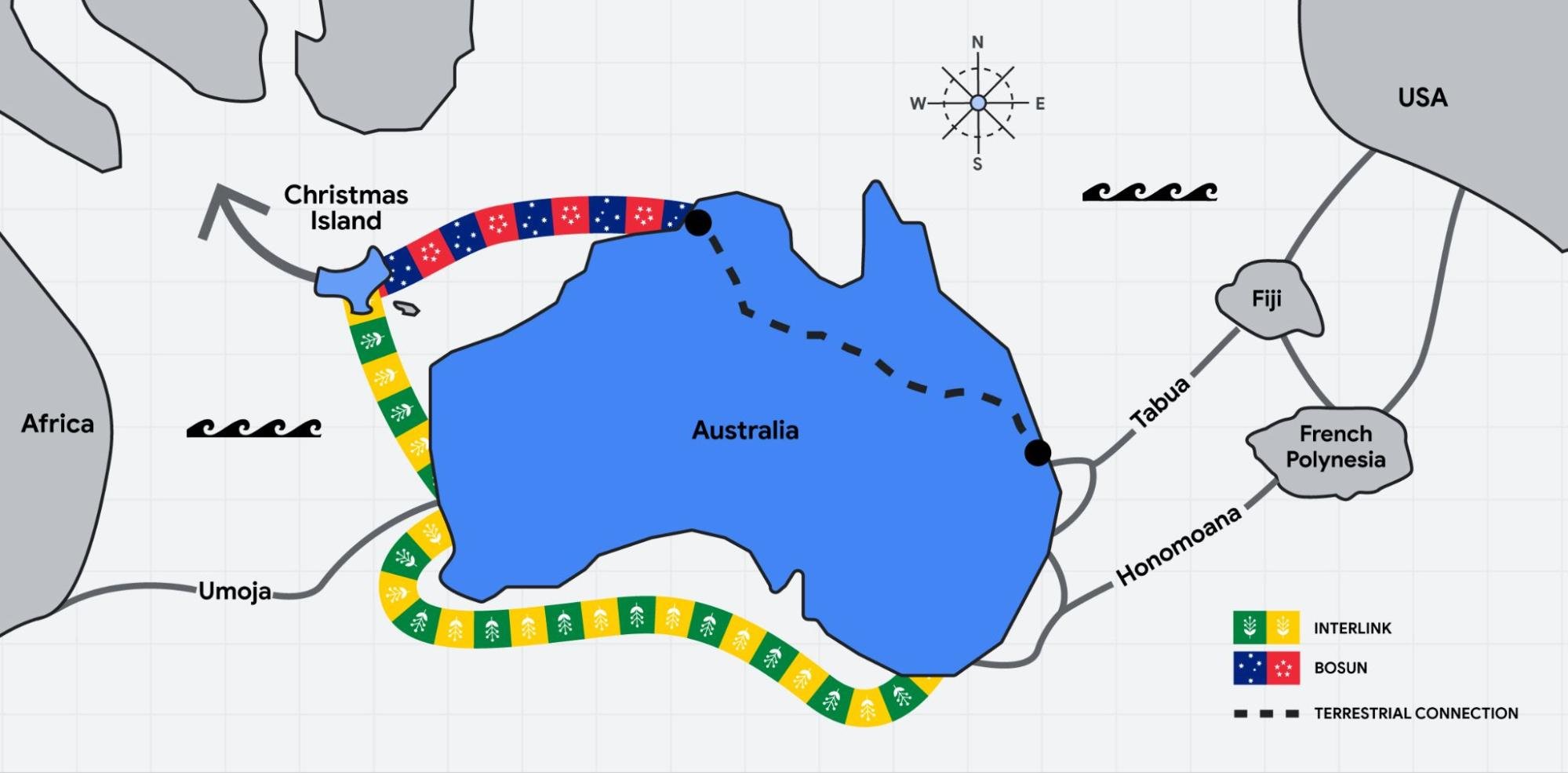

“Vocus is thrilled to have the opportunity to deepen our strategic network partnership with Google, and to play a part in establishing critical digital infrastructure for our region. Australia Connect will bolster our nation’s strategic position as a vital gateway between Asia and the United States by connecting key nodes located in Australia’s East, West, and North to global digital markets,” said Jarrod Nink, Interim Chief Executive Officer, Vocus.
“The combination of the new Australia Connect subsea cables with Vocus’ existing terrestrial route between Darwin and Brisbane, will create a low latency, secure, and stable network architecture. It will also establish Australia’s largest and most diverse domestic inter-capital network, with unparalleled reach and protection across terrestrial and subsea paths.
“By partnering with Google, we are ensuring that Vocus customers have access to high capacity, trusted and protected digital infrastructure linking Australia to the Asia Pacific and to the USA. “The new subsea paths, combined with Vocus’ existing land-based infrastructure, will provide unprecedented levels of diversity, capacity and reliability for Google, our customers and partners,” Nink said.
“Australia Connect advances Google’s mission to make the world’s information universally accessible and useful. We’re excited to collaborate with Vocus to build out the reach, reliability, and resiliency of internet access in Australia and across the Indo-Pacific region,” said Brian Quigley, VP, Global Network Infrastructure, Google Cloud.
Perth, Darwin, and Brisbane are key beneficiaries of this investment and are now emerging as key nodes on the global internet utilizing the competitive and diverse subsea and terrestrial infrastructure established by the Vocus network. Vocus will be in a position to supply an initial 20-30Tbps of capacity per fiber pair on the announced systems, depending on the length of the segment.
References:
Google’s Equiano subsea cable lands in Namibia en route to Cape Town, South Africa
Google’s Topaz subsea cable to link Canada and Japan
“SMART” undersea cable to connect New Caledonia and Vanuatu in the southwest Pacific Ocean
Telstra International partners with: Trans Pacific Networks to build Echo cable; Google and APTelecom for central Pacific Connect cables
HGC Global Communications, DE-CIX & Intelsat perspectives on damaged Red Sea internet cables
Orange Deploys Infinera’s GX Series to Power AMITIE Subsea Cable
NEC completes Patara-2 subsea cable system in Indonesia
SEACOM telecom services now on Equiano subsea cable surrounding Africa
Bharti Airtel and Meta extend 2Africa Pearls subsea cable system to India
China seeks to control Asian subsea cable systems; SJC2 delayed, Apricot and Echo avoid South China Sea
Intentional or Accident: Russian fiber optic cable cut (1 of 3) by Chinese container ship under Baltic Sea
Altice Portugal MEO signs landing party agreement for Medusa subsea cable in Lisbon
2Africa subsea cable system adds 4 new branches
Echo and Bifrost: Facebook’s new subsea cables between Asia-Pacific and North America
Equinix and Vodafone to Build Digital Subsea Cable Hub in Genoa, Italy
Google Cloud revenues up 54% YoY; Cloud native security is a top priority
Google Cloud revenues increased 54% year over year to $4.62 billion during the second quarter of 2021, parent company Alphabet reported today. Google Cloud’s operating loss shrunk 59%, from $1.42 billion a year ago to $591 million last quarter.
Google Cloud includes both Google Cloud Platform (GCP) and its Workspace (formerly G Suite) cloud computing services and collaboration tools.
Like previous quarters, “GCPs revenue growth was, again, above cloud overall, reflecting significant growth in both infrastructure and platform services,” the company said in a statement.
“As for Google Cloud, we remain focused on revenue growth, and are pleased with the trends we’re seeing across cloud,” Google CFO Ruth Porat said on the company’s 2Q-2021 earnings call today. Porat added that growth in its Google Cloud Platform segment again surpassed overall cloud gains “reflecting significant growth in both infrastructure and platform services.”
“We will continue to invest aggressively, including expanding our go-to-market organization, our channel expansion, our product offerings, and our compute capacity,” she said.
Also on today’s earnings call, Google CEO Sundar Pichai cited security as a competitive differentiator and “our strongest product portfolio.” Google will continue to invest in security and continue its work to integrate its various security products such as Beyond Corp and Chronicle, he added.
“Cyber threats increasingly are on the mind of not just CIOs but CEOs across our partners. So it’s definitely an area where we are seeing a lot of conversations, a lot of interest…so a definite source of strength and you’ll see us continue to invest here,” he said.
“We are cloud native, we pioneered … zero trust and built the architecture out from a security-first perspective. Particularly, over the course of the last couple of years, with the recent attacks, [companies] really started thinking deeply about vulnerabilities, supply chain security has been a major source of consensus, cyber threats are increasingly on the mind of, not just CIOs, but CEOs across our partners. So it’s definitely an area where we are seeing a lot of conversations, a lot of interest.”
Google Cloud, along with its other business units, boosted Alphabet’s revenue 62% year over year, to $61.9 billion. As usual, Google ad revenue represented the biggest piece of the pie. It grew 69% to $50.44 billion. Retail was the biggest contributor to advertising growth.
Google Cloud holds around 7% market share in the cloud services segment, according to a Canalys report released in April 2021. It trails Amazon Web Services (AWS) and Microsoft Azure, which hold 32% and 19% market share, respectively.
Microsoft posted financial results Tuesday, its Intelligent Cloud revenue increased 30% to $17.4 billion. The company stated Azure revenue grew of 51%, but did not break out a dollar figure. Amazon is set to report earnings on Thursday.
Along with their hyper-scale cloud competitors Google Cloud is partnering with telecom companies all over the world to help them drive transformation and accelerate 5G adoption and monetization.
Here are a few of their telco partners:








………………………………………………………………….
References:
https://abc.xyz/investor/static/pdf/2021Q2_alphabet_earnings_release.pdf?cache=4db52a1
https://www.fiercetelecom.com/financial/google-cloud-revenue-climbs-54-q2
https://www.sdxcentral.com/articles/news/google-cloud-losses-shrink-59-revenue-hits-4-6b/2021/07/