
Network spending
Telecom Equipment Market Extends Recovery as AI Infrastructure Spending Accelerates
Executive Summary:
Global telecom equipment revenues have been in a state of steady decline until last year. While there was an increase in spending for 5G FWA & 5G SA core networks, the main revenue driver was strong growth in fiber-optic-based network gear needed for connectivity inside and between AI data centers.
Market research firm Dell’Oro Group has just published findings that analyze how that trend has extended into the first half of this year. To no one’s surprise, AI data center connectivity now accounts for nearly all telco equipment revenue growth.
Preliminary Dell’Oro Group estimates indicate that aggregate global revenues across six tracked equipment domains—Broadband Access, Microwave Transport, Optical Transport, Mobile Core Network (MCN), Radio Access Network (RAN), and High-End Routing and Aggregation—increased 5% year over year (YoY) in 1H2026. The result represents a sixth consecutive quarter of year-over-year expansion.
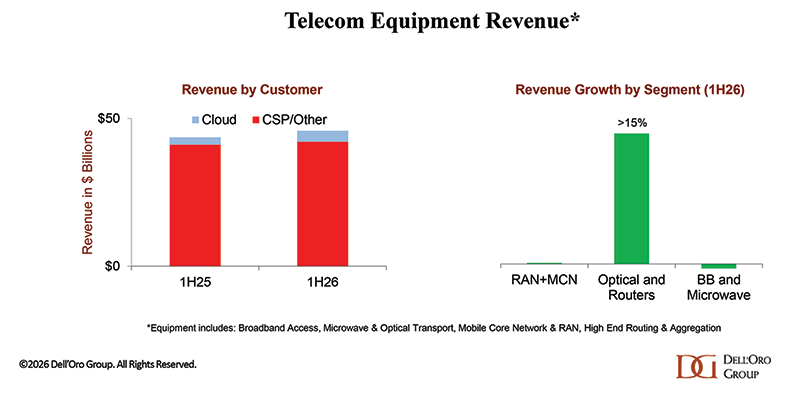
The 1H2026 performance follows a 4% telecom equipment spending increase in 2025, when the industry returned to growth after aggregate revenues declined 14% between 2022 and 2024. The 2025 rebound was supported by inventory normalization, easier year-over-year comparisons, improving wireless and wireline demand, and rising cloud capital expenditure. In 1H2026, however, the growth mix shifted more decisively toward equipment categories linked to AI infrastructure and hyperscale data-center connectivity.
Cloud investment reshapes demand:
Traditional communications service providers (CSPs) still generate more than 90% of worldwide telecom equipment revenue. However, cloud providers are now an increasingly consequential source of incremental demand. Dell’Oro Group estimates that cloud providers accounted for approximately 55% of total equipment-market revenue growth in 1H26, driven by sustained investment in AI compute infrastructure, data-center expansion, and the high-capacity transport and routing layers required to interconnect those facilities.
This does not signal a wholesale replacement of telecom operator demand by hyperscaler spending. Rather, it illustrates how the equipment market’s near-term growth profile is being reshaped by the convergence of telecom networking, cloud architecture, and AI infrastructure. The technologies benefiting most are those closest to data-center interconnect, backbone capacity expansion, and high-performance IP networking.
Optical and routing lead growth:
Growth was concentrated in Optical Transport and High-End Routing and Aggregation—the two segments with the most direct exposure to cloud and data-center investment cycles.
Optical Transport revenue increased at a double-digit rate in 1H26, supported by demand for data-center interconnect capacity and the expansion of high-bandwidth optical infrastructure. High-End Routing and Aggregation also recorded strong gains, reflecting robust spending from both cloud providers and CSPs.
By comparison, more traditional telecom infrastructure categories remained comparatively stable:
-
Aggregate RAN and MCN revenue was broadly flat.
-
Broadband Access revenue was relatively unchanged.
-
Microwave Transport revenue also showed limited growth.
The divergence underscores an important market distinction: AI-related infrastructure spending is currently lifting transport, optical, and routing investment more directly than it is stimulating broad-based growth in mobile access or core-network equipment.
Regional and supplier trends:
Regional conditions were favorable outside China. North America, EMEA, the Caribbean and Latin America (CALA), and Asia-Pacific excluding China all contributed to the 1H26 market expansion. North America continued to benefit disproportionately from AI- and cloud-driven infrastructure investment, including demand for optical transport, routing, and fiber-access platforms.
China remained the principal weak point. Telecom infrastructure investment is increasingly being displaced by compute-oriented capital expenditure. China’s three largest CSPs are collectively targeting 40% growth in computing capex during 2026, while conventional connectivity capex is expected to decline by 24%. That reallocation reinforces the broader shift from traditional network buildouts toward AI infrastructure, although the equipment beneficiaries differ substantially by technology segment.
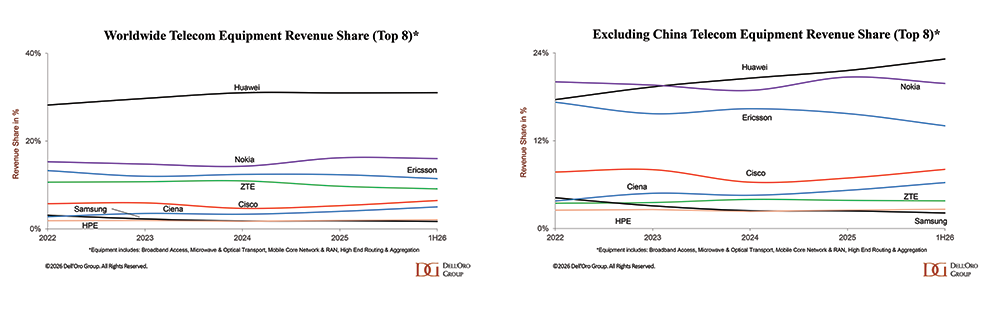
Global supplier rankings remained broadly stable during the first half of the year. Huawei retained its position as the largest worldwide telecom equipment supplier, followed by Nokia and Ericsson. Outside China, however, market-share shifts were more pronounced:
-
Huawei and Cisco gained share in 1H26 relative to 2025.
-
Ericsson and Nokia together lost roughly three percentage points of revenue share.
-
The changes partly reflect differing exposure to the faster-growing optical and routing segments, as well as regional demand patterns.
Revised Outlook:
Dell’Oro Group’s analyst team has raised its 2026 outlook for the six tracked equipment markets. Worldwide revenue is now projected to grow 3% to 5% for the full year, compared with a previous forecast of 2% to 4%.
The risk profile has also changed. China is tracking below earlier full-year expectations, while rising memory and component costs have become more significant second-half concerns. Those headwinds are being offset, at least in part, by continued strength in cloud and AI infrastructure investment.
Telecom equipment demand has stabilized and entered a renewed growth phase, supported by sustained hyperscale investment in AI compute, optical interconnect, and high-end routing. The key question for 2026 is whether this momentum broadens into a more balanced, network-wide recovery—particularly across RAN, core, and access segments, which have not yet participated materially in the expansion.
The central market question is whether sustained hyperscale investment in AI compute, optical interconnect, and high-end routing can broaden into a more durable, network-wide equipment recovery.
……………………………………………………………………………………………………………………………………………………………….
References:
Cloud Providers Drive Telecom Equipment Growth in 1H26 – Dell’Oro Group
Dell’Oro: Data Center capex grew 92% in 2Q-2026 (caveats galore)
Dell’Oro: AI RAN revenue forecast: $35B from 2026-to-2030; 3 types of AI RAN explained
Dell’Oro: Telecom carriers are on a 5G SA spending spree with more to come
Dell’Oro: Global RAN market stable (again) in 1Q 2026; top 5 RAN vendors are unchanged
Dell’Oro: RAN Market Stabilized in 2025 with 1% CAG forecast over next 5 years; Opinion on AI RAN, 5G Advanced, 6G RAN/Core risks
Dell’Oro: RAN market stable, Mobile Core Network market +14% Y/Y with 72 5G SA core networks deployed
Dell’Oro Group: RAN Market Grows Outside of China in 2Q 2025
Dell’Oro: Fixed Wireless Access revenues +10% in 2025 & will continue to grow 10% annually through 2029
Dell’Oro: AI RAN to account for 1/3 of RAN market by 2029; AI RAN Alliance membership increases but few telcos have joined
Analysis: AT&T’s $250B network investment to advance U.S. connectivity
Rapid adoption of artificial intelligence (AI), cloud computing and IoT connected devices has prompted telecom operators to invest heavily in fiber and 5G networks. In line with that movement, AT&T announced it will spend more than $250 billion over five years in the U.S. to expand its network and make deals to boost wireless and fiber connectivity in the U.S.
“Today, we’re committing more than $250 billion to increase U.S. connectivity competitiveness and expand access to AT&T’s leading fiber and wireless networks – the best way to get on the internet,” said John Stankey, Chairman and CEO of AT&T. “Current Federal telecommunications policy is as strong as I’ve seen in my career, making our commitment to invest possible. We look forward to serving American communities and businesses for the next 150 years.”
Ubiquitous networks that provide reliable, always-on connectivity are the critical conduits that make Artificial Intelligence, autonomous technologies, cloud computing, and data-heavy digital services possible. AT&T’s investment will expand future-ready fiber and wireless services, modernize critical infrastructure, and strengthen network resilience and security to support communities and the economy for decades to come, including:
- Accelerating the deployment of fiber, 5G home internet, wireless and satellite across urban, suburban, and rural America.
- AT&T’s satellite collaboration with AST SpaceMobile will extend coverage into remote areas.
- Strengthening FirstNet®, Built with AT&T – the nation’s first and only network built with and for first responders – and modernizing vital infrastructure for public safety and resilience
- With AT&T Dynamic Defense, we deliver the only network connectivity with comprehensive built-in security controls.
- Laying the groundwork for the next wave of American technological leadership through smart infrastructure and network optimization.
- AT&T’s Wi-Fi Personalization provides a tailored home experience that matches our customers’ daily habits, and AT&T Turbo Live allows customers to boost their data experience at live events to get the reliable connection they want, even in crowded venues.
AT&T says they will continue investing in technologies that advance and protect the connected economy, including:
- Scaling network security and AI-driven threat intelligence.
- Enabling the next wave of American invention across industries by opening up our network to allow new entrants to innovate and supply telecommunications equipment.
- Strengthening collaboration with public-sector partners to support national resilience and first responders.
- Supporting America’s leadership in global technology and innovation.
With this commitment, AT&T says it will keep building the network Americans rely on, whether delivered by fiber, wireless, or satellite, so more people and businesses have access to fast, reliable connectivity. It’s the foundation for what’s next, from remote care, to autonomous vehicles to AI, and it will help keep America connected for the next 150 years.

AT&T store, building exterior, Fifth Avenue, New York City, New York, USA. Photo by: Plexi Images/GHI/Universal Images Group via Getty Images
…………………………………………………………………………………………………………………
Comment and Analysis:
- Comcast is defending its subscriber base while undergoing strategic changes. The company on Tuesday began a $5.9 million network‑expansion project in Greater Hartford and Middletown, set to finish later this year.
- Verizon has accelerated its fixed‑broadband expansion after completing its acquisition of Frontier Communications earlier this year and is rolling out limited‑time discounted bundles to attract customers.
| Feature | AT&T | Verizon | T-Mobile |
|---|---|---|---|
| Headline Commitment | $250 Billion (5-Year Total) | $16.0 – $16.5 Billion (Annual) | ~$10 Billion (Annual) |
| Estimated Annual Capex | $23 – $24 Billion | $16.0 – $16.5 Billion | ~$10 Billion |
| Key Strategic Focus | Aggressive fiber-to-the-home (FTTH) and 5G/6G | Network “densification,” software, and Frontier integration | 5G Advanced features and rural expansion via BEAD |
| Spending Trend | Increasing: Doubling previous capex levels | Decreasing: Down from $17B in 2025 to improve margins | Disciplined: Focusing on cash generation over heavy builds |
- AT&T’s “All-In” Approach: AT&T is significantly outspending its rivals to “build something more valuable tomorrow”. Its $250 billion figure reflects a broad “inclusive spend” that covers fiber expansion, 5G upgrades, and recent spectrum acquisitions like the $23 billion EchoStar deal.
- Verizon’s Fiscally Responsible Pivot: Under new CEO Dan Schulman, Verizon is reducing its capex for 2026. The company is transitioning from a “coverage” phase to a “densification” and software-focused phase, as its C-band deployment is now 90% complete. Verizon is prioritizing free cash flow and dividend sustainability over aggressive new builds.
- T-Mobile’s Capital Efficiency: T-Mobile is maintaining the lowest capex among the “Big Three,” focusing instead on shareholder returns (with an authorized $14.6 billion for 2026). Its growth strategy has shifted toward upselling customers to higher-rate plans (“more for more”) and leveraging government funding, like the BEAD program, for rural coverage rather than pure internal spending.
- Analysts at Recon Analytics note that AT&T’s proposed annual spend ($50B if divided evenly, though actual capex guidance is closer to $24B) is roughly 3x Verizon and 5x T-Mobile.
- While AT&T bets on long-term infrastructure dominance, the high debt load ($118.4B) remains a risk compared to Verizon’s clearer deleveraging path.
………………………………………………………………………………………………………………………………………………………………………
Details Lacking:
AT&T’s $250 billion spend announcement through 2030 lacks granular details on several fronts, making it more of a high-level commitment than a fully specified plan.
- AT&T reported capital investment of $22B for full-year 2025 and its outlook for the 2026-2028 period puts capital investment at $23B-to-$24B per annum. That accounts for about half the annual sum AT&T now says it will spend ($25B/year for the next 5 years).
- AT&T did not state how much of the $250B to be spent would be on network infrastructure build-outs vs deals with other companies (e.g. AST Space Mobile) vs money spent on new hires. The AT&T press release (see Reference #1 below) says the telco will be recruiting and training new technicians to build and maintain those networks. The plan includes “hiring thousands of technicians in 2026 alone.”
- More importantly, there were no network coverage targets announced or new technologies to be deployed, e.g. 5G Advanced, 6G, 50G PON, etc.
Coverage Targets:
The announcement targets “unmatched coverage for more than 100 million customers” across fiber and wireless networks in urban, suburban, and rural areas, but provides no maps, timelines, or metrics like gigabit availability percentages or specific unserved locations.
Technologies Deployed:
AT&T highlights accelerating fiber broadband, 5G wireless and home internet, satellite via AST SpaceMobile partnership for remote areas, FirstNet modernization, and AI-driven security like Dynamic Defense, without naming new equipment vendors, spectrum bands beyond past deals, or deployment schedules. No mention of new technologies.
Spending Breakdown:
No explicit allocation is given for infrastructure capex versus partnerships (e.g., AST SpaceMobile collaboration or the prior $23B EchoStar spectrum purchase), hiring (thousands of technicians in 2026 alone), or training within its ~110,000 U.S. workforce; the total is framed as a multi-year pledge dependent on favorable tax/regulatory conditions.
AT&T’s press release did not mention its $23 billion spectrum deal with EchoStar, which has yet to close. That $23B is surely included in the total spend. There will likely be other similar lines in its spreadsheet that will enable AT&T to get to the magic $250 billion mark.
References:
https://about.att.com/story/2026/att-announces-250-billion-commitment.html
AT&T and AWS to deliver last mile connectivity for AI workloads; AT&T Geo Modeler™ AI simulation tool
AT&T and Ericsson boost Cloud RAN performance with AI-native software running on Intel Xeon 6 SoC
AT&T’s convergence strategy is working as per its 3Q 2025 earnings report
AT&T deploys nationwide 5G SA while Verizon lags and T-Mobile leads
AT&T to buy spectrum licenses from EchoStar for $23 billion
T-Mobile’s new CEO Srini Gopalan faces fierce competition from AT&T, Verizon and MVNOs