

Agentic AI
The Financial Trap of Autonomous Networks: Scaling Agentic AI in the Telecom Core
By Pavan Madduri with Ajay Lotan Thakur
The telecom industry wants autonomous, self-healing networks, but nobody is looking at the GPU bill. Running Agentic AI 24/7 “just in case” will bankrupt your IT department and ruin your ESG goals. The only way to survive the autonomous era is ruthless, event-driven orchestration that scales cognitive compute to absolute zero.
Introduction – The Compute Crisis:
The Compute Crisis Nobody is Talking About
Everyone in telecom right now is obsessed with “self-healing” autonomous networks. The vendor pitch sounds amazing. Just drop in some Agentic AI, let it watch your data plane, and watch it fix anomalies without a human ever touching a keyboard. But there’s a massive trap hiding underneath all that hype, and enterprise architects are completely ignoring it. It comes down to the raw physics of AI compute.
Unlike your standard microservices, which just run deterministic, compiled code on cheap CPU cycles, Agentic AI needs massive foundation models. To actually reason through a network failure, these models have to load gigabytes of weights into Video RAM and generate tokens. You need dedicated GPUs for this. We aren’t talking about cheap, stateless API calls here. These are the most expensive, power-hungry workloads in your entire datacenter.
If a telco tries to run an autonomous core the old-fashioned way by keeping high-end GPU nodes spinning 24/7 just in case a BGP route flaps, their cloud bill is going to wipe out any operational savings the AI was supposed to deliver.
The reality is that autonomy is no longer just a software problem. It’s a financial one. The telcos that actually win will not be the ones with the smartest AI. They will be the ones who figure out how to build a strict “scale-to-zero” environment. They need to spin up that expensive cognitive compute exactly when it is needed, and kill it the exact second the job is done.
Why Traditional Auto-scaling is Broken for AI:
When platform engineers first see the compute costs of running these AI agents, their first instinct is usually just to slap standard Kubernetes Horizontal Pod Autoscaling (HPA) on the cluster and call it a day. But standard HPA was built for stateless web servers, not massive cognitive engines. If you try to use it for Agentic AI in a telecom core, you’re going to fail for two big reasons.
The Cold-Start Penalty: Traditional autoscaling is entirely reactive. It sits around waiting for a CPU to hit 80% before it decides to scale up. In telecom, SLAs are measured in sub-milliseconds. If you wait for an anomaly to spike your CPU, then provision a new GPU node, pull a massive AI container image, and load the model weights into VRAM, you are talking about minutes of delay. By the time your AI agent actually wakes up to fix the problem, you have already breached your SLA.
CPU Utilization is a Liar: For AI workloads, standard hardware metrics are completely misleading. A GPU could be pegged at 90% utilization just thinking through a minor log warning, while a massive, critical network failure is stuck waiting in the queue. If your scaling logic is tied to hardware metrics instead of the actual severity of the event queue, you are just going to burn budget scaling blindly.
We have to abandon reactive resource metrics entirely and move to event-driven orchestration.
The Fix – Event-Driven Orchestration:
If standard HPA is broken for this, what is the fix? You have to completely decouple the infrastructure from the workload using strict, event-driven orchestration.
Instead of keeping baseline infrastructure running just to maintain a state, you treat cognitive compute as 100% ephemeral. You don’t scale based on how hard the CPU is working. You scale based on the exact depth and severity of the anomaly queue.
To actually build this, architects need purpose-built event-driven scalers like KEDA (Kubernetes Event-driven Autoscaling). KEDA lets your cluster completely bypass those reactive hardware metrics and listen directly to the network’s data plane.
But how do you avoid the cold-start latency of booting a fresh GPU pod? KEDA solves this by reacting to the event queue length itself rather than waiting for an existing pod’s CPU to max out. By the time a traditional HPA notices a CPU spike, the system is already overwhelmed. (To solve this exact issue in production, I open-sourced a custom KEDA scaler specifically designed to scrape and react to native GPU metrics, allowing the orchestrator to scale cognitive workloads preemptively. You can view the architecture on [GitHub])
KEDA intercepts the telemetry trigger at the source. When paired with a warm pool of paused GPU nodes and pre-pulled container images, KEDA can scale a pod from zero to active in milliseconds. The infrastructure is anticipating the load based on the queue, not reacting to the stress of it.
Here is what the workflow actually looks like when you do it right:
- The Trigger: Telemetry picks up a severe anomaly ,like a sudden 5G slice degradation, and pushes an event straight to a message broker like Kafka.
- The Scale-Up: KEDA intercepts that exact metric and instantly provisions a dedicated, GPU-backed AI pod from a warm standby pool.
- The Execution: The Agentic AI loads into VRAM, figures out the blast radius of the anomaly, and executes a fix. This is usually by reconciling the state through a GitOps controller.
- The Kill Switch: The absolute millisecond that the event queue clears and the network is stable, the orchestrator aggressively terminates the pod and gives the GPU back to the node pool.
You only pay the premium GPU tax during moments of active reasoning. The 24/7 idle tax is gone.
Architecting the Scale-to-Zero Core:
To make this scale-to-zero dream a reality, you have to fundamentally change how you handle network observability. The biggest mistake I see architects make is tightly coupling their monitoring tools with their AI execution layer. If your observability stack is running on the same hardware as your AI engine, you are literally wasting premium GPU compute just to watch logs.
You need a strict, physical separation of concerns:
The Watchers (The Lightweight Control Plane):
Your network data plane needs to be monitored by lightweight, CPU-efficient edge collectors like Prometheus or OpenTelemetry. These sit right at the edge, continuously eating millions of telemetry data points and BGP state changes. Because they don’t do any complex reasoning, they run incredibly cheap on standard CPU nodes.
The Thinkers (The Heavyweight Execution Plane):
Your expensive AI models are completely isolated in a separate, GPU-backed node pool that literally defaults to zero instances.
When the Watchers spot an anomaly, they don’t try to fix it. They just fire an alert to KEDA. KEDA then wakes up the Thinkers, spinning up the exact number of GPU pods needed to handle that specific blast radius. By decoupling the watchers from the thinkers, you guarantee that not a single cycle of GPU compute is wasted on baseline monitoring.
The Bottom Line:
Autonomous telecom networks are going to happen. But trying to brute-force the infrastructure provisioning is a fast track to bankrupting your IT department. The smartest Agentic AI in the world is useless if you can’t afford the cloud bill to run it.
Furthermore, this isn’t just about protecting the IT budget. Running idle GPUs 24/7 creates a massive, unnecessary carbon footprint. By enforcing a scale-to-zero architecture, telcos can drastically reduce the energy consumption of their autonomous networks, turning a massive ESG liability into a sustainable operational model.
Autonomy is no longer just a software engineering problem. It is an infrastructure balancing act. If Agentic AI is going to survive in the telecom core, we have to ditch legacy threshold scaling and embrace strict, event-driven orchestration.
Tools like KEDA give us the ability to build networks that are both cognitively brilliant and financially ruthless. We can spin up massive intelligence at the exact millisecond of failure and scale right back to zero the moment the network is healed.
References and Further Reading:
- Unlocking Energy Saving in Telecom Networks: A Path to a Sustainable Future – A deep dive into the operational and ESG mandates driving energy efficiency in modern telecom infrastructure.
- KEDA Documentation: Kubernetes Event-driven Autoscaling – Technical specifications for decoupling workload scaling from standard CPU/Memory metrics.
- keda-gpu-scaler – An open-source custom KEDA scaler I developed to enable event-driven autoscaling specifically tied to native GPU telemetry and queue depth.
Building and Operating a Cloud Native 5G SA Core Network
How Network Repository Function Plays a Critical Role in Cloud Native 5G SA Network
HPE Aruba Launches “Cloud Native” Private 5G Network with 4G/5G Small Cell Radios
…………………………………………………………………………………………….
About the Author:

Pavan Madduri is a Cloud-Native Architect, CNCF Golden Kubestronaut, and active IEEE researcher specializing in enterprise infrastructure automation, Agentic SREs, and Kubernetes networking. He designs scalable, zero-trust cloud environments and frequently writes about the intersection of AI governance and cloud-native infrastructure.
Connect with Pavan Madduri on [LinkedIn] .
Disclaimer: The author acknowledges the use of AI-assisted tools for structural formatting, language refinement, and copyediting during the drafting of this article. The core architectural concepts, technical opinions, and engineering strategies remain entirely original.
Huawei unveils AI Centric Network roadmap, U6 GHz products, 5G Advanced strategy and SuperPoD cluster computing platforms
Missing from all the MWC 2026 6G AI alliance announcements, Huawei released a series of all-scenario U6 GHz products to help carriers unlock the full potential of 5G Advanced (5G-A) and set the stage for a seamless transition to 6G. Huawei also showcased its SuperPoD cluster for the first time outside China, which they have created to offer “a new option for the intelligent world.”
- The all-scenario U6 GHz products and solutions Huawei released today use innovative technologies to create a high-capacity, low-latency, optimal-experience backbone designed for mobile AI applications.
- There are already 70 million 5G-A users globally, and 5G-A is increasingly being adopted by carriers at scale. In China, Huawei has helped carriers deliver contiguous 5G-A coverage across 270 cities and launch 5G-A packages that monetize experience in over 30 provinces.
The company also launched enhanced AI-Centric Network solutions [1.] that will help carriers prepare for the agentic era by enabling intelligent services, networks, and network elements (NEs). The company’s plans to build more AI-centric networks and computing backbones that will help carriers and industry customers seize opportunities from the AI era.
Note 1. Huawei’s AI-Centric Network roadmap is designed to integrate intelligence directly into 5G-Advanced (5G-A) infrastructure and accelerate the transition toward Level-4 Autonomous Networks. The company plans to work with global carriers (where its not blacklisted) on the large-scale 5G-A deployment, use high uplink to address surging consumer and industry demand for mobile AI applications, and use the U6 GHz band to unlock the full value of spectrum and pave the way for smooth evolution to 6G.

Photo Credit: Huawei
………………………………………………………………………………………………………………
Three-Layer Intelligence in AI-Centric Networks: Accelerating the Agentic Era:
As mobile network operators transition toward AI-native 5G-Advanced and early 6G architectures, Huawei is positioning its AI-Centric Network portfolio as the blueprint for next-generation intelligent networks. By embedding intelligence across service, network, and network element (NE) layers, Huawei aims to establish the foundation for fully agentic, autonomously managed infrastructures.
- Service Layer: Focuses on multi-agent collaboration platforms to transform core carrier services—such as voice and home broadband—into intelligent service platforms.
- Network Layer: Aims to evolve from single-scenario automation to end-to-end single-domain network autonomy. Huawei officially launched AUTINOps, an AI-native intelligent operations solution designed to replace traditional manual O&M with predictive, preventive “digital employees”.
- Network Element (NE) Layer: Utilizes AI to optimize algorithms for RANs (Radio Access Networks) and core networks, improving spectral efficiency and service awareness.
At the Service layer, Huawei is enabling carriers to operationalize multi-agent collaboration frameworks that embed domain-specific intelligence into key service categories: voice, broadband, and digital experience monetization. These AI agents dynamically manage customer experience and lifecycle value, supporting the transformation of core connectivity services into intelligent, context-aware digital offerings.
At the Network layer, the company’s Autonomous Driving Network Level 4 (ADN L4) initiative focuses on single-scenario automation, delivering measurable improvements in O&M efficiency, service quality, and monetization agility. By the close of 2025, ADN single-scenario deployments were active across more than 130 commercial telecom networks. The next phase targets end-to-end, single-domain autonomy across transport, access, and core networks—an essential step toward zero-touch O&M and intent-driven orchestration in 5G-A and 6G environments.
At the Network Element layer, Huawei is jointly advancing AI-driven innovation across RAN, WAN, and core domains. This includes algorithmic optimization for intelligent RAN scheduling, service-aware traffic identification in WANs, and unified intent modeling across B2C and B2H use cases. Such capabilities enhance spectral and energy efficiency, enable predictive resilience, and provide fine-grained service awareness—all foundational for AI-native air interface and network control in 6G.
Computing Backbone with SuperPoD Clusters:
Supporting this vision, Huawei is introducing its next-generation SuperPoD and cluster computing platforms, designed as high-performance compute backbones for distributed AI model training and inference within telecom and enterprise domains. Featuring the proprietary UnifiedBus interconnect and system-level architecture innovations, the Atlas 950, TaiShan 950, and Atlas 850E SuperPoDs, along with the TaiShan 200–500 servers, deliver ultra-low latency and high throughput optimized for trillion-parameter AI models and real-time agentic operations.
Aligned with its open innovation strategy, Huawei continues to expand an open, collaborative computing ecosystem, supporting open-source frameworks and open-access platforms to accelerate the deployment of intelligent, AI-driven digital infrastructure worldwide.
Intelligent Transformation Across Industry Domains:
At MWC Barcelona 2026, Huawei is highlighting 115 end-to-end industrial intelligence showcases across verticals, underscoring its role in helping enterprises adopt AI-centric operational models. Through the SHAPE 2.0 Partner Framework, 22 co-developed AI and digital infrastructure solutions will demonstrate how vertical industries—from manufacturing and energy to transportation and healthcare—can harness 5G-A and AI integration to deliver measurable business outcomes.
Toward 5G-A Commercialization and 6G Evolution:
With large-scale 5G-Advanced rollouts accelerating, Huawei is collaborating with global carriers and ecosystem partners to realize level-4 autonomous networks and establish the architectural bridge to 6G. Central to this evolution is the convergence of AI, connectivity, and computing—enabling networks that can self-learn, self-optimize, and autonomously orchestrate service intent. These AI-Centric Network initiatives and SuperPoD-based computing backbones form the foundation for value-driven, intelligent networks built for the agentic era.
5G-Advanced and Infrastructure Innovations:
Huawei’s 5G-A strategy, branded as GigaUplink, focuses on delivering the high-uplink capacity and low latency required for mobile AI applications:
- U6 GHz Spectrum: Launched a comprehensive portfolio of all-scenario U6 GHz products to unlock 5G-A’s full potential and provide a smooth evolution path to 6G.
- Agentic Core: Introduced the Agentic Core solution, which integrates intelligence natively into the core network to support ubiquitous AI agent access across devices.
- All-Optical Target Network: Proposed an AI-centric optical roadmap featuring dual strategies: “AI for networks” (optimizing operations) and “networks for AI” (supporting AI workloads with ultra-low latency benchmarks of 1-5ms).
………………………………………………………………………………………………………………………………………………………..
References:
https://www.huawei.com/en/news/2026/3/mwc-ai-centric-network
https://carrier.huawei.com/en/minisite/events/mwc2026/
Huawei FY2025: 2.2% YoY revenue increase; strategic pivot to AI & Automotive
NVIDIA and global telecom leaders to build 6G on open and secure AI-native platforms + Linux Foundation launches OCUDU
Omdia on resurgence of Huawei: #1 RAN vendor in 3 out of 5 regions; RAN market has bottomed
Huawei, Qualcomm, Samsung, and Ericsson Leading Patent Race in $15 Billion 5G Licensing Market
Huawei Cloud Review and Global Sales Partner Policies for 2026
Huawei’s Electric Vehicle Charging Technology & Top 10 Charging Trends
Huawei to Double Output of Ascend AI chips in 2026; OpenAI orders HBM chips from SK Hynix & Samsung for Stargate UAE project
Huawei launches CloudMatrix 384 AI System to rival Nvidia’s most advanced AI system
U.S. export controls on Nvidia H20 AI chips enables Huawei’s 910C GPU to be favored by AI tech giants in China
AT&T and Ericsson boost Cloud RAN performance with AI-native software running on Intel Xeon 6 SoC
Ericsson and Intel collaborate to accelerate AI-Native 6G; other AI-Native 6G advancements at MWC 2026
Ericsson and Intel at MWC 2026:
Building on milestones in Cloud RAN, 5G Core, and open network innovation, Ericsson and Intel are showcasing joint technology advancements at the Mobile World Congress (MWC) 2026 in Barcelona this week. Demonstrations can be experienced at the Ericsson Pavilion (Hall 2), Intel Booth (Hall 3, Stand 3E31), and across partner event spaces, highlighting the companies’ shared progress in enabling the next era of AI-driven networks.
The two companies are strengthening their long-standing technology partnership to accelerate ecosystem readiness for AI-native 6G networks and use cases. The expanded collaboration spans next-generation mobile connectivity, cloud infrastructure, and compute acceleration — with a focus on AI-driven RAN and packet core evolution, platform-level security, and scalable cloud-native architectures designed to shorten time-to-market for advanced network solutions.
“6G is not merely an iteration of mobile technology; it will serve as the foundational infrastructure distributing AI across devices, the edge, and the cloud,” said Börje Ekholm, President and CEO of Ericsson. “With our deep history in network innovation and global-scale operator deployments, Ericsson is uniquely positioned to drive practical 6G integration from research to commercialization.”
Lip-Bu Tan, CEO of Intel, added: “Intel’s vision is to lead the industry in unifying RAN, Core, and edge AI to enable seamless deployment of AI-native 6G environments. Together with Ericsson, we are proving that next-generation connectivity can be open, energy-efficient, secure, and intelligent. With future Ericsson Silicon built on Intel’s most advanced process technologies, coupled with Intel Xeon-powered AI-RAN ready Cloud RAN and collaborative multi-year research efforts, we are delivering the performance, efficiency, and supply assurance demanded by leading operators worldwide.”
As 6G transitions from research to commercialization, the industry must align around a mature, standards-based ecosystem. The Ericsson–Intel collaboration aims to accelerate development of high-performance, energy-efficient compute architectures optimized for both AI for Networks and Networks for AI.
AI-native 6G will fuse intelligent, programmable network functions with distributed compute and real-time sensing, bringing processing power closer to the network edge and enabling ultra-responsive, adaptive services. This convergence will enhance network efficiency, agility, and service intelligence across future deployments.
About Ericsson:
Ericsson‘s high-performing networks provide connectivity for billions of people every day. For 150 years, we’ve been pioneers in creating technology for communication. We offer mobile communication and connectivity solutions for service providers and enterprises. Together with our customers and partners, we make the digital world of tomorrow a reality.
About Intel:
Intel is an industry leader, creating world-changing technology that enables global progress and enriches lives. Inspired by Moore’s Law, we continuously work to advance the design and manufacturing of semiconductors to help address our customers’ greatest challenges. By embedding intelligence in the cloud, network, edge and every kind of computing device, we unleash the potential of data to transform business and society for the better.
…………………………………………………………………………………………………………………………………………………………
Related AI-Native 6G Announcements at MWC 2026:

In addition to the Ericsson-Intel collaboration, several vendors and operators announced AI-native 6G advancements or related demos at MWC Barcelona 2026. These initiatives emphasize AI-RAN integration, software-defined architectures, and ecosystem partnerships to bridge 5G-A to 6G.
NVIDIA Multi-Partner Commitment: NVIDIA rallied operators and vendors including Booz Allen, BT Group, Cisco, Deutsche Telekom, Ericsson, Nokia, SK Telecom, SoftBank, and T-Mobile to build open, secure AI-native 6G platforms. The focus is on software-defined wireless with AI embedded in RAN, edge, and core for integrated sensing, communications, and interoperability.
Nokia AI-RAN: Nokia highlighted new partnerships with Dell, Quanta, Red Hat, SuperMicro, NVIDIA, and operators like T-Mobile, Indosat Ooredoo Hutchison, BT, Elisa, NTT DOCOMO, and Vodafone for AI-RAN trials paving the way to cognitive 6G networks. Live demos at Nokia’s Hall 3 Booth 3B20 included Southeast Asia’s first AI-RAN Layer 3 5G call on shared GPU infrastructure and vision AI for immersive services.
T-Mobile & Deutsche Telekom Hub: T-Mobile US and (major shareholder) Deutsche Telekom launched a joint 6G Innovation Hub targeting AI-native autonomous networks, secure sensing/positioning, and connectivity-compute convergence for Physical AI. It builds on agentic AI proofs like network-integrated translation, emphasizing “kinetic tokens” for real-time physical world control.
ZTE GigaMIMO 6G Prototype: ZTE unveiled the world’s first 6G prototype with 2000+ U6G-band antenna elements (GigaMIMO), powered by AI algorithms for 10x capacity over 5G-A, 30% spectral efficiency gains, and AI-driven immersive services. Booth 3F30 demos integrate AI across connectivity, computing, and devices for “AI serves AI” networks.
Qualcomm Agentic AI RAN: Qualcomm announced AI-native RAN management services in its Dragonwing suite for autonomous 6G-grade networks, plus new Open RAN AI features for performance optimization. CEO Cristiano Amon’s keynote focused on “Architecting 6G for the AI Era,” with device-to-data-center transformations.
Huawei U6GHz for 6G Path:
Huawei released all-scenario U6GHz products (macro/micro sites, microwave) with AI-centric solutions for 5G-A capacity (100 Gbps downlink) and low-latency AI apps, enabling smooth 6G evolution. Emphasizes hyper-resolution MU-MIMO and multi-band coordination for indoor/outdoor AI experiences.
Summary Chart:
| Vendor/Operator | Key Focus | Partners/Demos | Booth/Location |
|---|---|---|---|
| NVIDIA | Open AI-native platforms | Multiple operators/vendors | MWC general |
| Nokia | AI-RAN trials & cognitive networks | NVIDIA, T-Mobile, IOH et al. | Hall 3, 3B20 |
| T-Mobile/DT | Physical AI hub | Joint R&D | Announced pre-MWC |
| ZTE | GigaMIMO 6G prototype | China Mobile, Qualcomm | Hall 3, 3F30 |
| Qualcomm | Agentic RAN automation | Open RAN ecosystem | Keynote & demos |
| Huawei | U6GHz AI-centric evolution | Carrier-focused | MWC showcase |
…………………………………………………………………………………………………………………………………………………………………………………….
References:
NVIDIA and global telecom leaders to build 6G on open and secure AI-native platforms + Linux Foundation launches OCUDU
Comparing AI Native mode in 6G (IMT 2030) vs AI Overlay/Add-On status in 5G (IMT 2020)
SKT 6G ATHENA White Paper: a mid-to-long term network evolution strategy for the AI era
Dell’Oro: RAN Market Stabilized in 2025 with 1% CAG forecast over next 5 years; Opinion on AI RAN, 5G Advanced, 6G RAN/Core risks
Nokia and Rohde & Schwarz collaborate on AI-powered 6G receiver years before IMT 2030 RIT submissions to ITU-R WP5D
SK Telecom, DOCOMO, NTT and Nokia develop 6G AI-native air interface
Market research firms Omdia and Dell’Oro: impact of 6G and AI investments on telcos
Ericsson goes with custom silicon (rather than Nvidia GPUs) for AI RAN
Dell’Oro: Analysis of the Nokia-NVIDIA-partnership on AI RAN
RAN silicon rethink – from purpose built products & ASICs to general purpose processors or GPUs for vRAN & AI RAN
Cisco’s Silicon One G300 as the dominant AI networking fabric, competing with Broadcom’s Tomahawk 6 series
On February 10, 2026, Cisco announced the Silicon One G300 102.4 Tbps Ethernet switch silicon, claiming it can power gigawatt-scale AI clusters for training, inference, and real-time agentic workloads, while maximizing GPU utilization with a 28% improvement in job completion time. The G300 was said to offer Intelligent Collective Networking, which combines an industry-leading fully shared packet buffer, path-based load balancing, and proactive network telemetry to offer better performance and profitability for large-scale data centers. It efficiently absorbs bursty AI traffic, responds faster to link failures, and prevents packet drops that can stall jobs, ensuring reliable data delivery even over long distances. With Intelligent Collective Networking, Cisco can deliver 33% increased network utilization, and a 28% reduction in job completion time versus simulated non-optimized path selection, making AI data centers more profitable with more tokens generated per GPU-hour. Also, the Cisco Silicon One G300 is highly programmable, enabling equipment to be upgraded for new network functionality even after it has been deployed. This enables Silicon One-based products to support emerging use cases and play multiple network roles, protecting long-term infrastructure investments. And with security fused into the hardware, customers can embrace holistic, at-speed security to keep clusters up and running.
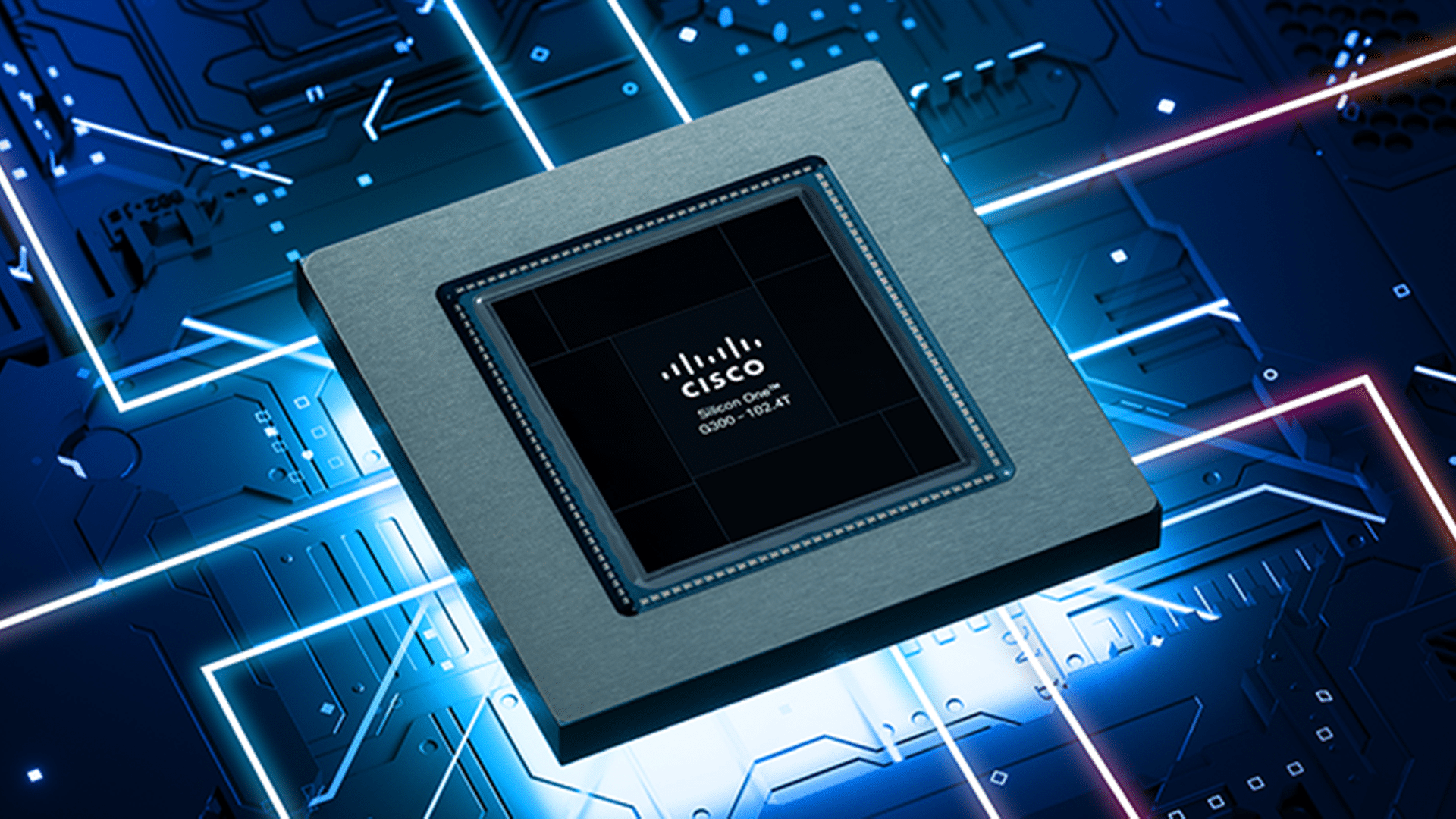
The Cisco Silicon One G300 will power new Cisco N9000 and Cisco 8000 systems that push the frontier of AI networking in the data center. The systems feature innovative liquid cooling and support high-density optics to achieve new efficiency benchmarks and ensure customers get the most out of their GPU investments. In addition, the company enhanced Nexus One to make it easier for enterprises to operate their AI networks — on-premises or in the cloud — removing the complexity that can hold organizations back from scaling AI data centers.
“We are spearheading performance, manageability, and security in AI networking by innovating across the full stack – from silicon to systems and software,” said Jeetu Patel, President and Chief Product Officer, Cisco. “We’re building the foundation for the future of infrastructure, supporting every type of customer—from hyperscalers to enterprises—as they shift to AI-powered workloads.”
“As AI training and inference continues to scale, data movement is the key to efficient AI compute; the network becomes part of the compute itself. It’s not just about faster GPUs – the network must deliver scalable bandwidth and reliable, congestion-free data movement,” said Martin Lund, Executive Vice President of Cisco’s Common Hardware Group. “Cisco Silicon One G300, powering our new Cisco N9000 and Cisco 8000 systems, delivers high-performance, programmable, and deterministic networking – enabling every customer to fully utilize their compute and scale AI securely and reliably in production.”
The networking industry reaction to Cisco’s newest ASIC has been largely positive, with industry analysts and partners highlighting its role in reclaiming Cisco’s dominance in the AI infrastructure market. For example, Brendan Burke of Futurium thinks Cisco’s Silicon One G300 could be the backbone of Agentic AI Inference. His take: “Cisco’s latest announcements represent a calculated move to assert dominance in the AI networking fabric by attacking the specific bottlenecks of GPU cluster efficiency. As AI workloads shift toward agentic inference, where autonomous agents continuously interact across distributed environments, the network must handle unpredictable traffic patterns, unlike the structured flows of traditional training. Cisco is leveraging its vertical integration strategy to address the reliability and power constraints that plague these massive clusters. By emphasizing programmable silicon and rigorous optic qualification, Cisco aims to decouple network lifespan from rapid GPU innovation cycles, ensuring infrastructure can adapt to new traffic steering algorithms without hardware replacements. The G300 is a bid to make Ethernet the undisputed standard for AI back-end networks.”
- Industry-Leading Specs: Market analysts have noted that the G300’s 102.4 Tbps switching capacity sets a new benchmark for AI scale-out and scale-across networking.
- Efficiency Gains: Initial simulations showing a 28% reduction in job completion time (JCT) and a 33% increase in network utilization have been cited as major differentiators for large-scale AI clusters.
- Sustainability Focus: The shift toward liquid-cooled systems for the G300, which offers 70% greater energy efficiency per bit, is being viewed as a critical move for sustainable AI growth.
- Competitive Positioning: Experts from HyperFRAME Research suggest that the new silicon signals a “new confidence” from Cisco, positioning them as the “Apple of infrastructure” by tightly integrating hardware and software.
- AI Infrastructure Pivot: Financial analysts at Seeking Alpha have upgraded Cisco’s outlook, viewing the company no longer as just a legacy hardware firm but as a central player in the AI revolution.
- Partner Confidence: Major partners, such as Shanghai Lichan Technology, have expressed excitement about the Nexus 9100 Series powered by this silicon, specifically for its ability to simplify and scale AI deployments.
- Nvidia & Broadcom Competition: While the G300 is seen as a strong challenger to Nvidia’s Spectrum-X and Broadcom’s Tomahawk/Jericho lines, some observers note that Cisco still faces a steep climb to regain market share lost to these competitors in recent years.
- Complexity Concerns: Some industry veterans have pointed out that while the silicon is “hyperscale ready,” the success of these ASICs in the enterprise will depend on Cisco’s ability to maintain operational simplicity through tools like the Nexus Dashboard.
……………………………………………………………………………………………………………………………………………………………………………………………
|
Cisco Silicon One G300
|
Broadcom Tomahawk 6 (BCM78910 Series)
|
|---|---|
|
Bandwidth
102.4 Tbps  |
Bandwidth
102.4 Tbps  |
|
Manufacturing Process
TSMC 3nm  |
Manufacturing Process
3nm technology |
|
SerDes Lanes & Speed
512 lanes at 200 Gbps per link  |
SerDes Lanes & Speed
512 lanes at 200 Gbps per link, or 1024 lanes at 100G |
|
Port Configuration
Up to 64 x 1.6TbE ports or 512 x 200GbE ports |
Port Configuration
Up to 64 x 1.6TbE ports or 512 x 200GbE ports |
|
Target AI Cluster Size
Supports deployments of up to 128,000 GPUs |
Target AI Cluster Size
Supports over 100,000 XPUs (accelerators) Broadcom |
- Congestion Management: Cisco differentiates its G300 with an “Intelligent Collective Networking” approach featuring a fully shared packet buffer and a load-balancing agent that communicates across all G300s in the network to build a global map of congestion. Broadcom’s Tomahawk series also includes smart congestion control and global load balancing, though Cisco claims its implementation achieves higher network utilization (33% better).
- Programmability: Cisco emphasizes P4 programmability, allowing customers to update network functionality even after deployment.
- Ecosystem & Integration: Broadcom operates primarily in the merchant silicon market, with their chips used by various partners like HPE Juniper Networking. Cisco uses its own silicon to power its
Nexus 9000 and 8000 Series switches, tightly integrating hardware with software management platforms like Nexus One for a unified solution.
- Cooling Solutions: The Cisco G300 is designed to support high-density optics and is offered in new systems that include liquid-cooled options, providing 70% greater energy efficiency per bit compared to previous generations.
………………………………………………………………………………………………………………………………………………………………………………
References:
https://newsroom.cisco.com/c/r/newsroom/en/us/a/y2026/m02/cisco-announces-new-silicon-one-g300.html
https://blogs.cisco.com/sp/cisco-silicon-one-g300-the-next-wave-of-ai-innovation
Will Cisco’s Silicon One G300 Be the Backbone of Agentic Inference?
Analysis: Ethernet gains on InfiniBand in data center connectivity market; White Box/ODM vendors top choice for AI hyperscalers
Cisco CEO sees great potential in AI data center connectivity, silicon, optics, and optical systems
Networking chips and modules for AI data centers: Infiniband, Ultra Ethernet, Optical Connections
Nvidia enters Data Center Ethernet market with its Spectrum-X networking platform
Will AI clusters be interconnected via Infiniband or Ethernet: NVIDIA doesn’t care, but Broadcom sure does!
Telecom operators investing in Agentic AI while Self Organizing Network AI market set for rapid growth
Telecom companies are planning to use Agentic AI [1.] for customer experience and network automation. A recent RADCOM survey shows 71% of network operators plan to deploy agentic AI in 2026, while 14% have already begun, prioritizing areas that directly influence trust and customer satisfaction: security and fraud prevention (57%) and customer service and support (56%). The top use cases are automated customer complaint resolution and autonomous fault resolution.
Operators are betting on agentic AI to remove friction before customers feel it, with the highest-value use cases reflecting this shift, including:
- 57% – automated customer complaint resolution
- 54% – autonomous fault resolution before it impacts service
- 52% – predicting experience to prevent churn
This technology is shifting networks from simply detecting issues to preventing them before customers notice. In contact centers, 2026 is expected to see a rise in human and AI agent collaboration to improve efficiency and customer service.
Note 1. Agentic AI refers to autonomous artificial intelligence systems that can perceive, reason, plan, and act independently to achieve complex goals with minimal human intervention, going beyond simple command-response to manage multi-step tasks, use various tools, and adapt to new information for proactive automation in dynamic environments. These intelligent agents function like digital coworkers, coordinating internally and with other systems to execute sophisticated workflows.
……………………………………………………………………………………………………………………………………………………………………………………………
ResearchAndMarkets.com has just published a “Self-Organizing Network Artificial Intelligence (AI) Global Market Report 2025.” The market research firm says that the self-organizing network AI [2.] is forecast to expand from $5.19 billion in 2024 to $6.18 billion in 2025, at a CAGR of 19.2%. This surge is driven by the integration of machine learning and AI in telecom networks, smart network management investment, and the growing demand for features like self-healing and self-optimization, as well as predictive maintenance technologies.driven by the expansion of 5G, increasing automation demands, and AI integration for network optimization. Opportunities include AI-driven RRM and predictive maintenance. Asia-Pacific emerges as the fast-growing region, boosting telecom innovations amid global trade shifts.
Note 2. Self-organizing network AI leverages software, hardware, and services to dynamically optimize and manage telecom networks, applicable across various network types and deployment modes. The market encompasses a broad range of solutions, from network optimization software to AI-driven planning products, underscoring its expansive potential.

Looking further ahead, the market is expected to reach $12.32 billion by 2029, with a CAGR of 18.8%. Key drivers during this period include heightened demand for automation, increased 5G deployments, and growing network densification, accompanied by rising data traffic and subscriber numbers. Trends such as AI-driven network automation advancements, machine learning integration for real-time optimization, and the rise of generative AI for analytics are reshaping the landscape.
The expansion of 5G networks plays a pivotal role in propelling this growth. These networks, characterized by high-speed data and ultra-low latency, significantly enhance the capabilities of self-organizing network AI. The integration facilitates real-time data processing, supporting automation, optimization, and predictive maintenance, thereby improving service quality and user experience. A notable development in 2023 saw UK outdoor 5G coverage rise to 85-93%, reflecting growing demand and technological advancement.
Huawei Technologies and other major tech companies, are pioneering innovative solutions like AI-driven radio resource management (RRM), which optimizes network performance and enhances user experience. These solutions rely on AI and machine learning for dynamic spectrum and network resource management. For instance, Huawei’s AI Core Network, introduced at MWC 2025, marks a substantial leap in intelligent telecommunications, integrating AI into core systems for seamless connectivity and real-time decision-making.
Strategic acquisitions are also shaping the market, exemplified by Amdocs Limited acquiring TEOCO Corporation in 2023 to bolster its network optimization and analytics capabilities. This acquisition aims to enhance end-to-end network intelligence and operational efficiency.
Leading players in the market include Huawei, Cisco Systems Inc., Qualcomm Incorporated, and many others, driving innovation and competition. Europe held the largest market share in 2024, with Asia-Pacific poised to be the fastest-growing region through the forecast period.
References:
Operator Priorities for 2026 and Beyond: Data, Automation, Customer Experience
https://uk.finance.yahoo.com/news/self-organizing-network-artificial-intelligence-105400706.html
Ericsson integrates agentic AI into its NetCloud platform for self healing and autonomous 5G private network
Agentic AI and the Future of Communications for Autonomous Vehicles (V2X)
IDC Report: Telecom Operators Turn to AI to Boost EBITDA Margins
Omdia: How telcos will evolve in the AI era
Palo Alto Networks and Google Cloud expand partnership with advanced AI infrastructure and cloud security
Ericsson integrates Agentic AI into its NetCloud platform for self healing and autonomous 5G private networks
Ericsson is integrating Agentic AI into its NetCloud platform to create self-healing and autonomous 5G private (enterprise) networks. This initiative upgrades the existing NetCloud Assistant (ANA), a generative AI tool, into a strategic partner capable of managing complex workflows and orchestrating multiple AI agents. The agentic AI agent aims to simplify private 5G adoption by reducing deployment complexity and the need for specialized administration. This new agentic architecture allows the new Ericsson system to interpret high-level instructions and autonomously assign tasks to a team of specialized AI agents.
Key AI features include:
- Agentic organizational hierarchy: ANA will be supported by multiple orchestrator and functional AI agents capable of planning and executing (with administrator direction). Orchestrator agents will be deployed in phases, starting with a troubleshooting agent planned in Q4 2025, followed by configuration, deployment, and policy agents planned in 2026. These orchestrators will connect with task, process, knowledge, and decision agents within an integrated agentic framework.
- Automated troubleshooting: ANA’s troubleshooting orchestrator will include automated workflows that address the top issues identified by Ericsson support teams, partners, and customers, such as offline devices and poor signal quality. Planned to launch in Q4 2025, this feature is expected to reduce downtime and customer support cases by over 20 percent.
- Multi-modal content generation: ANA can now generate dynamic graphs to visually represent trends and complex query results involving multiple data points.
- Explainable AI: ANA displays real-time process feedback, revealing steps taken by AI agents in order to enhance transparency and trust.
- Expanded AIOps insights: NetCloud AIOps will be expanded to provide isolation and correlation of fault, performance, configuration, and accounting anomalies for Wireless WAN and NetCloud SASE. For Ericsson Private 5G, NetCloud is expected to provide service health analytics including KPI monitoring and user equipment connectivity diagnostics. Planned availability Q4 2025.


Manish Tiwari, Head of Enterprise 5G, Ericsson Enterprise Wireless Solutions, adds: “With the integration of Ericsson Private 5G into the NetCloud platform, we’re taking a major step forward in making enterprise connectivity smarter, simpler, and adaptive. By building on powerful AI foundations, seamless lifecycle management, and the ability to scale securely across sites, we are providing flexibility to further accelerate digital transformation across industries. This is about more than connectivity: it is about giving enterprises the business-critical foundation they need to run IT and OT systems with confidence and unlock the next wave of innovation for their businesses.”
Pankaj Malhotra, Head of WWAN & Security, Ericsson Enterprise Wireless Solutions, says: “By introducing agentic AI into NetCloud, we’re enabling enterprises to simplify deployment and operations while also improving reliability, performance, and user experience. More importantly, it lays the foundation for our vision of fully autonomous, self-optimizing 5G enterprise networks, that can power the next generation of enterprise innovation.”
Agentic AI and the Future of Communications for Autonomous Vehicle (V2X)
Ericsson completes Aduna joint venture with 12 telcos to drive network API adoption
Ericsson reports ~flat 2Q-2025 results; sees potential for 5G SA and AI to drive growth
Ericsson revamps its OSS/BSS with AI using Amazon Bedrock as a foundation
Ericsson’s sales rose for the first time in 8 quarters; mobile networks need an AI boost
Agentic AI and the Future of Communications for Autonomous Vehicles (V2X)
by Prashant Vajpayee (bio below), edited by Alan J Weissberger
Abstract:
Autonomous vehicles increasingly depend on Vehicle-to-Everything (V2X) communications, but 5G networks face challenges such as latency, coverage gaps, high infrastructure costs, and security risks. To overcome these limitations, this article explores alternative protocols like DSRC, VANETs, ISAC, PLC, and Federated Learning, which offer decentralized, low-latency communication solutions.
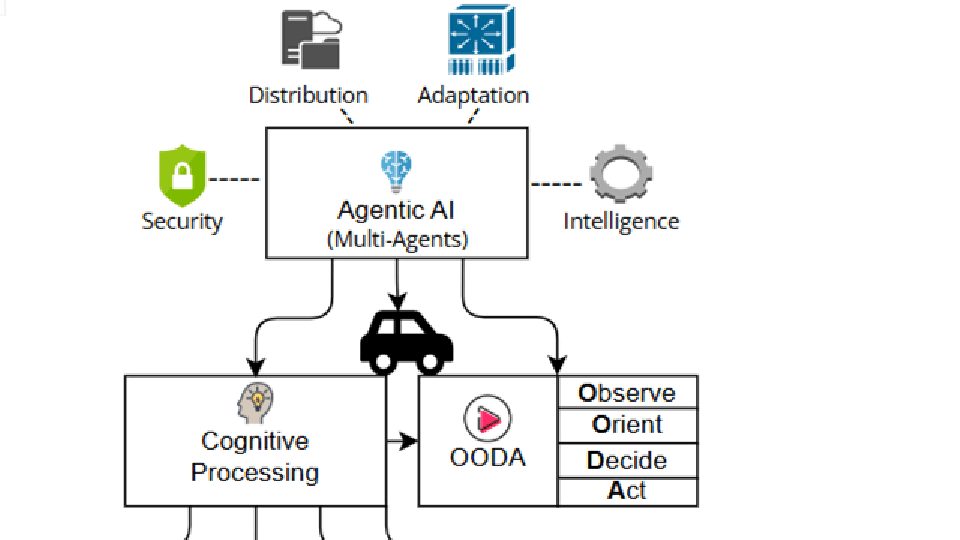
Of critical importance for this approach is Agentic AI—a distributed intelligence model based on the Object, Orient, Decide, and Act (OODA) loop—that enhances adaptability, collaboration, and security across the V2X stack. Together, these technologies lay the groundwork for a resilient, scalable, and secure next-generation Intelligent Transportation System (ITS).
Problems with 5G for V2X Communications:
There are several problems with using 5G for V2X communications, which is why the 5G NR (New Radio) V2X specification, developed by the 3rd Generation Partnership Project (3GPP) in Release 16, hasn’t been widely implemented. Here are a few of them:
- Variable latency: Even though 5G promises sub-milliseconds latency, realistic deployment often reflects 10 to 50 milliseconds delay, specifically V2X server is hosted in cloud environment. Furthermore, multi-hop routing, network slicing, and delay in handovers cause increment in latency. Due to this fact, 5G becomes unsuitable for ultra-reliable low-latency communication (URLLC) in critical scenarios [1, 2].
- Coverage Gaps & Handover Issues: Availability of 5G network is a problem in rural and remote areas. Furthermore, in fast moving vehicle, switching between 5G networks can cause delays in communication and connectivity failure [3, 4].
- Infrastructure and Cost Constraint: The deployment of full 5G infrastructure requires dense small-cell infrastructure, which cost burden and logistically complex solution especially in developing regions and along highways.
- Spectrum Congestion and Interference: During the scenarios of share spectrum, other services can cause interference in realm of 5G network, which cause degradation on V2X reliability.
- Security and Trust Issues: Centralized nature of 5G architectures remain vulnerable to single point of failure, which is risky for autonomous systems in realm of cybersecurity.
Alternative Communications Protocols as a Solution for V2X (when integrated with Agentic AI):
The following list of alternative protocols offers a potential remedy for the above 5G shortcomings when integrated with Agentic AI.
|
While these alternatives reduce dependency on centralized infrastructure and provide greater fault tolerance, they also introduce complexity. As autonomous vehicles (AVs) become increasingly prevalent, Vehicle-to-Everything (V2X) communication is emerging as the digital nervous system of intelligent transportation systems. Given the deployment and reliability challenges associated with 5G, the industry is shifting toward alternative networking solutions—where Agentic AI is being introduced as a cognitive layer that renders these ecosystems adaptive, secure, and resilient.
The following use cases show how Agentic AI can bring efficiency:
- Cognitive Autonomy: Each vehicle or roadside unit (RSU) operates an AI agent capable of observing, orienting, deciding, and acting (OOAD) without continuous reliance on cloud supervision. This autonomy enables real-time decision-making for scenarios such as rerouting, merging, or hazard avoidance—even in disconnected environments [12].
- Multi-Agent Collaboration: AI agents negotiate and coordinate with one another using standardized protocols (e.g., MCP, A2A), enabling guidance on optimal vehicle spacing, intersection management, and dynamic traffic control—without the need for centralized orchestration [13].
- Embedded Security Intelligence: While multiple agents collaborate, dedicated security agents monitor system activities for anomalies, enforce access control policies, and quarantine threats at the edge. As Forbes notes, “Agentic AI demands agentic security,” emphasizing the importance of embedding trust and resilience into every decision node [14].
- Protocol-Agnostic Adaptability: Agentic AI can dynamically switch among various communication protocols—including DSRC, VANETs, ISAC, or PLC—based on real-time evaluations of signal quality, latency, and network congestion. Agents equipped with cognitive capabilities enhance system robustness against 5G performance limitations or outages.
- Federated Learning and Self-Improvement: Vehicles independently train machine learning models locally and transmit only model updates—preserving data privacy, minimizing bandwidth usage, and improving processing efficiency.
The figure below illustrates the proposed architectural framework for secure Agentic AI enablement within V2X communications, leveraging alternative communication protocols and the OODA (Observe–Orient–Decide–Act) cognitive model.
Conclusions:
With the integration of an intelligent Agentic AI layer into V2X systems, autonomous, adaptive, and efficient decision-making emerges from seamless collaboration of the distributed intelligent components.
Numerous examples highlight the potential of Agentic AI to deliver significant business value.
- TechCrunch reports that Amazon’s R&D division is actively developing an Agentic AI framework to automate warehouse operations through robotics [15]. A similar architecture can be extended to autonomous vehicles (AVs) to enhance both communication and cybersecurity capabilities.
- Forbes emphasizes that “Agentic AI demands agentic security,” underscoring the need for every action—whether executed by human or machine—to undergo rigorous review and validation from a security perspective [16]. Forbes notes, “Agentic AI represents the next evolution in AI—a major transition from traditional models that simply respond to human prompts.” By combining Agentic AI with alternative networking protocols, robust V2X ecosystems can be developed—capable of maintaining resilience despite connectivity losses or infrastructure gaps, enforcing strong cyber defense, and exhibiting intelligence that learns, adapts, and acts autonomously [19].
- Business Insider highlights the scalability of Agentic AI, referencing how Qualtrics has implemented continuous feedback loops to retrain its AI agents dynamically [17]. This feedback-driven approach is equally applicable in the mobility domain, where it can support real-time coordination, dynamic rerouting, and adaptive decision-making.
- Multi-agent systems are also advancing rapidly. As Amazon outlines its vision for deploying “multi-talented assistants” capable of operating independently in complex environments, the trajectory of Agentic AI becomes even more evident [18].
References:
-
- Coll-Perales, B., Lucas-Estañ, M. C., Shimizu, T., Gozalvez, J., Higuchi, T., Avedisov, S., … & Sepulcre, M. (2022). End-to-end V2X latency modeling and analysis in 5G networks. IEEE Transactions on Vehicular Technology, 72(4), 5094-5109.
- Horta, J., Siller, M., & Villarreal-Reyes, S. (2025). Cross-layer latency analysis for 5G NR in V2X communications. PloS one, 20(1), e0313772.
- Cellular V2X Communications Towards 5G- Available at “pdf”
- Al Harthi, F. R. A., Touzene, A., Alzidi, N., & Al Salti, F. (2025, July). Intelligent Handover Decision-Making for Vehicle-to-Everything (V2X) 5G Networks. In Telecom (Vol. 6, No. 3, p. 47). MDPI.
- DSRC Safety Modem, Available at- “https://www.nxp.com/products/wireless-connectivity/dsrc-safety-modem:DSRC-MODEM”
- VANETs and V2X Communication, Available at- “https://www.sanfoundry.com/vanets-and-v2x-communication/#“
- Yu, K., Feng, Z., Li, D., & Yu, J. (2023). Secure-ISAC: Secure V2X communication: An integrated sensing and communication perspective. arXiv preprint arXiv:2312.01720.
- Study on integrated sensing and communication (ISAC) for C-V2X application, Available at- “https://5gaa.org/content/uploads/2025/05/wi-isac-i-tr-v.1.0-may-2025.pdf“
- Ramasamy, D. (2023). Possible hardware architectures for power line communication in automotive v2g applications. Journal of The Institution of Engineers (India): Series B, 104(3), 813-819.
- Xu, K., Zhou, S., & Li, G. Y. (2024). Federated reinforcement learning for resource allocation in V2X networks. IEEE Journal of Selected Topics in Signal Processing.
- Asad, M., Shaukat, S., Nakazato, J., Javanmardi, E., & Tsukada, M. (2025). Federated learning for secure and efficient vehicular communications in open RAN. Cluster Computing, 28(3), 1-12.
- Bryant, D. J. (2006). Rethinking OODA: Toward a modern cognitive framework of command decision making. Military Psychology, 18(3), 183-206.
- Agentic AI Communication Protocols: The Backbone of Autonomous Multi-Agent Systems, Available at- “https://datasciencedojo.com/blog/agentic-ai-communication-protocols/”
- Agentic AI And The Future Of Communications Networks, Available at- “https://www.forbes.com/councils/forbestechcouncil/2025/05/27/agentic-ai-and-the-future-of-communications-networks/”
- Amazon launches new R&D group focused on agentic AI and robotics, Available at- “Amazon launches new R&D group focused on agentic AI and robotics”
- Securing Identities For The Agentic AI Landscape, Available at “https://www.forbes.com/councils/forbestechcouncil/2025/07/03/securing-identities-for-the-agentic-ai-landscape/”
- Qualtrics’ president of product has a vision for agentic AI in the workplace: ‘We’re going to operate in a multiagent world’, Available at- “https://www.businessinsider.com/agentic-ai-improve-qualtrics-company-customer-communication-data-collection-2025-5”
- Amazon’s R&D lab forms new agentic AI group, Available at- “https://www.cnbc.com/2025/06/04/amazons-rd-lab-forms-new-agentic-ai-group.html”
- Agentic AI: The Next Frontier In Autonomous Work, Available at- “https://www.forbes.com/councils/forbestechcouncil/2025/06/27/agentic-ai-the-next-frontier-in-autonomous-work/”
About the Author:

Prashant Vajpayee is a Senior Product Manager and researcher in AI and cybersecurity, with expertise in enterprise data integration, cyber risk modeling, and intelligent transportation systems. With a foundation in strategic leadership and innovation, he has led transformative initiatives at Salesforce and advanced research focused on cyber risk quantification and resilience across critical infrastructure, including Transportation 5.0 and global supply chain. His work empowers organizations to implement secure, scalable, and ethically grounded digital ecosystems. Through his writing, Prashant seeks to demystify complex cybersecurity as well as AI challenges and share actionable insights with technologists, researchers, and industry leaders.