

Private Mobile Networks
Dell’Oro: Private Wireless Revenue Growth Prospects and Challenges
Executive Summary:
Dell’Oro Group just published its 2Q26 Private Wireless Report [1.]. The latest findings support the premise that the momentum is slowing, particularly in the enterprise campus segment, prompting another downward revision to their forecast.
Note 1. Dell’Oro Group explicitly measures Private Wireless RAN revenue. I believe they are referring ONLY to the cellular RAN equipment market, rather than a Wi-Fi LAN or conventional WAN market. However, private cellular deployments may coexist with Wi-Fi, and the RAN revenue measure should not be presented as total private-network spending.
“Private wireless continues to grow, but the market is developing more slowly than initially anticipated,” said Stefan Pongratz, Vice President at the Dell’Oro Group. “The divergence between campus and wide-area deployments is becoming more pronounced. While enterprise adoption remains gradual, demand for larger and more demanding wide-area networks is providing an important source of growth. We remain optimistic about the broader long-term private 5G/6G opportunity, though the adoption curve is clearly more gradual than initially expected.”
Private Wireless RAN revenue increased at a mid-single-digit rate in 1H26, down from the double-digit growth recorded in 2025. The slowdown is more pronounced in the Campus Network segment. Meanwhile, Wide-Area private wireless grew at a double-digit rate, reflecting stronger momentum in larger, mission-critical networks.
Supplier concentration remains high. Huawei continues to lead globally, while Nokia and Ericsson dominate outside China. The top five suppliers accounted for approximately 95% of Private Wireless RAN revenue in the first half of 2026. Despite slowing growth and downward forecast revisions, private wireless remains one of the stronger growth opportunities within the broader RAN market, which is expected to remain relatively flat. Private Wireless RAN revenue is projected to grow at a 10 to 13 percent CAGR over the next five years [2.].
Note 2. The 10–13% CAGR is a forecast, not an observed growth rate. The reported mid-single-digit growth in 1H2026 indicates near-term deceleration, while the latest forecast revision signals that the adoption trajectory remains less favorable than previously expected.

Dell’Oro’s message has not changed. Private wireless remains a largely untapped growth opportunity, but broader adoption is proving slower and more challenging than expected. The opportunity is increasingly shifting toward larger, wide-area and mission-critical deployments, while the enterprise campus segment continues to face headwinds. Private wireless network revenues are expected to account for 5 to 10% of total RAN revenues by 2030.
Analysis- Private Cellular Growth Prospects and Adoption Barriers:
Dell’Oro’s findings highlight an important distinction between the growth of private cellular RAN equipment revenue and the broader adoption of private wireless networking. The projected 10–13% CAGR over five years is attractive relative to a largely flat overall RAN market, but it starts from a comparatively small revenue base and follows another downward forecast revision. A double-digit growth rate therefore does not, by itself, establish that private wireless will become a major RAN revenue contributor.
Several factors help explain the slower-than-expected enterprise campus adoption. Private LTE/5G networks must compete with mature, less expensive Wi-Fi solutions that already meet many enterprise connectivity requirements. Additional obstacles include deployment and integration costs, spectrum availability, a limited ecosystem of compatible industrial devices, and the expertise required to operate cellular networks. Private 5G is most compelling where coverage, mobility, reliability, security, or predictable performance justify the additional investment.
The relative strength of wide-area deployments is consistent with the requirements of utilities, transportation systems, public safety, ports, mines, and other geographically extensive or mission-critical operations. These applications can justify dedicated cellular infrastructure where conventional Wi-Fi is impractical or insufficient.
The key question is whether private cellular can move beyond specialized industrial and mission-critical applications into repeatable, economically attractive enterprise deployments. Simpler turnkey solutions, lower total cost of ownership, and stronger integration with existing IT and operational technology networks will be important to expanding the addressable market. For RAN suppliers, private wireless represents a credible growth opportunity, but its commercial scale and timing remain uncertain.
References:
Private Wireless RAN Growth Slows to Mid-Single Digits in 1H26, According to Dell’Oro Group
Private 5G’s Business Model Shifts: Ericsson’s Move Signals a Market Reset
Nokia’s ECE Divestiture: Impact on Private 5G Market & Disaggregation
Dell’Oro: 6G RAN Capex to reach $500 billion by 2034 + Counterpoint
SNS Telecom & IT: Private 5G for the Defense Sector to hit $2.5 Billion by 2029
5G infrastructure moves from coverage and speeds to cloud-native, orchestration, automation and AI-assisted networks
SNS Telecom & IT: Private 5G Market to Reach $6.6 Billion as Physical AI Takes Hold
GSA: Global private mobile networks exceed 2,000 worldwide; Ericsson Private 5G from Verizon Business extends beyond U.S.
SNS Telecom & IT: Mission-Critical Networks a $9.2 Billion Market
Dell’Oro: Fixed Wireless Access revenues +10% in 2025 & will continue to grow 10% annually through 2029
Dell’Oro: RAN revenue growth in 1Q2025; AI RAN is a conundrum
Dell’Oro: Global RAN Market to Drop 21% between 2021 and 2029
Ericsson leads SK Telecom AI RAN vs. NVIDIA’s GPU centric AI RAN Alliance
AT&T/Ericsson Demonstrate 5G-Based ISAC for Drone Detection at World Cup Stadium
AI-RAN and Agentic AI get real: Ericsson, Nokia, Verizon & other operators enter into a new network automation era
Analysis: Ericsson’s leading role in French INTENTION 6G project
Ericsson’s June 2026 Mobility Report Highlights + AI impact on network traffic
Private 5G’s Business Model Shifts: Ericsson’s Move Signals a Market Reset
Following in the footsteps of Nokia’s sale of its Enterprise Campus Edge (ECE) business to AURELIUS, Ericsson is dissolving its Enterprise Wireless Solutions business as a standalone business unit, while retaining its portfolio. Neutral-host solutions and Ericsson Private 5G will move into Business Area Networks, where management expects greater R&D scale and a faster route to profitability. Cradlepoint’s wireless-WAN business will remain standalone within Ericsson’s Americas organization.
The transfer of Ericsson’s Enterprise Wireless Solutions will include both its private 5G and neutral-host portfolios—segments recently positioned as potential sources of growth as operators’ core 5G spending matured. That growth case has yet to materialize: Ericsson reported in its Q3 review that Enterprise sales rose only 1% organically year over year, compared with 7% organic growth for the group overall. Reported Enterprise sales fell 10% to SEK 4.6 billion, reflecting the August 2025 divestment of number-portability administrator iconectiv.
The modest organic increase was partly supported by pre-emptive purchasing from cost-conscious customers anticipating higher AI-related pricing. Enterprise adjusted gross margin declined to 50%, also reflecting the iconectiv divestment, while adjusted EBITA was negative SEK 0.5 billion—though it improved sequentially.
The restructuring therefore signals portfolio rationalization rather than an outright exit from private 5G. It also underscores the gap between the strategic promise of enterprise wireless and its current contribution: Enterprise accounted for about 8% of group revenue in the quarter, with limited organic momentum and continued profitability challenges.
Chafic Nassif, currently Head of Market Area North East Asia and Andres Vicente, Head of Market Area South East Asia, Oceania and India, will support the formation of the new unit and hand over responsibilites on December 31, 2026. New Ericsson CEO Per Narvinger (took over from Bjore Ekholm on October 1st) said:
“Chafic has been with Ericsson for more than sixteen years and has contributed greatly to the Company in the different roles he has had across Europe, Latin America and Asia. I especially want to thank him for his time on the Executive Team where he has played an important role for our business in North East Asia,” and continues. Andres has a deep understanding of commercial aspects of our industry where he has drawn on his extensive experience from working in Europe and Asia. He has been important in the development of our position in the market area. I would like to extend my gratitude for his efforts.”
“We are strengthening our focus on seamless connectivity and want to make sure that we can offer a rich portfolio that leverages the full R&D competence in the company and meets both CSP and Enterprise demand. Åsa has been instrumental in creating new channels to Enterprises for our portfolio, which now enables us to take the next step in developing our indoor and Enterprise business. She has also been an important change leader in the company, serving on the Executive Team and successfully leading multiple businesses since 2018. I am grateful for her many contributions.”

Deep Dive Analysis:
Ericsson’s move is a portfolio rationalization, not an exit from private 5G. By folding Ericsson Private 5G and Neutral Host into Business Area Networks, the company is signaling that standalone enterprise-wireless economics were insufficient and that these products must borrow scale, R&D, channels, and indoor-connectivity assets from the core RAN business.
Before & After Table via Perplexity.ai:
| Dimension | Before | After |
|---|---|---|
| Organizational home | Enterprise Wireless Solutions business area | Business Area Networks |
| Product focus | Enterprise-specific private 5G and neutral-host offerings | Integrated with indoor technology and core RAN development ericsson+1 |
| Strategic rationale | Dedicated enterprise growth platform | R&D synergies, scale, innovation, and faster profitability theglobeandmail+1 |
| Market signal | Private 5G as a distinct enterprise business | Private 5G as an extension of network infrastructure lightreading+1 |
Implications for private 5G market:
-
The market is consolidating around infrastructure economics. Ericsson is treating private 5G less as a vertically separate enterprise software business and more as a product line that can reuse RAN silicon, radio platforms, network-management software, and indoor systems. That should reduce duplicated development but may narrow product differentiation.ericsson+1
-
Expect tighter product-roadmap discipline. Private 5G and neutral-host capabilities will now compete for R&D and commercial priority inside a division whose primary revenue engine remains macro RAN. Ericsson says the units will retain full focus on customers and partners, but integration naturally raises the risk that niche enterprise requirements receive less dedicated investment.ericsson+1
-
Neutral host gains strategic relevance. Moving Neutral Host alongside indoor technology suggests Ericsson sees shared infrastructure—coverage for multiple operators in venues, campuses, and enterprise sites—as a more scalable route than purely standalone private networks. This aligns private wireless with in-building coverage, capacity offload, and operator monetization.ericsson+1
-
Profitability becomes the near-term test. Ericsson explicitly frames the transfer as a way to “accelerate the journey towards profitability,” an implicit acknowledgment that the enterprise-wireless structure had not delivered the expected returns. Customers and partners should expect more selective deal pursuit, standardized offerings, and less willingness to fund bespoke deployments.theglobeandmail+1
Competitive consequences:
Ericsson’s move contrasts with Nokia’s decision to sell its Enterprise Campus Edge business to Aurelius and operate it as a standalone company. The two vendors are therefore taking opposite structural approaches: Nokia is separating enterprise private wireless from its core business, while Ericsson is embedding it more deeply in Networks. That divergence could reshape vendor positioning:
-
Ericsson may become stronger where private 5G is sold as part of a broader RAN, indoor, and operator-managed infrastructure package.
-
Smaller private-network specialists may gain opportunities where enterprises want dedicated roadmaps, flexible commercial models, or rapid customization.
-
Neutral-host deployments could become a more prominent competitive arena, especially for venues and large campuses where shared infrastructure improves the business case.
Conclusions:
The transfer validates a sobering conclusion: private 5G has not become a self-sustaining, high-growth enterprise category at the scale once projected. Ericsson is preserving the technology but removing the standalone business structure, effectively betting that private and neutral-host 5G will succeed only when treated as part of the broader mobile-network and indoor-connectivity stack. Ericsson’s asset transfer is less an organizational footnote than evidence that private 5G’s commercial model is entering a more disciplined, infrastructure-led phase.
-
Private 5G remains strategically relevant but commercially immature. Ericsson’s decision to retain the portfolio while dissolving its dedicated business area indicates that the technology has a role, but not yet the standalone revenue scale or margin profile required to justify an independent operating unit.theglobeandmail+1
-
The market is shifting from “private networks as a product” to “private connectivity as infrastructure.” The strongest near-term business cases are likely to be tied to RAN modernization, indoor coverage, neutral-host deployments, mission-critical connectivity, and operator-managed services—not isolated enterprise LAN replacements.
-
Neutral host may be the more durable growth vector. Its inclusion in Networks alongside indoor technology suggests Ericsson sees shared, multi-operator infrastructure as better aligned with venue economics, capacity monetization, and recurring service revenue than purely private single-enterprise networks.ericsson+1
-
Vendor consolidation is likely to continue. If Ericsson and Nokia are both restructuring their private-wireless operations—Ericsson by integration and Nokia through divestiture—smaller specialists will face pressure to demonstrate differentiated technology, vertical expertise, or superior unit economics.
-
Customers should expect more standardized, ecosystem-led offerings. Ericsson’s stated emphasis on scale, R&D synergies, and profitability implies fewer bespoke deployments and greater reliance on partners, system integrators, and repeatable enterprise solutions.theglobeandmail+1
-
The next proof point is execution, not organizational design. The restructuring will succeed only if Ericsson can translate RAN scale and indoor assets into faster private-5G sales cycles, lower delivery costs, and sustained profitability; otherwise, the portfolio risks becoming a low-priority adjunct to the core Networks business.
“With the development of AI, many new applications are going to be dependent on mobile connectivity. Networks will need to be more reliable and resilient. With AI models optimized for use cases, leveraging Ericsson’s purpose-built silicon, we [will help] customers get more out of their spectrum assets without increasing power consumption. We will continue to invest and make sure we stay at the forefront of this development. At the same time, we remain realistic about the market. The RAN market is broadly flat and component costs are increasing in the wake of the AI boom. We’ve been able to mitigate this with tactical actions such as product substitution and upselling. [But] these efforts will not be enough long-term.”
“We are also taking structural action, including portfolio optimization, raising prices, supply chain measures, and efficiency improvements. Many customer contracts are multi-year, so structural mitigations will take time to flow through. We will not be immune to higher component costs, but protecting the value of our technology and profitability of our mobile networks business remains our top priority.”
“The area where we have more work to do, of course, is in the enterprise segment,” said Narvinger in a Q&A on the Q3 earnings call. “We will dissolve the business, as such, but continue with the portfolio and solutions… We are moving neutral host and [private 5G] to networks, where we can get the better R&D muscle, and then also accelerate towards profitability.”
“Satellite will be a fantastic addition to terrestrial networks. What will be important is to have seamless connectivity between outdoor and indoor. That’s going to be one of the challenges – how to take the outdoor coverage indoors. That seamless high performing experience is going to be very, very important. That’s also one of the reasons we are consolidating our R&D efforts in the indoor segment, [moving] our enterprise wireless business into networks.”
References:
https://rcrwireless.com/20261015/network-infrastructure/ericsson-retools-in-flat-market
Nokia’s ECE Divestiture: Impact on Private 5G Market & Disaggregation
4.8 GHz to 4.9 GHz frequency band uses & Verizon Wireless experimental license for testing ISAC with Ericsson
Ericsson and MediaTek Demonstrate 3GPP-Based GNSS RTK Positioning with Sub-30cm Accuracy Over a Commercial 5G Network
AT&T’s 600 MHz Deployment with Ericsson: Turning Low-Band Spectrum Into Coverage and Uplink Capacity
Ericsson leads SK Telecom AI RAN vs. NVIDIA’s GPU centric AI RAN Alliance
AT&T/Ericsson Demonstrate 5G-Based ISAC for Drone Detection at World Cup Stadium
AI-RAN and Agentic AI get real: Ericsson, Nokia, Verizon & other operators enter into a new network automation era
Analysis: Ericsson’s leading role in French INTENTION 6G project
Ericsson’s June 2026 Mobility Report Highlights + AI impact on network traffic
GSA: Global private mobile networks exceed 2,000 worldwide; Ericsson Private 5G from Verizon Business extends beyond U.S
Optus and Ericsson achieve 180MHz across 2.3GHz and 3.5GHz bands using carrier aggregation on a live 5G SA network
Ericsson reports 10% drop in 1st quarter sales; targets network growth
Nokia’s ECE Divestiture: Impact on Private 5G Market & Disaggregation
Executive Summary:
On October 13th, Nokia said it will sell its Enterprise Campus Edge (ECE) business to AURELIUS, a private-equity investor focused on corporate carve-outs. The planned transaction is expected to close in the first half of 2027, subject to customary closing conditions. Financial terms were not disclosed.
ECE is a substantial part of Nokia’s enterprise private-wireless franchise. Its portfolio spans private LTE and 5G networking through the Digital Automation Cloud, industrial edge and micro-edge computing, industrial devices, and software applications for AI-enabled industrial use cases.
Nokia’s ECE business serves nearly 900 enterprise customers in manufacturing, mining, logistics, airports, ports, and power generation. Its digitalization platform connects industrial assets and processes operational-technology (OT) data on premises, positioning data security, sovereignty, automation, worker safety, and sustainability as core value propositions. The unit reportedly employs about 1,000 people and generates more than €170 million in annual revenue, yet Nokia concluded that its enterprise-campus economics did not fit its post-restructuring priorities in fixed networks, mobile infrastructure, defense, data centers, and AI.
Strategic Rationale:
For Nokia, the sale is consistent with its stated objective of concentrating capital and resources on businesses where it believes it can achieve the greatest long-term differentiation and value creation. Nokia Chief Corporate Development Officer Konstanty Owczarek characterized the divestment as portfolio sharpening, while emphasizing continuity for ECE customers and employees during the transition.
For AURELIUS, the attraction is a globally deployed private-5G and industrial-edge platform with an established enterprise customer base, including Fortune 500 accounts. Fabian Steger, Managing Director of AURELIUS Funds IV and V, said the firm sees scope to expand ECE’s position in private 5G and industrial edge, particularly in AI-powered industrial automation.
Operational implications:
ECE will operate as a standalone company under AURELIUS ownership. Nokia said ECE employees are expected to transfer with the business at closing, in accordance with applicable local employment processes, and that the two companies will cooperate to preserve customer and employee continuity.
The carve-out removes a business with meaningful enterprise exposure from Nokia’s portfolio, but it does not signal an exit from enterprise connectivity altogether. Rather, it reflects Nokia’s broader restructuring under CEO Justin Hotard: prioritizing fixed and mobile network infrastructure, defense, and AI-oriented network opportunities, while shedding or reviewing non-core units.
Nokia’s earlier strategic review encompassed ECE alongside FWA CPE, site implementation and outside plant, and microwave radio units—businesses that collectively generated approximately €900 million in revenue and a €100 million operating loss over the preceding 12 months.
Why It Matters:
The transaction underscores a widening split in the private-networks market between diversified infrastructure vendors and specialist operators focused on industrial digitalization. ECE’s on-premises OT edge, private 5G, and industrial AI software assets give AURELIUS a platform positioned for manufacturing automation, mission-critical campus connectivity, and sovereign data processing.
For Nokia, the deal further advances its pivot toward network infrastructure aligned with AI-driven traffic growth, data-center interconnect, optical and IP networking, and defense communications. The company has set a target of raising annual operating profit to €2.7 billion–€3.2 billion by 2028, from €2 billion in 2024.
Private 4G/5G Market Assessment:
Private cellular remains a real and growing market: industry estimates cited by TelecomTV value 4G/5G private networks at about $4 billion in 2025, rising to $7.2 billion by 2028, while Berg Insight projects growth from $2.4 billion in 2025 to $12 billion by 2030. The issue is not demand for deterministic, licensed-spectrum industrial connectivity; it is the cost and complexity of selling, integrating, and supporting highly customized campus networks at scale.
Nokia’s move therefore removes a major end-to-end competitor from the broad enterprise campus segment, but not from private wireless altogether. Nokia says it will continue selling radios for private deployments with Nokia and third-party cores, while retaining mission-critical capabilities in defense, rail, and utility-grid communications.
Market Impact:
The deal should intensify competition among vendors that can deliver private 5G as a repeatable product rather than a systems-integration project. It’s summarized in this table:
| Market segment | Likely effect of Nokia’s ECE sale |
|---|---|
| Enterprise private-5G specialists | Celona, Kajeet, Anterix-adjacent ecosystem players, and similar vendors gain a larger addressable base as ECE becomes a standalone competitor rather than part of a diversified Nokia portfolio. Omdia’s 2026 assessment already treats Celona, Ericsson, HPE, Nokia, Samsung, and ZTE as leading end-to-end private-5G vendors. |
| Mobile operators | Nokia’s reduced direct enterprise engagement may reduce channel conflict with operators selling private 5G to the same factories, ports, and campuses—an issue Fierce Network identifies as part of Nokia’s rationale. |
| Systems integrators |
A private-equity-owned ECE is likely to be more open to third-party radios, cores, edge compute, and integration partners, expanding routes to market for component and software suppliers.
|
| Industrial OT and AI vendors | ECE’s emphasis on on-premises OT data, sovereignty, and AI-enabled automation validates the shift from “private 5G as connectivity” toward private 5G as an industrial automation platform. |
| Hyperscalers and cloud providers | The sale reinforces the view that enterprise edge value is migrating toward application orchestration, data pipelines, and AI workloads—areas where cloud-native entrants can compete without owning the RAN. |
Conclusions:
Nokia’s sale of ECE will likely make the private-5G market more fragmented, more multi-vendor, and more focused on industrial outcomes rather than network equipment alone. That favors AI wireless specialists such as Celona, systems integrators like Kyndryl, and silicon innovators such as EdgeQ—but only if they can convert openness into lower total cost of ownership, faster deployment, and proven operational reliability.
The ECE sale removes one major integrated competitor from the enterprise campus. It does not remove the requirement that private 5G operate with industrial-grade determinism, security, and lifecycle assurance. The near-term risk for ECE is transition uncertainty. Its customers will want assurance that product roadmaps, support arrangements, and contractual commitments survive the ownership change.
Longer term, however, AURELIUS’s stated plan to expand ECE into AI-powered industrial automation could make it a more focused, and potentially more aggressive, competitor in manufacturing, logistics, mining, ports, and energy.
References:
https://www.nokia.com/newsroom/nokia-to-sell-enterprise-campus-edge-business-to-aurelius/
https://www.telecoms.com/telecoms-infrastructure/nokia-sells-off-enterprise-campus-edge-business
SNS Telecom & IT: Private 5G for the Defense Sector to hit $2.5 Billion by 2029
SNS Telecom & IT: Private 5G Market to Reach $6.6 Billion as Physical AI Takes Hold
GSA: Global private mobile networks exceed 2,000 worldwide; Ericsson Private 5G from Verizon Business extends beyond U.S.
Private 5G networks move to include automation, autonomous systems, edge computing & AI operations
OneLayer Raises $28M Series A funding to transform private 5G networks with enhanced security
Verizon partners with Nokia to deploy large private 5G network in the UK
EdgeQ’s breakthrough demos and partnerships showcased at MWC 2024 & MWC 2023
EdgeQ Samples World’s 1st Software-Defined 5G Base Station-on-a-Chip
SoC start-up EdgeQ comes out of stealth mode with 5G/AI silicon for 5G private networks/IIoT
SNS Telecom & IT: Private 5G Market to Reach $6.6 Billion as Physical AI Takes Hold
Private 5G networks are transitioning from limited-scale deployments to a more material segment of the wireless infrastructure market. SNS Telecom & IT estimates that annual spending on private 5G networks will exceed $6.6 billion by 2029, driven by multi-site and multi-national enterprise rollouts supporting industrial automation, “physical AI” systems, and mission-critical communications across both commercial and public-sector domains.
Historically, private cellular deployments remained a niche market during the 2G/3G era, with notable exceptions such as GSM-R for railway communications. The introduction of private LTE in the early 2010s established a foundation for dedicated enterprise connectivity; however, adoption remained constrained by performance limitations and ecosystem maturity. The evolution to 3GPP-defined 5G NPN architectures—both standalone (SNPN) and public network-integrated (PNI-NPN)—is now enabling broader applicability across industrial verticals, with a trajectory that exceeds prior-generation adoption levels. Concurrently, legacy systems such as GSM-R are expected to transition toward 5G-based FRMCS implementations aligned with 3GPP specifications.
From a technical perspective, 5G introduces capabilities that are better aligned with industrial communication requirements than LTE. Enhanced mobile broadband (eMBB), ultra-reliable low-latency communications (URLLC), and massive machine-type communications (mMTC) collectively support higher throughput, sub-10 ms latency targets, improved reliability, and significantly greater device densities. These characteristics enable 5G NPNs to address use cases traditionally served by wired Ethernet or deterministic industrial networks, particularly in scenarios requiring mobility and flexible topology. Additional attributes—including improved coverage per radio node, network slicing, time-sensitive networking (TSN) integration, and enhanced security mechanisms—position private 5G as a viable alternative to interference-prone unlicensed technologies in dense IIoT environments.
Deployment momentum is increasingly visible across manufacturing, logistics, energy, and transportation sectors. Production-grade implementations have demonstrated measurable operational benefits, including reduced downtime, improved safety, and expanded coverage in previously unconnected areas. A common pattern involves the migration of AGV and AMR connectivity from Wi-Fi to private 5G, enabling more deterministic performance and reduced susceptibility to interference. In parallel, private 5G is extending connectivity to challenging industrial zones where wired infrastructure is cost-prohibitive or operationally restrictive. Emerging use cases also include coordinated robotics and edge-controlled automation systems, often described as “physical AI,” where low-latency and reliable connectivity are critical for closed-loop control.
In the public-sector domain, private 5G is gaining traction for mission-critical communications. Applications span defense, public safety, railways, and utilities, where requirements include high availability, secure communications, and support for MCX services (mission-critical push-to-talk, video, and data). The evolution toward 5G-Advanced, as defined in 3GPP Releases 18 through 20, introduces further enhancements relevant to these deployments, including support for reduced channel bandwidth operation in dedicated spectrum, expanded frequency bands, and specific feature sets aligned with FRMCS and mission-critical service requirements.
Geographically, adoption is concentrated in markets with established industrial bases and supportive regulatory frameworks, including North America, Europe, and parts of Asia-Pacific. As enterprises scale digitalization initiatives—encompassing automation, AI-driven operations, and connected workforce applications—private 5G deployments are increasingly moving beyond pilot phases to multi-site, production-grade networks.
SNS Telecom & IT projects a compound annual growth rate of approximately 34% for private 5G investments between 2026 and 2029. Growth is expected to be led by localized enterprise and campus networks, alongside parallel expansion in mission-critical infrastructure. The combination of maturing 3GPP standards, improving device ecosystems, and demonstrated operational benefits is positioning private 5G as a foundational connectivity layer for next-generation industrial and public-sector systems.
References:
https://www.snstelecom.com/private5g
GSA: Global private mobile networks exceed 2,000 worldwide; Ericsson Private 5G from Verizon Business extends beyond U.S.
Private 5G networks move to include automation, autonomous systems, edge computing & AI operations
SNS Telecom & IT: Mission-Critical Networks a $9.2 Billion Market
SNS Telecom & IT: Private 5G Market Nears Mainstream With $5 Billion Surge
SNS Telecom & IT: Private 5G and 4G LTE cellular networks for the global defense sector are a $1.5B opportunity
OneLayer Raises $28M Series A funding to transform private 5G networks with enhanced security
Verizon partners with Nokia to deploy large private 5G network in the UK
GSA: Global private mobile networks exceed 2,000 worldwide; Ericsson Private 5G from Verizon Business extends beyond U.S.
The number of worldwide private mobile networks that are worth more than €100,000 exceeds 2,000, according to the Global mobile Suppliers Association (GSA). Demand is being driven by the growing data, security, digitization and mobility requirements of modern enterprise and government entities. GSA said that at the end of 1Q2026, it had identified 2,003 organizations in 88 countries worldwide that had deployed one or more private mobile networks. The private mobile networks it counted had contract values of more than €100,000 (~$116,000). A further 178 private mobile networks are worth between €50,000 and €100,000, GSA said.
4G-LTE remains the dominant technology, accounting for 1,369 of the customers catalogued by the GSA, but 5G is inching up; 5G is deployed in 974 of the networks, often in conjunction with LTE, but 5G-only networks increased by one percentage point on Q4 2025 to account for 30.3% of customers. GSA said that 76% of the references are non-public and unique. Some industries are cagier than others– in sectors like military and defense, maritime, and the power plants space more than 80% of references are not in the public domain.
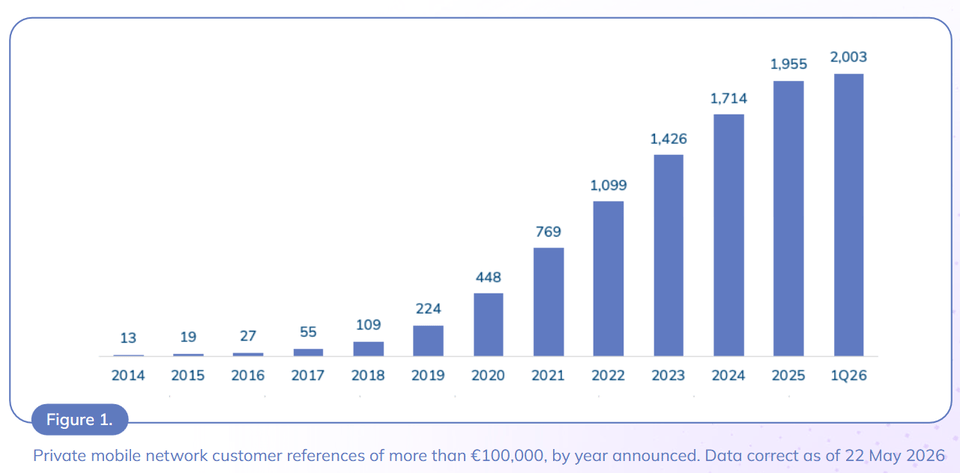
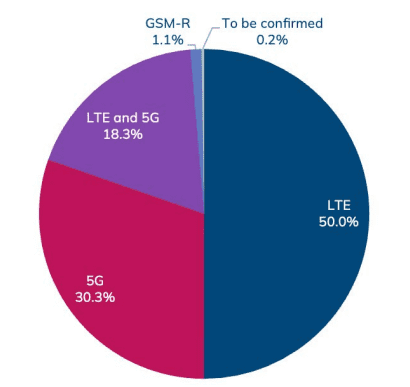
Image Source: GSA
Although the proportion of 5G only deployments makes up a significant number of references (30.3%), it must be noted that this number skews toward long-term trials and deployments within educational and test-bed or validation facilities, with a limited number running real operation in industrial situations.
………………………………………………………………………………………………………………………………………………………………………………………………………….
The top five markets are currently the US, Germany, the UK, China and Japan, but those markets were exceeded in growth terms in the first quarter of 2026 by another market in the top 10; Canada saw the number of customers of private mobile networks grow by 5% in Q1. The UK had the next-highest growth rate at 4%, followed by the US at 2% and Germany at 1%.
China is often reported to have a high number of private networks at more than 40,000, the GSA said. But it believes that many of those networks actually use public mobile networks and therefore do not meet its definition for inclusion in its report.
“As the report clearly shows, a large number and varied range of market participants are actively engaged in developing and delivering solutions for private mobile networks,” said GSA president Joe Barrett, in a statement accompanying the group’s latest Private Mobile Networks publication.
“With so much opportunity, and so many regulators planning initiatives to make spectrum available for LTE and 5G private usage, we expect significant market developments over the next couple of years,” Barrett said. Naturally, there is a strong correlation between the number of private mobile networks in a country and the availability of dedicated spectrum there. In addition, private mobile network deployments are mainly in high-income and upper-middle-income countries, according to the GSA.
The GSA did not specifically mention the high-income Middle Eastern markets in its report summary, but it’s probably safe to assume that countries like Oman will help to drive growth going forward. Port of Salalah in the south of Oman announced the launch of the country’s first fully managed private 5G network in partnership with incumbent telecoms operator Omantel. The network will support automation and accelerate the port’s digital transformation, boosting the efficiency of its logistics operations, it said. And both parties indicated that they expect the deal to kick-start the wider use of private enterprise 5G networks in Oman, looking specifically at ports, logistics and industry.
…………………………………………………………………………………………………………………………………………………………………………………………………………………………………
Ericsson Private 5G is now available through Verizon Business beyond U.S. borders. It’s targeted at global enterprises already using Ericsson technology in Verizon Business Private 5G Networks in the U.S., allowing them to extend it to international campuses. It offers a dual mode 4G and 5G network with global spectrum support
“Verizon Business can offer more optionality and flexibility to its private wireless customers who operate across international borders,” states the press release.
Hannes Ekström, Senior Vice President and Head of Customer Unit Verizon, Ericsson Americas, says: “Enterprises are rapidly embracing digital transformation, leveraging secure and high-performing private 5G networks as a key driver of innovation and efficiency. Our multinational customers in the U.S. have already unlocked significant growth through 5G-enabled private networks, and now they seek to replicate this success globally.”
“Through our collaboration with Verizon, we are expanding the reach of our Ericsson Private 5G solution to support Verizon Business’s international deployments, enabling seamless global operations. By simplifying 5G adoption and enhancing reliability, low latency, and security, we are empowering industries to harness next-generation connectivity and drive innovation on a global scale.”
“Verizon Business is proud of our expanding private wireless portfolio, and we’re committed to providing the best possible private wireless experience to our customers around the world,” said Robb Juliano, Vice President of 5G Acceleration, Verizon Business. “By extending the availability of Ericsson Private 5G outside of the U.S., we’re offering enterprises more flexibility in driving innovation, enhancing security, and optimizing operations with private wireless networks on a global scale.”
References:
https://gsacom.com/technology/private-mobile-networks/
https://gsacom.com/paper/private-mobile-networks-june-2026/
https://www.telecoms.com/5g-6g/private-mobile-networks-exceed-2-000-worldwide
https://www.ericsson.com/en/press-releases/2026/6/ericsson-private-5g-for-verizon-business
Private 5G networks move to include automation, autonomous systems, edge computing & AI operations
SNS Telecom & IT: Private 5G Market Nears Mainstream With $5 Billion Surge
SNS Telecom & IT: Private LTE & 5G Network Ecosystem – CAGR 22% from 2025-2030
SNS Telecom & IT: Mission-Critical Networks a $9.2 Billion Market
Verizon partners with Nokia to deploy large private 5G network in the UK
SNS Telecom & IT: Private 5G and 4G LTE cellular networks for the global defense sector are a $1.5B opportunity
HPE Aruba Launches “Cloud Native” Private 5G Network with 4G/5G Small Cell Radios
SNS Telecom & IT: Private 5G Network market annual spending will be $3.5 Billion by 2027
SNS Telecom & IT: Private 5G and 4G LTE cellular networks for the global defense sector are a $1.5B opportunity
Ericsson integrates Agentic AI into its NetCloud platform for self healing and autonomous 5G private networks