

Optical Transport Market
Impact of optical component shortages & bottlenecks explained + Hyperscaler’s CAPEX
LightCounting’s August 2026 market and component report highlights how severe physical supply shortages for high-speed optical components are reshaping data-center architectures and forcing cloud builders to expand their vendor pools from the traditional 2-3 suppliers up to 5-7 specialized hardware manufacturers. Qualifying and managing all of them is a new challenge.
- Applied Optoelectronics, Macom, and MaxLinear have already reported accelerating growth in Q2 2026 and we expect to see more examples in the upcoming earnings reports.
- Coherent and Lumentum have also reported improvements in growth rates for the last quarter, catching up with Eoptolink and Innolight (reporting at the end of August). Eoptolink has already disclosed a sharp increase in the profits expected for Q2. Accelink and CIG also report sharply higher profits.
- Tower Semiconductor reported triple-digit growth (y-o-y) in silicon photonics revenue in Q2-2026.
- GlobalFoundries plans to double its silicon photonics business in 2026.
- Cisco reported “a remarkable 28% y-o-y increase” in the networking segment revenues, up from 25% in Q1. Cisco reported three new hyperscale AI design wins and 40% growth in orders during the quarter. The company also reported record orders for campus networking – up 20% y-o-y.
- Arista Networks reported Q2 2026 revenue of $3.04 billion, marking its first-ever $3 billion quarter. This represented a roughly 38% year-over-year increase. Management also raised its full-year 2026 revenue growth outlook to 40%.
- Calix reported 21% y-o-y growth in Q2 and guided for another 15% in the current quarter. Growth in company’s revenue is attributed to sales of broadband equipment and AI-enhanced software to telecom operators.
- Extreme Networks reported 14% y-o-y growth in product sales, in part driven by success of its agentic AI networking platform.
Surging data-center traffic driven by AI queries has created acute optical component shortages, fundamentally altering supply chain qualifications for hyper-dense network switches and interconnects. The primary optical component bottleneck is a severe production shortage of Indium Phosphide (InP) laser chips and EML (Electro-Absorption Modulated Laser) components, which are failing to keep pace with a projected 53% surge in total optical transceiver and hardware demand, reaching $39 billion. Current demand for high-speed datacom optics is outstripping available supply by roughly 30%, forcing hyperscalers and system vendors to fundamentally restructure their supply chains. More details in the Addendum at the end of this article.
………………………………………………………………………………………………………………………………………………………………………………………………
Dell’Oro Group says that the rise of agentic AI and inference workloads is driving new demand and introducing network requirements that differ from those associated with training workloads. This shift is leading to significant expansion of front-end networks to support the broader buildout of AI infrastructure. We estimate that more than half of the growth in Front-end Data Center Switch sales over the next few years will be driven by AI-related opportunities. These deployments represent net-new expansion opportunities for both established vendors and new market entrants.
Accton, Arista, Celestica, Cisco, HPE/Juniper, H3C, Huawei, NVIDIA and others—emerge as the primary beneficiaries of this growth, according to the market research company.
“As AI infrastructure shifts from large-scale training to inference and agentic workflows, there is an increasing demand for general-purpose infrastructure, and expanded front-end network requirements,” said Sameh Boujelbene, Vice President at Dell’Oro Group. “The traditional assumption of a 10-to-1 ratio of XPU to CPU no longer applies across all deployments, with some environments moving closer to a 1-to-1 ratio. CPUs are becoming increasingly important for workloads orchestration and data movement. Additionally, networking for KV caching storage rack is also needed for inferencing applications,” added Boujelbene.
……………………………………………………………………………………………………………………………………………………………………………………….
As for the network providers/ISPs:
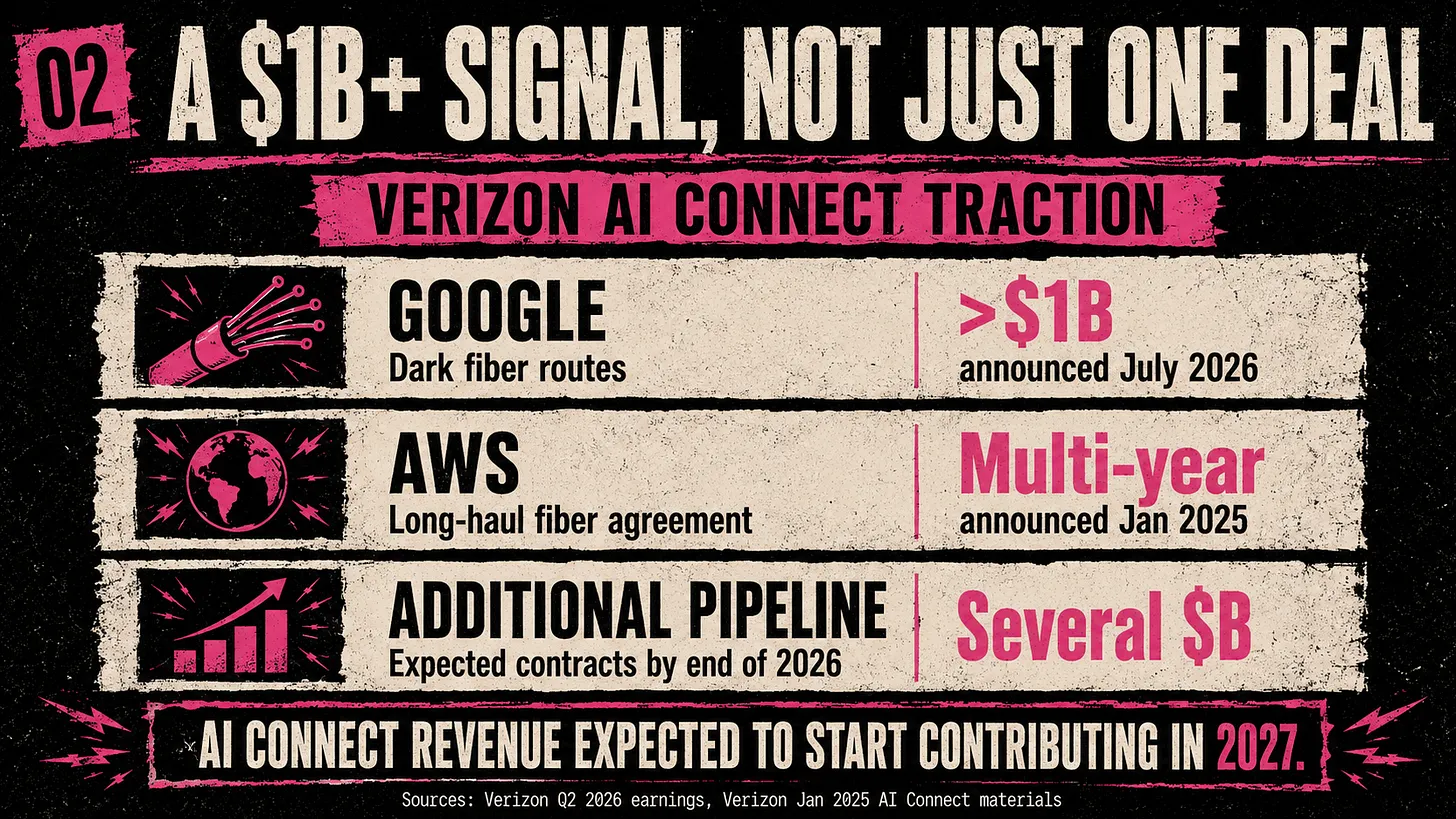
- Verizon announced a dark-fiber deal with Google to support the hyperscaler’s data center traffic growth. The deal is valued at over $1 billion and Verizon said there will be other deals announced before year-end.
- Deutsche Telekom said its AI factory for Germany’s public institutions and businesses that opened in February, has already sold the site’s 10,000 Blackwell GPUs capacity. DT is now looking at increasing capacity by another 20,000 GPUs.
- Comcast cites that its upstream broadband traffic is growing at 2.5x the rate of downstream data, which it links to AI-driven queries.
- AT&T is seeing rapid increases in large-scale data traffic requiring high-capacity metro and intercity fiber infrastructure.
Capex of Telecom Service Providers is still expected to be flat (or down 1%) in 2026, but AT&T and Comcast reported 16% and 20% y-o-y growth in capex for Q2, respectively. Both companies are investing more in broadband access. Verizon’s capex was also up, but only by 5% in Q2.
……………………………………………………………………………………………………………………………………………………………………………………….
Hyperscaler CAPEX:
The chart below illustrates the capital intensity of the TOP 4 Cloud companies. It is up sharply: Meta is already at 51% and Microsoft is at 46% in Q2. Oracle (not included in the figure) would have been off the chart at above 80% in Q1. The company reports earnings in early September and the key question is how it intends to finance future investments. Some moderation in spending growth is well needed. Amazon is the largest spender with $54.2 billion for the quarter, up 73% y-o-y. Amazon also increased guidance for 2026 capex from $200 billion to $220 billion.

Recent $ Trillion fundraising activities of Anthropic and OpenAI, supported by Nvidia, were widely covered yet both companies continue to lose money. Some financial experts refer to these activities as the “future for financial engineering.” Any innovation comes with some risk, but we all hope for the best.
………………………………………………………………………………………………………………………………………………………………………………………
Addendum: Optical Network Bottlenecks Explained:
-
- InP Epitaxial Production Limits: The primary physical constraint lies in the fabrication and epitaxy capacity for Indium Phosphide wafers used to build high-frequency lasers, where specialized manufacturing equipment (such as MOCVD systems) remains heavily backordered.
- Electrical Trace and Power Walls: Inside massive AI clusters, traditional pluggable optical modules face severe latency, thermal, and signal-integrity walls due to long copper electrical traces running from switch ASICs to the optical engine.
- Packaging and Testing Complexities: Shifting from legacy designs to dense 800G, 1.6T, and co-packaged optics (CPO) introduces intricate multi-die integration and hybrid bonding hurdles that slow down final module validation and packaging yields.
- Expanding Vendor Pools: Cloud builders are aggressively expanding their sourcing lists, moving from a concentrated pool of 2–3 legacy optical vendors out to 5–7 specialized component manufacturers to secure allocation.
- Ecosystem Pivot to Photonics: Major semiconductor players (such as Marvell’s acquisition of Celestial AI) and optical fabricators are pouring capital into silicon photonics and optical interconnect architectures to bypass standard copper and discrete laser constraints.
-
- Mechanism: LPO removes the power-hungry Digital Signal Processor (DSP) and clock/data recovery (CDR) chips directly from inside the optical transceiver module.
- The Fix: Raw, linear analog signals are driven straight from the switch or network interface card (NIC) ASIC.
- Benefits: Slashes module power consumption by 50% or more and cuts latency while preserving the hot-swappable, multi-vendor front-panel pluggable form factor.
- Trade-off: Requires host ASICs with advanced analog front-end and signal-equalization capabilities to process the raw electrical signals.
- Mechanism: CPO moves the optical engine (which converts electrical signals into light) off the front-panel cage and places it directly onto the same substrate or interposer as the switch or accelerator ASIC.
- The Fix: Electrical traces shrink from centimeters down to mere millimeters, completely bypassing lossy copper-clad circuit boards and high-power SerDes requirements.
- Benefits: Reduces optical-interface power consumption by up to 75% and maximizes bandwidth density for ultra-dense GPU scale-up fabrics.
- Trade-off: Reworks serviceability—if an optical engine fails, the repair domain shifts from a simple two-minute transceiver swap to board- or switch-level replacement
………………………………………………………………………………………………………………………………………………………………………
References:
Agentic AI and Inference to Supercharge Front-End Networks Growth, According to Dell’Oro Group
Networking chips and modules for AI data centers: Infiniband, Ultra Ethernet, Optical Connections
Goldman Sachs report: Optical Networking is the next mega trend in AI infrastructure
Cisco Execs: New “Network Supercycle” as Agentic AI Workloads Reshape Telecom Infrastructure
Cisco report: Agentic AI to reshape WAN traffic, AI inference will be ~25% of total traffic by 2035
Meta’s “Iris” AI Chip for MTIA: Implications for Telecom-Grade Optical Networking, DCI and High Capacity Ethernet Fabrics
Oriole Networks photonic networking platform to be integrated with AMD GPUs/CPUs for next-gen AI data center fabrics
Cheap Chinese AI Models: Unappreciated Threat to U.S. Hyperscaler AI Dominance
Verizon’s $1 Billion Google Dark Fiber Deal Highlights Importance of Optical Networks
Executive Summary:
Verizon CEO Dan Schulman said on Friday the company had secured a more-than-$1 billion dark fiber agreement with Google. It underscores how hyperscale AI growth is elevating dark fiber, route diversity, and high-capacity optical engineering into core industry priorities and is evidence that the network layer is becoming a central enabler of AI-scale computing. The deal, disclosed during Verizon’s Q2 2026 earnings call, is intended to connect Google data centers and support the transport demands of AI workloads.
“We have other deals that we expect to announce by year end that taken together are expected to be worth multiple billions of dollars in revenue over the next several years,” Schulman said on Verizon’s post-earnings call.
From a telecom perspective, the significance lies in the shift from best-effort connectivity toward engineered optical infrastructure with explicit performance objectives. As hyperscalers expand distributed AI training and inference, the requirements for capacity, latency, route diversity, and operational control increasingly favor dark fiber over shared transport models.blogs.cisco+2
Why This Matters for Network Architecture:
Dark fiber gives the customer direct control over the optical layer, enabling custom design choices for line rates, protection schemes, and traffic engineering. That flexibility is especially relevant for large data-center interconnect environments, where traffic growth can quickly outpace conventional managed services.blogs.cisco+1
The Verizon-Google transaction also reinforces the role of long-haul and metro fiber as strategic infrastructure rather than commodity bandwidth. In practice, this places greater emphasis on fiber route resilience, diverse path design, and the ability to scale toward higher-capacity optical systems as AI clusters expand.blogs.cisco+1
Standards and Industry Implications:
While the deal itself is commercial, its implications touch several standards-adjacent concerns that are increasingly important to operators and vendors. These include high-capacity optical transport, inter-domain coordination, deterministic latency for distributed workloads, and the operational models needed to support AI-driven traffic growth.blogs.cisco+1
For IEEE ComSoc readers, the broader signal is that future network evolution may be shaped as much by AI infrastructure economics as by traditional access or mobility growth. The value proposition is moving toward fiber-based transport layers that can support hyperscale interconnect, cloud adjacency, and resilient backhaul for distributed computing environments.benton+1
Conclusions:
Verizon’s reported dark fiber deal with Google suggests that optical connectivity is no longer a passive enabler but a competitive differentiator in the data-center supply chain. It highlights a broader shift in network economics: AI growth is elevating fiber infrastructure from a supporting asset to a strategic enabler. For carriers, the message is clear — the winners in the AI era may be those that can pair scale, route control, and transport engineering with the capacity demands of hyperscale cloud buildouts.
Text & Images from Sebastian Barros:
Verizon’s billion dollar agreement with Google shows that the AI infrastructure boom is moving beyond chips, data centers and electricity. The next constraint is connecting everything together. Verizon will use existing fiber where possible and construct new routes where necessary. It can provide either dark fiber or managed, lit capacity, depending on what the customer wants.

Google already operates one of the most advanced private networks in the world. Its infrastructure spans more than two million miles of lit fiber, 33 subsea cable investments, more than 200 network edge locations, and thousands of content delivery sites. Yet Google still needs Verizon to provide additional routes.
The (hyperscaler) companies building the largest AI brains cannot build every nerve themselves, as the pace is too fast. The telco opportunity begins when data needs to leave the campus.
Models must be copied between regions; training datasets must be moved from storage locations to computing clusters; companies need private connections to cloud platforms; AI applications must retrieve enterprise information stored across different data centers. Inference results must reach factories, vehicles, hospitals, stores, offices, and consumers.
AI therefore requires two different networks. The first connects processors inside the brain. The second connects different brains with the outside world, and Telcos have a much stronger position in the second.
References:
https://sebastianbarros.substack.com/p/every-brain-needs-a-nervous-system
Verizon to build new, long-haul, high-capacity fiber pathways to connect AWS data centers
Hyper Scale Mega Data Centers: Time is NOW for Fiber Optics to the Compute Server
S&P Global Market Intelligence Surveys: Fiber Deployments in U.S. and Europe + AI Infrastructure Causes Market Shift
Amazon and Corning in Multi-Billion-Dollar Fiber Infrastructure Deal in North Carolina
2026 Fiber Connect Keynote: “The Future of Fiber Optics: AI and the Quantum”
Big Fiber’s $250M financing deal to buildout dark fiber routes for AI Data Center expansion
Amazon and Corning in Multi-Billion-Dollar Fiber Infrastructure Deal in North Carolina
Introduction:
The surge in optical fiber demand is intensifying as hyperscale cloud providers accelerate infrastructure buildouts to support AI-driven workloads and high-density data center interconnect (DCI). Corning [1.] today announced a multi‑billion‑dollar investment from Amazon to expand fiber manufacturing capacity in North Carolina—incremental to its previously announced $10 billion regional cloud infrastructure expansion—reflects a broader structural shift in how optical supply chains are being secured and scaled.
Note 1. Corning’s fiber-optic infrastructure uses highly pure strands of optical glass thinner than a human hair to transmit massive amounts of data as pulses of light. These networks serve as the backbone for modern communications, connecting everything from rural broadband rollouts to hyperscale data centers driving generative AI. In hyperscale cloud and AI data centers, Corning provides high-density optical hardware and cables, such as their GlassWorks AI™ solutions. These large setups feature massive fiber-optic trunk cables containing hundreds to thousands of individual fibers bundled together to link powerful processors and servers. For outdoor networks running underground or on utility poles, you will see ruggedized cables protected by thick jackets and aramid yarn. These cables are designed to withstand weather, crushing, and extreme temperatures.
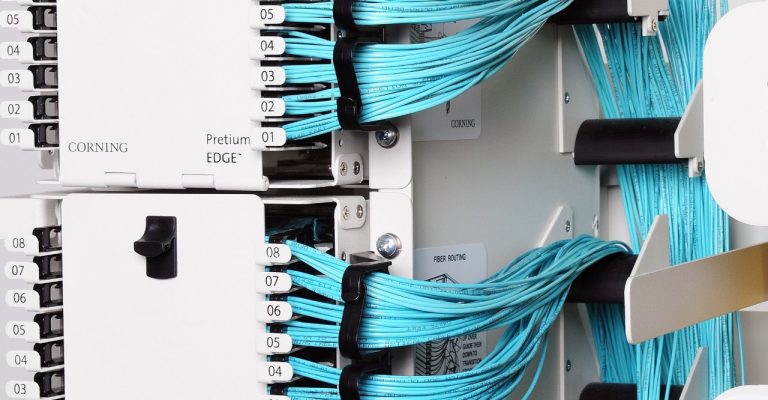
Corning’s structured cable solutions for internal data center connectivity. Image Credit: Corning
…………………………………………………………………………………………………………………………………………………………………………………….
This trend is not isolated. Hyperscalers including Meta, Microsoft, and wireline network operator Lumen are proactively entering long-term supply and co-investment agreements with fiber and cable manufacturers, effectively reshaping the upstream optical ecosystem.
Recent Fiber Supply Agreements with Corning:
-
May 2026: NVIDIA committed $500 million to Corning to support construction of three new optical manufacturing facilities in North Carolina and Texas. This investment is expected to increase Corning’s U.S.-based optical connectivity manufacturing capacity by approximately 10× and expand domestic fiber production by over 50%, targeting AI cluster interconnect requirements characterized by high fiber count and low-latency links aligned with IEEE 802.3 Ethernet and emerging co-packaged optics ecosystems.
-
January 2026: Meta finalized a $6 billion agreement with Corning to secure fiber supply for large-scale data center fabrics. These fabrics increasingly rely on high-fiber-density architectures consistent with leaf-spine topologies and standards such as IEEE 802.3bs/ck (400G/800G Ethernet), as well as parallel single-mode fiber (PSM) and wavelength-division multiplexing (WDM) approaches defined in ITU-T G.694.x.
-
September 2025: Microsoft entered a manufacturing agreement with Corning and Heraeus focused on hollow-core fiber (HCF), a technology aligned with ITU-T G.650 characterization frameworks. HCF offers lower latency (reduced group index) and improved performance for latency-sensitive AI workloads and inter-data center transport.
-
August 2024: Corning and Lumen established a supply agreement for next-generation fiber optic cable to support AI-driven traffic growth. This aligns with ITU-T G.652.D and G.657 fiber standards for bend-insensitive and high-capacity terrestrial deployments, as well as evolving requirements for high-count ribbon fiber cables in dense metro and campus environments.
Structural Implications for the Optical Supply Chain:
Hyperscalers are transitioning from passive consumers of optical components to active participants in manufacturing scale-up, including:
-
Anchor tenancy models: As seen with Meta’s backing of Corning’s North Carolina facility, hyperscalers are underwriting capacity expansion, effectively securing preferential access to supply.
-
Vertical influence: Direct investments and long-term offtake agreements allow hyperscalers to influence fiber specifications, manufacturing roadmaps, and deployment architectures (e.g., optimized fiber types for short-reach vs. long-haul DCI).
-
Workforce development: Amazon and Corning’s collaboration with Catawba Valley Community College to expand fiber technician training reflects a strategic effort to address labor constraints in optical manufacturing and deployment, reinforcing domestic supply chain resilience.
Implications for Telecom Operators:
These developments introduce non-trivial risks and strategic considerations for telecom operators:
-
Supply prioritization: Hyperscaler-backed agreements may shift allocation dynamics, potentially constraining availability for traditional telecom buyers during periods of tight supply.
-
Pricing pressure: Long-term, high-volume contracts could influence pricing benchmarks, potentially disadvantaging operators without comparable scale or capital flexibility.
-
BEAD timing mismatch: U.S. operators anticipating fiber expansion funded by BEAD (Broadband Equity, Access, and Deployment) may face supply bottlenecks if hyperscaler demand absorbs near-term manufacturing output.
-
Architectural divergence: Hyperscaler-driven requirements—optimized for short-reach, ultra-high-capacity intra-data-center and DCI links—may skew innovation toward their use cases, potentially misaligning with traditional access network needs governed by ITU-T G.984 (GPON), G.9807 (XGS-PON), and emerging 25G/50G PON standards.
A useful analogy is the semiconductor industry, where hyperscaler influence has already reshaped foundry capacity allocation and advanced node prioritization. A similar dynamic is now emerging in optical fiber and connectivity, with hyperscalers effectively acting as quasi-industrial planners for next-generation optical infrastructure.
Quotes:
“Amazon’s investments in North Carolina have created more than 26,000 jobs across the state. This multibillion-dollar agreement with Corning continues that commitment, channeling investment into American manufacturing and creating 1,000 new jobs at their facilities near our data centers,” said Matt Garman, CEO of AWS. “We’re also partnering to train North Carolinians for highly skilled roles in fiber optics and fusion splicing. These long-term investments create long-term careers and real opportunity in the communities where we operate.”
“This agreement with Amazon represents a significant milestone for Corning and for American manufacturing,” said Wendell Weeks, chairman, CEO, and president of Corning. “For 175 years, Corning has pioneered the technologies that connect people and transform industries. Amazon’s investment will help us expand production, create 1,000 new advanced manufacturing jobs at our facilities, and lead the way toward building a resilient U.S. manufacturing base.”
Clearfield CEO Cheri Beranek told Fierce Network at Fiber Connect that supply chain issues are re-emerging, particularly around high-count fiber. “There’s absolutely a shortage of ribbon fiber,” she said, referring to a conversation with Hawaii Telecom, a Clearfield customer. “The high count for the ribbon fiber … everything over 432 is tough to get,” she said. “The fiber companies want to tell you that there’s enough American‑made fiber… but there can’t be.”
“In talking to fiber optic suppliers, they all say one thing, ‘It’s nice to finally be the cool kid on the block.’ Hyperscalers are finally realizing that they not only need compute, storage, chips, power, water and real estate, they also need fiber optic connectivity,” said Fierce Network’s Chief Analyst Linda Hardesty.
The net effect is a tightening coupling between AI infrastructure demand and optical supply chain strategy—one that telecom operators will need to actively manage through procurement strategy, vendor diversification, and potentially deeper participation in supply-side partnerships.
End Note:
Amazon’s long-term commitment to North Carolina goes beyond direct investments and jobs created in the state. Through workforce development, Career Choice, and upskilling programs, Amazon has already provided practical training for nearly 7,000 people in North Carolina, helping to open new pathways for higher-paying jobs and fulfilling careers.
In the last decade, Amazon has contributed more than $72 million to charities and organizations supporting local needs across North Carolina, with $10 million provided in 2025 alone to 26 local community partners. This includes contributions like $1.5 million to enhance public safety services for southeastern Hamlet and surrounding Richmond County communities by funding a new fire substation that is expected to lower emergency response times and homeowner insurance premiums.
References:
https://www.corning.com/data-center/au/en/home/applications/enterprise-private-data-center.html
https://www.aboutamazon.com/news/company-news/amazon-corning-fiber-optics-1000-jobs-north-carolina
Fiber Optic Boost: Corning and Meta in multiyear $6 billion deal to accelerate U.S data center buildout
Corning to Build New Fiber Optic Plant in Phoenix, AZ for AT&T Fiber Network Expansion
Calix and Corning Weigh In: When Will Broadband Wireline Spending Increase?
Verizon-Corning $1.05B fiber deal part of larger build-out or buy program
Goldman Sachs report: Optical Networking is the next mega trend in AI infrastructure
Goldman Sachs analysts forecast a $154billion opportunity in optical networking driven by skyrocketing capacity demands from hyperscale cloud and AI workloads. Carriers and vendors are integrating 10GbE edge networking and AI-RAN (Artificial Intelligence Radio Access Network) trials on live 5G networks.
Goldman argues that AI infrastructure is creating a networking bottleneck phase, where optical interconnects become essential to connect more chips, keep latency low, and let AI clusters scale efficiently. The total optical networking market forecast 9x increase to $154 billion is due to both scale-up and scale-out AI data center architectures grow.
AI compute gains are no longer just about faster GPU and HBM chips; they depend on moving data fast enough between chips, racks, and super-nodes. Goldman Sachs emphasizes that networking now “unlocks computing capability” by enabling seamless exchange across multiple AI chips, which is exactly where copper-based links start to fall short. That makes fiber-optic connectivity, pluggable optics, and co-packaged optics central to the next phase of AI build-out. The report splits opportunity across scale-up and scale-out networking, plus component categories such as copper cables, pluggable optical modules, CPO, and PCB midplanes.
External coverage of this report says Goldman Sachs sees scale-up as the larger pool, about $106 billion or 69% of the $154 billion TAM, while CPO could represent about $91 billion or 59% of the total, assuming 29% penetration in scale-out networking. In practical terms, the report is signaling that the highest-value optical opportunity sits inside tightly coupled AI systems, not just in long-haul or metro transport.
………………………………………………………………………………………………………………………………………………………………………………………….
Goldman projects the following:
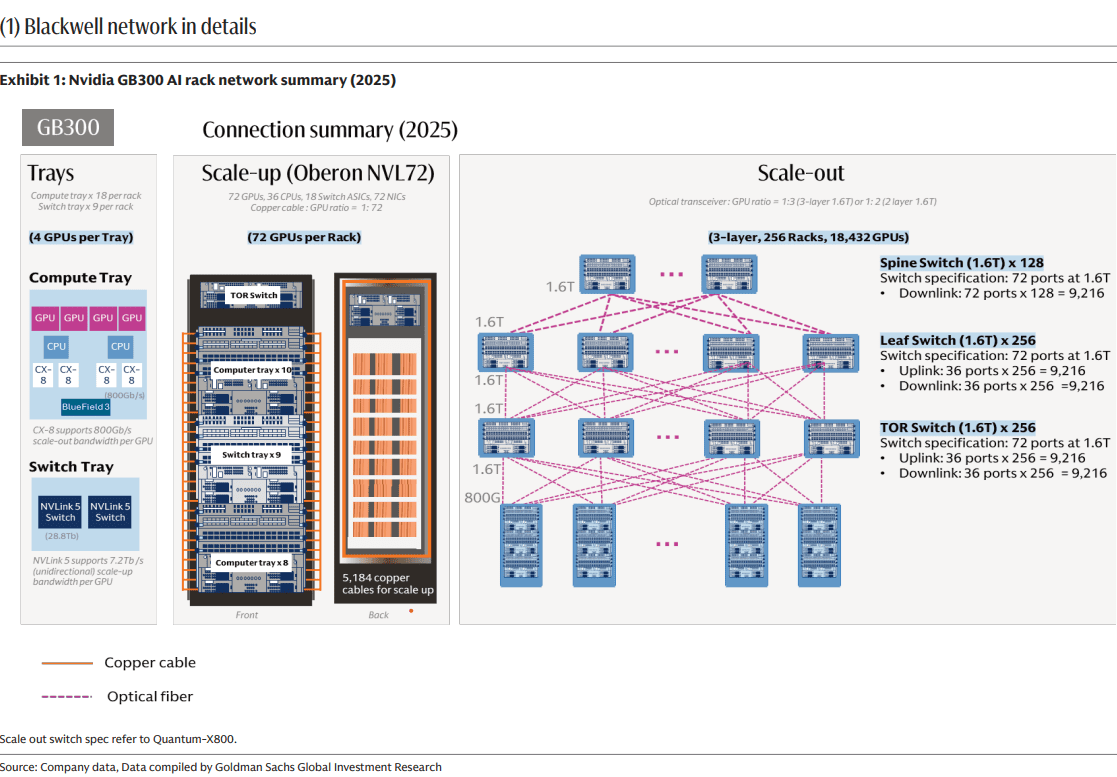
- Dollar content increase by 16x / 45x in Scale Out / Scale Up per computing unit from GB300 NVL72 (per computing unit means 72 GPUs per rack to reach NVL72) to Rubin Ultra NVL576 (per computing unit means 72 GPUs per rack, and 8 racks together to reach NVL576), with opportunities across pluggable optical modules, optical engines in CPO, copper cables, and PCB midplanes.
- A 13x larger addressable market for optical modules / optical engines expanding from scale out (e.g. GB300 NVL72) to scale up (e.g. Nvidia Rubin Ultra [1.] NVL576 level 2 scale up via CPO) per computing unit. n
- A 10x larger value market for pluggable optical modules in scale out per computing unit from GB300 NVL72 to Rubin Ultra NVL576, even with a 29% CPO penetration rate. The numbers of pluggable optical module (1.6T equivalent) per computing unit would increase from 216 units in GB300 NVL72 to 2.5k units in Rubin Ultra NVL576.
Note 1. Nvidia Rubin Ultra is a flagship, next-generation AI and high-performance computing (HPC) processor succeeding the standard Rubin architecture. Scheduled to debut in late 2027, it utilizes massive multi-die chiplet designs and unprecedented memory configurations to power the next wave of generative and agentic AI.
………………………………………………………………………………………………………………………………………………………………………….
Market Forecasts:
The investment bank expects the aggregate dollar content per computing unit across scale up and scale out to increase by 29x from US$315k in GB300 NVL72 to US$9.4bn in Rubin Ultra NVL576, and assuming the numbers of racks through the full product cycle are 48k racks for GB300 NVL72, and 16.5k computing units for Rubin Ultra NVL576, the aggregate value TAM across scale up and scale out would increase by 9x from US$15bn in GB300 NVL72 (mainly in 2026) to US$154bn in Rubin Ultra NVL576 (mainly in 2028).
Among the US$154bn value TAM, 69% goes to scale up, or US$106bn, and CPO contributes US$91bn, or 59% of the US$154bn value TAM, assuming CPO at 29% penetration rate in scale out.
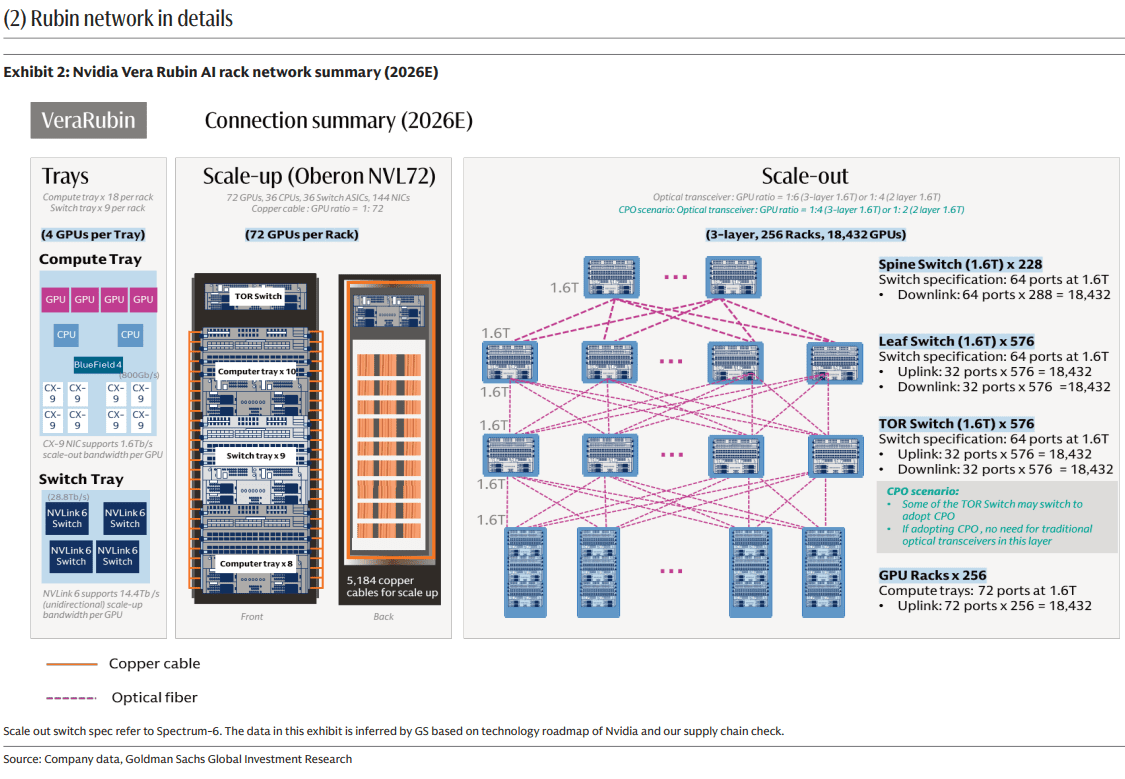
For network architects, the important takeaway is that AI clusters are becoming optics-heavy at more layers of the network stack, not just at the edge of the rack. The likely winners are suppliers that can reduce power, improve density, and simplify packaging for very high-bandwidth links, especially around CPO and advanced pluggables. This is less a story about traditional telecom optics and more about datacenter interconnects optimized for GPU fabrics and AI training/inference throughput.
The most consistently cited “top beneficiaries” are Coherent, Lumentum, and Fabrinet. These companies sit close to the core optical component modules and manufacturing layers that scale with higher AI interconnect demand. That makes them the most straightforward proxies for the forecasted optics expansion. The report’s thesis favors companies with strong exposure to high-end optical transport, coherent optics, and data-center interconnect rather than the broader optical networking/PON equipment companies like Ciena, Nokia/Infinera, Cisco/Acacia, ADVA, or Calix.
Conclusions:
Strategically, Goldman Sachs maintains that optical networking is no longer a niche enabling layer; it is becoming a core enabler of AI capex scaling. That shifts investor attention toward optical component vendors, silicon photonics, transceiver suppliers, and adjacent packaging ecosystems. The report’s core message is simple: as AI clusters grow, the network fabric becomes a first-order constraint, and optics are the most likely answer.
References:
2026 Fiber Connect Keynote: “The Future of Fiber Optics: AI and the Quantum”
How will fiber and equipment vendors meet the increased demand for fiber optics in 2026 due to AI data center buildouts?
Big Fiber’s $250M financing deal to buildout dark fiber routes for AI Data Center expansion
Analysis: Fiber Broadband Association (FBA) whitepaper: Upgrading MSO Networks to Fiber to the Home (FTTH): A Technical Perspective
Fiber Optic Boost: Corning and Meta in multiyear $6 billion deal to accelerate U.S data center buildout
Fiber Optic Networks & Subsea Cable Systems as the foundation for AI and Cloud services
AI infrastructure investments drive demand for Ciena’s products including 800G coherent optics
DriveNets and Ciena Complete Joint Testing of 400G ZR/ZR+ optics for Network Cloud Platform
Analysis: Nokia’s strong growth in Optical Networks and AI network infrastructure
Executive Summary:
While Nokia’s first-quarter profitability improved across all reported metrics, year-over-year comparisons were significantly affected by a €120 million ($140 million) non-recurring charge recorded in the Mobile Networks business in the prior-year period. On a comparable basis, net profit increased 93% to approximately €295 million ($345 million). Despite ongoing cost restructuring initiatives, the company’s comparable operating margin remained at 6.2%, well below the ~11% levels observed in the corresponding quarters of 2021 and 2022, indicating continued margin compression relative to earlier cycle peaks.
Optical networking has emerged as Nokia’s primary growth engine, significantly outpacing the company’s overall performance. At the group level, Nokia reported first-quarter comparable revenue growth of 3% year-over-year (4% in constant currency) to €4.5 billion ($5.3 billion). The acquisition of Infinera, which was completed in March last year, surely helped. As did massive investments by AI data center companies because Nokia’s optical gear is used for both intra and inter data center connectivity.
The company said Thursday that first-quarter sales of optical network infrastructure rose 12% on year, driven by demand from AI and cloud customers in the Americas. It booked 1 billion euros ($1.17 billion) of orders from AI & Cloud customers in the quarter and now sees overall sales in the network infrastructure business growing 12%-14% this year, having previously expected 6%-8%. The company had previously announced it was investing in additional manufacturing capacity to support growth and maximize the opportunity in this accelerating market.
When Nokia held its capital markets day last November, the company expecting hyperscalers to invest about $540 billion in total capital expenditure this year. That number has now been raised to more than $700 billion, Nokia CEO Justin Hotard told reporters. As part of that flows into Nokia’s order book, first-quarter optical sales grew 56% year-over-year, to €821 million (US$959 million).
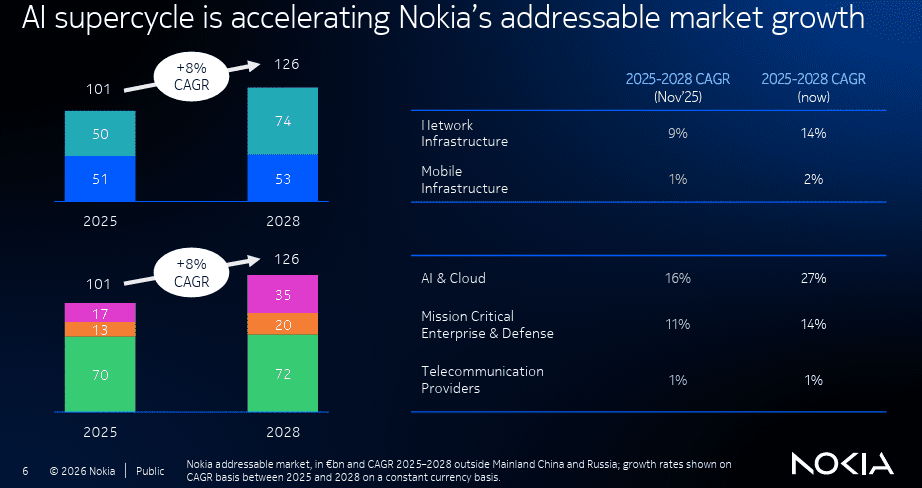
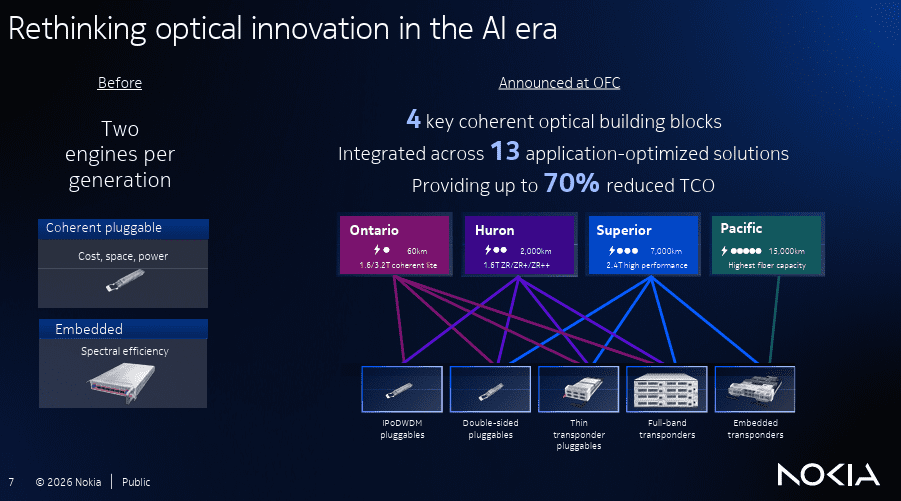
Image Credits: NOKIA
……………………………………………………………………………………………………………………………………………………………………………………………………….
Performance across segments remains uneven. Key drags included the fixed broadband segment within Network Infrastructure (NI)—which also encompasses optical—as well as the Mobile Networks (MN) radio access business. Despite these headwinds, CEO Justin Hotard is positioning NI, particularly its optical and IP routing units, as the core drivers of near-term growth. The company has raised its full-year NI growth outlook to 12–14%, up from the 6–8% range communicated in January, reflecting stronger momentum in high-capacity transport and IP networking demand.
Nokia is also guiding for full-year comparable operating profit in the range of €2.0–2.5 billion ($2.3–2.9 billion). At the midpoint, this would represent approximately 11% year-over-year growth relative to 2025, indicating improving operational leverage as higher-growth segments scale. The strongest momentum remains in optical and IP networking, while the legacy radio access business is still working through margin pressure, mix shifts, and the higher capital intensity of next-generation RAN evolution.
Within this context, the Mobile Infrastructure (MI) segment remains the principal source of performance uncertainty. Following internal reorganization, the “radio networks” unit—comprising the majority of the former Mobile Networks business—accounts for 63% of MI revenue. While constant-currency performance was broadly stable, reported radio networks revenue declined 5% year-over-year to €1.58 billion ($1.85 billion), contributing to a 3% decline in total MI revenue to approximately €2.5 billion.
Segment-level profitability metrics require careful normalization. MI reported operating profit of €222 million ($259 million), representing a 68% year-over-year increase. However, adjusting for the absence of the prior-year €120 million charge, operating profit would have declined by approximately 12%. On a normalized basis, operating margin would have decreased from ~9.8% to ~8.9%, rather than increasing from the reported 5.1%, indicating underlying margin pressure in the radio access portfolio.
Additional analytical complexity arises from the inclusion of Nokia Technologies within MI reporting. This licensing-driven business has historically exhibited operating margins exceeding 70%. Assuming a comparable margin profile in the current quarter, its implied operating contribution (~€270 million / $316 million) exceeds the total reported MI operating profit. This suggests that the combined radio networks and associated software activities may be operating at or near breakeven when disaggregated from licensing revenues, highlighting the importance of segment-level transparency in assessing the underlying economic performance of Nokia’s RAN portfolio.
A restructuring program, initiated under Pekka Lundmark and continued by CEO Justin Hotard, is designed to deliver approximately €1.2 billion ($1.4 billion) in annualized cost savings by the end of 2026. This is primarily driven by a planned reduction of approximately 14,000 positions from a September 2023 baseline of ~84,000 employees (excluding subsequently divested businesses). As of year-end 2025, Nokia reported 74,100 employees, excluding Infinera, implying that the majority of targeted reductions have been completed and that approximately 4,000 additional reductions remain. Management has indicated that future efficiency gains are expected to be incremental rather than driven by further large-scale restructuring.
…………………………………………………………………………………………………………………………………………………………………………………………
Analysis:
From a systems perspective, the key signal is that transport and aggregation layers are gaining strategic weight relative to the traditional macro-RAN hardware layer. Optical growth reflects the continued densification of metro and backbone networks, driven by higher east-west traffic, AI and cloud interconnect demand, and the need for lower-latency transport to support distributed radio and edge workloads. That makes optical and IP less of a “supporting cast” and more of the enabling fabric for cloudified telecom architectures.
The RAN market is moving toward software-defined, cloud-native, and increasingly AI-assisted architectures, which raises the bar for vendor differentiation. Nokia has been emphasizing AI-RAN and anyRAN work with NVIDIA and operators including BT, NTT Docomo, T-Mobile, and others, positioning itself around AI-for-RAN, AI-on-RAN, and AI-and-RAN use cases. Architecturally, this suggests the company is trying to move beyond a pure radio-box supplier model toward a compute-centric platform strategy tied to 5G-Advanced and AI-native 6G.
This transition intensifies competition with vendors pursuing virtualized RAN, Open RAN, and multi-vendor disaggregation strategies. In that environment, the critical battleground shifts from integrated proprietary base stations to software portability, orchestration, open interfaces, cloud infrastructure integration, and accelerator support. For Nokia, the commercial challenge is that the economics of vRAN and AI-RAN depend not only on technical readiness, but also on whether operators can justify new compute and orchestration layers without eroding total cost of ownership.
The broader networking trend is convergence between mobile, optical, IP, and cloud infrastructure. The same traffic growth that pressures RAN capacity also increases demand for optical transport, IP routing, and security-aware automation across the transport and service layers. In that sense, Nokia’s segment mix highlights a wider industry direction: radio access is becoming only one part of a larger distributed compute and transport system, rather than the dominant center of gravity.
In conclusion, Nokia is benefiting as telecom architecture is becoming more horizontal and software-driven, while still facing friction in the vertically integrated legacy RAN model. Optical and IP are scaling nicely with increased high speed data center traffic; RAN is being redefined by cloud (vRAN), AI, and disaggregation; and the vendor that can best align silicon, software, orchestration, and transport will be better positioned for 5G-Advanced and early 6G/IMT 2030 transitions.
…………………………………………………………………………………………………………………………………………………………………………………………
References:
https://www.nokia.com/about-us/investors/results-reports/
Nokia in major pivot from traditional telecom to AI, cloud infrastructure, data center networking and 6G
Nokia’s AI Applications Study: “Physical AI” may require RAN redesign to support high‑volume, low‑latency uplink traffic
Nokia to showcase agentic AI network slicing; Ericsson partners with Ookla to measure 5G network slicing performance
Australia’s NBN and Nokia demonstrate multi-generation optical technologies concurrently over existing FTTP infrastructure
China’s telecom industry rapid growth in 2025 eludes Nokia and Ericsson as sales collapse
Dell’Oro: Analysis of the Nokia-NVIDIA-partnership on AI RAN
Indosat Ooredoo Hutchison, Nokia and Nvidia AI-RAN research center in Indonesia amongst telco skepticism
Nokia Bell Labs and KDDI Research partner for 6G energy efficiency and network resiliency
Fiber Broadband Association Middle Mile WG: how to use “Digital Infrastructure Networks” for coordinated fiber backbone investments
The Fiber Broadband Association (FBA) today released guidance from its Middle Mile Working Group (WG) which outlines how states can strengthen digital infrastructure through coordinated fiber backbone investment. Fiber is the foundation of AI, powering the high-capacity, low-latency, secure connectivity that links data centers, cloud infrastructure, and the communities that depend on them. To meet rising national demand, the U.S. must scale fiber deployment 2.3x by 2029. This goal requires accelerated infrastructure builds and strong coordination among states, utilities, and industry partners.
Digital Infrastructure Networks are strategic fiber optic systems that connect the core internet backbone to last-mile broadband providers. By strengthening these middle-mile connections, states can reduce the cost of broadband deployment, improve network resiliency, and expand connectivity to unserved and underserved communities.
“Middle-mile infrastructure is what allows broadband networks to scale,” said Sachin Gupta, Chair of the Middle Mile Working Group and Vice President of Business and Technology Strategies at Centranet. “When high-capacity fiber backbones are located closer to underserved communities, providers can extend last-mile networks more affordably, reach more locations, operate more efficiently, and better serve communities across the state.”
Among the recommendations:
- Coordinate infrastructure projects across agencies to streamline deployment and reduce unnecessary construction
- Implement “dig once” policies that install conduit or fiber whenever roads or utility corridors are opened for construction
- Leverage state-owned assets, including rights-of-way, existing fiber routes, and utility infrastructure
- Modernize permitting and coordination processes to accelerate broadband builds
FBA will further explore these strategies during two Middle Mile Working Group breakout sessions at Fiber Connect 2026, taking place Tuesday morning. The sessions include:
- Rural Collaboration, Infrastructure Planning, and Sustaining Affordable, High-Performance Middle Mile Broadband
- Unlocking New Middle Mile Opportunities for ISPs and Community Networks
……………………………………………………………………………………………………………………………………………………………………………………………………………………………………
Technical Topology: The DWDM Advantage:
- Massive Spectral Efficiency: Multiplexing up to 96+ channels onto a single fiber, with each wavelength supporting 100G, 400G, or 800G data rates.
- Scalable Architecture: Capacity can be increased incrementally by lighting new wavelengths without forklift upgrades or additional trenching.
- Resilient Topologies:
- Ring Networks: Often preferred for regional backhaul, utilizing Optical Add/Drop Multiplexers (OADMs) to provide self-healing 1+1 protection and sub-50ms failover.
- Mesh Networks: The gold standard for reliability, offering multiple diverse paths to ensure uptime even during multiple fiber cuts.
- Long-Haul Performance: Utilizing Erbium-Doped Fiber Amplifiers (EDFAs) and Raman amplification to maintain signal integrity over spans exceeding 1,000 km without electronic regeneration.


References:
Learn more; fiberconnect.fiberbroadband.org. Learn more about FBA’s research here or subscribe to FBA’s Fiber Forward Weekly newsletter here to stay updated.
Digital Infrastructure Networks: Meeting the Broadband Challenge for State Governments
Australia’s NBN and Nokia demonstrate multi-generation optical technologies concurrently over existing FTTP infrastructure
Automating Fiber Testing in the Last Mile: An Experiment from the Field
U.S. fiber rollouts now pass ~52% of homes and businesses but are still far behind HFC
Highlights of FiberConnect 2024: PON-related products dominate
Fiber Broadband Association: 1.4M Fiber Miles Needed for 5G in Top 25 U.S. Metros
AT&T expands its fiber-optic network amid slowdown in mobile subscriber growth
STL completes successful Multi-Core Fiber (MCF) trial with Colt in London, UK
India based STL, a global provider of optical and digital connectivity solutions for AI-era networks, has completed multi-core fiber (MCF) field trials with Colt Technology Services on Colt’s London metro optical network. The trial is a meaningful proof point for space-division multiplexing (SDM) in carrier environments, demonstrating that MCF can lift per-fiber strand capacity while staying within existing civil and duct constraints and improving overall network energy and cost metrics.
The deployment used STL’s Multiverse™ four-core MCF, designed with the same 125 µm cladding diameter as conventional single-mode fibre (SMF) and a 250/200 µm coating, enabling seamless handling with existing cable designs and installation practices. The trial route connected two Colt Points of Presence (PoPs) on the London metro network over spans of approximately 9 km and 63 km, representing both short-haul metro and longer metro-regional use cases.
From a transmission standpoint, the network achieved an 800 Gbps line rate with service validation for 100GE and 400GE, aligning with current high-capacity router and data-centre interconnect interfaces. STL and Colt validated performance across a broad set of optical and system parameters, including chromatic dispersion (CD), polarization mode dispersion (PMD), inter-core crosstalk, throughput, fault behavior, OTDR signatures, insertion loss, and optical return loss (ORL), with results within expected design envelopes. This indicates that Multiverse™ MCF can be engineered and operated to comparable performance baselines as legacy SMF while delivering higher spatial capacity.
Architecturally, STL’s MCF platform integrates four independent cores within a standard SMF cladding profile, effectively multiplying per-fibre capacity without increasing cable diameter. For operators, this directly addresses constraints in congested metro ducts, legacy civil infrastructure, and brownfield routes where augmenting capacity by pulling additional cables is either cost-prohibitive or operationally disruptive. In these scenarios, MCF creates a higher bit-per-mm² and bit-per-duct investment profile, improving both capex efficiency (less civil work, fewer ducts) and opex metrics such as energy per transported bit.
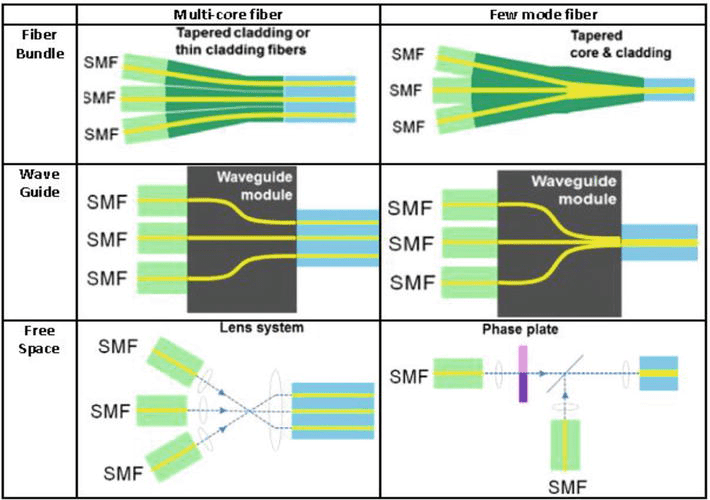
STL positions itself as one of the early movers in taking MCF from controlled lab demonstrations into operational networks, including buried and ducted plant, backed by a full ecosystem spanning fibre, cable, and connectivity hardware through its Optotec portfolio. Coupled with STL’s broader focus on AI-ready optical infrastructure and 5G-ready digital network solutions, the Colt trial underlines a practical migration path for carriers looking to future-proof metro and data-centre interconnect footprints against emerging AI, cloud, and 5G traffic patterns without wholesale rebuilds of underlying passive infrastructure.
“As network demand accelerates, customers are looking for more bandwidth without sacrificing security, performance, or sustainability,” said Buddy Bayer, Chief Operating Officer, Colt Technology Services. “At Colt, we continue to push optical networking forward, and this pilot represents an important step in Europe and the USA. It reflects our focus on building scalable networks that deliver growth in capacity without increasing environmental impact.”
Dr Badri Gomatam, CTO, STL, said the trial highlights the value of joint innovation in advancing optical infrastructure. “Collaborations like this speed up adoption of next-generation connectivity technologies. STL’s Multiverse MCF portfolio is designed for the high-density, ultra-low latency, and resilient connectivity requirements of AI, hyperscale cloud, and future digital platforms globally,” he said. STL stated that the trial results strengthen confidence in MCF as a viable technology for the growing bandwidth requirements driven by AI workloads, cloud scale-out, and new digital services.
“As network demand accelerates, customers are looking for more bandwidth without sacrificing security, performance, or sustainability,” said Buddy Bayer, Chief Operating Officer, Colt Technology Services. “At Colt, we continue to push optical networking forward, and this pilot represents an important step in Europe and the USA. It reflects our focus on building scalable networks that deliver growth in capacity without increasing environmental impact.”
Dr Badri Gomatam, CTO, STL, said the trial highlights the value of joint innovation in advancing optical infrastructure. “Collaborations like this speed up adoption of next-generation connectivity technologies. STL’s Multiverse MCF portfolio is designed for the high-density, ultra-low latency, and resilient connectivity requirements of AI, hyperscale cloud, and future digital platforms globally,” he said. STL stated that the trial results strengthen confidence in MCF as a viable technology for the growing bandwidth requirements driven by AI workloads, cloud scale-out, and new digital services.
………………………………………………………………………………………………………………………………………………………………….
About STL-– Sterlite Technologies Ltd:
STL is a global provider of advanced connectivity solutions, offering end-to-end products and services for building AI-ready networks across FTTx, rural broadband, enterprise, and data centres. With manufacturing operations in North America, Europe, and Asia, STL supplies connectivity solutions in more than 100 countries and works with telecom operators, cloud and data center companies, internet service providers, and large enterprises to build future-ready AI digital infrastructure.
On January 23, 2026, STL reported continued sequential improvement in Operational EBITDA margin for the fifth consecutive quarter, driven by a higher-margin product mix and increased contribution from the US market. With the US–India Bilateral Trade Agreement under advanced discussion, STL remains well-positioned to leverage emerging opportunities by offering reliable, high-quality solutions for building AI-ready digital infrastructure.
……………………………………………………………………………………………………………………………………………………
References:
https://www.intechopen.com/chapters/78908
How will fiber and equipment vendors meet the increased demand for fiber optics in 2026 due to AI data center buildouts?
Big tech spending on AI data centers and
AT&T sets 1.6 Tbps long distance speed record on its white box based fiber optic network
Dell’Oro: Optical Transport Systems market +15% year-over-year in 3Q2025 driven by Cloud Service Providers
Dell’Oro Group recently published its 3Q25 Optical Transport report, highlighting continued strength in the market as demand accelerates across customer segments and technology areas. Below is a summary of the key findings from this latest research.
The Optical Transport Systems market increased by 15% year-over-year (Y/Y) in 3Q2025, driven by robust demand across all major customer groups and technology segments. The most significant growth was seen in Cloud Service Providers (CSPs) which grew +58% Y/Y and the DWDM Long Haul segment which grew +24% Y/Y. Direct sales for data center interconnect (DCI) continued to be the driving application for optical transport equipment sales, growing 34% Y/Y. Non-DCI also performed well, rising 7% Y/Y, driven by increased spending by communication service providers (CSPs).
In the first nine months of 2025, two vendors—Ciena and Nokia—gained more than one percentage point of market share. Other vendors that gained some market share included 1Finity, Adtran, Cisco, and Smartoptics. Note that Nokia acquired Infinera -a fiber optic equipment company on February 28, 2025.

Image Source: Jimmy Yu, Dell’Oro Group
The Dell’Oro Group Optical Transport Quarterly Report offers complete, in-depth coverage of the market with tables covering manufacturers’ revenue, average selling prices, and unit shipments (by speed up to 1.6 Tbps). The report tracks DWDM long haul, WDM metro, multiservice multiplexers (SONET/SDH), data center interconnect (metro and long haul), disaggregated WDM systems, and IPoDWDM ZR/ZR+ Optics. To purchase this report, please contact us at [email protected].
…………………………………………………………………………………………………………………………………………………………………………………………
Backgrounder:
- Optical Transceivers: Convert electrical signals into optical signals for transmission over fibers, and vice versa, at the endpoints of a link.
- Wavelength Division Multiplexers (WDM/DWDM): Devices that combine multiple optical signals (each on a different wavelength) into a single fiber for transmission, and separate them at the receiving end, maximizing fiber capacity.
- Optical Add/Drop Multiplexers (OADMs): Allow specific wavelengths (channels) to be added or removed from a fiber link at intermediate points in the network without interrupting the other channels.
- Optical Cross-Connects (OXCs) / Optical Switches: Used to route optical signals from one incoming fiber to a different outgoing fiber in the optical domain, often used in core networks.
- Regenerators / Optical Amplifiers (EDFAs): Used to amplify or regenerate optical signals over long distances to maintain signal strength and quality.
- OTN Terminal Equipment / Muxponders & Transponders: These devices package client signals (like Ethernet, Fibre Channel, or even SONET/SDH signals) into the standard OTN frame format (ITU G.709) for efficient transport.
- SONET/SDH: These are legacy, connection-oriented, circuit-switched technologies originally designed for carrying voice traffic in North America (SONET) and globally (SDH). They operate at the physical layer (Layer 1) and use Time Division Multiplexing (TDM).
- Usage: They are still widely deployed in existing network infrastructure, especially where high reliability and stringent latency requirements for legacy TDM services are necessary.
- OTN: OTN (ITU-T G.709 standard) is the modern successor, designed to combine the management and protection capabilities of SONET/SDH with the bandwidth efficiency of WDM.
- Usage: OTN has largely replaced SONET/SDH in new core and metro networks due to its ability to transparently carry multiple types of traffic (Ethernet, IP, Fibre Channel, and SONET/SDH frames) over a single, high-capacity infrastructure. It offers enhanced performance monitoring, Forward Error Correction (FEC) for longer reach, and greater scalability.
- Huawei has consistently maintained a leading position in the global optical networking market.
- Ciena is a major leader, particularly in North America (holding nearly 50% share in the U.S. market) and among cloud providers, benefiting from strong demand for its WaveLogic 6e and 400ZR/ZR+ solutions.
- Nokia has significantly strengthened its position, becoming the second-largest optical networking vendor globally (with approximately 20% market share) following its acquisition of Infinera in February 2025. The combined company saw substantial growth in revenue from cloud customers.
- Cisco saw a 31% increase in revenue from cloud operators in Q2 2025, a key driver of market growth.
- ZTE and FiberHome are also among the top six, often noted for their competitive solutions in global and emerging markets.
- Excluding sales into China, the leading vendors are Ciena, Huawei, Nokia, Infinera (now part of Nokia), and Fujitsu, accounting for around 80% of that specific market segment.
References:
Optical Transport Market Surges 15% in 3Q25, According to Dell’Oro Group
Dell’Oro: Optical Transport market to hit $17B by 2027; Lumen Technologies 400G wavelength market
LightCounting: Q1 2024 Optical Network Equipment market split between telecoms (-) and hyperscalers (+)
Highlights of LightCounting’s December 2023 Quarterly Market Update on Optical Networking
Dell’Oro: Optical Transport Market Down 2% in 1st 9 Months of 2021
Dell’Oro: Optical Transport Equipment Market Stagnant in 1Q 2021; Jimmy Yu’s Take
Dell’ Oro: Huawei still top telecom equipment supplier; optical transport market +1% in 2020
AI infrastructure investments drive demand for Ciena’s products including 800G coherent optics
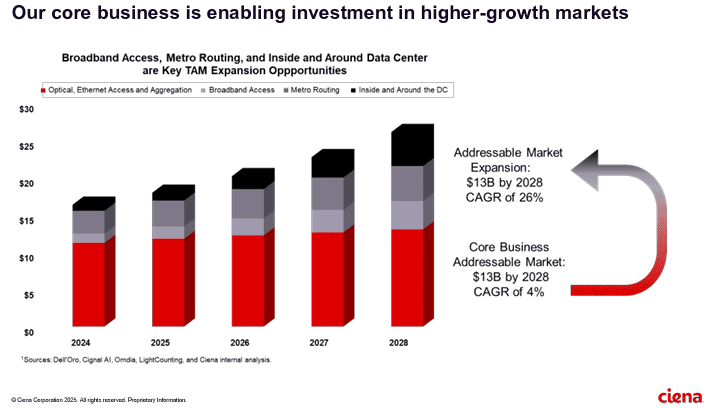
Artificial Intelligence (AI) infrastructure investments are starting to shift toward networks needed to support the technology, rather than focusing exclusively on computing and power, according to Ciena Chief Executive Gary Smith. The trends helped Ciena swing to a profit and post a 24% jump in sales in the recent quarter.
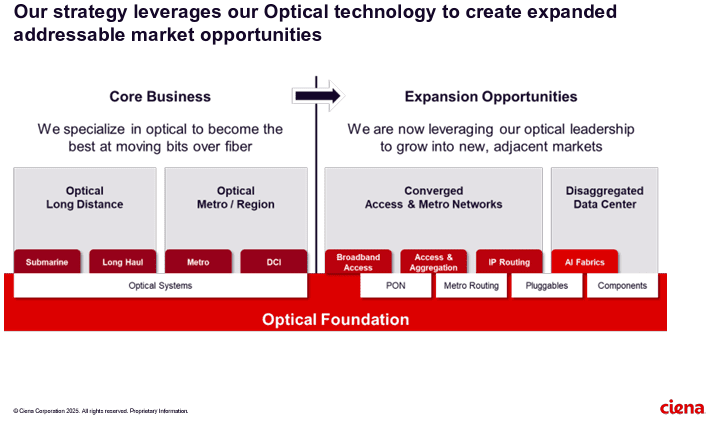
The company enables high-speed fiber optic connectivity for telecommunications and data centers, helping hyper-scalers such as Amazon and Microsoft support AI initiatives via data center interconnects and intra-data center networking. Currently, the company is ramping up production to meet surging demand fueled by cloud and AI investments.
“There’s no point in investing in these massive amounts of GPUs if we’re going to strand it because we didn’t invest in the network,” Smith said Thursday.
……………………………………………………………………………………………………………………………………………………..
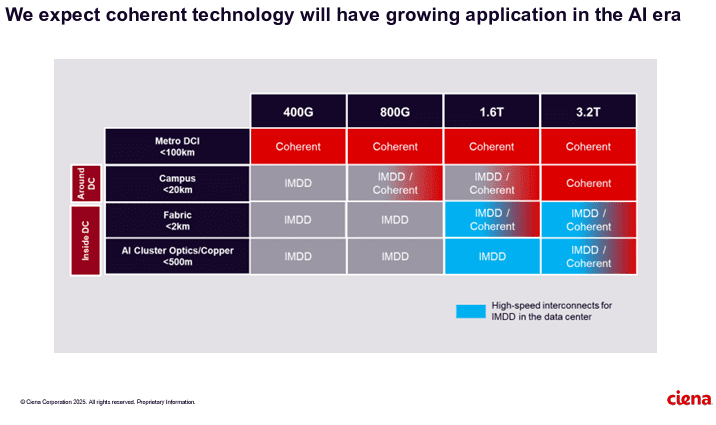
Ciena sees a bright future in 800G coherent optics that can accommodate AI traffic. Smith said a global cloud provider has selected Ciena’s coherent 800-gig pluggable modules and Reconfigurable Line System (RLS) photonics for investing in geographically distributed, regional GPU clusters. “With our coherent optical technology ideally suited for this type of connectivity, we expect to see more of these opportunities emerge as cloud providers evolve their data center network architectures to support their AI strategies,” he added.
It’s still early innings for 800G adoption, but demand is climbing due to AI and cloud connectivity. Vertical Systems Group expects to see “a measurable increase” in 800G installations this year. Dell’Oro optical networking analyst Jimmy Yu noted on LinkedIn Ciena’s data center interconnect win is the first he’s heard of that involves connecting GPU clusters across 100+ kilometer spans. “It was a hot topic of discussion for nearly 2 years. It is now going to start,” Yu said.
……………………………………………………………………………………………………………………………………………………
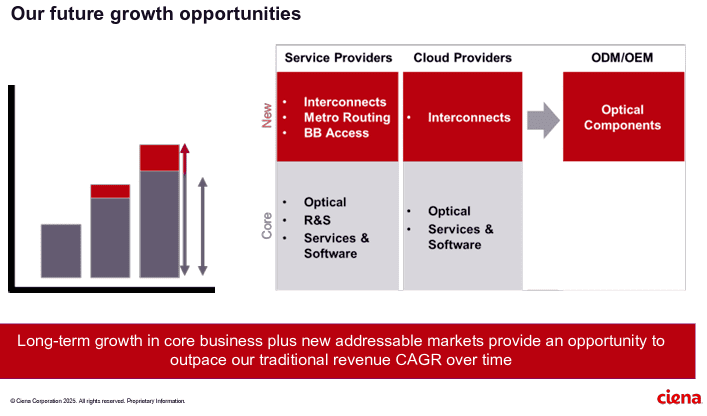
Ciena’s future growth opportunities include network service and cloud service providers as well as ODM/OEM sales of optical components.
References:
https://www.wsj.com/business/earnings/ciena-swings-to-profit-as-ai-investments-drive-demand-0195f30c
https://investor.ciena.com/static-files/d964ccac-74b3-43d9-a73e-ecf67fab6060
https://www.fierce-network.com/broadband/ciena-now-expects-tariff-costs-10m-quarter
Lumen and Ciena Transmit 1.2 Tbps Wavelength Service Across 3,050 Kilometers
Lumen and Ciena have teamed up for a significant new network trial. They have successfully demonstrated a 1.2Tbps wavelength spanning 3,050k m (more than 1,800 miles) on Lumen’s Ultra-Low-Loss (ULL) fiber network, making it the world’s longest 1.2 terabit non-regenerated signal. The trial leveraged Ciena’s WL6e technology over a 6500 photonic line system and Lumen’s fiber network between Denver and Dallas. They also used 800Gbps routing technology from Juniper’s PTX Series to establish Ethernet and IP services. Lumen’s 400G-enabled network already spans over 78,000 route miles, and the company continues to invest in next-generation fiber to enhance its Ultra-Low Loss (ULL) fiber network, the largest in North America.
Using 800G interfaces, Lumen and Ciena successfully tested and qualified the services to support wavelength, Ethernet, and IP services over the 1.2 Tbps single carrier channel. The live network trial from Denver to Dallas used Ciena’s latest WaveLogic 6 Extreme (WL6e) technology equipped in the Waveserver platform running over a 6500 photonic line system.
“1.2 terabits per second isn’t just about incredible speed and long distances, it’s about the value of enabling the next wave of digital transformation. Lumen is at the forefront of building a next-generation network designed to handle the explosive growth of AI and cloud workloads,” said Dave Ward, Lumen’s chief technology and product officer. “Our investment in increased capacity, powered by Ciena’s WaveLogic 6 technology, provides our hyperscale cloud partners and enterprises with the ultra-high-capacity connectivity needed to scale their AI and cloud applications. With 400G connectivity speeds today and a seamless upgrade path to 1.2 terabits, Lumen stands as the trusted network for AI.”
The trial also showcased the impressive performance and seamless interoperability between Ciena’s Waveserver platform and the Juniper PTX10002-36QDD Packet Transport Router at 800 Gbps over the ultra-long-haul 1.2 Tbps intercity network. By leveraging the performance, flexibility and scalability of the Juniper PTX Series Routers, Lumen successfully established Ethernet and IP services with minimal latency and zero packet loss throughout the tests.
Editor’s Note:
While the companies March 27th joint press release stated the 1.2T bps wavelength transport was a record, AT&T claimed two weeks earlier that it “achieved a long distance world record top speed of 1.6Tb/s over a single wavelength across 296 km of its long haul fiber optic network.” We reported that in this IEEE Techblog post. So yes, it’s a record considering the Lumen network wavelength distance was > 10 times that claimed by AT&T.

Faster connections up to 1.2 Tbps wavelengths means less lag, more capacity and the flexibility to handle the most data-hungry applications across multiple industries:
- AI & Machine Learning
- Hyperscale Cloud & Data Center Interconnects
- Financial Trading and Market Data Transport
- Cybersecurity & AI-powered Threat Intelligence
- Media & Streaming
“At Microsoft, the demand for ultra-high-speed, low-latency connectivity is growing exponentially as AI workloads, cloud applications, and real-time analytics scale,” Lumen said. “Lumen and Ciena’s successful wavelength trial showcases a forward-thinking approach to meeting these growing demands. By enabling more efficient data movement over vast distances, this solution helps us optimize cloud performance, enhance customer experiences, and support the rapid expansion of AI training and inferencing models across our global infrastructure.”
Ciena’s WL6e is the industry’s first high-bandwidth coherent transceiver using state-of-the-art 3nm silicon, capable of carrying capacity up to 1.6 terabits per second per wavelength.
“As the pioneer in high-speed optical innovation, we are dedicated to helping our customers set new benchmarks in network performance and efficiency,” said Brodie Gage, Ciena senior vice president, global products and supply chain. “This industry-first trial with Lumen marks a pivotal step in our efforts to prepare networks for the AI era. Lumen’s network does not stand still. Continuous investment in the latest network technology is essential for keeping up with bandwidth demands today and into the future.”
Additional Resources:
About Lumen Technologies:
Lumen is unleashing the world’s digital potential. We ignite business growth by connecting people, data, and applications – quickly, securely, and effortlessly. As the trusted network for AI, Lumen uses the scale of our network to help companies realize AI’s full potential. From metro connectivity to long-haul data transport to our edge cloud, security, managed service, and digital platform capabilities, we meet our customers’ needs today and as they build for tomorrow.
SOURCE: Lumen Technologies
References:
Analysts weigh in: AT&T in talks to buy Lumen’s consumer fiber unit – Bloomberg
AT&T sets 1.6 Tbps long distance speed record on its white box based fiber optic network
China Telecom with ZTE demo single-wavelength 1.2T bps hollow-core fiber transmission system over 100T bps