

Month: February 2026
Alphabet’s 2026 capex forecast soars; Gemini 3 AI model is a huge success
Google parent company Alphabet forecast 2026 capital expenditures of $175 billion to $185 billion this year, a massive jump compared with average analyst expectations that it would spend about $115.26 billion this year, according to data compiled by LSEG. The midpoint capex forecast of $180 billion was well above the $119.5 billion projected by analysts tracked by Bloomberg. Alphabet’s fourth quarter capex of $27.9 billion was slightly less than the expected $28.2 billion for the period, per Bloomberg estimates.
“We’re seeing our AI investments and infrastructure drive revenue and growth across the board,” CEO Sundar Pichai said in the company’s press release. He said the higher 2026 spending would allow the company “to meet customer demand and capitalize on the growing opportunities.”
The release of Google’s Gemini 3 AI model — which outperformed competing models on benchmark tests and prompted rival OpenAI to declare a “code red” — as well as the announcement of a landmark deal with Apple, cemented Alphabet’s position as an AI winner. Google Gemini gained significant market share against ChatGPT. This changed the AI landscape from a near-monopoly to a more competitive duopoly. Although ChatGPT still leads in total traffic, Gemini’s growth has narrowed the gap. This growth is due Gemini’s integration into Google’s ecosystem, especially Chrome, Android phones/tablets and Google Cloud.
“The launch of Gemini 3 was a major milestone and we have great momentum,” Pichai noted. He added that the Gemini app now has more than 750 million monthly active users.
In a related comment, Emarketer analyst Nate Elliott wrote:
“Gemini continues to grow quickly, from 650 million monthly active users at the end of Q3 to 750 million at the end of the year. But it’s worth noting that Gemini’s user number grew only about one-third as fast in Q4 as in Q3. That might explain why Google continues to keep its flagship AI tool advertising-free, hoping the lack of ads makes it more attractive to users than ChatGPT. It also explains why the company is now more aggressively pushing search users from AI Overviews into AI Mode: it’s looking for additional avenues to increase usage of its full-fledged AI chatbots.”
Google offices in Mountain View, Calif. (Reuters/Manuel Orbegozo) · Reuters / Reuters
Alphabet’s 4th quarter revenue climbed 18% to $113.8 billion from the year-ago period, ahead of the $111.4 billion expected by analysts. The tech giant’s earnings per share rose to $2.82 from $2.15 in the previous year, also higher than the $2.65 projected. The big increase in sales was spurred by a 48% spike in Google Cloud revenue to $17.7 billion, more than the $16.2 billion expected by analysts.
………………………………………………………………………………………………………………………………………………………
Update:
“Both Alphabet and Amazon delivered strong underlying business performance, driven by better-than-expected growth in cloud. But that hasn’t been enough to distract markets from their ballooning capital investment plans,” said Aarin Chiekrie, equity analyst, Hargreaves Lansdown.

References:
https://s206.q4cdn.com/479360582/files/doc_financials/2025/q4/2025q4-alphabet-earnings-release.pdf
Google announces Gemini: it’s most powerful AI model, powered by TPU chips
Comparing AI Native mode in 6G (IMT 2030) vs AI Overlay/Add-On status in 5G (IMT 2020)
Analysis: Edge AI and Qualcomm’s AI Program for Innovators 2026 – APAC for startups to lead in AI innovation
China’s open source AI models to capture a larger share of 2026 global AI market
China gaining on U.S. in AI technology arms race- silicon, models and research
IDC Report: Telecom Operators Turn to AI to Boost EBITDA Margins
AI spending boom accelerates: Big tech to invest an aggregate of $400 billion in 2025; much more in 2026!
Amazon’s Jeff Bezos at Italian Tech Week: “AI is a kind of industrial bubble”
OpenAI and Broadcom in $10B deal to make custom AI chips
AI Frenzy Backgrounder; Review of AI Products and Services from Nvidia, Microsoft, Amazon, Google and Meta; Conclusions
Will billions of dollars big tech is spending on Gen AI data centers produce a decent ROI?
China’s telecom industry rapid growth in 2025 eludes Nokia and Ericsson as sales collapse
According to a Chinese government update, “Telecommunications business volume and revenue grew steadily, mobile internet access traffic maintained rapid growth, and the construction of network infrastructure such as 5G, gigabit optical networks, and the Internet of Things was further promoted.”
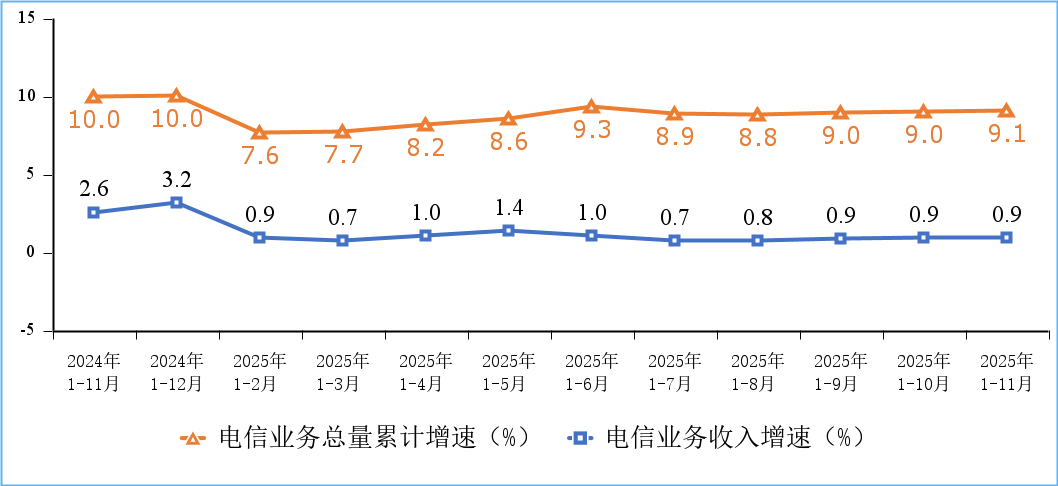
Figure 1. Cumulative growth rate of telecommunications service revenue and total telecommunications service volume
There were 4.83 million 5G base stations in service in China at the end of November 2025, an increase of 579,000 since late 2024 and 37.4% of the total number of mobile base stations in China. In one year, China claims to have added more 5G base stations than Europe has installed since the 5G technology was first put into service.
The total number of mobile phone users of the top four Chinese telcos (China Mobile, China Telecom, China Unicom, China Broadcasting Network) reached 1.828 billion, a net increase of 38.54 million from the end of last year. Among them, 5G mobile phone users reached 1.193 billion, a net increase of 179 million from the end of last year, accounting for 65.3% of all mobile phone users.
Meanwhile, the total number of fixed broadband internet access users of the three state owned telecom operators (China Mobile, China Telecom and China Unicom) reached 697 million, a net increase of 27.12 million from the end of last year. Among them, fixed broadband internet access users with access speeds of 100Mbps and above reached 664 million, accounting for 95.2% of the total users; fixed broadband internet access users with access speeds of 1000Mbps and above reached 239 million, a net increase of 32.52 million from the end of last year, accounting for 34.3% of the total users, an increase of 3.4 percentage points from the end of last year.
The construction of gigabit fiber optic broadband networks continues to advance. As of the end of November, the number of broadband internet access ports nationwide reached 1.25 billion, a net increase of 48.11 million compared to the end of last year. Among them, fiber optic access (FTTH/O) ports reached 1.21 billion, a net increase of 49.42 million compared to the end of last year, accounting for 96.8% of all broadband internet access ports. As of the end of November, the number of 10G PON ports with gigabit network service capabilities reached 31.34 million, a net increase of 3.133 million compared to the end of last year.
The penetration rate of gigabit and 5G users continued to increase across all regions. As of the end of November, the penetration rates of fixed broadband access users with speeds of 1000Mbps and above in the eastern, central, western, and northeastern regions were 34.6%, 33.8%, 35.8%, and 28.5%, respectively, representing increases of 3.4, 2.6, 4.1, and 4.9 percentage points compared to the end of last year; the penetration rates of 5G mobile phone users were 64.9%, 65.9%, 65.1%, and 65.9%, respectively, representing increases of 8.2, 8.7, 8.8, and 9.6 percentage points compared to the end of last year.
…………………………………………………………………………………………………………………………………………………………………
Separately, Light Reading reports that Ericsson and Nokia sales of networking equipment to China have collapsed.
Ericsson recently published earnings release for the final quarter of 2025 puts China revenues at just 3% of total sales last year. This would equate to revenues of 7.1 billion Swedish kronor (US$798 million). Based on a rounding range of 2.5% to 3.4%, it works out to be between SEK5.92 billion ($665 million) and SEK8.05 billion ($905 million) – down sharply compared with the SEK10.2 billion ($1.15 billion) Ericsson made in 2024, according to that year’s Ericsson annual report.
Nokia does not break out details of revenues from mainland China, instead lumping them together with the sales it generates in neighboring Hong Kong and Taiwan. But this “Greater China” business is in decline. Total annual revenues – which include Nokia’s sales of fixed, Internet Protocol and optical network products, as well as 5G – slumped from almost €2.2 billion ($2.6 billion) in 2019 to around €1.5 billion ($1.8 billion) in 2020, before creeping back up to nearly €1.6 billion ($1.9 billion) by 2022. Two years later, they had fallen to about €1.1 billion ($1.3 billion).
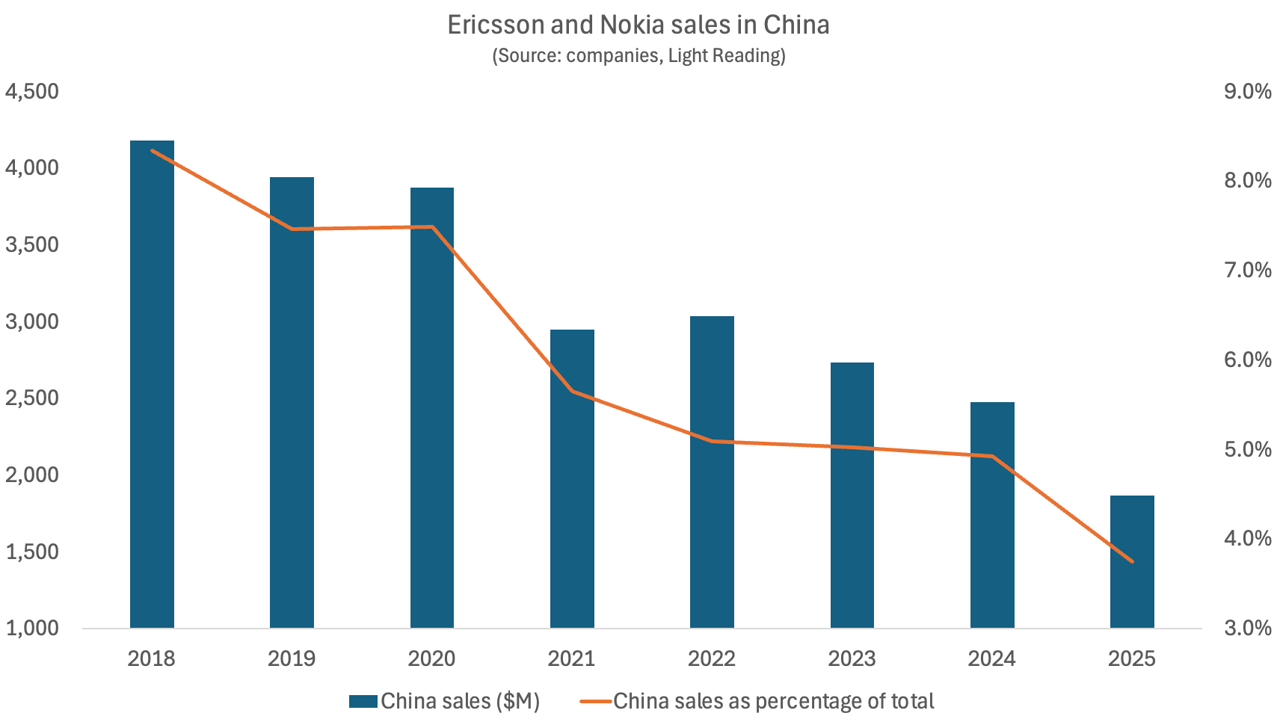
Bar Chart Credit: Light Reading
Nokia has recently indicated the complete disappearance of its China business. “Western suppliers, which is only us and Ericsson, have 3% market share now in China and it’s been coming down, and we are going to be excluded from China for national security reasons,” said Tommi Uitto, the former president of Nokia’s mobile networks business group, at a September press conference in Finland also attended by Justin Hotard, Nokia’s CEO. It implies China’s government is now treating the Nordic vendors in the same way Europe and the U.S. are banning Huawei and ZTE networking equipment.
Nokia revealed in its latest earnings update that Greater China revenues for 2025 had fallen by another 19%, to €913 million ($1.08 billion) – just 42% of what Nokia earned in the region seven years earlier. In the last few years, moreover, Nokia has cut more jobs in Greater China than in any other single region. While figures are not yet available for 2025, the Greater China headcount numbered 8,700 employees in 2024, down from 15,700 in 2019.
Ericsson has significantly reduced its China operations following greatly reduced 5G market share. In September 2021, the company consolidated three operator-specific customer units into a unified structure, impacting several hundred sales and delivery roles within its ~10,000-person local workforce. This followed the divestment of a Nanjing-based R&D center (approx. 650 employees), aligning with strategic pivots away from legacy 2G-4G technologies. The company’s total workforce in Northeast Asia plummeted from about 14,000 in mid-2021 to roughly 9,500 at the end of last year, according to Ericsson’s financial statements.
Exclusion from China would leave Ericsson and Nokia on the outside of the world’s most promising 6G market in 2030. That would intensify concern about a bifurcation of 6G into Western and Chinese variants of IMT 20230 RIT/SRIT standard and the 3GPP specified 6G core network.
……………………………………………………………………………………………………………………………………….
References:
https://www.miit.gov.cn/gxsj/tjfx/txy/art/2025/art_7514154ec01c42ecbcb76057464652e4.html
https://www.lightreading.com/5g/ericsson-and-nokia-see-their-sales-in-china-fall-off-a-cliff
https://www.mordorintelligence.com/industry-reports/china-telecom-market
China’s open source AI models to capture a larger share of 2026 global AI market
Goldman Sachs: Big 3 China telecom operators are the biggest beneficiaries of China’s AI boom via DeepSeek models; China Mobile’s ‘AI+NETWORK’ strategy
China Telecom’s 2025 priorities: cloud based AI smartphones (?), 5G new calling (GSMA), and satellite-to-phone services
China ITU filing to put ~200K satellites in low earth orbit while FCC authorizes 7.5K additional Starlink LEO satellites
China gaining on U.S. in AI technology arms race- silicon, models and research
Analysis: Edge AI and Qualcomm’s AI Program for Innovators 2026 – APAC for startups to lead in AI innovation
Qualcomm is a strong believer in Edge AI as an enabler of faster, more secure, and energy-efficient processing directly on devices—rather than the cloud—unlocking real-time intelligence for industries like robotics and smart cities.
In support of that vision, the fabless SoC company announced the official launch of its Qualcomm AI Program for Innovators (QAIPI) 2026 – APAC, a regional startup incubation initiative that supports startups across Japan, Singapore, and South Korea in advancing the development and commercialization of innovative edge AI solutions.
Building on Qualcomm’s commitment to edge AI innovation, the second edition of QAIPI-APAC invites startups to develop intelligent solutions across a broad range of edge-AI applications using Qualcomm Dragonwing™ and Snapdragon® platforms, together with the new Arduino® UNO Q development board, strengthening their pathway toward global commercialization.
Startups gain comprehensive support and resources, including access to Qualcomm Dragonwing™ and Snapdragon® platforms, the Arduino® UNO Q development board, technical guidance and mentorship, a grant of up to US$10,000, and eligibility for up to US$5,000 in patent filing incentives, accelerating AI product development and deployment.
Applications are open now through April 30, 2026 and will be evaluated based on innovation, technical feasibility, potential societal impact, and commercial relevance. The program will be implemented in two phases. The application phase is open to eligible startups incorporated and registered in Japan, Singapore, or South Korea. Shortlisted startups will enter the mentorship phase, receiving one-on-one guidance, online training, technical support, and access to Qualcomm-powered hardware platforms and development kits for product development. They will also receive a shortlist grant of up to US$10,000 and may be eligible for a patent filing incentive of up to US$5,000. At the conclusion of the program, shortlisted startups may be invited to showcase their innovations at a signature Demo Day in late 2026, engaging with industry leaders, investors, and potential collaborators across the APAC innovation ecosystem.
Comment and Analysis:
Qualcomm is a strong believer in Edge AI—the practice of running AI models directly on devices (smartphones, cars, IoT, PCs) rather than in the cloud—because they view it as the next major technological paradigm shift, overcoming limitations inherent in cloud computing. Despite the challenges of power consumption and processing limitations, Qualcomm’s strategy hinges on specialized, heterogenous computing rather than relying solely on RISC-based CPU cores.
Key Issues for Qualcomm’s Edge AI solutions:
- Qualcomm® AI Engine: This combines specialized hardware, including the Hexagon NPU (Neural Processing Unit), Adreno GPU, and CPU. The NPU is specifically designed to handle high-performance, complex AI workloads (like Generative AI) far more efficiently than a generic CPU.
- Custom Oryon CPU: The latest Snapdragon X Elite platform features customized cores that provide high performance while outperforming traditional x86 solutions in power efficiency for everyday tasks.
- Specialization Saves Power: By using specialized AI engines (NPUs) rather than general-purpose CPU/GPU cores, Qualcomm can run inference tasks at a fraction of the power cost.
- Lower Overall Energy: Doing AI at the edge can save total energy by avoiding the need to send data to a power-hungry data center, which requires network infrastructure, and then sending it back.
- Intelligent Efficiency: The Snapdragon 8 Elite, for example, saw a 27% reduction in power consumption while increasing AI performance significantly.
- Instant Responsiveness (Low Latency): For autonomous vehicles or industrial robotics, a few milliseconds of latency to the cloud can be catastrophic. Edge AI provides real-time, instantaneous analysis.
- Privacy and Security: Data never leaves the device. This is crucial for privacy-conscious users (biometrics) and compliance (GDPR), which is a major advantage over cloud-based AI.
- Offline Capability: Edge devices, such as agricultural sensors or smart home devices in remote areas, continue to function without internet connectivity.
- Diversification: With the smartphone market maturing, Qualcomm sees the “Connected Intelligent Edge” as a huge growth opportunity, extending their reach into automotive, IoT, and PCs.
- “Ecosystem of You”: Qualcomm aims to connect billions of devices, making AI personal and context-aware, rather than generic.
- Qualcomm AI Hub: This makes it easier for developers to deploy optimized models on Snapdragon devices.
- Model Optimization: They specialize in making AI models smaller and more efficient (using quantization and specialized AI inference) to run on devices without requiring massive, cloud-sized computing power.
References:
Qualcomm CEO: AI will become pervasive, at the edge, and run on Snapdragon SoC devices
Huawei, Qualcomm, Samsung, and Ericsson Leading Patent Race in $15 Billion 5G Licensing Market
Private 5G networks move to include automation, autonomous systems, edge computing & AI operations
Nvidia’s networking solutions give it an edge over competitive AI chip makers
Nvidia AI-RAN survey results; AI inferencing as a reinvention of edge computing?
CES 2025: Intel announces edge compute processors with AI inferencing capabilities
Qualcomm CEO: expect “pre-commercial” 6G devices by 2028
SoftBank and Ericsson-Japan achieve 24% 5G throughput improvement using AI-optimized Massive MIMO
SoftBank Corp. and Ericsson Japan K.K. have announced a successful demonstration and deployment of an AI-powered, externally controlled optimization system for Massive MIMO, resulting in a 24% improvement in 5G downlink throughput, increasing speeds from 76.9 Mbps to 95.5 Mbps during periods of high traffic fluctuation.
- Dynamic Beam Patterns: The system automatically adjusts horizontal and vertical beam patterns every minute based on real-time user distribution.
- Packet Stalling Mitigation: By reacting to sudden traffic surges (e.g., during fireworks or concerts), the AI helps prevent “packet stalling,” where data transmission typically freezes due to congestion.
- Commercial Deployment: Following the successful trials at Expo 2025, SoftBank and Ericsson have begun deploying this AI-based system at other large-scale event venues, including major arenas and dome-type facilities in the Tokyo metropolitan area, to manage heavily fluctuating traffic patterns.
Overview of the System:
- An external control device (server) uses user distribution data collected from base stations at one-minute intervals to automatically determine event occurrence using AI
- Dynamically and automatically optimizes the horizontal and vertical coverage patterns of Massive MIMO base stations

Overview of demonstration at Expo 2025:
An AI model was constructed using performance results obtained when multiple coverage patterns were changed in advance as training data. Based on user distribution-related data such as Massive MIMO beam estimation information*2 acquired by an external control device from base stations at one-minute intervals, the system automatically determined event occurrence status and switched base station coverage patterns to optimal configurations.
……………………………………………………………………………………………………………………………….
ABOUT SOFTBANK:
Guided by the SoftBank Group’s corporate philosophy, “Information Revolution – Happiness for everyone,” SoftBank Corp. (TOKYO: 9434) operates telecommunications and IT businesses in Japan and globally. Building on its strong business foundation, SoftBank Corp. is expanding into non-telecom fields in line with its “Beyond Carrier” growth strategy while further growing its telecom business by harnessing the power of 5G/6G, IoT, Digital Twin and Non-Terrestrial Network (NTN) solutions, including High Altitude Platform Station (HAPS)-based stratospheric telecommunications. While constructing AI data centers and developing homegrown LLMs specialized for the Japanese language, SoftBank is integrating AI with radio access networks (AI-RAN), with the aim of becoming a provider of next-generation social infrastructure. To learn more, please visit https://www.softbank.jp/en/corp/
………………………………………………………………………………………………………………………………….
References:
SoftBank’s Transformer AI model boosts 5G AI-RAN uplink throughput by 30%, compared to a baseline model without AI
Softbank developing autonomous AI agents; an AI model that can predict and capture human cognition
Nokia, BT Group & Qualcomm achieve enhanced 5G SA downlink speeds using 5G Carrier Aggregation with 5 Component Carriers
T‑Mobile achieves record 5G Uplink speed with 5G NR Dual Connectivity
Huawei, Qualcomm, Samsung, and Ericsson Leading Patent Race in $15 Billion 5G Licensing Market
Ericsson announces capability for 5G Advanced location based services in Q1-2026
Highlights of Ericsson’s Mobility Report – November 2025
Ericsson integrates Agentic AI into its NetCloud platform for self healing and autonomous 5G private networks
Analysis: SpaceX FCC filing to launch up to 1M LEO satellites for solar powered AI data centers in space
SpaceX has applied to the Federal Communications Commission (FCC) for permission to launch up to 1 million LEO satellites for a new solar-powered AI data center system in space. The private company, 40% owned by Elon Musk, envisions an orbital data center system with “unprecedented computing capacity” needed to run large-scale AI inference and applications for billions of users, according to SpaceX’s filing entered late on Friday.
Credit: Blueee/Alamy Stock Photo
The proposed new satellites would operate in “narrow orbital shells” of up to 50 kilometers each. The satellites would operate at altitudes of between 500 kilometers and 2,000 kilometers, and 30 degrees, and “sun-synchronous orbit inclinations” to capture power from the sun. The system is designed to be interconnected via optical links with existing Starlink broadband satellites, which would transmit data traffic back to ground Earth stations.
“Fortunately, the development of fully reusable launch vehicles like Starship that can deploy millions of tons of mass per year to orbit when launching at rate, means on-orbit processing capacity can reach unprecedented scale and speed compared to terrestrial buildouts, with significantly reduced environmental impact,” SpaceX said.
- Energy Density & Sustainability: By tapping into “near-constant solar power,” SpaceX aims to utilize a fraction of the Sun’s output—noting that even a millionth of its energy exceeds current civilizational demand by four orders of magnitude.
- Thermal Management: To address the cooling requirements of high-density AI clusters, these satellites will utilize radiative heat dissipation, eliminating the water-intensive cooling loops required by terrestrial facilities.
- Opex & Scalability: The financial viability of this orbital layer is tethered to the Starship launch platform. SpaceX anticipates that the radical reduction in $/kg launch costs provided by a fully reusable heavy-lift vehicle will enable rapid scaling and ensure that, within years, the lowest LCOA (Levelized Cost of AI) will be achieved in orbit.
- Vacuum-Speed Data Transmission: In a vacuum, light propagates roughly 50% faster than through terrestrial fiber optic cables. By utilizing Starlink’s optical inter-satellite links (OISLs)—a “petabit” laser mesh—data can bypass terrestrial bottlenecks and subsea cables. This potentially reduces intercontinental latency for AI inference to under 50ms, surpassing many long-haul terrestrial routes.
- Edge-Native Processing & Data Gravity: Current workflows require downlinking massive raw datasets (e.g., Synthetic Aperture Radar imagery) for terrestrial processing, a process that can take hours. Shifting to orbital edge computing allows for “in-situ” AI inference, processing data onboard to deliver actionable insights in minutes rather than hours. This “Space Cloud” architecture eliminates the need to route raw data back to the Earth’s internet backbone, reducing data transmission volumes by up to 90%.
- LEO Proximity vs. Terrestrial Hops: While terrestrial fiber remains the “gold standard” for short-range latency (typically 1–10ms), it is often hindered by inefficient routing and multiple hops. SpaceX’s LEO constellation, operating at altitudes between 340km and 614km, currently delivers median peak-hour latencies of ~26ms in the US. Future orbital configurations may feature clusters at varying 50km intervals to optimize for specific workload and latency tiers.
………………………………………………………………………………………………………………………………………………………………………………………
The SpaceX FCC filing on Friday follows an exclusive report by Reuters that Elon Musk is considering merging SpaceX with his xAI (Grok chatbot) company ahead of an IPO later this year. Under the proposed merger, shares of xAI would be exchanged for shares in SpaceX. Two entities have been set up in Nevada to facilitate the transaction, Reuters said. Musk also runs electric automaker Tesla, tunnel company The Boring Co. and neurotechnology company Neuralink.
………………………………………………………………………………………………………………………………………………………………………………………
References:
Google’s Project Suncatcher: a moonshot project to power ML/AI compute from space
Blue Origin announces TeraWave – satellite internet rival for Starlink and Amazon Leo
China ITU filing to put ~200K satellites in low earth orbit while FCC authorizes 7.5K additional Starlink LEO satellites
Amazon Leo (formerly Project Kuiper) unveils satellite broadband for enterprises; Competitive analysis with Starlink
Telecoms.com’s survey: 5G NTNs to highlight service reliability and network redundancy
Huge significance of EchoStar’s AWS-4 spectrum sale to SpaceX
U.S. BEAD overhaul to benefit Starlink/SpaceX at the expense of fiber broadband providers
Telstra selects SpaceX’s Starlink to bring Satellite-to-Mobile text messaging to its customers in Australia
SpaceX launches first set of Starlink satellites with direct-to-cell capabilities
AST SpaceMobile to deliver U.S. nationwide LEO satellite services in 2026
GEO satellite internet from HughesNet and Viasat can’t compete with LEO Starlink in speed or latency
How will fiber and equipment vendors meet the increased demand for fiber optics in 2026 due to AI data center buildouts?
Subsea cable systems: the new high-capacity, high-resilience backbone of the AI-driven global network