

AI in 6G (IMT 2030)
Autonomous customer experience required for AI-Native 6G and distributed intelligence at the network edge
Executive Sumary:
Communications service providers (CSPs) have historically competed on network-centric KPIs—coverage, capacity, reliability, and price—anchored in 3GPP performance and management frameworks (e.g., TS 28-series, TS 23.501 QoS models). However, these metrics alone are no longer sufficient to sustain differentiation in increasingly saturated and capital-intensive markets, according to Chantel Cary, Product Marketing Senior Manager at Oracle Communications [1],
“The battleground has shifted,” Cary told Capacity Global. “Today, customer experience is becoming the clearest point of differentiation, and in many cases, the most important driver of growth.”
This shift is unfolding alongside structural constraints: flat ARPU, rising capex associated with 5G standalone, fiber access (FTTx), and edge cloud expansion, and increasing customer acquisition and retention costs. At the same time, customer expectations—benchmarked against hyperscaler-grade digital platforms—are becoming uniformly high across mobile and fixed broadband services.
“They do not compare a telecom provider only to other providers,” she said. “They compare every experience to the best experience they have anywhere.”
…………………………………………………………………………………………………………………………………………………………………………………………………………………..
Note 1. Oracle Communications is a dedicated global business unit and product portfolio fully owned and operated by Oracle. It provides enterprise software and infrastructure designed specifically for telecommunications service providers (like AT&T or Verizon) and large enterprises. Their solutions manage everything from network routing, security, and signaling (including 5G) to back-office billing, revenue management, and customer experience operations,
…………………………………………………………………………………………………………………………………………………………………………………………………………………..
Analysys Mason reports that 97% of operators view AI-powered automation as essential for survival and growth, reinforcing alignment with TM Forum’s Autonomous Networks framework and the broader industry transition toward AI-native system design.
AI-Native Customer Experience Architecture:
Cary’s concept of “autonomous customer experience” maps directly to the emerging paradigm of AI-native networks, where intelligence is embedded across both network and service layers rather than applied as an overlay. “It is not about removing the human element from engagement,” she explained. “It is about using AI to continuously orchestrate the customer lifecycle in ways that humans alone cannot manage at scale.”
In wireless networks, this evolution is reflected in 3GPP-defined enablers such as the Network Data Analytics Function (NWDAF, TS 23.288), which provides real-time analytics to optimize policy control, mobility, and QoS. In parallel, O-RAN Alliance architectures introduce the near-real-time and non-real-time RAN Intelligent Controllers (near-RT RIC, non-RT RIC), enabling AI-driven control loops for radio resource management and service optimization.

Image Credit: Aisera
In wireline and converged networks, similar principles are emerging through SDN-based control planes, broadband network gateways (BNG) with telemetry streaming, and ITU-T frameworks (e.g., Y.3172 for machine learning in future networks), enabling closed-loop optimization across access, aggregation, and core domains.
However, Cary notes that most OSS/BSS environments remain fragmented, limiting the ability to operationalize these capabilities at the customer experience layer. Data silos, batch-oriented processing, and loosely coupled workflows constrain real-time, cross-domain orchestration.
AI Across Commercial and Network Domains:
Cary identifies three primary domains of impact, increasingly converging with network intelligence:
-
Marketing: AI-driven personalization is evolving toward real-time, context-aware engagement informed by both customer behavior and network conditions (e.g., location, QoS state, congestion). This aligns with event-driven architectures and customer data platforms integrated with network analytics (e.g., NWDAF exposure via APIs). “Personalisation shifts from broad audiences to the individual,” she said, adding that relevance is now “a prerequisite for attention.”
-
Sales: AI enables next-best-action and dynamic offer generation, incorporating network-aware insights such as service availability, slice characteristics (in 5G SA), and fiber capacity constraints. Integration with policy control (3GPP TS 23.203) and service orchestration frameworks supports closed-loop order capture and fulfillment. “That combination of higher conversion and lower friction is valuable,” she said.
-
Service: AI-driven assurance is transitioning from reactive fault management to predictive and intent-based service assurance across both wireless and wireline domains. Telemetry from RAN, transport, and fixed access networks feeds AI models that anticipate degradation and trigger remediation before customer impact. “Human agents still play a central role,” Cary said, “but they can be augmented with real-time recommendations, contextual history and autonomous processes that improve both speed and consistency.”
Scaling Challenges in AI-Native Transformation:
Despite progress in AI models and domain-specific analytics, Cary highlights a systemic gap in operationalization.
“What it lacks, in many cases, is the ability to turn fragmented customer data into real-time decisions that can actually be executed across marketing, sales and service,” she said.
Analysys Mason data indicates that only 6% of operators achieve ROI above 25% from AI initiatives, while 60% advance just 20% of proofs of concept into production. This reflects challenges in integrating heterogeneous data sources across OSS, BSS, and network domains, as well as limitations in MLOps and real-time orchestration frameworks.
Fragmentation is compounded in converged networks, where wireless (3GPP-based) and wireline (e.g., Broadband Forum TR-369/USP, TR-383 for disaggregated BNG) ecosystems often evolve independently. Additionally, 93% of operators cite multi-vendor complexity as increasing total cost of ownership, underscoring the need for interoperable, standards-based integration across AI, network, and IT domains.
“That creates an unfortunate pattern across the industry,” she said, “promising AI initiatives that demonstrate value in isolation but fail to scale because they are not connected to the data, systems and processes where real work happens.”
Toward Fully AI-Native Operations:
Cary emphasizes that the target state is not incremental automation but fully AI-native operations, where intelligence is embedded into both network control loops and customer engagement workflows.
“This is why the future of customer experience in communications is not about layering AI onto the edge of the enterprise,” Cary said. “It is about making AI operational at the core of engagement.”
This vision aligns with emerging 6G research directions, where AI is treated as a native design primitive across RAN, core, and service layers, as well as with TM Forum’s Open Digital Architecture (ODA), which promotes composable, API-driven integration between OSS, BSS, and AI components.
Oracle’s approach reflects this convergence by unifying customer data, embedding AI into engagement and orchestration layers, and integrating these capabilities with telecom operational systems across both wireless and wireline domains.
Implementation Suggestions:
Cary said that network providers do not need to transform everything at once. She recommends starting by unifying customer data across touchpoints to establish a trusted, real-time view, before activating high-value AI use cases across marketing, sales and service. From there, providers can embed AI into workflows so insight translates into action rather than sitting in dashboards, eventually connecting those capabilities into end-to-end orchestration.
Indeed, Cary advocates a phased approach consistent with AI-native transformation:
-
Establish a unified, real-time data fabric spanning customer, service, and network domains.
-
Deploy high-value AI use cases (e.g., next-best-action, churn prediction, predictive assurance) leveraging both IT and network telemetry.
-
Embed AI into execution workflows to enable closed-loop, intent-driven orchestration across the customer lifecycle.
This progression reflects the broader industry trajectory toward converged, AI-native networks, where customer experience is no longer an overlay on connectivity, but a direct outcome of tightly coupled intelligence across wireless and wireline infrastructures.
“The communications providers that lead in the years ahead will not be the ones that simply adopt more AI tools. They will be the ones that use AI to rethink how customer engagement works across the enterprise. AI is not just enhancing customer experience,” she added. “It is redefining how customer experience is delivered, and in communications, that shift is likely to separate the providers that keep pace from the ones that set the pace.”
………………………………………………………………………………………………………………………………
Editorial Analysis:
Cary’s vision aligns with IMT 2030/6G’s shift from AI as an overlay to AI as an architectural primitive, spanning the air interface, semantic service handling, and distributed edge intelligence across wireless and wireline domains. The cleanest way to map her suggestions into 6G is to treat “autonomous customer experience” as the service-layer expression of an AI-native network stack: AI decisions would no longer sit only in OSS/BSS, but would be distributed across RAN, transport, core, and edge applications, with closed-loop control spanning wireless and wireline domains. That maps well to current AI-native 6G proposals that emphasize model interdependencies, distributed intelligence, and AI embedded directly in the architecture rather than layered on top.
For the AI native air interface, the link is to AI-assisted radio control, where the network uses learned models to optimize scheduling, mobility, beam management, and QoS-aware policy decisions in real time. In a 6G framing, that extends beyond today’s AI for RAN optimization and toward an AI-native air interface in which the radio stack itself is designed for machine-driven adaptation, including distributed control loops between UE, RAN, and core. For your article, this supports language that customer experience is increasingly shaped by network intelligence at the point of access, not just by back-office engagement systems.ieeexplore.ieee+2
Semantic communications maps to the idea that the network should optimize for meaning or task relevance, not simply bit delivery. In practice, that means a 6G service layer could prioritize the semantic value of an interaction—such as whether a customer is trying to resolve an outage, confirm a move order, or change a plan—and allocate resources accordingly across wireless and wireline paths. The relevance to Cary’s argument is that customer experience becomes more contextual and intent-aware when the network itself can distinguish between low-value traffic and high-importance service interactions.
Distributed intelligence at the network edge is the most direct bridge between CSP operations and 6G design. In a converged wireless-wireline environment, edge AI can fuse RAN telemetry, fixed access metrics, subscriber context, and service history to trigger local decisions such as proactive care, dynamic QoS adjustment, or preemptive fault mitigation. That makes the experience layer more autonomous because the decision point moves closer to where the event occurs, reducing dependence on centralized, slower, batch-oriented processing.
…………………………………………………………………………………………………………………………………………………………………………………………………………………………………………
References:
https://www.nokia.com/6g/unlocking-the-full-potential-of-ai-native-6g-through-standards/
Comparing AI Native mode in 6G (IMT 2030) vs AI Overlay/Add-On status in 5G (IMT 2020)
SHIELD-6G with AI-native cyber threat intelligence platform to enhance cybersecurity for Europe’s future 6G networks
AT&T and Ericsson boost Cloud RAN performance with AI-native software running on Intel Xeon 6 SoC
Ericsson and Intel collaborate to accelerate AI-Native 6G; other AI-Native 6G advancements at MWC 2026
NVIDIA and global telecom leaders to build 6G on open and secure AI-native platforms + Linux Foundation launches OCUDU
AT&T and Ericsson boost Cloud RAN performance with AI-native software running on Intel Xeon 6 SoC
Comparing AI Native mode in 6G (IMT 2030) vs AI Overlay/Add-On status in 5G (IMT 2020)
Executive Summary:
AI integration in 6G specifications (3GPP) and standards (ITU-R IMT 2030) highlights a strategic shift in the telecom industry towards AI-native networks, with telecom industry heavyweights like Huawei, Samsung, Ericsson, and Nokia actively developing foundational technologies. Unlike 5G, where AI and machine learning were limited applications or add-on features over existing architecture, 6G will incorporate AI from the onset with an “AI native” approach where intelligence will allow the network to be smart, agile, and able to learn and adapt according to changing network dynamics.
This transformation is necessary because future 6G networks will be too complex for human operators to manage, requiring AI-empowered and learning-driven networks that can facilitate zero-touch network management through capabilities including learning, reasoning, and decision-making.
- AI-Native Networks: The industry consensus is that 6G will be “AI-native,” meaning artificial intelligence will be built directly into the core functions of network control, resource management, and service orchestration. This moves AI from an optimization layer in 5G to an foundational element in 6G.
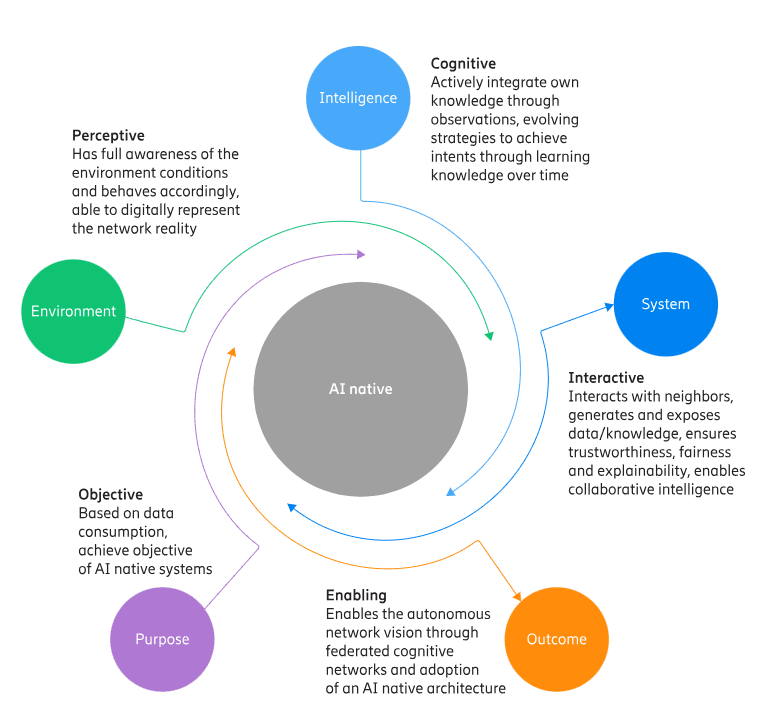
AI Native Image Courtesy of Ericsson
…………………………………………………………………………………………………………………………………………………………………………………………………………………………………………………………………………………………………
- Company Initiatives:
- Huawei is focused on making AI a native element of the network architecture (AI-native 6G) rather than an overlay technology, integrating communication, sensing, computing, and intelligence. This vision, called “Connected Intelligence,” involves two aspects: AI for 6G (network automation) and 6G for AI (AI as a Service, AIaaS). More in Huawei Research Areas below.
- Samsung is a major proponent of AI-RAN (Radio Access Network) technology. The company hosted a summit in November 2025 to showcase working AI-RAN technology that autonomously optimizes network performance and is conducting joint research with SK Telecom (SKT) on AI-supported RAN. Samsung sees vRAN (virtualized RAN) as a key enabler for “AI-native, 6G-ready networks”.
- Ericsson emphasizes the necessity of a strong 5G Standalone (5G SA) foundation for an AI future, using AI to manage and automate current networks in preparation for 6G’s demands. Ericsson is also integrating agentic AI into its platforms for more autonomous network management.
- Nokia is deepening its AI push, licensing software to expand AI use in mobile networks and preparing for early field trials in 2026 by porting baseband software to platforms like NVIDIA’s, which opens the door for more advanced AI use cases.
- Industry Analysis and Trends:
- Standardization: 2026 is crucial as formal 6G specification work begins in earnest within 3GPP with Release 21. In WP5D, the IMT 2030 RIT/SRIT standardization work will commence at the February 2027 meeting with the final deadline for submissions at the February 2029 meeting. More in the ITU-R WP5D section below.
- The AI-RAN Alliance is an industry initiative (not a traditional SDO) focused on accelerating real-world AI applications and integration within the RAN. It works alongside SDOs, providing industry insights and pushing for rapid validation and testing of AI-RAN technologies, with a specific focus on leveraging accelerated computing.
- Automation and Efficiency: AI-native algorithms in 6G are expected to deliver extreme spectrum and energy efficiency, significantly reducing operational costs for telcos while improving reliability and performance.
- Monetization Challenges: Despite the technological promise, analysts caution that 6G remains largely theoretical for now. Some operators are stalling on full 5G SA deployment, waiting to move to 6G-ready cores later in the decade, leading to concerns that 5G SA might become an “odd generation.”
- Infrastructure Constraints: The physical demands of AI infrastructure, particularly energy consumption and construction timelines, are becoming operational realities that may bound the pace of AI growth in 2026, regardless of software advancements.
- ITU-R Working Party (WP) 5D is making AI a native and foundational element of the 6G (IMT-2030) system, rather than the “add-on” or “overlay” status it had in 5G (IMT 2020). This shift is being achieved through the definition of specific AI capabilities and requirements that future 6G technologies must inherently support. In particular:
- Defining AI as a Core Capability: The Recommendation ITU-R M.2160 (“Framework and overall objectives of the future development of IMT for 2030 and Beyond”) officially defines “Artificial Intelligence and Communication” as one of the six major usage scenarios and an overarching design principle for IMT-2030.
- Integrating AI into the Radio Interface: WP 5D is actively developing technical performance requirements (TPRs) and evaluation criteria for proposed 6G radio interface technologies (RITs) that inherently incorporate AI/Machine Learning (ML). This includes work on:
- AI-enabled air interface design: This involves the physical layer, potentially moving towards AI-native physical (PHY) layers that can dynamically adapt waveforms and network parameters in real-time, rather than relying on predefined, static configurations.
- AI-driven resource management: AI/ML algorithms will be crucial for real-time optimization of spectral and energy efficiency, managing complex traffic, and ensuring Quality of Service (QoS).
- Enabling AI-Driven Services: The framework for IMT-2030 is designed to support the full lifecycle of AI components, from data collection and model training to deployment and performance monitoring, enabling new AI-driven services and applications directly within the network infrastructure.
- Establishing a Formal Timeline: WP 5D has established a clear timeline for 6G standardization, with specific stages for vision, requirements, evaluation methodology, and specifications. This structured approach ensures that all proposed RITs/SRITs are evaluated against the new AI-native requirements, promoting global alignment and preventing AI from becoming a fragmented, proprietary solution.
- Stage 1 (Vision): Completed in June 2023.
- Stage 2 (Requirements & Evaluation): Targeted for completion in 2026.
- Stage 3 (Specifications): Expected by the end of 2030.
- Purpose: AI is integral to the entire network lifecycle, from initial design and deployment to autonomous operation and service creation.
- Integration Level: Intelligence is embedded across all layers of the network stack, including the physical layer (air interface), control plane, and data plane.
- Scope: AI enables core functionalities such as real-time self-optimization, self- healing capabilities, and dynamic resource allocation, rather than static, predefined configurations.
- Outcome: The creation of a fully cognitive, self-managing, and highly adaptable “intelligence fabric” capable of supporting advanced use cases like real-time holographic communication, digital twins, and autonomous systems with ultra-low latency.
| Feature | 5G (IMT-2020) | 6G (IMT-2030) |
|---|---|---|
| AI Role | Optimization tool (overlay) | Foundational and native element |
| Network Operation | Manual configuration with AI assistance | Autonomous and self-managing |
| Air Interface | Human-designed with some ML optimization | AI/ML-designed and managed |
| Complexity Management | Relies on standard protocols | Manages complexity through embedded AI/ML |
| Services Supported | Enhanced mobile broadband, basic IoT | Integrated AI & Communication, sensing, holographic comms |
–>By embedding AI into the fundamental design principles and technical requirements of IMT-2030, ITU-R WP 5D is ensuring that 6G is an AI-native network capable of self-management, self-optimization, and supporting a vast ecosystem of AI applications, a significant shift from the supplementary role AI played in 5G.
- Agentic-AI Core (A-Core): Huawei unveiled a blueprint for a 6G core network (which will be specified by 3GPP and NOT ITU) where services are managed by specialized AI agents using a large-scale network AI model called “NetGPT”. This allows the network to program, update, and execute its own control procedures automatically without human intervention, based on natural language instructions.
- Network Architecture Redesign: Huawei proposes the NET4AI system architecture, a service-oriented design that moves beyond the 5G service-based architecture. It introduces a dedicated data plane (DP) to handle the massive volume of data generated by AI and sensing services, enabling flexible and efficient many-to-many data flow for distributed learning and inference.
- Integrated Sensing and Communication (ISAC): A core pillar of Huawei’s 6G work is the native integration of sensing with communication. This allows the network to use radio waves for high-resolution sensing, localization, and imaging, creating a “digital twin” of the physical world. The large volume of data collected from sensing then serves as a source for AI model training and real-time environmental monitoring.
- Distributed Machine Learning: Huawei researches deep-edge architecture to enable massive, distributed, and collaborative machine learning (ML). This includes the development of frameworks like a two-level learning architecture that combines federated learning (FL) and split learning (SL) to optimize computing resources and ensure data privacy by keeping raw data local to devices.
- AI as a Service (AIaaS): The 6G network is designed to provide AI capabilities as a service, allowing the training and inference of large AI models to be distributed across the network (edge and cloud). This offers low-latency performance and access to rich data for AI-driven applications like collaborative robotics and autonomous driving.
- Energy Efficiency and Sustainability: The company is researching how native AI capabilities can improve overall energy efficiency by up to 100 times compared to 5G. This involves smart energy control, dynamic resource scaling, and optimizing communication paths for lower power consumption.
- Standardization and White Papers: Huawei is actively contributing to global 6G discussions and standardization bodies like the ITU-R, sharing its vision through publications such as the book 6G: The Next Horizon – From Connected People and Things to Connected Intelligence and various technical white papers. The goal is to define the technical specifications and use cases for 6G that will drive industry-wide innovation by around 2030.
References:
https://www.ericsson.com/en/reports-and-papers/white-papers/ai-native
Roles of 3GPP and ITU-R WP 5D in the IMT 2030/6G standards process
AI wireless and fiber optic network technologies; IMT 2030 “native AI” concept
ITU-R WP5D IMT 2030 Submission & Evaluation Guidelines vs 6G specs in 3GPP Release 20 & 21
ITU-R WP 5D Timeline for submission, evaluation process & consensus building for IMT-2030 (6G) RITs/SRITs
ITU-R WP 5D reports on: IMT-2030 (“6G”) Minimum Technology Performance Requirements; Evaluation Criteria & Methodology
AI wireless and fiber optic network technologies; IMT 2030 “native AI” concept
Highlights of 3GPP Stage 1 Workshop on IMT 2030 (6G) Use Cases
Should Peak Data Rates be specified for 5G (IMT 2020) and 6G (IMT 2030) networks?
GSMA Vision 2040 study identifies spectrum needs during the peak 6G era of 2035–2040
Highlights and Summary of the 2025 Brooklyn 6G Summit
NGMN: 6G Key Messages from a network operator point of view
Nokia and Rohde & Schwarz collaborate on AI-powered 6G receiver years before IMT 2030 RIT submissions to ITU-R WP5D
Verizon’s 6G Innovation Forum joins a crowded list of 6G efforts that may conflict with 3GPP and ITU-R IMT-2030 work
Nokia Bell Labs and KDDI Research partner for 6G energy efficiency and network resiliency
Deutsche Telekom: successful completion of the 6G-TakeOff project with “3D networks”
Market research firms Omdia and Dell’Oro: impact of 6G and AI investments on telcos
Qualcomm CEO: expect “pre-commercial” 6G devices by 2028
Ericsson and e& (UAE) sign MoU for 6G collaboration vs ITU-R IMT-2030 framework
KT and LG Electronics to cooperate on 6G technologies and standards, especially full-duplex communications
Highlights of Nokia’s Smart Factory in Oulu, Finland for 5G and 6G innovation
Nokia sees new types of 6G connected devices facilitated by a “3 layer technology stack”
Rakuten Symphony exec: “5G is a failure; breaking the bank; to the extent 6G may not be affordable”
India’s TRAI releases Recommendations on use of Tera Hertz Spectrum for 6G
New ITU report in progress: Technical feasibility of IMT in bands above 100 GHz (92 GHz and 400 GHz)