

Quantum Network
Toshiba Wins UK Contract to Advance Commercial Quantum Networking: Can It Leverage Existing Optical Fiber Infrastructure?
Disclaimer: ChatGPT was used extensively to research and analyze the references cited in this article. The author provided editorial guidance and direction, reviewed the material, and is 100% responsible for the article’s final content.
…………………………………………………………………………………………………………………………………………………………………………………………………………………………………….
Introduction:
Toshiba Europe has been awarded a contract by Innovate UK, part of UK Research and Innovation (UKRI), to develop technologies intended to accelerate the commercial deployment of quantum networks. The Innovate UK-funded project targets scalable, multi-user quantum networks, but specialized Physical-layer requirements and deployment economics could limit their integration with conventional carrier optical networks. The project will focus on technologies for long-distance quantum links and multi-user quantum networks, with prototype subsystems evaluated under realistic operating conditions.
The contract was awarded through Innovate UK’s Enabling Commercial Quantum Networking competition, which supports UK companies developing components and subsystems for quantum networks. The competition represents a combined £20 million investment in the UK’s quantum technology ecosystem and aims to strengthen domestic capabilities across the emerging quantum networking supply chain.
The project supports the UK’s National Quantum Strategy, which includes an ambition to deploy advanced quantum networks at scale by 2035 and establish foundations for a future quantum internet. Such networks could eventually enable quantum information to be distributed among geographically separated quantum computers and other quantum systems.
Toshiba will develop and evaluate prototype subsystems designed to make quantum networks easier and more economical to expand using the UK’s existing optical fiber infrastructure. The work will investigate more efficient utilization of network resources and management of connectivity as the number of connected users and sites increases. Improved resource utilization could reduce infrastructure requirements and capital expenditures while making quantum networking services more accessible to telecommunications operators and customers.
UK network operators BT and Colt Technology Services will collaborate on validating the technology against practical network deployment and operational requirements.
Quantum networking and telecommunications infrastructure:
A significant longer-term application of quantum networking is connecting quantum processors located in separate data centers so that they can potentially work together on distributed computational tasks. Interconnecting quantum processors could expand the computational resources available to researchers and organizations and contribute to advances in areas such as pharmaceutical discovery and materials science. However, scaling quantum networks presents substantial engineering challenges. Unlike conventional optical communications, which transmit classical information using light, quantum networks must distribute and preserve fragile quantum states. This introduces requirements for specialized optical components, quantum-state management, synchronization and, ultimately, quantum repeaters capable of extending quantum communications over longer distances.
Integration with existing carrier fiber infrastructure is another important consideration. Network operators must address fiber loss, optical signal coexistence, routing, resource allocation and operational management while accommodating the specialized requirements of quantum communications.
One potential approach is to multiplex quantum and conventional data channels over the same optical fiber using wavelength-division multiplexing (WDM). This could avoid the expense of deploying entirely separate fiber networks. However, conventional optical signals can introduce noise and other impairments that degrade quantum channels. Raman scattering, optical power levels, fiber attenuation and losses introduced by multiplexers and other optical components all require careful engineering.
Furthermore, conventional optical amplifiers cannot simply be used to amplify unknown quantum states because of the quantum no-cloning principle. Quantum repeaters, which are needed to extend quantum communications over longer distances without relying on conventional amplification, remain a significant technology-development challenge.
Consequently, sharing existing fiber infrastructure does not necessarily mean that quantum networks can use conventional carrier optical equipment, transmission systems and operational procedures without substantial modification.
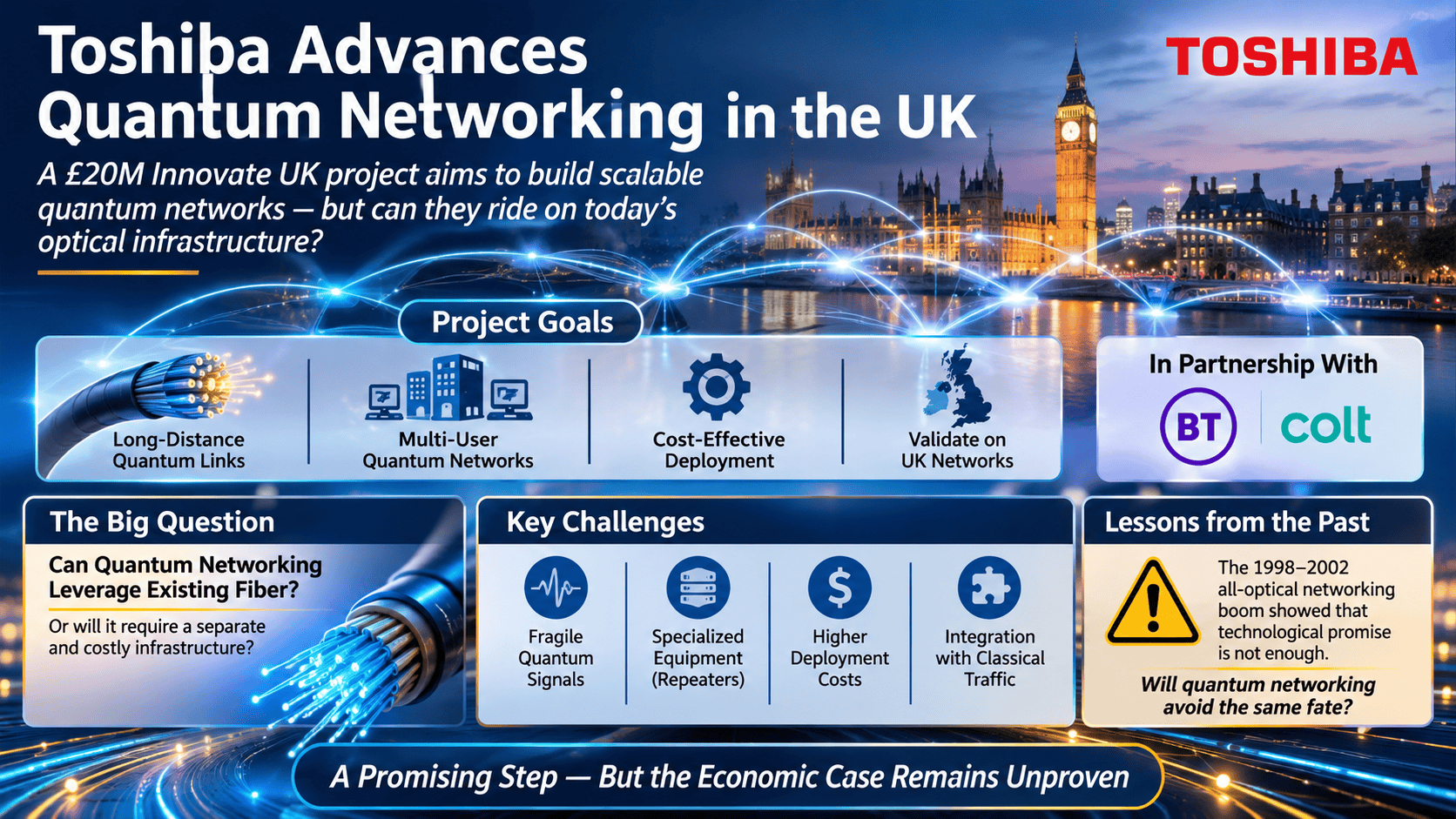
Image Created by ChatGPT
……………………………………………………………………………………………………………………………………………………………
Can quantum networking become an economically viable extension of carrier optical networks?
This is arguably the most important commercial question surrounding Toshiba’s project. The telecommunications industry has a long history of investing in promising optical networking technologies that did not achieve their anticipated commercial potential. During the 1998–2002 optical networking boom period, substantial investment went into photonic switching and all-optical networking. The vision was to eliminate repeated optical-electrical-optical (O-E-O) conversions, allowing data to remain in the optical domain throughout the network. That was supposed to usher in ultra-long-haul, repeater-less optical transmission. Photonic switches were expected to deliver enormous capacity improvements, reduce equipment complexity and lower network costs.
Despite considerable technical development and industry investment, all-optical switching did not become the dominant architecture envisioned by its proponents. Although optical circuit switches, MEMS-based photonic switches and ROADMs achieved commercial deployment in carrier networks, the broader vision of entirely photonic networking—with switching logic and control performed optically and without electronic processing—never became a commercially viable mainstream architecture. Conventional optical transport networks instead evolved through improvements in WDM, coherent optics, optical amplification, electronic switching and increasingly sophisticated optical-electrical-optical interfaces. The telecommunications industry ultimately favored hybrid optical-electronic networks.
Quantum networking could face a comparable commercialization problem. The ability to demonstrate quantum communication over existing fiber does not establish that a scalable, economically competitive carrier network can be built using conventional optical infrastructure.
There have been encouraging demonstrations of quantum and classical communications sharing the same fiber. For example, Toshiba and KDDI reported in March 2025 a demonstration carrying 33.4 Tbps of conventional data traffic alongside quantum key distribution (QKD) over an 80-kilometer fiber. This is an important proof of technical feasibility, but it does not establish the economics of a nationwide, multi-user quantum network.
There are also fundamental differences among quantum networking applications. QKD distributes cryptographic keys, while entanglement-based networking and distributed quantum computing require additional capabilities and substantially different performance characteristics. Success in multiplexing QKD with conventional traffic does not automatically demonstrate that geographically distributed quantum computers can be interconnected economically.
My assessment is that quantum networking is more likely, at least initially, to require specialized infrastructure and equipment than to become a straightforward extension of today’s carrier optical transport networks. Existing fiber may be reusable in selected applications, particularly metropolitan links and carefully engineered WDM deployments. But specialized quantum transmitters, detectors, synchronization systems, quantum memories, repeaters and associated control systems could impose substantial additional capital and operating expenses.
The economics become even more challenging when dedicated fiber, trusted intermediate nodes, environmental controls and specialized maintenance are required. Carrier operators will need to justify these costs against the actual revenue-generating applications and the alternatives available to customers.
The US and European quantum networking research communities have demonstrated that coexistence with conventional optical traffic is possible. Nevertheless, practical quantum repeaters, long-distance entanglement distribution, multi-vendor interoperability and scalable network management remain important obstacles.
It is therefore premature to assume that quantum networking will develop into a broadly deployed carrier service simply because existing fiber can be used in selected demonstrations.
The photonic switching experience of 1998–2002 is a useful cautionary precedent: technically impressive demonstrations and substantial R&D investment do not necessarily translate into commercially successful network architectures.
Toshiba’s quantum technology background:
The project builds on more than 25 years of Toshiba research and development in quantum technologies. The company recently introduced its Quantum-Safe Networking (QSN) Platform, designed to help organizations integrate quantum-safe protection into existing communications networks with reduced complexity, equipment footprint and cost.
It is important to distinguish these two technology areas. Quantum networking seeks to distribute quantum information and connect geographically separated quantum systems. Quantum-safe networking, by contrast, protects conventional communications against current and anticipated future cryptographic threats, including those posed by sufficiently powerful quantum computers.
Although related through their use of quantum technologies, these are distinct applications with different architectures, infrastructure requirements and deployment objectives.
Conclusions:
Toshiba’s collaboration with BT and Colt is a worthwhile technology-development effort addressing a genuine challenge: how to scale quantum networking without incurring the prohibitive cost of building entirely new fiber infrastructure. However, the critical test is not whether quantum signals can coexist with conventional data traffic over selected fiber links. It is whether the complete quantum networking architecture—including its specialized optical components, repeaters, control systems, maintenance requirements and operating costs—can deliver sufficient commercial value to justify deployment by telecommunications operators. Until that economic and technical case is demonstrated at meaningful scale, expectations for quantum networking as a natural extension of existing carrier optical infrastructure should remain guarded.
The historical lesson from the 1998–2002 photonic switching and all-optical networking boom is not that optical switching failed altogether. Rather, the ambitious vision of an entirely optical network, eliminating electronic switching and processing throughout the network, never materialized. Commercial optical switching did succeed, particularly at the wavelength and circuit layers, through technologies such as MEMS switches and reconfigurable optical add/drop multiplexers (ROADMs). However, electronic switching, processing and control remained essential components of commercial carrier networks. The industry ultimately adopted hybrid optical-electronic architectures rather than the fully photonic networks originally envisioned.
Quantum networking faces a similar commercialization challenge. Will it establish economically viable applications as a specialized extension of conventional optical networks, leveraging existing fiber wherever technically feasible? Or will its unique physical-layer requirements—including quantum repeaters, specialized transmitters and detectors, synchronization and stringent signal-management requirements—necessitate largely separate infrastructure with substantially higher deployment and operating costs? The ability to demonstrate quantum communications over existing fiber is encouraging, but does not establish that a scalable, commercially competitive carrier-network architecture is achievable. Ultimately, as with photonic switching, technical feasibility must translate into compelling economics and sustainable customer demand.
……………………………………………………………………………………………………………………………………………………………………………………………………………………
References:
Toshiba awarded contract to advance commercial quantum networking in the UK
UK Government – Quantum Key Distribution Research Report
https://www.gov.uk/government/publications/quantum-key-distribution-research-report/quantum-key-distribution-research-report
GSMA – Quantum Technologies and Telecom Use Cases (PDF)
https://www.gsma.com/solutions-and-impact/technologies/quantum-technologies/wp-content/uploads/2026/02/IG.19-Quantum-Technologies-Telcom-Use-Cases.pdf
CNAS – The Entanglement Edge (May 2026)
https://www.cnas.org/publications/reports/the-entanglement-edge
Nature – Quantum and Classical Coexistence over Hollow-Core Fiber
https://www.nature.com/articles/s41534-025-01125-7
ARCEP – Quantum Technologies and Their Impact on Networks (June 2026, PDF)
https://en.arcep.fr/uploads/tx_gspublication/futur-networks-briefing-note-quantum-technologies_june2026.pdf
PsiQuantum Targets AI Data Center Networks with Silicon-Photonic Optical Switching
2026 OCP Summit: Full-Stack AI Networking Silicon from Nvidia/Cisco and Broadcom; Ethernet vs InfiniBand Interconnects
Goldman Sachs report: Optical Networking is the next mega trend in AI infrastructure
2026 Fiber Connect Keynote: “The Future of Fiber Optics: AI and the Quantum”
IBM to Build World’s First Large-Scale, Fault-Tolerant Quantum Computer – Starling
Countdown to Q-day: How modern-day Quantum and AI collusion could lead to The Death of Encryption
Ultra-secure quantum messages sent a record distance over a fiber optic network
Google’s new quantum computer chip Willow infinitely outpaces the world’s fastest supercomputers
Quantum Computers and Qubits: IDTechEx report; Alice & Bob whitepaper & roadmap
Bloomberg on Quantum Computing: appeal, who’s building them, how does it work?
Ultra-secure quantum messages sent a record distance over a fiber optic network
Unlike binary bit based digital communications, quantum information is transmitted in qubits, which can store multiple values at once, making quantum communications more secure. A recently published article in Nature states that scientists have sent quantum information across a record-breaking 158 miles using ordinary computers and fiber-optic cables. It’s the first time coherent quantum communication—an ultra-secure means of transmitting data—has been achieved using existing telecommunications infrastructure, without the expensive cryogenic cooling that is typically required.
“Our equipment was running alongside the fibers that we use for regular communication literally buried underneath the roads and train stations,” said Mirko Pittaluga, a physicist and lead author of the study. Pittaluga and his colleagues at Toshiba Europe sent quantum information from regular computers hooked into the telecommunications network at data centers in the German cities of Kehl and Frankfurt, relaying them through a detector at a third data center roughly midway between them in Kirchfeld. The three-location setup enabled the group to extend the distance the messages were sent more than 150 miles, an uninterrupted distance only ever achieved in a laboratory environment.
Pittaluga said that his team’s work is critical to solving the problem of keeping sensitive data out of the reach of hackers. One means of fixing this problem, Pittaluga said, is through quantum cryptography, which relies on the physics of quantum mechanics rather than mathematical algorithms to generate encryption keys. But to use quantum encryption keys, you have to successfully distribute them across meaningful distances, a task that has stymied researchers outside the lab for decades.

Quantum data was sent over an ordinary telecom network with fiber-optic cables.© julie sebadelha/Agence France-Presse/Getty Images
Integrating the technology into existing infrastructure using largely off-the-shelf equipment is a key step in expanding the accessibility of quantum communication and its use in encrypting information for more secure transmission of data, according to multiple physicists and engineers who weren’t involved in the study.
“This is about as real-world as one could imagine,” said David Awschalom, a professor of physics and molecular engineering at the University of Chicago who wasn’t a part of the new work. “It’s an impressive, quite beautiful demonstration.” Working at these types of distances, Awschalom said, means that quantum information could be sent across entire metropolitan areas or between nearby cities, making it useful for hospitals, banks and other institutions, for which secure communications are paramount.
“The likelihood of them being able to reverse engineer a quantum key, which is the number you would need to decrypt your information, is vanishingly small,” according to Awschalom.
Other groups in the U.K. and U.S., including researchers at the University of Pennsylvania, are also working on extending the distances achievable by quantum communication.
Today, bank statements, health records and other data transmitted online are protected using mathematically formulated encryption keys. These keys are the only means of unlocking the data, keeping it secure from cyber thieves. For conventional computers, breaking these keys takes an impractically long time, but quantum computers are up to the task, and as they become more powerful, encryption keys become vulnerable to attack.
“Anything meaningful that’s over the internet can be tapped, recorded and saved for the next decade, and can be decrypted years later,” according to Prem Kumar, a professor of electrical and computer engineering at Northwestern University, who wasn’t a part of the new work. “It’s what’s called harvest now and decrypt later.”
Internet and telecommunications infrastructure are based on optical fibers all over the world that carry pulses of light containing photons. Classical bits of information are sent as a single impulse of light carrying tens of millions of photons. Quantum information, stored in qubits, is sent in a package of a single photon.
Efficiently detecting single photons usually requires expensive superconducting detectors that cost on the order of hundreds of thousands of dollars. These high-efficiency sensors must be cryogenically cooled, using liquid helium, to super low temperatures below minus 454 degrees Fahrenheit, making the technology expensive and incompatible with existing infrastructure.
Pittaluga and his colleagues at Toshiba got around this by using cheaper detectors known as avalanche photodiodes, which cost just thousands of dollars and can run at or just below room temperature, like today’s traditional internet equipment.
Such detectors hadn’t been used for coherent quantum communication before, as they can be nearly an order of magnitude less efficient at detecting single photons and are affected by what is called the afterpulse effect—when the current detection is frustrated by leftover echoes from an earlier transmission. Superconducting detectors aren’t affected by afterpulsing, Pittaluga said.
To address the effect in the more practical and cost-effective photodiodes, his group employed two separate sets of the detectors, using one to read the signal and the other to remove the environmental noise from that signal. The goal of this setup is to bring us one step closer to a quantum internet, with incredibly secure information, Pittaluga added.
Yet despite this innovation, the technology remains expensive and difficult to implement compared with current encryption systems and networks—for now. “My personal view is that we’ll be seeing quantum encryption of data sets and metropolitan-scale quantum networks within a decade,” Awschalom added.
……………………………………………………………………………………………………………………………………………………………………………..
Why quantum computers are faster at solving problems:
Quantum computers are faster than traditional computers for optimization problems, such as finding the more efficient options for supply chains.
A traditional computer tries each combination individually. A quantum computer tries all combinations at once.

Source: Google Quantum AI
Peter Champelli/THE WALL STREET JOURNAL
………………………………………………………………………………………………………………………………………………………………………..
References:
https://www.nature.com/articles/s41586-025-08801-w
Google’s new quantum computer chip Willow infinitely outpaces the world’s fastest supercomputers
Quantum Computers and Qubits: IDTechEx report; Alice & Bob whitepaper & roadmap
Bloomberg on Quantum Computing: appeal, who’s building them, how does it work?
SK Telecom and Thales Trial Post-quantum Cryptography to Enhance Users’ Protection on 5G SA Network
SK Telecom and Thales Trial Post-quantum Cryptography to Enhance Users’ Protection on 5G SA Network
Research on quantum communications using a chain of synchronously moving satellites without repeaters
Quantum Computers and Qubits: IDTechEx report; Alice & Bob whitepaper & roadmap
Introduction:
In the last decade, the number of companies actively developing quantum computer hardware has quadrupled. Between 2022 and 2024 multiple funding rounds surpassing US$100 million have been closed, and the transition from lab-based toys to commercial product has begun. Competition is building in the quantum computing market, not only between different companies but between quantum computing technologies. The focus today has intensified on the need for logical or error-corrected qubits [1.]. The challenge ahead is to scale up hardware and increase qubit number while reducing errors as well as infrastructure demand. Leaders today have between 1 and 50 logical qubits, thousands are likely needed to provide a meaningful advantage over classical computing alternatives.
Note 1. Quantum computing is based on the use of qubits – the quantum equivalent to classical bits – the architectures available to create them vary substantially. Many are now familiar with IBM and their superconducting qubits – housed inside large cryostats and cooled to temperatures colder than deep space. Indeed, in 2023 superconducting quantum computers broke the 1000 qubit milestone – with smaller systems made accessible via the cloud for companies to trial out their problems.
However, many agree that the highest value problems – such as drug discovery – need many more qubits, perhaps millions more. As such, alternatives to the superconducting design, many proposing more inherent scalability, have received investment. There are now more than eight technology approaches meaningfully competing to reach the million-qubit milestone.
The quantum computing hardware market today has the unique property of seeing rapid growth in revenue generation despite remaining at a low technology readiness level. National laboratories and supercomputing centers are already investing in the installation of early-stage machines on premises, primarily for research but also to allow more local users the ability to ‘pay to play’. This is, in part, a result of the intensifying governmental stake in the technology – and its potential to provide significant economic and national security advantages in conjunction with quantum sensing and quantum communications. As a result, while multiple technical challenges remain, it appears that the race to commercial advantage could well be paved with gold for some. However, towards the end of the decade, as pressure mounts to deliver commercial value and return on investment – some of those leading the charge today may not necessarily prove to be the true winners in the long term.
With so many competing quantum computing technologies across a fragmented landscape, determining which approaches are likely to dominate is essential in identifying opportunities within this exciting industry. IDTechEx uses an in-house framework for quantum commercial readiness level to measure how quantum computer hardware is progressing in comparison with its classical predecessor. Furthermore, as the initial hype around quantum computing begins to cool investors will increasingly demand demonstration of practical benefits, such as quantum supremacy for commercially relevant algorithms. As such, hardware developers need to show not only the quality and quantity of qubits but the entire initialization, manipulation, and readout systems. Improving manufacturing scalability and reducing cooling requirements are also important, which will create opportunities for methodology agnostic providers of infrastructure such as speciality materials and cooling systems. By evaluating both the sector and competing quantum computing technologies, this report provides insight into the opportunities provided by this potentially transformative technology.

……………………………………………………………………………………………………………………………………………………………………………………………………………………………………………………..
Alice & Bob, a leading innovator in fault-tolerant quantum computing, just released their whitepaper and technology roadmap titled, “Think Inside the Box: Quantum Computing with Cat Qubits.”
Key highlights of the whitepaper:
- Exponential Error Reduction: Cat qubits simplify error correction by reducing it from a 2D to a 1D problem, achieving unmatched fidelity (99.999999%) and reducing hardware requirements by up to 200x compared to traditional approaches.
- Roadmap Milestones: Alice & Bob’s plan moves from mastering single qubits to developing commercially viable quantum computers by 2030, with transformative applications across industries such as finance, healthcare, and cybersecurity.
- Quantum Advantage: Their technology positions them to deliver practical solutions to computational problems that are currently beyond the reach of classical computing.

Image Credit: Alice & Bob
………………………………………………………………………………………………………………………………………………………………………………………………
The roadmap details five key milestones in Alice & Bob’s plan to deliver a universal, fault-tolerant quantum computer by 2030:
- Milestone 1: Master the Cat Qubit Achieved in 2024 with the Boson chip series, this milestone established a reliable, reproducible cat qubit capable of storing quantum information while resisting bit-flip errors. Milestone 2: Build a Logical Qubit Currently under development with the Helium chip series, this stage focuses on creating the company’s first error-corrected logical qubit operating below the error-correction threshold.
- Milestone 3: Fault-Tolerant Quantum Computing With the upcoming Lithium chip series, Alice & Bob aims to scale multi-logical-qubit systems and demonstrate the first error-corrected logical gate.
- Milestone 4: Universal Quantum Computing The Beryllium chip series will enable a universal set of logical gates enabled by magic state factories and live error correction, unlocking the ability to run any quantum algorithm.
- Milestone 5: Useful Quantum Computing The Graphene chip series, featuring 100 high-fidelity logical qubits, will deliver a quantum computer capable of demonstrating quantum advantage in early industrial use cases by 2030, integrating into existing high-performance computing (HPC) facilities.
“Our roadmap lays out a clear path to solving quantum’s toughest engineering challenges,” said Raphael Lescanne, CTO and Co-Founder of Alice & Bob. “Quantum computing can seem opaque, but it shouldn’t be. This white paper makes our technology and roadmap accessible for engineers, business leaders and tech enthusiasts alike.”
Achieving practical quantum advantage requires overcoming the errors inherent in quantum systems. Quantum error correction typically relies on additional qubits to detect and correct these errors, but the resource requirements grow quadratically with complexity, making large-scale, useful quantum computing a significant challenge.
Alice & Bob’s cat qubits offer a promising solution to this bottleneck. These superconducting chips feature an active stabilization mechanism that effectively shields the qubits from some external errors. This unique approach has enabled cat qubits to set the world record for bit-flip protection, one of the two major types of errors in quantum computing, effectively eliminating them.
This protection reduces error correction from a 2D problem to a simpler, 1D problem, enabling error correction to scale more efficiently. As a result, Alice & Bob can produce high-quality logical qubits with 99.9999% fidelity, what they call a “6-nines” logical qubit, using a fraction of the resources required by other approaches.
“Quantum computing should be a tool for solving useful problems in science and industry. This white paper shows how Alice & Bob’s cat qubits can bring that vision to life in a practical way by the decade’s end,” said Théau Peronnin CEO and co-founder of Alice & Bob.
References:
https://alice-bob.com/products/solution-the-box/
Bloomberg on Quantum Computing: appeal, who’s building them, how does it work?
China Mobile verifies optimized 5G algorithm based on universal quantum computer
Can Quantum Technologies Crack RSA Encryption as China Researchers Claim?
Quantum Technologies Update: U.S. vs China now and in the future
AT&T will be “quantum ready” by the year 2025
Bloomberg on Quantum Computing: appeal, who’s building them, how does it work?
1. What’s the appeal of quantum computers?
They can do things that classical computers can’t. Google revealed in April that one of its quantum computers had solved a problem in seconds that would have taken the world’s most powerful supercomputer 47 years. Experimental quantum computers are typically given tasks that a conventional computer would take too long to do, such as simulating the interaction of complex molecules for drug discovery. Their greatest potential is for modeling complex systems involving large numbers of moving parts whose behavior changes as they interact — such as predicting the behavior of financial markets, optimizing supply chains and operating the large language models used in generative artificial intelligence. They’re not expected to be much use in the laborious but simpler work fulfilled by most of today’s computers — processing a more limited number of isolated inputs sequentially on a mass scale.
2. Who’s building them?
Canadian company D-Wave Systems Inc. became the first to sell quantum computers to solve optimization problems in 2011. International Business Machines Corp., Alphabet Inc.’s Google, Amazon Web Services and numerous startups have all created working quantum computers. More recently, companies such as Microsoft Corp. have made progress toward building scalable and practical quantum supercomputers. Intel Corp. started shipping a silicon quantum chip to researchers with transistors known as qubits (quantum bits) that are as much as 1 million times smaller than other types. Microsoft and other companies, including startup Universal Quantum, expect to build a quantum supercomputer within the next ten years. China is building a $10 billion National Laboratory for Quantum Information Sciences as part of a big push in the field.
3. How do quantum computers work?
They use tiny circuits to perform calculations, as do traditional computers. But they make these calculations in parallel, rather than sequentially, which is what makes them so fast. Regular computers process information in units called bits, which can represent one of two possible states — 0 or 1 — that correspond to whether a portion of the computer chip called a logic gate is open or closed. Before a
traditional computer moves on to process the next piece of information, it must have assigned the previous piece a value. By contrast, thanks to the probabilistic aspect of quantum mechanics, the qubits in quantum computers don’t have to be assigned a value until the computer has finished the whole calculation. This is known as “superposition.” So whereas three bits in a conventional computer would only be able to represent one of eight possibilities – 000, 001, 010, 011, 100, 101, 110 and 111 – a quantum computer of three qubits can process all of them at the same time. A quantum computer with 4 qubits can in theory handle 16 times as much information as an equally-sized conventional computer and will keep doubling in power with every qubit that’s added. That’s why a quantum computer can process exponentially more information than a classic computer.
Why Quantum Will Be Quicker
Problems like breaking encryption or mapping a molecule’s structure can require sorting through millions of possibilities.
4. How does it return a result?
In designing a standard computer, engineers spend a lot of time trying to ensure that the status of each bit is independent from those of all the other bits. But qubits are entangled, meaning the properties of one depend on the properties of the qubits around it. This is an advantage, as information can be transferred quicker between qubits as they work together to arrive at a solution. As a quantum algorithm runs, contradictory (and therefore incorrect) results from the qubits cancel each other out, whilst compatible (and therefore likely) results are amplified. This phenomenon, called coherence, allows the computer to spit out the answer it deems most likely to be correct.
5. How do you make a qubit?
In theory, anything exhibiting quantum mechanical properties that can be controlled could be used to make qubits. IBM, D-Wave and Google use tiny loops of superconducting wire. Others use semiconductors and some use a combination of both. Some scientists have created qubits by manipulating trapped ions, pulses of photons or the spin of electrons. Many of these approaches require very specialized conditions, such as temperatures colder than those found in deep space.
6. How many qubits are needed?
Lots. Although qubits can process exponentially more information than classical bits, their inherently uncertain nature makes them heavily prone to errors. Errors creep into qubits’ calculations when they fall out of coherence with each other. Outside the lab, scientists have only been able to keep qubits in coherence for fractions of a second — in many cases, too short a period of time to run an entire algorithm. Theorists are working to develop algorithms that can correct some of these errors. But an inevitable part of the fix is adding more qubits. Scientists estimate that a computer needs millions – if not billions – of qubits to reliably run programs suited for commercial use. Sticking enough of them together is the main challenge. As a computer gets larger in size, it emits more heat, which makes it more likely that qubits will fall out of coherence. The current record for qubits connected is 1,180, achieved by California startup Atom Computing in October 2023 — more than double the previous record of 433, set by IBM in November 2022.
7. When do I get my quantum computer?
It depends on what you want to use it for. Academics are already solving problems on 100-strong qubit machines through the cloud-based IBM Quantum Platform, which the general public is able to try out (if you know how to develop quantum code). Scientists aim to deliver a so-called “universal” quantum computer suitable for commercial applications within the next decade. One caveat of the enormous problem-solving power of quantum computers is their potential for cracking classical encryption systems. Perhaps the best indication of just how close we are to quantum computing is that governments are signing directives and businesses are pouring millions of dollars into securing legacy computing systems against being cracked by quantum machines.
References:
SK Telecom and Thales Trial Post-quantum Cryptography to Enhance Users’ Protection on 5G SA Network
SKT Develops Technology for Integration of Heterogeneous Quantum Cryptography Communication Networks
Research on quantum communications using a chain of synchronously moving satellites without repeaters
China Mobile verifies optimized 5G algorithm based on universal quantum computer
UAE’s “etisalat by e&” announces first software defined quantum satellite network
Can Quantum Technologies Crack RSA Encryption as China Researchers Claim?
Quantum Technologies Update: U.S. vs China now and in the future
ASPI’s Critical Technology Tracker finds China ahead in 37 of 44 technologies evaluated
Research on quantum communications using a chain of synchronously moving satellites without repeaters
Academic and industry researchers are increasingly eyeing the prospect of global communications networks that would take advantage of quantum technology. Long-distance quantum communication can be achieved by directly sending light through space using a train of orbiting satellites that function as optical lenses without using repeaters.
Some research groups are looking at satellite-based quantum communications, in which quantum information would ride on laser beams between spacecraft in low Earth orbit (LEO). However, the loss of photons in diffracting laser beams, as well as the curvature of the Earth itself, would likely limit realistic distances of high-efficiency quantum links between LEO satellites to less than 2000 km.
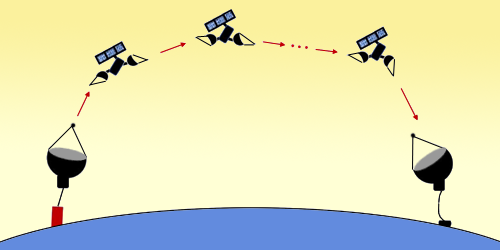
Image Credit: S. Goswami/University of Calgary
Recently, researchers Sumit Goswami of the University of Calgary, Canada, and Sayandip Dhara of the University of Central Florida, US, have laid out a proposal showing how those pitfalls could be overcome (Phys. Rev. Appl., doi: 10.1103/PhysRevApplied.20.024048). Their proposal involves relaying delicate quantum signals across a chain of relatively closely spaced, synchronously moving satellites. Those satellites, the pair suggests, could effectively act “like a set of lenses on an optical table,” focusing and bending beams along Earth’s curvature and preventing photon loss across distances as great as 20,000 km—without the need for quantum repeaters. Goswami said that a chain of around 160 satellites would be needed to cover the full 20,000-km distance modeled in the paper. Such a single, geostationary chain, he noted, would cover most of the globe every three days as the Earth rotated beneath the satellite array—so, Goswami said, “even just one chain can be used for connecting many places at different times.” But a larger, 2D network, to enable uninterrupted worldwide quantum communications, would require tens of thousands of new satellites.
While Goswami and Dhara metaphorically refer to the nodes in their proposed all-satellite quantum network (ASQN) as satellite lenses, in reality the optical magic happens with mirrors, to keep absorption-related photon losses to an absolute minimum. In simplified terms, a given satellite in the chain sends a beam of light to the next one, perhaps 120 km away. That next satellite captures and refocuses the beam with a receiving mirror and bounces it off of two smaller mirrors to a final transmitting mirror, which relays the signal on to the next satellite in the chain.
In their modeling, Goswami and Dhara considered a chain of satellites, each separated from the next by 120 km; given expected beam divergence in Earth orbit, that implies a telescope diameter of 60 cm for each satellite. The team’s modeling suggests that such a relay setup, using vortex beams to pass the quantum signal from satellite to satellite, would virtually eliminate diffraction loss across distances of 20,000 km.
With diffraction loss taken care of, Goswami and Dhara methodically looked at other potential sources of loss in the satellite-lens system. One obvious one is reflection loss of some photons at the mirrors themselves, which the pair thinks could be kept manageable through a configuration combining large metal mirrors and small, ultrahigh-reflectivity Bragg mirrors. Another source of loss lies in tracking and positioning errors for the satellites in the chain; such hiccups would need to be held to a minimum to keep the satellites in sync with one another.
A final source of loss has nothing to do with the satellites. Depending on the quantum communication architecture, quantum information needs to be transmitted from and to stations on Earth’s surface. For free-space optical signals, that opens the prospect of data losses due to atmospheric turbulence, which can dramatically increase the beam size and spread. Turbulence turns out to be a much bigger problem for data in the uplink (ground to satellite) than in the downlink (satellite to ground). That’s because in the uplink, the turbulence is doing its dirty work at the beginning of the communication chain rather than at its end; thus the turbulence-induced beam divergence and fragmentation is magnified across the large propagation distance of the satellite network as a whole.
Outperforming fiber—without repeaters:

Image Credit: S. Goswami and S. Dhara, Phys. Rev. Appl. 20, 024048 (2023), doi: 10.1103/PhysRevApplied.20.024048; copyright 2023 by the American Physical Society [Enlarge image]
For their proposed all-satellite quantum network (ASQN), Goswami and Dhara modeled two different quantum communication schemes. In one, qubit transmission (top), photons are transmitted from a ground-based source to a first satellite, relayed through space along a chain of reflector satellites, and beamed to another ground station, with beam diffraction controlled by focusing. In the other, entanglement distribution, an entanglement source is located either in a satellite (S1) or on the ground (S2), and entangled photons are distributed to widely separated ground stations, where they’re tested for quantum-secure communication.
Taking all of these sources of loss (and a few others) into account, Goswami and Dhara numerically simulated how such a chain of relay satellite lenses might work in transmitting quantum information under two scenarios. One is so-called entanglement distribution, the protocol demonstrated by researchers in China on the Micius satellite, in which photons are entangled in space and sent in different directions via the satellite lenses, ultimately to be transmitted down to widely separated stations on Earth and tested for quantum security.
The other is a simpler “qubit transmission” protocol, in which quantum bits (qubits) are simply sent from a ground station to the first satellite, transmitted across the chain and finally beamed down to a second, distant ground station. Such a system would require a different kind of optical design, to counteract the impact of turbulence on the satellite uplink. Goswami and Dhara think this approach may have certain advantages, however, as it keeps both the qubit source and detection in more controllable, better-outfitted ground stations.
Under both scenarios, the team found that the total signal loss across 20,000 km would come in at around 30 dB. That’s comparable to the loss experienced across only 200 km of a direct optical-fiber link (assuming a loss rate of 0.15 dB/km in the fiber). “Such a low-loss satellite-based optical-relay protocol,” Goswami and Dhara write, “would enable robust, multimode global quantum communication and would not require either quantum memories or repeater protocol.”
“What this proposal basically does,” Goswami observed in an email to OPN, “is that it shifts the task of creating quantum network from physics to engineering.” He added, however, that some of the engineering likely wouldn’t be trivial, particularly with respect to designing and developing the satellites in the fleet. Still, he and Dhara stress in the paper that recent developments in space technology—embodied in reusable launch vehicles from organizations such as SpaceX and the vast constellations of classical-communications satellites being lofted into LEO by a number of private companies—make a system such as their ASQN considerably more feasible than it would have been in the past. Goswami and Dhara stress that recent developments in space technology make a system such as their ASQN considerably more feasible than it would have been in the past.
Goswami and Dhara believe that, by dispensing with the need for quantum repeaters or memory, the scheme they’ve proposed and modeled could open a range of possibilities implicit in a quantum network. Such prospects include secure communication via quantum key distribution, the linking of quantum computers, and precision long-distance quantum sensing.
The researchers admit, however, that a more complex network—that is, the long-term vision of a “quantum internet” now being fleshed out in a variety of research labs—would still require some sort of quantum memory to ensure completely lossless transmission.
This research could pave the way for the development of globally secure quantum communications networks, as the use of satellites would provide a high level of security against hacking and eavesdropping. The proposed system still needs further development and testing, but it presents a promising solution for enabling long-distance quantum communication without the need for repeaters.
References:
https://physics.aps.org/articles/v16/s103
China Mobile verifies optimized 5G algorithm based on universal quantum computer
China has achieved the country’s first algorithm verification of a communication network optimization based on a universal quantum computer, according to the Quantum Computing Engineering Research Center in east China’s Anhui Province.
China Mobile, the country’s largest mobile carrier, is currently in the stage of 5G network operation and 6G research and development. Compared with 5G, 6G will face computing problems such as larger-scale business optimization, network optimization, signal processing and machine learning, bringing about great pressure to the classical computation and algorithms, said Cui Chunfeng, an official from the China Mobile Research Institution (CMRI).
The tremendous computing power is the main characteristic of quantum computers. “We try to start from small-scale problems in some typical scenarios to evaluate and verify the application feasibility of quantum computing in communication networks, especially in 6G,” Cui said.
The CMRI and the Origin Quantum Computing Technology Corporation signed a cooperation memorandum on June 30 to jointly promote the integration of quantum computing into the communication network and arithmetic network as the core of the mobile information network.
Aiming at the optimization of large-scale antenna parameters of 5G base stations, the Origin Quantum has preliminarily proved the feasibility of quantum algorithm in the specific problem through effective modeling, algorithm design and real-machine verification, said Dou Manghan, director of the software center of the Origin Quantum.
He noted that the company has the country’s first case of using quantum computers with real machines for communication network algorithm verification, achieving a good start for the application of quantum computing.
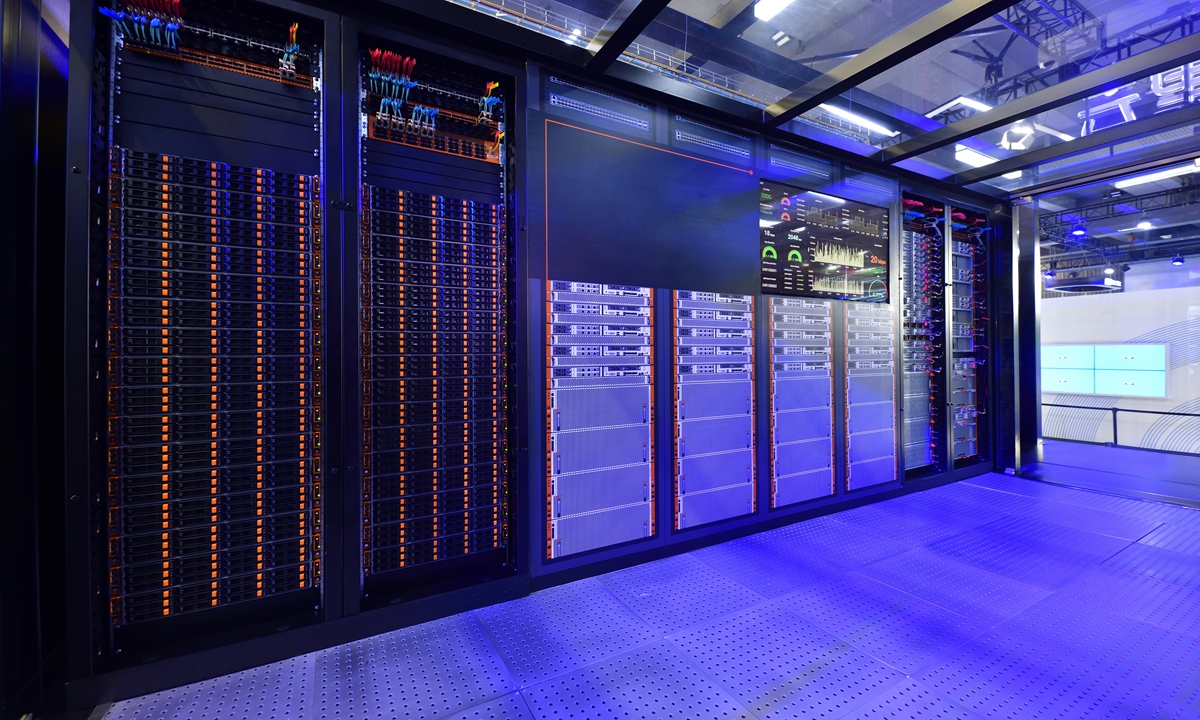
A quantum computer in China Photo: VCG
In the future, China Mobile will design quantum algorithms with better performance, boost the integrated development of quantum computing and communication industry, and explore a leapfrog path for the development of mobile information networks, Cui said.
Source(s): Xinhua News Agency
References:
SKT Develops Technology for Integration of Heterogeneous Quantum Cryptography Communication Networks
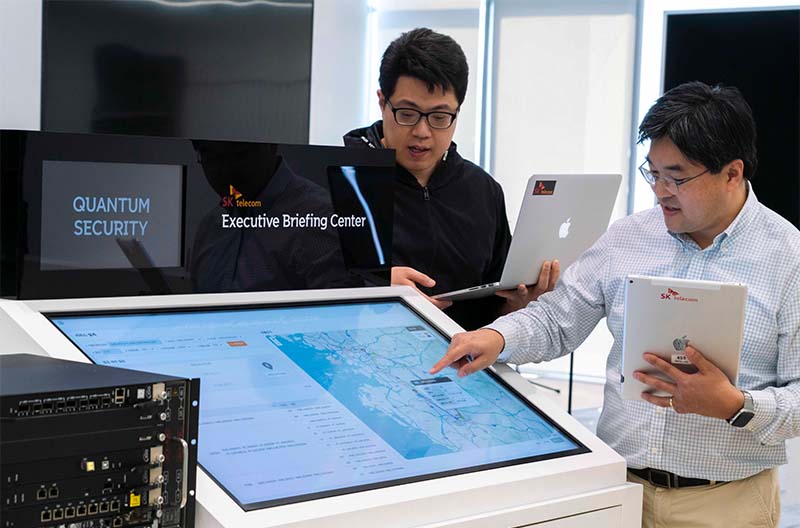
SK Telecom (SKT) today announced that for the first time in the world, it developed a technology that allows for integrated control and operation of quantum cryptography networks by integrating networks composed of equipment from different manufacturers via software-defined networking (SDN) and distributing quantum keys in an automated manner.
So far it was impossible to connect and operate quantum cryptography communication networks of different companies and countries. However, with SKT‘s new technology, quantum cryptography communication networks of diverse manufacturers, mobile operators and nations can be interconnected and co-operated.
The company said that it completed verification of the technology on the Korea Advanced Research Network (KOREN), a non-profit testbed network infrastructure operated by the National Information Society Agency (NIA) to facilitate research, test and verification of future network leading technologies and related equipment.
Based on the results of development and verification of the technology, SKT has been actively promoting standardization by sharing the case with global telcos.
To set international standards for the integration of quantum cryptography communication networks, SKT proposed two standardization tasks – i.e. ‘Control Interface of Software Defined Networks’ and ‘Orchestration Interface of Software Defined Networks for Interoperable Key Management System’ – to the European Telecommunications Standards Institute (ETSI), and they were chosen as work items by the ETSI industry specification group for QKD (ISG-QKD) in March 2023.
If approved as international standards, they will provide a technical basis for creating a large-scale network by interconnecting quantum cryptography communication networks built by many different operators. SKT plans to continue developing additional technologies for interworking of services between different operators/countries, as well as management of service quality.
Through these efforts, the company expects to strengthen the competitiveness of domestic companies and boost the quantum cryptography ecosystem both home and abroad.
Meanwhile, at this year’s IOWN Global Forum Workshop, SKT presented ‘Quantum Secure Interconnection for Critical Infrastructure,’ covering use cases for next-generation transmission encryption technology and proposal for a proof-of-concept (PoC) of quantum cryptography in All-Photonics Network (APN). The company also showcased its quantum cryptography communication technologies at 2023 MWC Barcelona.
“The two standardization tasks approved as work items by ETSI will boost the expansion of quantum cryptography communication in the global market,” said Ha Min-yong, Chief Development Officer of SKT. “We will work with diverse global players in many different areas to create new business opportunities in the global market.”
Disclaimer:
SK Telecom Co. Ltd. published this content on 05 April 2023 and is solely responsible for the information contained therein. https://www.sktelecom.com/en/press/press_detail.do?idx=1563¤tPage=1&type=&keyword=
………………………………………………………………………………………………………………………………………………………………….
From SDxCentral:
Quantum cryptography communication transmits each bit of information as a single photon of light, which encrypts that information against eavesdropping or decryption. Telecom operators and vendors have been working for several years on integrating that level of encryption into networks.
For instance, Toshiba and the Tohoku Medical Megabank Organization at Tohoku University used quantum technology in 2018 to hit one-month-average key distribution speeds exceeding 10 Mb/s over installed optical fiber lines. They also used the technology to monitor the performance of installed optical fiber lines in different environments.
Toshiba later partnered with U.K.-based operator BT on using QKD across to secure a network transmission.
SK Telecom also has a long quantum history, including work with Swiss-based strategic partner ID Quantique, which focuses on quantum cryptography communication technology.
Industry trade group GSMA last year announced its Post-Quantum Telco Network Taskforce focused on supporting the industry’s creation of a roadmap to secure networks, devices and systems across the entire supply chain.” That work was initiated with IBM and Vodafone, and has since gained more than 45 members.
Lory Thorpe, GSMA Post-Quantum Telco Networks chairperson and head of IBM Consulting’s Telco Transformation Offerings, told SDxCentral last month that the core objective of the taskforce is to ensure the implementation of the right requirements and standards in a timely manner to avoid being “late to the party.” Thorpe explained the initial problem statement was “around how do we support the telco ecosystem to navigate the path to quantum safe.”
“When you look at where cryptography is used in telco systems, it impacts basically all of the different systems. But it also then impacts all of the standards that underpin these systems as well,” she said. “We’re advocating that people start planning, not panicking, but at least planning because … this isn’t something that just happens overnight.”
Can Quantum Technologies Crack RSA Encryption as China Researchers Claim?
Scientists in China claim they have found a way for current-generation quantum computers to crack the RSA algorithm underlying the most common form of online encryption. The researchers said the encryption could be broken with a 372-quantum-bit (qubit) system using hybrid quantum-classical methods to overcome scaling limitations. The Chinese paper “Factoring integers with sublinear resources on a superconducting quantum processor” stated that the algorithm used factored a number with 48 bits on a quantum system with 10 qubits.
The likelihood that quantum computers would be able to crack online encryption was widely believed a danger that could lie a decade or more in the future. But the 24 researchers, from a number of China’s top universities and government-backed laboratories, said their research showed it could be possible using quantum technology that is already available. The quantum bits, or qubits, used in today’s machines are highly unstable and only hold their quantum states for extremely short periods, creating “noise.”
As a result, “errors accumulate in the computer and after around 100 operations there are so many errors the computation fails,” said Steve Brierley, chief executive of quantum software company Riverlane. That has led to a search for more stable qubits as well as error-correction techniques to overcome the “noise,” pushing back the date when quantum computers are likely to reach their full potential by many years. The Chinese claim, by contrast, appeared to be an endorsement of today’s “noisy” systems, while also prompting a flurry of concern in the cyber security world over a potentially imminent threat to online security.
By late last week, a number of researchers at the intersection of advanced mathematics and quantum mechanics had thrown cold water on the Chinese claim:
- Massachusetts Institute of Technology’s Peter Shor pointed out that the team had “failed to address how fast the algorithm will run,” as it could “still take millions of years.” Shor, the American mathematician who first proposed a way for quantum computers to crack encryption, predicted that the inability to run all the computations at once meant it would take “millions of years” for a quantum computer to run the calculation proposed in the paper. The Chinese research comes at a time when many companies working on the technology are in a race to prove that today’s “noisy” systems can reach so-called quantum advantage — the point at which a quantum computer can perform a useful task more efficiently than a traditional, or “classical”, machine, ushering in commercial use of the technology.
- Brierley at Riverlane said it “can’t possibly work” because the Chinese researchers had assumed that a quantum computer would be able to simply run a vast number of computations simultaneously, rather than trying to gain an advantage through applying the system’s quantum properties.
- Four years ago, John Preskill, a professor of theoretical physics at the California Institute of Technology, predicted that quantum systems would start to outperform and might have commercial uses once they reached 50-100 qubits in size. But that moment has come and gone without quantum systems showing any clear superiority. IBM unveiled a 127-qubit computer more than a year ago, and last month announced that a new 433-qubit processor would be available in the first quarter of 2023. These days, Preskill sounds more cautious. “I expect that for practical applications with significant business value we’ll have to wait for error-corrected fault-tolerant quantum computers,” he said, adding that this was likely to be “a ways off.” But he added that today’s systems already had scientific value. One reason that hopes have retreated is that new ways have been found to program classical computers to handle tasks that were once thought to be beyond them.
This has pushed back the quantum frontier, delaying the moment when people building quantum systems can claim an advantage, said Oskar Painter, head of quantum hardware in the cloud computing division at Amazon, one of the tech companies that is building its own quantum computer. “They never finally could say, ‘This will be better,’” he said. After years of rising expectations, the lack of practical uses for the technology has led some experts to warn of a potential “quantum winter” — a period when disappointment about a new technology leads to a waning of interest for a number of years. The term is borrowed from the AI “winters” of the 1970s and 1980s, when a number of promising research avenues turned out to be dead ends, setting the field back for prolonged periods.
“People are worried it will be really harsh,” said Painter at Amazon Web Services. Like many in the field, though, he said that any short-term backlash was unlikely to hit long-term research funding. “I don’t think it will go away.” Receding hopes for early benefits from quantum computing have already contributed to a sharp fall in the stocks of a handful of companies that rode the wave of enthusiasm over the sector to go public since the middle of 2021. Based on their peak share prices soon after they each went public, Arquit, IonQ, D-Wave and Rigetti reached a combined value of $12.5bn. That has since fallen to $1.4bn.
Among the events to batter the quantum companies last year, IonQ was hit by a report from a short seller claiming its technology did not live up to its claims, while Rigetti founder Chad Rigetti was removed as chief executive before quitting the company late in the year.
Part of the problem facing the sector has been an excess of “hype” about the technology, said Constantin Gonciulea, chief technology officer of advanced technology at Wells Fargo. He compared the build-up of expectations around quantum to the crypto industry, as many non-experts have been drawn into the field and promises for the technology have far outgrown its potential in the near term. Despite this, companies working on the first quantum machines and software still insist that practical uses of the technology are just around the corner — while continuing to carefully avoid giving too precise a prediction about exactly when that will be.
David Rivas, head of engineering and product at Rigetti, said that the company still believed it would reach quantum advantage when its computers have “a few hundred to a few thousand qubits.” Even if they cannot match the performance of today’s supercomputers, they will still be useful if they cost much less, or if they can operate faster or with more precision, he said. For some quantum companies, the startling Chinese claim about online encryption was a sign that the technology’s big moment is drawing nearer. But for the doubters, the apparent impracticality of the research will serve as confirmation that quantum computing is still an impressive science experiment rather than a practical technology.
References:
https://arxiv.org/pdf/2212.12372.pdf
https://www.ft.com/content/d64e45b4-692a-429e-bc64-146303ec7fdf
Quantum Technologies Update: U.S. vs China now and in the future
AT&T will be “quantum ready” by the year 2025; New fiber network launched in Indiana
New ITU-T SG13 Recommendations related to IMT 2020 and Quantum Key Distribution
AT&T will be “quantum ready” by the year 2025; New fiber network launched in Indiana
AT&T is aiming to become “quantum ready” by the year 2025, said an AT&T quantum security and preparedness team member during this week’s AT&T Security Conference. The tier-one operator has been identifying its cryptographic assets, vetting post-quantum cryptography solutions, and taking trials to identify those solutions, according to Brian Miles, principal member of tech staff at AT&T. “We’ve got AT&T quantum ready on our roadmap by 2025,” Miles said, adding that doesn’t mean the company will be fully quantum secured.
“This just means that we have done all our due diligence. And we have a clear path forward and we have all the solutions identified to target and address some of the different problems posed by quantum computing.”
Editor’s Note:
Quantum technologies function by harnessing the key characteristics of the theory of quantum mechanics, including superposition, entanglement and uncertainty. The resulting technologies are expected to be diverse and far reaching. For example, quantum computers are expected to overcome most “public key encryption” systems, presaging a radical change in cybersecurity. Given its aptitude for navigating complexity, quantum tools are expected to shave years off the time to market for medicines. Secure, efficient communications among drones and other autonomous vehicles will underpin safety and operational effectiveness in the crowded skies of the future. Of course, these nearer terms examples will be joined by applications barely yet imagined as the technology matures.
…………………………………………………………………………………………………………………………………………..
That effort should put AT&T in a better position before the cryptographically relevant quantum computer (CRQC) emerges. CRQC is defined as a quantum computer that reaches the compute capability to break an RSA-2048 key using Shor’s algorithm, according to Miles. Shor’s algorithm is a quantum computer algorithm developed in 1994 by American mathematician Peter Shor.
Miles also urges organizations to implement cryptography agility, which is a framework or architecture that allows companies to replace their cryptographic primitives, underlying cryptography, and encryption algorithms with little or no impact on the existing applications.
“In a nutshell, that means you get off board your cryptography, get it out of your applications, get it more centralized, ultimately put automation in place to make the underlying infrastructure [transition] relatively painless,” he explained.
The next significant step is to identify the cryptographic assets and who has the responsibility for that inventory within the company, Miles noted.
“It’s incredibly important to get started on a crypto-agile architecture roadmap within your company quickly,” he said. “The whole crypto-agile architecture at least gives you the tools and the ability to pivot to different cryptography on short notice.”
……………………………………………………………………………………………………………………………………………………..
Separately, AT&T is connecting its first customers to its new fiber network in Indiana. The company is investing $29.7 million – on top of $9.9 million contributed by Vanderburgh County, allocated from the American Rescue Plan – to build to 20,000 locations.
In a press release, AT&T calls Vanderburgh a “largely rural community where roughly one-third of homes, farms and businesses did not have access to fixed broadband service before this fiber build.” The network build is expected to be complete in November 2023 and will deliver service up to 5 Gbit/sec.
“We have a once-in-a-generation opportunity to bring high-speed, reliable broadband to communities across the country,” said AT&T CEO John Stankey. “Combining public sector funding and private sector investment is the most cost-effective way to ensure more Americans are able to take advantage of robust connectivity. This type of public-private partnership can serve as a model to help close the digital divide once and for all.”
“If you live in a big city, you probably take your high-speed internet for granted. But it’s a different story in rural parts of the country,” said Cheryl Musgrave, commissioner, Vanderburgh County. “Fortunately, through this collaboration with AT&T, thousands of our rural neighbors will have a new story to tell, because they’ll also have access to fiber-powered broadband.
“I’m truly excited to see the impact this new connectivity will have on our schools and families, and the economic growth of our community,” Musgrave added.
AT&T worked quickly to bring the benefits of fiber to Vanderburgh County residents and businesses, with the network core becoming operational only seven months after the previously announced contract agreement was finalized. That allowed AT&T to connect the first fiber locations earlier than expected. The project will be completed by November 2023.
The new fiber network is capable of delivering speeds up to 5 Gbps on both upload and download. The faster speeds and capacity mean customers can now connect to data intensive online tools and applications, deploy precision agriculture technologies and access vital education resources.
AT&T has extensive experience deploying fiber-optics across Indiana. In fact, hundreds of thousands of locations in the state have access to AT&T Fiber today. AT&T is also currently working with the City of Boonville and the City of Martinsville on public-private partnerships to bring AT&T Fiber to those communities.
References:
https://www.sdxcentral.com/articles/news/att-aims-to-be-quantum-ready-by-2025/2022/10/
BT and Toshiba commercial trial of a ‘quantum-secured’ metro network
BT and Toshiba have launched what they say is the world’s first “commercial trial” of a quantum-secured metro network (QSMN).
The QSMN infrastructure will be able to connect numerous customers across London, helping them to secure the transmission of valuable data and information between multiple physical locations over standard fiber optic links using quantum key distribution (QKD).
QKD is an important technology, playing a fundamental role in protecting networks and data against the emerging threat of cyber-attack using quantum computing. The London network represents a critical step towards reaching the UK government’s strategy to become a quantum-enabled economy
The QSMN is a three-node London exchange fiber optic ring using commercially available QKD hardware from Toshiba. BT provided fiber connectivity and “quantum-enabled” local exchanges.
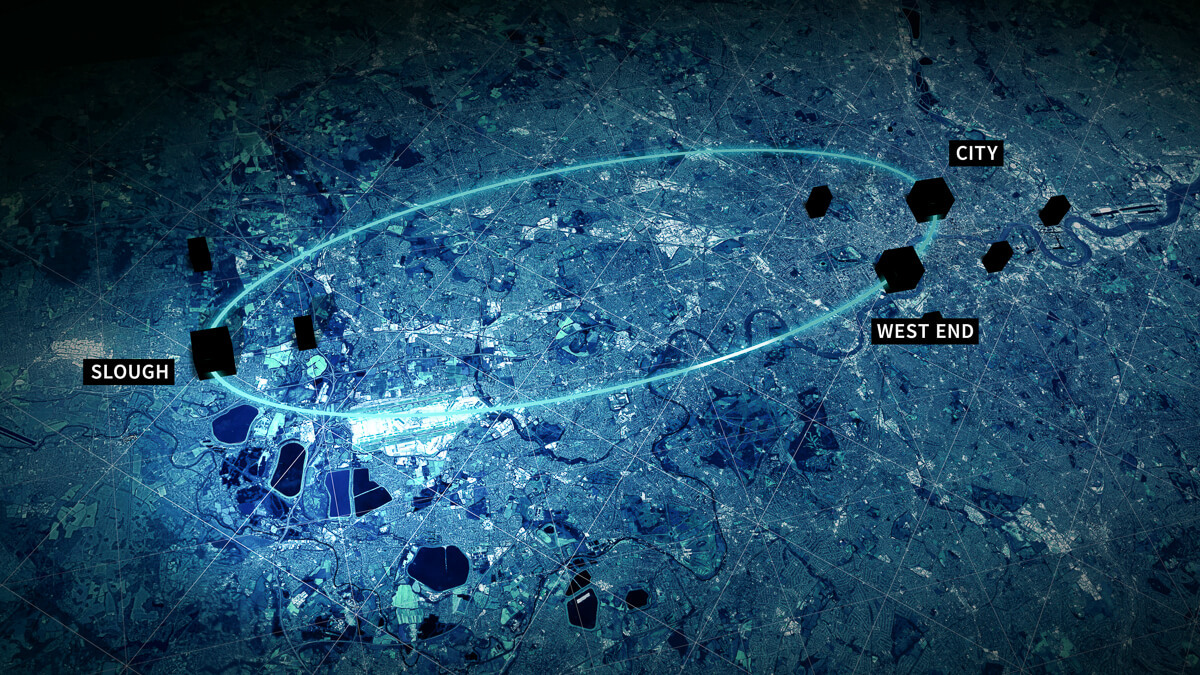
Source: BT
German based optical network vendor ADVA is also involved in the QSMN. For the dedicated QKD “access tails,” BT used a commercially available Optical Spectrum Access Filter Connect (OSA FC) solution from Openreach, the UK incumbent’s infrastructure arm. OSA FC was developed by ADVA.
Financial services firm EY, the network’s first commercial customer, will use the network to connect two of its sites in London, one in Canary Wharf, and one near London Bridge. It will demonstrate how data secured using QKD can move between sites and will showcase the benefits this network brings to its own customers.
BT is working with EY (a non paying customer) and others that want to try QSMN to work out which types of QKD services will be in demand and how the business case might pan out. That initiative will likely be done over a three-year period,
“It’s a commercial trial in the sense that it’s built on commercial kit,” Professor Tim Whitley, managing director at BT’s applied research division, told Light Reading.
“It’s also a commercial trial in the sense that, unlike many trials around, it is effectively integrated in and part of a national operator’s communications infrastructure. It is managed out of our national operations center at Adastral Park.”
BT and Toshiba announced their commitment to creating a trial network in October 2021. BT will operate the network, providing a range of quantum-secured services including dedicated high bandwidth end-to-end encrypted links, delivered over Openreach’s private fibre networks, while Toshiba will provide quantum key distribution hardware and key management software. In the network, QKD keys will be combined with the in-built ethernet security, based on public-key based encryption, which will enable the resultant keys to be used to encrypt the data.
Some recent QKD history:
- BT and Toshiba have been conducting QKD trials since 2013, including a recent collaboration to provide a point-to-point QKD link in Bristol between the National Composites Centre and the Centre for Modelling & Simulation.
- In April 2020, Leo Lehman wrote an article about New ITU-T SG13 Recommendations related to IMT 2020 and Quantum Key Distribution.
- In September 2020, Verizon said it was trialing QKD for encryption over Fiber Optic Links.
……………………………………………………………………………………………………………………….Quotes:
Howard Watson, CTO, BT stated: “Quantum-enabled technologies are expected to have a profound impact on how society and business operates in the future, but they are remarkably complex to understand, develop and build: in particular, ensuring that the end-to-end service designs meet the stringent security requirements of the market. I’m incredibly proud that BT and Toshiba have successfully united to deliver this unique network, and with EY as our first trial customer, we are paving the way for further commercial explorations for quantum technologies and their use in commercial, and societal applications in the future.”
Shunsuke Okada, Corporate Senior Vice President and Chief Digital Officer of Toshiba commented: “Both Toshiba and BT have demonstrated world-class technology development and leadership through decades of innovation and operation. Combining BT’s leadership in networks technologies and Toshiba’s leadership in quantum technologies has brought this network to life, allowing businesses across London to benefit from quantum secured communications for the first time.”
Preparation, technical deployment and testing for the network commenced in late 2021. This included equipment deployment in racks, adding security systems and resilience testing, and finally running and optimising the network. While Tuesday 26th April marked the official launch of the network, it has been running since early April, and will operate for an initial period of up to three years.
Praveen Shankar, EY UK & Ireland Managing Partner for Technology, Media and Telecoms (TMT), commented: “Quantum technology creates new and significant opportunities for business, but presents potential risks. Quantum secure data transmission represents the next major leap forward in protecting data, an essential component of doing business in a digital economy. Our work with two of the world’s leading technology innovators will allow us to demonstrate the power of quantum to both EY and our clients.”
………………………………………………………………………………………………………………
The UK Government’s “strategic intent” to develop a quantum-enabled economy was first published in 2020. It sets out a vision for the next 10 years in which quantum technologies will become an integral part of the UK’s digital backbone, unlock innovation to drive growth and help build a thriving and resilient economy, and contribute significant value to the UK’s prosperity and security.
The London network represents an important step to building a national network for quantum secured communications, which will stimulate the growth of a quantum ready economy in the UK.
Howard Watson continued: “This is a significant moment in the UK’s journey towards a quantum-enabled economy, but we’re not there yet. Further investment commitments will be required to broaden the study of quantum technologies that will contribute to this new economy, including quantum computing, quantum cryptography and quantum communications. We look forward to working with our government and industry partners to continue the momentum BT has started and shaping the UK’s quantum strategy.”
The technical collaboration for this network was conducted in BT’s Adastral Park labs in Suffolk, UK, and the Quantum technology Business Division of Toshiba, based in Tokyo, Japan and Cambridge, UK, where the quantum key distribution technology has been developed and is manufactured.
………………………………………………………………………………………………….
References:
https://www.global.toshiba/ww/news/corporate/2022/04/news-20220427-01.html
Verizon Trials Quantum Key Distribution for Encryption over Fiber Optic Links
New ITU-T SG13 Recommendations related to IMT 2020 and Quantum Key Distribution