

Verizon offers free online AI training tailored to your interests!
Verizon has launched an online portal that curates AI training content from several tech giants, including IBM, Google, Microsoft, Anthropic, OpenAI, and online course provider Coursera. The U.S.’ largest wireless carrier by subscriber count says that the type of courses on offer normally cost in the region of $700 per year, but it is making them available for free.
“Strengthening the American economy starts with making sure every individual has the opportunity to adapt and succeed in a rapidly changing world. AI isn’t just a technological shift – it will change the face of every workforce around the world,” said Verizon CEO Dan Schulman.
“Companies, working closely together and with the public sector, have a responsibility to invest in people with the same urgency they invest in technology. By giving people and small businesses free access to the best AI training, we are helping workers retain their jobs, navigate transitions, support their families, and help small businesses grow – while building confidence in our American economy. When you empower people to embrace change rather than fear it, you create a ripple effect that builds healthier communities and a stronger and more resilient national economy.”
Linked to this initiative is a separate $1 million grant that Verizon has awarded to the Liberty Science Center (LSC) in Jersey City, New Jersey. The funds will be spend on providing practical AI skills to individuals and small businesses.
“As a company with a strong footprint in New Jersey, Verizon is deeply committed to supporting the communities we call home, and our longstanding partnership with Liberty Science Centre is a cornerstone of that commitment,” said Donna Epps, chief responsible business officer of Verizon. “Verizon and LSC have a shared vision of empowering the learners and leaders of tomorrow, and we’re excited to work together to create programming that evokes curiosity for new technologies for educators, families and students from across the state.”
The non-profit “Centre for Humane Technology (CHT)” – co-founded by ex-Googler Tristan Harris – has published a report (PDF) explaining how AI could damage everything from personal relationships to governments, and -most significantly- the workplace.
References:
https://www.verizon.com/ai-skills/home
The AI Infrastructure Build-Out: A $10 Trillion Bet on Compute, Power, and Networks
Dell’Oro: 2H2026 Data Center Capex to Accelerate due to massive AI Deployments
PwC: Global AI data center spending to hit $31.6tn by 2050; Role of full stack orchestration layer explained
Nvidia CEO Huang: AI is the largest infrastructure buildout in human history; AI Data Center CAPEX will generate new revenue streams for operators
AI risks and backlash increase; Recap of the circular loop of fake AI profits and hyperscaler markups of private AI companies
China vs U.S.: Race to Generate Power for AI Data Centers as Electricity Demand Soars
How will fiber and equipment vendors meet the increased demand for fiber optics in 2026 due to AI data center buildouts?
Expose: AI is more than a bubble; it’s a data center debt bomb
Will billions of dollars big tech is spending on Gen AI data centers produce a decent ROI?
Huge Risks for the proposed $500B AI Investments from Giant Wall Street firms
Can the debt fueling the new wave of AI infrastructure buildouts ever be repaid?
Analysis: Cisco, HPE/Juniper, and Nvidia network equipment for AI data centers
Networking chips and modules for AI data centers: Infiniband, Ultra Ethernet, Optical Connections
The AI Infrastructure Build-Out: A $10 Trillion Bet on Compute, Power, and Networks
Introduction:
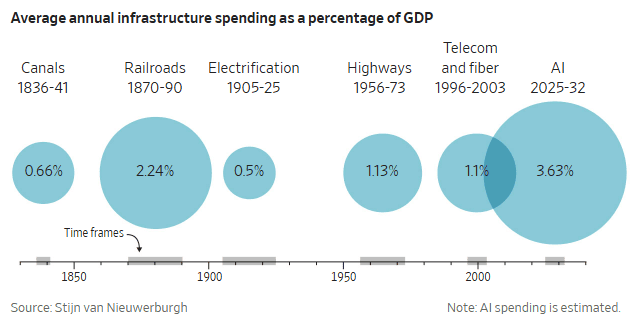
According to the Wall Street Journal, the AI build-out is rapidly becoming the largest concentrated infrastructure investment cycle in modern American economic history. Unlike earlier national build-outs—railroads, interstate highways, electrification, or the commercial internet—this cycle is being driven largely by a small group of cloud platforms deploying highly specialized compute, networking, power, cooling, and semiconductor infrastructure at unprecedented speed. Economist Stijn van Nieuwerburgh estimates that U.S. spending on data centers and related AI infrastructure could reach $10.3 trillion [1.] between 2025 and 2032, equivalent to an average of 3.6% of annual GDP. The estimate encompasses far more than conventional enterprise data centers: it reflects the industrial-scale infrastructure needed to train and serve frontier AI models, including GPU and accelerator clusters, high-bandwidth memory, advanced packaging, optical interconnects, high-capacity Ethernet and InfiniBand fabrics, grid interconnection, substations, backup generation, liquid cooling, and long-haul fiber connectivity.
Note 1. The $10.3 trillion number is a scenario-based estimate of U.S. AI infrastructure investment during 2025–2032—not a forecast of announced corporate spending. The Brookings analysis behind it assumes that about 183 GW of new data-center capacity will be completed through 2032, versus a 509-GW announced/planned pipeline. A representative 200-MW AI campus is estimated to cost about $8.2 billion: $5.6 billion for IT equipment, $2.2 billion for the facility, and $0.4 billion for power infrastructure. Thus, most of the investment is in compute and networking hardware rather than buildings. The scale creates a major financing challenge: the five largest hyperscalers are projected to spend about $800 billion on capex in 2026, exceeding their combined operating cash flow. Under the Brookings assumptions, the resulting infrastructure would need roughly $3.7 trillion of annual revenue by 2032 to produce a 10% unlevered return. The key economic issue, therefore, is whether future AI revenue and utilization can justify the enormous capital investment.
From Cloud Data Centers to AI Factories:
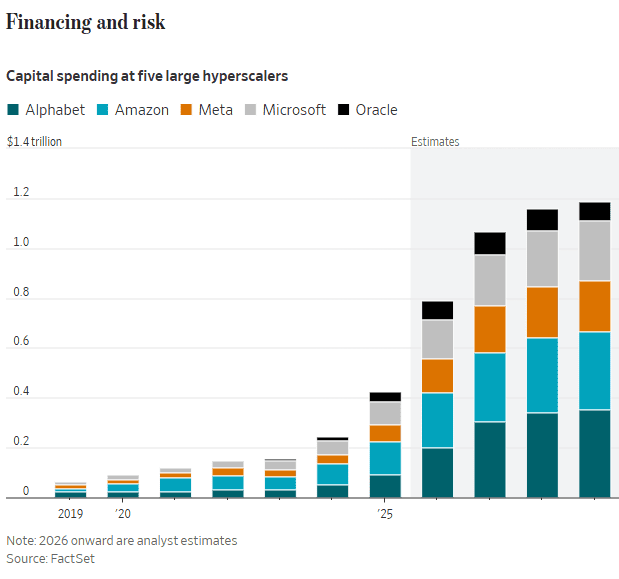
The defining characteristic of this AI buildout investment cycle is its concentration. The five U.S. hyperscalers (Alphabet, Amazon, Meta, Microsoft, and Oracle) are collectively expected to invest roughly $4.2 trillion in capital expenditures during the four years ending in 2029, according to FactSet estimates cited in the source material. Increasingly, this capital is directed toward AI-optimized facilities: campuses designed around megawatt-scale accelerator pods, dense GPU clusters, high-radix network fabrics, and power delivery systems capable of supporting workloads whose energy and cooling profiles differ sharply from those of traditional cloud computing.
Those five major hyperscalers increased combined capital expenditures from approximately $97 billion in 2020 to more than $400 billion in 2025, with the paper projecting approximately $800.5 billion in 2026. That 2026 figure is significant because it exceeds their combined operating cash flow of approximately $707.1 billion. In other words, projected capex is about 113% of operating cash flow. Pacific Software Ventures That creates a MAJOR financing problem: AI infrastructure investment is becoming too large to be financed entirely from hyperscaler internally generated cash.
AI infrastructure is not simply an expansion of conventional cloud capacity. Large-model training and inference create a distinct systems-engineering problem. Training AI frontier foundation models requires thousands to hundreds of thousands of tightly coupled accelerators. Those accelerators must exchange model parameters, activation data, and gradients at extremely high rates. Network performance therefore becomes a first-order determinant of usable compute capacity. A GPU cluster can deliver poor economics if its fabric introduces congestion, latency, packet loss, or inadequate bisection bandwidth during distributed training.
That requirement is accelerating deployment of:
-
GPU- and AI-accelerator servers with high-bandwidth memory and advanced semiconductor packaging.
-
High-speed scale-up interconnects within accelerator nodes and scale-out fabrics across clusters.
-
400 GbE, 800 GbE, and emerging 1.6 TbE Ethernet architectures, along with InfiniBand deployments for tightly coupled training environments.
-
Optical transceivers, co-packaged optics research, photonic switching, and expanded fiber density within and between data-center campuses.
-
AI-aware workload scheduling, distributed storage, data pipelines, checkpointing systems, and network telemetry.
-
Direct-to-chip liquid cooling, rear-door heat exchangers, chilled-water systems, and other thermal-management systems required by high-density AI racks.
-
New transmission lines, substations, transformers, gas generation, battery systems, and other power infrastructure needed to support multi-hundred-megawatt and gigawatt-scale campuses.
In effect, hyperscalers are building what are increasingly described as AI factories: integrated physical and digital production systems that convert electricity, capital equipment, data, and semiconductor capacity into trained models, inference tokens, and AI-enabled cloud services.
A Historically Large Capital Concentration:
AI investment is projected to reach 1.9% of U.S. GDP in 2026, according to Goldman Sachs estimates cited in the source material. The late-19th-century railroad boom was the last period in which a single new infrastructure category represented a larger share of the U.S. economy.
The comparison is useful, but incomplete. Railroads connected physical markets over decades. The AI build-out is being deployed on a far more compressed timetable and is dependent on global supply chains for leading-edge accelerators, high-bandwidth memory, advanced substrates, optical components, power equipment, and data-center construction capacity.
This creates a reinforcing investment loop:
-
Foundation-model developers require more compute to train larger or more capable models.
-
Cloud providers build additional accelerator capacity to support training and inference demand.
-
Semiconductor vendors, memory suppliers, networking companies, optical-component manufacturers, and power-equipment suppliers expand production.
-
Data-center developers secure land, power contracts, grid interconnections, fiber routes, water or cooling capacity, and financing.
-
Enterprises adopt AI services, increasing inference demand and reinforcing hyperscaler investment.
The strategic question is whether revenue from AI applications, enterprise subscriptions, API usage, advertising optimization, software agents, automation, and industry-specific deployments will scale fast enough to justify the capital intensity of the underlying infrastructure.
Financial and Infrastructure Risks:
The scale of investment introduces material financial-system risk. A growing portion of AI-related infrastructure is being financed through debt, including special-purpose entities and off-balance-sheet structures that may have limited public disclosure. These structures can allow technology companies and infrastructure developers to finance data-center construction, equipment purchases, and long-term capacity commitments without placing all obligations directly on corporate balance sheets.
That can be economically rational when capacity utilization is high and long-term AI demand is durable. However, it also creates exposure if expected AI revenues, cloud bookings, or accelerator utilization fail to materialize.
The central risk is not merely that an individual model underperforms. It is that a synchronized reduction in AI capital expenditure could affect multiple interconnected sectors at once:
-
Data-center developers and construction firms.
-
Semiconductor, memory, storage, and server suppliers.
-
Optical networking and switching vendors.
-
Utilities, independent power producers, and grid-equipment manufacturers.
-
Banks, private-credit funds, infrastructure lenders, and equipment-finance providers.
-
Commercial real-estate markets in data-center-heavy regions.
A sudden pause in hyperscaler spending would therefore have broader consequences than a typical technology downcycle. It could reduce orders across a deeply interdependent industrial supply chain while exposing leveraged infrastructure vehicles to weaker cash flows.
IT Product Inflation, Power, and Network Capacity:
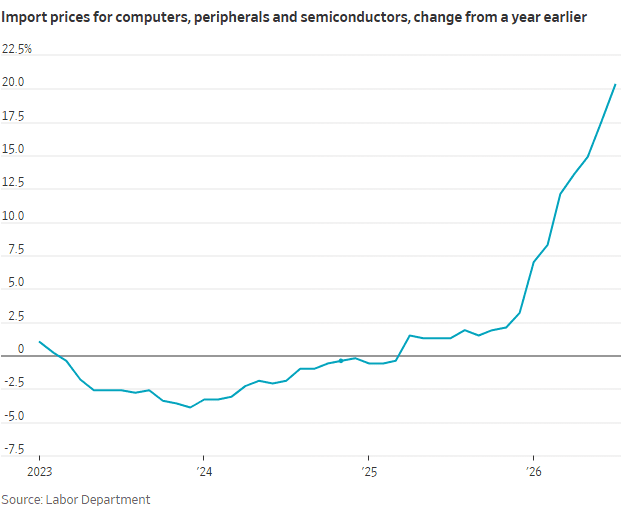
The AI build-out is also creating supply-side pressure in strategic technology markets. Demand for data-center equipment—especially memory, advanced semiconductors, servers, optics, and power-delivery equipment—has tightened supply and raised costs. The source material notes that prices paid by importers for computers, peripherals, and semiconductors were 20% higher in August than a year earlier.
That inflation can propagate beyond the data center. Higher component prices can increase the cost of consumer electronics, including smartphones, PCs, gaming systems, and storage products. Enterprises may also face higher prices for servers, networking equipment, cloud services, and AI-enabled software.
Power is an equally important constraint. AI data centers concentrate demand geographically, often creating large and relatively inflexible new loads on regional grids. A single large campus may require hundreds of megawatts, while the next generation of AI campuses could require gigawatt-scale capacity. This is driving demand for new generation, transmission capacity, substations, transformers, energy storage, and grid-management technologies.
The result is a collision between digital infrastructure planning and energy-system planning. Data-center capacity is no longer determined primarily by real estate, fiber connectivity, or server availability. In many markets, the gating factor is now the ability to obtain firm power, complete interconnection studies, procure transformers and switchgear, and finance new grid infrastructure.
Conclusions:
For IEEE Techblog readers, the central issue is not whether AI demand is real. It is whether the industry can build an economically sustainable, energy-efficient, resilient, and interoperable infrastructure stack at the required scale.
That challenge spans multiple engineering domains:
-
Semiconductor architecture, packaging, memory bandwidth, and energy efficiency.
-
Data-center electrical design, cooling, rack density, and operational resiliency.
-
High-performance networking, congestion control, optical interconnects, and distributed-system design.
-
AI software optimization, including model efficiency, quantization, sparsity, scheduling, and inference optimization.
-
Grid integration, power electronics, demand response, and energy-aware workload placement.
-
Security, supply-chain assurance, and operational management across increasingly autonomous infrastructure.
The AI boom may indeed become the defining infrastructure investment cycle of this era. Its long-term success, however, will depend less on headline capital-expenditure totals than on whether the industry can translate massive spending on accelerators and data centers into durable productivity gains, commercially viable AI services, and infrastructure that does not impose unsustainable costs on power systems, supply chains, consumers, or the financial sector.
………………………………………………………………………………………………………………………………………………
References:
Dell’Oro: Data Center capex grew 92% in 2Q-2026 (caveats galore)
Dell’Oro: 2H2026 Data Center Capex to Accelerate due to massive AI Deployments
PwC: Global AI data center spending to hit $31.6tn by 2050; Role of full stack orchestration layer explained
Nvidia CEO Huang: AI is the largest infrastructure buildout in human history; AI Data Center CAPEX will generate new revenue streams for operators
AI risks and backlash increase; Recap of the circular loop of fake AI profits and hyperscaler markups of private AI companies
China vs U.S.: Race to Generate Power for AI Data Centers as Electricity Demand Soars
How will fiber and equipment vendors meet the increased demand for fiber optics in 2026 due to AI data center buildouts?
Expose: AI is more than a bubble; it’s a data center debt bomb
Will billions of dollars big tech is spending on Gen AI data centers produce a decent ROI?
Huge Risks for the proposed $500B AI Investments from Giant Wall Street firms
Can the debt fueling the new wave of AI infrastructure buildouts ever be repaid?
Sept 2026 3GPP meeting updates for 5G Advanced and 6G planning (with timeline for submisson to ITU-R WP 5D via ATIS)

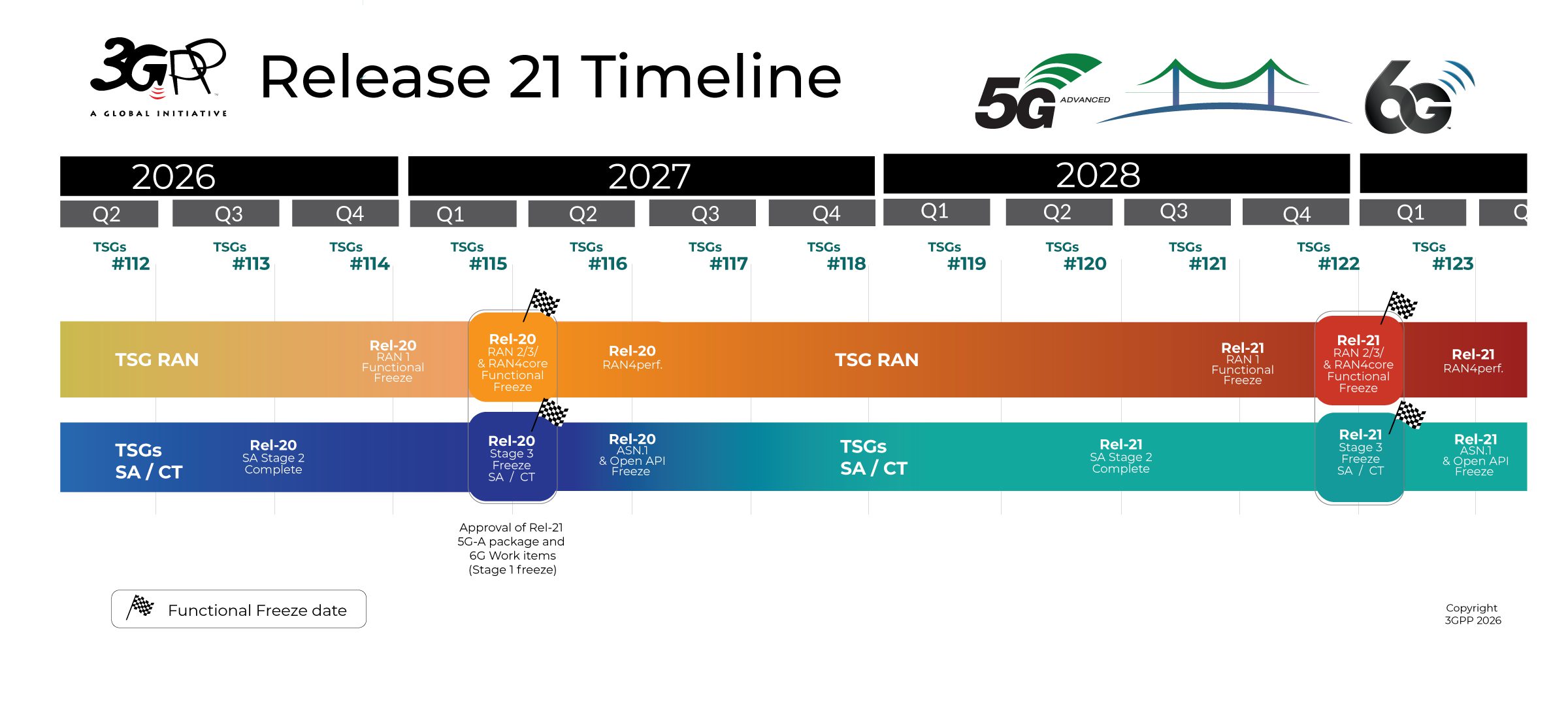
- 100% Stage 2 Freeze: The primary technical output for Release 20 was hitting the 100% completion target for Stage 2 (System Architecture). This officially locks down the architectural aspects for 5G Advanced next wave, transitioning the bulk of execution entirely to Stage 3 protocol and core implementation.
- 6G Dual Connectivity Way Forward: Delegates finalized critical deployment decisions regarding how 6G will integrate with existing infrastructure. Focus solidified around Option 1 (6G-anchored dual connectivity with 5G NR) and Option 3 (Dual stack, no RAN-level aggregation).
- Multi-RAT Spectrum Sharing (MRSS): RAN1 delivered its highly anticipated MRSS preliminary performance evaluation. This evaluates the overhead costs of operators running 5G and 6G simultaneously on the same frequencies, safeguarding migration investments.
- Use Cases and Services: Deepened studies into Integrated Sensing and Communications (ISAC), native AI/ML network applications, and ubiquitous connectivity (“anywhere to everywhere”).
- Radio Advancements: Maturation of the 6G RAN study on Scenarios and Requirements (TR 38.914), steering the industry closer to initial physical layer specifications.
……………………………………………………………………………………………………………………………………………………………….
-
- Dual Connectivity Framework: Delegates officially locked down the deployment pathways for the first phase of 6G. They established a clear consensus favoring Option 1 (6G-anchored dual connectivity with 5G NR) and Option 3 (Dual stack/independent radio lines), settling intense architectural debates on how 6G will overlay on 5G infrastructure.
- MRSS Performance Baseline: RAN1 finalized its preliminary performance evaluations for Multi-RAT Spectrum Sharing (MRSS). This technical milestone establishes the exact overhead margins required to run 5G and 6G simultaneously on legacy bands, preventing spectral efficiency loss during the transition.
- TR 38.914 Technical Alignment: The radio groups finalized the foundational baseline for the Radio Scenarios and Requirements report (TR 38.914), updating propagation channel models to explicitly match the new spectrum ranges targeted for initial Release 21 designs.
- ISAC Requirements Progression: SA2 finalized early system-level flows for Integrated Sensing and Communications (ISAC), formalizing how a 6G network will dynamically allocate base station radio energy to double as radar mapping infrastructure.
-
- Initial Framework Alignment (Mid-2027): ATIS will submit the early Release 21 architectural structures and capability definitions resulting from these choices to the 55th meeting of WP 5D. This acts as an initial informational contribution to show compliance with the IMT-2030 (6G) Framework.
- Formal Candidate Technology Submission (Late 2028 / Early 2029): Once these 2026 foundational agreements are fully written into frozen protocol code during the December 2028 Stage 3 Freeze, ATIS will package them into a formal “Candidate RIT (Radio Interface Technology)” proposal.
- The Absolute Cutoff: This complete compliance package and its accompanying technical self-evaluation will be submitted directly ahead of the 59th meeting of WP 5D in February 2029, which is the final deadline for IMT-2030 candidate evaluations.
References:
https://www.3gpp.org/news-events/3gpp-news/ran113-reports
https://portal.3gpp.org/?tbid=373&SubTB=373#/
Roles of 3GPP and ITU-R WP 5D in the IMT 2030/6G standards process
Comparing AI Native mode in 6G (IMT 2030) vs AI Overlay/Add-On status in 5G (IMT 2020)
ITU-R WP5D IMT 2030 Submission & Evaluation Guidelines vs 6G specs in 3GPP Release 20 & 21
ITU-R M.[IMT-2030.EVAL] & ITU-R M.[IMT-2030.SUBMISSION] reports: Evaluation & Submission Guidelines for 6G RIT/SRITs (6G)
ITU-R WP5D invites IMT-2030 RIT/SRIT contributions
How NTIA “Call to Action for 6G Leadership and Security” might influence 6G/IMT-2030 standards and 3GPP specifications
NGMN issues ITU-R framework for IMT-2030 vs ITU-R WP5D Timeline for RIT/SRIT Standardization
IMT-2030 (“6G”) Minimum Technology Performance Requirements for Radio Interface Technologies
IMT-2030 Technical Performance Requirements (TPR) from ITU-R WP5D
Telecom Equipment Market Extends Recovery as AI Infrastructure Spending Accelerates
Executive Summary:
Global telecom equipment revenues have been in a state of steady decline until last year. While there was an increase in spending for 5G FWA & 5G SA core networks, the main revenue driver was strong growth in fiber-optic-based network gear needed for connectivity inside and between AI data centers.
Market research firm Dell’Oro Group has just published findings that analyze how that trend has extended into the first half of this year. To no one’s surprise, AI data center connectivity now accounts for nearly all telco equipment revenue growth.
Preliminary Dell’Oro Group estimates indicate that aggregate global revenues across six tracked equipment domains—Broadband Access, Microwave Transport, Optical Transport, Mobile Core Network (MCN), Radio Access Network (RAN), and High-End Routing and Aggregation—increased 5% year over year (YoY) in 1H2026. The result represents a sixth consecutive quarter of year-over-year expansion.
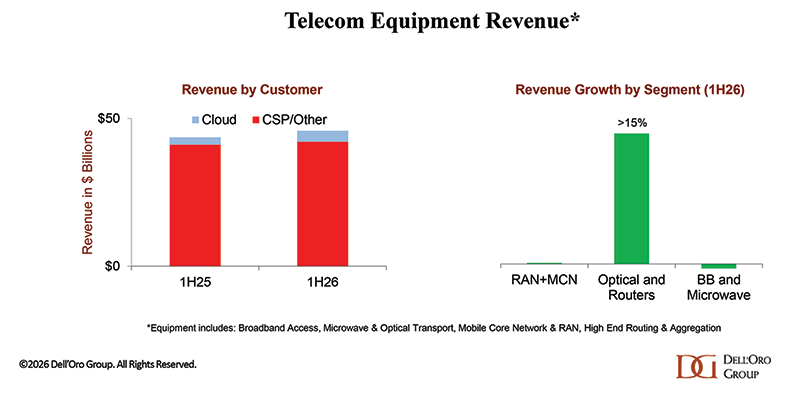
The 1H2026 performance follows a 4% telecom equipment spending increase in 2025, when the industry returned to growth after aggregate revenues declined 14% between 2022 and 2024. The 2025 rebound was supported by inventory normalization, easier year-over-year comparisons, improving wireless and wireline demand, and rising cloud capital expenditure. In 1H2026, however, the growth mix shifted more decisively toward equipment categories linked to AI infrastructure and hyperscale data-center connectivity.
Cloud investment reshapes demand:
Traditional communications service providers (CSPs) still generate more than 90% of worldwide telecom equipment revenue. However, cloud providers are now an increasingly consequential source of incremental demand. Dell’Oro Group estimates that cloud providers accounted for approximately 55% of total equipment-market revenue growth in 1H26, driven by sustained investment in AI compute infrastructure, data-center expansion, and the high-capacity transport and routing layers required to interconnect those facilities.
This does not signal a wholesale replacement of telecom operator demand by hyperscaler spending. Rather, it illustrates how the equipment market’s near-term growth profile is being reshaped by the convergence of telecom networking, cloud architecture, and AI infrastructure. The technologies benefiting most are those closest to data-center interconnect, backbone capacity expansion, and high-performance IP networking.
Optical and routing lead growth:
Growth was concentrated in Optical Transport and High-End Routing and Aggregation—the two segments with the most direct exposure to cloud and data-center investment cycles.
Optical Transport revenue increased at a double-digit rate in 1H26, supported by demand for data-center interconnect capacity and the expansion of high-bandwidth optical infrastructure. High-End Routing and Aggregation also recorded strong gains, reflecting robust spending from both cloud providers and CSPs.
By comparison, more traditional telecom infrastructure categories remained comparatively stable:
-
Aggregate RAN and MCN revenue was broadly flat.
-
Broadband Access revenue was relatively unchanged.
-
Microwave Transport revenue also showed limited growth.
The divergence underscores an important market distinction: AI-related infrastructure spending is currently lifting transport, optical, and routing investment more directly than it is stimulating broad-based growth in mobile access or core-network equipment.
Regional and supplier trends:
Regional conditions were favorable outside China. North America, EMEA, the Caribbean and Latin America (CALA), and Asia-Pacific excluding China all contributed to the 1H26 market expansion. North America continued to benefit disproportionately from AI- and cloud-driven infrastructure investment, including demand for optical transport, routing, and fiber-access platforms.
China remained the principal weak point. Telecom infrastructure investment is increasingly being displaced by compute-oriented capital expenditure. China’s three largest CSPs are collectively targeting 40% growth in computing capex during 2026, while conventional connectivity capex is expected to decline by 24%. That reallocation reinforces the broader shift from traditional network buildouts toward AI infrastructure, although the equipment beneficiaries differ substantially by technology segment.
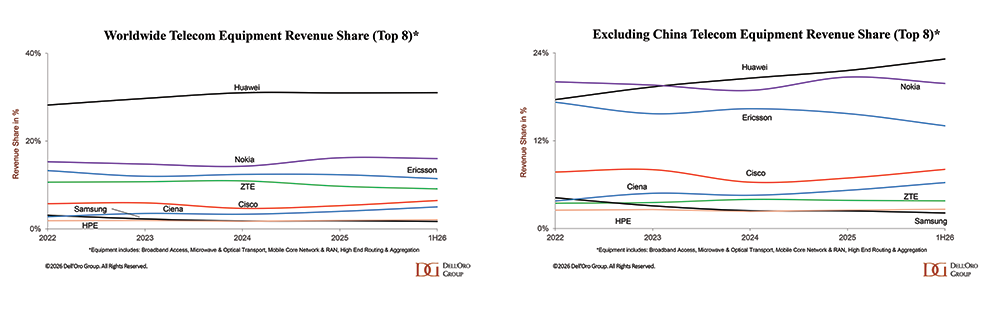
Global supplier rankings remained broadly stable during the first half of the year. Huawei retained its position as the largest worldwide telecom equipment supplier, followed by Nokia and Ericsson. Outside China, however, market-share shifts were more pronounced:
-
Huawei and Cisco gained share in 1H26 relative to 2025.
-
Ericsson and Nokia together lost roughly three percentage points of revenue share.
-
The changes partly reflect differing exposure to the faster-growing optical and routing segments, as well as regional demand patterns.
Revised Outlook:
Dell’Oro Group’s analyst team has raised its 2026 outlook for the six tracked equipment markets. Worldwide revenue is now projected to grow 3% to 5% for the full year, compared with a previous forecast of 2% to 4%.
The risk profile has also changed. China is tracking below earlier full-year expectations, while rising memory and component costs have become more significant second-half concerns. Those headwinds are being offset, at least in part, by continued strength in cloud and AI infrastructure investment.
Telecom equipment demand has stabilized and entered a renewed growth phase, supported by sustained hyperscale investment in AI compute, optical interconnect, and high-end routing. The key question for 2026 is whether this momentum broadens into a more balanced, network-wide recovery—particularly across RAN, core, and access segments, which have not yet participated materially in the expansion.
The central market question is whether sustained hyperscale investment in AI compute, optical interconnect, and high-end routing can broaden into a more durable, network-wide equipment recovery.
……………………………………………………………………………………………………………………………………………………………….
References:
Cloud Providers Drive Telecom Equipment Growth in 1H26 – Dell’Oro Group
Dell’Oro: Data Center capex grew 92% in 2Q-2026 (caveats galore)
Dell’Oro: AI RAN revenue forecast: $35B from 2026-to-2030; 3 types of AI RAN explained
Dell’Oro: Telecom carriers are on a 5G SA spending spree with more to come
Dell’Oro: Global RAN market stable (again) in 1Q 2026; top 5 RAN vendors are unchanged
Dell’Oro: RAN Market Stabilized in 2025 with 1% CAG forecast over next 5 years; Opinion on AI RAN, 5G Advanced, 6G RAN/Core risks
Dell’Oro: RAN market stable, Mobile Core Network market +14% Y/Y with 72 5G SA core networks deployed
Dell’Oro Group: RAN Market Grows Outside of China in 2Q 2025
Dell’Oro: Fixed Wireless Access revenues +10% in 2025 & will continue to grow 10% annually through 2029
Dell’Oro: AI RAN to account for 1/3 of RAN market by 2029; AI RAN Alliance membership increases but few telcos have joined
FCC plans 6G spectrum auctions before IMT 2030 frequencies have been identified and without a 6G frequency arrangement standard
Executive Summary:
Federal Communications Commission (FCC) Chairman Brendan Carr said Wednesday that a series of planned wireless-spectrum auctions could generate more than $100 billion in proceeds over the next several years. In July, the FCC voted to conduct a 2027 auction of 160 megahertz of mid-band spectrum in the Upper C-Band (3.98–4.2 GHz), creating a contiguous “super band” of over 440 megahertz.
Mr. Carr said the agency is also preparing three additional auctions targeting pipeline bands such as 1.6 GHz, 2.7 GHz, 4.4 GHz, and 7 GHz for 6G commercial use. The FCC has formally notified stakeholders of those plans and is targeting completion of all four auctions by the end of 2028.
Carr said demand for licensed spectrum extends beyond the three national mobile network operators—AT&T, Verizon, and T-Mobile, which collectively provide nearly all U.S. mobile service. He said the planned auctions could broaden participation in the wireless ecosystem and promote additional competition. “We’re seeing real response in the market in ways that we didn’t see just a couple of years ago,” Carr said.
–>We sincerely doubt that after Dish Wireless’ spectaular 5G O-RAN failure!
The FCC’s auction strategy follows several high-profile spectrum transactions. In May, the agency approved EchoStar’s $40 billion sale of wireless-spectrum assets to SpaceX, AT&T, and Verizon. It also approved Verizon’s 2024 $1 billion transaction to acquire selected spectrum assets from U.S. Cellular.
SpaceX acquired spectrum to support Starlink’s direct-to-device service and other satellite-enabled connectivity offerings. Last week, the FCC said it was advancing efforts to make additional spectrum available for space-based broadband services. The agency had previously approved SpaceX’s plan to deploy thousands of additional satellites intended to support next-generation mobile services and broadband speeds of up to 1 Gbit/s.
The Trump administration said Friday that it is laying the policy and regulatory groundwork for multiple 6G-focused spectrum auctions in 2028. The FCC is accelerating its spectrum-auction agenda in response to rapid growth in wireless demand and emerging applications, including artificial intelligence workloads, autonomous vehicles, connected sensors, and other advanced connectivity use cases.
“It’s more competition. It drives prices down for consumers. It raises money for the Treasury,” Carr said, noting that a prior auction raised funds to replace Chinese gear in U.S. networks that raised national security concerns.
The planned auctions come as mobile-data demand continues to increase, albeit at a slower rate. CTIA, the wireless-industry association, reported that U.S. consumers used 159.3 trillion MB of mobile data in 2025, a 20% increase from 2024. CTIA also said AI-related traffic is growing at roughly three times the rate of conventional wireless traffic and could account for nearly one-third of all broadband traffic by 2034.
Nokia’s 6G Spectrum Vision:
From a regulatory perspective, IMT’s identification of new spectrum in the extended mid-band will be vital for the industry, as it can enable global or regional harmonization, provide regulatory certainty for technological investments in the ecosystem, and create economies of scale for faster development and broader adoption.

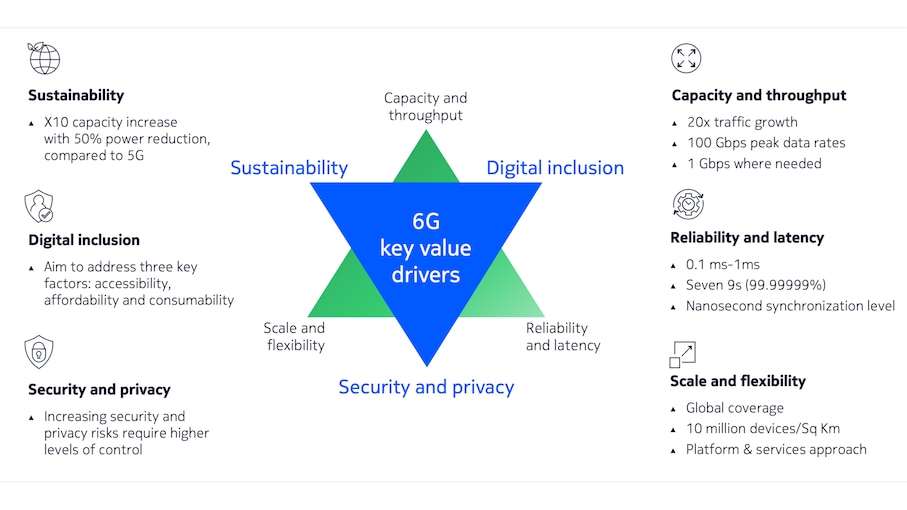
Nokia on 6G Drivers:
Analysis- What the FCC is Totally Missing:
What the FCC’s 6G auction planning appears to overlook is the international spectrum-harmonization timeline. The FCC’s accelerated 6G auction agenda risks getting ahead of the global standards and spectrum-harmonization process. Frequency bands for 6G, formally addressed by the ITU as IMT-R-2030, will not be identified at the international level until the ITU-R World Radiocommunication Conference 2027 (WRC-27) which will take place in Shanghai, China, from October 18 to November 12, 2027.
Starting at ITU-R WP 5D meeting #57, which takes place in Jan/Feb 2028, 5D will start to develop IMT-2030 frequency arrangements for the designated bands identified at WRC-27. Those frequenc arrangements are vitally important because they establish the technical basis for globally or regionally harmonized use of spectrum, including band plans and deployment approaches that support equipment interoperability, scale, and international roaming. They should greatly simplify IMT 2030 roaming between carriers that use the same 6G frequency bands.
As a result, auctioning spectrum specifically characterized as “6G” before that process is complete could force U.S. policy ahead of the eventual international framework. The FCC can prepare candidate bands, study sharing and coexistence conditions, and develop auction authority and rules in advance, but it cannot yet know which bands will ultimately receive broad international support for IMT-2030.
Importance of a 6G Frequency Arrangements Standard:
The explicit purpose of this ITU-R recommendation (international standard) is to guide administrations in selecting transmitting and receiving frequency arrangements for terrestrial IMT and to promote efficient spectrum use.
Core functions of IMT frequency arrangements:
In summary, IMT frequency arrangements do considerably more than identify whether a band uses FDD or TDD. They define the uplink and downlink frequency blocks, duplex direction, duplex separation, center gap, carrier-pairing relationships, usable sub-band segmentation, and alternative arrangements needed to translate an IMT identification into an interoperable and commercially deployable spectrum plan.
A Very Bad Omen from ITU-R WP5D – 2.8 Year Gap Between IMT 2020 Co-Recommendations M.2150-0 and M.1036-7:
One should not equate a WRC-27 IMT frequency identification with a completed 6G spectrum standard. The IMT-2020 precedent is highly instructive: after WRC-19 identified new 5G bands, ITU-R WP 5D did not complete the corresponding ITU-R M.1036 frequency arrangements recommendation on the same timetable as the IMT-2020 RIT/SRIT specification. despite being a co-requisite standard. The ITU-R M.2150-0 radio-interface recommendation (IMT 2020 RIT/SRIT) was approved and published on February 1, 2021, while the internationally agreed IMT 2020 frequency band (M.1036-7) recommendation wasn’t approved until December 13, 2023. [All versions of ITU-R M.1036 (IMT 2020 frequency arrangements) are available for download here.]
For over two and 10 months, 5G (IMT-2020 RIT/SRIT ) was actively deployed globally without a finalized, globally harmonized UN/ITU-R standard for its internationally specified frequency arrangements (specifically the mmWave bands designated by WRC-19). During that interval, the formal 5G radio-interface standard existed, but the internationally agreed spectrum-arrangements framework remained incomplete for the major new WRC-19 IMT 2020 frequency bands. The nearly three-year disconnect demonstrated that an IMT RIT/SRIT recommendation, by itself, was not a complete international 5G standardization outcome. Without settled arrangements for duplexing, spectrum segmentation, uplink/downlink operation, carrier placement, and coexistence, WRC-identified spectrum does not automatically become harmonized, deployable IMT spectrum. Let’s hope WP 5D learned a lesson from that fiasco.
–>Since ITU-R Recommendations are technically voluntary and non-binding, national regulators and regional bodies simply bypassed the ITU-R impasse to build their 5G networks. Nonetheless, several 5G deployment problems resulted:
-
- The Problem: WRC-19 had identified these bands for 5G, but because a geopolitical impasse (largely driven by the Russian Federation over existing satellite/military service protections) blocked the M.1036 frequency arrangement consensus, there was no UN-sanctioned blueprint for channel channeling plans or guard bands.
- The Impact: Outside of early adopters like the US (via the FCC), most global operators refused to touch mmWave spectrum. Capital expenditure shifted entirely to mid-band (C-band) frequencies, stalling the rollout of ultra-low latency, high-capacity 5G applications for years.
-
- The Problem: The industry treated 3GPP Release 16 and subsequent spectrum definitions as the de facto authority.
- The Impact: Rather than utilizing an internationally validated ITU framework, global network vendors and national regulators (like the FCC in the US or CEPT in Europe) executed their own domestic spectrum rules. This reduced the ITU’s role during that window from an active coordinator to a passive archivist validating rules after the networks were already built.
-
- The Problem: Without a finalized international agreement on exact band arrangements, device OEMs (Original Equipment Manufacturers) faced uncertainty about which exact block matrices and duplexing directions would become standard globally.
- The Impact: Early 5G smartphones required highly fragmented, region-specific RF front-end architectures. This slowed down the decline of 5G handset prices, particularly for phones capable of international roaming on high-frequency bands.
- The Problem: In regions like Europe, Africa, and parts of Asia, countries sit in close geographical proximity. Without M.1036 specifying standard guard bands and TDD (Time Division Duplexing) synchronization models for the newly opened frequencies, there was no international baseline for interference mitigation.
- The Impact: Neighboring nations had to negotiate messy, bilateral spectrum-sharing agreements to prevent base stations in one country from bleeding over and blinding mobile networks or satellite receivers in another
Bottom Line:
For IMT-2030, the same distinction will be decisive. WRC-27 may identify additional bands for IMT-2030, but identification alone will not produce globally usable 6G spectrum. WP 5D must subsequently develop agreed IMT-2030 frequency arrangements for those bands. Until that work is concluded, it is premature to presume that frequencies auctioned in 2028 will have internationally harmonized 6G band plans or broad device-ecosystem support. Make no mistake that detailed IMT 2030 (6G) frequency arrangements will be needed for interoperable 6G deployment.
The ITU-R IMT 2030 Frequency Arrangements recommendation, expected to be approved in late 2030 or early 2031, will provide the internationally recognized implementation alternatives for arranging that spectrum. A national regulator may still adopt a different domestic plan, but departure from that standard will likely reduce device scale, raise RF complexity, and weaken prospects for roaming and cross-border 6G compatibility.
An FCC auction in 2028 may be feasible as a U.S. domestic spectrum-policy action, but calling it a “6G auction” would be technically way premature until the relevant IMT-2030 frequency arrangements have been completed by WP 5D and internationally supported.
………………………………………………………………………………………………………………………………………………………………………………………………..
References:
https://www.itu.int/rec/R-REC-M.1036/en
https://www.nokia.com/6g/spectrum-for-6G-explained/
GSMA Vision 2040 study identifies spectrum needs during the peak 6G era of 2035–2040
ITU-R M.[IMT-2030.EVAL] & ITU-R M.[IMT-2030.SUBMISSION] reports: Evaluation & Submission Guidelines for 6G RIT/SRITs (6G)
Roles of 3GPP and ITU-R WP 5D in the IMT 2030/6G standards process
ITU-R M.2150: Detailed specifications of the radio interfaces of IMT-2020
IMT 2020.SPECS approved by ITU-R but may not meet 5G performance requirements; no 5G frequencies (revision of M.1036); 5G non-radio aspects not included
Only domestic network equipment may be used for 5G in Russia; Revision of ITU-R M.1036 urgently needed
Huawei’s Ascend Silicon Roadmap Extends From AI Chips to Cluster-Scale Infrastructure
Note: Perplexity.ai was use to research this article.
……………………………………………………………………………………..
Executive Summary:
Huawei is accelerating development of an indigenous AI-computing platform intended to reduce China’s reliance on U.S.-supplied accelerators, networking technologies, and associated software ecosystems. The effort aligns with the company’s stated strategy of becoming a full-stack supplier of AI-era computing and connectivity infrastructure—rather than primarily a developer of frontier foundation models.
Huawei said it plans to introduce two new Ascend AI accelerators in 2027: the Ascend 960DT in the first quarter and the Ascend 960PR in the third quarter. The company also disclosed a longer product roadmap extending through 2029 and said it has shipped more than 1,000 AI-computing systems to over 370 customers.
A necessary distinction is that Huawei designs its Ascend processors through HiSilicon, its semiconductor-design subsidiary, but does not own or operate leading-edge chip fabrication facilities. Production therefore depends on external foundry, memory, advanced-packaging, and equipment supply chains—areas that remain materially constrained by U.S. export controls and by the capabilities of China’s domestic semiconductor ecosystem. For example, Huawei can’t use TSMC to make its silicon so must rely on Chinese chipmakers.
As per an earlier IEEE Techblog post this week, Guo Ping, chairman of Huawei’s supervisory board, told new employees that Huawei’s objective in computing and communications is to “become Nvidia.” In technical terms, Huawei is not attempting merely to replicate a GPU. It is seeking to assemble an alternative AI-infrastructure stack: Ascend accelerators; Kunpeng general-purpose processors; servers and rack-scale systems; high-speed interconnect; storage; cloud services; and the CANN software environment that must serve, in China, some of the platform role CUDA performs globally for Nvidia.

Visitors tour Huawei’s Ascend AI exhibition booth during a conference last year. Andy Wong/
From accelerator to system architecture:
Huawei’s principal response to a per-device performance gap is system-scale integration. Rather than relying exclusively on the performance of a single accelerator generation, the company is assembling larger clusters of Ascend devices and attempting to improve the efficiency of communication, memory access, workload partitioning, and collective operations across those systems.
This is strategically relevant because training and serving large AI models are increasingly limited not only by floating-point throughput, but also by memory capacity and bandwidth, interconnect latency, bisection bandwidth, power delivery, cooling, and software efficiency. A large accelerator cluster can only approach the behavior of a unified computing resource if its networking and systems software prevent communication overhead from overwhelming the benefits of adding more processors.
Huawei has promoted UnifiedBus as an architectural approach for improving communication among processors, memory, and devices across server and rack boundaries. The underlying objective is familiar to data-center architects: reduce data-movement overhead and make a distributed accelerator cluster behave more like a coherent, programmable system. Whether Huawei can deliver this at scale will depend on achievable latency, bandwidth, congestion control, fault tolerance, topology-aware scheduling, and software maturity—not simply on the number of accelerators installed.
That systems emphasis is consistent with Huawei’s established position in telecom infrastructure. Unlike a pure-play AI-chip supplier, Huawei can combine AI computing with data-center networking, optical transport, IP infrastructure, cloud platforms, mobile networks, and edge-computing systems. The potential differentiator is therefore architectural integration, particularly for AI-RAN, autonomous network operations, edge inference, digital twins, and operator cloud deployments where AI workloads must interact with network telemetry and real-time control functions.
Interconnect and optics matter:
The company is also pursuing near-packaged optics, an approach intended to shorten electrical paths between switching or compute silicon and optical transceivers. In principle, placing optical components close to high-speed silicon can reduce electrical-channel loss and potentially improve energy efficiency as link speeds and port densities rise.
Huawei’s terminology should not be conflated automatically with co-packaged optics. Co-packaged optics generally integrates optical engines and switch or compute ASICs in a common package or closely coupled assembly; near-packaged approaches may retain more physical separation while still reducing copper reach. The key engineering question is not the label, but the extent to which the architecture can deliver lower power per transmitted bit, higher density, manufacturability, serviceability, and operational reliability at scale.
For large AI clusters, the interconnect fabric is increasingly a first-order design constraint. As clusters expand, network performance determines how effectively distributed training workloads can scale. The challenge is particularly acute where a vendor seeks to compensate for lower accelerator performance by deploying more devices: more devices can increase aggregate compute capacity, but they also increase synchronization traffic, power consumption, cabling complexity, failure exposure, and the burden on cluster-management software.
Constraints remain substantial:
Huawei’s roadmap should be assessed as a bid to establish a credible domestic alternative AI platform, not as evidence that it has achieved parity with Nvidia’s highest-end systems. Its Ascend roadmap faces several interdependent constraints:
-
Advanced fabrication remains dependent on external foundry capacity and equipment availability, even though HiSilicon can design sophisticated processors.
-
High-bandwidth memory availability, yield, packaging capability, and supply-chain scale can materially affect system output and performance.
-
Cluster-level competitiveness depends on interconnect bandwidth, latency, memory architecture, power efficiency, and the ability to operate reliably at very large scale.
-
CANN must attract developers, framework integrations, tools, libraries, and application vendors in an ecosystem where CUDA remains deeply embedded.
-
Customer adoption will depend on total cost of ownership, application portability, model performance, support quality, and availability of hardware at predictable volumes.
The strategic rationale is nonetheless clear. Export controls have increased the value of a domestically supplied AI-computing stack, even if individual components or systems lag the frontier in some metrics. As Huawei rotating chairman Eric Xu put it, the company’s concern is not only whether it can access the most advanced technology, but whether it can avoid strategic dependence on supply decisions made elsewhere.
For telecom operators, the central issue is whether Huawei can turn this silicon-and-systems program into deployable AI infrastructure for network operations. A credible offering would require more than Ascend processors. It would require validated reference architectures for AI-RAN and telco cloud, high-performance east-west networking, operational automation, observability, model lifecycle management, security controls, and a software ecosystem that can support carrier-grade availability.
Huawei’s advantage is that it already participates across many of those domains. Its challenge is proving that the integrated stack can deliver competitive performance, efficiency, ecosystem breadth, and supply assurance under sustained technology restrictions. That is the practical test of its ambition to become China’s Nvidia-equivalent in AI infrastructure.
……………………………………………………………………………………………………………………………………………………………..
References:
https://www.wsj.com/tech/ai/huaweis-plan-to-become-chinas-nvidia-8af8d8a1 [paywall]
https://www.wsj.com/tech/chinas-huawei-develops-new-ai-chip-seeking-to-match-nvidia-8166f606 [paywall]
Huawei Chairman: Strategic Focus on AI Computing & Connectivity Infrastructure
Huawei unveils AI Centric Network roadmap, U6 GHz products, 5G Advanced strategy and SuperPoD cluster computing platforms
Key take-aways: “16th Smart City and Intelligent Economy Expo” for Huawei, Alibaba & China’s three state backed carriers
Omdia’s 2025 Mobile Core Network Leaders: Huawei #1 in market share; Nokia #1 for portfolio competitiveness
Analysis: Huawei”s upgraded Xinghe Intelligent Network Solution for South Africa
Huawei’s AI-Centric Network Vision: Six Imperatives for the Next Decade; Critical Questions for IEEE Techblog Community
Huawei FY2025: 2.2% YoY revenue increase; strategic pivot to AI and intelligent automotive solutions
Huawei, Qualcomm, Samsung, and Ericsson Leading Patent Race in $15 Billion 5G Licensing Market
Huawei Cloud Review and Global Sales Partner Policies for 2026
Huawei’s Electric Vehicle Charging Technology & Top 10 Charging Trends
Huawei to Double Output of Ascend AI chips in 2026; OpenAI orders HBM chips from SK Hynix & Samsung for Stargate UAE project
4.8 GHz to 4.9 GHz frequency band uses & Verizon Wireless experimental license for testing ISAC with Ericsson
Introduction:
The 4.8 GHz to 4.9 GHz frequency band is a critical slice of mid-band spectrum located within the larger IEEE C-band (4.0 to 8.0 GHz) and the ITU Ultra High Frequency (UHF)/Super High Frequency (SHF) boundary. It is currently used primarily for public safety operations (especially the 4.9 GHz portion allocated to FirstNet for drone control and crisis response) and select 5G deployments (part of 3GPP 5G NR Sub-6 GHz Band n79 in parts of Asia). It is extensively deployed for commercial 5G networks across Asia (such as China and Japan) and Europe, while in the United States, it is being studied for repurposing and testing advanced 5G/6G integrated sensing and communication (ISAC). Finally, it is actively being studied for future 5G-Advanced and 6G mobile broadband and sensing use cases.
Executive Summary:
| Region / Country | 5G Spectrum Range | Mid-Band Status |
|---|---|---|
| China | 4.8 GHz – 4.9 GHz (and 3.3–3.6 GHz) | Actively deployed for 5G NR Band n79 |
| Japan | 3.6–4.1 GHz & 4.5–4.9 GHz | Allocated to major carriers (e.g., NTT Docomo) |
| United States | 4.4 GHz – 4.94 GHz | Historically Federal/Military; currently under review for commercial 5G/6G |
- Favorable Propagation: It provides a strong balance between coverage area and high data throughput (bandwidth). [1]
- Capacity: This frequency handles heavy data loads—like high-definition real-time video streaming—much better than lower bands (like 700 MHz). [1]
- Indoor Penetration: It experiences higher atmospheric and structural attenuation compared to 2.4 GHz or 3.5 GHz, meaning it requires denser small-cell deployments for deep indoor coverage
Verizon’s Experimental License for the 4.8GHz-4.9GHz Band:
Verizon Wireless (under the company name Cellco Partnership) has applied to the FCC for an experimental license to use the 4.8GHz-4.9GHz band in and around its lab in Los Angeles, California. Verizon Wireless’s request is temporary, expiring one year from grant. The application is pending approval, but the license is expected to be granted soon, according to Steve Crowley.
Verizon said, “this experimental authorization is necessary to test Ericsson software and hardware in a noncommercial environment. Verizon Wireless requests this authorization to demonstrate 5G advanced technology use cases such as object sensing as a precursor to 6G Integrated Sensing and Communication (ISAC). This work will facilitate the adoption of use cases across commercial, public safety, and defense sectors.”
Grant of the experimental authorization will allow Verizon Wireless to set up hardware radiating in 4.8-4.9 GHz as part of a private network not connected to commercial operators. The radios are certified for use under 47 C.F.R. Part 27 and Part 96. The testing will be conducted using varying bandwidths to allow for range, resolution, and confidence assessments. Testing will occur outdoors and all transmissions will be controlled at the locations provided in the application. The fixed base stations will employ directional antennas and will have a maximum antenna elevation as described in the application. The base station antenna has a half-power beam width of approximately 24º vertically and 65º horizontally.
Verizon Wireless is unable to determine the incumbent users in the 4.8-4.9 GHz band. Verizon Wireless will coordinate with the incumbents once the FCC and NTIA have provided the agencies impacted, and prior to commencing testing, to avoid any potential disruptions to their operations. If incumbent licensees experience interference, Verizon Wireless will cease interfering operations.
Verizon is one of the first companies to apply for a test license in 4.4GHz specifically for 6G-related trials, according to Crowley. He noted it is also first time the carrier has requested a test license in any of the frequencies under study, which include 1.6GHz, 2.7GHz, 4.4GHz and 7GHz.
Other Entities Pursuing the 4GHz Band:
Samsung Research America requested an experimental license this month to use 4720MHz-4820MHz in Plano, Texas, but its application did not specify use cases to be tested.
The 4.8GHz-4.9GHz spectrum falls within the so-called 4.4GHz band (4400MHz-4940MHz) that the NTIA has identified for study to repurpose for commercial licensed use as part of the U.S. plan to make more frequencies available for 5G and 6G.
The CTIA refers to the band as 4GHz, rather than 4.4GHz. The group published a report this week to make an economic and technical case for the “prime midband spectrum” and urged policymakers to move quickly on studies this fall. They described 4GHz as the “a cornerstone” of the US spectrum pipeline, along with upper C-band, 2.7GHz and 7GHz, because it offers potential 400MHz of bandwidth and already has some equipment and device support. Further, it is a “compelling alternative” to China’s push for licensed use of the 6GHz band in spectrum negotiations at ITU World Radiocommunication Conference 2027 (ITU WRC-27).
Will It Be Used for 6G?
- International Consideration: The ITU-R and organizations like Nokia are studying the 4.4–4.8 GHz and neighboring ranges as potential mid-band spectrum for future IMT-2030 (6G) services. There are several ongoing compatibility studies in ITU-R WP 5d between terrestrial, maritime and satellite use of this band. They are in preparation for ITU WRC-27 which will specify IMT 2030 (6G) frequencies.
- Industry Support: Industry groups like the CTIA advocate for the broader 4 GHz mid-band range as a prime, lower-risk spectrum for wide-area mobile capacity to bridge 5G-Advanced and early 6G rollouts.
- Global Hurdles: Formal decisions regarding international mobile allocation for this band will be evaluated globally at the ITU-R World Radiocommunication Conference (WRC-27), though support varies by region due to existing incumbent and defense users.
-
Verizon added nine new members to its 6G Innovation Forum this week and signaled intent to test more use cases in the areas of ISAC, digital twins, robotics, AI and wearables. The new members are Amazon Web Services (AWS), Cisco, Intel, Keysight Technologies, MediaTek, Nvidia, Palo Alto Networks, Rohde & Schwarz and Viavi Solutions. They join founding members Ericsson, Samsung, Nokia, Meta and Qualcomm Technologies.
References:
https://x.com/StevenJCrowley/status/2097450891444142433
https://apps.fcc.gov/els/GetAtt.html?id=412698&x=
https://www.lightreading.com/6g/verizon-seeks-fcc-approval-to-test-6g-use-cases-in-4ghz
https://urgentcomm.com/network-tech/an-introduction-to-4-9-ghz
ETSI Integrated Sensing and Communications ISG targets 6G
Key take-aways: “16th Smart City and Intelligent Economy Expo” for Huawei, Alibaba & China’s three state backed carriers
Analysis: Cohere’s $28M U.S. DoD FutureG ISAC contract; OTFS vs OFDM; 6G-NR/IMT 2030 RIT standards outlook
3GPP approves timelines for Release 21 which will specify 6G RAN, Core and 5G Advanced
Dell’Oro: Data Center capex grew 92% in 2Q-2026 (caveats galore)
According to a new report by Dell’Oro Group, the global data center capital expenditures strongly accelerated in 2Q 2026. Continued AI infrastructure investment supported growth across compute, storage, networking, and physical infrastructure, while rising memory and storage prices significantly increased server average selling prices.
“Data center capex growth broadened in the second quarter as investment accelerated across both established Cloud Service Providers and emerging AI infrastructure customers,” said Baron Fung, Vice President of Research at Dell’Oro Group.
“Spending remained concentrated in NVIDIA Blackwell Ultra and hyperscaler custom accelerators, while agentic AI created incremental demand for general-purpose compute, storage, and complementary networking. Neocloud providers and AI model builders are also becoming increasingly important contributors to infrastructure investment. These companies are rapidly expanding their own capacity while deepening partnerships with cloud service providers.”
“Looking ahead, ongoing accelerator deployments and emerging agentic AI and AI-related storage workloads should sustain strong capex growth through the remainder of 2026 and beyond, although supply constraints could limit the pace at which planned infrastructure is deployed,” explained Fung.
Additional highlights from the 2Q 2026 Data Center IT Capex Quarterly Report:
- Neocloud and AI Model Builder capex grew the fastest among the customer segments, reflecting the early stages of their infrastructure buildouts.
- Higher memory and storage prices provided an additional lift to capex by driving server average selling prices higher.
- Dell led server OEM revenue, followed by SuperMicro and Lenovo, while white-box server revenue reached a record high.
………………………………………………………………………………………………………………………………………………………….
On August 18th Dell’Oro Group forecasted that worldwide data center capital capex is to maintain growth momentum and surpass $3 trillion by 2030. High-end accelerators powering accelerated servers optimized for AI are expected to represent the largest share of data center capex and remain the primary driver of capex growth over the forecast period.
“Our 2030 data center capex outlook has nearly doubled since the January 2026 forecast, reflecting higher hyperscale capex guidance, increased projections for global data center power capacity, and higher commodity costs,” said Baron Fung, Vice President of Research at Dell’Oro Group. “High-end accelerators powering AI-optimized servers are expected to account for the largest share of data center capex and remain the primary driver of growth over the forecast period.
“However, the pace of growth will depend on the sustainability of investment, power availability, and supply chain conditions. Accelerated and heterogeneous computing, along with innovations in server efficiency, could help mitigate the rising cost and infrastructure demands of AI. The Top 4 US hyperscalers alone could represent about half of global capex, while enterprise investment remains constrained by uncertain AI returns,” according to Fung.
Additional highlights from the Data Center IT Capex 5-Year July 2026 Forecast Report:
- High-end accelerators are expected to account for the largest share of data center capex and remain the primary driver of spending growth through 2030.
- General-purpose server demand is expected to benefit from growing inference, agentic AI, and storage workloads, broadening infrastructure growth beyond accelerated computing.
- The newly added AI-specialized cloud segment, comprising AI model builders and neocloud service providers, is projected to grow at nearly a 60 percent CAGR, outpacing the growth of other customer segments.
Additional highlights from the Data Center IT Capex 5-Year July 2026 Forecast Report:
- High-end accelerators are expected to account for the largest share of data center capex and remain the primary driver of spending growth through 2030.
- General-purpose server demand is expected to benefit from growing inference, agentic AI, and storage workloads, broadening infrastructure growth beyond accelerated computing.
- The newly added AI-specialized cloud segment, comprising AI model builders and neocloud service providers, is projected to grow at nearly a 60 percent CAGR, outpacing the growth of other customer segments.
IEEE Techblog Analysis:
- Dell’Oro had already raised its 2026 global data-center capex outlook to more than $1 trillion in its June 2026 report. It also said 2H26 growth was expected to accelerate because of NVIDIA Rubin deployments and hyperscaler custom-accelerator refreshes. That makes the new 92% 2Q figure much more significant: this isn’t simply a strong quarter; it is occurring within a $1-trillion-plus annual investment cycle.
- Epoch AI’s tracking shows combined hyperscaler quarterly capex has been increasing at an average 72% annual rate since 2Q23 and projects approximately $770 billion for 2026 if the trend continues.
- Another estimate from Moody’s put 2026 hyperscaler capex at $785 billion, including Microsoft, Amazon, Meta, Alphabet, Oracle and CoreWeave.
- Dell’Oro’s separate 2Q semiconductor/component report says data-center component revenue increased 182% YoY, while DRAM and storage-drive average selling prices per bit more than doubled. Therefore, some of the 92% increase in data-center capex is clearly inflation in the cost of the equipment, not necessarily an equivalent increase in physical infrastructure.
- Therefore, the 92% increase in capex should not be interpreted as a 92% increase in deployed computing capacity, because sharply higher DRAM, NAND/storage and other component prices are inflating server system costs.
What’s Missing from this Report:
The press release for this report notes that worldwide data center capital expenditures grew 92% in 2Q02026, driven by surging AI demand and memory costs. However, it omits precise spending figures for individual hyperscalers (Alphabet, Amazon, Meta, Microsoft and Oracle) as well as OEM market share details. Moreover, YoY growth can conceal the current trajectory. Sequential growth would show whether the AI infrastructure spending acceleration actually intensified during 2Q of 2026.
Conclusions:
The 92% year-over-year increase in 2Q26 data-center capex needs to be viewed against a much larger AI infrastructure investment cycle. Dell’Oro had already raised its 2026 global data-center capex forecast to more than $1 trillion, with 2H26 spending expected to accelerate further as NVIDIA’s Rubin systems and hyperscaler custom accelerators ramp. At the same time, Dell’Oro reported that data-center semiconductor and component revenue surged 182% in 2Q26, with DRAM and storage-drive prices per bit more than doubling year over year. Consequently, a significant portion of the reported capex growth reflects higher equipment prices rather than a comparable increase in physical computing capacity. Meanwhile, hyperscaler capex is increasingly being supplemented by debt-financed Neocloud and AI-model-builder infrastructure, broadening the investment cycle beyond the traditional cloud giants.
Dell’Oro Group’s Data Center IT Capex Quarterly Report details the data center infrastructure capital expenditures of the largest hyperscale cloud service providers, AI Model Builders, Neocloud, Rest of Cloud, Telco, and Enterprise customer segments. It provides the allocation of data center infrastructure capex for general-purpose and accelerated servers, storage systems, and other auxiliary data center equipment. The report also discusses market trends, drivers of the leading cloud service providers’ capex growth during the quarter, and the outlook for the next year. To purchase this report, please contact us at [email protected].

…………………………………………………………………………………………………………………………………………………………………………………..
References:
Dell’Oro: 2H2026 Data Center Capex to Accelerate due to massive AI Deployments
PwC: Global AI data center spending to hit $31.6tn by 2050; Role of full stack orchestration layer explained
Nvidia CEO Huang: AI is the largest infrastructure buildout in human history; AI Data Center CAPEX will generate new revenue streams for operators
China vs U.S.: Race to Generate Power for AI Data Centers as Electricity Demand Soars
AI risks and backlash increase; Recap of the circular loop of fake AI profits and hyperscaler markups of private AI companies
Big tech spending on AI data centers and infrastructure vs the fiber optic buildout during the dot-com boom (& bust)
Analysis: Cisco, HPE/Juniper, and Nvidia network equipment for AI data centers
Networking chips and modules for AI data centers: Infiniband, Ultra Ethernet, Optical Connections
Expose: AI is more than a bubble; it’s a data center debt bomb
Will billions of dollars big tech is spending on Gen AI data centers produce a decent ROI?
Huge Risks for the proposed $500B AI Investments from Giant Wall Street firms
Huawei Chairman: Strategic Focus on AI Computing & Connectivity Infrastructure
Note: Perplexity.ai was use to research this article.
According to Chairman Guo Ping, Huawei aims to position itself as a full-stack provider of AI-era computing and connectivity infrastructure—effectively a Chinese counterpart to Nvidia in the infrastructure layer rather than in foundation-model development. In remarks posted to Huawei’s internal Xinsheng bulletin board, Guo told a group of new employees that the company’s strategic priority remains the advancement of its core connectivity and computing capabilities, rather than diversification into unrelated businesses. “There are no plans for business expansion,” he said, framing artificial intelligence (AI) as Huawei’s most significant strategic opportunity. Via Google Translate:
“Huawei’s core strategy is “focus”—specifically, deepening our expertise in the fields of connectivity and computing. We have no plans for business expansion. We aim to achieve even better results by providing digital infrastructure solutions to global customers, offering diverse solutions for the development of artificial intelligence, and contributing to the rise of China’s electronics industry. This is our vision for the future: to deepen our focus in our core areas and create greater value.”
Guo characterized AI as potentially humanity’s “last technology revolution,” arguing that Huawei must establish a durable competitive position in the sector. His comments suggest that Huawei sees its principal AI opportunity not in competing directly with hyperscalers and model developers on proprietary large language models (LLMs), but in supplying the underlying platforms on which a broad range of models can be trained, inferred, and deployed.
That strategy centers on Huawei’s Ascend AI processors and associated computing systems, together with Kunpeng general-purpose server platforms. The company’s objective is to provide an alternative AI infrastructure stack spanning processors, servers, networking, cloud platforms, and AI software tooling—capable, in Huawei’s view, of supporting diverse foundation models and enterprise AI workloads.
Image from Huawei
However, Guo indicated that Huawei does not regard AI model development as entirely optional. Its device and intelligent-automotive businesses will require domain-specific large models because open-source alternatives remain insufficient for certain proprietary, embedded, and safety-sensitive use cases. In addition, the increasing convergence of cloud infrastructure and AI services means Huawei Cloud must continue developing its own LLM capabilities to preserve platform competitiveness.
Strategic Implications:
The distinction is important. Huawei appears to be pursuing a layered AI strategy:
-
Infrastructure first: Ascend AI accelerators, Kunpeng processors, AI servers, high-performance interconnects, storage, and data-center infrastructure form the company’s primary competitive focus.
-
Models where strategically necessary: Huawei’s AI developed models (such as its enterprise Pangu LLM suite) are intended to support cloud services and vertical applications where open models do not meet performance, integration, security, or product-control requirements.
-
Connectivity as a differentiator: Unlike Nvidia, Huawei can combine AI computing platforms with extensive capabilities in wireless RAN, core networks, IP transport, optical networking, enterprise networking, and cloud infrastructure.
-
Domestic ecosystem resilience: The strategy also advances China’s effort to reduce dependency on U.S.-origin AI processors, software ecosystems, and advanced semiconductor supply chains.
For telecom operators, the relevant issue is whether Huawei can translate this integrated portfolio into credible AI-RAN, autonomous-network, edge-AI, and cloud-network offerings. The company’s position in radio access, transport, optical, and data-center infrastructure could give it an architectural advantage in deployments where AI workloads are tightly coupled with network telemetry, operational data, and real-time control loops.
Controversies, Constraints and Competition:
Guo’s remarks are more confirmatory than revelatory, but they provide an uncommon view of the company’s internal strategic framing. Huawei has substantially curtailed engagement with many foreign media and public-policy audiences, particularly as U.S. sanctions, export controls, and security restrictions have constrained its international operations.
The internal question-and-answer format also allows executives to articulate strategic priorities without directly addressing the numerous controversies facing the company, including the racketeering trial involving Huawei’s business with Iran that began in New York earlier this month.
Guo said Huawei would continue supplying digital infrastructure and AI solutions to customers in China and international markets. He ruled out expansion into satellite or launch-vehicle manufacturing and said the company does not intend to enter automobile manufacturing—consistent with Huawei’s previous position that it will provide intelligent-vehicle technology rather than build branded cars.
Huawei’s hardware production is heavily bottlenecked by U.S. sanctions (yield issues on advanced chips, SMIC node restrictions, and high-bandwidth memory shortages). On the prospect of additional sanctions or technology restrictions, Guo argued that China’s domestic market—home to roughly 1.4 billion people—provides Huawei with a sufficient base for long-term survival. But he also emphasized that the company’s aspirations extend beyond domestic demand: “Our concern is whether we are competitive compared to domestic and international competitors.”
AI infrastructure relies as much or even more on software than hardware. Huawei’s CANN software layer must compete with Nvidia’s CUDA, which makes AI developer adoption a tough uphill battle.
Analysis & Conclusions:
That will be the central test of Huawei’s AI strategy. Its ability to build a viable alternative to Nvidia-led AI infrastructure faces immediate supply-chain constraints under U.S. sanctions. There’s also the software challenge of driving developer adoption toward Huawei’s CANN architecture over Nvidia’s CUDA. Long-term viability will depend not only on Ascend AI silicon performance, but also. but also on software maturity, developer adoption, supply-chain scale, interconnect and memory performance, power efficiency, and the breadth of its ecosystem outside China.
Guo’s comments underline Huawei’s attempt to convert its established strengths in telecommunications, enterprise infrastructure, cloud, and silicon into an integrated AI platform strategy. The approach offers the company a potentially differentiated position in AI-enabled networks and cloud infrastructure, but its success will depend on whether the company’s Ascend AI silicon and the broader Huawei software ecosystem can achieve sufficient performance, scale, developer support, and supply-chain resilience to compete beyond China.
Achieving Huawei’s AI infrastructure aspirations faces severe headwinds, including ongoing U.S. chip sanctions that limit advanced node and memory production, as well as the steep challenge of driving developer migration from Nvidia’s CUDA to Huawei’s CANN ecosystem. Furthermore, while Huawei insists models are secondary, its domain-specific Pangu LLM suite will be critical to proving its cloud and enterprise viability.
“Large corporations have both strengths and weaknesses; to adapt to the future, a company must constantly evolve and reinvent itself,” Guo said. That will be Huawei’s formidable challenge in the age of AI.
……………………………………………………………………………………………………………………………………………
References:
https://xinsheng.huawei.com/next/detail/#/index?uuid=1316483709694681088
https://www.lightreading.com/ai-machine-learning/we-want-to-be-the-nvidia-of-ict-says-huawei-boss
Huawei unveils AI Centric Network roadmap, U6 GHz products, 5G Advanced strategy and SuperPoD cluster computing platforms
Key take-aways: “16th Smart City and Intelligent Economy Expo” for Huawei, Alibaba & China’s three state backed carriers
Omdia’s 2025 Mobile Core Network Leaders: Huawei #1 in market share; Nokia #1 for portfolio competitiveness
Analysis: Huawei”s upgraded Xinghe Intelligent Network Solution for South Africa
Huawei’s AI-Centric Network Vision: Six Imperatives for the Next Decade; Critical Questions for IEEE Techblog Community
Huawei FY2025: 2.2% YoY revenue increase; strategic pivot to AI and intelligent automotive solutions
Huawei, Qualcomm, Samsung, and Ericsson Leading Patent Race in $15 Billion 5G Licensing Market
Huawei Cloud Review and Global Sales Partner Policies for 2026
Huawei’s Electric Vehicle Charging Technology & Top 10 Charging Trends
Huawei to Double Output of Ascend AI chips in 2026; OpenAI orders HBM chips from SK Hynix & Samsung for Stargate UAE project
Bain: AI to greatly increase network operator expenses; network re-engineering needed!
Introduction by Bain:
“Over the next three to five years, the operating cost structure used by telecom operators is likely to undergo one of the most significant shifts in decades. As AI agents become embedded across customer care, network operations, software engineering, and enterprise functions, tokens will account for a growing share of operating expenditures.”
Key Points:
- Unless telcos proactively manage their costs, scaling up AI will simply add expenses to an already-heavy legacy base.
- An agentic operating model is emerging: a 70-to-30 ratio of legacy to AI costs, with AI automating or augmenting work across processes.
- Cost traps lurk: cheaper AI models, bigger bills; bolting AI onto legacy processes; and demos mistaken for transformation.
- Telco leaders can take five key actions today to avoid the traps.
Executive Summary:
Telecom operators are extending AI agents across network operations as they pursue higher levels of autonomy, but the shift could introduce a significant new operating-cost burden unless legacy processes, tooling and organizational structures are retired alongside the automation, according to Bain & Company.
Bain’s warning comes as operators accelerate plans for autonomous networks. TM Forum reported in June that 81% of 80 surveyed operators are targeting Level 4 autonomous networks or higher by 2030, and 20% expect to reach that threshold by 2027.
Under TM Forum’s Autonomous Networks framework, Level 4 moves beyond rule-based or preconfigured automation toward closed-loop, intent-driven decision-making within defined network domains. Current Level 4 work includes deployment of closed-loop operations in production networks, agent-based operating architectures, and metrics intended to quantify the operational and business value of autonomous-network use cases.
-
- Lagging Returns: According to Bain’s Automation and AI Pathfinder Survey, nearly 40% of companies saw AI cost savings land below 10%.
- Growing Budgets: Despite missing initial savings targets, 90% of these companies are still increasing their AI budgets.
- Autonomous Agents: Only 7% of companies currently run fully autonomous AI agents in production. Data access remains the top barrier to progress.
- AI Summaries: Bain’s research on Zero-Click Search shows that 80% of consumers rely on AI-written results for at least 40% of their searches.
- Fewer Clicks: About 60% of searches now end without the user clicking through to another website. This shift reduces organic web traffic by 15% to 25%.
Bain estimates that AI agents and associated token consumption could represent 20% to 30% of a telecom operator’s operating-cost base within the next three to five years, leaving conventional operating costs at 70% to 80%.
As AI spending rises, telcos risk increasing total costs without generating proportional gains in productivity or growth.
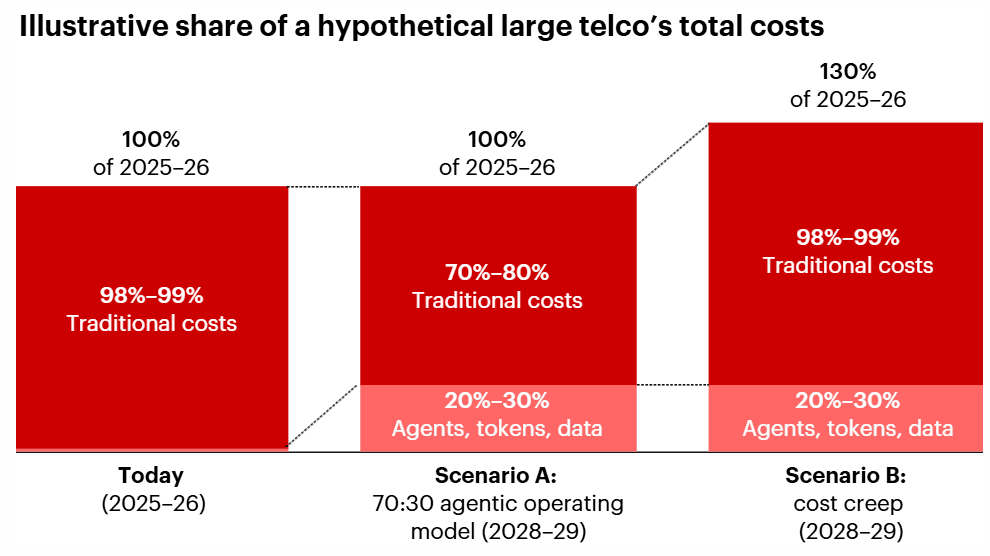
Notes: Illustration doesn’t incorporate absolute value changes; traditional costs are fully loaded, including costs from traditional software-as-a-service and cloud infrastructure, agency/outsourcing, depreciation, and more. Source: Bain estimates
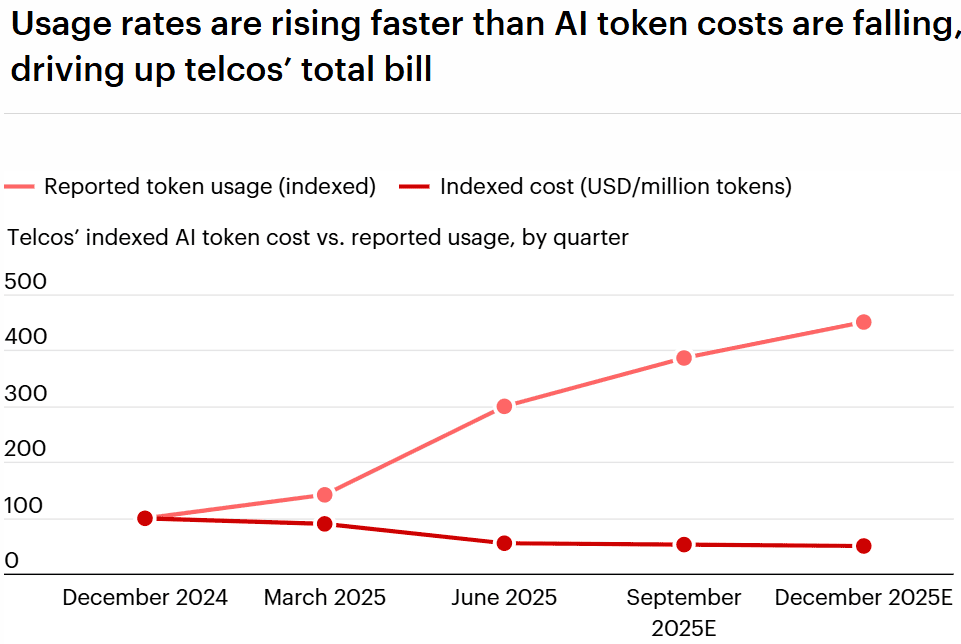
Sources: Wells Fargo (October 2025); Barclays (November 2025); company websites; news and industry reports; Bain analysis.
…………………………………………………………………………………………………………………………………………………………………………………..
However, cost is not the main issue. The principal risk is that network operators can create a parallel operating model when they layer agentic AI onto established network-operations processes without eliminating the people, software, outsourced functions and infrastructure those processes were designed to support.
In that scenario, AI compute, model inference and agent orchestration become incremental expenses, while legacy network operations centers, monitoring platforms, user-facing software licenses, managed-service arrangements and manual operational handoffs remain largely intact.
Network Re-engineering Required:
Avoiding this outcome requires process re-engineering rather than task-level automation. Bain recommends that operators redesign end-to-end workflows around the work agents assume, including:
-
Reducing manual monitoring, ticket triage and operational handoffs.
-
Reassessing workforce requirements as agents absorb repeatable diagnostic and remediation tasks.
-
Reviewing software, tooling and managed-service contracts when agents begin performing functions previously executed through conventional applications or outsourced processes.
-
Removing redundant operational steps rather than simply automating them.
-
Measuring the cost of an operational outcome, rather than the unit cost of model inference or token consumption.
This distinction is especially important in network operations, where an agent may continuously ingest alarms, correlate events, retrieve telemetry, diagnose faults, select a remediation action, trigger network tools, validate results and escalate exceptions to human operators. Each stage can add cost.
Inference is therefore only one component of the AI operating model. A production-grade agentic workflow may also require orchestration, tool and API calls, runtime evaluation, observability, data storage, policy enforcement, security controls, human-in-the-loop escalation and supporting compute infrastructure.
Bain argues that operators should evaluate the complete cost of the resolved operational event. For a service-affecting incident, that includes the total cost of detection, triage, diagnosis, remediation, validation and any remaining human intervention—not simply the marginal cost of the model invocation.
Closed-Loop Operations and Opex Reduction:
Bain cited Vivo in Brazil as an example of an operator redesigning a complete network workflow around AI-enabled automation rather than applying automation to discrete tasks. As part of Telefónica’s Autonomous Network Journey program, Vivo implemented a self-healing mechanism for its virtualized standalone 5G core.
The implementation monitors network-function performance, detects anomalies, identifies root causes and applies corrective actions automatically. It then validates whether the action restored normal operation and can progress to an additional remediation level when required.
Telefónica said the system correlates events across logical and physical infrastructure and completes the detect-to-resolve sequence without human intervention. For the targeted incidents, the company reported a 30-minute reduction in mean time to resolution.
The deployment also reduces repetitive work and manual intervention, while improving the use of computational resources. Telefónica has not disclosed a monetary estimate of the operating-cost savings associated with the implementation, however.
The significance of the Vivo deployment is architectural as much as operational. It integrates detection, correlation, diagnosis, remediation and verification into a closed-loop workflow. That is materially different from deploying an AI assistant within an otherwise unchanged operating model.
Other operator deployments illustrate the potential conventional opex benefits associated with higher autonomy. In a TM Forum case study, China Mobile reported that intelligent agents helped its network operations center achieve Level 4 autonomy under its self-assessment using TM Forum’s Autonomous Networks Levels framework.
China Mobile reported:
-
More than 30% reduction in backend operations-and-maintenance manpower.
-
More than 5% savings in frontline installation-and-maintenance manpower.
-
An average 30% reduction in mean time to repair for network faults and customer complaints.
An earlier TM Forum autonomous-network case study involving China Mobile reported O&M efficiency improvements of 10% to 20%, service-provisioning time reductions of 30% to 50%, and energy-consumption reductions of 3% to 5% across participating internet data centers and base stations.
The reported figures are operator-reported results published through TM Forum case studies. They demonstrate the possible efficiency gains from closed-loop automation, but they do not eliminate the need to account for AI-specific costs such as inference, orchestration, tool execution, supporting infrastructure and operational governance.
Measure Autonomous Networks by Outcomes:
TM Forum is also developing mechanisms to measure the value generated by autonomous-network deployments. In July, it approved version 2.0 of its Autonomous Networks High-Value Scenarios Effectiveness Indicators guide, intended to help operators quantify the impact of Level 4 autonomous-network scenarios.
This outcome-based approach aligns with Bain’s recommendation. For network operations, operators should move beyond narrow AI measures such as token counts, model cost per query or inference latency. Those measures remain operationally useful, but they do not establish whether an AI deployment improves the economics of network operation.
The most relevant measures include:
An operator may accept higher AI spending per workflow if it meaningfully reduces outage duration, truck rolls, customer-impacting incidents, workforce requirements or service-activation delays. Conversely, a deployment that lowers model-inference costs but leaves manual handoffs, duplicate monitoring tools and legacy support structures unchanged may offer limited net operating benefit.
AI Consumption at Telecom Scale:
AT&T has illustrated the potential scale of enterprise AI consumption, although its reported figures span AI workloads across the business and are not limited to autonomous network operations. The operator said in July that it processes an average of 45 billion tokens per day.
AT&T uses an AI gateway to route tasks among models based on cost, latency and expected output quality. The company said the platform can switch models during multi-turn interactions and has reduced costs for certain AI workloads by as much as 90%, producing multimillion-dollar savings.
The operating principle is relevant to telecom network automation: only a minority of tasks require the most capable—and most expensive—models. Routine classification, alarm enrichment, knowledge retrieval, configuration validation and other bounded operational tasks may be suitable for smaller models, purpose-built models or conventional deterministic automation. More capable reasoning models can be reserved for ambiguous, multi-domain or exception-heavy cases.
Bain similarly recommends matching model capability to task complexity rather than applying a single model class across every AI workload. Operators should establish dedicated compute budgets, instrument workflow-level economics and treat inference capacity as an operational resource that requires active governance.
Governing Agentic Network Operations:
Agent behavior itself can become a material source of cost and operational risk. Poorly designed agents may repeatedly transmit large context windows, loop without completing a task, invoke overlapping diagnostic tools or conduct duplicative checks that add token and infrastructure consumption without improving the result.
Bain recommends guardrails that limit both expenditure and runtime. In a telecom network-operations environment, those controls could include:
-
Maximum token, compute and tool-call budgets per incident or workflow.
-
Time limits before an agent must escalate an unresolved task to a human operator.
-
Context-management rules that prevent unnecessary repetition of telemetry, alarms and historical ticket data.
-
Controls to consolidate overlapping diagnostic checks and duplicate agent activity.
-
Policy constraints governing which network changes an agent may propose, execute or validate autonomously.
-
Continuous monitoring for model drift, abnormal agent behavior, spending anomalies and degraded operational outcomes.
-
Explicit business and financial ownership for each production agent and workflow.
The central issue is that autonomous networks will not necessarily lower opex simply because they reduce manual work. Operators must also remove the legacy cost structures that agentic systems replace. Otherwise, AI agents risk becoming an additional layer of expense on top of existing network operations rather than the foundation for a more efficient operating model.
……………………………………………………………………………………………………………………………………….
References:
Bain & Co, McKinsey & Co, AWS suggest how telcos can use and adapt Generative AI
McKinsey: AI infrastructure opportunity for telcos? AI developments in the telecom sector
AI risks and backlash increase; Recap of the circular loop of fake AI profits and hyperscaler markups of private AI companies
5G infrastructure moves from coverage and speeds to cloud-native, orchestration, automation and AI-assisted networks