

Month: August 2026
AT&T’s 600 MHz Deployment with Ericsson: Turning Low-Band Spectrum Into Coverage and Uplink Capacity
Executive Summary:
AT&T has selected Ericsson to supply 600 MHz dual-band radios for deployment of the low-band spectrum it recently acquired from EchoStar. The equipment choice is notable not simply because it activates new spectrum, but because it enables AT&T to introduce uplink-enhancing eight-receiver (8RX) technology across its low-band holdings for the first time. AT&T says it will disclose rollout timing and commercial-availability plans later.
—>By selecting Ericsson’s dual-band radios for its newly acquired 600 MHz holdings, AT&T is moving from spectrum ownership to the more consequential task of operationalizing low-band capacity across its entire RAN.
Spectrum Is Not a Network:
The announcement illustrates an elementary but sometimes overlooked fact of mobile-network economics: a spectrum license is not yet a network capability. It becomes one only when an operator has compatible radios, antennas, baseband and transport resources, site access, configuration, optimization, and a viable deployment program.
AT&T’s EchoStar acquisition delivered approximately 20 MHz of nationwide 600 MHz spectrum alongside 30 MHz of 3.45 GHz mid-band spectrum. The mid-band component could be put into service comparatively quickly, while the 600 MHz component required radio equipment that AT&T had not previously deployed at scale. That hardware gap makes the Ericsson selection an operational milestone rather than a routine vendor purchase.lightreading+1
Ericsson’s selected radios support both 600 MHz Band 71 and 700 MHz Band 14—the latter associated with FirstNet. This dual-band approach potentially lets AT&T refresh or augment low-band radio infrastructure while adding a new frequency layer, rather than treating the 600 MHz deployment as a stand-alone overlay.fierce-network
Why 600 MHz Matters:
Spectrum below 1 GHz is valuable principally for propagation rather than for peak throughput. A 600 MHz signal can generally cover a wider geographic area and penetrate buildings better than mid-band spectrum, which makes it especially useful for rural coverage, suburban edge coverage, indoor service, and reliability-oriented capacity layers. AT&T and Ericsson characterize the deployment as improving capacity, reliability, coverage, and overall network performance.ericsson+1
That does not mean 600 MHz should be viewed as a substitute for mid-band 5G capacity. With a nationwide block of roughly 20 MHz, AT&T’s 600 MHz spectrum is unlikely to match the raw throughput potential of wider mid-band channels. Its strategic value lies instead in extending a dependable coverage foundation to locations where higher-frequency spectrum either reaches fewer users per site or suffers greater indoor loss.
In this respect, the acquisition and radio deployment form a complementary two-layer strategy. The 3.45 GHz spectrum can add substantial metropolitan and suburban capacity, while 600 MHz strengthens the wide-area and in-building layer beneath it. The relevant measure of success will therefore not be a single peak-speed benchmark, but whether AT&T can improve user experience at the cell edge, indoors, and in markets where macro-site density is inherently limited.
The 8RX Uplink Dimension:
The technically distinctive part of the announcement is AT&T’s plan to deploy 8RX technology across low bands for the first time. In simplified terms, 8RX refers to use of eight receive paths at the base station. This can improve the network’s ability to receive signals transmitted by user equipment, improving uplink link budget, interference handling, and potentially uplink capacity or consistency. 8RX improves uplink because the base station has eight receive branches—rather than the four normally used for low-band FDD radios—to hear and separate signals sent by handsets. More receive branches improve receiver diversity, spatial interference rejection, and link budget, especially for weak uplink transmissions at the cell edge or indoors.
This matters because mobile usage is no longer overwhelmingly downlink-centric. Consumers upload high-resolution video, participate in real-time communications, share content, use cloud applications, and increasingly interact with AI-enabled services that may generate meaningful upstream traffic. Enterprises also depend on upstream performance for field video, surveillance, industrial devices, connected vehicles, and edge-to-cloud telemetry.
Low-band FDD deployments commonly use four receiver paths; moving to 8RX can therefore increase the base-station receive capability at the coverage layer where user devices are most likely to operate at weak-signal conditions. Light Reading reported that AT&T views the Ericsson radio selection as a means to introduce this uplink-enhancing configuration across its low-band spectrum, although performance results and deployment scope remain to be demonstrated in the field.
The important caveat is that 8RX does not create spectrum. Its contribution is to improve how effectively the network uses the uplink resources it has, particularly where coverage, interference, or link budget constrain the user’s transmitted signal. The realized benefit will depend on radio design, antenna implementation, spectrum configuration, device capability, traffic mix, and local RF conditions. See Addendum.
A Modernization Program, Not an Isolated Upgrade:
AT&T frames the effort as part of a wider network-modernization program. The company says upgraded Ericsson infrastructure has already delivered up to two-times faster average speeds in relevant areas, a 10% reduction in dropped or blocked calls, fewer slow-speed incidents, and lower uplink interference; these are operator-reported figures and should not be generalized to the forthcoming 600 MHz layer until independently validated.
The deployment also fits AT&T’s stated Open RAN direction. In 2023, AT&T said it intended for 70% of its wireless traffic to flow over open-capable platforms by late 2026, with Ericsson among the suppliers supporting its modernization path. The 600 MHz deployment itself should not be conflated with an Open RAN announcement, but it will take place within a RAN estate being progressively modernized for greater openness and flexibility.
What to Watch Next:
The immediate question is deployment execution. AT&T has not yet released commercial launch dates, market sequencing, site counts, or device-support details for its new 600 MHz spectrum. Those disclosures will determine whether this is primarily a targeted coverage investment, a broad nationwide low-band overlay, or a phased modernization program extending over several years.lightreading+1
The more substantive test will be whether AT&T can translate a high-value spectrum acquisition into measurable improvements in rural availability, indoor coverage, cell-edge performance, and uplink experience. The Ericsson selection is the necessary first step: it turns an underutilized spectrum asset into a deployable radio-network program. The ultimate value will come from execution at scale.
Addendum- “8RX” Explained:
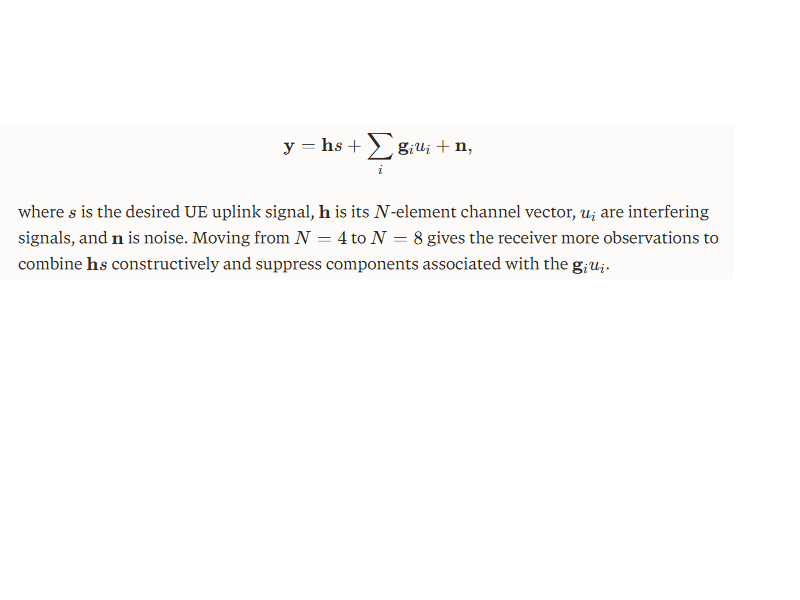
In this AT&T/Ericsson deployment, 8RX means eight radio-frequency receive chains at the network side. The handset still transmits its normal uplink signal; the cell site has more antenna/receiver observations from which to recover it.
This differs from 8RX in a handset or fixed-wireless terminal, where it generally improves the device’s downlink reception. Here, the direction is reversed: the base station’s added receive capability benefits device-to-network traffic.
Uplink mechanisms:
-
Diversity gain: The eight branches experience somewhat different fading and multipath conditions. Combining them makes it less likely that a deep fade on one path causes decoding failure.
-
Array/combining gain: When receive paths can be coherently combined, the desired UE signal arrives with a stronger effective signal-to-noise-plus-interference ratio. In an idealized case, doubling the number of equivalent receive branches from four to eight can provide roughly 3 dB of additional combining gain, though the field result depends on antenna correlation, propagation, and implementation.
-
Interference suppression: More antenna observations give the receiver more spatial degrees of freedom to distinguish a desired UE from co-channel interferers. This can improve uplink SINR and allow more robust—or, when conditions permit, higher-order—uplink modulation and coding.
-
Better cell-edge operation: The uplink is often the limiting direction in wide-area low-band coverage because UE transmit power is tightly constrained. Improving the base-station receiver makes a low-power device more likely to maintain service from a building, rural location, or cell edge.
Why it is significant at 600 MHz:
600 MHz’s principal advantage is coverage: it propagates farther and penetrates buildings more effectively than higher-frequency spectrum. But broad downlink coverage can expose an uplink asymmetry—the device may receive the cell reliably yet lack sufficient transmit power for an equally strong return path.
8RX specifically addresses that asymmetry. AT&T says its Ericsson radios will enable uplink-enhancing 8RX across low bands for the first time, while Light Reading notes that low-band FDD networks such as 600 MHz have typically used 4RX radios and that 8RX had been relatively uncommon below 1 GHz.
Conceptually, with NN receive branches, the base station adheres to this equation:
References:
https://about.att.com/story/2026/att-ericsson-enhance-wireless-nationwide.html
https://www.lightreading.com/5g/at-t-puts-600mhz-to-work-with-ericsson-for-coverage-and-uplink
AT&T/Ericsson Demonstrate 5G-Based ISAC for Drone Detection at World Cup Stadium
AT&T and Ericsson boost Cloud RAN performance with AI-native software running on Intel Xeon 6 SoC
Analysis: AT&T 1Q-2026 results: increased fiber penetration, FWA momentum, D2D deals, and mobile/home internet bundles
Analysis: AT&T’s $250B network investment to advance U.S. connectivity
AT&T deploys nationwide 5G SA while Verizon lags and T-Mobile leads
Starlink Mobile: NTN–Terrestrial Convergence, Network Capacity, and the Limits of Disruption
Executive Summary:
Elon Musk’s strategic objective for Starlink extends beyond satellite broadband connectivity for remote, maritime, aviation, and enterprise users. SpaceX is positioning Starlink for a broader role in mobile communications through an integrated non-terrestrial network (NTN) and terrestrial-network architecture. That strategy could combine direct-to-device (D2D) satellite connectivity, satellite backhaul, selected terrestrial access infrastructure, and potentially a retail mobile service.
Financial markets have treated that prospect seriously. Shares of U.S. wireless network operators have been under pressure since SpaceX President Gwynne Shotwell described the opportunity for “Starlink Mobile” as “huge,” in a CNBC interview on June 12th. On SpaceX’s recent earnings call, Shotwell characterized the U.S. wireless market as generating $600 billion in annual revenue and stated, “and I anticipate us to be able to acquire quite a few of their customers because I think our service will be better.”
Editor’s Note: The combined annual revenue of AT&T, Verizon, and T-Mobile is closer to $360 billion, depending on the reporting period and whether total revenue or service revenue is used.
The timing, service architecture, spectrum strategy, device ecosystem, and go-to-market model for a SpaceX mobile offering remain unresolved. A central distinction is needed: direct-to-device NTN service, satellite backhaul, a terrestrial radio access network (RAN), and a consumer mobile service are related but technically and commercially distinct propositions.
The most plausible medium-term outcome is not wholesale replacement of U.S. mobile network operators (MNOs), but deeper NTN–terrestrial integration. LEO satellite systems can extend coverage, improve resilience, support mobility, and connect underserved areas. Dense terrestrial networks retain structural advantages for high-traffic urban service, indoor coverage, and busy-hour mobile capacity.
“The perceived risk of Starlink Mobile disrupting the U.S. wireless industry is greater than the actual risk in the next one to two years,” says Morgan Stanley analyst Sean Diffley.
Starlink’s satellite-broadband business serves 12 million subscribers and reportedly generates profit margins above 60%. Musk’s ambitions, however, extend beyond connectivity for aircraft, ships, and remote fixed locations. SpaceX plans a large third-generation Starlink constellation, supported by the anticipated launch economics of its fully reusable Starship system. Starlink V3 satellites are expected to materially increase satellite capacity relative to earlier generations.
However, aggregate constellation capacity should not be equated with mobile-network capacity in dense urban markets. The relevant question is how much spectrum, beam capacity, spatial reuse, and backhaul capacity can be delivered to a given area during the busy hour.

Image Source: Facebook
…………………………………………………………………………………………………………………………………………………
Starlink Mobile could develop along four, potentially overlapping, paths:
The proposed Starlink Mobile service should therefore be assessed as an integrated network proposition, not as a simple satellite replacement for a nationwide cellular network.
Why Terrestrial Networks Retain an Advantage:
The central technical constraint is spatial/spectrum reuse. Terrestrial mobile networks deliver high area capacity by repeatedly reusing licensed spectrum across dense grids of macro cells, small cells, and indoor systems. Capacity is further increased through sectorization, advanced antenna systems, massive MIMO, carrier aggregation, and high-capacity fiber or microwave backhaul.
A LEO satellite system has different strengths. It can provide wide-area reach, support mobility, offer resilience during terrestrial outages, and extend coverage to regions where conventional network deployment is uneconomic. Yet its radio resources are shared across comparatively large beam footprints. This creates more demanding link-budget, capacity, and spectral-efficiency constraints in high-density areas, particularly for indoor service and busy-hour traffic.
Terrestrial-cell coverage areas vary considerably with spectrum band, terrain, urban morphology, antenna configuration, and load. Nevertheless, the architectural distinction remains: terrestrial networks achieve high capacity by spatially reusing spectrum over relatively small geographic areas, whereas satellite systems must manage shared capacity over much broader footprints.
For this reason, Starlink V3 satellites may substantially improve overall system capability without eliminating the terrestrial RAN advantage in dense urban and suburban markets. The strongest near-term use cases for NTN are likely to include coverage extension, emergency communications, maritime and aviation connectivity, mobility, IoT, selected backhaul, and service in remote or underserved locations.
3GPP’s NTN work is specifically directed toward integration with terrestrial cellular and wireline networks, reinforcing the view that NTN will develop as part of a broader communications architecture rather than wholly separate from it. Analyss opinions:
- Daiwa Capital Markets analyst Jonathan Kees similarly argues that Starlink is “only a complement, not a substitute” for existing wireless infrastructure.
- BofA Securities analyst Michael Funk reaches a comparable conclusion: “Existing direct-to-device satellite technology [is] underdeveloped and largely complementary to terrestrial mobile networks,” Funk says.
Spectrum, Capital, and AI:
SpaceX has acquired valuable spectrum assets through its EchoStar transactions. The FCC approved the transfer of approximately 65 MHz of spectrum to SpaceX for next-generation direct-to-device use. This is strategically important, but spectrum ownership alone does not establish a nationwide facilities-based mobile network.
A fourth nationwide MNO would require much more than spectrum. It would require:
-
Radio-access infrastructure, including macro sites, small cells, antennas, radios, and power.
-
High-capacity backhaul and transport networks.
-
Mobile core-network functions, service assurance, cybersecurity, and operational-support systems.
-
Device testing and certification, distribution, retail channels, billing, customer care, and subscriber-acquisition spending.
-
Sustained capital investment to expand coverage and capacity as traffic grows.
SpaceX must also finance Starlink V3 production, launches, constellation replenishment, gateways, ground infrastructure, and continuing development of D2D and NTN capabilities. At the same time, the company is investing heavily in AI infrastructure and Starship. Reported second-quarter capex exceeded $18 billion, including approximately $15.83 billion associated with AI infrastructure.
This does not establish that SpaceX lacks the financial capability to enter mobile communications. It does establish a major capital-allocation challenge. AI infrastructure requires rapid, front-loaded investment; terrestrial mobile networks require multi-year and geographically distributed deployment; and satellite systems require recurring capital expenditure for replenishment and capacity expansion.
—->Please see detailed discussion of this issue in Addendum below Conclusions subhead.
The key strategic risk is therefore prioritization. If AI, Starship, and satellite-constellation investment continue to absorb the majority of incremental capital, Starlink Mobile may progress more slowly as an independent terrestrial build. It may instead favor targeted terrestrial deployment, satellite-enabled backhaul, wholesale arrangements, or an MVNO model.
Starlink Coverage Issues as per Iain Morris of Light Reading:
Starlink is estimated to have between 3 and 4 million subscribers in the U.S., mostly in rural areas where there is no fixed or mobile alternative. That is, after all, why someone would opt for satellite broadband. But a small cell network built on the rooftops of these 3 to 4 million customers – or several times that amount – is not going to provide the mobile coverage demanded by anyone who even occasionally travels a few miles from home. And inside the building, what advantage would a Starlink cellular service have over Starlink-supported Wi-Fi?
SpaceX cannot possibly hope to address this coverage problem without some kind of physics-defying technological breakthrough. According to figures shared by an authoritative source on the telco side, a small cell might get you coverage about half a kilometer from the basestation, while a rural macro site would take you up to 20 kilometers from it. In urban areas where higher-frequency spectrum comes into play, this radius would probably fall to about 2 kilometers, making small cells look more competitive. The trouble there is Starlink’s lack of subscribers in cities.
Other estimates do not improve the outlook. William Webb, an academic and analyst who previously worked for UK telecom regulator Ofcom, thinks Starlink might be able to achieve a coverage radius of 1 to 2 kilometers with roof-mounted antennas, “assuming a reasonably high gain cellular antenna is integrated into the Starlink terminal and oriented correctly,” as he wrote in a LinkedIn update. But mounting below roof level would reduce the figure to less than 1 kilometer, according to Webb.
“The biggest issue will likely be that overall coverage will be patchy, concentrated in areas where there are the most Starlink broadband subscribers,” he said. “These are likely to be rural areas where fixed broadband provision is poor. As a result, coverage will likely be overlapping in rural communities but sparse outside of these areas.”
Commercial Models and Possible Partnerships:
SpaceX may determine that a fully independent nationwide mobile network is not the most efficient near-term approach. An MVNO arrangement would allow SpaceX to purchase terrestrial capacity at wholesale rates while offering a consumer service incorporating Starlink capabilities. Such a model could provide near-national coverage more rapidly, though it would reduce SpaceX’s control over network economics, service differentiation, and quality-of-service management.
Several Starlink Mobile outcomes are plausible:
Why would AT&T, Verizon, or T-Mobile enter an MVNO or deeper partnership with a prospective competitor? The answer may be competitive strategy. The first MNO to secure a commercially favorable relationship with SpaceX could gain a relative advantage in coverage, satellite integration, customer acquisition, or enterprise services.
SpaceX is “going to have to partner with one of the mobile network operators like a Verizon or T-Mobile,” says RBC Capital Markets analyst Ken Herbert. “They’re going to have to find ways to work with other companies.”
T-Mobile already has a direct-to-cell/device (D2D) relationship with SpaceX. Verizon’s FWA business is more directly exposed to fixed-broadband competition from Starlink, while AT&T, Verizon, and T-Mobile each possess extensive spectrum, RAN, transport, and customer-service assets that would be difficult and costly for a new nationwide entrant to replicate.
Evaluating Starlink/Spacex Deployment Plans:
Starlink’s satellite-broadband business serves 12 million subscribers and reportedly generates profit margins above 60%. Musk’s ambition, however, is substantially broader than providing internet access to aircraft and oceangoing vessels. SpaceX plans to deploy as many as 100,000 third-generation Starlink satellites, supported by the anticipated economics of its fully reusable Starship launch system. Starship remains in the test phase, but SpaceX has stated that it is designed to place up to 150 metric tons in orbit per launch at approximately one-tenth the per-kilogram cost of Falcon 9. Starlink V3 satellites are expected to provide roughly 10 times the capacity of earlier-generation spacecraft.
SpaceX is advancing these plans at a time when the U.S. communications market is already experiencing cross-sector competitive convergence. Fifth-generation mobile technology enabled MNOs to expand fixed wireless access (FWA) offerings and compete more directly with cable operators for residential broadband customers. The resulting service bundles combine mobile subscriptions, home broadband, and, in some cases, video and value-added services. Cable operators, in turn, have expanded mobile offerings, generally using Wi-Fi offload, their extensive wireline footprints, and mobile virtual network operator (MVNO) arrangements with incumbent wireless carriers for wide-area cellular coverage.
This competitive equilibrium has modestly favored wireless operators, although neither sector has emerged unambiguously dominant. AT&T, for example, is expected to generate sales and earnings growth over the next several years, albeit below broader market growth rates. Comcast faces a more constrained outlook, with relatively flat expected revenue and earnings performance. The valuation gap reflects both differing growth expectations and the capital intensity of maintaining and upgrading nationwide communications infrastructure.
Wall Street has amplified concerns about SpaceX’s competitive impact. Early research coverage has broadly characterized the launch, satellite-connectivity, and artificial-intelligence company as a disruptive force. The average analyst price target for SpaceX stock is approximately $227, implying a valuation near $3 trillion—roughly five times the combined market capitalization of AT&T, Verizon, and T-Mobile.
The major U.S. MNOs also operate with substantial debt burdens. AT&T, Verizon, and T-Mobile collectively carry approximately $420 billion in net debt, against about $140 billion in expected 2026 EBITDA. “I would not for a second sleep easily if I had the investments that [wireless telecom providers] have, and the debt that they have, and Elon Musk working on a superweapon as it pertains to my business,” says Drew Cupps of Polen Capital.
Nevertheless, Starlink faces significant capital, engineering, and deployment challenges before it can offer a broadly substitutable mobile service. Daiwa Capital Markets analyst Jonathan Kees argues that the investment required to build a V3-based Starlink constellation capable of materially disrupting terrestrial operators is underestimated. He estimates that constellation deployment could require more than $100 billion, excluding investment associated with SpaceX’s AI initiatives. Starlink is “only a complement, not a substitute” for existing wireless infrastructure, says Kees.
The fundamental constraint is spatial reuse and capacity density. A terrestrial cell site can concentrate spectrum resources over a coverage area measured in a few square miles, while a LEO satellite beam may serve a much broader footprint. Satellite systems therefore face more difficult link-budget, capacity, and spectral-efficiency challenges in dense urban environments, particularly for indoor service and high-traffic applications. V3 satellites may substantially improve system capacity, but they do not eliminate the capacity advantage of dense terrestrial RAN deployments.
For that reason, BofA Securities analyst Michael Funk does not view SpaceX as an immediate, large-scale competitive threat to incumbent MNOs. While some projections assign LEO-based mobile services 15% to 35% of the U.S. telecommunications market, Funk regards those estimates as overly optimistic. “Existing direct-to-device satellite technology [is] underdeveloped and largely complementary to terrestrial mobile networks,” Funk says. That assessment is consistent with Starlink’s present international model, which emphasizes partnerships with mobile operators rather than wholesale replacement of their networks.
Conclusions:
Starlink Mobile is an important strategic development in the evolution of NTN–terrestrial convergence. It should not, however, be evaluated as a satellite-only replacement for nationwide cellular networks.
LEO systems can provide broad-area reach, coverage extension, resilience, mobility, selected backhaul, and direct-to-device services. Dense terrestrial RAN infrastructure retains decisive advantages in spatial reuse, indoor coverage, spectrum utilization, and busy-hour capacity. Starlink’s most credible competitive impact in the near and medium term is therefore likely to occur in selected coverage, mobility, resilience, backhaul, and fixed-broadband segments—not through immediate replacement of nationwide terrestrial mobile networks.
The central uncertainty is which architecture and commercial model SpaceX will adopt. Its concurrent commitments to AI infrastructure, Starship, satellite replenishment, and spectrum assets may favor a hybrid or partnership-led approach over a fully independent nationwide MNO build.
In that outcome, incumbent operators’ spectrum, terrestrial RAN, fiber backhaul, tower infrastructure, customer relationships, and regulatory authorizations remain strategically important. Rather than becoming obsolete, those assets may increase in value as NTN and terrestrial networks become more tightly integrated.
If satellite and terrestrial systems become increasingly interdependent, incumbent operators’ assets may become more valuable rather than less. Spectrum, fiber backhaul, tower infrastructure, distributed RAN assets, customer relationships, billing systems, and regulatory authorizations remain essential elements of an integrated non-terrestrial network (NTN) and terrestrial-network ecosystem. EchoStar’s share-price appreciation over the past year illustrates the strategic value that spectrum holdings can command, particularly as SpaceX and AT&T acquire additional spectrum assets.
The three national U.S. wireless operators collectively hold spectrum assets estimated to be worth more than $400 billion based on recent transaction benchmarks. That figure is approximately 80% of their combined market capitalization and is broadly comparable to their aggregate debt burden. Spectrum holdings alone do not establish an investment thesis, but they provide a meaningful asset-value foundation as satellite, terrestrial, and hybrid connectivity models continue to evolve. They aren’t going to sell their spectrum. They have businesses to run, and those businesses are reasonably valued and growing.
Addendum: AI Capex is a Significant Risk for Starlink Mobile:
AI-data-center investment is a significant capital-allocation risk to Starlink Mobile, but it is not, by itself, evidence that SpaceX lacks the financial capacity to enter mobile communications. The more credible concern is that AI, Starship, constellation replenishment, and terrestrial mobile deployment will compete for capital simultaneously—potentially slowing Starlink Mobile’s rollout, limiting network densification, or increasing reliance on an MVNO partnership.
SpaceX’s capital spending has risen sharply: reported second-quarter capex exceeded $18 billion, including approximately $15.83 billion directed to AI infrastructure. Management indicated that similarly elevated capex could continue over subsequent quarters. Meanwhile, Starlink profitability and connectivity operations remain an important source of funding for the broader AI strategy.
A facilities-based mobile network would add another exceptionally capital-intensive program:
-
SpaceX has already committed approximately $19.6 billion through its EchoStar spectrum transactions for up to 65 MHz of spectrum, including associated debt obligations. Thus, the issue is not whether it can acquire any spectrum; it has already done so. The issue is whether that spectrum portfolio is sufficient for a competitive nationwide terrestrial-mobile network, particularly in high-density markets.reuters
-
A fourth nationwide MNO requires far more than spectrum: site acquisition, radios, antennas, power, backhaul, core-network functions, device certification, retail/distribution, customer care, and sustained subscriber-acquisition spending.
-
Starlink must also fund V3 satellite production, launch capacity, gateway infrastructure, constellation replenishment, and the evolution of direct-to-device/non-terrestrial-network capabilities.
These programs have distinctly different investment horizons. AI infrastructure requires rapid, front-loaded spending to secure compute capacity; terrestrial mobile networks require multi-year, geographically distributed capex; and satellite systems require continuous capital expenditure to maintain and upgrade orbital capacity.
The likely consequence is not cancellation of Starlink Mobile, but a more capital-disciplined architecture than a conventional nationwide greenfield MNO build. SpaceX has said it intends to build terrestrial mobile services but has not disclosed projected mobile capex or a site-count plan; analysts have warned that a competitive direct-to-consumer national offering would be very difficult without an MVNO agreement providing broad baseline coverage. This produces three plausible outcomes:
Satellite connectivity can reduce backhaul requirements at selected sites and enhance rural, maritime, aviation, emergency, and resilience use cases. It cannot economically substitute for dense terrestrial spectral reuse in the highest-traffic urban areas. Therefore, AI-related capex pressure is particularly relevant because Starlink Mobile needs substantial investment precisely where the satellite component provides the least complete replacement for terrestrial infrastructure.
A key additional risk is strategic prioritization, not immediate insolvency. If SpaceX continues allocating the overwhelming share of incremental capital to AI data centers and Starship, Starlink Mobile may emerge as a hybrid service, wholesale platform, or MVNO-enabled offering rather than a fully independent fourth nationwide carrier. That outcome would reduce the near- to medium-term disruption risk to AT&T, T-Mobile, and Verizon. It would also reinforce the more technically credible view that Starlink is likely to be complementary to terrestrial mobile networks for years, even if it becomes a powerful competitor in selected coverage, backhaul, and mobility segments.
……………………………………………………………………………………………………………………………………………………………..
References:
https://www.barrons.com/articles/spacex-wont-destroy-telecomit-will-just-reinvent-it-79b88d1a
https://www.lightreading.com/satellite/spacex-small-cell-plan-serves-up-more-musk-madness
FT: SpaceX considering Starlink Direct-to-Consumer mobile service & terrestrial cellular network infrastructure in the U.S. (See Comments below the article)
Ookla: Starlink a viable competitor for hybrid 5G/NTN services due to network performance improvements and larger coverage area
Ookla: D2D satellite connectivity surged 24.5% during last 9 months; Starlink’s footprint expansion leads the way
US Mobile’s new bundle combines its multi-network mobile service with Starlink residential internet
Direct-to-Device (D2D) satellite network comparison: Starlink V2 (Starlink Mobile) vs “Satellite Connect Europe”
Blue Origin announces TeraWave – satellite internet rival for Starlink and Amazon Leo
Eutelsat hails EC’s IRIS-2 project to take on U.S. NTN providers
Executive Summary:
The European Commission (EC) has announced the next steps for the IRIS2 [1.] project after reaching an implementation agreement with the prime contractors, one of which is Eutelsat. The EC agreed terms with the SpaceRISE consortium – comprising Eutelsat, Hispasat and SES – for deploying the satellite system, which includes adding 66 more low-Earth orbit (LEO) satellites dedicated to defense, security and emergency services, and launching services from 2029.
Note 1. IRIS² Backgrounder:
IRIS² is the European Union’s secure-connectivity LEO satellite program: Infrastructure for Resilience, Interconnectivity and Security by Satellite. It is intended to provide sovereign, resilient communications for EU governmental users while also supporting commercial broadband and connectivity in underserved areas. IRIS² is planned as a multi-orbit constellation of 290 satellites, principally in low-Earth orbit (LEO) and medium-Earth orbit (MEO). Combining LEO’s lower latency with MEO’s wider coverage is meant to support secure, high-availability communications across Europe and beyond.
IRIS² was established under Regulation (EU) 2023/588, the Union Secure Connectivity Programme for 2023–2027. The Commission awarded a 12-year concession in December 2024 to the SpaceRISE consortium—SES, Eutelsat, and Hispasat—with major European aerospace, satellite, and telecom companies participating as subcontractors.
The current planning cited by ESA anticipates first satellite launches in 2029, initial services in 2030, and full operations targeted for 2031. In the interim, initial governmental capability is to draw on pooled national satellite resources through GOVSATCOM.
IRIS² is commonly described as the EU’s third flagship space program after Galileo and Copernicus. Its strategic rationale is European digital and communications sovereignty: reducing reliance on non-European satellite systems, improving resilience against cyber and physical disruptions, and sustaining a European space/telecom industrial base. It is not simply a European retail satellite-internet competitor to Starlink; secure governmental connectivity and strategic autonomy are central design objectives.
A good part of the motivation to build the IRIS2 satellite system is to reduce reliance on U.S. satellites internet providers (e.g. Starlink, Amazon LEO), especially for sensitive military and government communications.
Principal uses of IRIS2 include:
-
Secure communications for EU institutions, Member States, defence/security users, embassies, and critical infrastructure.
-
Crisis management, disaster/humanitarian response, border or surveillance-related applications.
-
Broadband, transport connectivity, satellite trunking, and service in terrestrial coverage gaps.
-
Integration with 5G/non-terrestrial-network technology; the Commission’s 2026 terminal-industrialization call explicitly includes 5G NR NTN-compliant modem/baseband capabilities.
……………………………………………………………………………………………………………………………………………………………………………………………………………………………………………………………………
Eutelsat CEO Jean-François Fallacher said this is “a very important milestone” that moves the project on from design and preparation to an “operational phase” and confirms Eutelsat’s role as the program’s “LEO lead.” Fallacher shared a high-level view of some of the system’s new technology that is hoped to give it an advantage over larger U.S. rivals. He said the multi-orbit MEO-LEO constellation is “very advanced,” and will have “much more” capacity than satellite internet provider OneWeb has today.
He also confirmed it will be based on 5G non-terrestrial network (NTN) standards, which is “important.”
“We use 5G NTN technology. For IRIS2, we want to normalize the technology … This is also a way to fight against the American giants because today each of the technology used by ourselves on OneWeb (now owned by Eutelsat), by Amazon or by Starlink are full proprietary technologies,” he said. “Going to normalized technologies such as 5G NTN will also help [in] bringing the cost down [and] having antennas which will be cheaper and of a smaller size.”
Eutelsat, which also operates 31 geostationary orbit (GEO) satellites, gained its LEO constellation with the acquisition of OneWeb in 2023. It is a distant second LEO operator with around 650 satellites, compared to Starlink’s more than 10,000. They both operate LEO constellations, but Eutelsat has a “fundamentally different constellation with different target customers, business models and scale.” LEO connectivity accounted for 25% of Eutelsat’s total revenue of €1.23 billion (US$1.41 billion) for the fiscal year ending June 30, and LEO revenue grew 70% year-over-year.
Photo Credit: HJBC/Alamy Stock Photo
………………………………………………………………………………………………………………………………………………………………………………………………………………………………………………..
For IRIS2, Eutelsat will design and operate 264 dual Mil-Ka/Ku band and 66 Mil-Ka band satellites. The company said it will invest €2.23 billion ($2.57 billion) in the shared infrastructure and €1.16 billion ($1.34 billion) in the commercial infrastructure (which includes Ku payload and commercial ground equipment), with spending phased from 2027 to 2034. According to its concession agreement with the EC, the company said it expects revenue from IRIS2 activity to be more than €10 billion ($11.6 billion) from 2032 to 2040. The Ka-only satellites are planned to start launching in 2029, while the commercial Ku LEO system is expected to be operational by mid-2032. Eutelsat also said it plans to add 229 satellites to OneWeb through 2034 in addition to 440 new first-generation satellites for an investment of €1 billion ($1.2 billion).
https://www.lightreading.com/satellite/eutelsat-hails-5g-ntn-to-take-on-american-giants
European Consortium 5G NTN transmission paves the way for standards based direct to device (D2D) connectivity
Non-Terrestrial Networks (NTN) Tutorial: Architecture, Spectrum, and Technical Foundations
Non-Terrestrial Networks (NTNs): market, specifications & standards in 3GPP and ITU-R
ITU-R recommendation IMT-2020-SAT.SPECS from ITU-R WP 4B to be based on 3GPP 5G NR-NTN and IoT-NTN (from Release 17 & 18)
From LPWAN to Hybrid Networks: Satellite and NTN as Enablers of Enterprise IoT – Part 2
Telecoms.com’s survey: 5G NTNs to highlight service reliability and network redundancy
InterSAT extends Pan-African satellite services via Ku-band on Eutelsat 70B satellite
Orange France satellite Internet based on Eutelsat Konnect VHTS satellite
France’s Eutelsat nears deal to buy UK satellite internet company OneWeb
Optus and Nokia’s pre-“6G” Trial in Australia: Upper 6 GHz May Be Widely Deployable
Executive Summary:
Australia’s Optus and Nokia have delivered one of the more credible pre 6G demonstrations yet: a live-field trial in Sydney that paired multi-gigabit speed with good coverage. The most notable result was the 3.5 Gbps peak download rate and the indication that upper 6 GHz could support a macrocell footprint comparable to today’s 5G 3.5 GHz network. The trial suggested the upper 6GHz band can cover roughly the same footprint as Optus’ existing 5G 3.5 GHz layer—an encouraging sign for lower-cost 6G upgrades.
TABLE 1. Optus–Nokia 6G Trial: Editorial Comparison of Technical Takeaways
(Adapted from reported trial results.)
Why this trial stands out:
In early 6G discussions, spectrum, coverage, and deployment economics are inseparable. Higher-frequency bands can offer more capacity, but they often demand denser networks and new site builds; that is precisely why the Sydney result matters.ericsson+1
Optus and Nokia’s trial suggests upper 6 GHz may offer a useful compromise: enough bandwidth for high throughput, yet enough propagation performance—when paired with advanced antenna techniques—to preserve broad-area coverage on existing infrastructure.telconews.com+1
What was tested:
According to the reported trial details, the teams used 200 MHz of upper 6 GHz spectrum, divided into two 100 MHz channels between 6,890 MHz and 7,090 MHz. Nokia’s proof-of-concept AirScale massive MIMO active antenna unit used 768 antenna elements and 128 transceiver chains at an existing Optus site operating alongside a live 5G network.telconews.com+1
That setup matters because it moves the conversation beyond lab conditions. A field trial on a live site is a better indicator of how upper 6 GHz may behave in real deployments, where interference, propagation, and network integration all shape performance.telconews.com+1
The bigger 6G implication:
The strongest signal from the trial is economic, not just technical. If operators can use upper 6 GHz with existing towers and familiar radio footprints, they may be able to introduce early 6G services without rebuilding their networks from scratch.telconews.com+1
That would be a major shift in how the industry thinks about 6G rollout. Instead of requiring an entirely new layer of dense infrastructure, upper 6 GHz could become a practical evolution path from 5G to 6G, especially for operators seeking capacity gains without a full civil-engineering reset.nokia+1
Spectrum policy:
This trial also lands in the middle of a broader spectrum-policy debate. The upper 6 GHz band is widely viewed as strategically important for future mobile networks, and results like this strengthen the case for allocating at least part of the band to licensed mobile use.ericsson+1
At the same time, the band remains attractive for other services, including unlicensed use cases. The Sydney trial does not settle that debate, but it does provide real-world evidence that upper 6 GHz is not merely theoretical: it can deliver both range and capacity under conditions that resemble operational deployment.
Quotes:
According to Sri Amirthalingam, Optus Chief Technology Officer, the achievement forms part of Optus’ ongoing network innovation program and its long-term work to help shape the technologies, standards and spectrum frameworks that will underpin the evolution from 5G to 6G.
“This trial is an important milestone in Optus’ long-term 6G research program and helps us better understand how future mobile networks can be designed to meet Australia’s unique connectivity needs. Achieving 3.5Gbps using upper 6GHz spectrum demonstrates the significant opportunity this band could provide for future networks as demand for data-intensive applications such as AI services, immersive video, cloud applications and connected devices continues to grow.
“As networks become increasingly AI-native, that enhanced capability will unlock a new generation of AI-powered experiences, from smarter digital assistants that can understand their environment, to more immersive education and real-time support for frontline workers. Our focus is on turning these innovations into meaningful benefits for Australians,” he added.
Mark Atkinson, Head of Radio Networks, Mobile Infrastructure at Nokia, says, “This trial with Optus demonstrates the potential of upper 6GHz spectrum to deliver the high capacity and performance that future networks will require, while also validating how existing infrastructure can evolve towards 6G.
“At Nokia, we see AI and connectivity becoming increasingly intertwined, with AI-native networks and AI-RAN enabling operators to deliver greater efficiency, better customer experiences and the platform required for AI-powered applications at scale. Through continued innovation and collaboration with Optus, we are advancing connectivity through AI-driven network innovation, helping shape the future of mobile communications and supporting Australia’s leadership in next-generation digital and AI technologies.”
Conclusions:
The Optus-Nokia result is not a commercial 6G launch, but it is a meaningful milestone. A smartphone-form-factor speed record is eye-catching; the more consequential finding is that upper 6 GHz may be deployable on today’s network footprint with far less infrastructure disruption than many expected. That would significantly improve the business case for upper 6 GHz. If network operators can reuse existing sites and achieve coverage similar to 5G 3.5 GHz, then the transition from trial to deployment could be less capital-intensive than many expected.
For network operators, regulators, and vendors, that is the kind of evidence that can shape both deployment strategy and spectrum decisions. If upper 6 GHz continues to perform this well in additional trials, it could become one of the most important bands in the transition from 5G-Advanced to 6G.
……………………………………………………………………………………………………………………………………………………………………………………………
Frequently Asked Questions:
What is massive MIMO and why does the antenna element count matter for upper 6GHz performance?
Massive MIMO (multiple-input multiple-output) is a technology that uses a large array of antennas at a base station to serve multiple users simultaneously in the same frequency resource, using spatial beamforming to direct signal energy precisely toward each device. Higher frequencies like upper 6GHz experience greater signal loss over distance than lower 5G frequencies — so more antenna elements are needed to compensate through more precise beamforming gain. The Nokia antenna in the Optus trial packs 768 elements into a proof-of-concept unit; commercial 5G radios typically use around 192. That difference in element count is the primary reason the Optus trial reached 3.5Gbps while Vodafone’s October 2025 trial with a less advanced antenna reached 2.5Gbps using the same 200MHz bandwidth.
Will upper 6GHz 6G services actually reach consumers without new towers being built?
The Optus trial’s outdoor coverage result suggests it may be possible — but only if the antenna hardware at existing sites is upgraded. The 768-element Nokia antenna compensates for upper 6GHz’s higher path loss through beamforming, matching the coverage footprint of a 3.5GHz 5G cell. Nokia’s CTO has previously confirmed that a 768-element array at 7GHz can fit in approximately the same physical enclosure as a standard 5G unit, because the higher frequency means each element is smaller. If that holds through production hardware, operators could upgrade existing sites rather than build new ones — a critical factor in the cost and timeline of any 6G rollout.
Why does Australia’s spectrum regulator have to decide about upper 6GHz, and what are the options?
The upper 6GHz band (6,425–7,125MHz) is currently under a spectrum embargo from ACMA, meaning no new licenses can be issued while it evaluates how to use the band. The core decision is whether to allocate upper 6GHz to licensed mobile networks (enabling 6G), to unlicensed Wi-Fi (enabling Wi-Fi 6E/7 at higher outdoor power), or to some sharing framework. Mobile operators argue they need the spectrum for future 6G. The Wi-Fi industry argues the same spectrum would dramatically expand outdoor Wi-Fi capacity. There is no technical path that gives both industries full access to the same frequencies simultaneously — ACMA will need to choose, and the Optus-Nokia trial results are now part of the evidence base it will weigh.
What happens globally if countries allocate upper 6GHz differently — mobile in some, Wi-Fi in others?
This is the central risk that the GSMA and mobile standards bodies have identified since WRC-23. If a significant portion of the world’s population — particularly the US, which has already dedicated the full 6GHz band to unlicensed Wi-Fi — does not align on upper 6GHz for mobile, device manufacturers will face a fragmented market: 6G handsets designed for global use cannot rely on upper 6GHz connectivity in all markets. The result would be regional rather than global 6G ecosystems, with separate equipment lines and higher costs. Australia’s decision, while one country among many, will contribute to the critical-mass calculation for whether the WRC-23 mobile identification becomes commercially viable or remains a regulatory aspiration without a unified device ecosystem behind it.
…………………………………………………………………………………………………………………………………………………………………………………………………………
References:
How NTIA “Call to Action for 6G Leadership and Security” might influence 6G/IMT-2030 standards and 3GPP specifications
3GPP approves timelines for Release 21 which will specify 6G RAN, Core and 5G Advanced
IMT-2030 (“6G”) Minimum Technology Performance Requirements for Radio Interface Technologies
ITU-R M.[IMT-2030.EVAL] & ITU-R M.[IMT-2030.SUBMISSION] reports: Evaluation & Submission Guidelines for 6G RIT/SRITs (6G)
Roles of 3GPP and ITU-R WP 5D in the IMT 2030/6G standards process
Dell’Oro: 6G RAN Capex to reach $500 billion by 2034 + Counterpoint
ABI Research: 6G Radio Installed Base by Region from 2029 to 2034
Analysis: Cohere’s $28M U.S. DoD FutureG ISAC contract; OTFS vs OFDM; 6G-NR/IMT 2030 RIT standards outlook
Analysis: Ericsson’s leading role in French INTENTION 6G project
Analysis: Nvidia’s rumored new 6G AI-RAN – likely features/functions and industry impact
Analysis: Nokia’s new AI-RAN platform and Standalone AI-RAN node with Nvidia GPUs
Ericsson and Intel collaborate to accelerate AI-Native 6G; other AI-Native 6G advancements at MWC 2026
NVIDIA and global telecom leaders to build 6G on open and secure AI-native platforms + Linux Foundation launches OCUDU
Nokia and Rohde & Schwarz collaborate on AI-powered 6G receiver years before IMT 2030 RIT submissions to ITU-R WP5D
AI wireless and fiber optic network technologies; IMT 2030 “native AI” concept
Comparing AI Native mode in 6G (IMT 2030) vs AI Overlay/Add-On status in 5G (IMT 2020)
SKT 6G ATHENA White Paper: a mid-to-long term network evolution strategy for the AI era
Verizon’s 6G Innovation Forum joins a crowded list of 6G efforts that may conflict with 3GPP and ITU-R IMT-2030 work
Highlights of 3GPP Stage 1 Workshop on IMT 2030 (6G) Use Cases
Ericsson and e& (UAE) sign MoU for 6G collaboration vs ITU-R IMT-2030 framework
Ookla: U.S. dominates global WiFi 7 while adoption grew 4X to 7.2% by Q1-2026
Introduction:
According to Ookla’s new WiFi report, cablecos Spectrum (Charter) is the largest Wi-Fi 7 provider in the world! WiFi 7 is actually IEEE 802.11be, also known as Extremely High Throughput (EHT).
Following Ookla’s recent report on The Global State of Wi-Fi , this article focuses on the U.S. and updates last year’s Wi-Fi 7 Speeds Up in the U.S. report. Key points:
- Adoption of Wi-Fi 7—the latest Wi-Fi generation currently in market deployment—has only just started to gain meaningful traction in the United States.
- Prototypes for Wi-Fi 8 are expected soon, and commercial availability could follow in roughly two years. Meanwhile, discussion of Wi-Fi 9 is already beginning among industry observers.
- Fiber drives penetration, Cable drives scale: National Wi-Fi 7 adoption hit 7.2% in Q1 2026. Non-cable ISPs led in customer base penetration by CenturyLink (14.7%) and Frontier (14.3%). Cable giants owned the total volume, with Spectrum alone commanding 24.9% of all U.S. Wi-Fi 7 Speedtest samples.
- U.S. dominated global Wi-Fi 7 footprint: U.S. providers accounted for half of the top 10 Wi-Fi 7 networks globally by sample volume, with Spectrum taking the #1 spot in the world, followed by Comcast Xfinity at #2.
- Cable upstream upgrades paying off: Cable’s spectrum splits combined with Wi-Fi 7 drove large performance gains, particularly for Xfinity’s median Wi-Fi 7 upload speeds, which more than doubled YoY to 108.8 Mbps.
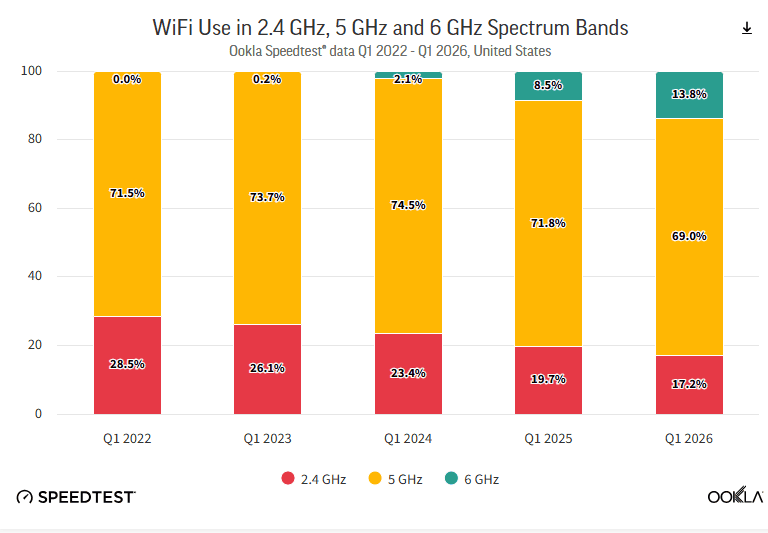
- 6 GHz band enters the mainstream: Unlicensed 6 GHz spectrum usage jumped 62% YoY to represent 13.8% of total U.S. Wi-Fi sample traffic, reflecting both router upgrades and user device (smartphone/laptop) maturity.
- FCC security rules won’t stifle next-gen Wi-Fi: While foreign router restrictions initially cast a broad net, the FCC’s conditional approval process established a de facto ban isolated to Chinese entities. Because Chinese vendors hold nearly no share of 6 GHz / Wi-Fi 7 hardware, regulatory actions appear unlikely to impede U.S. Wi-Fi 7 rollout momentum.
Wi-Fi 7 is finally here:
Wi-Fi 7 began commercial rollout in early 2024. At the end of Q1 2024, Speedtest samples showed adoption below 1%. One year later, sample shares remained in the low single digits across providers, reaching only 1.8% overall in Q1 2025. By Q1 2026, however, Wi-Fi 7 adoption had increased by 300%, reaching a 7.2% share of Wi-Fi router generations across all providers. That average masks substantial variation by operator. Among leading providers, CenturyLink (14.7%) and Frontier Fiber (14.3%) were about twice the national adoption rate, while Ziply Fiber (13.3%) and MetroNet (13.0%) were also close to that level. These customer bases appear to be moving from the early-adopter phase toward the early majority, using the terminology of Crossing the Chasm.
The cable operators Cox, Spectrum, and Xfinity reported lower Wi-Fi 7 shares among their own customer samples—4.5%, 6.6%, and 4.0%, respectively—than the national average. However, because of their large subscriber bases, their relative importance becomes more apparent when Wi-Fi 7 samples are measured as a share of all U.S. Wi-Fi 7 observations. On that basis, Spectrum’s 6.6% share within its customer base translated to 24.9% of all U.S. Wi-Fi 7 samples in Q1 2026.
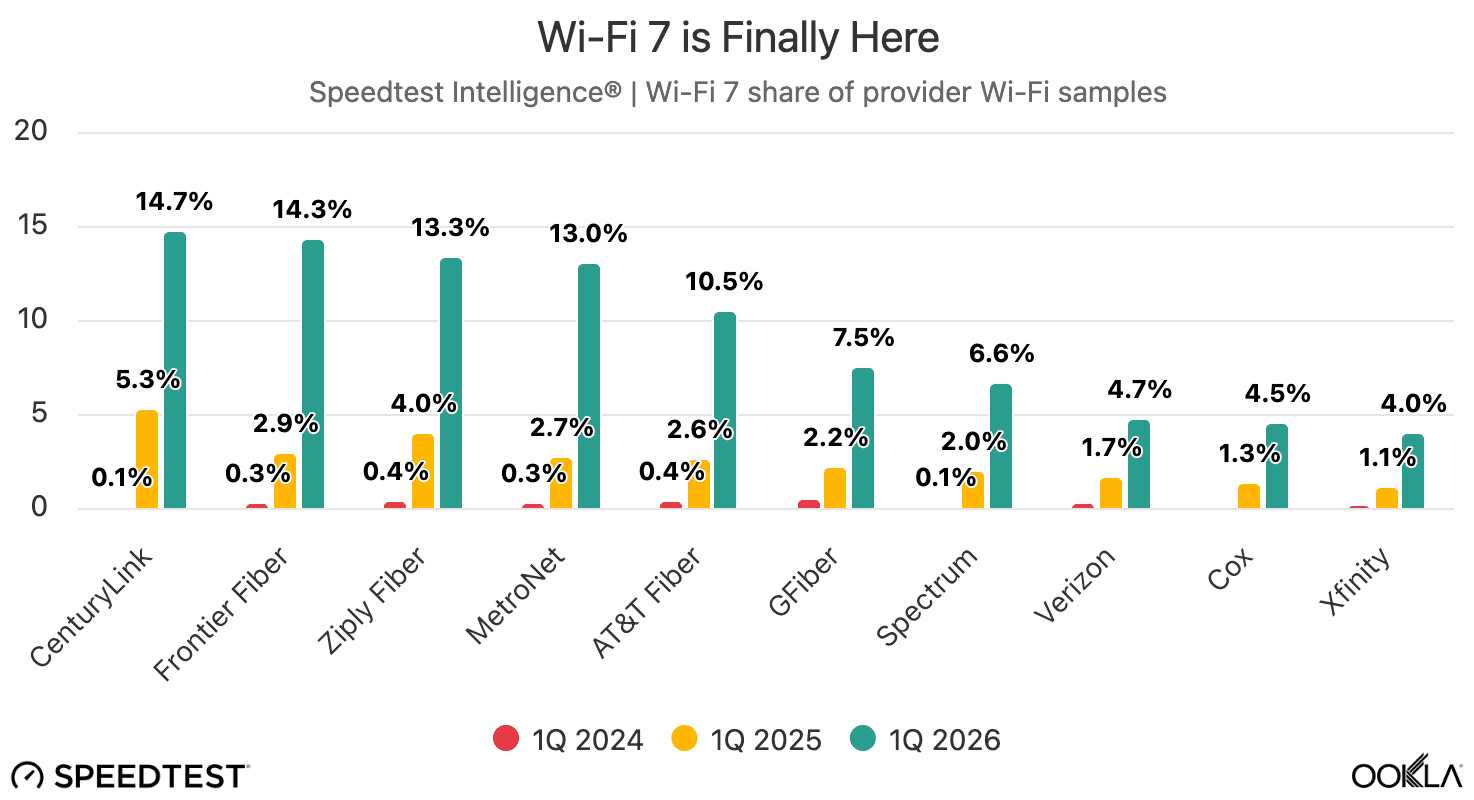
CableCos: The cable companies Cox, Spectrum, and Xfinity had relatively lower shares of Wi-Fi 7 samples (4.5%, 6.6%, and 4.0%) than the national average. However, with Spectrum’s and Xfinity’s large customer bases, their Wi-Fi 7 leadership is revealed by flipping from Wi-Fi 7 adoption among providers’ customer base to a providers’ share of all Wi-Fi 7 Speedtest samples. In other words, Spectrum’s 6.6% share of Wi-Fi 7 Speedtest users in its customer base (above), instead compared to all Wi-Fi 7 samples in the U.S. reveals that Spectrum owned a quarter (24.9%) of all Wi-Fi 7 (below) in Q1 2026.
Spectrum’s share of Wi-Fi 7 was 2x larger than Xfinity (12.4%) and Frontier (11.9%). On the other end, the long tail of “Other ISPs” averaged just 0.03% share across the 689 providers measured with Speedtest samples (24.0% all together).
Wi-Fi 7 adoption in the U.S. also leads Wi-Fi 7 globally. Based on its share of Speedtest samples, Spectrum is the world’s largest provider of Wi-Fi 7, heading a pack of five U.S. providers out of the top 10.
Top 10 Rank of Global Wi-Fi 7 Speedtest Samples, Q1 2026
| Rank | Provider | Country |
| 1 | Spectrum | United States |
| 2 | Xfinity | United States |
| 3 | China Telecom | China |
| 4 | Frontier Fiber | United States |
| 5 | WINDTRE | Italy |
| 6 | AT&T Fiber | United States |
| 7 | Free | France |
| 8 | CenturyLink | United States |
| 9 | China Unicom | China |
| 10 | HiNet | Taiwan |
Spectrum will add to its total of Wi-Fi 7 users when parent Charter Communications completes its anticipated Cox Communications merger in mid-to-late August. However, as a share of its own customer base, Cox had just 4.5% of its customers measured on Wi-Fi 7 with Speedtest samples. This will slightly dilute the share of Wi-Fi 7 of the merged entity’s base.
China Telecom and China Unicom make the list because their customer bases are massive (439 million mobile subscribers and 232 million 5G network customers in Q4 2025, respectively). However, the 6 GHz spectrum band in China, that Wi-Fi 7 could take advantage of, is licensed for mobile telecommunications (i.e., 5G and 6G) rather than for public, unlicensed Wi-Fi use.
More spectrum, more capacity, faster Wi-Fi:
Adoption of Wi-Fi 7 (and Wi-Fi 6E) has led to increased use of the 6 GHz spectrum frequency band (1,200 MHz from 5.925 GHz to 7.125 GHz of unlicensed spectrum). The growth in the use of this band not only comes from Wi-Fi routers, but also the end-user device – laptops, tablets, and smartphones. (Both ends of the connection require the newer Wi-Fi technology capability.) 6 GHz usage increased 62% from Q1 2025 to Q1 2026, accounting for 13.8% of Speedtest samples in the U.S.
Overall, speeds by providers across different generations of Wi-Fi have not changed much from the prior year. While headline-grabbing multi-gig speed rate plan announcements draw eyeballs, what really helped overall speeds and latency improve is what happens when customers upgrade their devices and routers. (The latest Wi-Fi 7 doesn’t have to be the solution to a better customer experience. Sometimes an upgrade to Wi-Fi 6E, or even just Wi-Fi 6 is the right fit for the customer’s needs.) In the case of the router upgrade, if it is leased or purchased through their provider, the customer may be optimizing their plan to a faster (or slower, but usually faster) speed tier to better align their needs with the technology’s capabilities. This mix shift to newer technologies lifts speed performance at each step in Wi-Fi generation.
References:
Research & Markets: WiFi 6E and WiFi 7 Chipset Market Report; Independent Analysis
Analysis: Broadcom’s end-to-end 50G PON Edge AI portfolio with WiFi 8 support
WiFi 7 and the controversy over 6 GHz unlicensed vs licensed spectrum
Analysis and Impact of Blockbuster FCC ban on foreign made WiFi routers
Ericsson leads SK Telecom AI RAN vs. NVIDIA’s GPU centric AI RAN Alliance
Executive Summary:
Ericsson says it has been selected as the sole global technology partner in SK Telecom’s consortium for Korea’s Hyper-AI Network Infrastructure Demonstration Project, a South Korea government-backed initiative led by the Ministry of Science and ICT and the National Information Society Agency. The program is intended to validate AI-RAN pilot networks as a cornerstone of Korea’s national “AI Highway” strategy and its longer-term 6G roadmap.
Ericsson’s contribution [1.] to this project centers on the RAN and the automation layer that surrounds it. According to Ericsson, its role in the project includes 5G Standalone expertise, AI-in-RAN capabilities, and intelligent network automation through the Ericsson Intelligent Automation Platform (EIAP) and AI-powered rApps, enabling autonomous control, resource orchestration, and real-time optimization for physical AI services. Ericsson is not being positioned as a general AI infrastructure provider, but as the core network technology partner bringing telco-grade RAN, automation, and orchestration into a live industrial validation environment. Ericsson will contribute what it calls an “end-to-end network foundation” to the project that is intended to connect and continuously optimize intelligent machines and autonomous industrial operations. In the second phase of the project, Ericsson’s AI-RAN pilot network is expected to be applied to a real-world logistics environment at KG Mobility’s Pyeongtaek plant.
Note 1. It’s interesting to note that Ericsson is a founding member of the Nvidia GPU centric AI-RAN Alliance, contributing the operator-centric “AI-for-RAN” perspective by embedding telco-grade AI into basebands and radios to improve network performance, automation, and energy efficiency. The company’s delegates hold leadership roles in the alliance’s working groups and technical committees.
For telecom operators, the significance is not just radio performance but the shift toward a network architecture that can support physical AI use cases with tighter latency, stronger uplink capacity, and higher service assurance. SK Telecom plans to demonstrate AI-RAN pilots through 2027 across scenarios such as autonomous transport, industrial safety monitoring, and humanoid robotics, with a second-phase deployment targeted for KG Mobility’s Pyeongtaek plant.
Sibel Tombaz, Head of Customer Unit Korea, Ericsson, says: “Being selected as a key global technology partner in this government-backed Hyper-AI Network consortium is a significant recognition of Ericsson’s technology leadership and our long-term partnership with SK Telecom. Korea is moving with clear ambition to shape the future of AI-native networks and 6G, and Ericsson is proud to contribute our global expertise in 5G, AI-RAN, orchestration, and intelligent network automation to this important national initiative. We look forward to working closely with SK Telecom and the consortium partners to help turn Korea’s 6G vision into real industrial value.”
Takki Yu, VP and Head of Network R&D at SK Telecom, says: “As a key national project supporting Korea’s Hyper-AI Network strategy, SK Telecom is pleased to collaborate with Ericsson as a key technology partner to advance AI-RAN technology through global cooperation. Together, we aim to build a strategic win-win partnership, demonstrate real industrial value, and help strengthen Korea’s AI-RAN technology capabilities and ecosystem for the future.”
Comparison with NVIDIA GPU centric AI-RAN Alliance:
The SK Telecom–Ericsson initiative and the NVIDIA-led AI-RAN ecosystem share a common thesis: the RAN is evolving into a distributed compute platform that can host or coordinate AI workloads closer to where data is generated. But they emphasize different layers of the stack. SK Telecom’s Ericsson-led project is centered on operator-grade RAN validation, network autonomy, and physical AI service delivery in industrial settings, while NVIDIA’s effort is broader and more compute-centric, tied to AI factories, GPU infrastructure, and open 6G ecosystem development.
- NVIDIA is a founding member of the AI-RAN Alliance and acts as one of its most visible technical drivers, contributing reference architectures and accelerated-computing platforms for AI-RAN.
- Ericsson is the operator-focused RAN technology partner proving AI-RAN in live telco and industrial network deployments.
The practical takeaway is that Ericsson’s role is more narrowly telecom-native, while NVIDIA’s consortium is more infrastructure- and compute-oriented. For 6G, the two approaches are complementary rather than contradictory: one is proving how the network behaves as a deterministic industrial platform, the other is building the compute substrate that can feed AI-native services into that platform.ericsson+2
Why it matters:
SKT announced the Hyper-AI Network Infrastructure Development project last month, and at the time Ericsson, Nokia, Samsung and private mobile networking specialist HFR were named as those providing the kit and related network and software solutions.
South Korea has become one of the most advanced and competitive mobile markets, and this makes it a useful proving ground for AI-RAN. If the SK Telecom pilot succeeds, it could strengthen the case that future mobile networks must support not only connectivity, but distributed inference, orchestration, and machine control for robots, vehicles, and industrial systems.
From a standards and market perspective, the more interesting question is how these pilots influence the eventual division of labor between RAN, edge compute, and centralized AI infrastructure in 6G-era networks. That is where the SK Telecom–Ericsson model, with its operator-led network validation, may prove especially influential.
…………………………………………………………………………………………………………………………………………………………………………………………………
References:
https://www.ericsson.com/en/press-releases/2026/8/skt-hyper-ai-consortium
https://www.telecoms.com/ai/ericsson-named-sole-global-vendor-for-sk-telecom-s-hyper-ai-consortium
Ericsson goes with custom silicon (rather than Nvidia GPUs) for AI RAN
Dell’Oro: AI RAN revenue forecast: $35B from 2026-to-2030; 3 types of AI RAN explained
Dell’Oro: RAN Market Stabilized in 2025 with 1% CAG forecast over next 5 years; Opinion on AI RAN, 5G Advanced, 6G RAN/Core risks
Dell’Oro: Analysis of the Nokia-NVIDIA-partnership on AI RAN
RAN silicon rethink – from purpose built products & ASICs to general purpose processors or GPUs for vRAN & AI RAN
Dell’Oro: AI RAN to account for 1/3 of RAN market by 2029; AI RAN Alliance membership increases but few telcos have joined
Dell’Oro: RAN revenue growth in 1Q2025; AI RAN is a conundrum
How NTIA “Call to Action for 6G Leadership and Security” might influence 6G/IMT-2030 standards and 3GPP specifications
Introduction:
The U.S. National Telecommunications and Information Administration (NTIA) has launched the “Call to Action for 6G Leadership and Security,” a multilateral initiative uniting more than 20 like-minded governments to coordinate on a shared vision for open, interoperable, secure, and resilient 6G networks. While politically significant, the effort operates alongside—not in place of—the established technical standards ecosystem led by 3GPP and ITU-R, and its impact will hinge on closing critical supply-chain and participation gaps.
“The Call to Action for 6G Leadership and Security reflects an unprecedented level of international coordination on the future of communications technology,” said Arielle Roth, Assistant Secretary of Commerce for Communications and Information and NTIA Administrator. “Today’s action recognizes that 6G will be dramatically different from 5G, and that advancing U.S. and allied leadership requires a dramatically different playbook. By working now with trusted partners, we will ensure that next generation networks reflect our shared security interests, strengthen our competitiveness, and drive innovation. I am proud of the role NTIA has played in building this global partnership, and I look forward to seeing our shared commitments translated into meaningful action.”
 NTIA is launching this initiative alongside more than 20 partner governments spanning Europe, the Indo-Pacific, and the Western Hemisphere. Through the Call to Action, participating governments have pledged to strengthen cooperation on 6G over the next 12 months and beyond in support of security, interoperability, and resilience in next generation networks. The initiative also recognizes that trusted artificial intelligence (AI) will be central to the development and operation of secure and innovative 6G networks for the United States and its global partners.
Initiative scope and strategic alignment:
The Call to Action explicitly advances the objectives of President Trump’s December 2025 Presidential Memorandum on “Winning the 6G Race,” which frames 6G as foundational to U.S. national security, foreign policy, and economic prosperity. Participating governments commit to strengthening cooperation over the next 12 months and beyond on security, interoperability, and resilience, with an emphasis on trusted AI as central to 6G operations. The document also stresses avoiding duplication with industry-driven standards bodies while exploring constructive interfaces with private-sector stakeholders.
Initial milestones include establishing government points of contact, engaging industry and academia, identifying barriers to leadership, and exploring ways to strengthen secure and resilient supply chains.
Membership composition and notable absences:
The coalition includes the United States and key advanced-economy partners with strong mobile capabilities and intellectual property portfolios—among them Finland, Sweden, Japan, and South Korea—alongside a broader set of allies across Europe, the Indo-Pacific, and the Western Hemisphere. However, several strategically important economies are not signatories, including India, Vietnam, and Taiwan, as well as Thailand, Malaysia, and Mexico.ntia+2
-
India and Taiwan participate in various Huawei-free supply initiatives but are not part of this specific Call to Action.
-
Vietnam maintains a cautious posture toward China and has pursued domestic 5G equipment development, yet it remains outside the current framework.
These absences matter because 6G security is only as strong as its end-to-end supply chain. A credible security posture requires participation from low- to medium-cost manufacturing hubs aspiring to grow their hardware sectors—an endeavor that demands coordinated reshoring and friend-shoring at scale.
Standards reality check – 3GPP and ITU-R WP5D remain responsible:
This NTIA led alliance is a high-level political and policy forum; it does not set 6G standards or specifications. The NTIA will likely shape U.S. positions and coordinate federal input so that U.S. industry contributions to 3GPP and ITU‑R reflect national security, spectrum, and innovation priorities. In practice, NTIA’s role is policy, spectrum, and interagency coordination, while the detailed 6G standards are produced by 3GPP and then submitted to ITU‑R WP5D for IMT‑2030 approval. Technical standardization will continue to be driven by:
-
3GPP Release 21, expected to deliver the first set of 3GPP 6G technical specifications and serve as the basis for IMT-2030 submission before 2030.
-
The Release 21 timeline is to be finalized by June 2026, with ASN.1/OpenAPI freeze no earlier than March 2029 (some industry views target end-2028).
-
-
ITU-R WP5D, which is developing the IMT-2030 framework and evaluation guidelines, and has opened a submission window for candidate Radio Interface Technologies (RIT/SRIT) from February 2027 to February 2029.itu+3
IMT-2030 RIT/SRIT submissions are expected to align closely with 3GPP Release 21 outputs. The Call to Action can help smooth policy disagreements and align security priorities, but it cannot override or replace these processes; at worst, it risks adding another layer of complexity or politicization if not carefully scoped.
How NTIA interfaces with 3GPP:
-
Policy and requirements feed‑in: NTIA gathers input from industry, academia, and other agencies (e.g., via its 6G Request for Comments and the Commerce Spectrum Management Advisory Committee) to inform the U.S. government’s 6G policy and priorities. Those priorities—open, interoperable, secure, and reliable architectures; public‑safety needs; and spectrum alignment—are then reflected in U.S. positions carried into 3GPP by U.S. standards bodies and companies.
-
Standards‑body channel via ATIS: In 3GPP, the U.S. Organizational Partner is ATIS. NTIA does not sit inside 3GPP as a member, but it works with ATIS and U.S. stakeholders to ensure that federal requirements (e.g., for public safety, security, and spectrum harmonization) are represented in 3GPP work items and technical reports. For example, the FirstNet Authority (working under a congressional mandate) actively participates in 3GPP to advance public‑safety requirements into 5G‑Advanced and 6G.
-
Spectrum and R&D alignment: NTIA’s National Spectrum Strategy and federal R&D programs are designed to make sure that the bands and research directions needed for 6G are available and de‑risked before 3GPP locks in key radio and system designs. This indirectly shapes what is feasible in 3GPP Release 21 (the expected first 6G release).
How NTIA interfaces with ITU‑R WP5D (IMT‑2030):
-
U.S. administration role in ITU‑R: NTIA is the U.S. administration for ITU‑R matters. It coordinates U.S. government positions, prepares proposals, and supports U.S. delegations at ITU‑R WP5D meetings, including WP5D’s work on IMT‑2030 (6G) RIT/SRITs.
-
Requirements and evaluation framework: ITU‑R WP5D defines the IMT‑2030 framework, minimum performance requirements, and evaluation guidelines for candidate 6G radio technologies (RIT/SRIT). NTIA helps ensure that U.S. views on security, resilience, spectrum, and public‑safety are reflected in these high‑level requirements and evaluation criteria.
-
From 3GPP specs to IMT approval: 3GPP develops the actual 6G technical specifications (expected to be completed around 2028–2029 for Release 21) and, through ATIS, submits them to ITU‑R WP5D as the primary IMT‑2030 candidate. WP5D then evaluates the candidates against its requirements and, if they pass, incorporates them into ITU Recommendations. NTIA’s role here is to coordinate the U.S. position on those evaluations and the resulting Recommendations, not to write the 3GPP specs themselves.
In summary NTIA influences 6G standards indirectly—through spectrum policy, federal R&D, interagency coordination, and U.S. positions in ITU‑R—while relying on ATIS and U.S. industry to carry those priorities into 3GPP’s technical work and into ITU‑R’s IMT‑2030 process.
The new NTIA‑led Call to Action is a multilateral policy forum which could:
-
Align partner governments on shared security and interoperability principles that then inform national positions in 3GPP and ITU‑R.
-
Support supply‑chain and trusted‑AI initiatives that underpin secure 6G deployments, complementing the technical standards produced by 3GPP and approved by ITU‑R.
The initiative’s greatest value lies in creating a trusted, action-oriented forum to:
-
Coordinate on security-by-design principles, including open interfaces, interoperability, and resilience requirements that can feed into national procurement and regulatory frameworks.benton+1
-
Accelerate trusted AI integration into 6G network operations and management.ntia+1
-
Map and mitigate supply-chain vulnerabilities, especially for radio access network (RAN) components, semiconductors, and test/measurement ecosystems.
However, without bringing in pivotal manufacturing and assembly locations—particularly in South and Southeast Asia and Latin America—the alliance risks leaving the most exposed links in the 6G supply chain unaddressed.
From political alignment to measurable impact:
Given the proliferation of 6G alliances, the Call to Action must demonstrate tangible progress to remain relevant. Priority actions include:
-
Operationalize working groups within 12 months to produce concrete guidance on secure RAN architectures, AI-enabled operations, and resilience metrics.ntia+1
-
Bridge to standards work by channeling consensus positions into 3GPP and ITU-R via national standards bodies and industry coalitions, without duplicating technical workstreams.benton+1
-
Expand the circle by engaging non-signatory economies through targeted supply-chain and innovation programs, making participation economically attractive to members.
If executed with discipline, the Call to Action can reduce fragmentation, elevate security baselines, and de-risk the path to commercial 6G. If not, it may become another layer of diplomacy with limited effect on the technical and industrial realities that will define 6G.
………………………………………………………………………………………………………………………………………………………………………………………
References:
https://www.ntia.gov/press-release/2026/ntia-launches-global-call-action-6g-leadership-and-security
https://www.ntia.gov/sites/default/files/2026-07/call-to-action-for-6g-leadership-and-security.pdf
https://www.lightreading.com/6g/new-us-6g-alliance-must-show-it-can-make-a-difference
Roles of 3GPP and ITU-R WP 5D in the IMT 2030/6G standards process
IMT-2030 (“6G”) Minimum Technology Performance Requirements for Radio Interface Technologies
ITU-R M.[IMT-2030.EVAL] & ITU-R M.[IMT-2030.SUBMISSION] reports: Evaluation & Submission Guidelines for 6G RIT/SRITs (6G)
ITU-R WP5D IMT 2030 Submission & Evaluation Guidelines vs 6G specs in 3GPP Release 20 & 21
ITU-R WP 5D Timeline for submission, evaluation process & consensus building for IMT-2030 (6G) RITs/SRITs
Comparing AI Native mode in 6G (IMT 2030) vs AI Overlay/Add-On status in 5G (IMT 2020)
AI wireless and fiber optic network technologies; IMT 2030 “native AI” concept
Verizon’s 6G Innovation Forum joins a crowded list of 6G efforts that may conflict with 3GPP and ITU-R IMT-2030 work
Highlights of 3GPP Stage 1 Workshop on IMT 2030 (6G) Use Cases
Ericsson and e& (UAE) sign MoU for 6G collaboration vs ITU-R IMT-2030 framework
Analysis: Cell Tower Companies (towercos) & market forecast with small cells in the lead
Over the last few years, mobile network operators all over the world generated cash to fund their 5G buildouts by selling cell towers [1.]. Private equity has also entered the market in this period, and consolidation is expected to continue. There are hundreds of smaller tower companies that could be aggregated into a company that could rival American Tower, if the private equity firms have a strong desire to invest in them. They certainly have deep enough pockets.
Tower assets are monetized over multiple decades, in which the value is derived from the sum of its parts, rather than individual locations. Because of this, the average revenue per tower is surprisingly low on an annual basis.
Note 1. Cell Towers are telecommunications sites capable of transmitting 4G and 5G “New Radio” signals for wide-area coverage. They are typically 50 to 200 feet tall and designed to blend into the natural environment to limit the aesthetic impact. 5G cell towers use a combination of low, mid, and high-frequency bands for various connectivity use cases. For example, macrocell antennas can be installed on towers to efficiently deliver low-frequency cellular coverage to millions of devices over a large region. Low-band 5G can travel far distances and penetrate walls, windows, and other physical barriers.
…………………………………………………………………………………………………………………………………………………………………
RAN Research expects the number of cell towers to increase, yet the revenue generated per tower is projected to decline. For the towercos that post public data, the highest results are: ~$7,000 for China Tower, ~$13,000 for Indus Towers, to over $70,000 for American Tower. However, these headline public figures only scratch the surface. The reality is far more complex: utilization varies dramatically, portfolios are a mix of owned and leased assets, and amortization reshapes how these towers should be valued. A $70,000 annual return, for example, is actually more like $1.4 million over a 20-year lifecycle.
The market research firm expects total annual tower revenue to reach $173.83 billion in 2031, up from roughly $120–$130 billion in 2026. While top-line revenues are climbing due to higher lease rates, the physical asset market (hardware and construction) is growing at a more measured pace—rising from $30.07 billion in 2026 to $34.3 billion by 2031 at a 2.67% Compound Annual Growth Rate (CAGR). This disparity highlights a major industry shift: the market is transitioning from rapid greenfield building toward maximizing co-location leasing, structural density, and secondary infrastructure monetization.
RAN Research’s analysis is based on determining an average revenue per tower in each of the regions and then applying this to the number of towers. It is focused on the large towers that support the wide area footprint of the macro cell network. Asia is the biggest market, the firm says.
………………………………………………………………………………………………………………………………………………………………
The top 10 cell tower companies worldwide operate millions of macro sites combined. Led by state-backed giants and massive independent multinational operators, the largest owners include:
- China Tower: The world’s largest cellular tower company, managing roughly 2.15 million sites exclusively across China.
- Indus Towers: Based in India and majority-owned by Bharti Airtel, operating over 259,000 towers.
- Altius (Brookfield-owned): A major Indian infrastructure operator managing around 257,000 sites.
- Summit Digitel: A massive digital communications infrastructure provider operating heavily in India with over 150,000 sites.
- American Tower Corporation (AMT): Headquartered in Boston, the largest international and independent tower real estate investment trust (REIT), managing nearly 149,000 sites across the U.S., Latin America, Europe, and Africa/APAC.
- Cellnex Telecom: Europe’s leading independent wireless telecommunication operator, managing over 100,000 to 138,000 infrastructure sites across 12 European nations.
- BSNL Tower Corporation: A state-backed Indian tower operator controlling tens of thousands of communication sites.
- edotco Group: A pan-Asian regional tower infrastructure company owned by Axiata Group, operating over 50,000 sites across 9 countries.
- Vantage Towers: A prominent European tower infrastructure company spun out of Vodafone, managing upwards of 45,000 sites.
- Crown Castle: A major U.S.-focused infrastructure provider owning over 40,000 towers alongside an extensive footprint of small cells and fiber routes.
………………………………………………………………………………………………………………………………………………………………………..
Market Size & Projections (2026–2031) via Google Gemini:
| Market Layer / Sub-Sector | 2026 Valuation | 2031 Projected Valuation | CAGR | Primary Growth Catalyst |
|---|---|---|---|---|
| Global TowerCo Leases & Revenue | ~$135 Billion | $173.83 Billion | ~5.2% | Skyrocketing data consumption and Multi-tenant leasing |
| Physical Tower Assets & Hardware | $30.07 Billion | $34.30 Billion | 2.67% | Urban infill, macro-to-small cell handoffs |
| U.S. 5G Cell Towers Only | $7.80 Billion | $13.50 Billion | 11.6% | Mid-band spectrum densification, C-band rollouts |
| Tower Power Infrastructure | $6.70 Billion | $10.55 Billion | 9.53% | Off-grid expansions, hybrid lithium-ion & solar swaps |
-
- 5G Standalone (SA) and Mid-Band Densification: The 2026–2031 window marks the peak expansion of 5G Standalone networks. Unlike early 5G, mid-band and millimeter-wave frequencies require dense infrastructure setups, compressing typical urban inter-site distances to under 0.5 miles.
- The Independent TowerCo Oligopoly Model: Telecom operators are aggressively divesting their physical tower portfolios to free up capital for spectrum licenses and core software upgrades. Independent TowerCos (like American Tower and Cellnex) are absorbing these sites, immediately optimizing them by adding multiple tenants per pole.
- Infrastructure Sharing (Co-location): To defend profit margins against heavy capital expenditures, operators are increasingly abandoning proprietary towers in favor of neutral host infrastructure sharing. Increasing the co-location ratio heavily expands TowerCo revenue without the cost of building new physical sites.
-
- Elevated Capital Costs: Higher long-term interest rates have widened bid-ask spreads for infrastructure transactions, making debt-fueled portfolio acquisitions more expensive and delaying consolidation.
- Regulatory Obstacles: Complex permitting timelines and local aesthetic restrictions continue to delay urban site construction, shifting near-term focus toward indoor small cells.
…………………………………………………………………………………………………………………………………..
References:
https://www.anscorporate.com/blog/what-is-a-5g-cell-tower
Cell Tower Forecast 2026-2031 – Rethink
RAN-Research-Cell-Tower-Forecast-2026-2031-Executive-Summary-ec806.pdf
https://www.mordorintelligence.com/industry-reports/small-cell-network-market
Analysis: Huawei”s upgraded Xinghe Intelligent Network Solution for South Africa
The Huawei Network Summit 2026 South Africa concluded successfully in Johannesburg, drawing more than 400 industry leaders, technical experts, and ecosystem partners. At the event, Huawei introduced its upgraded Xinghe Intelligent Network Solution for Southern Africa, now positioned under the “Secure and Intelligent Connectivity” framework.
The announcement underscores Huawei’s continued push to enable intelligent transformation across industries in collaboration with customers and partners. As AI agents move from experimental deployments to mission-critical production environments, network requirements are shifting accordingly. Industry attention is increasingly moving beyond token consumption metrics to Daily Active Agents (DAA), reflecting the emergence of large-scale agentic AI adoption and the need for next-generation networks with stronger performance, resilience, and security.
Leon Wang, President of Huawei’s Data Communication Product Line, said: “Real-time AI interaction, multidimensional data flow, core business security, and other scenarios are driving networks to embrace an AI-centric paradigm shift. This marks a transition from ubiquitous ultra-broadband into a new journey defined by lossless computing power, integrated communication and sensing, full-scope security, and network autonomy.”
Powered by a next-generation intelligent network foundation, Southern Africa’s digital and intelligent transformation is entering a new phase, according to Huawei.
“Johannesburg is a vibrant city rich in opportunities, connecting talent, industries and cultures across Africa,” said Vincent Chen, Vice President of Enterprise Business, Southern Africa Region, Huawei. “Today, AI is becoming a key driver of global innovation, and its adoption in Africa is transitioning from pilot exploration to real-world deployment, accelerating intelligent transformation across sectors such as finance, education and public services. For the Southern African market, Huawei’s goal is to advance intelligence across industries by collaborating with industry partners to build intelligent, secure and reliable network infrastructure for the AI era.”
The rapid growth of AI agents is creating new use cases and requirements, placing unprecedented technical demands on network infrastructure.
“Today’s enterprise network infrastructure faces four major challenges on its path to digital and intelligent transformation. These include the ever-widening gap between computing supply and demand; traffic pattern shifts driven by AI agents; surging O&M complexity; and new AI-driven attacks compounding the vulnerabilities of new systems,” said Arthur Wang, Vice President of Huawei’s Data Communication Product Line. “To address these challenges, Huawei has upgraded its Xinghe Intelligent Network Solution under a new paradigm of ‘Secure and Intelligent Connectivity.’ The first is an intelligence upgrade, expanding AI beyond O&M into the entire network. The second is a security upgrade, advancing from single-point defence to end-to-end protection that deeply converges network and security. Through these two key upgrades, we aspire to build a solid connectivity foundation for every enterprise in the Agentic AI era.”
During the event, Huawei also unveiled its upgraded Xinghe Intelligent Network product portfolio and the Xinghe AI Cloud Campus SaaS Service Platform for Southern Africa.
Shi Lei, Vice President of the NCE Data Communication Domain of Huawei’s Data Communication Product Line, said:
“In the past, intelligent O&M was a luxury exclusive to large enterprises. Now, we have deeply integrated AI into the cloud management service platform, enabling SMEs to easily access these capabilities as a cloud service. This is more than tech inclusion; it is about making AI network services genuinely accessible, affordable, and actionable.”
Analysis & Opinion:
Huawei’s upgraded Xinghe Intelligent Network Solution for South Africa reflects a clear shift toward AI-native enterprise networking, with Huawei positioning the platform around “secure intelligent connectivity.” In practical terms, the upgrade extends AI beyond operations and management into the broader network fabric, while also tightening the convergence of networking and security across campus, WAN, data center, and security domains. The announcement also ties the solution to the broader “Agentic AI era,” which suggests Huawei is targeting workloads where connectivity, automation, and security need to operate together.
For South African enterprises, the strategic value is clear: AI adoption is pushing networks to support heavier east-west traffic, lower latency, stronger segmentation, and more autonomous operations. Huawei is effectively arguing that traditional, siloed infrastructure is no longer sufficient for production AI environments. Instead, the network must become a more autonomous, security-aware control layer that can sustain business continuity and scale with intelligent services.
Huawei unveils upgraded Xinghe Intelligent Network for Southern Africa
Huawei’s AI-Centric Network Vision: Six Imperatives for the Next Decade; Critical Questions for IEEE Techblog Community
Huawei FY2025: 2.2% YoY revenue increase; strategic pivot to AI and intelligent automotive solutions
Huawei unveils AI Centric Network roadmap, U6 GHz products, 5G Advanced strategy and SuperPoD cluster computing platforms
Huawei, Qualcomm, Samsung, and Ericsson Leading Patent Race in $15 Billion 5G Licensing Market
Huawei Cloud Review and Global Sales Partner Policies for 2026
Omdia on resurgence of Huawei: #1 RAN vendor in 3 out of 5 regions; RAN market has bottomed
Analysis & Opinion: SpaceX to build, lease or buy a hybrid/terrestrial satellite network?
Should SpaceX’s Starlink build, lease/rent or buy a hybrid terrestrial/satellite mobile network or perhaps do it through a mix of these alternatives. Several industry watchers see an MVNO deal as the most likely path (we agree- see Analysis & Opinion below). That way SpaceX/Starlink can deliver reliable service indoors and out because it will have access to necessary low band and mid band spectrum, plus access to its own direct-to-device (D2D) service to cover areas out of reach of the terrestrial cellular network. Some analysts suggest that SpaceX might try to exchange some of its spectrum for an MVNO agreement, or perhaps come up with some other means to achieve that goal.
“Starlink is playing the long game. It will continue to negotiate, cajole, and, if necessary, coerce, in an effort to secure an MVNO agreement with one of the Big Three,” MoffettNathanson analyst Craig Moffett said in a recent report (subscribers only) that sized up SpaceX’s options. “It is clear, however, that the Big Three (AT&T, Verizon, T-Mobile) fully understand the clear and present danger that would be posed by Starlink’s market entry as another Cable-like hybrid MNO/MVNO.”
Image Credit: Stephen Searle/Alamy Stock Photos
……………………………………………………………………………………………………………………………………………………………………………………………….
A recent a Semafor report suggests the build and buy options are both being consdiered at SpaceX, kicking it off with a lead proclaiming that “Elon Musk is coming for your cell phone networks.” The report said SpaceX is seeking spectrum that can deliver service in “cities and dense areas,” and is exploring some options to get there that include acquiring companies that already own spectrum or obtaining spectrum at auction.
“In the most recent sign that Musk’s Starlink plans to compete directly with AT&T, Verizon, and T-Mobile. Musk’s SpaceX has taken other steps into the conventional telecommunications business. President Gwynne Shotwell demonstrated a prototype mobile handset to some investors earlier this year, the Wall Street Journal reported. The Financial Times also reported that Shotwell had expressed interest in building their own terrestrial networks.”
“SpaceX wants to grow its Starlink mobile business, which analysts expect to hit $15 billion in revenue this year and which SpaceX, in its IPO pitch to investors, pegged at a $740 billion market. SpaceX is working on new technologies to improve Starlink’s coverage in tree-covered areas and inside buildings, and Musk has also said he’s considered building a hybrid satellite-terrestrial network to bolster the service.”
Elon Musk has kept the door open for SpaceX to attempt a takeover of an MNO in the future. Whether any would be willing to sell is a completely different discussion.
- Roger Entner, analyst and founder at Recon Analytics, suggested that SpaceX’s fight over the upper C-band buildout rules indicates that it’s not shopping to acquire a wireless carrier. He said it shows that SpaceX “is a company that means to win spectrum at auction and build a satellite and terrestrial hybrid network on it from the ground up, the same way it built its own dish and its own router rather than buying either off a shelf.”
- “The key thing to look at is where SpaceX can exert pressure on the MNOs at minimal cost to itself. I expect we’ll see more rumors of a Starlink phone & cable partnership. Perhaps even a CBRS purchase from EchoStar. But strict buildout timetable now makes upper C-band unappealing,” Tim Farrar, principal at TMF Associates, explained on X.
The Semafor report notes that SpaceX’s plans are fluid, and the company could ultimately choose not to follow through. Building a network is capital intensive, requiring continuous, steady investment in both towers and spectrum —- drawing capital away from businesses that investors more richly reward, chiefly AI.
………………………………………………………………………………………………………………………………………………………………………………………..
Analysis and Opinion (aided by Perplexity.ai):
SpaceX is most likely to buy spectrum and selectively acquire/lease assets, rather then build a lean, satellite‑centric terrestrial layer — not buy a legacy carrier, and not build a Dish‑scale greenfield MNO.
This is a hybrid “buy‑then‑build” playbook: buy the airwaves (and maybe some small operators or tower portfolios) to secure optionality, then build only the terrestrial pieces that are economically justified, letting Starlink Direct‑to‑Device do the heavy lifting for coverage.
Why a pure “build” MNO is unlikely:
-
Capital allocation: SpaceX’s 2025 capex was already dominated by AI (~$18B in AI spend, with total near‑term IG funding needs around $300B before FCF turns positive). A full terrestrial MNO build would compete directly with that priority.
-
Strategic fit: SpaceX’s historical pattern is to design and build its own infrastructure, but only where it unlocks a new market or margin (rockets, satellites, user terminals). A retail MNO with dense tower grids and low ARPU is a different beast.
-
Regulatory reality: FCC rules for the EchoStar spectrum impose strict buildout and performance obligations, but they also allow blending space and ground infrastructure—exactly what a satellite‑first hybrid needs.
Why a pure “buy a carrier” is also unlikely:
-
No willing seller at the right price: Major carriers have rejected MVNO/wholesale overtures, and buying AT&T/T‑Mobile/Verizon is not realistic.
-
Asset mismatch: Legacy carriers come with large, costly tower grids and cost bases that a satellite‑terrestrial hybrid is designed to minimize.
The middle path: buy spectrum, build sparingly:
Evidence points to this as SpaceX’s actual strategy:
-
Spectrum first: The $17B EchoStar deal (AWS‑4, H‑Block, unpaired AWS‑3) gives SpaceX ~65 MHz of nationwide, exclusive, contiguous midband spectrum explicitly for direct‑to‑cell and hybrid services.
-
Auction strategy: SpaceX is expected to bid aggressively in the upcoming upper C‑band auction (3.98–4.14 GHz, 160 MHz) to secure urban capacity for a full‑service mobile offering.
-
Terrestrial as a complement: In dense areas, smartphones would connect to terrestrial base stations SpaceX plans to deploy; outside those zones, devices would switch to Starlink Direct‑to‑Cell. This keeps tower counts and capex manageable.
-
Selective M&A: Rather than buying a Big Three carrier, SpaceX is more likely to acquire spectrum‑rich smaller operators or lease/buy tower capacity where it accelerates coverage without a full build.
Bottom line:
SpaceX will almost certainly enter the U.S. mobile market as a hybrid operator, but the most capital‑efficient and strategically consistent route is:
-
Buy: spectrum (EchoStar + auctions) and possibly small, targeted assets.
-
Build: a lean terrestrial layer only where density and economics justify it, relying on satellites for the rest.
This balances a valid concern about AI’s capital pull with SpaceX’s clear intent to control the customer relationship and avoid being just a wholesale satellite internet operator.
……………………………………………………………………………………………………………………………………………………………………………………………….
References:
https://www.semafor.com/article/07/29/2026/spacex-looks-to-compete-with-the-carriers
FT: SpaceX considering Starlink Direct-to-Consumer mobile service & terrestrial cellular network infrastructure in the U.S.
Elon Musk: Starlink could become a global mobile carrier; 2 year timeframe for new smartphones
US Mobile’s new bundle combines its multi-network mobile service with Starlink residential internet
Direct-to-Device (D2D) satellite network comparison: Starlink V2 (Starlink Mobile) vs “Satellite Connect Europe”
U.S. BEAD overhaul to benefit Starlink/SpaceX at the expense of fiber broadband providers