

AI in Networks Market
Ericsson and Intel collaborate to accelerate AI-Native 6G; other AI-Native 6G advancements at MWC 2026
Ericsson and Intel at MWC 2026:
Building on milestones in Cloud RAN, 5G Core, and open network innovation, Ericsson and Intel are showcasing joint technology advancements at the Mobile World Congress (MWC) 2026 in Barcelona this week. Demonstrations can be experienced at the Ericsson Pavilion (Hall 2), Intel Booth (Hall 3, Stand 3E31), and across partner event spaces, highlighting the companies’ shared progress in enabling the next era of AI-driven networks.
The two companies are strengthening their long-standing technology partnership to accelerate ecosystem readiness for AI-native 6G networks and use cases. The expanded collaboration spans next-generation mobile connectivity, cloud infrastructure, and compute acceleration — with a focus on AI-driven RAN and packet core evolution, platform-level security, and scalable cloud-native architectures designed to shorten time-to-market for advanced network solutions.
“6G is not merely an iteration of mobile technology; it will serve as the foundational infrastructure distributing AI across devices, the edge, and the cloud,” said Börje Ekholm, President and CEO of Ericsson. “With our deep history in network innovation and global-scale operator deployments, Ericsson is uniquely positioned to drive practical 6G integration from research to commercialization.”
Lip-Bu Tan, CEO of Intel, added: “Intel’s vision is to lead the industry in unifying RAN, Core, and edge AI to enable seamless deployment of AI-native 6G environments. Together with Ericsson, we are proving that next-generation connectivity can be open, energy-efficient, secure, and intelligent. With future Ericsson Silicon built on Intel’s most advanced process technologies, coupled with Intel Xeon-powered AI-RAN ready Cloud RAN and collaborative multi-year research efforts, we are delivering the performance, efficiency, and supply assurance demanded by leading operators worldwide.”
As 6G transitions from research to commercialization, the industry must align around a mature, standards-based ecosystem. The Ericsson–Intel collaboration aims to accelerate development of high-performance, energy-efficient compute architectures optimized for both AI for Networks and Networks for AI.
AI-native 6G will fuse intelligent, programmable network functions with distributed compute and real-time sensing, bringing processing power closer to the network edge and enabling ultra-responsive, adaptive services. This convergence will enhance network efficiency, agility, and service intelligence across future deployments.
About Ericsson:
Ericsson‘s high-performing networks provide connectivity for billions of people every day. For 150 years, we’ve been pioneers in creating technology for communication. We offer mobile communication and connectivity solutions for service providers and enterprises. Together with our customers and partners, we make the digital world of tomorrow a reality.
About Intel:
Intel is an industry leader, creating world-changing technology that enables global progress and enriches lives. Inspired by Moore’s Law, we continuously work to advance the design and manufacturing of semiconductors to help address our customers’ greatest challenges. By embedding intelligence in the cloud, network, edge and every kind of computing device, we unleash the potential of data to transform business and society for the better.
…………………………………………………………………………………………………………………………………………………………
Related AI-Native 6G Announcements at MWC 2026:

In addition to the Ericsson-Intel collaboration, several vendors and operators announced AI-native 6G advancements or related demos at MWC Barcelona 2026. These initiatives emphasize AI-RAN integration, software-defined architectures, and ecosystem partnerships to bridge 5G-A to 6G.
NVIDIA Multi-Partner Commitment: NVIDIA rallied operators and vendors including Booz Allen, BT Group, Cisco, Deutsche Telekom, Ericsson, Nokia, SK Telecom, SoftBank, and T-Mobile to build open, secure AI-native 6G platforms. The focus is on software-defined wireless with AI embedded in RAN, edge, and core for integrated sensing, communications, and interoperability.
Nokia AI-RAN: Nokia highlighted new partnerships with Dell, Quanta, Red Hat, SuperMicro, NVIDIA, and operators like T-Mobile, Indosat Ooredoo Hutchison, BT, Elisa, NTT DOCOMO, and Vodafone for AI-RAN trials paving the way to cognitive 6G networks. Live demos at Nokia’s Hall 3 Booth 3B20 included Southeast Asia’s first AI-RAN Layer 3 5G call on shared GPU infrastructure and vision AI for immersive services.
T-Mobile & Deutsche Telekom Hub: T-Mobile US and (major shareholder) Deutsche Telekom launched a joint 6G Innovation Hub targeting AI-native autonomous networks, secure sensing/positioning, and connectivity-compute convergence for Physical AI. It builds on agentic AI proofs like network-integrated translation, emphasizing “kinetic tokens” for real-time physical world control.
ZTE GigaMIMO 6G Prototype: ZTE unveiled the world’s first 6G prototype with 2000+ U6G-band antenna elements (GigaMIMO), powered by AI algorithms for 10x capacity over 5G-A, 30% spectral efficiency gains, and AI-driven immersive services. Booth 3F30 demos integrate AI across connectivity, computing, and devices for “AI serves AI” networks.
Qualcomm Agentic AI RAN: Qualcomm announced AI-native RAN management services in its Dragonwing suite for autonomous 6G-grade networks, plus new Open RAN AI features for performance optimization. CEO Cristiano Amon’s keynote focused on “Architecting 6G for the AI Era,” with device-to-data-center transformations.
Huawei U6GHz for 6G Path:
Huawei released all-scenario U6GHz products (macro/micro sites, microwave) with AI-centric solutions for 5G-A capacity (100 Gbps downlink) and low-latency AI apps, enabling smooth 6G evolution. Emphasizes hyper-resolution MU-MIMO and multi-band coordination for indoor/outdoor AI experiences.
Summary Chart:
| Vendor/Operator | Key Focus | Partners/Demos | Booth/Location |
|---|---|---|---|
| NVIDIA | Open AI-native platforms | Multiple operators/vendors | MWC general |
| Nokia | AI-RAN trials & cognitive networks | NVIDIA, T-Mobile, IOH et al. | Hall 3, 3B20 |
| T-Mobile/DT | Physical AI hub | Joint R&D | Announced pre-MWC |
| ZTE | GigaMIMO 6G prototype | China Mobile, Qualcomm | Hall 3, 3F30 |
| Qualcomm | Agentic RAN automation | Open RAN ecosystem | Keynote & demos |
| Huawei | U6GHz AI-centric evolution | Carrier-focused | MWC showcase |
…………………………………………………………………………………………………………………………………………………………………………………….
References:
NVIDIA and global telecom leaders to build 6G on open and secure AI-native platforms + Linux Foundation launches OCUDU
Comparing AI Native mode in 6G (IMT 2030) vs AI Overlay/Add-On status in 5G (IMT 2020)
SKT 6G ATHENA White Paper: a mid-to-long term network evolution strategy for the AI era
Dell’Oro: RAN Market Stabilized in 2025 with 1% CAG forecast over next 5 years; Opinion on AI RAN, 5G Advanced, 6G RAN/Core risks
Nokia and Rohde & Schwarz collaborate on AI-powered 6G receiver years before IMT 2030 RIT submissions to ITU-R WP5D
SK Telecom, DOCOMO, NTT and Nokia develop 6G AI-native air interface
Market research firms Omdia and Dell’Oro: impact of 6G and AI investments on telcos
Ericsson goes with custom silicon (rather than Nvidia GPUs) for AI RAN
Dell’Oro: Analysis of the Nokia-NVIDIA-partnership on AI RAN
RAN silicon rethink – from purpose built products & ASICs to general purpose processors or GPUs for vRAN & AI RAN
NVIDIA and global telecom leaders to build 6G on open and secure AI-native platforms + Linux Foundation launches OCUDU
- AI-RAN Integration: Shifting from fixed-function hardware to AI-RAN architecture to turn networks into programmable AI infrastructure.
- Architectural Resilience: Implementing open and trusted principles to ensure interoperability, supply-chain security, and rapid innovation cycles.
- Integrated Sensing & Communication: Leveraging AI-native platforms to enable real-time intelligence and decision-making at the network edge.
- Scalability: Addressing the complexity of 6G to support billions of autonomous endpoints that demand higher security and lower latency than current architectures can provide.
The NVIDIA AI Aerial platform is a software-defined, cloud-native framework for building, training, and deploying AI-native 5G and 6G wireless networks. It transitions traditional fixed-function hardware to a programmable, multi-tenant infrastructure that runs both Radio Access Network (RAN) and AI workloads simultaneously on NVIDIA-accelerated computing.

Image Credit: NVIDIA
Quotes:
“AI is driving the largest infrastructure buildout in history, and telecommunications is the next frontier,” stated Jensen Huang, founder and CEO of NVIDIA. “By building AI-RAN, we are transforming global telecom networks into a ubiquitous AI fabric.”
Allison Kirkby, chief executive of BT Group, said: “Connectivity is the backbone of economic growth, and with this collaboration, we’re helping lay the foundations for a future ecosystem that is intelligent, sustainable and secure. By building on open and trustworthy AI native platforms, we can simplify future technologies like 6G, ensuring they build upon the strengths of today’s 5G networks while still unlocking powerful new capabilities at scale.”
Tim Höttges, CEO of Deutsche Telekom AG, said: “Best network, best customer experience — that remains our promise. With an open, intelligent and trusted 6G infrastructure, we are laying the foundation for the era of physical AI and unlocking new value for our customers, for industry and for society.”
Arielle Roth, Assistant Secretary of Commerce for Communications and Information, and Administrator at the National Telecommunications and Information Administration, said: “America’s 6G leadership will be critical to our nation’s economic prosperity, national security and global competitiveness. Today’s announcement demonstrates that the United States and our allies and partners around the world are leading in this next-generation technology. We look forward to the next steps from this international industry coalition as they advance and implement their shared 6G vision.”
Jung Jai-hun, president and CEO of SK Telecom, said: “SKT is evolving telco infrastructure to serve as the foundation for the AI era, where connectivity serves as a platform for intelligence and innovation. Together, we can build open, trusted infrastructure that drives a global ecosystem of AI innovation.”
Hideyuki Tsukuda, executive vice president and chief technology officer of SoftBank Corp., said: “Al-native 6G will transform wireless networks into secure, software-defined infrastructure that supports the next wave of global innovation. SoftBank Corp. is driving this innovation with NVIDIA by advancing open and trusted platforms that enable interoperability, resilience and continuous evolution at scale.”
Srini Gopalan, CEO of T-Mobile, said: “We’re at a pivotal moment. In the U.S., we’ve laid the foundation with 5G Advanced and AI-native networks where intelligence lives inside the network. As 6G becomes the backbone of the AI era, telecom will serve as the nervous system of the digital economy, enabling autonomous systems and intelligent industries at scale and unlocking new value for customers and businesses alike. T-Mobile is proud to help define what’s next through deep ecosystem collaboration and sustained innovation.”
……………………………………………………………………………………………………………………………………………
Linux Foundation launches OCUDU:
Separately, the Linux Foundation (LF) today announced the formation of the Open Centralized Unit Distributed Unit (OCUDU) Ecosystem Foundation, an open collaboration hub dedicated to building, scaling, and sustaining the OCUDU technical project assets and leveraging them to establish a foundational reference platform for RAN including AI based algorithms and solutions. The OCUDU Ecosystem Foundation provides a critical mechanism for industry vendors to optimally guide OCUDU development to support 5G and early AI Native 6G services.
The OCUDU Ecosystem Foundation brings together an ecosystem across enterprise, telecom operators, cloud providers, equipment vendors, and research institutions to co-develop and integrate critical components required for 5G and early 6G deployments. This community-driven model complements global standards from 3GPP and O-RAN alliance and industry alliances like AI-RAN alliance. This global effort ensures that innovation, transparency, and interoperability remain at the core of global software-defined RAN evolution.
“By aligning global efforts under the Linux Foundation, we’re building an open, trusted, and secure open source platform to power the next decade of wireless innovation,” said Arpit Joshipura, general manager, Networking, Edge and IoT, at the Linux Foundation. “The OCUDU Ecosystem Foundation represents a key step forward in open source RAN, specifically for CU and DU.”
“This initiative brings the best of the open source model to one of the most critical layers of future wireless: the foundation for an interoperable, software-defined radio access network,” said Dr. Tom Rondeau, principal director for FutureG. “By shifting the maintenance of these common components to a collaborative, open-source project, under neutral governance at the Linux Foundation, we enable our industry partners to focus their resources on the innovative and monetizable technologies that are most effective for the nation. We are building a foundation that enables shared success and accelerates progress for the entire ecosystem. We are looking forward to seeing this approach provide a vital platform for strengthening our relationships and collaboration with our allies and international partners.”
“The key to driving innovation in wireless is to leverage a broad ecosystem of experts in networking, radio software, and emerging AI technologies,” said Joe Kochan, CEO of NSC. “What started with a competitive proposal process to elicit the best technology solutions from among NSC’s large and diverse membership is now expanding under the Linux Foundation, and NSC is proud to continue partnering with both LF and the FutureG team to advance OCUDU development efforts and build the next generation of wireless capabilities.”
References:
Comparing AI Native mode in 6G (IMT 2030) vs AI Overlay/Add-On status in 5G (IMT 2020)
SKT 6G ATHENA White Paper: a mid-to-long term network evolution strategy for the AI era
Dell’Oro: RAN Market Stabilized in 2025 with 1% CAG forecast over next 5 years; Opinion on AI RAN, 5G Advanced, 6G RAN/Core risks
Nokia and Rohde & Schwarz collaborate on AI-powered 6G receiver years before IMT 2030 RIT submissions to ITU-R WP5D
SK Telecom, DOCOMO, NTT and Nokia develop 6G AI-native air interface
Market research firms Omdia and Dell’Oro: impact of 6G and AI investments on telcos
Ericsson goes with custom silicon (rather than Nvidia GPUs) for AI RAN
Dell’Oro: Analysis of the Nokia-NVIDIA-partnership on AI RAN
RAN silicon rethink – from purpose built products & ASICs to general purpose processors or GPUs for vRAN & AI RAN
Nscale pitches “Sovereign AI” to telecom operators to provide AI-as-a-service (AIaaS)
Nscale [1.], headquartered in London, UK, is suggesting that telecom networks host “Sovereign AI” infrastructure, to ensure that data remains within regional borders while driving efficiency and automation. The company is collaborating with Nokia to accelerate global AI infrastructure deployment and is showcasing these solutions at MWC 2026. The company is partnering with telecom operators to transform their existing national fiber and edge sites into high-performance AI data centers. They aim to leverage telco assets to deliver GPU-powered AI-as-a-Service (AIaaS), optimize their 5G networks, and support AI-driven analytics.
Note 1. Nscale is building the advanced infrastructure, systems and solutions that enables practitioners, enterprises, and governments across the globe to create, deploy, and scale their most transformative AI systems. Nscale’s AI Compute offering provides on-demand access to high-performance GPUs, enabling businesses and developers to execute complex computational tasks like AI model training and data analysis without the need for upfront investment in expensive hardware. Nscale is building its own high-density data centers with direct liquid cooling to support these initiatives.
Nscale says they are “empowering telecommunications providers to deliver a range of AI services and solutions which help support network optimization and network performance monitoring, alongside improving customer experience with AI-powered automation tools. With our scalable GPU infrastructure and AI expertise, our telco customers can provide industry-leading AI-as-a-service (AIaaS), scale for 5G and benefit from artificial intelligence.”
Last week at the UK Telecoms Innovation Network (UKTIN)’s AI & Advanced Connectivity: State of AI panel, Nscale’s Simon Rowell spoke about the importance of building infrastructure that is resilient and able to adapt over time. Technologies evolve, but what matters is whether the underlying infrastructure can accommodate that change. Across telco networks and digital services, the fundamentals remain consistent: efficiency, automation, productivity, and resilience. Nscale is focused on building flexible AI infrastructure that can support real services as requirements change.

UK Telecoms Innovation Network Panel Session State of AI in UK Telecoms. Photo Credit: Nscale
…………………………………………………………………………………………………………………………………………………………………
Nokia and Nscale are collaborating to accelerate the development of AI-ready data center infrastructure across Europe and globally. As part of this partnership, Nokia serves as the preferred networking partner for Nscale, providing IP, optical networking, and data center switching technology to support high-performance AI clusters. Key aspects of the collaboration include:
- Infrastructure Build-out: Nokia is supplying its 7220 IXR and 7750 SR platforms to support Nscale’s AI-ready data centers, including a key project in Stavanger, Norway, and a 50 MW AI Campus in Loughton, U.K..
- Strategic Investment: Nokia is an investor in Nscale’s Series B funding round, supporting the company’s expansion and the deployment of up to 300,000 GPUs.
- Technology & Innovation: The partnership focuses on co-developing networking stacks for AI clusters, utilizing Nokia’s Ethernet-based data center fabric for low-latency, high-performance computing. Sustainability
- Focus: The collaboration emphasizes energy-efficient cooling and 100% renewable energy for data center operations. Nokia Nokia +4
David Power CTO at Nscale said, “Our mission is to redefine the boundaries of AI and High-Performance Computing through innovative, sustainable solutions. Nokia’s data center fabric enables us to scale our GPU clusters while maintaining the reliability and performance needed to serve our customers with cutting-edge AI services. The flexibility of Nokia’s solution ensures we can bring advanced AI capabilities to market faster.”
……………………………………………………………………………………………………………………………………………………………………..
References:
Sovereign AI infrastructure for telecom companies: implementation and challenges
Nokia in major pivot from traditional telecom to AI, cloud infrastructure, data center networking and 6G
Nokia selects Intel’s Justin Hotard as new CEO to increase growth in IP networking and data center connections
Comparing AI Native mode in 6G (IMT 2030) vs AI Overlay/Add-On status in 5G (IMT 2020)
Private 5G networks move to include automation, autonomous systems, edge computing & AI operations
Big tech spending on AI data centers and infrastructure vs the fiber optic buildout during the dot-com boom (& bust)
Cisco’s Silicon One G300 as the dominant AI networking fabric, competing with Broadcom’s Tomahawk 6 series
On February 10, 2026, Cisco announced the Silicon One G300 102.4 Tbps Ethernet switch silicon, claiming it can power gigawatt-scale AI clusters for training, inference, and real-time agentic workloads, while maximizing GPU utilization with a 28% improvement in job completion time. The G300 was said to offer Intelligent Collective Networking, which combines an industry-leading fully shared packet buffer, path-based load balancing, and proactive network telemetry to offer better performance and profitability for large-scale data centers. It efficiently absorbs bursty AI traffic, responds faster to link failures, and prevents packet drops that can stall jobs, ensuring reliable data delivery even over long distances. With Intelligent Collective Networking, Cisco can deliver 33% increased network utilization, and a 28% reduction in job completion time versus simulated non-optimized path selection, making AI data centers more profitable with more tokens generated per GPU-hour. Also, the Cisco Silicon One G300 is highly programmable, enabling equipment to be upgraded for new network functionality even after it has been deployed. This enables Silicon One-based products to support emerging use cases and play multiple network roles, protecting long-term infrastructure investments. And with security fused into the hardware, customers can embrace holistic, at-speed security to keep clusters up and running.
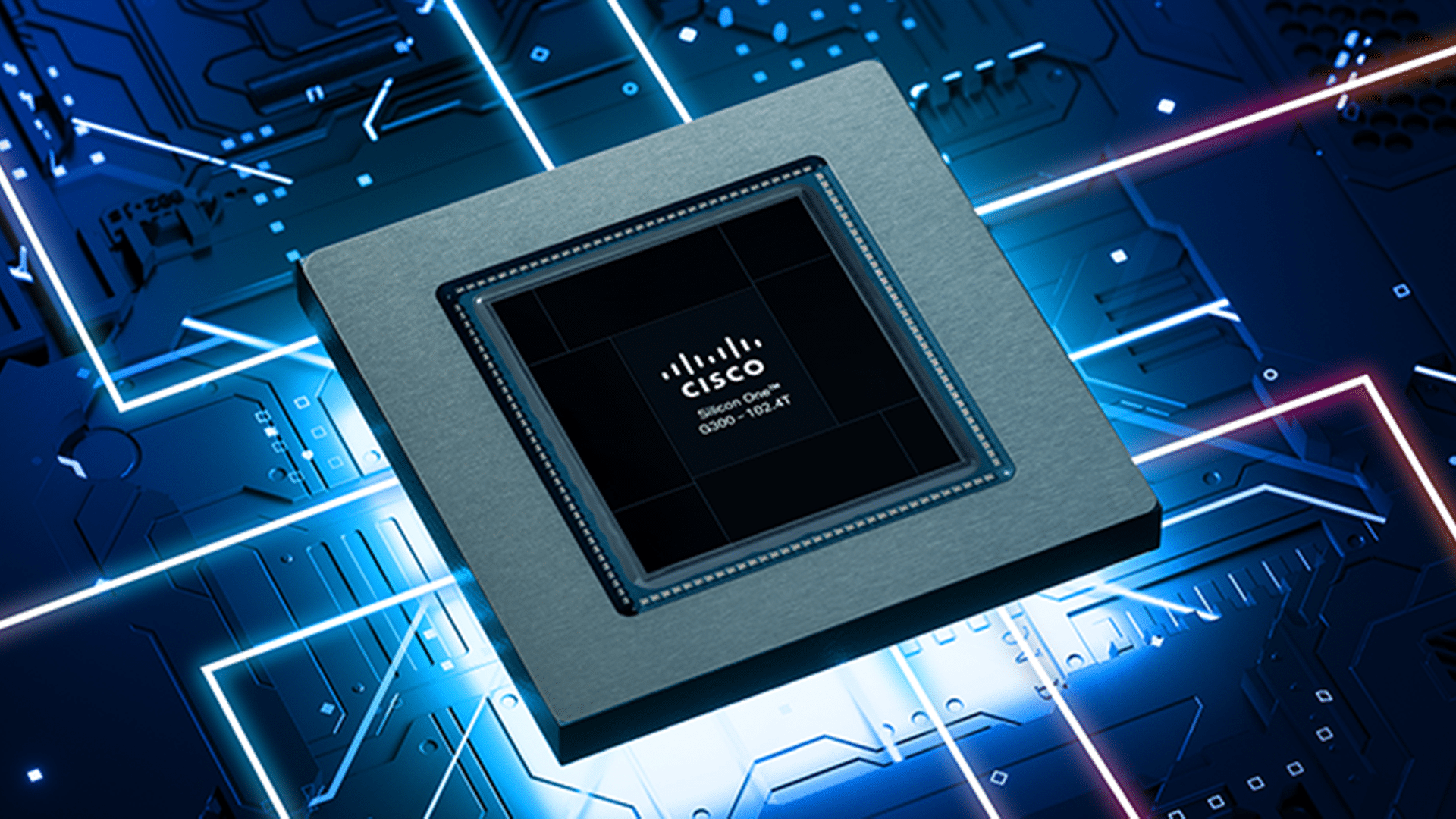
The Cisco Silicon One G300 will power new Cisco N9000 and Cisco 8000 systems that push the frontier of AI networking in the data center. The systems feature innovative liquid cooling and support high-density optics to achieve new efficiency benchmarks and ensure customers get the most out of their GPU investments. In addition, the company enhanced Nexus One to make it easier for enterprises to operate their AI networks — on-premises or in the cloud — removing the complexity that can hold organizations back from scaling AI data centers.
“We are spearheading performance, manageability, and security in AI networking by innovating across the full stack – from silicon to systems and software,” said Jeetu Patel, President and Chief Product Officer, Cisco. “We’re building the foundation for the future of infrastructure, supporting every type of customer—from hyperscalers to enterprises—as they shift to AI-powered workloads.”
“As AI training and inference continues to scale, data movement is the key to efficient AI compute; the network becomes part of the compute itself. It’s not just about faster GPUs – the network must deliver scalable bandwidth and reliable, congestion-free data movement,” said Martin Lund, Executive Vice President of Cisco’s Common Hardware Group. “Cisco Silicon One G300, powering our new Cisco N9000 and Cisco 8000 systems, delivers high-performance, programmable, and deterministic networking – enabling every customer to fully utilize their compute and scale AI securely and reliably in production.”
The networking industry reaction to Cisco’s newest ASIC has been largely positive, with industry analysts and partners highlighting its role in reclaiming Cisco’s dominance in the AI infrastructure market. For example, Brendan Burke of Futurium thinks Cisco’s Silicon One G300 could be the backbone of Agentic AI Inference. His take: “Cisco’s latest announcements represent a calculated move to assert dominance in the AI networking fabric by attacking the specific bottlenecks of GPU cluster efficiency. As AI workloads shift toward agentic inference, where autonomous agents continuously interact across distributed environments, the network must handle unpredictable traffic patterns, unlike the structured flows of traditional training. Cisco is leveraging its vertical integration strategy to address the reliability and power constraints that plague these massive clusters. By emphasizing programmable silicon and rigorous optic qualification, Cisco aims to decouple network lifespan from rapid GPU innovation cycles, ensuring infrastructure can adapt to new traffic steering algorithms without hardware replacements. The G300 is a bid to make Ethernet the undisputed standard for AI back-end networks.”
- Industry-Leading Specs: Market analysts have noted that the G300’s 102.4 Tbps switching capacity sets a new benchmark for AI scale-out and scale-across networking.
- Efficiency Gains: Initial simulations showing a 28% reduction in job completion time (JCT) and a 33% increase in network utilization have been cited as major differentiators for large-scale AI clusters.
- Sustainability Focus: The shift toward liquid-cooled systems for the G300, which offers 70% greater energy efficiency per bit, is being viewed as a critical move for sustainable AI growth.
- Competitive Positioning: Experts from HyperFRAME Research suggest that the new silicon signals a “new confidence” from Cisco, positioning them as the “Apple of infrastructure” by tightly integrating hardware and software.
- AI Infrastructure Pivot: Financial analysts at Seeking Alpha have upgraded Cisco’s outlook, viewing the company no longer as just a legacy hardware firm but as a central player in the AI revolution.
- Partner Confidence: Major partners, such as Shanghai Lichan Technology, have expressed excitement about the Nexus 9100 Series powered by this silicon, specifically for its ability to simplify and scale AI deployments.
- Nvidia & Broadcom Competition: While the G300 is seen as a strong challenger to Nvidia’s Spectrum-X and Broadcom’s Tomahawk/Jericho lines, some observers note that Cisco still faces a steep climb to regain market share lost to these competitors in recent years.
- Complexity Concerns: Some industry veterans have pointed out that while the silicon is “hyperscale ready,” the success of these ASICs in the enterprise will depend on Cisco’s ability to maintain operational simplicity through tools like the Nexus Dashboard.
……………………………………………………………………………………………………………………………………………………………………………………………
|
Cisco Silicon One G300
|
Broadcom Tomahawk 6 (BCM78910 Series)
|
|---|---|
|
Bandwidth
102.4 Tbps  |
Bandwidth
102.4 Tbps  |
|
Manufacturing Process
TSMC 3nm  |
Manufacturing Process
3nm technology |
|
SerDes Lanes & Speed
512 lanes at 200 Gbps per link  |
SerDes Lanes & Speed
512 lanes at 200 Gbps per link, or 1024 lanes at 100G |
|
Port Configuration
Up to 64 x 1.6TbE ports or 512 x 200GbE ports |
Port Configuration
Up to 64 x 1.6TbE ports or 512 x 200GbE ports |
|
Target AI Cluster Size
Supports deployments of up to 128,000 GPUs |
Target AI Cluster Size
Supports over 100,000 XPUs (accelerators) Broadcom |
- Congestion Management: Cisco differentiates its G300 with an “Intelligent Collective Networking” approach featuring a fully shared packet buffer and a load-balancing agent that communicates across all G300s in the network to build a global map of congestion. Broadcom’s Tomahawk series also includes smart congestion control and global load balancing, though Cisco claims its implementation achieves higher network utilization (33% better).
- Programmability: Cisco emphasizes P4 programmability, allowing customers to update network functionality even after deployment.
- Ecosystem & Integration: Broadcom operates primarily in the merchant silicon market, with their chips used by various partners like HPE Juniper Networking. Cisco uses its own silicon to power its
Nexus 9000 and 8000 Series switches, tightly integrating hardware with software management platforms like Nexus One for a unified solution.
- Cooling Solutions: The Cisco G300 is designed to support high-density optics and is offered in new systems that include liquid-cooled options, providing 70% greater energy efficiency per bit compared to previous generations.
………………………………………………………………………………………………………………………………………………………………………………
References:
https://newsroom.cisco.com/c/r/newsroom/en/us/a/y2026/m02/cisco-announces-new-silicon-one-g300.html
https://blogs.cisco.com/sp/cisco-silicon-one-g300-the-next-wave-of-ai-innovation
Will Cisco’s Silicon One G300 Be the Backbone of Agentic Inference?
Analysis: Ethernet gains on InfiniBand in data center connectivity market; White Box/ODM vendors top choice for AI hyperscalers
Cisco CEO sees great potential in AI data center connectivity, silicon, optics, and optical systems
Networking chips and modules for AI data centers: Infiniband, Ultra Ethernet, Optical Connections
Nvidia enters Data Center Ethernet market with its Spectrum-X networking platform
Will AI clusters be interconnected via Infiniband or Ethernet: NVIDIA doesn’t care, but Broadcom sure does!
Analysis: Rakuten Mobile and Intel partnership to embed AI directly into vRAN
Today, Rakuten Mobile and Intel announced a partnership to embed Artificial Intelligence (AI) directly into the virtualized Radio Access Network (vRAN) stack. While vRAN currently represents a small percentage of the total RAN market (Dell’Oro Group recently forecasts vRAN to account for 5% to 10% of the total RAN market by 2026), this partnership could boost increase that percentage as it addresses key adoption hurdles—performance, power, and AI integration. Key areas of innovation include:
- Enhanced Wireless Spectral Efficiency: Optimizing spectrum utilization for superior network performance and capacity.
- Automated RAN Operations: Streamlining network management and reducing operational complexities through intelligent automation.
- Optimized Resource Allocation: Dynamically allocating network resources for maximum efficiency and subscriber experience.
- Increased Energy Efficiency: Significantly reducing power consumption in the RAN, contributing to sustainable network operations.
The partnership essentially aims to make vRAN superior in performance and TCO (Total Cost of Ownership) compared to traditional, proprietary, purpose built RAN hardware.
“We are incredibly excited to expand our collaboration with Intel to pioneer truly AI-native RAN architectures,” said Sharad Sriwastawa, co-CEO and CTO, Rakuten Mobile. “Together, we are validating transformative AI-driven innovations that will not only shape but define the future of mobile networks. This partnership showcases how intelligent RAN can be achieved through the seamless and efficient integration of AI workloads directly within existing vRAN software stacks, delivering unparalleled performance and efficiency.”
Rakuten Mobile and Intel are engaged in rigorous testing and validation of cutting-edge RAN AI use cases across Layer 1, Layer 2, and comprehensive RAN operation and network platform management. A core objective is the seamless integration of AI directly into the RAN stack, meticulously addressing integration challenges while upholding carrier-grade reliability and stringent latency requirements.
Utilizing Intel FlexRAN reference software, the Intel vRAN AI Development Kit, and a robust suite of AI tools and libraries, Rakuten Mobile is collaboratively training, optimizing, and deploying sophisticated AI models specifically tailored for demanding RAN workloads. This collaborative effort is designed to realize ultra-low, real-time AI latency on Intel Xeon 6 SoC, capitalizing on their built-in AI acceleration capabilities, including AVX512/VNNI and AMX.
“AI is transforming how networks are built and operated,” said Kevork Kechichian, Executive Vice President and General Manager of the Data Center Group, Intel Corporation. “Together with Rakuten, we are demonstrating how AI benefits can be achieved in vRAN. Intel Xeon processors power the majority of commercial vRAN deployments worldwide, and this transformation momentum continues to accelerate. Intel is providing AI-ready Xeon platforms that allow operators like Rakuten to design AI-ready infrastructure from the ground up, with built-in acceleration capabilities.”
Rakuten says they are “poised to unlock new levels of RAN performance, efficiency, and automation by embedding AI directly into the RAN software stack, this AI-native evolution represents the future of cloud-native, AI-powered RAN – inherently software-upgradable and built on open, general-purpose computing platforms. Additionally, the extended collaboration between Rakuten Mobile and Intel marks a significant step toward realizing the vision of autonomous, self-optimizing networks and powerfully reinforces both companies’ commitment to open, programmable, and intelligent RAN infrastructure worldwide.”
……………………………………………………………………………………………………………………………………………………………………..
- AI-Native Efficiency & Performance: The collaboration focuses on integrating AI to improve network performance and energy efficiency, which is a major pain point for operators. By embedding AI directly into the vRAN stack, they are enhancing wireless spectral efficiency, reducing power consumption, and automating RAN operations.
- Leveraging High-Performance Hardware: The initiative utilizes Intel® Xeon® 6 processors with built-in vRAN Boost. This eliminates the need for external, power-hungry accelerator cards, offering up to 2.4x more capacity and 70% better performance-per-watt.
- Validation of Large-Scale Commercial Viability: Rakuten Mobile operates the world’s first fully virtualized, cloud-native network. Its continued collaboration with Intel to make the vRAN AI-native provides a proven blueprint for other operators, reducing the perceived risk of adopting vRAN, particularly in brownfield (existing) networks.
- Acceleration of Open RAN Ecosystem: The collaboration supports the broader push towards Open RAN, which is expected to see a significant rise in market share, doubling between 2022 and 2026.
………………………………………………………………………………………………………………………………………………………………
- Market Share Shift: Omdia forecasts that vRAN’s share of the RAN baseband subsector will reach 20% by 2028. That’s a significant jump from its current low single-digit percentage.
- Explosive CAGR: The global vRAN market is projected to grow from approximately $16.6 billion in 2024 to nearly $80 billion by 2033, representing a 19.5% CAGR.
- Small Cell Dominance: By the end of 2026, it is estimated that 77% of all vRAN implementations will be on small cell architectures, a key area where Rakuten and Intel have demonstrated success.
References:
https://corp.mobile.rakuten.co.jp/english/news/press/2026/0210_01/
Virtual RAN gets a boost from Samsung demo using Intel’s Grand Rapids/Xeon Series 6 SoC
RAN silicon rethink – from purpose built products & ASICs to general purpose processors or GPUs for vRAN & AI RAN
vRAN market disappoints – just like OpenRAN and mobile 5G
LightCounting: Open RAN/vRAN market is pausing and regrouping
Dell’Oro: Private 5G ecosystem is evolving; vRAN gaining momentum; skepticism increasing
https://www.mordorintelligence.com/industry-reports/virtualized-ran-vran-market
https://www.grandviewresearch.com/industry-analysis/virtualized-radio-access-network-market-report
Fiber Optic Boost: Corning and Meta in multiyear $6 billion deal to accelerate U.S data center buildout
Corning Incorporated and Meta Platforms, Inc. (previously known as Facebook) have entered a multiyear agreement valued at up to $6 billion. This strategic collaboration aims to accelerate the deployment of cutting-edge data center infrastructure within the U.S. to bolster Meta’s advanced applications, technologies, and ambitious artificial intelligence initiatives. The agreement specifies that Corning will furnish Meta with its latest advancements in optical fiber, cable, and comprehensive connectivity solutions. As part of this commitment, Corning plans to significantly scale its manufacturing capabilities across its North Carolina facilities.
A key element of this expansion is a substantial capacity increase at its fiber optic cable manufacturing plant in Hickory NC, for which Meta will serve as the foundational anchor customer. The construction and operation of these data centers — critical infrastructure that supports our technologies and moves us toward personalized superintelligence — necessitate robust server and hardware systems designed to facilitate information transfer and connectivity with minimal latency. Fiber optic cabling is a cornerstone component for enabling this high-speed, near real-time connectivity, powering applications from sophisticated wearable technology like the Ray-Ban Meta AI glasses to the global connectivity services utilized by billions of individuals and enterprises.
“This long-term partnership with Meta reflects Corning’s commitment to develop, innovate, and manufacture the critical technologies that power next-generation data centers here in the U.S.,” said Wendell P. Weeks, Chairman and Chief Executive Officer, Corning Incorporated. “The investment will expand our manufacturing footprint in North Carolina, support an increase in Corning’s employment levels in the state by 15 to 20 percent, and help sustain a highly skilled workforce of more than 5,000 — including the scientists, engineers, and production teams at two of the world’s largest optical fiber and cable manufacturing facilities. Together with Meta, we’re strengthening domestic supply chains and helping ensure that advanced data centers are built using U.S. innovation and advanced manufacturing.”
Meta is expanding its commitment to build industry-leading data centers in the U.S. and to source advanced technology made domestically. Here are two quotes from them:
- “Building the most advanced data centers in the U.S. requires world-class partners and American manufacturing,” said Joel Kaplan, Chief Global Affairs Officer at Meta. “We’re proud to partner with Corning – a company with deep expertise in optical connectivity and commitment to domestic manufacturing – for the high-performance fiber optic cables our AI infrastructure needs. This collaboration will help create good-paying, skilled U.S. jobs, strengthen local economies, and help secure the U.S. lead in the global AI race.”
- “As digital tools and generative AI continue to transform our economy — in fields like healthcare, finance, agriculture, and more — the demand for fiber connectivity will continue to grow. By supporting American companies like Corning and building and operating data centers in America, we’re helping ensure that our nation maintains its competitive edge in the digital economy and the global race for AI leadership.”
Key elements of the agreement:
- Multiyear, up to $6 billion commitment.
- Corning to supply latest generation optical fiber, cable and connectivity products designed to meet the density and scale demands of advanced AI data centers.
- New optical cable manufacturing facility in Hickory, North Carolina, in addition to expanded production capacity across Corning’s North Carolina operations.
- Agreement supports Corning’s projected employment growth in North Carolina by 15 to 20 percent, sustaining a skilled workforce of more than 5,000 employees in the state, including thousands of jobs tied to two of the world’s largest optical fiber and cable manufacturing facilities.
…………………………………………………………………………………………………………………………………………………………….
Comment and Analysis:
Corning’s “up to $6 billion” Meta agreement is essentially a long‑term, anchor‑tenant bet that AI‑era data centers will be fundamentally more fiber‑intensive than legacy cloud resident data centers, with Corning positioning itself as the default U.S. optical plant for Meta’s buildout through ~2030. In practice, this deal is a long‑term take‑or‑pay style capacity lock that de‑risks Corning’s capex while giving Meta priority access to scarce, high‑performance data‑center‑grade fiber and cabling.
AI data centers are becoming the new FTTH in the sense that hyperscale AI buildouts are now the primary structural driver of incremental fiber demand, design innovation, and capex prioritization—but with far higher fiber intensity per site and far tighter performance constraints than residential access ever imposed.
Why “AI Data Centers are the new FTTH” for fiber optic vendors:
For fiber‑optic vendors, AI data centers now play the role that FTTH did in the 2005–2015 cycle: the anchor use case that justifies new glass, cable, and connectivity capacity.
-
AI‑optimized data centers need 2–4× more fiber cabling than traditional hyperscalers, and in some designs more than 10×, driven by massively parallel GPU fabrics and east–west traffic.
-
U.S. hyperscale capacity is expected to triple by 2029, forcing roughly a 2× increase in fiber route miles and a 2.3× increase in total fiber miles, a demand shock comparable to or larger than the early FTTH boom but concentrated in fewer, much larger customers.
-
This is already reshaping product roadmaps toward ultra‑high‑fiber‑count (UHFC) cable, bend‑insensitive fiber, and very‑small‑form‑factor connectors to handle hundreds to thousands of fibers per rack and per duct.
In other words, where FTTH once dictated volume and economies of scale, AI data centers now dictate density, performance, and margin mix.
Carrier‑infrastructure: from access to fabric:
From a carrier perspective, the “new FTTH” analogy is about what drives long‑haul and metro planning: instead of last‑mile penetration, it’s AI fabric connectivity and east–west inter‑DC routes.
-
Each new hyperscale/AI data center is modeled to require on the order of 135 new fiber route miles just to reach three core network interconnection points, plus additional miles for new long‑haul routes and capacity upgrades.
-
An FBA‑commissioned study projects U.S. data centers alone will need on the order of 214 million additional fiber miles by 2029, nearly doubling the installed base from ~160M to ~373M fiber miles; that is the new “build everywhere” narrative operators once used for FTTH.
-
Carriers now plan backbone routes, ILAs, and regional rings around dense clusters of AI campuses, treating them as primary traffic gravity wells rather than as just a handful of peering sites at the edge of a consumer broadband network.
The strategic shift: FTTH made the access network fiber‑rich; AI makes the entire cloud and transport fabric fiber‑hungry.
Strategic implications:
-
AI is now the dominant incremental fiber use case: residential fiber adds subscribers; AI adds orders of magnitude more fibers per site and per route.
-
Network economics are moving from passing more homes to feeding more GPUs: route miles, fiber counts, and connector density are being dimensioned to training clusters and inference fabrics, not household penetration curves.
-
Policy and investment narratives should treat AI inter‑DC and campus fiber as “national infrastructure” on par with last‑mile FTTH, given the scale of projected doubling in route miles and more than doubling in fiber miles by 2029.
In summary, the next decade of fiber innovation and capex will be written less in curb‑side PON and more in ultra‑dense, AI‑centric data centers with internal fiber optical fabrics and interconnects.
……………………………………………………………………………………………………………………………………………………………………………………………….
References:
Meta Announces Up to $6 Billion Agreement With Corning to Support US Manufacturing
Big tech spending on AI data centers and infrastructure vs the fiber optic buildout during the dot-com boom (& bust)
Analysis: Cisco, HPE/Juniper, and Nvidia network equipment for AI data centers
Networking chips and modules for AI data centers: Infiniband, Ultra Ethernet, Optical Connections
Will billions of dollars big tech is spending on Gen AI data centers produce a decent ROI?
Superclusters of Nvidia GPU/AI chips combined with end-to-end network platforms to create next generation data centers
Lumen Technologies to connect Prometheus Hyperscale’s energy efficient AI data centers
Proposed solutions to high energy consumption of Generative AI LLMs: optimized hardware, new algorithms, green data centers
Hyper Scale Mega Data Centers: Time is NOW for Fiber Optics to the Compute Server
Fierce Network Research report examines telcos role in the AI economy and profiles early AI adopters
The telecommunications industry is at a critical crossroads. As AI reshapes global value chains, communications service providers (CSPs) must determine their strategic position: will they remain infrastructure enablers or evolve into full-scale participants in the AI economy?
A new Fierce Network Research report — “Risk, Reward and Revenue: Defining Telcos’ Role in the AI Economy” — examines this identity challenge — and how network operators are recalibrating for the next generation of network-driven intelligence. Based on a global survey of 500 technology decision-makers across 40 countries, the findings reveal a pronounced industry divide. A majority (57%) of operators see their core opportunity in infrastructure — networks, data centers, and secure connectivity — while 43% advocate for a more integrated position, aspiring to orchestrate AI ecosystems (19%) or participate fully in the AI value chain (24%).
Some of the industry’s early adopters are already showing what that future might look like.
- AT&T reports a twofold increase in cash flow for every dollar it invests in AI, emphasizing measurable outcomes over vague productivity gains. An AT&T executive said that success in the AI era depends on “Goldilocks governance” — a balance not too rigid to stifle innovation, and not too loose to compromise compliance and trust.
- Bell Canada is moving in a similar direction, targeting a doubling of enterprise AI revenue by 2028 and positioning its Ateko subsidiary and AI Fabric platform as the backbone of a “sovereign digital spine” for Canada.
- “We’re using AI to enhance our products and services and make them better,” Ed Fox, MetTel CTO. The company provides a private network to deliver integrated communications and IT services to U.S. businesses and government agencies, including voice, data, network, cloud, mobility, IoT and security solutions. MetTel also provides managed network services such as SD-WAN and secure access service edge (SASE).
- Rick Lievano, Microsoft CTO for the worldwide telecommunications industry, sees operators expanding their use of AI beyond efficiency. “Initially, the first place where telcos began to experiment with AI is around efficiency gains — how can I save money, and how can I do more with fewer people? That’s been the target of the first couple of waves of AI,” Lievano said. “However, their eyes light up when we talk with them about new revenue opportunities,” Lievano said.
The research highlights that telcos possess critical assets few other industries can match: globally distributed data center capacity, secure and resilient networks, and deep, long-standing relationships with enterprise and government customers. But the barriers are equally significant — from proving the business case for AI infrastructure to navigating a shortage of data science and AI talent. Legacy technology debt continues to drag, with one executive lamenting that 145 years of accumulated systems make modern data integration “extraordinarily complex.”

A new Fierce Network Research report reveals how communication service providers are navigating the AI economy amid uncertainty about their role and strategy. (Google Gemini)
The bottom line is clear: to remain relevant in the AI-driven economy, telcos must modernize both infrastructure and business models — transforming from connectivity providers into intelligent digital enablers. However, we’ve heard that cry for telco transformation from dumb pipes to intelligent and autonomous network and IT providers, but it has yet to be realized. Will this time be any different?
References:
https://www.fierce-network.com/cloud/dumb-pipes-or-ai-powerhouses-telcos-face-identity-crisis
Full REPORT: “Risk, Reward and Revenue: Defining telcos’ role in the AI economy.”
Private 5G networks move to include automation, autonomous systems, edge computing & AI operations
Palo Alto Networks and Google Cloud expand partnership with advanced AI infrastructure and cloud security
Generative AI could put telecom jobs in jeopardy; compelling AI in telecom use cases
Generative AI in telecom; ChatGPT as a manager? ChatGPT vs Google Search
Allied Market Research: Global AI in telecom market forecast to reach $38.8 by 2031 with CAGR of 41.4% (from 2022 to 2031)
Markets and Markets: Global AI in Networks market worth $10.9 billion in 2024; projected to reach $46.8 billion by 2029
Ericsson integrates Agentic AI into its NetCloud platform for self healing and autonomous 5G private networks
Ericsson CEO’s strong statements on 5G SA, WRC 27, and AI in networks
New Linux Foundation white paper: How to integrate AI applications with telecom networks using standardized CAMARA APIs and the Model Context Protocol (MCP)
Comparing AI Native mode in 6G (IMT 2030) vs AI Overlay/Add-On status in 5G (IMT 2020)
Executive Summary:
AI integration in 6G specifications (3GPP) and standards (ITU-R IMT 2030) highlights a strategic shift in the telecom industry towards AI-native networks, with telecom industry heavyweights like Huawei, Samsung, Ericsson, and Nokia actively developing foundational technologies. Unlike 5G, where AI and machine learning were limited applications or add-on features over existing architecture, 6G will incorporate AI from the onset with an “AI native” approach where intelligence will allow the network to be smart, agile, and able to learn and adapt according to changing network dynamics.
This transformation is necessary because future 6G networks will be too complex for human operators to manage, requiring AI-empowered and learning-driven networks that can facilitate zero-touch network management through capabilities including learning, reasoning, and decision-making.
- AI-Native Networks: The industry consensus is that 6G will be “AI-native,” meaning artificial intelligence will be built directly into the core functions of network control, resource management, and service orchestration. This moves AI from an optimization layer in 5G to an foundational element in 6G.
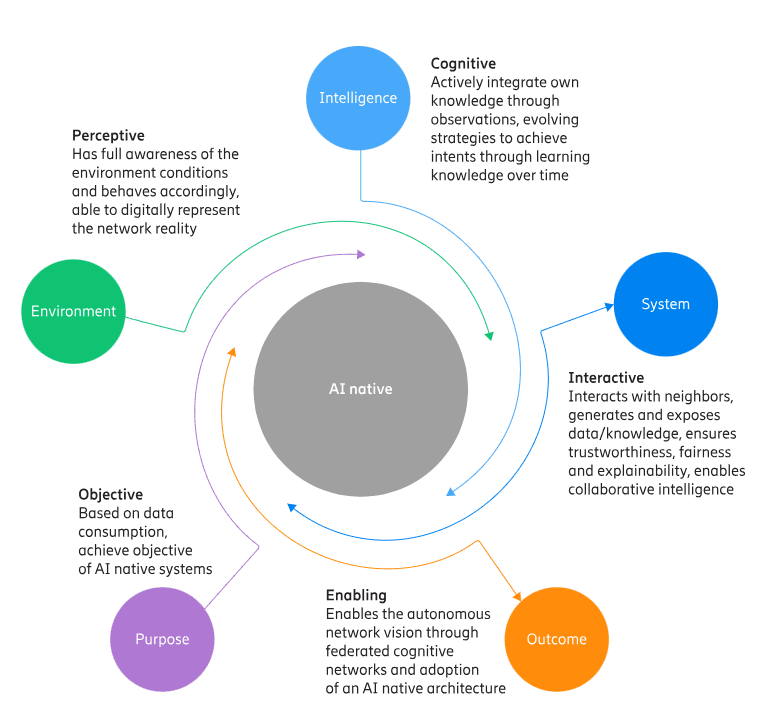
AI Native Image Courtesy of Ericsson
…………………………………………………………………………………………………………………………………………………………………………………………………………………………………………………………………………………………………
- Company Initiatives:
- Huawei is focused on making AI a native element of the network architecture (AI-native 6G) rather than an overlay technology, integrating communication, sensing, computing, and intelligence. This vision, called “Connected Intelligence,” involves two aspects: AI for 6G (network automation) and 6G for AI (AI as a Service, AIaaS). More in Huawei Research Areas below.
- Samsung is a major proponent of AI-RAN (Radio Access Network) technology. The company hosted a summit in November 2025 to showcase working AI-RAN technology that autonomously optimizes network performance and is conducting joint research with SK Telecom (SKT) on AI-supported RAN. Samsung sees vRAN (virtualized RAN) as a key enabler for “AI-native, 6G-ready networks”.
- Ericsson emphasizes the necessity of a strong 5G Standalone (5G SA) foundation for an AI future, using AI to manage and automate current networks in preparation for 6G’s demands. Ericsson is also integrating agentic AI into its platforms for more autonomous network management.
- Nokia is deepening its AI push, licensing software to expand AI use in mobile networks and preparing for early field trials in 2026 by porting baseband software to platforms like NVIDIA’s, which opens the door for more advanced AI use cases.
- Industry Analysis and Trends:
- Standardization: 2026 is crucial as formal 6G specification work begins in earnest within 3GPP with Release 21. In WP5D, the IMT 2030 RIT/SRIT standardization work will commence at the February 2027 meeting with the final deadline for submissions at the February 2029 meeting. More in the ITU-R WP5D section below.
- The AI-RAN Alliance is an industry initiative (not a traditional SDO) focused on accelerating real-world AI applications and integration within the RAN. It works alongside SDOs, providing industry insights and pushing for rapid validation and testing of AI-RAN technologies, with a specific focus on leveraging accelerated computing.
- Automation and Efficiency: AI-native algorithms in 6G are expected to deliver extreme spectrum and energy efficiency, significantly reducing operational costs for telcos while improving reliability and performance.
- Monetization Challenges: Despite the technological promise, analysts caution that 6G remains largely theoretical for now. Some operators are stalling on full 5G SA deployment, waiting to move to 6G-ready cores later in the decade, leading to concerns that 5G SA might become an “odd generation.”
- Infrastructure Constraints: The physical demands of AI infrastructure, particularly energy consumption and construction timelines, are becoming operational realities that may bound the pace of AI growth in 2026, regardless of software advancements.
- ITU-R Working Party (WP) 5D is making AI a native and foundational element of the 6G (IMT-2030) system, rather than the “add-on” or “overlay” status it had in 5G (IMT 2020). This shift is being achieved through the definition of specific AI capabilities and requirements that future 6G technologies must inherently support. In particular:
- Defining AI as a Core Capability: The Recommendation ITU-R M.2160 (“Framework and overall objectives of the future development of IMT for 2030 and Beyond”) officially defines “Artificial Intelligence and Communication” as one of the six major usage scenarios and an overarching design principle for IMT-2030.
- Integrating AI into the Radio Interface: WP 5D is actively developing technical performance requirements (TPRs) and evaluation criteria for proposed 6G radio interface technologies (RITs) that inherently incorporate AI/Machine Learning (ML). This includes work on:
- AI-enabled air interface design: This involves the physical layer, potentially moving towards AI-native physical (PHY) layers that can dynamically adapt waveforms and network parameters in real-time, rather than relying on predefined, static configurations.
- AI-driven resource management: AI/ML algorithms will be crucial for real-time optimization of spectral and energy efficiency, managing complex traffic, and ensuring Quality of Service (QoS).
- Enabling AI-Driven Services: The framework for IMT-2030 is designed to support the full lifecycle of AI components, from data collection and model training to deployment and performance monitoring, enabling new AI-driven services and applications directly within the network infrastructure.
- Establishing a Formal Timeline: WP 5D has established a clear timeline for 6G standardization, with specific stages for vision, requirements, evaluation methodology, and specifications. This structured approach ensures that all proposed RITs/SRITs are evaluated against the new AI-native requirements, promoting global alignment and preventing AI from becoming a fragmented, proprietary solution.
- Stage 1 (Vision): Completed in June 2023.
- Stage 2 (Requirements & Evaluation): Targeted for completion in 2026.
- Stage 3 (Specifications): Expected by the end of 2030.
- Purpose: AI is integral to the entire network lifecycle, from initial design and deployment to autonomous operation and service creation.
- Integration Level: Intelligence is embedded across all layers of the network stack, including the physical layer (air interface), control plane, and data plane.
- Scope: AI enables core functionalities such as real-time self-optimization, self- healing capabilities, and dynamic resource allocation, rather than static, predefined configurations.
- Outcome: The creation of a fully cognitive, self-managing, and highly adaptable “intelligence fabric” capable of supporting advanced use cases like real-time holographic communication, digital twins, and autonomous systems with ultra-low latency.
| Feature | 5G (IMT-2020) | 6G (IMT-2030) |
|---|---|---|
| AI Role | Optimization tool (overlay) | Foundational and native element |
| Network Operation | Manual configuration with AI assistance | Autonomous and self-managing |
| Air Interface | Human-designed with some ML optimization | AI/ML-designed and managed |
| Complexity Management | Relies on standard protocols | Manages complexity through embedded AI/ML |
| Services Supported | Enhanced mobile broadband, basic IoT | Integrated AI & Communication, sensing, holographic comms |
–>By embedding AI into the fundamental design principles and technical requirements of IMT-2030, ITU-R WP 5D is ensuring that 6G is an AI-native network capable of self-management, self-optimization, and supporting a vast ecosystem of AI applications, a significant shift from the supplementary role AI played in 5G.
- Agentic-AI Core (A-Core): Huawei unveiled a blueprint for a 6G core network (which will be specified by 3GPP and NOT ITU) where services are managed by specialized AI agents using a large-scale network AI model called “NetGPT”. This allows the network to program, update, and execute its own control procedures automatically without human intervention, based on natural language instructions.
- Network Architecture Redesign: Huawei proposes the NET4AI system architecture, a service-oriented design that moves beyond the 5G service-based architecture. It introduces a dedicated data plane (DP) to handle the massive volume of data generated by AI and sensing services, enabling flexible and efficient many-to-many data flow for distributed learning and inference.
- Integrated Sensing and Communication (ISAC): A core pillar of Huawei’s 6G work is the native integration of sensing with communication. This allows the network to use radio waves for high-resolution sensing, localization, and imaging, creating a “digital twin” of the physical world. The large volume of data collected from sensing then serves as a source for AI model training and real-time environmental monitoring.
- Distributed Machine Learning: Huawei researches deep-edge architecture to enable massive, distributed, and collaborative machine learning (ML). This includes the development of frameworks like a two-level learning architecture that combines federated learning (FL) and split learning (SL) to optimize computing resources and ensure data privacy by keeping raw data local to devices.
- AI as a Service (AIaaS): The 6G network is designed to provide AI capabilities as a service, allowing the training and inference of large AI models to be distributed across the network (edge and cloud). This offers low-latency performance and access to rich data for AI-driven applications like collaborative robotics and autonomous driving.
- Energy Efficiency and Sustainability: The company is researching how native AI capabilities can improve overall energy efficiency by up to 100 times compared to 5G. This involves smart energy control, dynamic resource scaling, and optimizing communication paths for lower power consumption.
- Standardization and White Papers: Huawei is actively contributing to global 6G discussions and standardization bodies like the ITU-R, sharing its vision through publications such as the book 6G: The Next Horizon – From Connected People and Things to Connected Intelligence and various technical white papers. The goal is to define the technical specifications and use cases for 6G that will drive industry-wide innovation by around 2030.
References:
https://www.ericsson.com/en/reports-and-papers/white-papers/ai-native
Roles of 3GPP and ITU-R WP 5D in the IMT 2030/6G standards process
AI wireless and fiber optic network technologies; IMT 2030 “native AI” concept
ITU-R WP5D IMT 2030 Submission & Evaluation Guidelines vs 6G specs in 3GPP Release 20 & 21
ITU-R WP 5D Timeline for submission, evaluation process & consensus building for IMT-2030 (6G) RITs/SRITs
ITU-R WP 5D reports on: IMT-2030 (“6G”) Minimum Technology Performance Requirements; Evaluation Criteria & Methodology
AI wireless and fiber optic network technologies; IMT 2030 “native AI” concept
Highlights of 3GPP Stage 1 Workshop on IMT 2030 (6G) Use Cases
Should Peak Data Rates be specified for 5G (IMT 2020) and 6G (IMT 2030) networks?
GSMA Vision 2040 study identifies spectrum needs during the peak 6G era of 2035–2040
Highlights and Summary of the 2025 Brooklyn 6G Summit
NGMN: 6G Key Messages from a network operator point of view
Nokia and Rohde & Schwarz collaborate on AI-powered 6G receiver years before IMT 2030 RIT submissions to ITU-R WP5D
Verizon’s 6G Innovation Forum joins a crowded list of 6G efforts that may conflict with 3GPP and ITU-R IMT-2030 work
Nokia Bell Labs and KDDI Research partner for 6G energy efficiency and network resiliency
Deutsche Telekom: successful completion of the 6G-TakeOff project with “3D networks”
Market research firms Omdia and Dell’Oro: impact of 6G and AI investments on telcos
Qualcomm CEO: expect “pre-commercial” 6G devices by 2028
Ericsson and e& (UAE) sign MoU for 6G collaboration vs ITU-R IMT-2030 framework
KT and LG Electronics to cooperate on 6G technologies and standards, especially full-duplex communications
Highlights of Nokia’s Smart Factory in Oulu, Finland for 5G and 6G innovation
Nokia sees new types of 6G connected devices facilitated by a “3 layer technology stack”
Rakuten Symphony exec: “5G is a failure; breaking the bank; to the extent 6G may not be affordable”
India’s TRAI releases Recommendations on use of Tera Hertz Spectrum for 6G
New ITU report in progress: Technical feasibility of IMT in bands above 100 GHz (92 GHz and 400 GHz)
Telecom operators investing in Agentic AI while Self Organizing Network AI market set for rapid growth
Telecom companies are planning to use Agentic AI [1.] for customer experience and network automation. A recent RADCOM survey shows 71% of network operators plan to deploy agentic AI in 2026, while 14% have already begun, prioritizing areas that directly influence trust and customer satisfaction: security and fraud prevention (57%) and customer service and support (56%). The top use cases are automated customer complaint resolution and autonomous fault resolution.
Operators are betting on agentic AI to remove friction before customers feel it, with the highest-value use cases reflecting this shift, including:
- 57% – automated customer complaint resolution
- 54% – autonomous fault resolution before it impacts service
- 52% – predicting experience to prevent churn
This technology is shifting networks from simply detecting issues to preventing them before customers notice. In contact centers, 2026 is expected to see a rise in human and AI agent collaboration to improve efficiency and customer service.
Note 1. Agentic AI refers to autonomous artificial intelligence systems that can perceive, reason, plan, and act independently to achieve complex goals with minimal human intervention, going beyond simple command-response to manage multi-step tasks, use various tools, and adapt to new information for proactive automation in dynamic environments. These intelligent agents function like digital coworkers, coordinating internally and with other systems to execute sophisticated workflows.
……………………………………………………………………………………………………………………………………………………………………………………………
ResearchAndMarkets.com has just published a “Self-Organizing Network Artificial Intelligence (AI) Global Market Report 2025.” The market research firm says that the self-organizing network AI [2.] is forecast to expand from $5.19 billion in 2024 to $6.18 billion in 2025, at a CAGR of 19.2%. This surge is driven by the integration of machine learning and AI in telecom networks, smart network management investment, and the growing demand for features like self-healing and self-optimization, as well as predictive maintenance technologies.driven by the expansion of 5G, increasing automation demands, and AI integration for network optimization. Opportunities include AI-driven RRM and predictive maintenance. Asia-Pacific emerges as the fast-growing region, boosting telecom innovations amid global trade shifts.
Note 2. Self-organizing network AI leverages software, hardware, and services to dynamically optimize and manage telecom networks, applicable across various network types and deployment modes. The market encompasses a broad range of solutions, from network optimization software to AI-driven planning products, underscoring its expansive potential.

Looking further ahead, the market is expected to reach $12.32 billion by 2029, with a CAGR of 18.8%. Key drivers during this period include heightened demand for automation, increased 5G deployments, and growing network densification, accompanied by rising data traffic and subscriber numbers. Trends such as AI-driven network automation advancements, machine learning integration for real-time optimization, and the rise of generative AI for analytics are reshaping the landscape.
The expansion of 5G networks plays a pivotal role in propelling this growth. These networks, characterized by high-speed data and ultra-low latency, significantly enhance the capabilities of self-organizing network AI. The integration facilitates real-time data processing, supporting automation, optimization, and predictive maintenance, thereby improving service quality and user experience. A notable development in 2023 saw UK outdoor 5G coverage rise to 85-93%, reflecting growing demand and technological advancement.
Huawei Technologies and other major tech companies, are pioneering innovative solutions like AI-driven radio resource management (RRM), which optimizes network performance and enhances user experience. These solutions rely on AI and machine learning for dynamic spectrum and network resource management. For instance, Huawei’s AI Core Network, introduced at MWC 2025, marks a substantial leap in intelligent telecommunications, integrating AI into core systems for seamless connectivity and real-time decision-making.
Strategic acquisitions are also shaping the market, exemplified by Amdocs Limited acquiring TEOCO Corporation in 2023 to bolster its network optimization and analytics capabilities. This acquisition aims to enhance end-to-end network intelligence and operational efficiency.
Leading players in the market include Huawei, Cisco Systems Inc., Qualcomm Incorporated, and many others, driving innovation and competition. Europe held the largest market share in 2024, with Asia-Pacific poised to be the fastest-growing region through the forecast period.
References:
Operator Priorities for 2026 and Beyond: Data, Automation, Customer Experience
https://uk.finance.yahoo.com/news/self-organizing-network-artificial-intelligence-105400706.html
Ericsson integrates agentic AI into its NetCloud platform for self healing and autonomous 5G private network
Agentic AI and the Future of Communications for Autonomous Vehicles (V2X)
IDC Report: Telecom Operators Turn to AI to Boost EBITDA Margins
Omdia: How telcos will evolve in the AI era
Palo Alto Networks and Google Cloud expand partnership with advanced AI infrastructure and cloud security
Sovereign AI infrastructure for telecom companies: implementation and challenges
Sovereign AI infrastructure refers to the domestic capability of a nation or an organization to own and control the entire technology stack for artificial intelligence (AI) systems within its own borders, subject to local laws and governance. This includes the physical data centers, specialized hardware (like GPUs), software, data, and skilled workforce. Sovereign AI infrastructure involves a full “stack” designed to ensure national control and reduce reliance on foreign providers. A few key features:
- Policies and technical controls (e.g., data localization, encryption) to ensure that sensitive data used for training and inference remains within the jurisdiction.
- Development and hosting of proprietary or locally tailored AI models and software frameworks that align with national values, languages, and ethical standards.
- Workforce Development: Investing in domestic talent, including data scientists, engineers, and legal experts, to build and maintain the local AI ecosystem.
- Regulatory Framework: A comprehensive legal and ethical framework for AI development and deployment that ensures compliance with national laws and standards.
Why It’s Important – The pursuit of sovereign AI infrastructure is driven by several strategic considerations for both governments and private enterprises:
- National Security: To ensure that critical systems in defense, intelligence, and public infrastructure are not dependent on potentially adversarial foreign technologies or subject to extraterritorial access laws (like the U.S. CLOUD Act).
- Economic Competitiveness: To foster a domestic tech industry, create high-skilled jobs, protect intellectual property, and capture the significant economic benefits of AI-driven growth.
- Data Privacy and Compliance: To comply with stringent local data protection regulations (e.g., GDPR in the EU) and build public trust by ensuring citizen data is handled securely and according to local laws. Cultural Preservation: To train AI models on local datasets and languages, preserving cultural nuances and avoiding bias found in generalized, globally trained models.

Image Credit: Nvidia
………………………………………………………………………………………………………………………………………………………………………………………………………..
Governments around the world are starting to build sovereign AI infrastructure, and according to a new report from Morningstar DBRS, which opines that major telecommunications companies are uniquely positioned to benefit from that shift. Here are a few take-aways from the report:
- Sovereign AI funding opens a new growth path for telcos – Governments investing in domestic AI infrastructure are increasingly turning to operators, whose network and regulatory strengths position them to capture a large share of this emerging market.
- Telcos’ capabilities align with sovereignty needs – Their expertise in large-scale networks, local presence, and established government relationships give them an edge over hyperscalers for sensitive, sovereignty-focused AI projects.
- Early adopters gain advantage – Operators in Canada and Europe are already moving into sovereign AI, positioning themselves to secure higher-margin enterprise and government workloads as national AI buildouts accelerate.
- Infrastructure Demands: Building robust domestic AI ecosystems requires specialized expertise spanning hardware, software, data governance, and policy.
- Resource Constraints: Dr. Matt Hasan, CEO at aiRESULTS and a former AT&T executive, highlights specific bottlenecks:
- Compute Density at Scale.
- Spectrum Allocation amidst political pressures.
- Energy Demand exceeding existing grid capacity.
- Intensified Reliability Requirements: Sovereign AI implementation places heightened demands on telecom providers for system uptime, reliability, quality, and data privacy. This necessitates a focus on efficient power consumption, resilient routing and backups, robust encryption, and comprehensive cybersecurity measures.
- Supply Chain Vulnerabilities: Geopolitical tensions introduce risks to the supply of critical components such as GPUs and specialized chips, underscoring the interconnected nature of global hardware supply chains.
- The rapid evolution of AI technology mandates continuous investment and technical agility to ensure sovereign deployments remain current.
- The interplay between global hyperscalers and regional telecom operators is expected to shift.
- Hasan predicts a collaborative model, with regional telcos leveraging their position as sovereign partners through joint ventures, rather than an outright displacement of hyperscalers.
References:
Telcos Across Five Continents Are Building NVIDIA-Powered Sovereign AI Infrastructure
https://www.rcrwireless.com/20251202/ai/sovereign-ai-telcos
Subsea cable systems: the new high-capacity, high-resilience backbone of the AI-driven global network
Analysis: OpenAI and Deutsche Telekom launch multi-year AI collaboration
AI infrastructure spending boom: a path towards AGI or speculative bubble?
Market research firms Omdia and Dell’Oro: impact of 6G and AI investments on telcos
Omdia: How telcos will evolve in the AI era
OpenAI announces new open weight, open source GPT models which Orange will deploy
Expose: AI is more than a bubble; it’s a data center debt bomb
Can the debt fueling the new wave of AI infrastructure buildouts ever be repaid?
Custom AI Chips: Powering the next wave of Intelligent Computing
AI spending boom accelerates: Big tech to invest an aggregate of $400 billion in 2025; much more in 2026!
IBM and Groq Partner to Accelerate Enterprise AI Inference Capabilities
Dell’Oro: Analysis of the Nokia-NVIDIA-partnership on AI RAN