

Month: December 2025
2025 Year End Review: Integration of Telecom and ICT; What to Expect in 2026
Disclosure:
Perplexity.ai was used as a resource to generate this article rather than use Google search engine results.
Executive Summary:
The Telecom and Information and Communications Technology (ICT) landscape is entering 2026 shaped by a deep integration of artificial intelligence (AI), cloud-native architectures, next-generation connectivity, and security frameworks. What once operated as parallel technology domains (or silos) has evolved into a unified, software-defined infrastructure layer that powers both the digital and physical dimensions of the global economy. AI has become the organizing principle of this new fabric—infusing intelligence into every layer of network and service delivery, from RAN and transport orchestration to enterprise automation and edge computing.
In this environment, connectivity is no longer just about bandwidth or coverage. Instead, it represents a programmable, dynamic interface between data generation and AI-driven decision-making. Cloud hyperscalers, telecom operators, and infrastructure vendors are aligning around disaggregated, service-based models that enable on-demand scalability, distributed computing, and seamless workload mobility across networks. This architectural shift redefines how capacity, latency, and resilience are provisioned—transforming the network into a real-time, adaptive resource optimized for varied enterprise and consumer needs.
As the world’s digital infrastructure becomes more interdependent, cybersecurity and digital trust function as the new currency of global stability. Zero-trust frameworks, sovereign cloud strategies, and AI-enabled threat detection systems are foundational elements ensuring operational continuity and regulatory compliance in an increasingly data-sovereign and geopolitically complex world.
Global Connectivity Advances:
Global connectivity continues to strengthen, with rising fixed and mobile broadband performance underpinned by sustained FTTH and FWA rollouts, 5G private network expansion, and growing 5G-Advanced trials in both mature and emerging markets. These capabilities are increasingly engineered around quality of experience and deterministic performance rather than raw coverage, positioning networks as strategic enablers of industrial digitalization, not just consumer access.
According to Ookla, as of the end of 2025, median fixed broadband download speeds reached 115.43 Mbps and upload speeds reached 58.94 Mbps, reflecting sustained infrastructure investments and wider FTTH penetration worldwide.
At the national level, the United Arab Emirates (UAE) led global mobile speeds, with median download speeds of 672.68 Mbps, followed closely by its Gulf peers, Qatar (542.56 Mbps) and Kuwait (398.66 Mbps). On the fixed broadband side, Singapore (407.05 Mbps), Chile (357.25 Mbps), the UAE (356.24 Mbps), and France (346.04 Mbps) were among the fastest globally, while emerging markets such as Vietnam (273.64 Mbps) posted significant gains by entering the top fixed speed brackets.
Saudi Arabia mobile network operators offer stable, high-speed FWA connections, with minimum download speeds starting at 70 Mbps and reaching up to 500 Mbps, effectively meeting users’ demands for high-quality gaming experiences. For instance, there are three package tiers—Home Basic, Home, and Home Plus—priced at SAR 239, 299, and 529, respectively. Only the premium Home Plus package includes gaming privileges, such as access to over 1,000 games via GeForce NOW, weekly updates with new titles, and the ability to play games in the cloud across all devices. Saudi operators have successfully monetized the FWA service by enhancing user experiences through high-speed, reliable network connections, tailored gaming services, and a comprehensive range of benefits.
According to the ITU’s Global Connectivity Report, about 74% of the world’s population are now using the Internet. 5G coverage has reached approximately 55%, with the report emphasizing that closing these gaps requires strengthening the six pillars of Universal and Meaningful Connectivity (UMC)—quality, availability, affordability, devices, skills, and safety/security—supported by policy, data measurement, and institutional capacity to ensure that connectivity delivers equitable, secure, and sustainable digital participation for all.

Image Credit: Telecom Review
AI-Native, Network Automation, and Cloud-Centric Architectures:
AI has moved from experimentation into the network and cloud fabric, with operators and vendors embedding intelligence across RAN, core, edge, and OSS/BSS to enable intent-based operations and closed-loop automation. In parallel, cloud strategies are being redefined around AI acceleration, network automation, multi-cloud orchestration, and sovereignty, as governments and enterprises seek control of the “intelligence layer” while still leveraging hyperscale innovation.
By Q4 2025, over 60% of Tier-1 operators had implemented AI-based network management tools, reducing operational expenditure by 15–25% through predictive maintenance and closed-loop automation. As 5G-Advanced and early 6G pilots mature, AI-native RAN and intent-based networking are expected to emerge as standard across national networks, with over 70% of new deployments shifting toward cloud-native infrastructure. This transformation enables networks to function as dynamic computing fabrics that allocate resources based on real-time demand, latency profiles, and workload type—effectively turning connectivity into a programmable, data-centric utility.
- Huawei is at the forefront of moving AI-native networks from concept into large-scale, commercial deployment, with intelligence now systematically embedded across the full network lifecycle—from RAN and core to edge domains and OSS/BSS stacks. This evolution is driven by the tight convergence of 5G-Advanced and AI, which Alex Xu, President of Carrier Business at Huawei Middle East and Central Asia, describes as “the dual engine accelerating the industry’s evolution from telco to techco,” enabling networks to operate as intent-driven, self-optimizing, and commercially intelligent platforms.
- This paradigm is being validated in live environments by collaborations such as China Mobile and Huawei, which demonstrate how 5G-Advanced features—enhanced uplink, deterministic latency, and integrated sensing—when coupled with AI, are redefining performance benchmarks and enabling truly cognitive, intent-centric network behavior. China Mobile’s AI+NETWORK framework, as articulated by Li Huidi, positions AI as a native capability within the network fabric, powering a broader digital-intelligent future rather than functioning as a peripheral optimization tool.
- Nokia is reinforcing this industry shift by explicitly positioning AI as the foundational layer for next-generation architectures, integrating automation, advanced analytics, and cloud-native design patterns to support autonomous operations and scalable service innovation at carrier grade. At the ecosystem level, the 19th Telecom Review Leaders’ Summit highlighted ZTE’s focus on inclusive innovation and AI-driven infrastructure, emphasizing that intelligent connectivity is now a cornerstone of sustainable digital development, while ZTE Overseas President Xiao Ming underscored that connectivity has evolved from basic infrastructure to the digital foundation for intelligent living and long-term sustainability.
- Ericsson is similarly sharpening the conversation around value-centric AI adoption, with Alain Maupin, Vice President and Head of Ericsson East and North Africa, stressing that the “real bias” that matters in AI is the bias toward tangible value creation for people, enterprises, and society. In parallel, the industry consensus is that intelligence is no longer confined to offline analytics; it is becoming increasingly agentic, autonomous, and revenue-generating. AWTG’s agentic AI implementations and perspectives from Ishwar Parulkar, Chief Technologist for Telecom at AWS, show how AI agents are transforming telecom operations via closed-loop automation, real-time decision-making, and predictive assurance, a direction reinforced at the Telecom Review AI Roundtable in Saudi Arabia, which explicitly linked AI-driven network automation with monetization and growth agendas.
The boundary between cloud and network infrastructure continues to disappear. Edge compute nodes increased by nearly 40% year-over-year in 2025, driven by enterprise AI applications, autonomous systems, and industrial IoT workflows. Hyperscaler-operator collaborations—such as co-location at metro data centers and multi-cloud orchestration partnerships—are allowing workloads to move seamlessly between private, public, and sovereign clouds. These hybrid models are reshaping the economics of data gravity, with up to 65% of new enterprise AI deployments projected to rely on edge-to-cloud integrations by 2026.
Sovereignty, Security, and Quantum Readiness:
Security and data sovereignty have evolved from regulatory concerns to competitive differentiators. Spending on AI-enhanced cybersecurity surged 30% globally in 2025, reaching nearly $220 billion, as operators integrated machine learning into traffic inspection, anomaly detection, and threat prediction. At the same time, national governments have accelerated sovereign digital programs, investing in localization of data centers, spectrum governance frameworks, and domestic semiconductor supply chains. This push toward sovereignty reinforces the importance of telecom infrastructure in geopolitical and economic resilience.
Digital sovereignty is now a board- and cabinet-level theme, driving investment in sovereign clouds, data residency–compliant architectures, and jurisdiction-first AI platforms across regions including the Middle East, Europe, and Asia. At the same time, cybersecurity and post-quantum resilience are reshaping architectural blueprints, with zero-trust models, quantum-safe cryptography, and AI-secure data center designs becoming foundational requirements for long-lived critical infrastructure.
In 2025, governments and national operators asserted direct control over infrastructure, data, and intelligence layers. In the UAE, this philosophy was encapsulated by du’s Jasim Al Awadi, who framed the strategy succinctly, “We build, we own, we operate,” underscoring a move away from dependency toward sovereign-by-design networks and platforms. This approach was further reinforced by du CEO Fahad Al Hassawi’s focus on trust, talent, and technology as the foundational pillars for the UAE’s AI era, aligning with Abu Dhabi’s ambition to become the world’s first AI-native government. In an exclusive interview with Telecom Review, His Excellency Wesam Lootah, Director General of GovDigital, detailed how GovDigital is delivering integrated platforms and services that unify government operations, data exchange, and citizen engagement.
The international policy landscape is evolving in parallel, with the United Nations establishing a scientific panel for AI governance, signaling that sovereign AI will shape global regulatory norms. Commercial ecosystems are responding accordingly: SoftBank and Oracle’s partnership to deliver Japan’s sovereign AI cloud, Indosat’s launch of a sovereign SOC in Indonesia, and HCLSoftware’s sovereign AI platforms for governments and regulated sectors all reflect a decisive shift toward nationally anchored AI stacks. In Europe, this trend is mirrored by Cisco’s expanded data sovereignty portfolio and SAP joining the AWS Sovereign Cloud, demonstrating how hyperscalers and vendors are adapting to jurisdiction-first architectures.
5G-Advanced, Monetization, and New Revenue Streams:
5G-Advanced is emerging as the experience layer between 5G and 6G, combining advanced radio features, spectrum aggregation, and edge capabilities to support industrial IoT, XR, and latency-sensitive enterprise use cases. Monetization is shifting from connectivity volume to platforms, APIs, and autonomous operations, as operators pursue new revenue through network exposure, enterprise-grade SLAs, and ecosystem partnerships rather than traditional data plans alone.
Standards status: The current ITU-R M.2150-2 standard for 5G RIT/SRIT incorporates the 3GPP Release 17 enhancements to the 5G standards (IMT-2020). 5G Advanced corresponds to 3GPP Release 18 and Release 19 specifications which are expected to be part of a future revision of the M.2150 recommendation which are currently under development by ITU-R Working Party 5D.
In 2025, Kuwait’s three major operators—Zain, stc, and Ooredoo—launched the initial stage of pre-standard 5G-Advanced under the authorization of the Kuwait Communications and Information Technology Regulatory Authority (CITRA) to comprehensively enhance the user network experience, marking Kuwait’s first entry into a new stage of global experience operations. UAE operators du and e& introduced differentiated experience packages for high-end users, including gaming and video bundles. Saudi Arabian operators released cloud travel acceleration and fixed wireless access (FWA) high-speed packages to enter the experience operation market, continuing to explore new business models that shift the focus from traffic monetization to experience-centric services.
What to expect in 2026:
As the telecom/ICT industry approaches 2026, the nature of partnership and regulation is increasingly shaping the trajectory of next-generation networks, particularly the five year transition from 5G to 6G which we expect to be deployed in late 2030-early 2031.
- 6G research partnerships like Nokia and du’s in the UAE, together with strategic alliances among Europe’s leading CEOs on AI and advanced technologies, signals a clear industry-level recognition that scaling 6G and AI requires tightly coordinated execution across operators, vendors, hyperscalers, and policymakers. This emerging model treats 6G not as a standalone radio upgrade, but as an integrated socio-technical program spanning spectrum policy, industrial strategy, standards, security, and national digital agendas.
- The technical requirements for 6G are correspondingly demanding. Sustaining projected traffic and service growth is expected to require on the order of three times today’s mid-band spectrum allocations, placing spectrum efficiency, refarming sprectrum, and new band access at the center of regulatory and engineering roadmaps. At the same time, AI-native network management will drive new KPIs, operating models, and governance structures, shifting from legacy availability and throughput metrics toward intent-based, experience-centric, and energy-aware performance indicators.
- Standards bodies (ITU-R and 3GPP) and multilateral forums are already shaping these trajectories by explicitly linking the co-evolution of AI, connectivity, next-generation protocols, and national priorities. National strategies, such as India’s spectrum-focused 6G vision and associated domestic R&D programs, illustrate how spectrum policy, local innovation ecosystems, and global standards participation are being aligned to secure both technological capability and economic competitiveness.
- Operational milestones are beginning to validate these strategic directions. NTT DOCOMO’s outdoor trials of AI-powered wireless interfaces demonstrate how intelligence will be embedded directly into the air interface and RAN control loops, rather than remaining confined to centralized analytics layers. In parallel, SoftBank’s work with 7 GHz spectrum showcases early readiness for ultra-dense urban 6G deployments, where capacity, beamforming precision, and interference management will be critical design vectors.
- Danial Mausoof, Nokia’s VP of Technology, Product, & Services for Mobile Networks in the Middle East & Africa emphasizes that the next era of intelligent connectivity hinges on aligning advanced technology with robust governance frameworks, so that “no connection, no progress” evolves from a slogan into an operational principle for universal, inclusive access. Taken together, these policy initiatives, cross-industry partnerships, and AI-driven infrastructure advances are laying the groundwork for a highly orchestrated, globally coordinated 6G paradigm in which regulation does not merely constrain innovation, but actively catalyzes investment, ecosystem development, and sustainable digital growth.
- Throughout 2026, programmable and data-driven telecom platforms will serve as the foundation for three intertwined priorities shaping global digital progress:
-
Enterprise AI scaling: Telecommunications networks are optimizing to support exponentially growing AI workloads, especially at the edge, where data proximity and latency sensitivity are key. We can expect high-intensity AI workloads, particularly in industrial automation, health, and finance, driving demand for distributed compute and low-latency connectivity.
-
Sovereign digital agendas: Nations are aiming to secure domestic control over critical data flows and cloud platforms. They are promoting autonomy in data management, spectrum control, and cloud governance, driving demand for localized infrastructure ecosystems.
-
Universal broadband acceleration: The continued expansion of fiber, 5G-Advanced, and satellite connectivity aims to close the digital divide and unlock inclusive economic growth.
Together, these trends point toward an unprecedented level of convergence, where telecom and ICT no longer describe separate sectors but rather a single global nervous system—intelligent, distributed, and central to economic expansion. As AI amplifies every layer of this infrastructure, 2026 marks a decisive shift from digital transformation to digital orchestration, where intelligent connectivity defines competitiveness, productivity, and resilience on a planetary scale. This environment positions 2026 as a pivotal year: the moment when connectivity itself becomes intelligent utility, forming the operational bedrock for a data-centric, expansionary global economy.
-
……………………………………………………………………………………………………………………………………………………………………………………………………….
References:
ITU’s Facts and Figures 2025 report: steady progress in Internet connectivity, but gaps in quality and affordability
How will fiber and equipment vendors meet the increased demand for fiber optics in 2026 due to AI data center buildouts?
Palo Alto Networks and Google Cloud expand partnership with advanced AI infrastructure and cloud security
GSMAi: key telecom developments in 2025; major trends to watch in 2026
Sovereign AI infrastructure for telecom companies: implementation and challenges
AI wireless and fiber optic network technologies; IMT 2030 “native AI” concept
Subsea cable systems: the new high-capacity, high-resilience backbone of the AI-driven global network
Wireless Broadband Alliance Report: WiFi 7, converged Wi-Fi and 5G, AI/Cognitive networks, and OpenRoaming
Analysis: OpenAI and Deutsche Telekom launch multi-year AI collaboration
Deutsche Telekom with AWS and VMware demonstrate a global enterprise network for seamless connectivity across geographically distributed data centers
Generative AI could put telecom jobs in jeopardy; compelling AI in telecom use cases
OpenSignal: real world 5G deployment in India, market status & what happened to 5Gi?
India’s 5G deployment has advanced beyond initial spectrum acquisition and market entry announcements. By late 2025, the operational scale of three privately owned India telecom providers, alongside the impending entry of the state-owned BSNL, is facilitating a concrete transformation in nationwide connectivity for millions of users. The prevailing industry focus has shifted from initial market leadership claims to the tangible performance outcomes of 5G infrastructure. This analysis, utilizing data from OpenSignal, evaluates the practical evolution of user experience during the 4G to 5G transition in India. It examines the impact of diverse network architectures on real-world usage scenarios and identifies successful monetization strategies currently being pursued by active operators.
In the Indian 5G market, Reliance Jio holds the largest share in terms of total subscribers and 5G availability, while Bharti Airtel is a strong second, known for superior performance metrics. Vodafone Idea (Vi) entered the market this year (more below), and state-run BSNL is preparing for its commercial launch. India had nearly 400 million 5G subscriptions by the end of 2025. The total number of mobile subscribers in the country reached approximately 1.17 billion as of October 2025.
Key takeaways from OpenSignal:
- The uplift is real: Moving from 4G to 5G delivers multi-fold gains in download speeds and a more consistent, “good enough” experience.
- Architecture matters: Standalone 5G converts availability into actual usage far more effectively than Non-Standalone deployments.
- FWA stands out: Fixed Wireless Access has emerged as India’s first large-scale, commercially successful 5G monetisation story.
Vodafone Idea (Vi) commercially launched 5G services in the Indian market in March 2025, initiating deployment in Mumbai several years subsequent to its competitors, Reliance Jio and Airtel. This initial launch was followed by a phased expansion throughout the first half of 2025, extending 5G availability across key licensed circles including Delhi, Bengaluru, Chandigarh, and Patna.
Despite a later market entry, Vi subscribers transitioning from 4G to 5G connectivity are experiencing substantial performance enhancements. Opensignal data indicates a significant sixfold increase in average 5G download speeds relative to Vi’s established 4G metrics. This improvement directly addresses data-intensive applications such as high-definition (HD) video streaming, expedited application downloads, and seamless social media integration, thereby optimizing core user experiences.


Consistent Quality measures how often users experience a network that is “good enough” for everyday tasks such as video streaming, video calls, and web browsing. Across all operators, 5G users experience fewer interruptions and less performance volatility than on 4G. This reinforces that the value of 5G lies not only in peak speeds, but in delivering a more reliable day-to-day experience. While performance enhancements elucidate the intrinsic value of 5G to end-users, the sustained accessibility of these networks offers critical insights into underlying network design principles and practical service delivery.
As 5G infrastructures mature, the key performance indicator (KPI) shifts from mere geographical deployment to quantifying the actual time users can leverage the technology. This analysis is further complicated by the concurrent operation of both 5G Standalone (SA) and Non-Standalone (NSA) network architectures. Historically, Opensignal’s “5G Availability” metric quantified the proportion of time users were actively linked to a 5G network bearer. This remains a crucial measure of real-world 5G utilization. To enhance definitional clarity, this metric has been renamed “Time on 5G,” representing the percentage of time users with 5G-capable devices are actively connected to a 5G signal. It is relevant to note that numerous markets continue to heavily rely on NSA infrastructure, where devices may display a 5G signal indicator even if the primary data traffic is routed via the 4G core network.
Operators can also configure the 5G indicator to denote proximity to coverage rather than active connectivity. To address this technical nuance, Opensignal introduced a revised “5G Availability” metric in October 2025. This metric measures the total proportion of time users detect a 5G signal, irrespective of the underlying data bearer technology (4G or 5G). Collectively, these two metrics provide a comprehensive analytical framework for the 5G experience:
- 5G Availability indicates network accessibility, measuring the frequency with which users are within range of a 5G signal.
- Time on 5G indicates network utilization, measuring the frequency with which users remain actively connected to and utilizing a 5G network while engaged in data activities.
As Vi focuses on coverage expansion, Jio and Airtel have entered a more mature optimisation phase. Data from September–November 2025 highlights how network architecture – not just footprint – shapes real-world 5G usage.

The gap between these two metrics reveals how effectively operators convert theoretical access into practical, sustained usage. A small gap suggests that users can stay on 5G during everyday activity; a large gap points to frequent fallback to 4G during active sessions, even when 5G coverage exists.
Reliance Jio: Standalone efficiency
Jio converts availability into usage almost one-to-one, with 67.3% Time on 5G versus 68.1% 5G Availability. Its Standalone (SA) architecture, combined with 700 MHz spectrum for deep indoor penetration, enables devices to remain on 5G throughout active data sessions – translating coverage directly into experience.
Bharti Airtel: Non-Standalone trade-offs:
Airtel matches Jio’s reach, with 66.6% Availability, but users spend only 28.0% of their time on 5G. This reflects characteristics of its Non-Standalone (NSA) deployment, where 5G relies on a 4G anchor for control signaling. While NSA has enabled faster nationwide rollout and earlier access to 5G services, it can also lead to more frequent handovers back to 4G during mobility or sustained data use.
Vodafone Idea: Early-stage rollout:
Vi records 32.5% Availability and 9.7% Time on 5G, consistent with a network still in the early phases of deployment rather than indicating inherent performance limitations. These gaps underline why operators are increasingly focusing on densification, including the deployment of small cells and street-level infrastructure, to improve indoor coverage and reduce reliance on 4G offload.
5G adoption and financial momentum:
As the “free 5G” era fades, India’s top-tier telcos are refining their monetization playbooks. We are seeing a clear divergence in how the “Big Two” approach the market:
- Reliance Jio’s scale play: Jio continues to lead in sheer volume, projected to approach 300 million 5G subscribers by FY26. Their strategy is one of deep vertical integration bundling 5G with AI-driven services and “Cloud Phones.” This approach lowers the hardware barrier to entry while increasing “stickiness” within the Jio digital ecosystem.
- Airtel’s Quality Focus: Bharti Airtel maintains higher ARPU of ₹256 (US$2.8) compared to Jio’s ₹211.4 ($2.3). Their focus remains on high-value customers and long-term network resilience. Its acquisition of 400 MHz of spectrum from Adani Data Networks in the 26GHz signals clear intent to lead on capacity and performance, particularly in urban hotspots and industrial corridors.
FWA: The New Revenue Frontier:
One of the most consequential developments of 2025 has been the rapid rise of 5G Fixed Wireless Access (FWA). For years, fibre expansion in India was constrained by Right-of-Way challenges and high deployment costs. 5G FWA has effectively bypassed these barriers. Our data also shows that FWA offers a comparable experience to fixed line in India.
By October 2025, the total 5G FWA base – including Unlicensed Band Radio (UBR) – reached 13.18 million subscribers. Reliance Jio dominates this segment, with 10.2 million AirFiber subscribers, around four times Airtel’s 2.5 million base. A meaningful share of Jio’s growth comes from its UBR-specific offering, which alone accounts for 2.8 million subscribers.
UBR allows operators to deliver last-mile broadband using unlicensed spectrum (typically in the 5 GHz band), while relying on licensed spectrum for backhaul and control. In practice, this hybrid approach lowers deployment costs, accelerates rollouts, and reduces pressure on licensed 5G spectrum.
FWA users were consuming more than 12 times the data of mobile users last year in India – a high value service to consumers that enabled operators to monetise 5G through higher-value, tiered broadband plans and digital home bundles. This marks India’s first successful non-mobile 5G monetisation use case at scale, particularly in Tier 2 and Tier 3 cities.
BSNL’s “Made in Bharat” Entry:
Looking ahead to 2026, BSNL’s planned 5G launch introduces a distinct strategic dimension. Using an entirely indigenous telecom stack developed by C-DOT and TCS, BSNL’s rollout aligns closely with India’s Atmanirbhar Bharat ambitions.
This not only bolsters India’s “Atmanirbhar Bharat” initiative but also positions the country as a global exporter of cost-effective, end-to-end telecom solutions. BSNL has already commissioned nearly 98,000 indigenous 4G towers that are 5G-convertible, aiming for a full 5G switch shortly after.
Looking Ahead:
As investor scrutiny intensifies ahead of Jio’s anticipated IPO, the metric for success has fundamentally changed. The market is no longer asking who rolled out the fastest; it is asking who can maintain quality as data consumption nears a staggering 40 GB per user per month.
With sub-₹10,000($112)5G smartphones accelerating adoption, network stress will only increase. The next phase of India’s digital journey will be won by operators that can balance scale with consistency, and deliver a 5G experience that remains reliably “good enough” for everyday life.
How Opensignal measures real-world 5G experience:
Opensignal’s insights are based on billions of measurements collected from real users’ devices. Our metrics reflect how consumers actually experience mobile networks in everyday conditions, rather than theoretical network capability.
- 5G Availability measures the proportion of time users with a 5G device and subscription detect a 5G signal.
- Time on 5G measures the proportion of time those users are actively connected to a 5G network bearer.
- Consistent Quality assesses how often the network is “good enough” for common activities such as streaming video, video calls, and web browsing.
By combining these metrics, Opensignal captures both access to 5G and actual usage of 5G, providing a holistic view of real-world network performance.
…………………………………………………………………………………………………………………………………………………………………………………………………………………………….
5G Market Status in India:
| Operator | Overall Wireless Market Share (October 2025) | 5G Strategy & Position |
|---|---|---|
| Reliance Jio | 41.36% | Market Leader in subscriber numbers, total availability, and 5G FWA (Fixed Wireless Access) with ~85% share in FWA. Uses a Standalone (SA) 5G architecture. |
| Bharti Airtel | 33.59% | Second Largest Operator, focuses on network quality and speed performance, often leading in average download speeds in independent tests. Uses a Non-Standalone (NSA) 5G architecture. |
| Vodafone Idea (Vi) | 17.13% | Entered the 5G market later in March 2025 and is in a phased rollout. Its customers upgrading to 5G experience a significant speed increase from their 4G service. |
| BSNL | 7.90% | State-owned operator, trailing the private players and preparing to launch its 5G services. |
Key Trends
- Rapid Adoption: India has one of the fastest 5G network rollouts globally, with coverage in virtually all districts.
- Focus Shift: The competitive metric has moved from simply who launched first to delivering consistent network quality and user experience as data consumption soars (average use reached 36 GB/month).
- FWA Growth: 5G Fixed Wireless Access (FWA) is a significant growth area, with over 13 million subscribers, primarily driven by Jio’s AirFiber service.
What became of the ITU-R 5Gi standard:
It’s quite disappointing to this author that none of India’s 5G network operators have rolled out, or plan to deploy has deployed the ITU M.2150 5Gi standard in their commercial networks. The 5Gi standard was developed by Indian academic institutions (IIT Hyderabad and IIT Madras) and the Telecommunications Standards Development Society, India (TSDSI) to address India-specific needs, primarily to enhance rural 5G coverage cost-effectively through Low Mobility Large Cell (LMLC) technology. 5Gi was officially recognized by the ITU-R as a legitimate 5G RIT standard alongside the 3GPP specifications in 2020.
Industry adoption failed: Despite government encouragement and the standard’s potential benefits for rural connectivity, Indian telecom operators and global equipment vendors (like Nokia, Ericsson, and Samsung) expressed significant reservations about its mandatory adoption. The industry cited concerns about the lack of a device ecosystem, potential interoperability issues with existing global 3GPP infrastructure, and increased costs and deployment delays if they were forced to re-engineer their networks.
In practice, the 5G networks rolled out in India use equipment and technology based on the established 3GPP specifications, with no specific, separate deployment of the original 5Gi standard. Vodafone Idea (Vi) had previously indicated interest in conducting trials with 5Gi technology, but these plans did not lead to commercial deployment
References:
https://insights.opensignal.com/2025/12/5g-experience-in-india-from-rollout-to-real-world-impact/dt
Nokia’s Bell Labs to use adapted 4G and 5G access technologies for Indian space missions
Reliance Jio in talks with Tesla to deploy private 5G network for the latter’s manufacturing plant in India
LightCounting & TÉRAL RESEARCH: India RAN market is buoyant with 5G rolling out at a fast pace
Communications Minister: India to be major telecom technology exporter in 3 years with its 4G/5G technology stack
India to set up 100 labs for developing 5G apps, business models and use-cases
Adani Group to launch private 5G network services in India this year
5G in India to be launched in 2023; air traffic safety a concern; 5G for agricultural monitoring to be very useful
5G Made in India: Bharti Airtel and Tata Group partner to implement 5G in India
5G in India dependent on fiber backhaul investments
Hindu businessline: Indian telcos deployed 33,000 5G base stations in 2022
Nokia Executive: India to Have Fastest 5G Rollout in the World; 5Gi/LMLC Missing!
At long last: India enters 5G era as carriers spend $ billions but don’t support 5Gi
Bharti Airtel to launch 5G services in India this August; Reliance Jio to follow
India government wants “home-grown” 5G; BSNL and MTNL will emerge as healthy
India Telcos say private networks will kill 5G business
Vi and A5G Networks partner to enable Industry 4.0, Smart Cities in “Digital India” using 4G spectrum
India’s Production Linked Incentive (PLI) scheme for 5G equipment attracts Nokia & Ericsson
Vodafone Idea to test 5G-based smart city solutions with Larsen & Toubro in Pune, India
TSDSI’s 5G Radio Interface spec advances to final step of IMT-2020.SPECS standard
India’s TSDSI candidate IMT 2020 RIT with Low Mobility Large Cell (LMLC) for rural coverage of 5G services
ITU-R WP5D IMT 2030 Submission & Evaluation Guidelines vs 6G specs in 3GPP Release 20 & 21
India unveils Bharat 6G vision document, launches 6G research and development testbed
ABI Research: Major contributors to 3GPP; How 3GPP specs become standards
Starlink doubles subscriber base; expands to to 42 new countries, territories & markets
Starlink, the satellite internet service by SpaceX, has nearly doubled its internet subscriber base in 2025 to over 9 million global customers. This rapid expansion from approximately 4.6 million subscribers at the end of 2024 has been driven by new service launches in 42 countries and territories, new subscription options, and the company’s focus on bridging the digital divide in remote and underserved areas.
- Total Subscribers: As of December 2025, Starlink connects over 9 million active customers across 155 countries.
- Growth Rate: The company added its most recent million users in just under seven weeks, a record pace of over 20,000 new users daily. Overall internet traffic from users more than doubled in 2025.
- Geographic Expansion: Starlink’s growth is heavily fueled by international markets where traditional broadband is limited. The U.S. subscriber base alone reached over 2 million by mid-2025.
- Infrastructure: SpaceX has focused heavily on scaling its network capacity, operating more than 9,000 active satellites in orbit and investing heavily in ground infrastructure.
Starlink’s Ground Network:
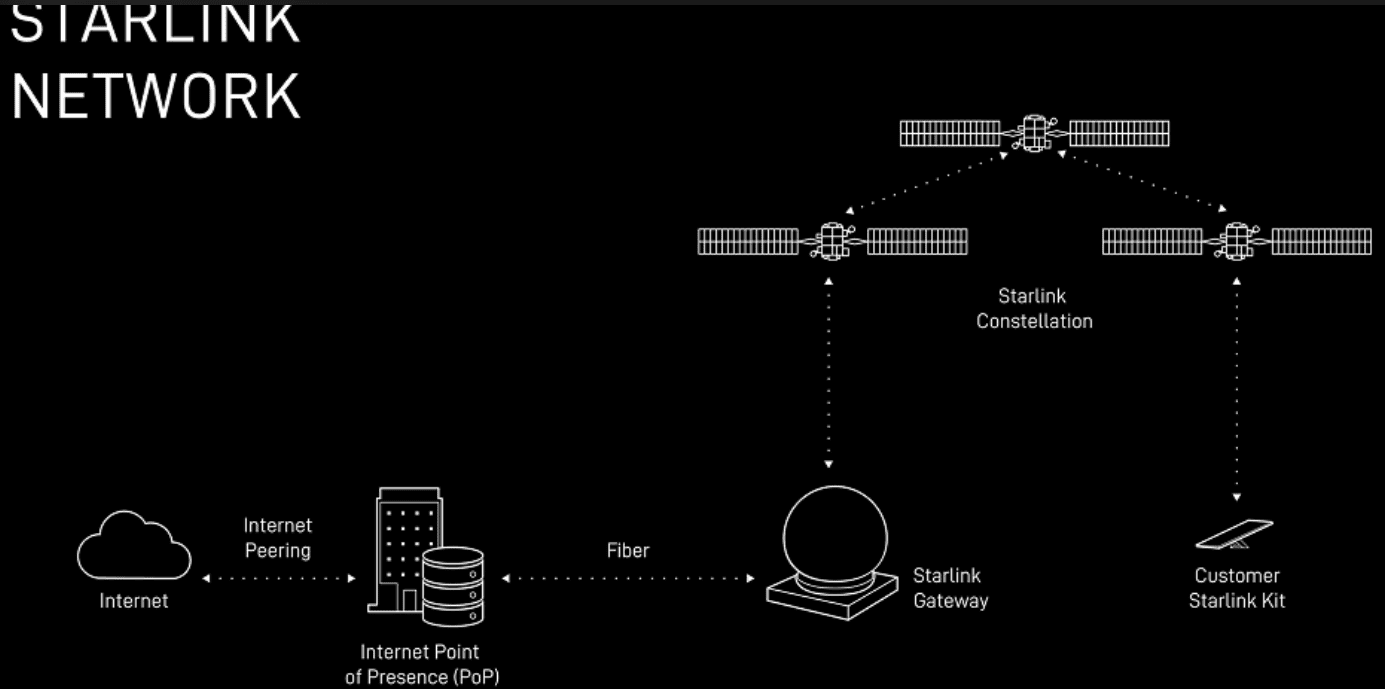
Starlink has also deployed the largest satellite ground network with more than 100 gateway sites in the United States alone – comprising a total of over 1,500 antennas – are strategically placed to deliver the lowest possible latency, especially for those who live in rural and remote areas.
Starlink produces these gateway antennas at our factory in Redmond, Washington where they rapidly scaled production to match satellite production and launch rate.
Network Resilience:
With more than 7,800 satellites in orbit, Starlink customers always have multiple satellites in view, as well as multiple gateway sites and internet points-of-presence locations (PoPs). As a result, Starlink customers benefit from continuous service even when terrestrial broadband is suffering from fiber cuts, subsea cable damage, and power outages that can deny service to millions of individuals for days.
Additionally, each Starlink satellite is equipped with cutting-edge optical links that ensure they can relay hundreds of gigabits of traffic directly with each other, no matter what happens on the ground. This laser network enables Starlink satellites to consistently and reliably deliver data around the world and route traffic around any ground conditions that affect terrestrial service at speeds that are physically impossible on Earth.
Starlink’s Latency:
To measure Starlink’s latency, the company collects anonymized measurements from millions of Starlink routers every 15 seconds. In the U.S., Starlink routers perform hundreds of thousands of speed test measurements and hundreds of billions of latency measurements every day. This high-frequency automated measurement assures consistent data quality, with minimal sampling bias, interference from Wi-Fi conditions, or bottlenecks from third-party hardware.
As of June 2025, Starlink is delivering median peak-hour latency of 25.7 milliseconds (ms) across all customers in the United States. In the US, fewer than one percent of measurements exceed 55 ms, significantly better than even some terrestrial operators.
- Addressing the Digital Divide: Starlink has positioned itself as a critical solution for rural and remote communities, offering high-speed, low-latency internet where fiber or cable is unfeasible.
- New Services: The company is expanding beyond individual households to include services for airlines, maritime operators, and businesses. There are also plans for a direct-to-cell service in partnership with mobile carriers like T-Mobile.
- Next-Generation Satellites: To manage the growing user base and increasing congestion, SpaceX plans to launch its larger, next-generation V3 satellites in 2026, which are designed to offer gigabit-class connectivity and dramatically increase network capacity.
- IPO Considerations: Starlink’s significant growth and role as SpaceX’s primary revenue driver have positioned the parent company for a potential initial public offering (IPO) in 2026.
Competition:
Starlink’s main LEO competitors are Amazon Leo (Project Kuiper) and OneWeb (Eutelsat), aiming for similar high-speed, low-latency service, while established providers Hughesnet and Viasat (mostly GEO) offer more traditional, affordable satellite options but with higher lag, though they’re adapting. Starlink leads in consumer availability and speed currently, but Amazon and OneWeb are rapidly scaling to challenge its dominance with LEO constellations, offering faster speeds and lower latency than older satellite tech.
……………………………………………………………………………………………………………..
References:
https://starlink.com/updates/network-update
Elon Musk: Starlink could become a global mobile carrier; 2 year timeframe for new smartphones
Amazon Leo (formerly Project Kuiper) unveils satellite broadband for enterprises; Competitive analysis with Starlink
NBN selects Amazon Project Kuiper over Starlink for LEO satellite internet service in Australia
GEO satellite internet from HughesNet and Viasat can’t compete with LEO Starlink in speed or latency
KDDI unveils AU Starlink direct-to-cell satellite service
Telstra selects SpaceX’s Starlink to bring Satellite-to-Mobile text messaging to its customers in Australia
U.S. BEAD overhaul to benefit Starlink/SpaceX at the expense of fiber broadband providers
One NZ launches commercial Satellite TXT service using Starlink LEO satellites
Reliance Jio vs Starlink: administrative process or auction for satellite broadband services in India?
FCC: More competition for Starlink; freeing up spectrum for satellite broadband service
SpaceX launches first set of Starlink satellites with direct-to-cell capabilities
Starlink Direct to Cell service (via Entel) is coming to Chile and Peru be end of 2024
NEC exits 4G/5G base station market underscoring Japan’s weak mobile infrastructure ecosystem
Japanese telecom vendor NEC has decided to cease development of 4G and 5G radio access base stations, effectively exiting a segment now overwhelmingly controlled by only five vendors (Huawei, Ericsson, Nokia, ZTE and Samsung). Huawei, Ericsson, and Nokia collectively hold ~80% of the worldwide 4G/5G base station market, while NEC and Fujitsu together hold under 1.5% global market share. That leaves Japan’s network equipment vendors structurally disadvantaged on both scale and pricing power. The move underscores structural weaknesses in Japan’s mobile infrastructure ecosystem, particularly its inability to reach scale in a highly globalized, capex‑intensive market.

Fujitsu spun off its communications-related business, including base stations, into a new subsidiary this July. Kyocera, which had planned to enter the 5G base station market in 2027, has also abandoned development of 5G base stations. NTT DoComo, Japan’s largest mobile network operator by subscriber count and market share, previously prioritized procurement from such Japanese companies such as NEC and Fujitsu but changed tack in 2024 and stepped up purchases from Ericsson, Nokia and other foreign companies.

A wireless base station on the roof of a building in Tokyo. (Photo obtained by Nikkei)
……………………………………………………………………………………………………………………………………………………………………
Key points:
-
NEC will halt new development of 4G and 5G base stations for smartphones and other endpoint devices, while stepping back from a market where its share had already fallen to a marginal level.
-
The decision is widely viewed as a market‑driven outcome, reflecting persistent losses in a business that never achieved the scale or cost structure required to compete with leading global RAN vendors.
-
Contemporary mobile infrastructure is a globalized and capital‑intensive industry, where survival hinges on high volumes to amortize R&D, silicon, software, manufacturing, and go‑to‑market costs across multiple product generations.
-
NEC will continue R&D for 6G and “Beyond 5G” systems, aligning with Japan’s national Beyond 5G Promotion Strategy, which targets commercialization of next‑generation services around 2030.
-
The company is concentrating research talent in areas such as open and virtualized RAN (v-RAN, Near‑RT RIC, AI-driven network optimization, and integrated terrestrial–non‑terrestrial networks, which are all positioned as building blocks for 6G.
-
However, Japan’s relatively shallow 5G deployment and weak installed base constrain its ability to test dense high‑frequency networks, a prerequisite for 6G architectures that will rely on ultra‑short‑range spectrum and far denser site grids.
-
Japan’s research and IP position in 6G remains modest, with domestic players accounting for roughly 10 percent of global 6G‑related patent filings in recent surveys, trailing several major competitors.
-
Limitations in technology reserves and standards participation raise questions about whether policy roadmaps alone can close the gap without corresponding gains in commercial scale and deployment experience.
-
Japan, along with Australia, Canada, the UK, and the US, has formed the Global Coalition on Telecommunications (GCOT), which is focusing on AI, security, and next‑generation standards, and is widely interpreted as a vehicle to counter China’s growing influence in telecom infrastructure.
-
Attempts to architect future high‑speed networks primarily around geopolitical blocs risk fragmenting markets, inflating development and compliance costs, and undermining interoperability—factors that historically have worked against technically superior but commercially isolated platforms in 4G and 5G.
-
Japan lacks a sufficiently large, unified domestic mobile market to independently sustain globally competitive RAN vendors and generate the economies of scale seen in China, Europe, or the US‑centric ecosystem.
-
Political alignment and industrial policy can provide funding and coordination, but they cannot substitute for large‑scale commercial demand, broad ecosystem participation, and sustained competitiveness across cost, performance, and time‑to‑market
References:
https://www.globaltimes.cn/page/202512/1351697.shtml
Japan to support telecom infrastructure in South Pacific using Open RAN technology
Japan telecoms are launching satellite-to-phone services
SNS Telecom & IT: Private 5G Market Nears Mainstream With $5 Billion Surge
Telecom sessions at Nvidia’s 2025 AI developers GTC: March 17–21 in San Jose, CA
SK Telecom, DOCOMO, NTT and Nokia develop 6G AI-native air interface
Nikkei Asia: Huawei demands royalties from Japanese companies
Smart electromagnetic surfaces/RIS: an optimal low-cost design for integrated communications, sensing and powering
Researchers at Xidian University in China have pioneered a smart electromagnetic surface that converts ambient electromagnetic waves into electrical power, marking a potential leap in stealth and wireless technologies. This meta-surface innovation merges advanced electromagnetic engineering with communication principles, enabling self-powered systems for demanding applications. The self-sustaining electronic system integrates wireless information transfer and energy harvesting and has the potential to upend the dynamics of electronic warfare.
The surface facilitates simultaneous energy harvesting and data transmission, drawing power from radar or environmental signals without traditional batteries. Xidian’s team highlights its role in “electromagnetic cooperative stealth,” where networked platforms collaboratively minimize radar cross-sections and sensor detectability. Prototypes demonstrate viability for real-time wave manipulation, building on metasurface designs that dynamically adjust phase and amplitude.
The researchers said this included investigating “electromagnetic cooperative stealth,” where multiple entities work together to reduce their visibility to radar and electromagnetic sensors. In electronic warfare, the technology flips the script on radar threats: stealth aircraft could harvest enemy beams for propulsion or comms, reducing logistical vulnerabilities. This cooperative approach extends to multi-asset formations, enhancing collective invisibility across spectra.
Early tests align with broader Reconfigurable Intelligent Surfaces (RIS), a two-dimensional reflecting surface. RIS advancements facilitate beam steering up to ±45° with low side lobes. According to a paper published in the IEEE Internet of Things magazine last year, RIS could also be used in anti-jamming technology, unmanned aerial vehicle communication and radio surveillance – all of which are difficult to do using older optimization tools.
Reconfigurable intelligent surfaces can also be configured to create intentional radio “dead zones” to mitigate interference and reduce the risk of eavesdropping, according to German electronics manufacturer Rohde & Schwarz. The European Space Agency has further highlighted RIS as a candidate technology for satellite-to-ground communications, where controllable reflection and redirection of signals could help route links around physical obstacles.
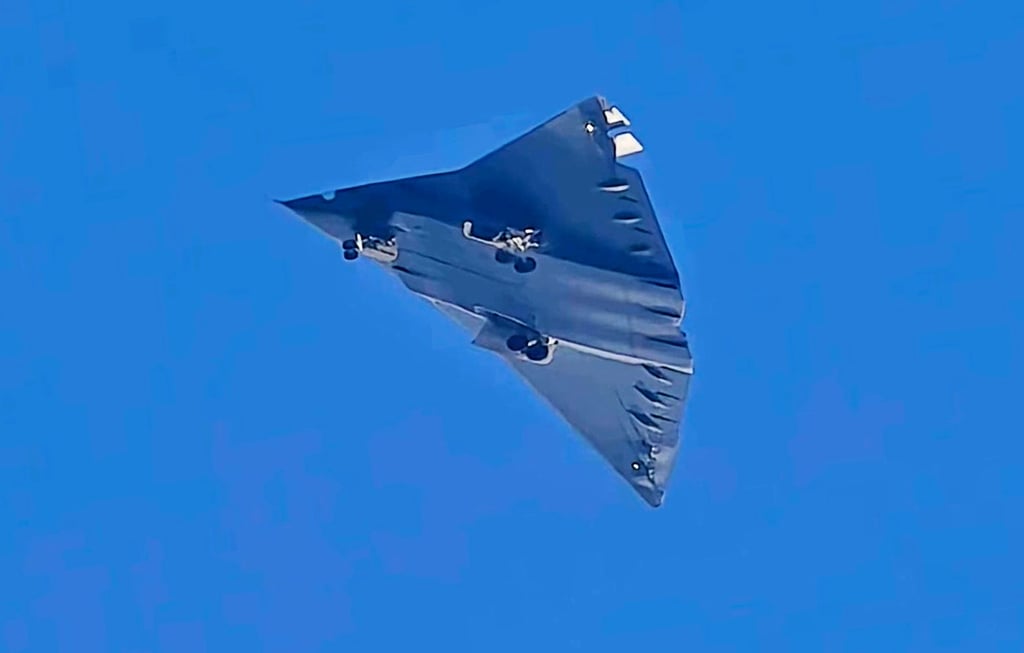
For telecommunications, the surface promises 6G breakthroughs like integrated sensing and powering satellites or base stations. China’s lead here could accelerate reconfigurable networks, improving coverage in non-line-of-sight scenarios. Ongoing refinements target complex interactions for higher precision. By including sensing, communication and power into one hardware platform, the device could allow for a range of advanced applications while reducing eavesdropping and interference.
“Ultimately, it is expected to have a broad impact on 6G communications, the Internet of Things, intelligent stealth and other related fields,” the team said in a paper published in the peer-reviewed journal National Science Review last month. Many scientists say that a key area for next-generation wireless communications will be the transmission channel.
Researchers from Fudan University, the University of Sydney and the Commonwealth Scientific and Industrial Research Organization note that, when combined with artificial intelligence (AI), this technology could significantly enhance the security of air-to-ground Internet of Things (IoT) links.
In their latest publication, the Xidian University team describes RIS as a “powerful solution” for future wireless networks, citing its low cost, high programmability and ease of deployment. However, for 6G systems, RIS must support both communication and sensing on a unified hardware platform by integrating data transmission and radar-like functionality to lower cost and optimize spectrum and hardware resource utilization.
Addressing this requirement will demand architectures that can jointly manipulate both scattered electromagnetic waves and actively radiated signals. The researchers propose that an electromagnetic all-in-one radiation–scattering RIS architecture could provide a viable path to meeting this dual-control challenge. “This achieves significant savings in physical space and cost while ensuring multifunctionality across diverse application scenarios,” the team said. The RIS system could also work in a receiver mode to harvest wireless energy to be used to power the meta-surface itself or charge other electronic devices, the paper added.
It could be used for line-of-sight wireless communication, where there is a direct, unobstructed path between a transmitter and receiver, as well as non-line-of-sight wireless communication, in which there is no direct visual link due to physical barriers like buildings.
The proposed RIS “stands out as the optimal low-cost design” for integrated communication and sensing. “In the future, this architecture could enable the development of environment-adaptive integrated sensing and communication systems, micro base stations and relay integrated systems, as well as self-powered sensing systems,” the team said.
………………………………………………………………………………………………………………………………………………………………………………………
References:
https://ieeexplore.ieee.org/document/10907868
Nokia sees new types of 6G connected devices facilitated by a “3 layer technology stack”
Electromagnetic Signal & Information Theory (ESIT): From Fundamentals to Standardization-Part I.
Electromagnetic Signal and Information Theory (ESIT): From Fundamentals to Standardization-Part II.
IMT Vision – Framework and overall objectives of the future development of IMT for 2030 and beyond
ITU-R WP5D: Studies on technical feasibility of IMT in bands above 100 GHz
Summary of ITU-R Workshop on “IMT for 2030 and beyond” (aka “6G”)
Excerpts of ITU-R preliminary draft new Report: FUTURE TECHNOLOGY TRENDS OF TERRESTRIAL IMT SYSTEMS TOWARDS 2030 AND BEYOND
Juniper Research: Global 6G Connections to be 290M in 1st 2 years of service, but network interference problem looms large
Groq and Nvidia in non-exclusive AI Inference technology licensing agreement; top Groq execs joining Nvidia
AI chip startup Groq [1.] today announced that it has entered into a non-exclusive licensing agreement with Nvidia for Groq’s AI inference technology [2.]. The agreement reflects a shared focus on expanding access to high-performance, low cost inference. As part of this agreement, Jonathan Ross, Groq’s Founder, Sunny Madra, Groq’s President, and other members of the Groq team will join Nvidia to help advance and scale the licensed technology. Groq will continue to operate as an independent company with Simon Edwards stepping into the role of Chief Executive Officer. GroqCloud will continue to operate without interruption. It remains to be seen how Groq’s new collaboration with Nvidia will effect its recent partnership with IBM.
Note 1. Founded in 2016, Groq specializes in what is known as inference, where artificial intelligence (AI) models that have already been trained respond to requests from users. While Nvidia dominates the market for training AI models (see Note 2.), it faces much more competition in inference, where traditional rivals such as Advanced Micro Devices have aimed to challenge it as well as startups such as Groq and Cerebras Systems.
Note 2. Training AI models (used by Nvidia GPUs) involves teaching a model to learn patterns from large amounts of data, while AI “inferencing” refers to using that trained model to generate outputs. Both processes demand massive computing power from AI chips.
…………………………………………………………………………………………………………………………………………………………………………………………………….
Groq has achieved a significant financial milestone, elevating its post-money valuation to $6.9 billion from $2.8 billion following a successful $750 million funding round in September. The company distinguishes itself in the competitive AI chip landscape by employing a unique architectural approach that does not rely on external high-bandwidth memory (HBM) chips. This design choice, leveraging on-chip static random-access memory (SRAM), mitigates the supply chain constraints currently impacting the global HBM market.
The LPU (Language Processing Unit) architecture, while enhancing inference speed for applications like chatbots, currently presents limitations regarding the maximum size of AI models that can be efficiently served. Groq’s primary competitor utilizing a similar architectural philosophy is Cerebras Systems, which has reportedly commenced preparations for an initial public offering (IPO) as early as next year. Both companies have strategically secured substantial contracts in the Middle Eastern market.

Nvidia’s investments in AI firms span the entire AI ecosystem, ranging from large language model developers such as OpenAI and xAI to “neoclouds” like Lambda and CoreWeave, which specialize in AI services and compete with its Big Tech customers. Nvidia has also invested in chipmakers Intel and Enfabrica. The company made a failed attempt around 2020 to acquire British chip architecture designer Arm Ltd. Nvidia’s wide-ranging investments — many of them in its own customers — have led to accusations that it’s involved in circular financing schemes reminiscent of the dot-com bubble. The company has vehemently denied those claims.
…………………………………………………………………………………………………………………………………………………………………..
This deal follows a familiar pattern in recent years where the world’s biggest technology firms pay large sums in deals with promising startups to take their technology and talent but stop short of formally acquiring the target.
- A great example of that was Meta which in June invested ~$14.3 billion in Scale AI for a 49% stake in the company. That move valued the startup at around $29 billion. As part of that deal, 28 year old Alexandr Wang resigned as CEO of Scale AI to become Meta’s first-ever Chief AI Officer. He will remain on Scale AI’s board of directors. Wang’s team at the new “superintelligence” lab is tasked with building advanced AI systems that can surpass human-level intelligence.
- In a similar but smaller scale deal, Microsoft agreed to pay AI startup Inflection about $650 million in cash in an unusual arrangement that would allow Microsoft to use Inflection’s models and hire most of the startup’s staff including its co-founders, a person familiar with the matter told Reuters. The high-profile AI startup’s models will be available on Microsoft’s Azure cloud service, the source said. Inflection is using the licensing fee to pay Greylock, Dragoneer and some other investors, the source added, saying the investors will get a return of 1.5 times what they invested.
Bernstein analyst Stacy Rasgon wrote in a note to clients on Wednesday after Groq’s announcement:
“The Nvidia-Groq deal appears strategic in nature for Nvidia as they leverage their increasingly powerful balance sheet to maintain dominance in key areas…..Antitrust would seem to be the primary risk here, though structuring the deal as a non-exclusive license may keep the fiction of competition alive (even as Groq’s leadership and, we would presume, technical talent move over to Nvidia). Nvidia CEO Jensen Huang’s “relationship with the Trump administration appears among the strongest of the key U.S. tech companies.”
…………………………………………………………………………………………………………………………………………………………………………………………………………….
Nvidia CEO Jensen Huang recently dedicated a significant portion of his 2025 GTC 2025 conference keynote speech to emphasize that Nvidia intends to maintain its market dominance as the AI sector increasingly transitions its focus from model training to inference workloads. Huang delivered two major GTC keynotes in 2025: The primary annual conference held in San Jose, California, in March 2025 and a second GTC in Washington, D.C., in October 2025. At these events, he emphasized the rise of “reasoning AI” and “agentic AI” as the drivers for an unprecedented 100x surge in demand for inference computing in just a couple of years. Huang announced that the new Blackwell system, designed as a “thinking machine” for reasoning, was in full production and optimized for both training and large-scale inference workloads.
Huang shared a vision of moving from traditional data centers to “AI factories“—ultra-high-performance computing environments designed specifically to generate intelligence at scale, positioning investment in Nvidia’s infrastructure as an economic necessity.
…………………………………………………………………………………………………………………………………………………………………………………………………………….
References:
https://www.arm.com/glossary/ai-inference
IBM and Groq Partner to Accelerate Enterprise AI Inference Capabilities
Sovereign AI infrastructure for telecom companies: implementation and challenges
AI wireless and fiber optic network technologies; IMT 2030 “native AI” concept
Custom AI Chips: Powering the next wave of Intelligent Computing
OpenAI and Broadcom in $10B deal to make custom AI chips
Reuters & Bloomberg: OpenAI to design “inference AI” chip with Broadcom and TSMC
Analysis: OpenAI and Deutsche Telekom launch multi-year AI collaboration
Expose: AI is more than a bubble; it’s a data center debt bomb
Will the wave of AI generated user-to/from-network traffic increase spectacularly as Cisco and Nokia predict?
Research & Markets: WiFi 6E and WiFi 7 Chipset Market Report; Independent Analysis
According to Research & Markets, the WiFi 6E (IEEE 802.11ax) and WiFi 7 (IEEE 802.11be [1.]) chipset market is expanding rapidly, with projections indicating a rise from $33.65 billion in 2024 to $40.50 billion by 2025, and estimates reaching $149.65 billion by 2032. This growth reflects a notable CAGR of 20.50%, primarily driven by organizations upgrading their wireless networks in response to rising digital application use and increasing data volume.
Note 1. IEEE 802.11be standard was published July 22, 2025. The Project Approval Request (PAR) is here.

Enterprises today require scalable, secure wireless infrastructure capable of supporting diverse and demanding workloads. The latest WiFi chipsets improve network performance, facilitate secure operations, and support robust digital transformation strategies. Adopting Wi-Fi 6E and Wi-Fi 7 chipsets positions organizations to deliver secure, agile connectivity with higher speeds and lower latency.
- Application Areas: Automotive organizations implement advanced chipsets to support secure, reliable vehicle connectivity and enhance driver-assistance systems. In consumer electronics, manufacturers drive higher interactivity and seamless device experiences with updated wireless integration. Enterprises emphasize improved workforce mobility, while healthcare adopts secure, high-speed wireless for telemedicine and remote diagnostics. Industry operators deploy chipsets to enable robotics, automation, and smart manufacturing environments.
- End Users: Commercial enterprises in sectors such as hospitality, offices, and retail seek enhanced connectivity to increase operational efficiency and elevate customer engagement. Industrial segments-including utilities and manufacturing-prioritize automation and resilient communications infrastructure. Residential users focus on smart technology integration and flexible, connected home environments.
- Chipset Technologies: Integrated combo chips provide straightforward deployment for rapid delivery and compatibility, while discrete chipsets offer a tailored approach in high-volume or specialized scenarios. System-on-chip solutions bring high-density integration, maximizing energy efficiency and aligning with sustainability targets.
- Distribution Channels: Organizations maintain robust supply chains utilizing established resellers and digital platforms, ensuring prompt response to evolving logistical demands and market conditions.
- Regional Coverage: The Americas, Europe, Middle East and Africa, and Asia-Pacific each offer unique opportunities and regulatory landscapes, guiding deployment strategies and technology adoption in response to local dynamics.
- Company Profiles: The industry includes innovation-focused leaders such as Broadcom, Qualcomm, and MediaTek. These companies exhibit diverse approaches to integration and product differentiation across the competitive landscape.
Strategic Insights:
- The expanded wireless spectrum empowers businesses to scale connectivity, supporting data-rich operational environments where performance stability and capacity are critical.
- Next-generation chipset architectures enhance automation and real-time data management, particularly in healthcare and manufacturing, strengthening capabilities for time-sensitive applications.
- Collaborations between chipset vendors and device manufacturers improve compatibility, enabling tailored wireless infrastructure to address bespoke enterprise requirements.
- Maintaining a flexible supply approach-leveraging diverse distribution channels-supports organizational agility in facing evolving international trade and supply scenarios.
- Ongoing improvements in wireless security and system reliability support compliance and data protection needs for sectors operating under stringent regulatory requirements.
Market Insights:
- Surge in demand for Wi-Fi 7 chipsets optimized for multi-gigabit data throughput in dense public venues
- Integration of advanced OFDMA and multi-user MIMO enhancements to support simultaneous high-bandwidth applications
- Adoption of 6 GHz spectrum by enterprise networks to enable low-latency connectivity for critical IoT devices
- Development of energy-efficient chipset architectures to extend battery life in mobile and IoT applications
- Emergence of AI-driven adaptive beamforming techniques to improve signal reliability in complex environments
- Strategic partnerships between chipset vendors and cloud providers to accelerate edge computing deployments
- Certification focus on security enhancements such as WPA3-SAE to address evolving wireless threat vectors
- Custom chipset solutions for automotive and industrial automation requiring ultra-reliable low-latency performance
For more information about this report visit: https://www.researchandmarkets.com/r/q1rlgd
…………………………………………………………………………………………………………………………………
Independent Analysis:
The top three WiFi chipset vendors are:
- Broadcom Inc.: Broadcom is generally recognized as the market leader in the Wi-Fi 6/6E and Wi-Fi 7 segment, particularly in terms of revenue share. They supply chips for a wide range of devices, from high-performance consumer routers (e.g., Netgear, Asus models) to enterprise-grade networking equipment, and are a key supplier for platform upgrades like those in flagship smartphones.
- Qualcomm Technologies, Inc.: Qualcomm is a major competitor, especially in the mobile and networking infrastructure segments. Their “FastConnect 7800” chipset has positioned them for significant growth, with Wi-Fi 6E and 7 products expected to comprise a large portion of their Wi-Fi sales in 2025. They are also a primary chip provider for many high-end routers and mesh systems.
- MediaTek Inc.: MediaTek is a strong player, particularly in the consumer electronics space and in Asia-Pacific markets. Their “Filogic 380/880” Wi-Fi 7 chipsets have seen high demand, and they have strong partnerships with major brands like TP-Link and ZTE.
Other WiFi chipset vendors include: Marvell Technology Group, Intel, Realtek Semiconductor Corporation NXP Semiconductors, Texas Instruments, and Samsung Electronics Co. The market is competitive, with these vendors heavily investing in R&D and strategic partnerships to drive the adoption of new Wi-Fi standards from IEEE 802.11 WG.
The top markets for WiFi 6E/7 chipsets are: Smartphones, PC /laptops, Access Point/WiFi routers, CPE /gateways /extenders, industry verticals (e.g. manufacturing, automotive, industrial, home appliances, gaming, augmented reality, etc).
Sources: Gemini, Perplexity AI
……………………………………………………………………………………………………………………………………………………………………..
References:
https://www.ieee802.org/11/PARs/P802_11be_PAR_Detail.pdf
Wireless Broadband Alliance Report: WiFi 7, converged Wi-Fi and 5G, AI/Cognitive networks, and OpenRoaming
WiFi 7: Backgrounder and CES 2025 Announcements
WiFi 7 and the controversy over 6 GHz unlicensed vs licensed spectrum
MediaTek to expand chipset portfolio to include WiFi7, smart homes, STBs, telematics and IoT
MediaTek Announces Filogic Connectivity Family for WiFi 6/6E
Intel and Broadcom complete first Wi-Fi 7 cross-vendor demonstration with speeds over 5 Gbps
Qualcomm FastConnect 7800 combining WiFi 7 and Bluetooth in single chip
Rethink Research: Private 5G deployment will be faster than public 5G; WiFi 6E will also be successful
WBA field trial of Low Power Indoor Wi-Fi 6E with CableLabs, Intel and Asus
Aruba Introduces Industry’s 1st Enterprise-Grade Wi-Fi 6E Access Point
Apple leads 128+% YoY increase in foreign mobile phones shipped within China; Global market share leaders
In November 2025, the volume of foreign-branded mobile phones shipped within China experienced a substantial year-over-year increase of 128.4%. This surge was primarily due to increased sales of Apple iPhones, especially iPhone 17. According to data released by the government-affiliated China Academy of Information and Communications Technology (CAICT), 6.93 million units of international brands were shipped last month. This sharp rise occurred within the context of a broader market increase — total national mobile phone shipments for November reached 30.16 million units, representing a more modest overall year-on-year growth of 1.9%.
The exceptional increase in foreign branded phones is largely attributed to the robust reception of the new iPhone 17 series in the Chinese market. Reports indicate the iPhone 17 line accounted for a substantial portion of Apple’s sales during the period, successfully recapturing market share that had been lost to strong local competition, such as Huawei, throughout the year.
This marks a significant turnaround for Apple in China. In the first month after the iPhone 17 launch, sales reportedly jumped 22% compared to the iPhone 16 launch the previous year. The performance stands in stark contrast to previous periods in 2024 where Apple’s sales had faced challenges and decline due to intensified competition and market saturation. In October 2025, iPhones reportedly accounted for one in every four smartphones sold in China, their highest market share since 2022.
Meanwhile, domestic phone brands like Huawei and Xiaomi saw slower momentum as they delayed some new product launches. That gave Apple a wider sales window and helped foreign brands capture about 23% of the market, compared with roughly 10% in past months.
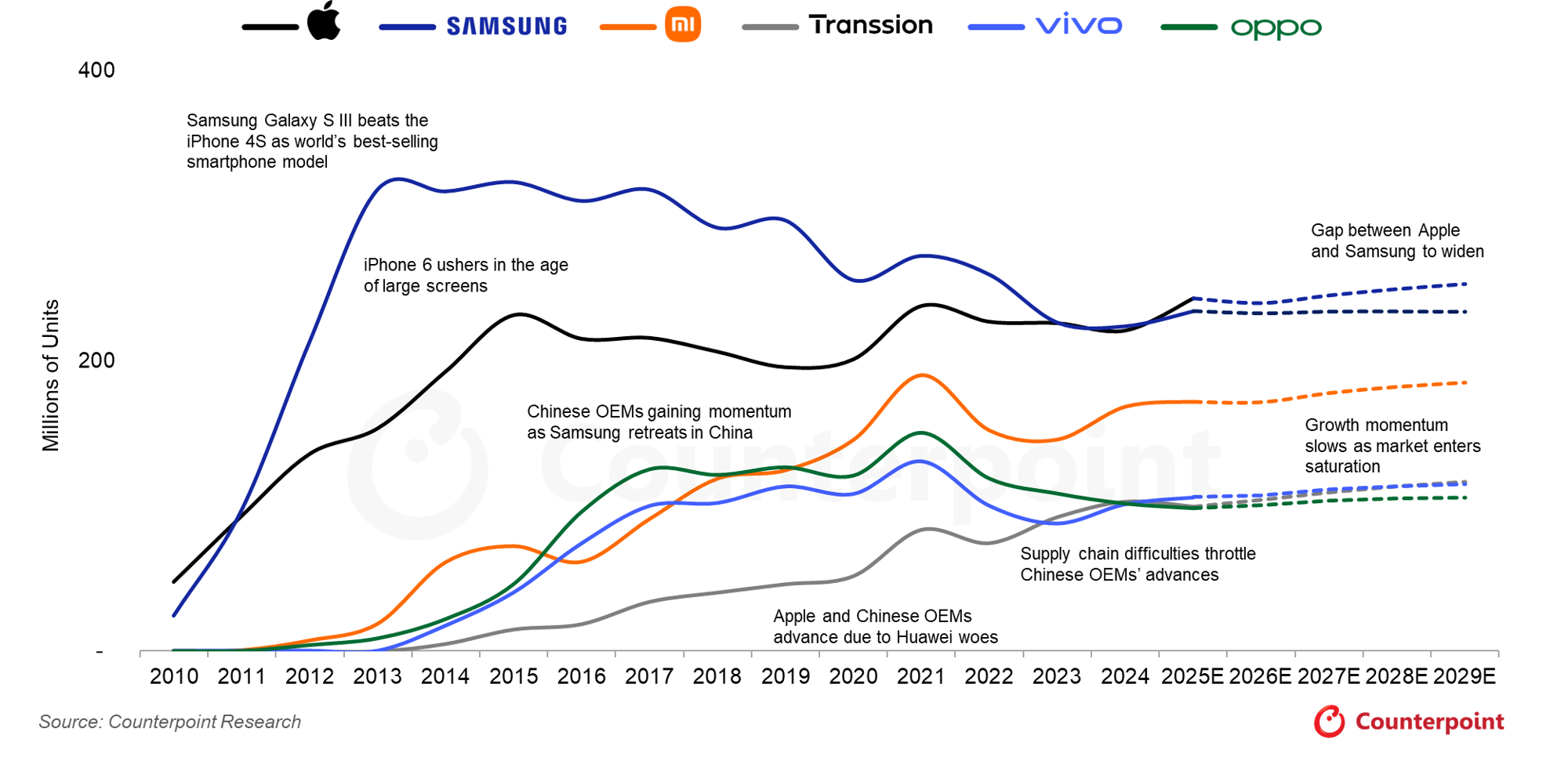
China brands account for eight of the top 10 global smartphone market share positions after Samsung and Apple.
………………………………………………………………………………………………………………………
https://counterpointresearch.com/en/insights/Global-Smartphone-Forecast-for-2025
IDC: Worldwide Smartphone Shipment +7.8% YoY; Samsung regains #1 position
Huawei forecast to increase mobile phone shipments despite Android ban
Non-Terrestrial Networks (NTNs): market, specifications & standards in 3GPP and ITU-R
Introduction:
A recent survey showed that Non-Terrestrial Networks (NTNs) are viewed by the telecom industry as reinforcing service reliability and adding an extra layer of network redundancy to 5G. This view increasingly makes the convergence of satellites and 5G (and fiber) a mainstream application in telecoms. With LEO constellation service revenues forecast to reach $15 billion next year, the industry is expected to experience unprecedented growth.
However, that growth will depend on interoperability to realize economies of scale. To achieve that goal NTN standards, regulatory and policy frameworks must evolve to keep pace and ensure equitable access to space for all. As such, we examine the status and future NTN work in 3GPP and ITU-R in this article.
…………………………………………………………………………………………………………………………………………………
3GPP (3rd Generation Partnership Project) has established NTNs as a key part of 5G and future 6G by defining standards in Release 17, which introduced support for satellites and High-Altitude Platforms (HAPS) for direct-to-device (D2D) communication, enabling ubiquitous connectivity. Current work in Release 18 and beyond (including ongoing Release 19 studies) focuses on enhancing performance, expanding spectrum, improving security, and integrating NTNs seamlessly with terrestrial networks for better resource management, leading towards a unified, hybrid telecom ecosystem for global coverage.
- Release 15 & 16 (Foundational): Established NTN use cases, system architectures, and channel models for satellite-based systems.
- Release 17 (First Standardized Release): Introduced the first normative specifications for 5G NR and NB-IoT NTNs, covering GEO and LEO/MEO satellites, addressing technical hurdles like propagation delay and Doppler shift for mass-market devices.
- Release 18 (Enhancements): Studied security aspects, improved 5G NR NTN for higher frequencies (above 10 GHz), and focused on resource management for efficient integration.
- Release 19 & Beyond (Ongoing): Continues to evolve NTNs, introducing features like regenerative payloads, Ku-band support, and further integration for future 5G-Advanced and 6G networks, with studies on 6G architecture.
- Hybrid Networks: Creating a unified framework for seamless terrestrial and non-terrestrial operation.
- Direct-to-Device (D2D) Evolution: Expanding services beyond basic IoT to support smartphones for voice and data in remote areas.
- Technical Refinements: Addressing RF performance, spectrum coordination, and operational complexity for LEO/MEO systems.
- 6G Foundation: Building architectural principles for ubiquitous connectivity that will underpin future 6G systems.
The International Telecommunication Union Radiocommunication Sector (ITU-R) Working Party 4B is actively shaping NTN’s by developing reports and recommendations to integrate satellites (LEO, MEO, GEO) and High-Altitude Platforms (HAPs) with 5G and future 6G cellular networks. The aim is to enable ubiquitous coverage, Direct-to-Device (D2D) services, and seamless hybrid networks, with ongoing work focusing on radio interface specifications, spectrum harmonization, and performance enhancements for reliable connectivity.

- Standardization: ITU-R is finalizing Recommendation ITU-R M.IMT-2020-SAT.SPECS (based on 3GPP’s Release 17/18 specs) to standardize 5G satellite-to-ground communication, supporting IoT and advanced mobile services.
- Working Groups: WP 4B (Satellite services) and other groups are key to defining NTN requirements, spectrum usage, and interoperability.
- Focus Areas:
- Hybrid Networks: Creating seamless service continuity between terrestrial and space/aerial segments.
- Direct-to-Device (D2D): Enabling smartphones to connect directly to satellites.
- Spectrum: Harmonizing spectrum for NTNs, including Ku-band, for expanded services.
- Performance: Addressing challenges like Doppler shift, propagation delay, and handover management for LEO/MEO constellations.
- 3GPP is a crucial partner, introducing NTN frameworks in Release 17 (IoT) and Release 18 (enhanced 5G), with continuous updates for 6G and beyond, closely coordinating with ITU-R.
- ITU-R’s reports discuss future trends, including AI-driven interfaces, diverse terminals (wearables, implants), and the role of NTNs in achieving global, resilient connectivity, supporting Sustainable Development Goals (SDGs).
References:
https://www.gsma.com/solutions-and-impact/technologies/networks/gsma_resources/non-terrestrial-networks-opportunities-and-challenges/
https://www.telecoms.com/satellite/key-non-terrestrial-network-developments-in-2025
https://www.3gpp.org/technologies/ntn-overview
Telecoms.com’s survey: 5G NTNs to highlight service reliability and network redundancy
ITU-R recommendation IMT-2020-SAT.SPECS from ITU-R WP 5B to be based on 3GPP 5G NR-NTN and IoT-NTN (from Release 17 & 18)
Standards are the key requirement for telco/satellite integration: D2D and satellite-based mobile backhaul
GSMAi: key telecom developments in 2025; major trends to watch in 2026
Deutsche Telekom: successful completion of the 6G-TakeOff project with “3D networks”
AST SpaceMobile to deliver U.S. nationwide LEO satellite services in 2026
MTN Consulting: Satellite network operators to focus on Direct-to-device (D2D), Internet of Things (IoT), and cloud-based services
Samsung announces 5G NTN modem technology for Exynos chip set; Omnispace and Ligado Networks MoU
How will fiber and equipment vendors meet the increased demand for fiber optics in 2026 due to AI data center buildouts?
Fiber optic vendors are employing a mix of manufacturing expansion, technological innovation in high-density and next-generation fibers, and strategic supply chain alignment to meet the anticipated surge in demand from AI and data centers in 2026. The demand is so high that at least one major fiber manufacturer, whose name was not explicitly disclosed in news reports, has already sold all its fiber inventory through 2026. Major fiber optic vendors by category are:
- Fiber & Cable Manufacturing: Corning, Prysmian Group, Sumitomo Electric, Fujikura, CommScope, Sterlite Technologies (STL), Yangtze Optical Fibre & Cable (YOFC)
- Optical Transport/Networking: Nokia, Ciena (gaining share), Cisco, Fujitsu, Huawei, Infinera (now part of Nokia)
- Optical Components/Transceivers: Coherent Corporation, Lumentum, Broadcom, Innolight, Accelink
Major focus areas of selected vendors:
- Corning: Leading in fiber cable quality and innovation
- Nokia & Ciena: Strong in optical transport and network solutions, gaining market share
- Cisco & Huawei: Significant players in optical transceivers, catching up to leaders
- CommScope, Clearfield, STL: Preparing for huge demand surges
John McGirr, SVP and general manager for Corning Optical Fiber & Cable, said, “The surge in hyperscale and AI network loads has significantly increased our expectations for fiber demand. Enterprise sales grew 58% year-over-year in Q3 2025, driven by continued strong adoption of Corning’s Gen AI products, largely due to AI network growth demands. The 72-GPU nodes, such as (Nvidia’s) Blackwell, require 16 times more fiber than traditional cloud switch racks. We see no signs of AI network growth slowing down especially as operators scale up (increase computational power by adding more resources within the existing backend AI network node) and scale out (increase the number of nodes to accommodate increasing demand) their networks.”
Rahul Puri, CEO of the Optical Networking Business at STL, said, “AI-focused data centers require significantly more fiber — about 36x more fiber than traditional CPU-based racks — to handle the massive data volumes and high-speed connectivity required by GPU clusters.” Puri predicts that cumulative hyperscale data capacity will increase by three times in the next few years alone. “The U.S. will need to add 213.3 million more fiber miles by 2029, more than doubling its current amount from 159.6 million fiber miles to 372.9 million miles. Our roadmap is shaped directly with the world’s leading cloud, AI and data center operators,”” Puri added.
CommScope’s VP of Technology John Chamberlain and VP of Hyperscale Cloud Erik Gronvall noted that the company has expanded its fiber manufacturing capacity in recent years to meet increased demand. “We are also innovating to reduce the amount of time it takes to deploy AI clusters,” said Chamberlain and Grovall.
………………………………………………………………………………………………………………………………………………………
Fiber Vendor Strategies:
Capacity Increase: Vendors like Corning and CommScope are investing in increasing their production capacity for fiber optic cables and the necessary preforms (raw material for fiber). This includes expanding existing facilities to help alleviate the current supply chain tightness and long lead times.
Technological Innovation in Fiber Design: To support the extreme bandwidth and low-latency needs of AI, vendors are focusing on advanced fiber technologies.
-
- Higher Fiber Counts: Companies are launching cables with extremely high fiber counts (e.g., 1,728+ strands) and higher density options to pack more capacity into existing infrastructure.
- Next-Generation Fibers: Research is ongoing in areas like hollow-core fiber (which uses air or a vacuum to transmit light faster and with less loss) and multicore fiber (multiple cores in one strand to increase capacity). These technologies, while not yet mainstream for 2026, are part of the long-term strategy.
- Bend-Insensitive Fiber: Innovations in bend-insensitive and ultra-high fiber count cables are improving durability and easing deployment in complex data center environments.
Pre-connectorized and Modular Solutions: To counter a persistent skilled labor shortage and speed up deployment, vendors are pushing factory-terminated, plug-and-play fiber systems and modular platforms (like Siemon’s LightStack). These solutions require less on-site expertise and reduce installation time.
Strategic Partnerships and Supply Chain Alignment: Vendors are forming strategic collaborations with hyperscalers and network operators (like the agreement between Corning and Lumen) to align manufacturing platforms with future demand and ensure supply. They are also working to optimize supply chains and, in some cases, regionalize manufacturing to reduce lead times.
Structured Cabling and Photonics: There is a renewed focus on structured cabling architectures, as recommended by some AI platform providers, to ensure predictable, low-latency performance and simpler long-term management. The industry is also exploring integrated photonics to address the power and thermal challenges of future systems.
Focus on AI-Specific Demands: Vendors recognize that AI data centers require up to five times more connectivity than traditional hyperscaler topologies and network architectures. Their strategies are specifically tailored to high-volume, intra-bay, inter-bay, and middle-mile fiber connections to link distributed data center clusters into a single, unified AI computing environment.
…………………………………………………………………………………………………………………………………………………………………………………………………………………………………………………………………
Ciena and Nokia:
- Ramping up Production: Ciena is accelerating the production of 800G ZR+ optical pluggables, with plans to ship a large volume in 2026 to major cloud providers who are currently testing the technology.
- New Architectures: The company is developing new interconnect solutions under the “Scaleacross” architecture designed to support growing AI workloads by significantly increasing capacity and density within the data center.
- Increased Forecasts: Driven by record orders from hyperscalers, Ciena has raised its revenue guidance for fiscal 2026 to a range of $5.7 billion to $6.1 billion, a significant increase that analysts tie directly to AI-driven demand.
- Strategic Positioning: Ciena emphasizes that the network will be the primary limiter of AI performance by 2026, positioning its high-speed fiber solutions as critical for moving massive amounts of data between compute nodes efficiently.
- Major U.S. Investment: Nokia announced a $4 billion investment in U.S. R&D and manufacturing capabilities for “AI-ready” network technologies, including optical and data center networking, to ensure robust domestic supply.
- Strategic Reorganization: Effective at the start of 2026, Nokia will reorganize into two primary segments, one of which is “Network Infrastructure” (including optical networks), which it sees as the center of the “AI supercycle.”
- Industry Collaboration: Nokia has deepened its commitment to the Open Compute Project (OCP) at the Platinum level, aiming to collaborate on open, interoperable AI networking innovations that optimize space, cost, and power efficiency with standards-driven technology.
- Advocacy for Network Modernization: Nokia’s research highlights that current networks are insufficient for future AI growth, advocating for substantial investment and cross-industry collaboration to modernize digital infrastructure to handle the uplink-heavy, distributed data flows generated by AI.
…………………………………………………………………………………………………………………………………………………………….
References:
https://www.fierce-network.com/broadband/major-fiber-vendors-strategize-huge-demand-ai-2026
https://www.fierce-network.com/premium/research/1410126?pk=FN-Research-Commscope-111925-listing
NTT to launch 25 Gps FTTH service in Tokyo starting March 2026
AI wireless and fiber optic network technologies; IMT 2030 “native AI” concept
AI infrastructure investments drive demand for Ciena’s products including 800G coherent optics
AT&T sets 1.6 Tbps long distance speed record on its white box based fiber optic network
China Telecom with ZTE demo single-wavelength 1.2T bps hollow-core fiber transmission system over 100T bps
Lumen and Ciena Transmit 1.2 Tbps Wavelength Service Across 3,050 Kilometers
Co-Packaged Optics to play an important role in data center switches
Coherent Optics: Synergistic for telecom, Data Center Interconnect (DCI) and inter-satellite Networks
Hyper Scale Mega Data Centers: Time is NOW for Fiber Optics to the Compute Server
Microsoft acquires Lumenisity – hollow core fiber high speed/low latency leader
China Mobile to deploy 400G QPSK by the end of 2023