

Ookla: D2D satellite connectivity surged 24.5% during last 9 months; Starlink’s footprint expansion leads the way
Introduction:
Direct-to-device (D2D) satellite connectivity, primarily driven by Starlink deployments, continues to accelerate despite nascent market maturity. Ookla’s latest analysis reveals that while global D2D connections surged 24.5% from July 2025 to March 2026—spurred by Starlink’s expansion into Chile, Ukraine, Peru, and the UK—penetration among mobile subscribers remains under 1.5% in leading markets.
Starlink dominates D2D traffic, accounting for the bulk of connections alongside contributions from Skylo and Lynk Global. Initial use cases center on non-terrestrial network (NTN) extensions for SMS and geolocation in coverage gaps, with next-gen systems eyeing 5G NR integration via acquired spectrum like EchoStar’s holdings. Regional growth offset US/Canada dips, potentially tied to T-Mobile and Rogers introducing D2D surcharges amid seasonal patterns.

Image Credit: Ookla
Market Share Breakdown:

Adoption Barriers:
Terrestrial networks already blanket 96% of the global population per GSMA Intelligence, curbing urgency for D2D beyond edge cases. Low awareness and constrained throughput—versus 5G benchmarks—further limit uptake, though link budgets and multi-orbit architectures promise evolution.
Future Outlook:
Based on the February GSA (Global mobile Suppliers Association) report, Direct-to-Device (D2D) services have achieved commercial launch in 15 markets, with 61 countries currently in the evaluation, testing, or deployment phases of Non-Terrestrial Network (NTN) partnerships. Starlink dominates the landscape with 59 partnerships, followed by AST SpaceMobile at 28. In China—a market excluded from GSA data—ABI Research indicates that China Unicom and China Telecom are already leveraging the Tiantong GEO system for D2D. China Mobile is utilizing the BeiDou constellation while planning integrations with emerging LEO networks. To evolve from narrowband emergency services to full mobile broadband, all three Tier-1 operators are aligning with state-backed LEO mega-constellations, specifically Project Guowang and G60 Qianfan (Spacesail).
For Mobile Network Operators (MNOs), D2D integration significantly alters CAPEX/OPEX strategies. In rural or remote areas, MNOs must now run a cost-benefit analysis: deploy traditional macro sites or utilize satellite-based coverage to eliminate dead zones. While Starlink argues that D2D allows MNOs to reduce terrestrial investment, the technology is largely limited to outdoor environments. Given that approximately 80% of mobile traffic is generated indoors—where satellite link budgets typically fail—terrestrial densification remains critical.
From a regulatory standpoint, the rise of NTN-D2D complicates Universal Service Fund (USF) allocations. In the U.S., the FCC is currently assessing how the $9 billion 5G Fund for Rural America should account for D2D capabilities. Ultimately, while D2D may solve the “dead zone” problem for outdoor mobility, it serves as a complement to, rather than a replacement for, high-capacity terrestrial infrastructure. Enhanced spectrum harmonization and handset chipsets could pivot D2D from supplemental to resilient 5G NTN layer, challenging capex models for rural densification. Network operators must navigate billing handoffs and QoS parity to unlock scale.
References:
https://www.ookla.com/articles/measuring-the-direct-to-device-d2d-marketplace-2026
US Mobile’s new bundle combines its multi-network mobile service with Starlink residential internet
Analysis: Amazon <- Globalstar – a strategic move for D2D and spectrum parity
GSA: 5G Non Terrestrial Networks, 5G SA and 5G Advanced gain momentum
Direct-to-Device (D2D) satellite network comparison: Starlink V2 (Starlink Mobile) vs “Satellite Connect Europe”
Standards are the key requirement for telco/satellite integration: D2D and satellite-based mobile backhaul
Deutsche Telekom selects Iridium for NB-IoT direct-to-device (D2D) connectivity
MTN Consulting: Satellite network operators to focus on Direct-to-device (D2D), Internet of Things (IoT), and cloud-based services
Blue Origin announces TeraWave – satellite internet rival for Starlink and Amazon Leo
China ITU filing to put ~200K satellites in low earth orbit while FCC authorizes 7.5K additional Starlink LEO satellites
Starlink doubles subscriber base; expands to to 42 new countries, territories & markets
Amazon Leo (formerly Project Kuiper) unveils satellite broadband for enterprises; Competitive analysis with Starlink
STL Partners webinar: Agentic AI needed for RAN autonomy & efficiency
Yesterday, a STL Partners webinar titled “Turning autonomy into margin: Agentic AI and the autonomous RAN,” suggested agentic AI is the missing layer that can turn RAN autonomy from a technical goal into a direct profit margin booster. It argues that operators should prioritize autonomy use cases by business impact, not just by how much automation coverage they add, and that the right roadmap can move autonomy from an engineering KPI to a commercial advantage.
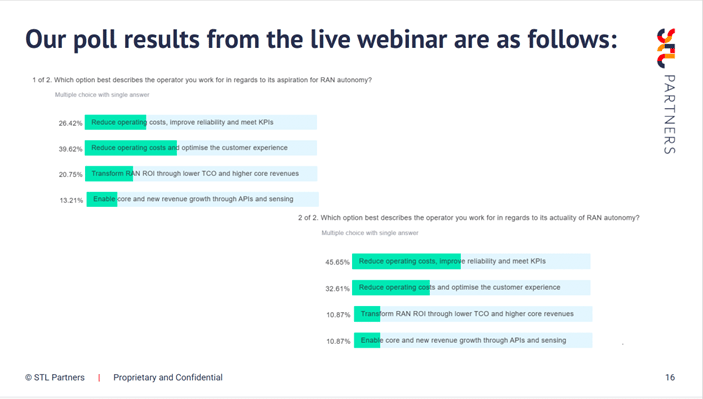
The central message was that autonomy only matters if it improves economics (see poll results below). The webinar revealed that network operators need a dual-axis framework that combines the usual autonomous-network maturity view with a value-creation lens, so they can focus on the capabilities that scale into measurable business outcomes.
Agentic AI is presented as the practical enabler for moving beyond human-in-the-loop operations. In this framing, agents help orchestrate tasks, make decisions, and coordinate network actions in ways that support more closed-loop automation than traditional workflows can deliver.
The results of an “actuality” poll relating to RAN autonomy revealed that controlling costs and reliability were most important, with the enablement of new revenue growth through APIs and sensing only scoring 10.87% of respondents. Similarly, results for an “aspirations” poll for RAN autonomy were also fairly evenly spread between reducing costs and optimizing the customer experience, with just 13.21% citing new revenue growth.
Source: STL Partners
Terje Jensen, SVP, global business security officer and head of network and cloud technology strategy at Telenor, said that he had expected to see network operators’ aspirations shift more clearly towards improving customer experience and even revenue generation, not just efficiency.
Darwin Janz, strategic technology planner at SaskTel, also thought network operators’ ambitions would be higher, but he noted that they still struggle to identify concrete, monetizable use cases. Without that, there’s a real risk of building technical solutions in search of a problem, rather than starting from clear enterprise needs and value, Darwin noted. “We really need to see those use cases and enterprise customer needs,” he added.
……………………………………………………………………………………………………………………….
The webinar was built around four practical questions:
- Which use cases create real commercial impact?
- How to shift from autonomy as an engineering metric to a margin driver?
- Where agentic does AI add value today?
- What data, orchestration, and organizational foundations are needed to scale beyond pilots.
For network operators, the implication is that autonomous RAN strategy should be tied to P&L outcomes such as lower operating cost, better resource utilization, and faster optimization cycles. The webinar’s message is that autonomy becomes strategically important only when it is deployed in a way that compounds across the network and business.
…………………………………………………………………………………………………………………..
References:
The Financial Trap of Autonomous Networks: Scaling Agentic AI in the Telecom Core
Nokia to showcase agentic AI network slicing; Ericsson partners with Ookla to measure 5G network slicing performance
T-Mobile US announces new broadband wireless and fiber targets, 5G-A with agentic AI and live voice call translation
Telecom operators investing in Agentic AI while Self Organizing Network AI market set for rapid growth
Omdia: Global telecom connectivity market hit $333 billion in Q4 2025 for 5% YoY growth
Market research firm Omdia (owned by Informa) reports the global telecom connectivity market reached reached $333 billion in Q4 2025, representing a 5% year-on-year (YoY) growth. Full year revenues came in at $1.3 trillion in 2025, representing a 4% YoY growth.
5G connections exceeded 3 billion and and growing 34% YoY, with Asia being the largest market, accounting for 69% of global 5G connections. By comparison 4G stands at 8.3 billion connections. Asia remains the largest 5G market, accounting for 69% of all global 5G connections.
Fixed broadband connections reached 1.6bn in 2025, with FTTx broadband continuing to dominate as the leading technology, surpassing 1.169bn connections, and growing 7% annually. In Q4 2025 India overtook the United States to become the leading 5G FWA market in the world, with 14.5m connections compared to 13.9m in the United States.
The report surmises the results highlight ongoing challenges for the telecom industry, in that it “remains reliant on a slow growing core business while still working to establish new revenue streams.” While 5G FWA in India and IoT growth offer new opportunities, operators face challenges due to reliance on slow-growing core revenue streams.
“Overall, the 2025 results show that the telecom industry’s core business remains highly relevant, but is facing strong headwinds, including slow growth, while the sector has yet to realize meaningful returns from investments in new technologies,” said Ari Lopes, Omdia Practice Leader for Service Provider Markets.

Omdia says the global ranking of telecom operators by connectivity revenues continues to be dominated by operators from the United States and China, which together account for eight out of the top ten positions. The remaining two operators are based in Japan. According to Perplexity.ai, these are the top 10 telecom operators by revenue:
Top 10 by revenue
Note that Perplexity.ai’s top 10 ranking differs from Omdia’s which states China and the U.S. account for eight telcos (which we assume are: China Mobile, China Telecom, China Unicom, Verizon, AT&T, Comcast, T-Mobile US, Charter Communications) with Japan at two telcos (which we assume are: NTT and Softbank).
References:
https://www.telecoms.com/5g-6g/5g-surpasses-3-billion-connections
Telco investments in mobile core networks surge 83% in 2025-Q4, but what about ROI?
Dell’Oro: RAN Market Stabilized in 2025 with 1% CAG forecast over next 5 years; Opinion on AI RAN, 5G Advanced, 6G RAN/Core risks
Dell’Oro: Mobile Core Networks +15% in 2025; Ookla: Global Reality Check on 5G SA and 5G Advanced in 2026
China’s telecom industry rapid growth in 2025 eludes Nokia and Ericsson as sales collapse
Dell’Oro: Fixed Wireless Access revenues +10% in 2025 & will continue to grow 10% annually through 2029
OpenSignal: real world 5G deployment in India, market status & what happened to 5Gi?
South Korea’s top 3 telcos reinvent themselves as “AI Companies;” growth strategies revealed
Overview:
South Korea’s telecommunications industry is rapidly shifting its center of gravity to AI, with SK Telecom, KT and LG Uplus all declaring their transformation into AI companies. Industry officials describe this as a restructuring process.
- SK Telecom is pushing a full-stack AI strategy spanning infrastructure, models and services.
- KT is accelerating a B2B-focused push to become an “AX” platform company.
- LG Uplus is positioning itself as an AI software company through its ixi-O agent, stressing safety and security. Industry officials say the next test is profitability.
Ryu Jong-heon, SKT’s CEO, wrote in a letter sent to shareholders ahead of last month’s annual general meeting, “If our AI business so far was about incubating various areas, we will now focus more on businesses where SKT can be competitive and secure sustainability in AI competition that is expanding without limit.”
- Next-Gen Compute: Strategic collaboration with Arm and Rebellions for AI CPU/NPU innovation.
- Infrastructure & Power: Agreements with Supermicro and Schneider Electric to optimize AIDC efficiency and server density.
- Model Scaling: With A.X K1 outperforming benchmarks like DeepSeek V3.1, SKT plans to transition to multimodal capabilities and trillion-parameter scaling to secure market dominance across B2B and B2C segments.
2. KT Corporation – Transitioning to an AX Platform Operator:
Under the leadership of CEO Yun-young Park, KT is accelerating its AX (AI Transformation) strategy with a sharp focus on the B2B sector. Following a structural reorganization that established the AX Future Technology Institute and the AX Business Division, KT is positioning itself as a platform enabler rather than a mere solution provider. Despite perceived lags in proprietary model development (e.g., the mi-deum LLM), KT is pursuing a pragmatic “practical gains” strategy. By partnering with Microsoft, KT is adopting a “detour” approach to rapidly integrate global-standard AI capabilities into its existing corporate customer base. CEO Yun-young Park explained, “If AI services are actors on a theatre stage, we are an AX platform company that builds that stage.”
3. LG Uplus -Move to AI-Driven Software and Security:
LG Uplus, led by CEO Beom-sik Hong, is leveraging security and reliability as its primary competitive differentiators. The company is transitioning into an AI-centric software (SW) company, focusing on high-margin service architectures over raw infrastructure. The cornerstone of this strategy is ixi-O, a voice AI agent. The upcoming ixi-O Pro will feature advanced behavioral analytics, including tone and emotional state detection, to provide proactive customer engagement. Hong stated, “We will become an AI-centred software (SW) company that leads solutions in telecommunications and AX technology,” signaling a two-track global expansion strategy involving both service exports and technology stack licensing.
References:
SKT 6G ATHENA White Paper: a mid-to-long term network evolution strategy for the AI era
SK Group and AWS to build Korea’s largest AI data center in Ulsan
South Korea has 30 million 5G users, but did not meet expectations; KT and SKT AI initiatives
McKinsey: AI infrastructure opportunity for telcos? AI developments in the telecom sector
WSJ: 5G in South Korea has not lived up to expectations
South Korea government fines mobile carriers $25M for exaggerating 5G speeds; KT says 5G vision not met
KT and LG Electronics to cooperate on 6G technologies and standards, especially full-duplex communications
SK Telecom (SKT) and Nokia to work on AI assisted “fiber sensing”
SKT Develops Technology for Integration of Heterogeneous Quantum Cryptography Communication Networks
SKT with Global Telcos to Expand Metaverse Platform in US, Europe and Southeast Asia
South Korean telcos to double 5G network bandwidth with massive MIMO; Private 5G
Omdia: ARPU declining or flat for South Korean 5G network operators
3 South Korean mobile operators to share 5G networks in remote areas
LG U+ first to deploy 600G backbone network in Korea with Ciena’s ROADM equipment
Ericsson reports 10% drop in 1st quarter sales; targets network growth
Executive Summary:
Ericsson reported mixed first-quarter 2026 results, characterized by continued resilience in its Networks segment despite regional demand variability and emerging supply-side cost pressures. The Swedish company recorded 7% year-over-year organic growth in its Networks business, supported by sustained network modernization programs and ongoing 5G deployments across Europe, the Middle East, and Africa (EMEA), as well as increased delivery volumes in India and Japan. This growth offset a decline in North American sales, which followed a period of elevated operator investment in 2025 and reflects a near-term reallocation of capital expenditure by key customers. However, Ericsson reported a 10% total sales drop to 49.33 billion kronor in the first quarter, with EBITA falling to 1.44 billion kronor.
Ericsson reiterated its expectation of a broadly flat global RAN market in 2026 but expressed confidence in its ability to outperform the overall sector. The Networks segment maintained a robust adjusted gross margin of 50.4%, within its guided 49–51% range, with similar margin performance anticipated in the second quarter. Sequential revenue growth is projected to align with typical seasonal trends, approximating a 4% increase.
Despite these operational strengths, Ericsson highlighted increasing uncertainty in the macroeconomic and geopolitical environment. Of particular concern is the rising cost of components—especially semiconductors—driven in part by global AI-related demand. The company indicated that while semiconductors represent a relatively limited portion of its total cost base, sustained price increases are expected to create headwinds.
To mitigate these pressures, Ericsson is pursuing a combination of supply chain optimization, product substitution strategies, operational efficiencies, and selective cost-sharing mechanisms with customers. The company emphasized that its prior investments in supply chain diversification have enhanced resilience, although it acknowledged that it remains exposed to broader market disruptions affecting pricing and component availability.
Geopolitical factors have also introduced operational challenges. Ongoing conflict in the Middle East has necessitated adjustments to logistics and transportation routes, resulting in incremental costs. Ericsson noted that its regional distribution infrastructure has been impacted but that supply continuity has been maintained through flexible supply chain management.
From a financial perspective, Ericsson reported first-quarter EBIT of SEK 1.44 billion, a significant decline from SEK 5.93 billion in the prior year, reflecting restructuring charges and adverse currency movements. Group revenue decreased 10% year-over-year to SEK 49.33 billion, below market expectations, while gross margin contracted to 47.2% from 48.2%.

Image Credit: lars schroder/Agence France-Presse/Getty Images
…………………………………………………………………………………………………………………………………………
Börje Ekholm, Ericsson President and CEO, said:
“Our Q1 results demonstrate continued resilience in a dynamic environment, with organic sales growth of 6%. Our healthy gross margins and strong cash flow reflect the progress we have made in recent years, reducing reliance on geographic mix and strengthening our foundations globally. Our multi-year investments in building a resilient, diversified, supply chain have enabled us to deliver consistently for customers amidst geopolitical and macroeconomic uncertainties. We are facing increasing input costs, especially in semiconductors, caused in part by AI demand. Our ambition is to offset these challenges, by working closely with customers and suppliers, and through product substitution and efficiency actions. Looking ahead, while we continue to expect a flattish RAN market, our focused strategy, leading portfolio, and strengthened positions in mission critical and Enterprise give us confidence in our ability to grow faster than the mobile networks market and drive long-term success.”
Overall, the results underscore a transitional phase for Ericsson, with strong execution in global 5G and modernization programs partially offset by cyclical demand softness in North America and emerging cost inflation in critical technology inputs. The company recorded 7% year-over-year organic growth in its Networks business, supported by sustained network modernization programs and ongoing 5G deployments across Europe, the Middle East, and Africa (EMEA), as well as increased delivery volumes in India and Japan. This growth offset a decline in North American sales, which followed a period of elevated operator investment in 2025 and reflects a near-term reallocation of capital expenditure by key customers.
Ericsson’s quarter reinforces a broader industry pattern: the global RAN market is stabilizing after the 5G deployment peak, but not re-entering a meaningful growth phase. Until 6G capex begins to scale later in the decade, vendor performance will depend more on regional share gains, modernization cycles, and margin discipline than on total market expansion. After the 5G buildout peak, network operators are largely shifting from coverage expansion to optimization, monetization, and cost efficiency, which limits near-term revenue upside for vendors even when unit shipments remain healthy.
………………………………………………………………………………………………………………………………………………
RAN Market dynamics:
The key issue is that RAN demand is no longer being driven by broad-based new macro rollouts. Instead, spending is being concentrated on targeted modernization, selective capacity adds, and feature upgrades, while legacy LTE revenue continues to decline and offsets much of the remaining 5G activity.
That helps explain why vendors can still post pockets of growth in regions like EMEA, India, and Japan while North America softens after a prior wave of heavy investment. In other words, regional growth is becoming more cyclical and more dependent on operators’ capex timing than on a sustained global upgrade super-cycle.
Why RAN growth stays muted:
The structural problem is that RAN is maturing into a low-growth infrastructure market. Dell’Oro’s latest forecast points to only about 1% CAGR over the next five years, with the broader market remaining largely flat until 6G-related capex begins to ramp late in the decade.
That means the industry is effectively living through a long gap between the end of the 5G peak and the start of the 6G investment cycle. During that gap, vendors compete less on market expansion and more on mix, efficiency, software attach, and share gains, which is why financial performance can diverge from headline market growth.
What this means for Ericsson:
For Ericsson, the implication is that beating the market may matter more than the market itself. If the underlying RAN market is flat to low-single-digit growth, then Ericsson’s ability to sustain margin through supply-chain discipline, pricing, and product mix becomes more important than chasing top-line expansion alone.
This is also why component inflation matters now. When market growth is weak, cost pressure from semiconductors, logistics, and geopolitics has a larger effect on earnings quality, because vendors have fewer natural volume tailwinds to absorb it.
6G/IMT 2030 timing risk:
The big strategic uncertainty is timing. If meaningful telco 6G capex does not begin until around 2030–2031 (which seems highly likely), then the wireless telecom industry faces several years of subdued RAN revenue. That creates pressure on vendors to extract value from 5G Advanced, automation, private networks, and software-led differentiation before the next technology cycle arrives.
This is why “no real growth till 6G in 2031” is a reasonable framing. It captures the reality that the market can remain technically active while still being economically stagnant, with limited aggregate revenue growth even as networks become more capable and more software-defined.
From Sebastian Barros:
“Ericsson’s Q1 results are a masterclass in structural paradox. Pulling a 6% organic growth rate in a dead-flat global RAN market is a massive operational flex for a 150-year-old heavyweight. But look under the hood. Reported sales took a 10% hit due to brutal FX headwinds, and their supply chain is under intense pressure as global AI data centers hoard 3nm semiconductor capacity. Their historic dominance in custom ASIC silicon and radio frequency is exactly what makes them structurally vulnerable today. Being functionally addicted to a $35 billion RAN market that accounts for over 60% of their portfolio is a massive liability, as that profit pool is being actively dismantled by x86/GPU disaggregation, open architectures, and geopolitical hardware wars…”
………………………………………………………………………………………………………………………………………………………………….
References:
Ericsson and Forschungszentrum Jülich MoU for neuromorphic computing use in 5G and 6G
AT&T and Ericsson boost Cloud RAN performance with AI-native software running on Intel Xeon 6 SoC
Ericsson and Intel collaborate to accelerate AI-Native 6G; other AI-Native 6G advancements at MWC 2026
Ericsson goes with custom silicon (rather than Nvidia GPUs) for AI RAN
China’s telecom industry rapid growth in 2025 eludes Nokia and Ericsson as sales collapse
SoftBank and Ericsson-Japan achieve 24% 5G throughput improvement using AI-optimized Massive MIMO
Huawei, Qualcomm, Samsung, and Ericsson Leading Patent Race in $15 Billion 5G Licensing Market
Ericsson announces capability for 5G Advanced location based services in Q1-2026
Highlights of Ericsson’s Mobility Report – November 2025
Ericsson’s revenue drops, profits soar; deal with Vodafone and partnership with Export Development Canada look promising
GSA: 5G Non Terrestrial Networks, 5G SA and 5G Advanced gain momentum
5G NTNs:
During an April 16th webinar titled “GSA Snapshot: 5G networks, spectrum & devices,” Joe Gardiner, market analyst at CCS Insight and a member of the GSA research team, said GSA data through March 31st reveal that 97 operators in 70 countries have announced they are investing in LEO satellite D2D technology.
“There’s a lot of interest in this area, but there’s also a lot of interest and movement towards 3GPP standards (see Note below), and the convergence of the terrestrial and the non-terrestrial standards map” starting with 3GPP Release 17, Gardiner observed.
Skylo, for example, is following a standards-based approach and already has D2D partnerships with operators such as Orange in France, Verizon and Vodafone IoT.
“Other players are [also] looking to use the standards-based approach, and looking to purchase the spectrum that’s compatible with the standards,” Gardiner said.
Note that 3GPP is not a SDO- it depends on ETSI and ITU-R to rubber stamp its specs and transpose them into official standards.
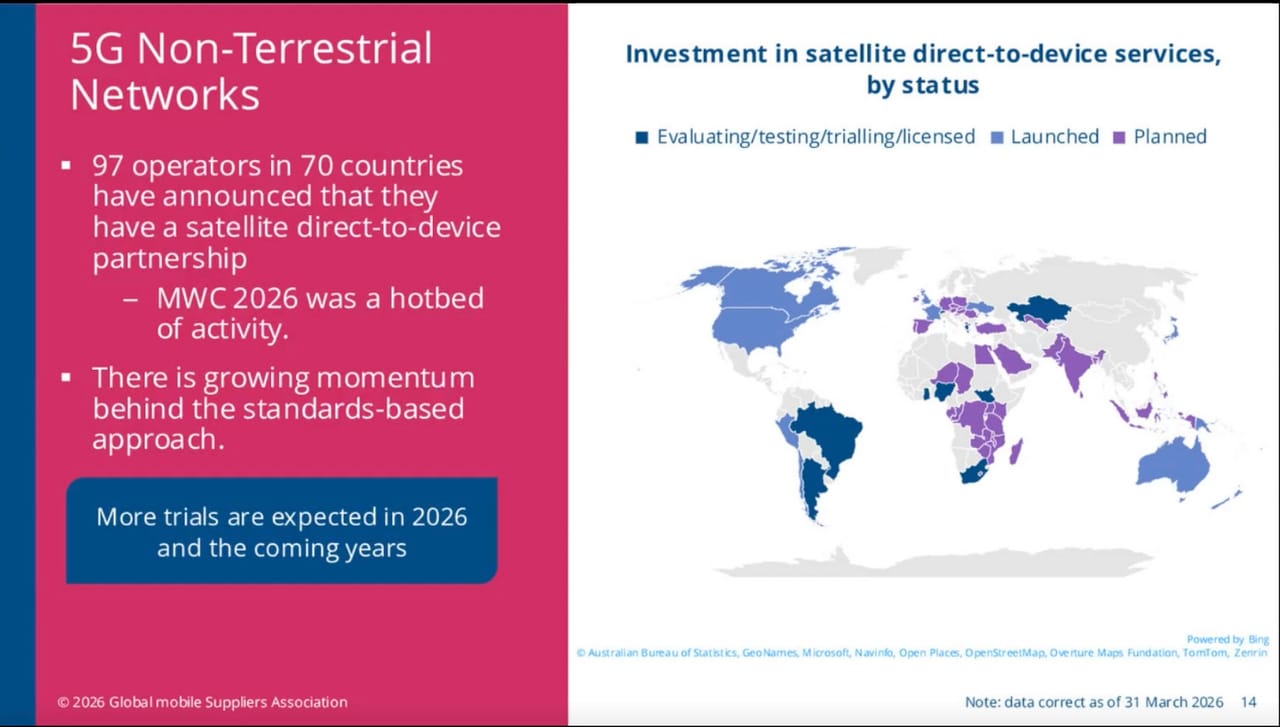
Image credit: GSA
He said that “Part of the reason Amazon is acquiring satellite Globalstar, was because of the spectrum assets that Globalstar has.” Gardiner added that a “lot of trials are taking place that are looking at the next stage of the standards, Release 18 with 5G NR NTN services.”
Gardiner referenced the trial announced by the European Space Agency (ESA), together with Airbus Defence and Space, Eutelsat OneWeb, and industry partners in November 2025.
In addition, Spain’s Sateliot is following the standards-based approach and has launched a Series C financing round to raise €100 million (US$117 million) to help fund the deployment its IoT-focused 5G satellite constellation. “We expect more trials like this to take place over the next few months and years,” Gardiner said. There is a “movement towards using mobile satellite services (MSS) spectrum,” although the drawback with this spectrum is the current lack of compatible mobile devices on the market.
……………………………………………………………………………………………………………………..
5G SA and 5G Advanced:
Ian Fogg, a research director at CCS Insight, who also works within the research team at the GSA, talked up the move towards 5G standalone (SA) and 5G Advanced networks.
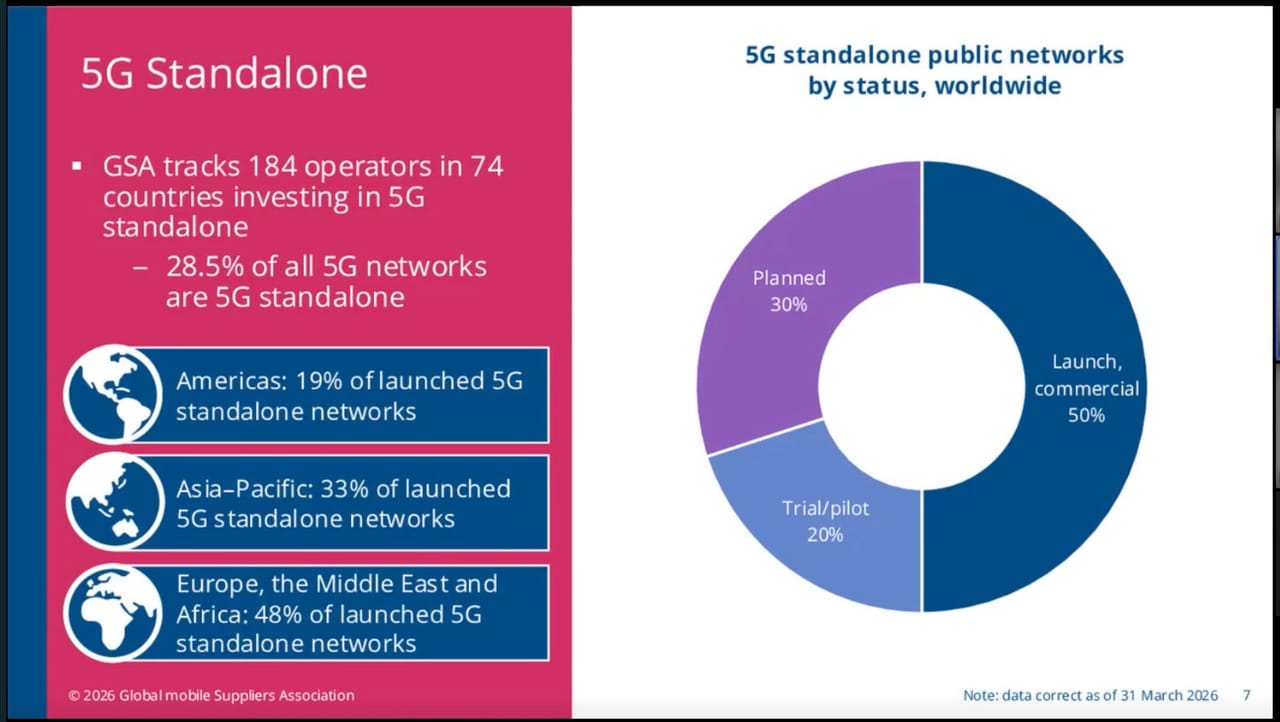
“Globally, we have 184 operators in 74 countries investing in 5G standalone. This is publicly. 28.5% of all 5G networks are now 5G standalone. So there’s real momentum happening here,” Fogg said.
Source: GSA
5G Advanced “is something that’s happening at the moment. We have 36 operators globally publicly saying they’re investing in 5G Advanced. We’ve seen eleven 5G Advanced networks commercially launched,” Fogg said, citing activity in China, Canada, Japan, Kuwait and Vietnam.
“I think what will happen in the next few years is we’ll see the gap between an operator adopting 5G standalone and 5G Advanced narrowing, because if you go to 5G standalone, it’s a natural thing to move fairly quickly on to 5G Advanced, if possible, because you get a lot more capabilities once you’re on a 5G advanced network,” he added.
………………………………………………………………………………………………………………
References:
https://gsacom.com/webinar/5g-networks-spectrum-devices/
Orange set to claim European satellite first
Skylo’s trajectory toward the ‘standardized sky’ looks to include multiple orbits
MWC2026: Skylo makes universal connectivity a reality; Vodafone IoT teams with Skylo for satellite connectivity
Non-Terrestrial Networks (NTNs): market, specifications & standards in 3GPP and ITU-R
ITU-R recommendation IMT-2020-SAT.SPECS from ITU-R WP 5B to be based on 3GPP 5G NR-NTN and IoT-NTN (from Release 17 & 18)
Analysis: Amazon <- Globalstar – a strategic move for D2D and spectrum parity
Enterprise IoT and the Transformation of UK Telecom Business Models – Part 1
From LPWAN to Hybrid Networks: Satellite and NTN as Enablers of Enterprise IoT – Part 2
Keysight Technologies Demonstrates 3GPP Rel-19 NR-NTN Connectivity in Band n252
Telecoms.com’s survey: 5G NTNs to highlight service reliability and network redundancy
Dell’Oro: Mobile Core Networks +15% in 2025; Ookla: Global Reality Check on 5G SA and 5G Advanced in 2026
Dell’Oro: RAN Market Stabilized in 2025 with 1% CAG forecast over next 5 years; Opinion on AI RAN, 5G Advanced, 6G RAN/Core risks
Dell’Oro: RAN market stable, Mobile Core Network market +14% Y/Y with 72 5G SA core networks deployed
AT&T deploys nationwide 5G SA while Verizon lags and T-Mobile leads
Analysis: Amazon <- Globalstar - a strategic move for D2D and spectrum parity
Overview:
Amazon said today that it will acquire Globalstar in an $11.57 billion deal, bolstering its fledgling satellite internet business as it tries to catch up with Elon Musk’s Starlink.
Amazon is accelerating its Project Kuiper deployment, aiming to launch approximately 3,200 Low Earth Orbit (LEO) satellites by 2029. To meet regulatory milestones, nearly 50% of the constellation must be operational by the July deadline, with commercial satellite broadband services slated for a soft launch later this year.
The acquisition of Globalstar augments Amazon’s Direct-to-Device (D2D) connectivity offerings. Globalstar’s current architecture is optimized for low-bandwidth, high-reliability mobile links that bypass traditional terrestrial RAN infrastructure. This capability is vital for ubiquitous emergency services and IoT connectivity in non-terrestrial network (NTN) white spaces. Through this deal, Amazon expects to operationalize its own D2D offerings by 2028.
IMPORTANT: It should be noted that ONLY 3GPP is developing the standards for NTNs – ITU-R and ETSI SDOs are simply rubber stamp SDOs for 3GPP NTN specs.
“There are billions of customers out there living, traveling, and operating in places beyond the reach of existing networks, and we started Amazon Leo to help bridge that divide,” said Panos Panay, Senior Vice President of Devices & Services, Amazon. “By combining Globalstar’s proven expertise and strong foundation with Amazon’s customer-obsession and innovation, customers can expect faster, more reliable service in more places—keeping them connected to the people and things that matter most. We’re excited to support Apple users through the Leo D2D system, and look forward to working with mobile network partners to help extend coverage to every corner of the planet,” Panay added.

The Competitive Landscape: Starlink vs. Kuiper:
SpaceX’s Starlink currently maintains a significant lead with over 9 million global subscribers. While Starlink’s core business remains high-throughput fixed wireless via proprietary user terminals, it is aggressively pursuing D2D through spectrum-sharing partnerships with Mobile Network Operators (MNOs) like T-Mobile.
Industry analysts suggest that acquiring Globalstar is a “spectrum play.” Armand Musey of Summit Ridge Group noted that the deal allows Amazon to secure a critical spectrum position and potentially leapfrog Starlink in D2D deployment timelines. Furthermore, Amazon’s proposed data center constellation is engineered for a massive scaling of network capacity, intended to exceed current LEO benchmarks.
“Amazon has been falling behind Starlink on satellite broadband. Acquiring Globalstar allows them to catch up on their D2D spectrum position, and leap ahead on D2D deployment,” said Armand Musey, president & founder of Summit Ridge Group.
Amazon LEO’s proposed data center constellation would dwarf Starlink’s current network by several magnitudes:

The Apple-Globalstar Ecosystem:
Crucially, Globalstar’s existing partnership with Apple remains intact. Globalstar currently provides the L-band connectivity powering Apple’s Emergency SOS and Find My features. Amazon has confirmed it will honor these agreements, maintaining the 2024 framework where Apple invested $1.5 billion for a 20% equity stake to expand the constellation to 54 satellites. See References below.
Market Consolidation and Valuations:
The move follows a broader trend of sector consolidation as players seek the scale required to compete with SpaceX’s vertical integration and launch frequency.
- Deal Metrics: Amazon’s acquisition values Globalstar at approximately $10.8 billion ($90/share), representing a 31% premium over the pre-announcement close.
- Regulatory Path: The merger is expected to close in 2025, pending FCC approval and the achievement of specific deployment KPIs. FCC Chair Brendan Carr indicated the agency remains “open-minded” regarding the consolidation.
Author’s Opinion & Analysis (aided by perplexity.ai):
Amazon’s Globalstar acquisition is a strong strategic move towards D2D, but it is more a spectrum-and-regulatory shortcut than a pure technology leap. The telecom significance is that Amazon is buying not just satellites, but licensed Mobile Satellite Spectrum (MSS), operational know-how, and an immediate path into direct-to-device connectivity that would otherwise take years to assemble.
From a telecom perspective, the key asset is spectrum parity. Globalstar holds licensed MSS spectrum in the L/S-band ranges used for satellite mobile services, and that spectrum is hard to replicate because the FCC has previously rejected or constrained new entrants in those bands. That makes the deal valuable less as a fleet expansion play and more as a way to secure a legally usable radio layer for D2D, which is not at all guaranteed.
Amazon’s stated plan is to combine Globalstar’s spectrum and MSS operations with Amazon Leo to deliver D2D services beginning in 2028, with claims of higher spectrum efficiency than legacy direct-to-cell systems. In telecom terms, that implies Amazon wants to move from “coverage extension” into a more integrated NTN architecture that can support voice, text, and eventually data services at scale. That’s certainly a tall order!
Against Starlink, this is a defensive and offensive move all at the same time. Starlink already has a lead in satellite scale and has commercialized carrier partnerships like T-Mobile’s direct-to-cell offering, so Amazon’s problem has been less launch capacity than spectrum and service readiness. Buying Globalstar narrows that gap by giving Amazon a ready-made regulatory and spectrum base instead of forcing it to negotiate every D2D pathway from scratch.
Against carriers, the move is more nuanced. Amazon is not simply disintermediating mobile operators; its own materials describe D2D as a way to help MNOs extend voice, text, and data beyond terrestrial reach. That suggests a wholesale or partner model, but the long-term competitive risk is obvious: if Amazon owns the satellite layer and the device/service stack, carriers may become optional distribution partners rather than network gatekeepers.
The phrase “spectrum parity” is the real strategic clue. In telecom, constellation size matters, but spectrum rights determine whether a constellation can actually deliver service with usable link budgets, device compatibility, and regulatory clearance. Globalstar’s spectrum therefore acts like a license to compete, not just a frequency block.
This also helps explain why the deal is strategically defensive for Amazon. Without Globalstar, Amazon would face a slower, less certain path through band planning, interference disputes, and NTNspecific regulatory work, especially in crowded MSS allocations. In that sense, the acquisition is a classic telecom play: buy scarce spectrum, then scale the network around it.
The biggest near-term risk to this deal is regulatory. The transaction will need FCC and likely antitrust review, and Amazon will also have to navigate the Apple/Globalstar relationship because Globalstar powers Apple’s Emergency SOS service. That creates both transition risk and potential bargaining leverage for Apple, which could complicate service continuity and deal terms.
Technically, D2D is still constrained by small link budgets, handset antenna limits, and the need to prioritize messaging and emergency services before richer data use cases. Even if Amazon claims better spectrum efficiency, the first commercially meaningful services will likely remain low-throughput, coverage-oriented offerings rather than full terrestrial substitutes. So the real competition is not “satellite internet for phones” in the consumer broadband sense, but who controls the premium coverage layer for dead zones, emergency service, enterprise continuity, and carrier augmentation.
In conclusion, Amazon is making a category-defining infrastructure purchase, not just a corporate acquisition. If approved, it gives Amazon a credible D2D spectrum position, reduces its regulatory latency, and turns Amazon Leo into a more complete and highly competitive NTN platform and D2D service provider.
……………………………………………………………………………………………………………………….
References:
https://www.aboutamazon.com/news/company-news/amazon-globalstar-apple
Amazon Leo (formerly Project Kuiper) unveils satellite broadband for enterprises; Competitive analysis with Starlink
Blue Origin announces TeraWave – satellite internet rival for Starlink and Amazon Leo
NBN selects Amazon Project Kuiper over Starlink for LEO satellite internet service in Australia
Amazon launches first Project Kuiper satellites in direct competition with SpaceX/Starlink
Emergency SOS: Apple iPhones to be able to send/receive texts via Globalstar LEO satellites in November
FCC proposes regulatory framework for space-mobile network operator collaboration
AT&T deal with AST SpaceMobile to provide wireless service from space
Starlink Direct to Cell service (via Entel) is coming to Chile and Peru be end of 2024
Starlink’s Direct to Cell service for existing LTE phones “wherever you can see the sky”
Anthropic’s Project Glasswing aims to reshape IT cybersecurity
Backgrounder:
Late last year, Anthropic said that state-sponsored Chinese hackers had used its artificial intelligence (AI) technology in an effort to infiltrate the computer systems of roughly 30 companies and government agencies around the world. The company said it was the first reported case of a cyberattack in which AI technologies had gathered sensitive information with limited help from human operators.
As Anthropic and its chief rival, OpenAI, prepare to release new and more powerful AI systems, cybersecurity experts are increasingly vocal in their warnings that AI is fundamentally changing cybersecurity. AI technology could allow hackers to identify security holes in computer systems far faster than in the past, vastly raising the stakes in the decades-long fight between hackers and the security experts guarding computer networks. As hackers deploy AI to break and steal, security experts are also leaning on AI to spot flaws in their systems — including some that had gone unnoticed for decades.
“This is the most change in the cyber environment, ever,” said Francis deSouza, the chief operating officer and president of security products at Google Cloud. “You have to fight A.I. “This is the most change in the cyber environment, ever,” said Francis deSouza, the chief operating officer and president of security products at Google Cloud. “You have to fight AI with AI.”
Hackers have used AI chatbots to draft phishing emails and ransom notes, cybersecurity experts said. Others have used AI to parse large quantities of stolen data and determine what information might be valuable. Without help from AI attackers could sometimes break into computer networks within minutes, Mr. deSouza said, but with the help of AI breaches can take just seconds. Some hackers specialize in breaking into systems and then selling off their access to other attackers. Those handoffs used to take as much as eight hours, as hackers negotiated the sales and passed along the compromised entry points, deSouza added. Now that process has accelerated to about 20 seconds, he said, with hackers sometimes using A.I. agents to speed up the process.
Some experts argue that the guardrails added by companies like Anthropic and OpenAI can actually provide an advantage to malicious attackers. Guardrails could cause an AI chatbot to deny help to a user trying to defend a system from an attack, they argue, but persistent hackers could be more diligent about finding vulnerabilities — and keeping those tricks to themselves.
In February, Anthropic said it had used its A.I. technologies to find over 500 so-called zero-day vulnerabilities — security holes that were unknown to software makers — in various pieces of commonly used open source software. The next month, a researcher at Anthropic revealed that he had used A.I. to find a serious security vulnerability in the core of the Linux operating system, which is software that powers much of the internet and is used in computer servers, cloud computing services, Android phones and Teslas. The bug had existed, apparently undiscovered, since 2003.
Project Glasswing Overview:
Anthropic has announced Project Glasswing – a new initiative that brings together Amazon Web Services, Anthropic, Apple, Broadcom, Cisco, CrowdStrike, Google, JPMorganChase, the Linux Foundation, Microsoft, NVIDIA, and Palo Alto Networks – in an effort to secure the world’s most critical software.
The fast growing AI private company has found that AI models (like its own Claude) have reached a level of coding capability where they can surpass all but the most skilled humans at finding and exploiting software vulnerabilities. Their Mythos Preview language model has already found thousands of high-severity vulnerabilities, including some in every major operating system and web browser.
Given the rate of AI progress, it will not be long before such capabilities proliferate, potentially beyond actors who are committed to deploying them safely. The fallout—for economies, public safety, and national security—could be severe. Project Glasswing is an urgent attempt to put these capabilities to work for defensive purposes.
The Project Glasswig partners will use Mythos Preview as part of their defensive security work. Anthropic will share what they learn so the entire IT industry can benefit. They have also extended access to a group of over 40 additional organizations that build or maintain critical software infrastructure so they can use the model to scan and secure both first-party and open-source systems.
Anthropic is committing up to $100M in usage credits for Mythos Preview across these efforts, as well as $4M in direct donations to open-source security organizations.
- Give Defenders a Head Start: The initiative aims to use Mythos’s capabilities to find and fix zero-day vulnerabilities in critical codebases before they can be discovered by malicious actors.
- Secure Critical Infrastructure: Partners use the model to scan first-party systems and open-source software that underpin global banking, energy, and logistics networks.
- Modernize Defense Practices: Anthropic is collaborating with partners to evolve security workflows, such as patching and disclosure processes, to match the “machine speed” of AI-driven vulnerability discovery.
- Zero-Day Discovery: In early testing, the model autonomously found thousands of high-severity vulnerabilities, including a 27-year-old bug in OpenBSD and a 16-year-old flaw in FFmpeg code that had been scanned by automated tools millions of times without detection.
- Performance Benchmarks: Mythos Preview scored 83% on the CyberGym cybersecurity benchmark, significantly outperforming previous models like Claude Opus.
References:
https://www.anthropic.com/glasswing
https://www.nytimes.com/2026/04/06/technology/ai-cybersecurity-hackers.html
Anthropic Glasswing: AI Vulnerability Detection Has Crossed a Threshold
Anthropic Claude Users Reveal AI Hallucinations as their Top Concern
Nvidia CEO Huang: AI is the largest infrastructure buildout in human history; AI Data Center CAPEX will generate new revenue streams for operators
New Linux Foundation white paper: How to integrate AI applications with telecom networks using standardized CAMARA APIs and the Model Context Protocol (MCP)
US Mobile’s new bundle combines its multi-network mobile service with Starlink residential internet
MVNO US Mobile has announced a partnership with Starlink to offer customers a bundle which includes its pre-paid wireless service with home internet from the Space X owned LEO satellite internet provider. Ahmed Khattak, CEO of US Mobile, announced the partnership on Reddit, saying their Starlink One service will be offered without data caps. Khattak stated the Starlink bundle will be offered with US Mobile’s unlimited standard or premium plans able to access all three networks, which means customers only need to deal with one bill, one app and “one company that actually picks up the phone.”
“I won’t tease numbers too hard, but imagine a plan for less than $50 a month that spans every major network in the United States, extends across Canada and Mexico, includes internet from space at home,” Khattak wrote. US Mobile has MNVO deals in place with AT&T, Verizon and T-Mobile US and uses a platform which gives customers the ability to switch between networks. This “terrestrial and celestial” unification allows customers to manage their home and mobile connectivity under a single bill and app.
US Mobile and SpaceX have joined forces to redefine convergence. | Image by US Mobile
Details on the exact cost of the bundled tier and Starlink equipment were not available. Wave7 Research analyst Jeff Moore told Mobile World Live Starlink started offering its home broadband service last month in 120 T-Mobile Boost retail stores as part of a pilot program. “If Starlink is working to sell home Internet via Boost and providing mobile connectivity via US Mobile, then Starlink is probably having conversations with other MVNOs about options for becoming channels for internet sales and for mobile satellite connectivity,” he explained.
Meanwhile, Khattak stated he expects similar deals will follow with additional satellite broadband providers such as Amazon Leo. “The endgame is Global Multi-Orbit Convergence. Every major terrestrial network on the ground, every major LEO constellation in the sky, stitched together into a single plan that follows you anywhere on earth,” Khattak added.
- Dynamic Network Switching: Users can access Warp (Verizon), Dark Star (AT&T), and Light Speed (T-Mobile).
- Automatic Handover: While US Mobile previously required manual “Teleporting” between networks, the new Multi-Network Add-on allows phones to automatically switch to the strongest available signal or a backup network if the primary one fails.
- Unified Account: Both the Starlink satellite session and terrestrial cellular lines are managed via a single “unification layer,” which CEO Ahmed Khattak describes as a software infrastructure that’s been a decade in the making.
- Introductory Pricing: Most Starlink discounts revert to standard pricing (an increase of roughly $20/month) after the first six months.
- Availability: The bundle is not available in certain areas subject to Starlink congestion pricing.
- Hardware Requirements: To use dynamic network switching, your device must support multiple active eSIMs.
AT&T recently launched OneConnect, a cellular and fiber bundle providing one mobile line and fiber internet for $90 per month. T-Mobile’s MVNO Mint Mobile countered with a wireless and 5G internet bundle starting at $45 per month.
……………………………………………………………………………………………………………………………………………………………………………………………………………………………………….
References:
https://www.phonearena.com/news/us-mobile-starlink_id179545
Direct-to-Device (D2D) satellite network comparison: Starlink V2 (Starlink Mobile) vs “Satellite Connect Europe”
Blue Origin announces TeraWave – satellite internet rival for Starlink and Amazon Leo
Amazon Leo (formerly Project Kuiper) unveils satellite broadband for enterprises; Competitive analysis with Starlink
Starlink doubles subscriber base; expands to to 42 new countries, territories & markets
Elon Musk: Starlink could become a global mobile carrier; 2 year timeframe for new smartphones
KDDI unveils AU Starlink direct-to-cell satellite service
GEO satellite internet from HughesNet and Viasat can’t compete with LEO Starlink in speed or latency
Nokia’s AI Applications Study: “Physical AI” may require RAN redesign to support high‑volume, low‑latency uplink traffic
According to Nokia, AI-generated traffic in most mobile networks is at an early stage, with application maturity and adoption by consumers and enterprises only at the start of a broader AI super cycle. The Finland based company analyzed more than 50 AI applications and came to three conclusions: higher uplink traffic, overall data growth and increasing sensitivity to delay in conversational services such as chat and voice. Also, the mobile network industry is moving toward “AI-RAN” or “6G-native” structures that embed AI into the network, transforming radio sites into “robotic” nodes capable of edge inference and handling these new demands.
–>Do those findings require a structural change in Radio Access Network (RAN) design? Let’s take a fresh look…..
Mobile networks traditionally support a heterogeneous mix of traffic, ranging from high-throughput video streaming to low-bandwidth, delay-tolerant messaging. Network operators typically address escalating capacity demands through infrastructure expansion and overprovisioning, relying on best-effort delivery—a model that has proven remarkably resilient. However, capacity alone is insufficient for new use cases.
The transition from circuit-switched voice to packet-switched (voice/video/data) IP traffic requires a redesign to accommodate variable packet sizes instead of predictable, continuous voice patterns. The proliferation of Internet of Things (IoT) devices introduced requirements for massive machine-type communications (mMTC), driving the development of LTE-M and NB-IoT to optimize for deep indoor penetration and power efficiency. Conversely, consumer web-based services and video streaming scale seamlessly by adding RAN and core capacity. Existing AI applications, such as generative AI chatbots, follow this model, making current RAN architectures adequate for the present load.
A paradigm shift is emerging with Physical AI [1.], which enables machines like autonomous vehicles and robots to interact with the environment in real time. Unlike traditional video streaming, these applications cannot leverage buffering to absorb network jitter. In Physical AI, high-definition video frames and sensor data must arrive within stringent time-to-live (TTL) constraints to remain actionable. This shifts the focus from average throughput to consistent low latency. Maintaining this strict QoS, particularly in the uplink, requires abandoning best-effort, overprovisioned models in favor of guaranteed scheduling, which necessitates substantial reserved capacity or specialized AI-RAN functionalities.
Note 1. Physical AI combines sensors, perception, decision-making, and actuators so machines can understand their environment and take physical (real world) action. Physical AI is used by robots, vehicles, drones, industrial machines, and smart infrastructure that generate and consume real-time sensor, video, and control traffic. These systems need tight coupling between low latency, high reliability, and continuous feedback loops because decisions in software immediately affect physical motion or control. Physical AI is different from typical generative AI because the output is not text or images; it is real-world action. That makes network performance critical, especially for uplink-heavy, latency-sensitive traffic where delays can affect safety, control accuracy, and operational efficiency.
“Physical AI introduces the possibility that large-volume uplink video with strict latency requirements. It will become a meaningful part of mobile traffic, creating both a design challenge and a monetization opportunity,” says Harish Viswanathan, Head of the Radio Systems Research Group at Nokia.

Image Credit: Techslang
Delivering uplink video with sub‑20 ms end-to-end latency can require provisioning three to four times the average uplink capacity. While this level of redundancy is manageable for low-bandwidth services such as voice or control signaling, it becomes prohibitively expensive when supporting high-throughput video streams.
As device densities increase, the required headroom for reserved capacity grows disproportionately, significantly constraining network scalability and driving up cost per bit. This makes Physical AI traffic—characterized by real-time sensor and video inputs for machine analysis—fundamentally different from conventional services, and unsuited to existing best‑effort transport models. From a Nokia blog post:
“Physical AI will rely on low latency videos to enable real-time control. While the machines or robots will perform most functions locally, there will be situations where they need to rely on more powerful models or human operators to provide remote control via the network. For example, driverless taxis may require remote assistance in unexpected scenarios; service robots may need guidance in complex environments; drones may depend on real‑time video analysis at the point of delivery; and field workers using AR may require timely visual instructions. In all these cases, the network must deliver fresh video information with low and predictable latency.”
To address these challenges, telecom operators are expected to adopt a multi‑layer approach encompassing network architecture, traffic management, and service monetization.
At the Application layer, not all traffic requires identical latency treatment. When video or sensor data is processed by AI rather than consumed by humans, only semantically relevant information may need immediate uplink transmission. This emerging paradigm, known as semantic communication, allows for significant data reduction while preserving information integrity within latency‑critical loops.
Within the network domain, established mechanisms such as Quality of Service (QoS) and network slicing remain essential. QoS enables prioritization of specific traffic classes, while slicing supports logically isolated virtual networks with guaranteed service-level attributes—latency, jitter, bandwidth, and reliability.
At the service and business model level, supporting low-latency, bandwidth-intensive applications reshapes network economics. Operators must evolve beyond best‑effort pricing structures toward differentiated service tiers or performance-based charging models aligned with enterprise and industrial use cases.
For the RAN, Physical AI underscores the need for greater programmability and elasticity. Future RAN designs will depend on dynamic resource allocation, real-time traffic classification, and AI-driven orchestration to balance throughput, latency, and reliability at scale.
As Physical AI deployments expand—from autonomous mobility to precision manufacturing and tele‑robotics—managing high‑volume, low‑latency uplink traffic will become a defining capability for next‑generation network strategy and differentiation. Unlike conventional mobile data, Physical AI cannot rely on buffering to manage traffic spikes. The requirement for continuous video and sensor data to arrive within strict time limits to inform real-time actions makes traditional “best-effort” network approaches inefficient and costly.
- Uplink-Centric Demand: Physical AI shifts the network requirement from downlink-heavy (human consumption) to uplink-heavy (machine-generated) traffic.
- Strict Latency & Throughput: Maintaining consistent low latency (e.g., around 20 milliseconds) for high-volume video uploads can require 3x to 4x more capacity than average, making overprovisioning unsustainable.
- Need for Programmable Architectures: To support this, RAN must move toward more flexible, AI-native architectures that prioritize critical data and provide deterministic, rather than best-effort, performance.
- Semantic Communication: To reduce data volume while maintaining performance, the RAN will need to adopt semantic communication—transmitting only the essential data needed for the AI to make decisions.
………………………………………………………………………………………………………………………………………………………..
References:
https://www.nokia.com/asset/215147/
https://www.nokia.com/blog/physical-ai-redefining-ran-and-telco-monetization/
https://telcomagazine.com/news/nokia-report-points-to-ai-driven-shift-in-mobile-traffic
Arm Holdings unveils “Physical AI” business unit to focus on robotics and automotive
Is the “far edge” a bridge to far to cross for AI inferencing? What about “Distributed AI Grids”?
The Financial Trap of Autonomous Networks: Scaling Agentic AI in the Telecom Core
Ericsson and Intel collaborate to accelerate AI-Native 6G; other AI-Native 6G advancements at MWC 2026
NVIDIA and global telecom leaders to build 6G on open and secure AI-native platforms + Linux Foundation launches OCUDU
Comparing AI Native mode in 6G (IMT 2030) vs AI Overlay/Add-On status in 5G (IMT 2020)
AI-RAN Reality Check: hype vs hesitation, shaky business case, no specific definition, no standards?