

Month: January 2026
China’s open source AI models to capture a larger share of 2026 global AI market
AI Models – China vs U.S. :
Chinese AI language models (LMs) have advanced rapidly and are now contesting with the U.S. for global market leadership. Alibaba’s Qwen-Image-2512 is emerging as a top-performing, free, open-source model capable of high-fidelity human, landscape, and text rendering. Other key, competitive models include Zhipu AI’s GLM-Image (trained on domestic chips), ByteDance’s Seedream 4.0, and UNIMO-G.
Today, Alibaba-backed Moonshot AI released an upgrade of its flagship AI model, heating up a domestic arms race ahead of an expected rollout by Chinese AI hotshot DeepSeek. The latest iteration of Moonshot’s Kimi can process text, images, and videos simultaneously from a single prompt, the company said in a statement, aligning with a trend toward so-called omni models pioneered by industry leaders like OpenAI and Alphabet Inc.’s Google.

Moonshot AI Kimi website.Photographer: Raul Ariano/Bloomberg
These models are rapidly narrowing the gap with Western counterparts in quality and accessibility. That shift is forcing U.S. AI leaders like Alphabet’s Google, Microsoft’s Copilot, OpenAI, and Anthropic to fight harder to maintain their technological lead in AI. That’s despite their humongous spending on AI data centers and related AI models and infrastructure.
In early 2025, investors seized on DeepSeek’s purportedly lean $5.6 million LM training bill as a sign that Nvidia’s high-end GPUs were already a relic and that U.S. hyperscalers had overspent on AI infrastructure. Instead, the opposite dynamic played out: as models became more capable and more efficient, usage exploded, proving out a classic Jevons’ Paradox and validating the massive data-center build-outs by Microsoft, Amazon, and Google.
The real competitive threat from DeepSeek and its peers is now coming from a different direction. Many Chinese foundation models are released as “open source” or “open weight,” which makes them effectively free to download, easy to modify, and cheap to run at scale. By contrast, most leading U.S. players keep tight control over their systems, restricting access to paid APIs and higher-priced subscriptions that protect margins but limit diffusion.
That strategic divergence is visible in how these systems are actually used. U.S. models such as Google’s Gemini, Anthropic’s Claude, and OpenAI’s GPT series still dominate frontier benchmarks and high‑stakes reasoning tasks. But Chinese open-weight models have quickly captured roughly 30% of the “working” AI market—especially in coding support and roleplay-style assistants—where developers and enterprises optimize for cost efficiency, local customization, and deployment freedom rather than raw leaderboard scores.
China’s open playbook:
China’s more permissive stance on model weights is not just a pricing strategy; it is an acceleration strategy. Opening weights turns the broader developer community into an extension of the R&D pipeline, allowing users to inspect internals, pressure‑test safety, and push incremental improvements upstream.
As Kyle Miller at Georgetown’s Center for Security and Emerging Technology argues, China is effectively trading away some proprietary control to gain speed and breadth: by letting capability diffuse across the ecosystem, it can partially offset the difficulty of going head‑to‑head with tightly controlled U.S. champions like OpenAI and Anthropic. That diffusion logic is particularly potent in a system where state planners, big tech platforms, and startups are all incentivized to show visible progress in AI.
Even so, the performance gap has not vanished. Estimates compiled by Epoch AI suggest that Chinese models, on average, trail leading U.S. releases by about seven months. The window briefly narrowed around DeepSeek’s R1 launch in early 2025, when it looked like Chinese labs might have structurally compressed the lag; since then, the gap has widened again as U.S. firms have pushed ahead at the frontier.
Capital, chips, and the power problem:
The reason the U.S. lead has held is massive AI infrastructure spending. Consensus forecasts put capital expenditure by largely American hyperscalers at roughly $400 billion in 2025 and more than $520 billion in 2026, according to Goldman Sachs Research. By comparison, UBS analysts estimate that China’s major internet platforms collectively spent only about $57 billion last year—a fraction of U.S. outlays, even if headline Chinese policy rhetoric around AI is more aggressive.
But sustaining that level of investment runs into a physical constraint that can’t be hand‑waved away: electricity. The newest data-center designs draw more than a gigawatt of power each—about the output of a nuclear reactor—turning grid capacity into a strategic bottleneck. China now generates more than twice as much power as the U.S., and its centralized planning system can more readily steer incremental capacity toward AI clusters than America’s fragmented, heavily regulated electricity market.
That asymmetry is already shaping how some on Wall Street frame the race. Christopher Woods, global head of equity strategy at Jefferies, recently reiterated that China’s combination of open‑source models and abundant cheap power makes it a structurally formidable AI competitor. In his view, the “DeepSeek moment” of early last year remains a warning that markets have largely chosen to ignore as they rotate back into U.S. AI mega‑caps.
A fragile U.S. AI advantage:
For now, U.S. companies still control the most important chokepoint in the stack: advanced AI accelerators. Access to Nvidia’s cutting‑edge GPUs remains a decisive advantage. Yesterday, Microsoft announced the Maia 200 chip – their first silicon and system platform optimized specifically for AI inference. The chip was was designed for efficiency, both in terms of its ability to deliver tokens per dollar and performance per watt of power used.

Image Credit: Microsoft
In concrete terms, Maia 200 can deliver “30% better performance per dollar than the latest generation hardware in our fleet today,” Microsoft EVP for Cloud and AI Scott Guthrie wrote in a blog post.
Leading Chinese AI research labs have struggled to match training results using only domestic silicon. DeepSeek, which is developing the successor to its flagship model and is widely expected to release it around Lunar New Year, reportedly experimented with chips from Huawei and other local vendors before concluding that performance was inadequate and turning to Nvidia GPUs for at least part of the training run.
That reliance underscores the limits of China’s current self‑reliance push—but it also shouldn’t be comforting to U.S. strategists. Chinese firms are actively working around the hardware gap, not waiting for it to close. DeepSeek’s latest research focuses on training larger models with fewer chips through more efficient memory design, an incremental but important reminder that architectural innovation can partially offset disadvantages in raw compute.
From a technology‑editorial perspective, the underlying story is not simply “China versus the U.S.” at the model frontier. It is a clash between two AI industrial strategies: an American approach that concentrates capital, compute, and control in a handful of tightly integrated platforms, and a Chinese approach that leans on open weights, diffusion, and state‑backed infrastructure to pull the broader ecosystem forward. The question for 2026 is whether U.S. firms’ lead in capability and chips can keep outrunning China’s advantages in openness and power—or whether the market will again wait for a shock like DeepSeek to re‑price that risk.
Deepseek and Other Chinese AI Models:
DeepSeek published research this month outlining a method of training larger models using fewer chips through a more efficient memory design. “We view DeepSeek’s architecture as a new, promising engineering solution that could enable continued model scaling without a proportional increase in GPU capacity,” wrote UBS analyst Timothy Arcuri.
Export controls haven’t prevented Chinese companies from training advanced models, but challenges emerge when the models are deployed at scale. Zhipu AI, which released its open-weight GLM 4.7 model in December, said this month it was rationing sales of its coding product to 20% of previous capacity after demand from users overwhelmed its servers.
Moonshot, Zhipu AI and MiniMax Group Inc are among a handful of AI LM front-runners in a hotly contested battle among Chinese large language model makers, which at one point was dubbed the “War of One Hundred Models.”
“I don’t see compute constraints limiting [Chinese companies’] ability to make models that are better and compete near the U.S. frontier,” Miller says. “I would say compute constraints hit on the wider ecosystem level when it comes to deployment.”
Gaining access to Nvidia AI chips:
President Donald Trump’s plan to allow Nvidia to sell its H200 chips to China could be pivotal. Alibaba Group and ByteDance, TikTok’s parent company, have privately indicated interest in ordering more than 200,000 units each, Bloomberg reported. The H200 outperforms any Chinese-produced AI chip, with a roughly 32% processing-power advantage over Huawei’s Ascend 910C.
With access to Nvidia AI chips, Chinese labs could build AI-training supercomputers as capable as American ones at 50% extra cost compared with U.S.-made ones, according to the Institute for Progress. Subsidies by the Chinese government could cover that differential, leveling the playing field, the institute says.
Conclusions:
A combination of open-source innovation and loosened chip controls could create a cheaper, more capable Chinese AI ecosystem. The possibility is emerging just as OpenAI and Anthropic consider public stock listings (IPOs) and U.S. hyperscalers such as Microsoft and Meta Platforms face pressure to justify heavy spending.
The risk for U.S. AI leaders is no longer theoretical; China’s open‑weight, low‑cost model ecosystem is already eroding the moat that Google, OpenAI, and Anthropic thought they were building. By prioritizing diffusion over tight control, Chinese firms are seeding a broad developer base, compressing iteration cycles, and normalizing expectations that powerful models should be cheap—or effectively free—to adapt and deploy.
U.S. AI leaders could face pressure on pricing and profit margins from China AI competitors while having to deal with AI infrastructure costs and power constraints. Their AI advantage remains real, but fragile—highly exposed to regulatory shifts, export controls, and any breakthrough in China’s workarounds on hardware and training efficiency. The uncomfortable prospect for U.S. AI incumbents is that they could win the race for the best models and still lose ground in the market if China’s diffusion‑driven strategy defines how AI is actually consumed at scale.
References:
https://www.barrons.com/articles/deepseek-ai-gemini-chatgpt-stocks-ccde892c
https://blogs.microsoft.com/blog/2026/01/26/maia-200-the-ai-accelerator-built-for-inference/
China gaining on U.S. in AI technology arms race- silicon, models and research
U.S. export controls on Nvidia H20 AI chips enables Huawei’s 910C GPU to be favored by AI tech giants in China
Goldman Sachs: Big 3 China telecom operators are the biggest beneficiaries of China’s AI boom via DeepSeek models; China Mobile’s ‘AI+NETWORK’ strategy
Bloomberg: China Lures Billionaires Into Race to Catch U.S. in AI
Comparing AI Native mode in 6G (IMT 2030) vs AI Overlay/Add-On status in 5G (IMT 2020)
Fierce Network Research report examines telcos role in the AI economy and profiles early AI adopters
The telecommunications industry is at a critical crossroads. As AI reshapes global value chains, communications service providers (CSPs) must determine their strategic position: will they remain infrastructure enablers or evolve into full-scale participants in the AI economy?
A new Fierce Network Research report — “Risk, Reward and Revenue: Defining Telcos’ Role in the AI Economy” — examines this identity challenge — and how network operators are recalibrating for the next generation of network-driven intelligence. Based on a global survey of 500 technology decision-makers across 40 countries, the findings reveal a pronounced industry divide. A majority (57%) of operators see their core opportunity in infrastructure — networks, data centers, and secure connectivity — while 43% advocate for a more integrated position, aspiring to orchestrate AI ecosystems (19%) or participate fully in the AI value chain (24%).
Some of the industry’s early adopters are already showing what that future might look like.
- AT&T reports a twofold increase in cash flow for every dollar it invests in AI, emphasizing measurable outcomes over vague productivity gains. An AT&T executive said that success in the AI era depends on “Goldilocks governance” — a balance not too rigid to stifle innovation, and not too loose to compromise compliance and trust.
- Bell Canada is moving in a similar direction, targeting a doubling of enterprise AI revenue by 2028 and positioning its Ateko subsidiary and AI Fabric platform as the backbone of a “sovereign digital spine” for Canada.
- “We’re using AI to enhance our products and services and make them better,” Ed Fox, MetTel CTO. The company provides a private network to deliver integrated communications and IT services to U.S. businesses and government agencies, including voice, data, network, cloud, mobility, IoT and security solutions. MetTel also provides managed network services such as SD-WAN and secure access service edge (SASE).
- Rick Lievano, Microsoft CTO for the worldwide telecommunications industry, sees operators expanding their use of AI beyond efficiency. “Initially, the first place where telcos began to experiment with AI is around efficiency gains — how can I save money, and how can I do more with fewer people? That’s been the target of the first couple of waves of AI,” Lievano said. “However, their eyes light up when we talk with them about new revenue opportunities,” Lievano said.
The research highlights that telcos possess critical assets few other industries can match: globally distributed data center capacity, secure and resilient networks, and deep, long-standing relationships with enterprise and government customers. But the barriers are equally significant — from proving the business case for AI infrastructure to navigating a shortage of data science and AI talent. Legacy technology debt continues to drag, with one executive lamenting that 145 years of accumulated systems make modern data integration “extraordinarily complex.”

A new Fierce Network Research report reveals how communication service providers are navigating the AI economy amid uncertainty about their role and strategy. (Google Gemini)
The bottom line is clear: to remain relevant in the AI-driven economy, telcos must modernize both infrastructure and business models — transforming from connectivity providers into intelligent digital enablers. However, we’ve heard that cry for telco transformation from dumb pipes to intelligent and autonomous network and IT providers, but it has yet to be realized. Will this time be any different?
References:
https://www.fierce-network.com/cloud/dumb-pipes-or-ai-powerhouses-telcos-face-identity-crisis
Full REPORT: “Risk, Reward and Revenue: Defining telcos’ role in the AI economy.”
Private 5G networks move to include automation, autonomous systems, edge computing & AI operations
Palo Alto Networks and Google Cloud expand partnership with advanced AI infrastructure and cloud security
Generative AI could put telecom jobs in jeopardy; compelling AI in telecom use cases
Generative AI in telecom; ChatGPT as a manager? ChatGPT vs Google Search
Allied Market Research: Global AI in telecom market forecast to reach $38.8 by 2031 with CAGR of 41.4% (from 2022 to 2031)
Markets and Markets: Global AI in Networks market worth $10.9 billion in 2024; projected to reach $46.8 billion by 2029
Ericsson integrates Agentic AI into its NetCloud platform for self healing and autonomous 5G private networks
Ericsson CEO’s strong statements on 5G SA, WRC 27, and AI in networks
New Linux Foundation white paper: How to integrate AI applications with telecom networks using standardized CAMARA APIs and the Model Context Protocol (MCP)
Vodafone Spain (Zegona), MasOrange and Telefonica in possible RANco joint venture
In an interview with Expansion published on January 26, 2026, Zegona [1.] CEO Eamonn O’Hare revealed that Vodafone Spain, MasOrange and Telefonica have been holding talks on the possibility of joining their mobile networks together since late last year. “We are talking with Orange and Telefónica to create a RANco,” he said.
Note 1. Zegona owns 100% of Vodafone Spain.
However, Zegona was unable to give the potential joint venture its full attention due to demands of its ongoing fiber projects. Telefonica and Vodafone created their Fiberpass joint venture (JV) in 2025 and agreed to sell a 40% stake to AXA in November. Meanwhile, Vodafone and MasOrange brought in GIC as an investor in their PremiumFiber JV last summer.

Eamonn O’Hare, president and CEO of Zegona
“The whole team was so involved in the fibercos that we didn’t have the time or energy to thoroughly develop the project,” O’Hare told the Expansion. Instead, his staff focused on tying up the fiber optic projects and then took a break over the Christmas period, he explained. “And now we’re back with more energy.”
Why a JV rather than a merger of telcos: “Mergers and acquisitions are not a priority in Spain and the regulatory risk is very high,” he said. Zegona has a greater motivation to make the RANco a reality. “Today there are three companies…that manage three national mobile networks with exactly the same fixed costs, but Orange and Telefónica have twice as many customers as us,” O’Hare explained. “Therefore, our national mobile network is inefficient. Just as our fixed infrastructure was inefficient and unprofitable, [and] that’s why we powered the fibercos.”
“It would be easier to broker a deal with MasOrange to share the network in certain areas, so the synergies would be in urban areas. But we don’t have anything with Telefónica, so there it would all be synergies.” Telefonica already has a mobile network sharing deal in place with Vodafone in sparsely populated areas, and was rumoured to be in talks with the telco on a broader RANco arrangement this time last year.
As a result, a partnership with Telefonica would bring greater synergies as there are no existing arrangements in place in the mobile space, but any deal would be a more difficult deal to hammer out and it would be trickier to bring in an investor, O’Hare added. Zegona has three priorities in Spain: to align its valuation with those of its competitors; to boost its cash flow to €1 billion; and to develop a RANco. “As long as we are in the middle of that transformation, we have no interest in mergers and acquisitions,” he said. And in addition, “the regulatory obstacle is…too big.”
“Historically, these small businesses have grown and then tried to sell themselves to MásMóvil. But MásMóvil no longer buys. Neither do we or Telefónica,” O’Hare said. “No one is buying. So they… will just be devoured by us and by Digi, as in the Pac-Man game.”
Would Huawei network equipment be used in the proposed Spanish RanCo? Vodafone is the mobile operator with the largest network provided by Huawei. Orange is reducing its share, and Telefónica only uses Huawei in part of its core network in Spain and not at all in its radio network. If the Brussels Cybersecurity Act mandates the replacement of this Chinese equipment, what will Vodafone Spain (Zegona) do?
“If Europe is more aggressive on the Huawei issue , I suppose we should accelerate efforts to reduce the amount of Huawei equipment in the network… should we accelerate RANco for this reason? Officially, the answer is no.”
……………………………………………………………………………………………………………….
References:
https://www.expansion.com/empresas/tecnologia/2026/01/26/6973ab17468aebd1418b4590.html
SNS Telecom & IT: Private 5G Market Nears Mainstream With $5 Billion Surge
España hit with major telecom blackout after power outage April 28th
Orange Spain & Ericsson to build 5G Infrastructure for 3 High-Speed Rail Lines
Telefónica and Nokia partner to boost use of 5G SA network APIs
Telefónica launches 5G SA in >700 towns and cities in Spain
Telefónica – Nokia alliance for private mobile networks to accelerate digital transformation for enterprises in Latin America
Ericsson and O2 Telefónica demo Europe’s 1st Cloud RAN 5G mmWave FWA use case
Telecom and AI Status in the EU
STL completes successful Multi-Core Fiber (MCF) trial with Colt in London, UK
India based STL, a global provider of optical and digital connectivity solutions for AI-era networks, has completed multi-core fiber (MCF) field trials with Colt Technology Services on Colt’s London metro optical network. The trial is a meaningful proof point for space-division multiplexing (SDM) in carrier environments, demonstrating that MCF can lift per-fiber strand capacity while staying within existing civil and duct constraints and improving overall network energy and cost metrics.
The deployment used STL’s Multiverse™ four-core MCF, designed with the same 125 µm cladding diameter as conventional single-mode fibre (SMF) and a 250/200 µm coating, enabling seamless handling with existing cable designs and installation practices. The trial route connected two Colt Points of Presence (PoPs) on the London metro network over spans of approximately 9 km and 63 km, representing both short-haul metro and longer metro-regional use cases.
From a transmission standpoint, the network achieved an 800 Gbps line rate with service validation for 100GE and 400GE, aligning with current high-capacity router and data-centre interconnect interfaces. STL and Colt validated performance across a broad set of optical and system parameters, including chromatic dispersion (CD), polarization mode dispersion (PMD), inter-core crosstalk, throughput, fault behavior, OTDR signatures, insertion loss, and optical return loss (ORL), with results within expected design envelopes. This indicates that Multiverse™ MCF can be engineered and operated to comparable performance baselines as legacy SMF while delivering higher spatial capacity.
Architecturally, STL’s MCF platform integrates four independent cores within a standard SMF cladding profile, effectively multiplying per-fibre capacity without increasing cable diameter. For operators, this directly addresses constraints in congested metro ducts, legacy civil infrastructure, and brownfield routes where augmenting capacity by pulling additional cables is either cost-prohibitive or operationally disruptive. In these scenarios, MCF creates a higher bit-per-mm² and bit-per-duct investment profile, improving both capex efficiency (less civil work, fewer ducts) and opex metrics such as energy per transported bit.
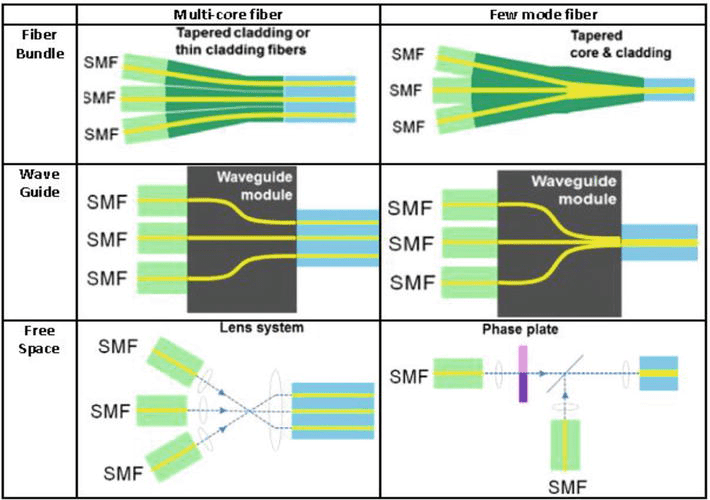
STL positions itself as one of the early movers in taking MCF from controlled lab demonstrations into operational networks, including buried and ducted plant, backed by a full ecosystem spanning fibre, cable, and connectivity hardware through its Optotec portfolio. Coupled with STL’s broader focus on AI-ready optical infrastructure and 5G-ready digital network solutions, the Colt trial underlines a practical migration path for carriers looking to future-proof metro and data-centre interconnect footprints against emerging AI, cloud, and 5G traffic patterns without wholesale rebuilds of underlying passive infrastructure.
“As network demand accelerates, customers are looking for more bandwidth without sacrificing security, performance, or sustainability,” said Buddy Bayer, Chief Operating Officer, Colt Technology Services. “At Colt, we continue to push optical networking forward, and this pilot represents an important step in Europe and the USA. It reflects our focus on building scalable networks that deliver growth in capacity without increasing environmental impact.”
Dr Badri Gomatam, CTO, STL, said the trial highlights the value of joint innovation in advancing optical infrastructure. “Collaborations like this speed up adoption of next-generation connectivity technologies. STL’s Multiverse MCF portfolio is designed for the high-density, ultra-low latency, and resilient connectivity requirements of AI, hyperscale cloud, and future digital platforms globally,” he said. STL stated that the trial results strengthen confidence in MCF as a viable technology for the growing bandwidth requirements driven by AI workloads, cloud scale-out, and new digital services.
“As network demand accelerates, customers are looking for more bandwidth without sacrificing security, performance, or sustainability,” said Buddy Bayer, Chief Operating Officer, Colt Technology Services. “At Colt, we continue to push optical networking forward, and this pilot represents an important step in Europe and the USA. It reflects our focus on building scalable networks that deliver growth in capacity without increasing environmental impact.”
Dr Badri Gomatam, CTO, STL, said the trial highlights the value of joint innovation in advancing optical infrastructure. “Collaborations like this speed up adoption of next-generation connectivity technologies. STL’s Multiverse MCF portfolio is designed for the high-density, ultra-low latency, and resilient connectivity requirements of AI, hyperscale cloud, and future digital platforms globally,” he said. STL stated that the trial results strengthen confidence in MCF as a viable technology for the growing bandwidth requirements driven by AI workloads, cloud scale-out, and new digital services.
………………………………………………………………………………………………………………………………………………………………….
About STL-– Sterlite Technologies Ltd:
STL is a global provider of advanced connectivity solutions, offering end-to-end products and services for building AI-ready networks across FTTx, rural broadband, enterprise, and data centres. With manufacturing operations in North America, Europe, and Asia, STL supplies connectivity solutions in more than 100 countries and works with telecom operators, cloud and data center companies, internet service providers, and large enterprises to build future-ready AI digital infrastructure.
On January 23, 2026, STL reported continued sequential improvement in Operational EBITDA margin for the fifth consecutive quarter, driven by a higher-margin product mix and increased contribution from the US market. With the US–India Bilateral Trade Agreement under advanced discussion, STL remains well-positioned to leverage emerging opportunities by offering reliable, high-quality solutions for building AI-ready digital infrastructure.
……………………………………………………………………………………………………………………………………………………
References:
https://www.intechopen.com/chapters/78908
How will fiber and equipment vendors meet the increased demand for fiber optics in 2026 due to AI data center buildouts?
Big tech spending on AI data centers and
AT&T sets 1.6 Tbps long distance speed record on its white box based fiber optic network
Huawei Cloud Review and Global Sales Partner Policies for 2026
Huawei Cloud is the cloud computing platform of Huawei Technologies Co. Ltd., offering a comprehensive suite of cloud services and solutions for enterprises and individual consumers. It’s ranked as the second-largest cloud service provider in China by market share, consistently placing behind the market leader, Alibaba Cloud.
Huawei Cloud provides a full range of services including Infrastructure as a Service (IaaS), Platform as a Service (PaaS), and Software as a Service (SaaS), supporting public, private, and hybrid cloud architectures. Cloud services include:
- Compute Services such as Elastic Cloud Servers (ECS), Bare Metal Servers (BMS), and container management via the Cloud Container Engine (CCE).
- Storage and Data Management Offerings include Object Storage Service (OBS), Elastic Volume Service (EVS), backup and disaster recovery solutions, and a range of database options like GaussDB and RDS for MySQL.
- Networking Services cover Virtual Private Cloud (VPC), Elastic IP (EIP), load balancing, and content delivery networks (CDN) to ensure fast and reliable connectivity.
- AI and Analytics This is a key focus area, featuring AI development platforms like ModelArts, pre-trained Pangu models, big data analytics services (MapReduce Service, Data Warehouse Service), and various AI-powered solutions for specific industries.
- Security and Compliance The platform offers robust security measures including firewalls, anti-DDoS services, data encryption, identity and access management (IAM), and comprehensive security operations centers.
- Developer and Management Tools A variety of tools for application development, operations management (O&M), migration, and governance.

Charles Yang, Huawei Senior Vice President, highlighted that the intelligent era presents immense opportunities and challenges for Huawei Cloud and its partners.
…………………………………………………………………………………………………………………………………………………….
- Global Visibility: Amplifying partner visibility through Huawei Cloud’s international media channels.
- Brand Enhancement: Assisting partners in improving their brand image using established global communication benchmarks.
- Enhanced Benefits: Upgrading partner benefits, including an increased Market Development Fund and comprehensive promotional support.
- Collaborative Marketing: Inviting partners to participate in Huawei Cloud’s own global marketing initiatives.
- Executive Level (CXO): Facilitating strategic exchanges on industry trends, digital transformation, and AI strategy to ensure vision alignment.
- Core Teams: Offering courses focused on business operations, industry analysis, and growth strategies.
- Sales and Technical Roles (BDs, SAs, CSMs): Providing hands-on training, including sales simulations and technical workshops, to enhance practical expertise.
References:
https://thetimes.com.au/news/press-releases?rkey=20260123AE69710&filter=24774
HUAWEI CLOUD launches partner programs in LatAm and Caribbean
Huawei’s Electric Vehicle Charging Technology & Top 10 Charging Trends
Huawei launches CloudMatrix 384 AI System to rival Nvidia’s most advanced AI system
Huawei to Double Output of Ascend AI chips in 2026; OpenAI orders HBM chips from SK Hynix & Samsung for Stargate UAE project
Omdia on resurgence of Huawei: #1 RAN vendor in 3 out of 5 regions; RAN market has bottomed
Blue Origin announces TeraWave – satellite internet rival for Starlink and Amazon Leo
The BBC reports that Jeff Bezos owned Blue Origin plans to create a new communications network called TeraWave, launching more than 5,400 satellites to offer global internet coverage. TeraWave will be focused on data centers, businesses and governments.
In a satellite internet market dominated by Elon Musk’s Starlink, Blue Origin would still have fewer satellites in orbit than Starlink. Yet TeraWave’s network at maximum speed would allow upload and download speeds of up to 6 terabits per second, much faster than rival commercial satellite offerings. The satellites are set to start launching by the end of 2027.
In April, Blue Origin launched an 11-minute space flight with an all-female crew, including Bezos’ now-wife Lauren Sánchez, singer Katie Perry and CBS presenter Gayle King. However, some commentators said it was “tone deaf” for celebrities to be taking part in such a fleeting and expensive trip at a time of economic struggle.

Blue Origin says TeraWave will be focused on data centers, businesses and governments. Blue Origin said its network, at its fastest, would allow upload and download speeds of as much as 6 terabits per second, much faster than rival commercial satellite services currently offer.
TeraWave is Optimized for Enterprise, Data Center, & Government Customers
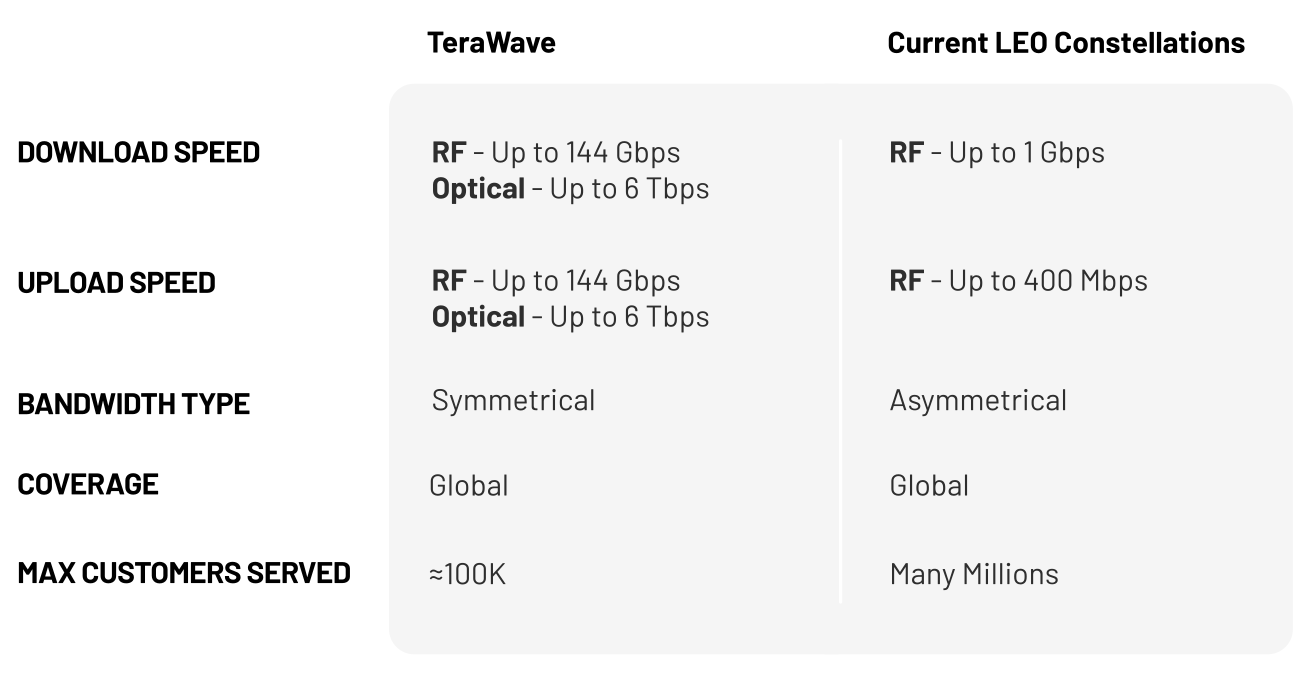
- Starlink – part of Musk’s rocket firm SpaceX (which is 40% owned by Elon Musk) is by far the #1 satellite internet and phone service provider, primarily to individual customers.
- Blue Origin’s TeraWave satellite network will also compete with Amazon Leo, but they are targeting different market segments despite both being backed by Jeff Bezos. While it currently has around 180 satellites in orbit, having launched dozens more just last week, it plans to have more than 3,000 in orbit. Like Starlink, Amazon is also more focused on the general public than businesses and governments, positioning Leo as a way to offer high-speed internet access globally. It has not said when all of the Leo satellites will be in orbit.
| Feature | Blue Origin TeraWave | Amazon Leo (formerly Project Kuiper) |
|---|---|---|
| Target Market | Enterprises, data centers, governments, and other high-capacity users. | Consumers and communities in remote and underserved areas. |
| Service Goal | Provide extremely high-speed, symmetrical, and redundant backbone connectivity. | Deliver general high-speed broadband internet access (consumer speeds). |
| Projected Speeds | Up to 6 terabits per second (Tbps) via optical links in MEO. | Up to 1 gigabit per second (Gbps) for its highest-end user terminal. |
| Constellation Size | Plan for 5,408 satellites (LEO and MEO). | Plan for over 3,200 satellites (LEO only). |
In November, Blue Origin successfully landed a rocket booster on a floating platform for the first time. Only SpaceX had previously accomplished that feat.
………………………………………………………………………………………………………………………………………………………………..
References:
https://www.bbc.com/news/articles/cn0yydwe89jo
AST SpaceMobile to deliver U.S. nationwide LEO satellite services in 2026
FCC grants Amazon’s Kuiper license for NGSO satellite constellation for internet services
Amazon to Spend Billions on 38 Space Launches for Project Kuiper
Starlink doubles subscriber base; expands to to 42 new countries, territories & markets
China ITU filing to put ~200K satellites in low earth orbit while FCC authorizes 7.5K additional Starlink LEO satellites
Amazon Leo (formerly Project Kuiper) unveils satellite broadband for enterprises; Competitive analysis with Starlink
Amazon launches first Project Kuiper satellites in direct competition with SpaceX/Starlink
NBN selects Amazon Project Kuiper over Starlink for LEO satellite internet service in Australia
Elon Musk: Starlink could become a global mobile carrier; 2 year timeframe for new smartphones
GEO satellite internet from HughesNet and Viasat can’t compete with LEO Starlink in speed or latency
Ericsson announces capability for 5G Advanced location based services in Q1-2026
Ericsson’s 5G Advanced location based services (LBS) offering is a comprehensive suite of innovations designed to redefine location-based services across commercial 5G Standalone (SA) networks. Set for release in Q1 2026, it makes Ericsson the leader in 5G positioning technology, offering a scalable and fully integrated solution on top of Ericsson’s dual-mode 5G Core network.
By embedding positioning as a core 5G SA network capability, Ericsson 5G Advanced location services enables Communications Service Providers (CSPs) to monetize precise location services and expand beyond traditional mobile offerings into verticals such as manufacturing, healthcare, public safety, automotive, drones, and more.
Key benefits:
- High Accuracy: Down to sub-meter for indoor and sub-10 cm for outdoor positioning, enabling precise tracking
- Scalability: Scalable, precise positioning for outdoor applications (automotive, agriculture, drones)
- Seamless Indoor/Outdoor Coverage: Unified 5G positioning technology for both environments.
- Developer & Device Friendliness: No need for device-side apps; improved battery life compared to satellite-based solutions
- Support for Large-Scale Use Cases: Enables massive geofencing, population density analysis, and tracking use cases.
Monica Zethzon, Head of Core Networks, Ericsson, says: “With the launch of 5G Advanced Location Services we are evolving the value of 5G Standalone networks. This innovation gives CSPs the precision and scalability to create differentiated services based on location capabilities.”
Caroline Gabriel, Partner at Analysys Mason, says: “Ericsson’s integrated approach to indoor and outdoor positioning sets a new benchmark in the industry. It addresses critical pain points for operators and enterprises, particularly in sectors where location accuracy is mission-critical.”
The global market for 5G positioning is in its early stages but poised for rapid growth, driven by demand for enhanced precision in diverse sectors. Ericsson’s solution responds to this demand with scalable, developer-friendly capabilities that improve device battery life compared to legacy systems.
This launch further strengthens Ericsson’s location solutions based on Real-Time Kinematics technology, with related devices from Ericsson planned for Q1 2026.

Photo Credit: Ericsson
………………………………………………………………………………………………………………………………………………………….
- Integrated Positioning: Positioning is built into the 5G Standalone (SA) architecture, moving beyond traditional GPS reliance.
- High Accuracy & Efficiency: New techniques improve accuracy (e.g., bandwidth aggregation, carrier-phase measurements) and reduce power consumption for devices.
- AI/ML Integration: Artificial Intelligence/Machine Learning is applied to enhance positioning accuracy, especially for challenging scenarios like beyond-visual-line-of-sight (BVLOS).
- Support for New Devices/Apps: Enables precise tracking for wearables, industrial sensors (RedCap), augmented reality (AR), drone control, and smart grids.
- Beyond-Line-of-Sight (BVLOS): Focus on reliable positioning for industrial and public safety applications where line-of-sight isn’t guaranteed.
- Reduced Power: Solutions target lower power usage, crucial for IoT devices.
- Release 18 (5G Advanced Start): Finalized mid-2024, introduced major LBS enhancements, including RedCap positioning, bandwidth aggregation, and carrier-phase support.
- Release 19 (Ongoing): Continues the evolution, extending LTM (L1/L2-triggered Mobility) and further exploring AI/ML for mobility and positioning.
- Release 20 & Beyond: Will build on these foundations, further evolving towards 6G capabilities.
References:
https://www.ericsson.com/en/press-releases/2026/1/5g-advanced-location-services
5G Advanced offers opportunities for new revenue streams; 3GPP specs for 5G FWA?
What is 5G Advanced and is it ready for deployment any time soon?
Hutchison Telecom is deploying 5G-Advanced in Hong Kong without 5G-A endpoints
China Mobile & ZTE use digital twin technology with 5G-Advanced on high-speed railway in China
Huawei pushes 5.5G (aka 5G Advanced) but there are no completed 3GPP specs or ITU-R standards!
ZTE and China Telecom unveil 5G-Advanced solution for B2B and B2C services
India 5G subscribers top 400 Million with rapid adoption continuing without 5Gi
With over 400 million 5G subscribers, India now ranks #2 globally (China is #1 [1.]). What’s even more remarkable is the speed of adoption after 5G spectrum auctions were repeatedly delayed. Jyotiraditya Scindia, India’s union minister for communications and development of the North Eastern Region, said the country is “setting new global benchmarks in scale, speed and digital transformation.”
According to figures cited by the minister, the country’s 5G subscriber base now exceeds that of other major markets, including the United States with around 350 million users, the European Union with 200 million, and Japan with 190 million. China remains the global leader, with more than 1.2 billion 5G connections.
Note 1. China has over 1.2 billion 5G subscribers as of late 2025, representing over 60% of all mobile connections in the country, driven by massive infrastructure rollout and strong adoption across major operators like China Mobile, China Telecom, and China Unicom, making it the global leader in 5G penetration.
……………………………………………………………………………………………………………………………………………………………………………………………………..
Bharti Airtel and Reliance Jio Infocomm spearheaded the launch, becoming the first carriers to operationalize 5G networks and achieving significant subscriber acquisition, with each surpassing the 50 million user milestone within their initial year of service [1]. Vodafone Idea subsequently entered the 5G market with launches in specific cities during 2025.
State-owned telecom provider BSNL is projected to launch 5G services within the current year [1]. This deployment is slated to exclusively utilize India’s indigenously developed telecom technology stack, a collaborative effort involving the Centre for Development of Telematics (C-DOT), Tejas Networks, and Tata Consultancy Services (TCS).
As of the close of 2025, the national 5G infrastructure comprised 518,854 operational base stations, marking a substantial increase from approximately 464,990 recorded at the start of the year [1]. The Department of Telecommunications (DoT) reported the deployment of 4,112 new 5G base transceiver stations (BTS) in December 2025 alone, contributing to the year-end cumulative total

- Infrastructure Growth: Rapid BTS deployment, exceeding 4,100 new installations in December 2025 alone, demonstrates intense network densification, with coverage now reaching most districts.
- Vodafone Idea’s Entry: Vi, after initial delays, commenced its phased 5G service introduction in select cities during 2025.
- BSNL’s Indigenous Strategy: The state-owned operator is slated to launch 5G using India’s homegrown stack (C-DOT, Tejas, TCS), showcasing self-reliance in telecom technology.
- Market Dynamics: The rapid expansion aims to unlock enterprise and consumer use cases, positioning India as a significant global 5G player, despite ongoing discussions about monetization and infrastructure investment.
Technical & Deployment Highlights:
- Architecture: A mix of 5G SA (Jio) and 5G NSA (Airtel) is prevalent, with SA offering lower latency and true 5G capabilities.
- Spectrum: Operators utilize various bands, including sub-6 GHz (3.3 GHz, 26 GHz) for broad coverage and capacity.
- Deployment Pace: Driven by ministerial targets, operators installed BTS at an accelerated pace, focusing initially on high-revenue urban centers.
This author deeply regrets that the Telecommunications Standards Development Society India (TSDSI)’s 5Gi RIT specification, included as part of the ITU-R M.2150 IMT 2020 RIT/SRIT standard, was not implemented in India. On January 25, 2022, TSDSI told the Telecommunication Engineering Center (TEC) under the DoT not to proceed with the adoption of 5Gi as a national 5G standard. TSDSI added that it “does not intend to further update 5Gi specifications.”
References:
OpenSignal: real world 5G deployment in India, market status & what happened to 5Gi?
Nokia Executive: India to Have Fastest 5G Rollout in the World; 5Gi/LMLC Missing!
LightCounting & TÉRAL RESEARCH: India RAN market is buoyant with 5G rolling out at a fast pace
Nokia’s Bell Labs to use adapted 4G and 5G access technologies for Indian space missions
Reliance Jio in talks with Tesla to deploy private 5G network for the latter’s manufacturing plant in India
Communications Minister: India to be major telecom technology exporter in 3 years with its 4G/5G technology stack
India to set up 100 labs for developing 5G apps, business models and use-cases
Adani Group to launch private 5G network services in India this year
Adani Group planning to enter India’s long delayed 5G spectrum auction
At long last: India enters 5G era as carriers spend $ billions but don’t support 5Gi
5G in India to be launched in 2023; air traffic safety a concern; 5G for agricultural monitoring to be very useful
Bharti Airtel to launch 5G services in India this August; Reliance Jio to follow
5G Made in India: Bharti Airtel and Tata Group partner to implement 5G in India
India government wants “home-grown” 5G; BSNL and MTNL will emerge as healthy
5G in India dependent on fiber backhaul investments
Hindu businessline: Indian telcos deployed 33,000 5G base stations in 2022
From LPWAN to Hybrid Networks: Satellite and NTN as Enablers of Enterprise IoT – Part 2
By Afnan Khan (ML Engineer) and Mehsam Bin Tahir (Data Engineer)
Introduction:
This is the second of two articles on the impact of the Internet of Things (IoT) on the UK Telecom industry. The first is at
Enterprise IoT and the Transformation of UK Telecom Business Models – Part 1
Executive Summary:
Early Internet of Things (IoT) deployments relied heavily on low power wide area networks (LPWANs) to deliver low-cost connectivity for distributed devices. While these technologies enabled initial IoT adoption, they struggled to deliver sustainable commercial returns for telecom operators. In response, attention has shifted towards hybrid terrestrial–satellite connectivity models that integrate Non-Terrestrial Networks (NTN) directly into mobile network architectures. In 2026, satellite connectivity is increasingly positioned not as a universal coverage solution but as a resilience and continuity layer for enterprise IoT services (Ofcom, 2025).
The Commercial Limits of LPWAN-Based IoT:
LPWAN technologies enabled low-cost connectivity for specific IoT use cases but were typically deployed outside mobile core architectures. This limited their ability to support quality of service guarantees, enterprise-grade security and integrated billing models. As a result, LPWAN deployments often remained fragmented and failed to scale into durable enterprise business models, restricting their long-term commercial value for telecom operators (Ofcom, 2025).
Satellite and NTN as Integrated Mobile Extensions:
In contrast, satellite and NTN connectivity extends existing mobile networks rather than operating as a parallel IoT layer. When non-terrestrial connectivity is integrated into 5G core infrastructure, telecom operators are able to deliver managed IoT services with consistent security, performance and billing models across both terrestrial and remote environments. This architectural shift allows satellite connectivity to be packaged as part of a unified enterprise service rather than sold as a standalone or niche connectivity product (3GPP, 2023). Figure 1 illustrates this hybrid terrestrial–satellite model, showing how satellite connectivity functions as an extension of mobile networks to support continuous IoT services across urban, rural and remote environments.
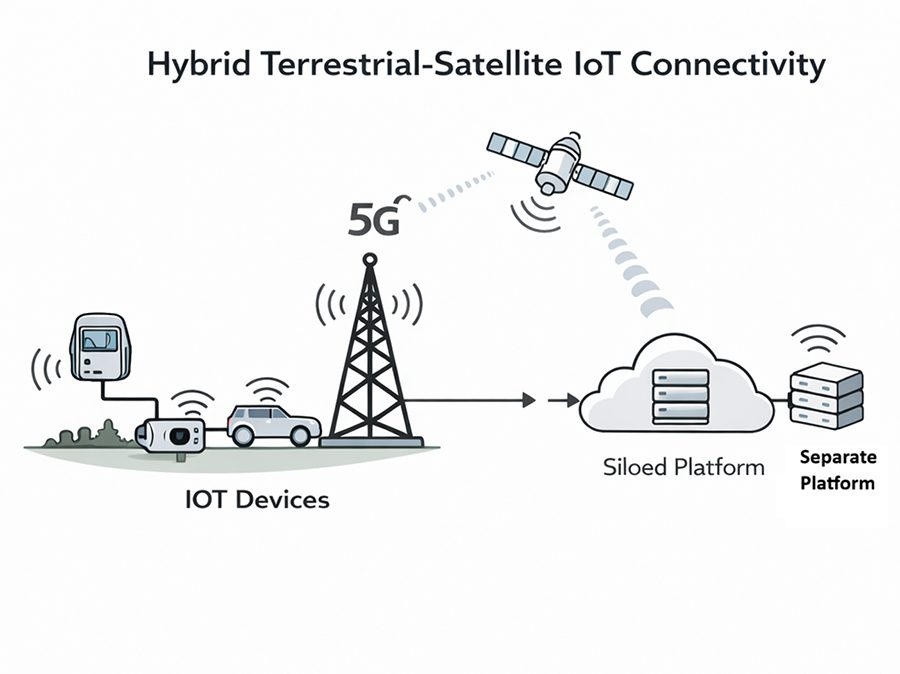
Figure 1: Hybrid terrestrial–satellite connectivity supporting continuous IoT services across urban, rural and remote environments.
Industrial Use Cases and Hybrid Connectivity
In sectors such as offshore energy, agriculture, logistics and remote infrastructure monitoring, IoT deployments prioritise coverage continuity and service resilience over peak data throughput. Hybrid terrestrial–satellite connectivity enables operators to offer coverage guarantees and service level agreements that LPWAN-based models could not reliably support. In 2026, Virgin Media O2 launched satellite-enabled services aimed at supporting rural connectivity and improving resilience for IoT-dependent applications, reflecting a broader operator strategy to monetise non-terrestrial coverage where reliability is a core requirement (Real Wireless, 2025).
The commercial implications of this transition are further illustrated in Figure 2, which contrasts siloed LPWAN deployments with integrated mobile and satellite IoT services delivered through a unified network core.
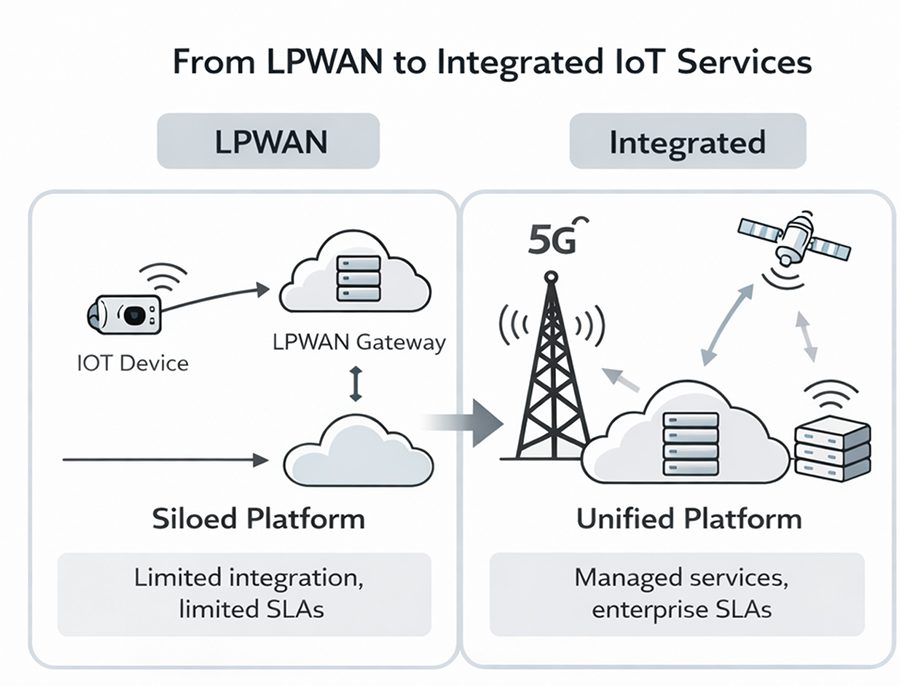
Figure 2: Transition from siloed LPWAN deployments to integrated mobile and satellite IoT services delivered through a unified network core.
Satellite Connectivity and Enterprise IoT at Scale:
The UK Space Agency has identified hybrid terrestrial–satellite connectivity as an enabling layer for remote industrial operations, environmental monitoring and agricultural IoT systems. UK-based firms such as Open Cosmos are contributing to this model by integrating Low Earth Orbit satellite connectivity with existing mobile core networks. This approach allows telecom operators to deliver end-to-end managed connectivity for enterprise customers without deploying separate IoT network stacks, converting coverage limitations from a cost burden into chargeable, service-based revenue opportunities (Open Cosmos, 2024; UK Space Agency, 2025).
Conclusion
In 2026, IoT is reshaping the UK telecom sector primarily by enabling new revenue models rather than by driving incremental network expansion. Following the limited commercial success of LPWAN-based IoT strategies, satellite and Non-Terrestrial Network integration is increasingly deployed as an extension of mobile networks to provide coverage continuity and service guarantees for industrial and remote use cases. When integrated into 5G core architectures, satellite connectivity enables telecom operators to monetise resilience and reliability as part of managed enterprise services rather than offering standalone connectivity. Taken together, these developments show that satellite and NTN integration has become a critical enabler of scalable, enterprise-led IoT business models in the UK (Ofcom-2025; 3GPP-2023).
…………………………………………………………………………………………………………………………………………………………………………
References:
Ofcom. (2025). Connected Nations UK report.
https://www.ofcom.org.uk
Real Wireless. (2025). Satellite to mobile connectivity and the UK market.
https://real-wireless.com
UK Space Agency. (2025). Connectivity and space infrastructure briefing
https://www.gov.uk/government/organisations/uk-space-agency
Open Cosmos. (2024). Satellite solutions for IoT and Earth observation.
https://open-cosmos.com
3GPP. (2023). Non-Terrestrial Networks (NTN) support in 5G systems.
https://www.3gpp.org/news-events/ntn
Non-Terrestrial Networks (NTNs): market, specifications & standards in 3GPP and ITU-R
Keysight Technologies Demonstrates 3GPP Rel-19 NR-NTN Connectivity in Band n252 (using Samsung modem chip set)
Telecoms.com’s survey: 5G NTNs to highlight service reliability and network redundancy
ITU-R recommendation IMT-2020-SAT.SPECS from ITU-R WP 5B to be based on 3GPP 5G NR-NTN and IoT-NTN (from Release 17 & 18)
China ITU filing to put ~200K satellites in low earth orbit while FCC authorizes 7.5K additional Starlink LEO satellites
Samsung announces 5G NTN modem technology for Exynos chip set; Omnispace and Ligado Networks MoU
Enterprise IoT and the Transformation of UK Telecom Business Models – Part 1
By Afnan Khan (ML Engineer) and Raabia Riaz (Data Scientist)
Introduction:
This is the first of two articles on the impact of the Internet of Things (IoT) on the UK Telecom industry. The second is at
From LPWAN to Hybrid Networks: Satellite and NTN as Enablers of Enterprise IoT – Part 2
Executive Summary:
In 2026, the Internet of Things (IoT) is fundamentally changing the UK telecom sector by enabling new business models rather than simply driving incremental network upgrades.
As consumer mobile markets show limited YoY growth between 2025 and 2026, telecom operators have prioritised IoT-led enterprise services as a source of new revenue (as per Ofcom-2025; GSMA-2024). Investment has shifted away from consumer facing upgrades towards private networks, managed connectivity and long-term service contracts for industry and infrastructure. This change reflects a broader move from usage-based connectivity towards service-based delivery.
IoT and Enterprise Connectivity through Private 5G:
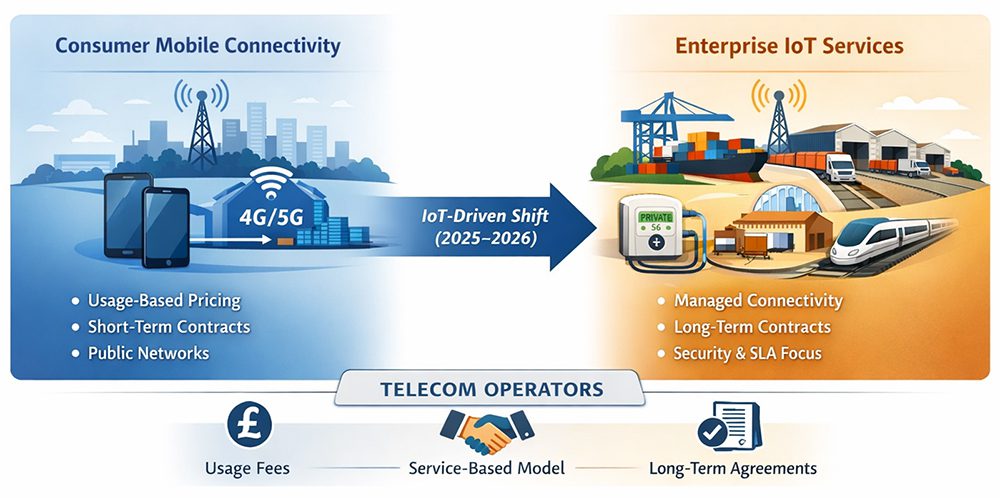
Figure 1: Transition from consumer mobile connectivity to enterprise IoT services in the UK telecom sector, highlighting the shift towards managed connectivity and long-term service contracts.
The growth of private 5G and managed enterprise networks represents one of the clearest IoT driven business shifts. Industrial customers increasingly require predictable performance, low latency and enhanced security, which are not consistently available through public mobile networks. 5G Standalone architecture enables features such as network slicing and low latency communication, allowing operators to sell connectivity as a managed service rather than a commodity product (Mobile UK, 2024).
In the UK, this model is visible in projects such as the Port of Felixstowe private 5G trials supporting automated port operations and asset tracking (BT Group, 2023), the Liverpool City Region 5G programme focused on connected logistics (DCMS, 2022), the West Midlands 5G transport and connected vehicle projects (WM5G, 2023) and Network Rail 5G rail monitoring trials supporting safety and asset management (Network Rail, 2024). These deployments are typically delivered through long term enterprise contracts.
Together, these projects illustrate how connectivity is increasingly sold as a managed operational capability embedded within enterprise workflows rather than them being priced through consumer-style data usage as illustrated in figure 1.
IoT and Long-Term Infrastructure Revenue:
IoT enables telecom operators to participate in long-term infrastructure-based revenue models. The UK national smart meter programme illustrates this shift. By the third quarter of 2025, more than 40 million smart and advanced meters had been installed across Great Britain, with around 70% operating in smart mode (Department for Energy Security and Net Zero, 2025).
These systems rely on continuous, secure connectivity over long lifecycles. The Data Communications Company network processes billions of encrypted messages each month, creating sustained demand for resilient connectivity (DCC, 2024). Ofcom has linked the growth of such systems to increased regulatory focus on network resilience where connectivity underpins critical national infrastructure, while the National Cyber Security Centre has highlighted security risks associated with large IoT deployments (Ofcom, 2025; NCSC, 2024).
For telecom operators, these deployments favour long-term service contracts and regulated infrastructure partnerships over short-term retail revenue models.
Conclusions:
In 2026, IoT is transforming the UK telecom sector primarily by reshaping how connectivity is monetised rather than by driving incremental network upgrades. As consumer mobile markets show limited growth, telecom operators have increasingly aligned investment with enterprise IoT demand through private 5G deployments and long-term infrastructure connectivity. These models prioritise predictable performance, security and service continuity over mass-market scale. Private 5G projects across ports, transport networks and logistics hubs demonstrate how IoT demand has accelerated the commercial adoption of 5G Standalone capabilities, allowing operators to sell connectivity as a managed operational service embedded within enterprise workflows (Mobile UK, 2024). At the same time, national smart infrastructure programmes such as smart metering illustrate how IoT supports long-duration connectivity contracts that favour regulated partnerships and resilient network design over short-term retail revenue (Department for Energy Security and Net Zero, 2025; DCC, 2024). Taken together, these developments indicate that IoT is no longer an adjunct to UK telecom networks. Instead, it has become a central driver of enterprise-led, service-based business models that align network investment with stable, long-term revenue streams and critical infrastructure requirements.
…………………………………………………………………………………………………………………………………………………………..
References:
BT Group. (2023). BT and Hutchison Ports trial private 5G at the Port of Felixstowe.
https://www.bt.com/about/news/2023/bt-hutchison-ports-5g-felixstowe
Data Communications Company. (2024). Annual report and accounts 2023–24.
https://www.smartdcc.co.uk/our-company/our-performance/annual-reports/
Department for Digital, Culture, Media and Sport. (2022). Liverpool City Region 5G Testbeds and Trials Programme.
https://www.gov.uk/government/publications/5g-testbeds-and-trials-programme
Department for Energy Security and Net Zero. (2025). Smart meter statistics in Great Britain Q3 2025.
https://www.gov.uk/government/collections/smart-meters-statistics
GSMA. (2024). The Mobile Economy Europe.
https://www.gsma.com/mobileeconomy/europe/
Mobile UK. (2024). Unleashing the power of 5G Standalone.
https://www.mobileuk.org
National Cyber Security Centre. (2024). Cyber security principles for connected places.
https://www.ncsc.gov.uk
Network Rail. (2024). 5G on the railway connectivity trials.
https://www.networkrail.co.uk
Ofcom. (2025). Connected Nations UK report.
https://www.ofcom.org.uk
MTN Consulting: Satellite network operators to focus on Direct-to-device (D2D), Internet of Things (IoT), and cloud-based services
IoT Market Research: Internet Of Things Eclipses The Internet Of People
Artificial Intelligence (AI) and Internet of Things (IoT): Huge Impact on Tech Industry
ITU-R M.2150-1 (5G RAN standard) will include 3GPP Release 17 enhancements; future revisions by 2025
5G Americas: LTE & LPWANs leading to ‘Massive Internet of Things’ + IDC’s IoT Forecast
GSA: 102 Network Operators in 52 Countries have Deployed NB-IoT and LTE-M LPWANs for IoT
LoRaWAN and Sigfox lead LPWANs; Interoperability via Compression
IEEE/SCU SoE Virtual Event: May 26, 2022- Critical Cybersecurity Issues for Cellular Networks (3G/4G, 5G), IoT, and Cloud Resident Data Centers