

Ericsson
Private 5G’s Business Model Shifts: Ericsson’s Move Signals a Market Reset
Following in the footsteps of Nokia’s sale of its Enterprise Campus Edge (ECE) business to AURELIUS, Ericsson is dissolving its Enterprise Wireless Solutions business as a standalone business unit, while retaining its portfolio. Neutral-host solutions and Ericsson Private 5G will move into Business Area Networks, where management expects greater R&D scale and a faster route to profitability. Cradlepoint’s wireless-WAN business will remain standalone within Ericsson’s Americas organization.
The transfer of Ericsson’s Enterprise Wireless Solutions will include both its private 5G and neutral-host portfolios—segments recently positioned as potential sources of growth as operators’ core 5G spending matured. That growth case has yet to materialize: Ericsson reported in its Q3 review that Enterprise sales rose only 1% organically year over year, compared with 7% organic growth for the group overall. Reported Enterprise sales fell 10% to SEK 4.6 billion, reflecting the August 2025 divestment of number-portability administrator iconectiv.
The modest organic increase was partly supported by pre-emptive purchasing from cost-conscious customers anticipating higher AI-related pricing. Enterprise adjusted gross margin declined to 50%, also reflecting the iconectiv divestment, while adjusted EBITA was negative SEK 0.5 billion—though it improved sequentially.
The restructuring therefore signals portfolio rationalization rather than an outright exit from private 5G. It also underscores the gap between the strategic promise of enterprise wireless and its current contribution: Enterprise accounted for about 8% of group revenue in the quarter, with limited organic momentum and continued profitability challenges.
Chafic Nassif, currently Head of Market Area North East Asia and Andres Vicente, Head of Market Area South East Asia, Oceania and India, will support the formation of the new unit and hand over responsibilites on December 31, 2026. New Ericsson CEO Per Narvinger (took over from Bjore Ekholm on October 1st) said:
“Chafic has been with Ericsson for more than sixteen years and has contributed greatly to the Company in the different roles he has had across Europe, Latin America and Asia. I especially want to thank him for his time on the Executive Team where he has played an important role for our business in North East Asia,” and continues. Andres has a deep understanding of commercial aspects of our industry where he has drawn on his extensive experience from working in Europe and Asia. He has been important in the development of our position in the market area. I would like to extend my gratitude for his efforts.”
“We are strengthening our focus on seamless connectivity and want to make sure that we can offer a rich portfolio that leverages the full R&D competence in the company and meets both CSP and Enterprise demand. Åsa has been instrumental in creating new channels to Enterprises for our portfolio, which now enables us to take the next step in developing our indoor and Enterprise business. She has also been an important change leader in the company, serving on the Executive Team and successfully leading multiple businesses since 2018. I am grateful for her many contributions.”

Deep Dive Analysis:
Ericsson’s move is a portfolio rationalization, not an exit from private 5G. By folding Ericsson Private 5G and Neutral Host into Business Area Networks, the company is signaling that standalone enterprise-wireless economics were insufficient and that these products must borrow scale, R&D, channels, and indoor-connectivity assets from the core RAN business.
Before & After Table via Perplexity.ai:
| Dimension | Before | After |
|---|---|---|
| Organizational home | Enterprise Wireless Solutions business area | Business Area Networks |
| Product focus | Enterprise-specific private 5G and neutral-host offerings | Integrated with indoor technology and core RAN development ericsson+1 |
| Strategic rationale | Dedicated enterprise growth platform | R&D synergies, scale, innovation, and faster profitability theglobeandmail+1 |
| Market signal | Private 5G as a distinct enterprise business | Private 5G as an extension of network infrastructure lightreading+1 |
Implications for private 5G market:
-
The market is consolidating around infrastructure economics. Ericsson is treating private 5G less as a vertically separate enterprise software business and more as a product line that can reuse RAN silicon, radio platforms, network-management software, and indoor systems. That should reduce duplicated development but may narrow product differentiation.ericsson+1
-
Expect tighter product-roadmap discipline. Private 5G and neutral-host capabilities will now compete for R&D and commercial priority inside a division whose primary revenue engine remains macro RAN. Ericsson says the units will retain full focus on customers and partners, but integration naturally raises the risk that niche enterprise requirements receive less dedicated investment.ericsson+1
-
Neutral host gains strategic relevance. Moving Neutral Host alongside indoor technology suggests Ericsson sees shared infrastructure—coverage for multiple operators in venues, campuses, and enterprise sites—as a more scalable route than purely standalone private networks. This aligns private wireless with in-building coverage, capacity offload, and operator monetization.ericsson+1
-
Profitability becomes the near-term test. Ericsson explicitly frames the transfer as a way to “accelerate the journey towards profitability,” an implicit acknowledgment that the enterprise-wireless structure had not delivered the expected returns. Customers and partners should expect more selective deal pursuit, standardized offerings, and less willingness to fund bespoke deployments.theglobeandmail+1
Competitive consequences:
Ericsson’s move contrasts with Nokia’s decision to sell its Enterprise Campus Edge business to Aurelius and operate it as a standalone company. The two vendors are therefore taking opposite structural approaches: Nokia is separating enterprise private wireless from its core business, while Ericsson is embedding it more deeply in Networks. That divergence could reshape vendor positioning:
-
Ericsson may become stronger where private 5G is sold as part of a broader RAN, indoor, and operator-managed infrastructure package.
-
Smaller private-network specialists may gain opportunities where enterprises want dedicated roadmaps, flexible commercial models, or rapid customization.
-
Neutral-host deployments could become a more prominent competitive arena, especially for venues and large campuses where shared infrastructure improves the business case.
Conclusions:
The transfer validates a sobering conclusion: private 5G has not become a self-sustaining, high-growth enterprise category at the scale once projected. Ericsson is preserving the technology but removing the standalone business structure, effectively betting that private and neutral-host 5G will succeed only when treated as part of the broader mobile-network and indoor-connectivity stack. Ericsson’s asset transfer is less an organizational footnote than evidence that private 5G’s commercial model is entering a more disciplined, infrastructure-led phase.
-
Private 5G remains strategically relevant but commercially immature. Ericsson’s decision to retain the portfolio while dissolving its dedicated business area indicates that the technology has a role, but not yet the standalone revenue scale or margin profile required to justify an independent operating unit.theglobeandmail+1
-
The market is shifting from “private networks as a product” to “private connectivity as infrastructure.” The strongest near-term business cases are likely to be tied to RAN modernization, indoor coverage, neutral-host deployments, mission-critical connectivity, and operator-managed services—not isolated enterprise LAN replacements.
-
Neutral host may be the more durable growth vector. Its inclusion in Networks alongside indoor technology suggests Ericsson sees shared, multi-operator infrastructure as better aligned with venue economics, capacity monetization, and recurring service revenue than purely private single-enterprise networks.ericsson+1
-
Vendor consolidation is likely to continue. If Ericsson and Nokia are both restructuring their private-wireless operations—Ericsson by integration and Nokia through divestiture—smaller specialists will face pressure to demonstrate differentiated technology, vertical expertise, or superior unit economics.
-
Customers should expect more standardized, ecosystem-led offerings. Ericsson’s stated emphasis on scale, R&D synergies, and profitability implies fewer bespoke deployments and greater reliance on partners, system integrators, and repeatable enterprise solutions.theglobeandmail+1
-
The next proof point is execution, not organizational design. The restructuring will succeed only if Ericsson can translate RAN scale and indoor assets into faster private-5G sales cycles, lower delivery costs, and sustained profitability; otherwise, the portfolio risks becoming a low-priority adjunct to the core Networks business.
“With the development of AI, many new applications are going to be dependent on mobile connectivity. Networks will need to be more reliable and resilient. With AI models optimized for use cases, leveraging Ericsson’s purpose-built silicon, we [will help] customers get more out of their spectrum assets without increasing power consumption. We will continue to invest and make sure we stay at the forefront of this development. At the same time, we remain realistic about the market. The RAN market is broadly flat and component costs are increasing in the wake of the AI boom. We’ve been able to mitigate this with tactical actions such as product substitution and upselling. [But] these efforts will not be enough long-term.”
“We are also taking structural action, including portfolio optimization, raising prices, supply chain measures, and efficiency improvements. Many customer contracts are multi-year, so structural mitigations will take time to flow through. We will not be immune to higher component costs, but protecting the value of our technology and profitability of our mobile networks business remains our top priority.”
“The area where we have more work to do, of course, is in the enterprise segment,” said Narvinger in a Q&A on the Q3 earnings call. “We will dissolve the business, as such, but continue with the portfolio and solutions… We are moving neutral host and [private 5G] to networks, where we can get the better R&D muscle, and then also accelerate towards profitability.”
“Satellite will be a fantastic addition to terrestrial networks. What will be important is to have seamless connectivity between outdoor and indoor. That’s going to be one of the challenges – how to take the outdoor coverage indoors. That seamless high performing experience is going to be very, very important. That’s also one of the reasons we are consolidating our R&D efforts in the indoor segment, [moving] our enterprise wireless business into networks.”
References:
https://rcrwireless.com/20261015/network-infrastructure/ericsson-retools-in-flat-market
Nokia’s ECE Divestiture: Impact on Private 5G Market & Disaggregation
4.8 GHz to 4.9 GHz frequency band uses & Verizon Wireless experimental license for testing ISAC with Ericsson
Ericsson and MediaTek Demonstrate 3GPP-Based GNSS RTK Positioning with Sub-30cm Accuracy Over a Commercial 5G Network
AT&T’s 600 MHz Deployment with Ericsson: Turning Low-Band Spectrum Into Coverage and Uplink Capacity
Ericsson leads SK Telecom AI RAN vs. NVIDIA’s GPU centric AI RAN Alliance
AT&T/Ericsson Demonstrate 5G-Based ISAC for Drone Detection at World Cup Stadium
AI-RAN and Agentic AI get real: Ericsson, Nokia, Verizon & other operators enter into a new network automation era
Analysis: Ericsson’s leading role in French INTENTION 6G project
Ericsson’s June 2026 Mobility Report Highlights + AI impact on network traffic
GSA: Global private mobile networks exceed 2,000 worldwide; Ericsson Private 5G from Verizon Business extends beyond U.S
Optus and Ericsson achieve 180MHz across 2.3GHz and 3.5GHz bands using carrier aggregation on a live 5G SA network
Ericsson reports 10% drop in 1st quarter sales; targets network growth
Ericsson signs MoU’s with Murata and Sumitomo to progress next-gen mobile network infrastructure
Introduction:
Ericsson has signed separate memoranda of understanding with Murata Manufacturing and Sumitomo Electric Industries to investigate component, radio, and network technologies for next-generation mobile infrastructure.
The collaborations are intended to link Japanese component and materials expertise with Ericsson’s RAN and system-integration capabilities, with an emphasis on technologies that could improve radio-network performance, lower energy consumption, and strengthen the resilience and trustworthiness of communications infrastructure for the 6G and AI era. Key takeaways:
- Ericsson, Murata Manufacturing and Sumitomo Electric Industries to explore advanced technologies aimed at enhancing network performance and improving product energy efficiency in the 6G and AI era
- Ericsson’s new R&D Center in Yokohama to provide a platform for closer collaboration with Japan’s technology ecosystem
- Collaborations to combine the advanced technology capabilities of Murata and Sumitomo Electric Industries with Ericsson’s global R&D capabilities and mobile network leadership
Focus on RAN innovation:
The MoUs provide a framework for joint technology assessment, engineering knowledge exchange, and proof-of-concept work. The companies will examine how advances in components, interconnects, radio hardware, and related technologies can be incorporated more effectively into future RAN platforms and programmable network architectures.
The work is expected to address a central 6G engineering challenge: translating innovation at the component level into system-level gains in capacity, coverage, energy efficiency, reliability, and operational flexibility. That includes evaluating technologies that can support increasingly software-defined, AI-assisted, and cloud-integrated mobile networks without compromising the performance and determinism required at the radio edge.
Linking components to systems:
Murata brings capabilities in electronic components and RF-related technologies, while Sumitomo Electric contributes expertise spanning optical communications, connectivity, materials, and related infrastructure technologies. Ericsson contributes global RAN research, network-architecture expertise, and experience in the design and deployment of programmable mobile networks.
Rather than positioning the agreements as product-development commitments, the MoUs establish an exploratory basis for identifying technical areas where Japanese component leadership can be aligned with Ericsson’s end-to-end network and RAN roadmap. The intended outcome is to accelerate the transition of promising technologies from component-level research into scalable network solutions relevant to both Japan and international markets.
Yokohama R&D role:
The collaborations will draw on Ericsson’s global R&D organization and its Yokohama R&D Center, which began operations in April 2026. The center develops advanced radio hardware and software for Japanese and global markets, including programmable network technologies, next-generation mobile systems, and open network architectures.
The Yokohama facility also serves as a collaboration point for customers and technology partners and supports Ericsson’s participation in international standardization. Its role is therefore broader than local product development: it connects Japanese technology innovation with Ericsson’s global research programs, ecosystem activities, and standards engagement.
Strategic significance:
For Ericsson, the agreements reinforce a long-term industrial commitment to Japan at a time when 6G research is increasingly focused on the interaction among advanced semiconductors and components, radio systems, AI-native network functions, cloud platforms, and energy-efficient infrastructure.
For the wider industry, the significance lies in the effort to close the gap between high-value component innovation and deployable network architecture. Future 6G systems will depend not only on new spectrum bands and radio techniques, but also on advances in RF front ends, antenna and packaging technologies, optical and electrical interconnects, power efficiency, and software-controlled RAN platforms. These collaborations position Ericsson, Murata, and Sumitomo Electric to evaluate where such technologies can deliver measurable system-level value in future mobile networks.
In August, NTT DoCoMo selected Ericsson’s RAN Compute platform for its networks in Japan, including for its 5G operations. The deployment is expected to improve network quality, and allow for some AI-native and programmable networks with an eye on long-term software evolution.
Executive Quotes:
Hiroshi Izumitani, Executive Vice President (Board Member), Director, Communication & Sensor Business Unit at Murata Manufacturing Co., Ltd., says:
“Murata has sought to address the challenges faced by its customers and society, contribute to solving them through technology, and support the advancement of culture. Through this collaboration, we aim to deepen our understanding of the needs and system requirements for next-generation communications infrastructure and explore the potential of our technologies to deliver value.”
Hirotake Iwadate, Executive Officer and General Manager, Transmission Devices Division, Sumitomo Electric Industries, Ltd., says:
“Sumitomo Electric recognizes the importance of long-term collaboration in advancing communications technologies. Through this collaboration with Ericsson, we look forward to deepening technical dialogue, exchanging expertise, and exploring opportunities for future innovation in communications and digital infrastructure technologies.”
Chafic Nassif, President of Ericsson Northeast Asia, says:
“Japan is home to many of the world’s most advanced component technologies. Through closer collaboration with Murata and Sumitomo Electric Industries, Ericsson aims to combine system-level knowledge from global network deployments with Japan’s deep component expertise, creating opportunities to accelerate innovation and expand the application of these technologies across communications, AI infrastructure, data centers, automotive systems and other advanced industries.”
………………………………………………………………………………………………………………………………………………………………………………..
References:
https://www.telecoms.com/5g-6g/ericsson-teams-up-with-murata-and-sumitomo-for-next-gen-networks
Yokohama announced as site of new Ericsson Japan R&D Center
4.8 GHz to 4.9 GHz frequency band uses & Verizon Wireless experimental license for testing ISAC with Ericsson
Ericsson and MediaTek Demonstrate 3GPP-Based GNSS RTK Positioning with Sub-30cm Accuracy Over a Commercial 5G Network
AT&T’s 600 MHz Deployment with Ericsson: Turning Low-Band Spectrum Into Coverage and Uplink Capacity
Ericsson leads SK Telecom AI RAN vs. NVIDIA’s GPU centric AI RAN Alliance
AT&T/Ericsson Demonstrate 5G-Based ISAC for Drone Detection at World Cup Stadium
AT&T’s 600 MHz Deployment with Ericsson: Turning Low-Band Spectrum Into Coverage and Uplink Capacity
Executive Summary:
AT&T has selected Ericsson to supply 600 MHz dual-band radios for deployment of the low-band spectrum it recently acquired from EchoStar. The equipment choice is notable not simply because it activates new spectrum, but because it enables AT&T to introduce uplink-enhancing eight-receiver (8RX) technology across its low-band holdings for the first time. AT&T says it will disclose rollout timing and commercial-availability plans later.
—>By selecting Ericsson’s dual-band radios for its newly acquired 600 MHz holdings, AT&T is moving from spectrum ownership to the more consequential task of operationalizing low-band capacity across its entire RAN.
Spectrum Is Not a Network:
The announcement illustrates an elementary but sometimes overlooked fact of mobile-network economics: a spectrum license is not yet a network capability. It becomes one only when an operator has compatible radios, antennas, baseband and transport resources, site access, configuration, optimization, and a viable deployment program.
AT&T’s EchoStar acquisition delivered approximately 20 MHz of nationwide 600 MHz spectrum alongside 30 MHz of 3.45 GHz mid-band spectrum. The mid-band component could be put into service comparatively quickly, while the 600 MHz component required radio equipment that AT&T had not previously deployed at scale. That hardware gap makes the Ericsson selection an operational milestone rather than a routine vendor purchase.lightreading+1
Ericsson’s selected radios support both 600 MHz Band 71 and 700 MHz Band 14—the latter associated with FirstNet. This dual-band approach potentially lets AT&T refresh or augment low-band radio infrastructure while adding a new frequency layer, rather than treating the 600 MHz deployment as a stand-alone overlay.fierce-network
Why 600 MHz Matters:
Spectrum below 1 GHz is valuable principally for propagation rather than for peak throughput. A 600 MHz signal can generally cover a wider geographic area and penetrate buildings better than mid-band spectrum, which makes it especially useful for rural coverage, suburban edge coverage, indoor service, and reliability-oriented capacity layers. AT&T and Ericsson characterize the deployment as improving capacity, reliability, coverage, and overall network performance.ericsson+1
That does not mean 600 MHz should be viewed as a substitute for mid-band 5G capacity. With a nationwide block of roughly 20 MHz, AT&T’s 600 MHz spectrum is unlikely to match the raw throughput potential of wider mid-band channels. Its strategic value lies instead in extending a dependable coverage foundation to locations where higher-frequency spectrum either reaches fewer users per site or suffers greater indoor loss.
In this respect, the acquisition and radio deployment form a complementary two-layer strategy. The 3.45 GHz spectrum can add substantial metropolitan and suburban capacity, while 600 MHz strengthens the wide-area and in-building layer beneath it. The relevant measure of success will therefore not be a single peak-speed benchmark, but whether AT&T can improve user experience at the cell edge, indoors, and in markets where macro-site density is inherently limited.
The 8RX Uplink Dimension:
The technically distinctive part of the announcement is AT&T’s plan to deploy 8RX technology across low bands for the first time. In simplified terms, 8RX refers to use of eight receive paths at the base station. This can improve the network’s ability to receive signals transmitted by user equipment, improving uplink link budget, interference handling, and potentially uplink capacity or consistency. 8RX improves uplink because the base station has eight receive branches—rather than the four normally used for low-band FDD radios—to hear and separate signals sent by handsets. More receive branches improve receiver diversity, spatial interference rejection, and link budget, especially for weak uplink transmissions at the cell edge or indoors.
This matters because mobile usage is no longer overwhelmingly downlink-centric. Consumers upload high-resolution video, participate in real-time communications, share content, use cloud applications, and increasingly interact with AI-enabled services that may generate meaningful upstream traffic. Enterprises also depend on upstream performance for field video, surveillance, industrial devices, connected vehicles, and edge-to-cloud telemetry.
Low-band FDD deployments commonly use four receiver paths; moving to 8RX can therefore increase the base-station receive capability at the coverage layer where user devices are most likely to operate at weak-signal conditions. Light Reading reported that AT&T views the Ericsson radio selection as a means to introduce this uplink-enhancing configuration across its low-band spectrum, although performance results and deployment scope remain to be demonstrated in the field.
The important caveat is that 8RX does not create spectrum. Its contribution is to improve how effectively the network uses the uplink resources it has, particularly where coverage, interference, or link budget constrain the user’s transmitted signal. The realized benefit will depend on radio design, antenna implementation, spectrum configuration, device capability, traffic mix, and local RF conditions. See Addendum.
A Modernization Program, Not an Isolated Upgrade:
AT&T frames the effort as part of a wider network-modernization program. The company says upgraded Ericsson infrastructure has already delivered up to two-times faster average speeds in relevant areas, a 10% reduction in dropped or blocked calls, fewer slow-speed incidents, and lower uplink interference; these are operator-reported figures and should not be generalized to the forthcoming 600 MHz layer until independently validated.
The deployment also fits AT&T’s stated Open RAN direction. In 2023, AT&T said it intended for 70% of its wireless traffic to flow over open-capable platforms by late 2026, with Ericsson among the suppliers supporting its modernization path. The 600 MHz deployment itself should not be conflated with an Open RAN announcement, but it will take place within a RAN estate being progressively modernized for greater openness and flexibility.
What to Watch Next:
The immediate question is deployment execution. AT&T has not yet released commercial launch dates, market sequencing, site counts, or device-support details for its new 600 MHz spectrum. Those disclosures will determine whether this is primarily a targeted coverage investment, a broad nationwide low-band overlay, or a phased modernization program extending over several years.lightreading+1
The more substantive test will be whether AT&T can translate a high-value spectrum acquisition into measurable improvements in rural availability, indoor coverage, cell-edge performance, and uplink experience. The Ericsson selection is the necessary first step: it turns an underutilized spectrum asset into a deployable radio-network program. The ultimate value will come from execution at scale.
Addendum- “8RX” Explained:
In this AT&T/Ericsson deployment, 8RX means eight radio-frequency receive chains at the network side. The handset still transmits its normal uplink signal; the cell site has more antenna/receiver observations from which to recover it.
This differs from 8RX in a handset or fixed-wireless terminal, where it generally improves the device’s downlink reception. Here, the direction is reversed: the base station’s added receive capability benefits device-to-network traffic.
Uplink mechanisms:
-
Diversity gain: The eight branches experience somewhat different fading and multipath conditions. Combining them makes it less likely that a deep fade on one path causes decoding failure.
-
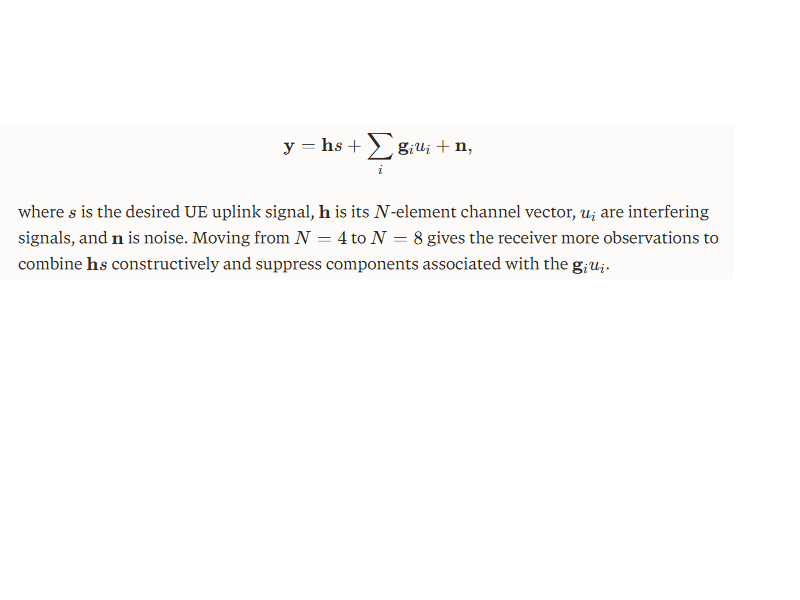
Array/combining gain: When receive paths can be coherently combined, the desired UE signal arrives with a stronger effective signal-to-noise-plus-interference ratio. In an idealized case, doubling the number of equivalent receive branches from four to eight can provide roughly 3 dB of additional combining gain, though the field result depends on antenna correlation, propagation, and implementation.
-
Interference suppression: More antenna observations give the receiver more spatial degrees of freedom to distinguish a desired UE from co-channel interferers. This can improve uplink SINR and allow more robust—or, when conditions permit, higher-order—uplink modulation and coding.
-
Better cell-edge operation: The uplink is often the limiting direction in wide-area low-band coverage because UE transmit power is tightly constrained. Improving the base-station receiver makes a low-power device more likely to maintain service from a building, rural location, or cell edge.
Why it is significant at 600 MHz:
600 MHz’s principal advantage is coverage: it propagates farther and penetrates buildings more effectively than higher-frequency spectrum. But broad downlink coverage can expose an uplink asymmetry—the device may receive the cell reliably yet lack sufficient transmit power for an equally strong return path.
8RX specifically addresses that asymmetry. AT&T says its Ericsson radios will enable uplink-enhancing 8RX across low bands for the first time, while Light Reading notes that low-band FDD networks such as 600 MHz have typically used 4RX radios and that 8RX had been relatively uncommon below 1 GHz.
Conceptually, with NN receive branches, the base station adheres to this equation:
References:
https://about.att.com/story/2026/att-ericsson-enhance-wireless-nationwide.html
https://www.lightreading.com/5g/at-t-puts-600mhz-to-work-with-ericsson-for-coverage-and-uplink
AT&T/Ericsson Demonstrate 5G-Based ISAC for Drone Detection at World Cup Stadium
AT&T and Ericsson boost Cloud RAN performance with AI-native software running on Intel Xeon 6 SoC
Analysis: AT&T 1Q-2026 results: increased fiber penetration, FWA momentum, D2D deals, and mobile/home internet bundles
Analysis: AT&T’s $250B network investment to advance U.S. connectivity
AT&T deploys nationwide 5G SA while Verizon lags and T-Mobile leads
Ericsson leads SK Telecom AI RAN vs. NVIDIA’s GPU centric AI RAN Alliance
Executive Summary:
Ericsson says it has been selected as the sole global technology partner in SK Telecom’s consortium for Korea’s Hyper-AI Network Infrastructure Demonstration Project, a South Korea government-backed initiative led by the Ministry of Science and ICT and the National Information Society Agency. The program is intended to validate AI-RAN pilot networks as a cornerstone of Korea’s national “AI Highway” strategy and its longer-term 6G roadmap.
Ericsson’s contribution [1.] to this project centers on the RAN and the automation layer that surrounds it. According to Ericsson, its role in the project includes 5G Standalone expertise, AI-in-RAN capabilities, and intelligent network automation through the Ericsson Intelligent Automation Platform (EIAP) and AI-powered rApps, enabling autonomous control, resource orchestration, and real-time optimization for physical AI services. Ericsson is not being positioned as a general AI infrastructure provider, but as the core network technology partner bringing telco-grade RAN, automation, and orchestration into a live industrial validation environment. Ericsson will contribute what it calls an “end-to-end network foundation” to the project that is intended to connect and continuously optimize intelligent machines and autonomous industrial operations. In the second phase of the project, Ericsson’s AI-RAN pilot network is expected to be applied to a real-world logistics environment at KG Mobility’s Pyeongtaek plant.
Note 1. It’s interesting to note that Ericsson is a founding member of the Nvidia GPU centric AI-RAN Alliance, contributing the operator-centric “AI-for-RAN” perspective by embedding telco-grade AI into basebands and radios to improve network performance, automation, and energy efficiency. The company’s delegates hold leadership roles in the alliance’s working groups and technical committees.
For telecom operators, the significance is not just radio performance but the shift toward a network architecture that can support physical AI use cases with tighter latency, stronger uplink capacity, and higher service assurance. SK Telecom plans to demonstrate AI-RAN pilots through 2027 across scenarios such as autonomous transport, industrial safety monitoring, and humanoid robotics, with a second-phase deployment targeted for KG Mobility’s Pyeongtaek plant.
Sibel Tombaz, Head of Customer Unit Korea, Ericsson, says: “Being selected as a key global technology partner in this government-backed Hyper-AI Network consortium is a significant recognition of Ericsson’s technology leadership and our long-term partnership with SK Telecom. Korea is moving with clear ambition to shape the future of AI-native networks and 6G, and Ericsson is proud to contribute our global expertise in 5G, AI-RAN, orchestration, and intelligent network automation to this important national initiative. We look forward to working closely with SK Telecom and the consortium partners to help turn Korea’s 6G vision into real industrial value.”
Takki Yu, VP and Head of Network R&D at SK Telecom, says: “As a key national project supporting Korea’s Hyper-AI Network strategy, SK Telecom is pleased to collaborate with Ericsson as a key technology partner to advance AI-RAN technology through global cooperation. Together, we aim to build a strategic win-win partnership, demonstrate real industrial value, and help strengthen Korea’s AI-RAN technology capabilities and ecosystem for the future.”
Comparison with NVIDIA GPU centric AI-RAN Alliance:
The SK Telecom–Ericsson initiative and the NVIDIA-led AI-RAN ecosystem share a common thesis: the RAN is evolving into a distributed compute platform that can host or coordinate AI workloads closer to where data is generated. But they emphasize different layers of the stack. SK Telecom’s Ericsson-led project is centered on operator-grade RAN validation, network autonomy, and physical AI service delivery in industrial settings, while NVIDIA’s effort is broader and more compute-centric, tied to AI factories, GPU infrastructure, and open 6G ecosystem development.
- NVIDIA is a founding member of the AI-RAN Alliance and acts as one of its most visible technical drivers, contributing reference architectures and accelerated-computing platforms for AI-RAN.
- Ericsson is the operator-focused RAN technology partner proving AI-RAN in live telco and industrial network deployments.
The practical takeaway is that Ericsson’s role is more narrowly telecom-native, while NVIDIA’s consortium is more infrastructure- and compute-oriented. For 6G, the two approaches are complementary rather than contradictory: one is proving how the network behaves as a deterministic industrial platform, the other is building the compute substrate that can feed AI-native services into that platform.ericsson+2
Why it matters:
SKT announced the Hyper-AI Network Infrastructure Development project last month, and at the time Ericsson, Nokia, Samsung and private mobile networking specialist HFR were named as those providing the kit and related network and software solutions.
South Korea has become one of the most advanced and competitive mobile markets, and this makes it a useful proving ground for AI-RAN. If the SK Telecom pilot succeeds, it could strengthen the case that future mobile networks must support not only connectivity, but distributed inference, orchestration, and machine control for robots, vehicles, and industrial systems.
From a standards and market perspective, the more interesting question is how these pilots influence the eventual division of labor between RAN, edge compute, and centralized AI infrastructure in 6G-era networks. That is where the SK Telecom–Ericsson model, with its operator-led network validation, may prove especially influential.
…………………………………………………………………………………………………………………………………………………………………………………………………
References:
https://www.ericsson.com/en/press-releases/2026/8/skt-hyper-ai-consortium
https://www.telecoms.com/ai/ericsson-named-sole-global-vendor-for-sk-telecom-s-hyper-ai-consortium
Ericsson goes with custom silicon (rather than Nvidia GPUs) for AI RAN
Dell’Oro: AI RAN revenue forecast: $35B from 2026-to-2030; 3 types of AI RAN explained
Dell’Oro: RAN Market Stabilized in 2025 with 1% CAG forecast over next 5 years; Opinion on AI RAN, 5G Advanced, 6G RAN/Core risks
Dell’Oro: Analysis of the Nokia-NVIDIA-partnership on AI RAN
RAN silicon rethink – from purpose built products & ASICs to general purpose processors or GPUs for vRAN & AI RAN
Dell’Oro: AI RAN to account for 1/3 of RAN market by 2029; AI RAN Alliance membership increases but few telcos have joined
Dell’Oro: RAN revenue growth in 1Q2025; AI RAN is a conundrum
AT&T/Ericsson Demonstrate 5G-Based ISAC for Drone Detection at World Cup Stadium
AT&T and Ericsson recently demonstrated the potential of 5G as a platform for integrated sensing and communications (ISAC) [1.] in support of critical infrastructure protection and public safety. The demonstration, conducted at a World Cup stadium near Dallas, TX highlights how cellular networks can evolve into dual-function systems that provide both connectivity and environmental sensing.
Note 1. Integrated Sensing and Communication (ISAC) is a flagship 6G/IMT 2030 capability that unifies mobile communication and environmental sensing into a single network. By using the same infrastructure, spectrum, and waveforms, 6G systems will act as spatially aware platforms. It allows networks to detect, track, and image objects while transmitting data. ITU-R officially designated ISAC as one of the six core usage scenarios in the IMT-2030 (6G) framework.
………………………………………………………………………………………………………………………………………………………………..
In this trial, AT&T and Ericsson (its primary RAN equipment supplier) employed 5G-based network sensing to detect and track unmanned aerial vehicles (UAVs) operating at altitudes between 300 and 400 feet in authorized airspace as they approached AT&T Stadium in Arlington, Texas. The approach reflects a joint communication and sensing (JCAS) paradigm, in which existing radio access network (RAN) infrastructure is leveraged for situational awareness without the need for dedicated radar or sensing overlays.
Ericsson deployed Massive MIMO radios across multiple sites to establish a “multi-static sensing configuration,” enabling spatial diversity and improved detection performance. By combining “sensing-enabled radio transmissions with advanced signal processing and AI-enabled sensing algorithms,” the system detected, localized, and tracked drones in real time. This capability exploits the propagation characteristics of RF signals used for communication, enabling object detection and tracking within the coverage footprint of the network.
Although no match was scheduled during the demonstration, AT&T Stadium has been a primary venue during the tournament and will host the semi-final between France and Spain later this week, providing a representative high-density and security-sensitive deployment context.
Cellular Sensing for Drone Mitigation:

Image Credit: AT&T
Unauthorized UAV activity has posed ongoing challenges for public safety authorities during the tournament. On match days, drone operations are prohibited within a one-nautical-mile radius of stadiums and up to 1,000 feet above ground level, according to the Federal Aviation Administration.
Reporting from the tech demo in Arlington, NBC 5 DFW indicated that U.S. authorities have detected approximately 1,500 drones and confiscated more than 700 across World Cup venues, including 53 in the vicinity of AT&T Stadium.
AT&T and Ericsson position cellular-based sensing as a complementary capability to existing counter-UAV systems deployed by law enforcement. While the Arlington Police Department indicated it was not directly involved in the demonstration, it acknowledged ongoing evaluation of emerging technologies that could enhance future operational capabilities, according to NBC 5 DFW.
Quotes:
Ildefonso de la Cruz, senior principal analyst at Omdia (owned by Informa-UK), characterized the demonstration as strategically timed and situated, noting its alignment with global attention on the World Cup and upcoming large-scale events such as the 2028 Summer Olympic Games in Los Angeles. “This demonstration shows that robust cellular infrastructure is the foundation to build reliable next-generation critical services for public safety and other critical infrastructure verticals,” he stated.
“As networks evolve, the opportunity is not just to prepare for 6G someday, but to begin introducing important building blocks now,” said Dyon Agnew, SVP and Head of Customer Unit AT&T, Ericsson Americas. “This demonstration with AT&T shows a product roadmap in action: using advanced 5G capabilities today to explore how sensing and connectivity can work together, then evolving those capabilities over time as the path to 6G becomes clearer.”
“Integrated sensing is an important part of the road to 6G, and this work helps show how we can start bringing that future to life right now,” said Yigal Elbaz, SVP and Network CTO, AT&T. “By working with Ericsson, we are exploring how advanced wireless networks can add sensing capabilities to connectivity in ways that could support safer operations, smarter venues, and stronger customer experiences, while creating a path to evolve these capabilities responsibly over time.”
………………………………………………………………………………………………………………………………………………….
Technical Takeaways:
-
Demonstrates early-stage ISAC/JCAS capabilities using commercial 5G Massive MIMO infrastructure, with implications for 6G-native sensing architectures.
-
Validates multi-static sensing configurations in cellular deployments, improving detection accuracy through spatial diversity.
-
Highlights the role of AI-driven signal processing in extracting sensing information from communication waveforms.
-
Suggests a pathway to cost-efficient sensing by reusing existing RAN assets, avoiding dedicated radar infrastructure.
-
Reinforces the potential for cellular networks to support public safety and critical infrastructure monitoring as a value-added service layer.
…………………………………………………………………………………………………………………………………………………
“Integrated sensing is an important part of the road to 6G, and this work helps show how we can start bringing that future to life right now,” said Yigal Elbaz, SVP and Network CTO, AT&T. “By working with Ericsson, we are exploring how advanced wireless networks can add sensing capabilities to connectivity in ways that could support safer operations, smarter venues, and stronger customer experiences, while creating a path to evolve these capabilities responsibly over time.”
What this roadmap will enable over time:
- Help event and facility teams improve planning and staffing by providing broader visibility into how vehicles move through large environments.
- Enhance coordination around temporary event infrastructure and logistics by adding network-based environmental awareness alongside connectivity.
- Support a wide-area drone awareness system for public-sector stakeholders, improving visibility into low-altitude drone activity as the low-altitude economy develops across cities and regions.
- Inform the evolution of future 5G and 6G capabilities as sensing and communications mature together for large venues, enterprises, governments, and public-sector environments.
Conclusions:
AT&T and Ericsson will continue exploring how sensing capabilities can be introduced pragmatically using existing network foundations, then advanced over time as standards, ecosystems, and market needs develop.
The goal is to help shape a practical path where future 6G/IMT 2030 capabilities are not treated as a distant leap, but as an evolution that can begin delivering value well before full 6G/IMT 2030 commercialization.
………………………………………………………………………………………………………………………………………………..
References:
https://about.att.com/story/2026/att-ericsson-drone-detection.html
https://www.lightreading.com/5g/att-and-ericsson-demo-5g-sensing-for-drone-detection
https://www.linkedin.com/feed/update/urn:li:activity:7481460850159943680/ by Yigal Elbaz, of AT&T
https://www.itu.int/en/ITU-R/study-groups/rsg5/rwp5d/imt-2030/pages/default.aspx
Analysis: Cohere’s $28M U.S. DoD FutureG ISAC contract; OTFS vs OFDM; 6G-NR/IMT 2030 RIT standards outlook
Analysis & Implications of the Communications Cybersecurity Information Sharing and Analysis Center (C2 ISAC)
Network X Americas: AT&T and Comcast reveal huge AI impact on network operations
Analysis: AT&T’s $250B network investment to advance U.S. connectivity
AI-RAN and Agentic AI get real: Ericsson, Nokia, Verizon & other operators enter into a new network automation era
Analysis: Ericsson’s leading role in French INTENTION 6G project
Ericsson’s R&D center in France is leading INTENTION-6G, a project worth more than €12 million over four years. It’s backed by the France 2030 plan to embed AI into RAN control for energy efficiency and intent-based operation. Partners include Orange, BubbleRAN and CentraleSupélec.
INTENTION 6G aims to optimize energy consumption of the Radio Access Network (RAN) while meeting 5G/6G traffic requirements. At the heart of the project is the integration of artificial intelligence into network control, particularly at RAN level, to improve both performance and energy efficiency. The project has now reached its mid development phase, enabling the first technology building blocks to be defined.
INTENTION 6G is based on a public private partnership approach that combines industrial, academic and entrepreneurial expertise. The project makes it possible to design, test and validate new solutions through demonstrators and experimental platforms, with a view to their gradual integration into tomorrow’s networks.
Several key areas structure the work: advanced automation of network functions, dynamic optimization of energy consumption, and the development of so called “intent based” networks, capable of automatically adjusting their performance to usage and needs thanks to artificial intelligence.
Christian Leon, Head of Ericsson Western Europe, says:
“Mobile networks are evolving to meet ever increasing requirements in terms of performance, energy efficiency and resource optimization. With INTENTION 6G, Ericsson France’s R&D center is actively contributing, alongside leading French partners, to laying today the foundations for the networks that will support tomorrow’s critical use cases and digital transformations.”

-
- Intent-Based Networking (IBN): The project designs networks capable of automatically adjusting performance. Operators issue high-level business goals (intents) via language models, which the system automatically translates into exact technical configurations.
- Advanced Automation: AI takes over network control loops at the Radio Access Network (RAN) level. This shifts management from rigid, manual rules to real-time, zero-touch autonomous domain operations.
- Dynamic Energy Optimization: Mitigating the heavy carbon footprint of next-gen hardware is a priority. AI dynamically monitors traffic demands to initiate micro-sleep and scale down RAN energy use without dropping service quality.
- Standalone Native AI Architecture: It avoids complex legacy radio splitting by prioritizing a standalone architecture. AI components function pervasively across the edge-cloud continuum through a dedicated “AI interconnect”.
- Integrated Sensing and Communication (ISAC): Turning the network into a radar grid to track real-time physical environments.
- Mass-Market Immersive Experiences: Assuring low-latency and continuous data throughput for holographic communications and mixed reality (XR).
- Industry 5.0: Powering dynamic workgroup creation and traffic handling for mobile robot swarms, autonomous delivery drones, and smart factories.
……………………………………………………………………………………………………………………………..
Building on its R&D center in France, opened in 2020, Ericsson says it’s leveraging its expertise in next generation network technologies. The teams involved are particularly specialized in 6G research, AI native networks, critical networks and cybersecurity. The center has already contributed to a portfolio of more than 180 patents in mobile technologies and is part of a strong ecosystem of academic and industrial partners in France.
By mobilizing its innovation capabilities and drawing on a rich and committed ecosystem, Ericsson is helping to prepare a new generation of networks that are smarter, more flexible and more sustainable.
References:
https://www.ericsson.com/en/press-releases/3/2026/intention-6g
https://ieeexplore.ieee.org/document/10942858/
3GPP approves timelines for Release 21 which will specify 6G RAN, Core and 5G Advanced
At 3GPPs meeting last week in Singapore, Technical Specification Group (TSG) RAN #112 approved the full Release-21 timeline jointly proposed by the three TSG Chairs. On June 12th, more than 150 participants from the regions ICT community attended ‘3GPP 6G Standardization: From Study to Specification,’ featuring the combined technical leadership of 3GPP. Topics covered in the summit included the 3GPP Chairs’ analysis of progress this week on 5G Advanced work items and 6G studies across the TSGs. There were also expert overviews on some key topics: AI/ML, ISAC (integrated sensing and communications), Massive MIMO evolution, NTN standards cooperation and security considerations for the 3GPP 6G System.
This formally completes the first 6G study item in 3GPP and sets the stage for the third quarter this year in which 3GPP working groups must settle numerous questions, including the migration architecture that network operators have wanted a decision on for over a year. 3GPP TSG RAN Chairman Younsun Kim, PhD, Samsung, said during a joint session with the other two TSGs (SA and CT) that “no decisions were possible” on migration options, with input now hoped for at TSG RAN#113, scheduled for September 14–17, 2026 in Madrid, Spain. Vodafone warned in a 3GPP contribution titled, “Good migration option decisions in September need hardware impacting decisions now!” that the September decision point only works if the plenary stopped deferring decisions.
Some achievements at this 3GPP Singapore meeting:
- Over 590 standards delegates welcomed by our Hosts to Singapore.
- Social events and a Singapore Industry summit on 3GPP held.
- Singapore Ministry and Government visitors welcomed as guests.
- All Work Items and Study Items for 5G‑Advanced on schedule in Release‑
- 14 Study Items for 6G progressing.
- The TSG RAN Study on 6G Scenarios and requirements (TR 38.914) approved this week.
- First timeline for early 6G specifications approved (Rel-21).
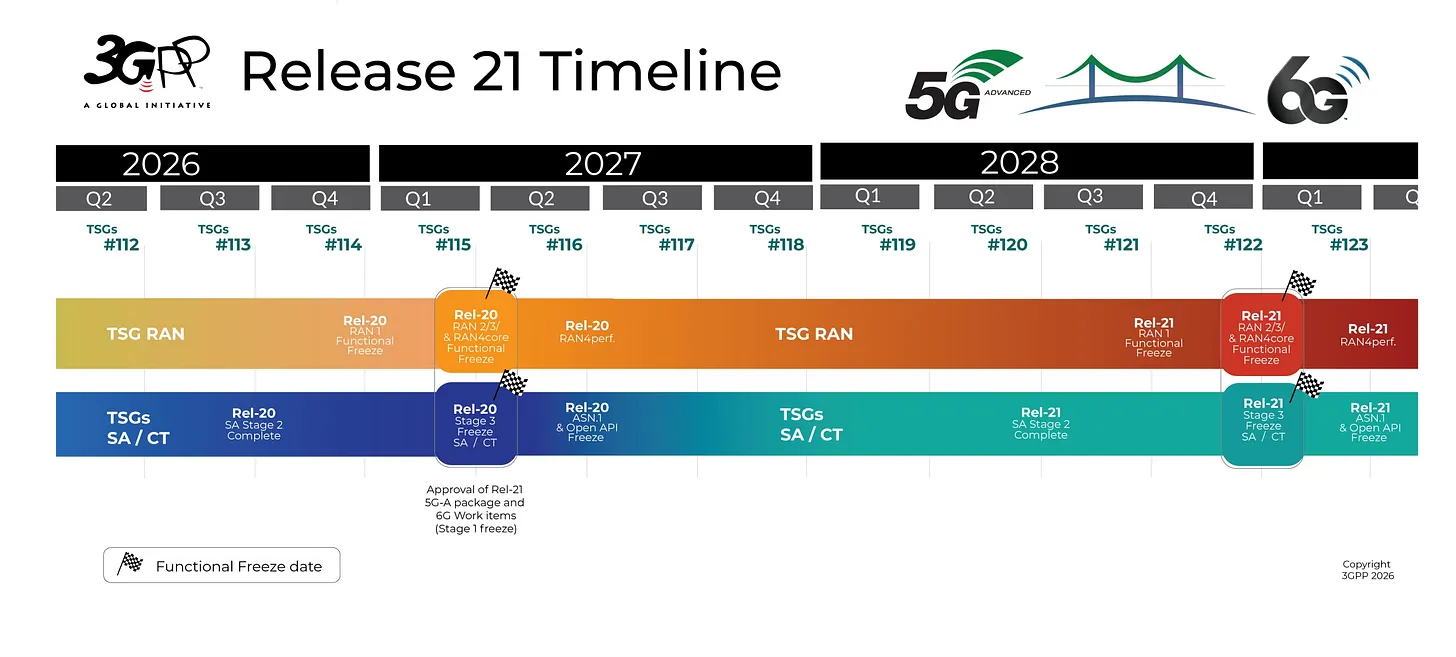
3GPP’s Release 21 will comprise the first 6G specs as well as 5G-Advanced. Release 21 work items for 6G and 5G-Advanced are scheduled to be approved with a first functional freeze in March 2027 and a second freeze in June 2028, with a “checkpoint” in March 2028 for 80% of the work to be done. The stage 3 final freeze is set for December 2028. The full and final code freeze is scheduled for March 2029.
Guy Daniels wrote in a blog post titled, “Analysis of 3GPP RAN #112: Timeline locked but the migration question unanswered“:
There is a 3GPP structural oddity in the details. The March 2027 6G “package approval” is the approval of a placeholder whose RAN2/3/4 content is finalized three months later. This is deliberate concurrency, not an oversight, it’s how the 3GPP works. The normative engineering windows are equally tight: RAN1 runs Q2 2027 to Q3 2028; RAN2/3/4 run Q3 2027 to Q4 2028; six quarters each to specify a new radio generation.”
“The Scenarios and Requirements study is finished, but the political questions it deferred are not. The requirements now say what 6G must do. September begins the fight over what it will be.”
……………………………………………………………………………………………………………………………………………………………………………………………………………………………….
In a blog post summarizing last week’s plenary meeting, Ericsson said 6G standardization “is in full swing” and highlighted some of the early 6G decisions, including choices for waveform, modulation, channel coding, a basic security framework and supported bandwidths. The agreed 6G waveform is to use cyclic-prefix orthogonal frequency-division multiplexing (CP-OFDM) in the downlink. There are two options for uplink: CP-OFDM and discrete Fourier transform spread OFDM (DFT-s-OFDM). Supported bandwidths will range from 3MHz to 400MHz. 3GPP also agreed that 5G channel codes “will be largely reused” in 6G.
Here’s Ericsson’s timeline for 6G:
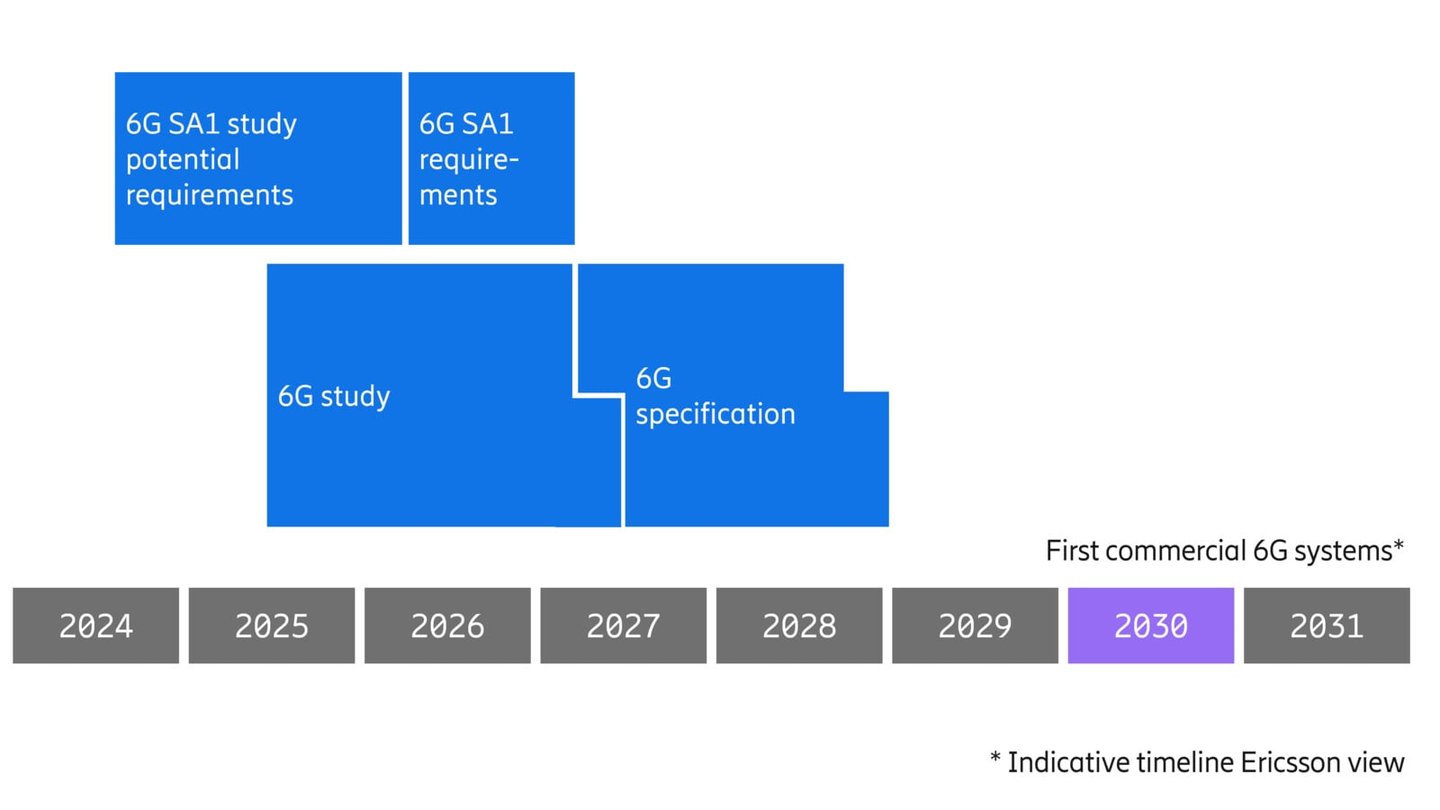
“6G is coming into focus…We are at a point now where a lot of pieces of the puzzle are starting to come together,” Gabriel Brown, senior principal analyst at Omdia, explained in a recent podcast with colleague and analyst Ruth Brown (no relation). The analysts also presented the 6G state of play at the 6G Summit hosted by ATIS’s Next G Alliance ahead of Network X Americas last month. Gabriel noted there has been a mindset shift among telcos about 6G from being “cautious” to “embracing it.” He said that the World Radiocommunication Conference next year (WRC-27) and the Summer Olympic Games in Los Angeles in 2028 will be important “checkpoints” for the anticipated early 2029 arrival of the 6G standards.
“[The LA Summer Olympics] is going to be an amazing opportunity for the U.S. ecosystem to showcase the potential of next-generation connectivity…It’s a chance to show how wireless can serve all the other industries there,” he added.
It will be important to watch for 3GPP’s September 2026 Madrid meeting output deliverables to get a sense of what functions and features might be in 6G RANs.
……………………………………………………………………………………………………………………………………………………………………………………….
6G Core Network:
The 6G core network architecture (such as signaling, network management, security, 6G specific features, and AI-native core architecture) will be defined in Release 21 Stage-2 (System & Architecture) scheduled to be completed in June 2028. Stage-3 (Protocol Specifications) is slated for December 2028 with ASN.1 & OpenAPI Freeze to be completed in March 2029.
3GPP decided NOT to liaise/contribute their 5G SA core network architecture specs to ITU-T, but ETSI rubber stamped them. Just as they did with IMT-2020 (5G), 3GPP will likely maintain exclusive development and control over all non-radio specifications for IMT-2030 (6G). Instead of formalizing them through ITU-T. 3GPP relies on its own Organizational Partners, e.g. ETSI and ATIS, to adopt the core network framework in their standards. 3GPP decided to bypass ITU-T for the 5G mobile core network, opting to develop 5G SA core network specs directly to ensure rapid, market-driven deployment.
……………………………………………………………………………………………………………………………………………………………………………………………
Addendum – 3GPP specs are NOT standards and have no legal standing:
What most, if not all, telecom trade publications (like this one) get completely wrong is that 3GPP does not produce standards, but specifications via their Releases. Those must be contributed, discussed, debated and approved by official SDOs like ITU-R and ETSI or other 3GPP members.
In the case of 5G/IMT 2020, ATIS presented all 3GPP RIT/SRIT specifications as contributions to ITU-R WP5D, which is 100% responsible for all IMT terrestrial radio interface standards (ITU-R recommendations). It should also be noted that ITU-R WP 5D has sole responsibility for IMT 2030/6G Frequency Arrangements which will be done after 6G frequencies are agreed at the ITU World Radiocommunication Conference (WRC-27),which is scheduled to take place from October 18 to November 12, 2027, in Shanghai, China.
“The 3GPP Technical Specifications and Technical Reports have, in themselves, no legal standing. They only become “official” when transposed into corresponding publications of the Partner Organizations (or the national / regional standards body acting as publisher for the Partner). At this point, the specifications are referred to as UMTS within ETSI and FOMA within ARIB/TTC.”
https://portal.etsi.org/new3g/specs/publications_partners.htm
From Qualcomm:
“3GPP Organization – Fixing three common misconceptions: 3GPP develops technical specifications, not standards. This is a subtle, but important organizational clarification. 3GPP is an engineering organization that develops technical specifications. These technical specifications are then transposed into standards by the seven regional Standards Setting Organizations (SSOs) that form the 3GPP partnership.”

https://www.qualcomm.com/news/onq/2017/08/understanding-3gpp-starting-basics
The Partnership Project is not a legal entity but is a collaborative activity between the following recognized Standards Development Organizations (SDO):
- The Association of Radio Industries and Businesses (ARIB) – Japan
- The Alliance for Telecommunications Industry Solutions (ATIS) – US
- China Communications Standards Association (CCSA) – China
- The European Telecommunications Standards Institute (ETSI) – Europe
- Telecommunications Standards Development Society (TSDSI) – India
- Telecommunications Technology Association (TTA) – South Korea
- Telecommunication Technology Committee (TTC) – Japan
The Partnership Project is entitled the “THIRD GENERATION PARTNERSHIP PROJECT” and may be known by the acronym “3GPP.”
………………………………………………………………………………………………………………………………………………………………………………………………
References:
https://www.3gpp.org/news-events/3gpp-news/tsg112#:~:text=3GPP%20plenaries
https://www.3gpp.org/news-events/3gpp-news/rel21-timeline
https://6gfutures.substack.com/p/analysis-of-3gpp-ran-112-timeline
https://www.ericsson.com/en/blog/2026/6/6g-standardization-key-milestones-and-ran-decisions
https://www.3gpp.org/about-us/legal-matters
https://portal.etsi.org/new3g/specs/publications_partners.htm
https://www.lightreading.com/6g/it-s-official-6g-specs-are-set-for-early-2029
https://www.itu.int/en/ITU-R/study-groups/rsg5/rwp5d/imt-2030/Pages/default.aspx
Roles of 3GPP and ITU-R WP 5D in the IMT 2030/6G standards process
ITU-R M.[IMT-2030.EVAL] & ITU-R M.[IMT-2030.SUBMISSION] reports: Evaluation & Submission Guidelines for 6G RIT/SRITs (6G)
IMT-2030 (“6G”) Minimum Technology Performance Requirements for Radio Interface Technologies
Comparing AI Native mode in 6G (IMT 2030) vs AI Overlay/Add-On status in 5G (IMT 2020)
Analysis: Nvidia’s rumored new 6G AI-RAN – likely features/functions and industry impact
ITU-R WP 5D Timeline for submission, evaluation process & consensus building for IMT-2030 (6G) RITs/SRITs
ITU-R WP 5D reports on: IMT-2030 (“6G”) Minimum Technology Performance Requirements; Evaluation Criteria & Methodology
AI wireless and fiber optic network technologies; IMT 2030 “native AI” concept
Highlights of 3GPP Stage 1 Workshop on IMT 2030 (6G) Use Cases
Should Peak Data Rates be specified for 5G (IMT 2020) and 6G (IMT 2030) networks?
GSMA Vision 2040 study identifies spectrum needs during the peak 6G era of 2035–2040
Highlights and Summary of the 2025 Brooklyn 6G Summit
NGMN: 6G Key Messages from a network operator point of view
Nokia and Rohde & Schwarz collaborate on AI-powered 6G receiver years before IMT 2030 RIT submissions to ITU-R WP5D
Verizon’s 6G Innovation Forum joins a crowded list of 6G efforts that may conflict with 3GPP and ITU-R IMT-2030 work
Nokia Bell Labs and KDDI Research partner for 6G energy efficiency and network resiliency
Deutsche Telekom: successful completion of the 6G-TakeOff project with “3D networks”
Market research firms Omdia and Dell’Oro: impact of 6G and AI investments on telcos
Qualcomm CEO: expect “pre-commercial” 6G devices by 2028
Ericsson and e& (UAE) sign MoU for 6G collaboration vs ITU-R IMT-2030 framework
Virtualization’s role in 5G Advanced (3GPP Release 18) and a proposed new hardware architecture
Ericsson’s June 2026 Mobility Report Highlights + AI impact on network traffic
Ericsson’s June 2026 Mobility report states that:
- 5G global subscriptions have now passed the 3 billion mark with the addition of 162 million in the first quarter of 2026.
- Half of the world’s mobile data traffic is now carried over 5G vs 48% at the end of 2025. It’s forecast to rise to 85% by the end of 2031.
- Mobile network data traffic growth exceeded expectations, at 22% between Q1 2025 and Q1 2026.
- Fixed Wireless Access (FWA) adoption is also growing, with around 70% of FWA service providers now offering the service over 5G.
- The number of commercial 5G SA network slicing offerings has increased from 65 to 84 in just 6 months.
- Cellular IoT connections are expected to approach 8 billion by the end of 2031
“With the upcoming transition to physical AI, traffic patterns will fundamentally shift as we move from centralized models in data centers to distributed, autonomous AI agents embedded across our device vehicles and cities, commonly connected by 5G,” said Ericsson CTO Erik Ekudden, in a statement accompanying the report.
“Mobile networks are no longer only about providing best-effort connectivity, they are becoming critical, intelligent infrastructure that meets diverse application needs, Reflecting part of this shift is the continued rise in new commercial service offerings based on 5G standalone network slicing and the number of communications service providers deploying 5G SA,” Ekudden said.
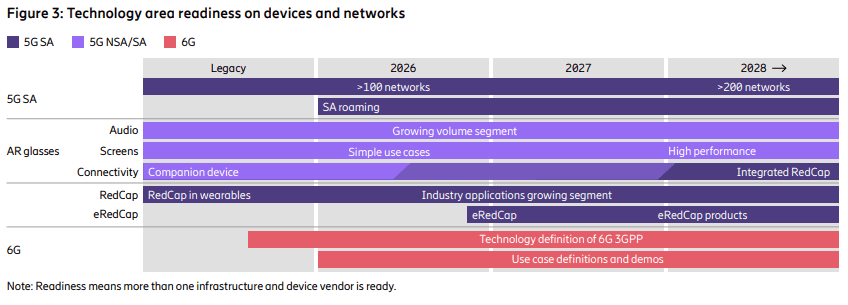
Image Credit: Ericsson
……………………………………………………………………………………………………………………………………………………………………….
Impact of Agentic AI workloads on network traffic:
The most critical engineering takeaway from the report is a profound asymmetry in data traffic growth, heavily driven by agentic AI workloads and user-generated content.
Key Insights:
- AI-driven applications – spanning smartphones, AI/AR smart glasses and autonomous vehicles – are inherently uplink heavy, generating continuous data streams that challenge traditional downlink-dominated traffic patterns.
- Uplink traffic growth is already outpacing downlink for many service providers, with field measurements indicating capacity constraints under peak load. Scenario modeling suggests that additional AI traffic will result in uplink traffic being three times higher in 2031 compared to 2025.
- Current networks are not dimensioned for sustained uplink demand, calling for a step change in design – from 5G software and hardware enhancements in the near term to 6G-native uplink innovations over the longer horizon.
- Traffic Inversion: Traditionally, cellular networks are architected and provisioned to handle heavily downlink-centric (DL) traffic patterns. However, the proliferation of multimodal generative AI and uplink-heavy applications is radically flipping this paradigm.
- Field Measurement Data: Out of 55 global operators analyzed, 43 experienced uplink (UL) growth rates outpaces DL growth. Crucially, 17 of those service providers reported UL expansion exceeding DL by a factor of 1.5x or higher.
- Projections: Ericsson’s scenario modeling suggests that cumulative AI-driven traffic could cause UL demands to spike threefold by 2031 compared to 2025 baselines.
- Near-Term: Immediate deployment of 5G RAN software optimizations and hardware refreshes. This includes pushing for 5G Standalone (SA) core migrations, leveraging AI-optimized Massive MIMO beamforming, and utilizing network slicing to guarantee bounded latency for critical UL channels.
- Long-Term: Transitioning to 6G-native uplink innovations. Early 6G standardization, targeted for finalization around 2028–2029, will focus deeply on AI-native architectures, Integrated Sensing and Communication (ISAC), and asymmetric air-interface designs natively optimized for continuous data streams.
Market Outlook:
Resolving these capacity constraints requires immediate, targeted infrastructure capital expenditure. While macro RAN spending has faced recent headwinds, the urgent necessity to re-dimension the air interface for an AI-centric world represents a powerful pipeline catalyst for Ericsson and its infrastructure rivals. Telco spending on RAN products has slumped from $45 billion in 2022 to $35 billion last year, according to analysts at Omdia, while Ericsson’s annual sales have dropped from SEK271.5 billion ($28.8 billion) to SEK236.7 billion ($25.1 billion) over this same period.
References:
https://www.ericsson.com/en/reports-and-papers/mobility-report/reports/june-2026
GSA: Global private mobile networks exceed 2,000 worldwide; Ericsson Private 5G from Verizon Business extends beyond U.S.
Ericsson reports 10% drop in 1st quarter sales; targets network growth
AT&T and Ericsson boost Cloud RAN performance with AI-native software running on Intel Xeon 6 SoC
Ericsson and Intel collaborate to accelerate AI-Native 6G; other AI-Native 6G advancements at MWC 2026
Ericsson goes with custom silicon (rather than Nvidia GPUs) for AI RAN
Nokia to showcase agentic AI network slicing; Ericsson partners with Ookla to measure 5G network slicing performance
China’s telecom industry rapid growth in 2025 eludes Nokia and Ericsson as sales collapse
Latest Ericsson Mobility Report talks up 5G SA networks and FWA
Ericsson Mobility Report touts “5G SA opportunities”
Optus and Ericsson achieve 180MHz across 2.3GHz and 3.5GHz bands using carrier aggregation on a live 5G SA network
Australian telco Optus has demonstrated advanced 5G NR carrier aggregation (5G NR-CA) performance on its 5G standalone (SA) network by implementing four-component carrier aggregation (4CC CA) across low-, mid-, and upper-mid-band spectrum. Using Ericsson 5G SA network equipment and software, the configuration aggregates FDD bands at 900 MHz (Band n8) and 2.1 GHz (Band n1) with TDD bands at 2.3 GHz (Band n40) and 3.5 GHz (Band n78). Two-Component Carrier (2CC CA) uplink aggregation
This combined Optus’ unique two mid-band TDD spectrum holdings across 2.3GHz and 3.5GHz, achieving a record 180MHz TDD spectrum aggregation. In particular:
- Four-Component Carrier aggregation enabled 220MHz downlink bandwidth, leveraging spectrum across four different bands of 900MHz, 2.1GHz, 2.3GHz and 3.5GHz
- Two-Component Carrier uplink aggregation combined one Frequency Division Duplex (FDD) band from 900MHz and 2.1GHz with one TDD band from 2.3GHz and 3.5GHz
- Achieved peak speeds of 3.4Gbps (downlink) and 200Mbps (uplink) in a live network site with commercial devices, including the Samsung Galaxy S26 Ultra
The demonstration aligns with 3GPP Release 16 and Release 17 5G NR-CA enhancements (TS 38.300, TS 38.101-1/2), which extend carrier aggregation capabilities across heterogeneous duplex modes (FDD+TDD) and multiple frequency ranges within FR1. The downlink configuration leverages cross-band scheduling and advanced MIMO layers (likely up to 4×4 or higher per component carrier, depending on band support) to maximize spectral efficiency across aggregated carriers.
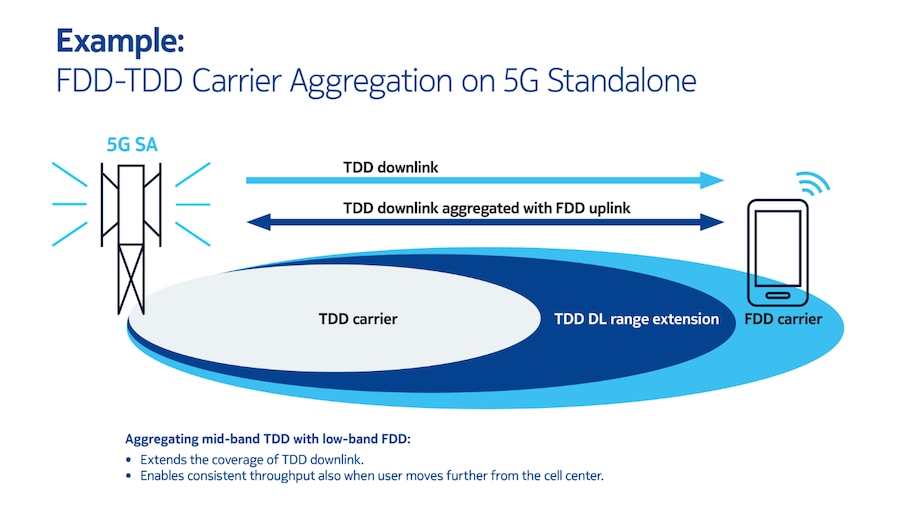
On the uplink, Optus and Ericsson reported 200 Mbps throughput using two-component carrier aggregation (2CC CA), combining FDD (n8/n1) and TDD (n40/n78) spectrum. This implementation is consistent with 3GPP Release 16 uplink enhancements, including uplink carrier aggregation and transmit (Tx) switching (TS 38.213), which enables efficient utilization of UE power resources across multiple uplink carriers, particularly in mixed duplex scenarios.
All results were achieved on a live commercial 5G SA network at Optus’ Sydney campus using commercial off-the-shelf (COTS) user equipment, including the Samsung Galaxy S26 Ultra. This indicates full compliance with 3GPP-defined UE capability signaling (TS 38.306) and the availability of device-side support for complex NR-CA band combinations, including inter-band and cross-duplex aggregation.
“This achievement demonstrates how we are translating cutting-edge 5G technology into meaningful benefits for customers in real-world environments. Through our ongoing collaboration with Ericsson, we are unlocking greater capacity and performance across our 5G network, enabling faster speeds and more reliable connectivity,” said Optus CTO Sri Amirthalingam. “This milestone marks an important step in our network evolution towards 5G Advanced, reinforcing our commitment to remain at the forefront of innovation and to deliver tangible value for our customers.”
Ludvig Landgren, head of Ericsson Australia and New Zealand operations said: “Optus continues to demonstrate strong leadership in adopting advanced 5G capabilities, and this milestone highlights the strength of our partnership. By expanding and combining multiple spectrum assets with Ericsson technology, we are helping Optus deliver meaningful performance improvements that translate directly into better everyday experiences for their customers.”
………………………………………………………………………………………………………………………………………………..
From a broader industry perspective, these results build on ongoing 5G NR-CA advancements. T-Mobile US has demonstrated approximately 6 Gbps downlink throughput using six aggregated carriers in FR1, as well as 550 Mbps uplink throughput leveraging uplink Tx switching across sub-6 GHz bands. In Europe, Vodafone and MediaTek achieved 277 Mbps uplink throughput using NR uplink CA, while Elisa, Ericsson, and MediaTek demonstrated 12CC aggregation reaching 8 Gbps downlink—highlighting the scalability of NR-CA as defined in 3GPP Release 17 and evolving into Release 18 (5G-Advanced).
Within Australia, Telstra has deployed Ericsson’s automated carrier aggregation (CA) optimization solution across more than 50 live 5G Advanced sites, leveraging dynamic CA configuration and traffic-aware scheduling—capabilities aligned with 3GPP Release 18 objectives for AI-assisted RAN optimization.
A notable aspect of the Optus/Ericsson demonstration is the aggregation of 180 MHz of mid-band spectrum across n40 (2.3 GHz) and n78 (3.5 GHz). While not a headline peak-rate milestone, this represents a first in terms of contiguous mid-band NR-CA deployment at this bandwidth scale. Mid-band aggregation is particularly significant within the 3.3–4.2 GHz “golden band” range defined in global 5G spectrum harmonization efforts, as it offers an optimal balance between coverage and capacity.
Operationally, this configuration is expected to deliver immediate gains in high-traffic scenarios—such as dense urban environments, transport hubs, and large venues—by increasing available cell throughput and improving user-level quality of service (QoS). Furthermore, the expanded mid-band capacity directly benefits fixed wireless access (FWA) deployments, where sustained throughput and cell-edge performance are critical. Because the demonstrated CA combinations are already supported by commercial UE categories, deployment can proceed without requiring new device classes, accelerating time-to-impact.
Ericsson was recently selected to modernize and expand SoftBank’s core networks, as well as accelerate the Japanese giant’s 5G SA adoption. Expanding on a previous 5G SA deal centered around its radio access network (RAN) products, Ericsson is providing SoftBank with its Core Networks’ portfolio, including a dual-mode 5G Core solution running on Ericsson’s Cloud Native Infrastructure Solution (CNIS).
……………………………………………………………………………………………………………………………..
References:
https://www.sdxcentral.com/news/ericsson-and-optus-claim-5g-sa-world-first/
https://www.ericsson.com/en/press-releases/7/2026/optus-and-ericsson-trial-ai-to-boost-5g-downlink
https://www.nokia.com/mobile-networks/ran/carrier-aggregation/5g-carrier-aggregation-explained/
China Unicom-Beijing and Huawei build “5.5G network” using 3 component carrier aggregation (3CC)
Nokia, BT Group & Qualcomm achieve enhanced 5G SA downlink speeds using 5G Carrier Aggregation with 5 Component Carriers
Finland’s Elisa, Ericsson and Qualcomm test uplink carrier aggregation on 5G SA network
T-Mobile US, Ericsson, and Qualcomm test 5G carrier aggregation with 6 component carriers
Ericsson and MediaTek set new 5G uplink speed record using Uplink Carrier Aggregation
BT tests 4CC Carrier Aggregation over a standalone 5G network using Nokia equipment
T-Mobile US achieves speeds over 3 Gbps using 5G Carrier Aggregation on its 5G SA network
Ericsson reports 10% drop in 1st quarter sales; targets network growth
Executive Summary:
Ericsson reported mixed first-quarter 2026 results, characterized by continued resilience in its Networks segment despite regional demand variability and emerging supply-side cost pressures. The Swedish company recorded 7% year-over-year organic growth in its Networks business, supported by sustained network modernization programs and ongoing 5G deployments across Europe, the Middle East, and Africa (EMEA), as well as increased delivery volumes in India and Japan. This growth offset a decline in North American sales, which followed a period of elevated operator investment in 2025 and reflects a near-term reallocation of capital expenditure by key customers. However, Ericsson reported a 10% total sales drop to 49.33 billion kronor in the first quarter, with EBITA falling to 1.44 billion kronor.
Ericsson reiterated its expectation of a broadly flat global RAN market in 2026 but expressed confidence in its ability to outperform the overall sector. The Networks segment maintained a robust adjusted gross margin of 50.4%, within its guided 49–51% range, with similar margin performance anticipated in the second quarter. Sequential revenue growth is projected to align with typical seasonal trends, approximating a 4% increase.
Despite these operational strengths, Ericsson highlighted increasing uncertainty in the macroeconomic and geopolitical environment. Of particular concern is the rising cost of components—especially semiconductors—driven in part by global AI-related demand. The company indicated that while semiconductors represent a relatively limited portion of its total cost base, sustained price increases are expected to create headwinds.
To mitigate these pressures, Ericsson is pursuing a combination of supply chain optimization, product substitution strategies, operational efficiencies, and selective cost-sharing mechanisms with customers. The company emphasized that its prior investments in supply chain diversification have enhanced resilience, although it acknowledged that it remains exposed to broader market disruptions affecting pricing and component availability.
Geopolitical factors have also introduced operational challenges. Ongoing conflict in the Middle East has necessitated adjustments to logistics and transportation routes, resulting in incremental costs. Ericsson noted that its regional distribution infrastructure has been impacted but that supply continuity has been maintained through flexible supply chain management.
From a financial perspective, Ericsson reported first-quarter EBIT of SEK 1.44 billion, a significant decline from SEK 5.93 billion in the prior year, reflecting restructuring charges and adverse currency movements. Group revenue decreased 10% year-over-year to SEK 49.33 billion, below market expectations, while gross margin contracted to 47.2% from 48.2%.

Image Credit: lars schroder/Agence France-Presse/Getty Images
…………………………………………………………………………………………………………………………………………
Börje Ekholm, Ericsson President and CEO, said:
“Our Q1 results demonstrate continued resilience in a dynamic environment, with organic sales growth of 6%. Our healthy gross margins and strong cash flow reflect the progress we have made in recent years, reducing reliance on geographic mix and strengthening our foundations globally. Our multi-year investments in building a resilient, diversified, supply chain have enabled us to deliver consistently for customers amidst geopolitical and macroeconomic uncertainties. We are facing increasing input costs, especially in semiconductors, caused in part by AI demand. Our ambition is to offset these challenges, by working closely with customers and suppliers, and through product substitution and efficiency actions. Looking ahead, while we continue to expect a flattish RAN market, our focused strategy, leading portfolio, and strengthened positions in mission critical and Enterprise give us confidence in our ability to grow faster than the mobile networks market and drive long-term success.”
Overall, the results underscore a transitional phase for Ericsson, with strong execution in global 5G and modernization programs partially offset by cyclical demand softness in North America and emerging cost inflation in critical technology inputs. The company recorded 7% year-over-year organic growth in its Networks business, supported by sustained network modernization programs and ongoing 5G deployments across Europe, the Middle East, and Africa (EMEA), as well as increased delivery volumes in India and Japan. This growth offset a decline in North American sales, which followed a period of elevated operator investment in 2025 and reflects a near-term reallocation of capital expenditure by key customers.
Ericsson’s quarter reinforces a broader industry pattern: the global RAN market is stabilizing after the 5G deployment peak, but not re-entering a meaningful growth phase. Until 6G capex begins to scale later in the decade, vendor performance will depend more on regional share gains, modernization cycles, and margin discipline than on total market expansion. After the 5G buildout peak, network operators are largely shifting from coverage expansion to optimization, monetization, and cost efficiency, which limits near-term revenue upside for vendors even when unit shipments remain healthy.
………………………………………………………………………………………………………………………………………………
RAN Market dynamics:
The key issue is that RAN demand is no longer being driven by broad-based new macro rollouts. Instead, spending is being concentrated on targeted modernization, selective capacity adds, and feature upgrades, while legacy LTE revenue continues to decline and offsets much of the remaining 5G activity.
That helps explain why vendors can still post pockets of growth in regions like EMEA, India, and Japan while North America softens after a prior wave of heavy investment. In other words, regional growth is becoming more cyclical and more dependent on operators’ capex timing than on a sustained global upgrade super-cycle.
Why RAN growth stays muted:
The structural problem is that RAN is maturing into a low-growth infrastructure market. Dell’Oro’s latest forecast points to only about 1% CAGR over the next five years, with the broader market remaining largely flat until 6G-related capex begins to ramp late in the decade.
That means the industry is effectively living through a long gap between the end of the 5G peak and the start of the 6G investment cycle. During that gap, vendors compete less on market expansion and more on mix, efficiency, software attach, and share gains, which is why financial performance can diverge from headline market growth.
What this means for Ericsson:
For Ericsson, the implication is that beating the market may matter more than the market itself. If the underlying RAN market is flat to low-single-digit growth, then Ericsson’s ability to sustain margin through supply-chain discipline, pricing, and product mix becomes more important than chasing top-line expansion alone.
This is also why component inflation matters now. When market growth is weak, cost pressure from semiconductors, logistics, and geopolitics has a larger effect on earnings quality, because vendors have fewer natural volume tailwinds to absorb it.
6G/IMT 2030 timing risk:
The big strategic uncertainty is timing. If meaningful telco 6G capex does not begin until around 2030–2031 (which seems highly likely), then the wireless telecom industry faces several years of subdued RAN revenue. That creates pressure on vendors to extract value from 5G Advanced, automation, private networks, and software-led differentiation before the next technology cycle arrives.
This is why “no real growth till 6G in 2031” is a reasonable framing. It captures the reality that the market can remain technically active while still being economically stagnant, with limited aggregate revenue growth even as networks become more capable and more software-defined.
From Sebastian Barros:
“Ericsson’s Q1 results are a masterclass in structural paradox. Pulling a 6% organic growth rate in a dead-flat global RAN market is a massive operational flex for a 150-year-old heavyweight. But look under the hood. Reported sales took a 10% hit due to brutal FX headwinds, and their supply chain is under intense pressure as global AI data centers hoard 3nm semiconductor capacity. Their historic dominance in custom ASIC silicon and radio frequency is exactly what makes them structurally vulnerable today. Being functionally addicted to a $35 billion RAN market that accounts for over 60% of their portfolio is a massive liability, as that profit pool is being actively dismantled by x86/GPU disaggregation, open architectures, and geopolitical hardware wars…”
………………………………………………………………………………………………………………………………………………………………….
References:
Ericsson and Forschungszentrum Jülich MoU for neuromorphic computing use in 5G and 6G
AT&T and Ericsson boost Cloud RAN performance with AI-native software running on Intel Xeon 6 SoC
Ericsson and Intel collaborate to accelerate AI-Native 6G; other AI-Native 6G advancements at MWC 2026
Ericsson goes with custom silicon (rather than Nvidia GPUs) for AI RAN
China’s telecom industry rapid growth in 2025 eludes Nokia and Ericsson as sales collapse
SoftBank and Ericsson-Japan achieve 24% 5G throughput improvement using AI-optimized Massive MIMO
Huawei, Qualcomm, Samsung, and Ericsson Leading Patent Race in $15 Billion 5G Licensing Market
Ericsson announces capability for 5G Advanced location based services in Q1-2026
Highlights of Ericsson’s Mobility Report – November 2025
Ericsson’s revenue drops, profits soar; deal with Vodafone and partnership with Export Development Canada look promising