

Samsung
RAN Silicon Rethink- Part II; vRAN and General-Purpose Compute
Overview:
The global Radio Access Network (RAN) market has experienced a significant decline, dropping by nearly $10 billion in annual product revenue between 2022 and 2024, from roughly $45 billion to about $35 billion by the end of last year (source: Omdia).
- As the IEEE Techblog previously reported, Nokia is gradually moving away from its long-held reliance on custom RAN baseband (BBU) silicon from Marvell [1.] as it pivots to use Nvidia’s GPUs, as part of the latter’s $1B investment in Nokia in October 2025.
Note 1. Nokia uses Marvell RAN silicon in its 5G ReefShark portfolio. The companies collaborate to develop custom OCTEON SoC (System-on-a-Chip) and Infrastructure Processors, which are used to boost 5G AirScale base station performance.
- Samsung has long partnered with Marvell Technology on purpose-built 5G baseband silicon. However, rising development costs and a contracting market for proprietary RAN hardware are reshaping that strategy. The economic case for new, custom RAN chipsets is becoming weaker as operators accelerate network virtualization.
- In sharp contrast, Ericsson continues to defend its investment in proprietary silicon architectures while maintaining a flexible approach for operators that prefer virtualized or cloud RAN implementations running on standard central processing units (CPUs). At present, those solutions rely exclusively on Intel processors, though Ericsson notes its software is being engineered with portability in mind to support future hardware diversity.
Samsung’s Silicon Strategy:
Among RAN equipment vendors accessible to operators across North America and much of Europe, Samsung now stands as the principal alternative to the two Nordic RAN equipment suppliers, following the exclusion of Huawei and ZTE from many Western markets.
The South Korean conglomerate has become the global frontrunner in virtualized RAN (vRAN) deployments. Whereas custom silicon once dominated RAN infrastructure design, Samsung’s strategy has notably inverted that paradigm: vRAN is now its mainstream offering, and purpose-built hardware has moved to the periphery.
By the close of last year, Samsung reported supporting approximately 53,000 vRAN sites worldwide — a significant share of which lies within Verizon’s U.S. footprint. The company also disclosed major European developments, including Vodafone’s planned rollout across Germany and other markets, which will rely entirely on vRAN technology. For Samsung, discussions of bespoke, purpose-built 5G infrastructure have become increasingly rare.
According to Alok Shah, Vice President of Network Strategy at Samsung Networks, this transition reflects both the rising cost of developing custom silicon and the performance enhancements achieved by general-purpose CPU platforms.
“We’re still selling our purpose-built BBUs to a number of customers, but I do believe that it’s a matter of time,” Shah told Light Reading during MWC Barcelona, when asked if Samsung envisions an eventual phaseout of its proprietary baseband hardware portfolio.
Virtualized RAN Gains Momentum:
Transitioning to virtualized RAN (vRAN) allows network equipment vendors to capitalize on the scale economies of commercial data-center silicon. Samsung has established commercial vRAN contracts with Verizon and Vodafone, reflecting growing operator confidence in software-defined architectures.
“Virtual RAN performance has reached parity,” Shah said. “I know not all of our competitors feel that way, but that’s certainly how we feel. And the cost of building that modem is pretty high, even for a company like Samsung that’s really good at semiconductors,” he added.

Intel’s Granite Rapids Xeon platform exemplifies this shift to vRAN. The processor’s increased core density enables operators to cut hardware footprints; in many configurations, a single server can now support workloads that previously required two. Several network operators have confirmed this performance improvement during field evaluations.
Samsung and Ericsson continue to explore additional CPU suppliers. AMD’s latest multicore x86 processors offer up to 84 cores, compared with 72 in Intel’s Granite Rapids. However, offloading Forward Error Correction (FEC)—one of the most compute-intensive RAN processes—remains a challenge. Intel’s vRAN Boost feature integrates a dedicated hardware accelerator for FEC, while AMD currently lacks a direct equivalent.
Samsung has also evaluated Arm-based platforms, which increasingly support efficient software migration from x86. Nvidia’s Grace CPU, built on Arm architecture, has emerged as a potential candidate, especially when paired with its GPUs for selective Layer 1 acceleration.
Samsung’s roadmap aligns with a gradual and selective introduction of GPU acceleration. The company demonstrated GPU-based beamforming optimization during MWC, illustrating how AI can refine radio energy targeting. However, Samsung executives maintain that the latest Intel CPUs also provide sufficient capacity to host AI inference workloads directly. “Granite Rapids has plenty of capacity to support AI algorithms on-platform,” noted Shah.
While Nokia is building a GPU-compatible Layer 1 to accelerate computationally intensive baseband functions—including FEC—Samsung’s approach appears incrementally narrower, focusing on targeted AI for RAN optimization rather than complete GPU offload. GPUs may ultimately support AI at the Edge applications—so-called AI and RAN—where telecom operators leverage deployed GPUs for latency-sensitive inference services.
The degree to which such applications will reside within RAN sites remains uncertain. Some operators suggest that edge inference may instead remain within core network clusters that can meet latency requirements more efficiently.
Samsung’s architecture already supports GPU integration through commercial off-the-shelf (COTS) servers from manufacturers such as HPE, Dell, and Supermicro—aligning with broader cloud-native RAN trends. “It’s an off-the-shelf card that can be integrated directly into standard servers,” said Shah.
For now, Intel remains Samsung’s primary compute partner for commercial vRAN products. “We haven’t had an instance where customers are pushing for a second platform—it’s primarily a matter of commercial interest,” Shah added. The direction is clear: Samsung, like other leading vendors, is prioritizing scalable, general-purpose compute over bespoke 5G silicon as vRAN deployment accelerates.
……………………………………………………………………………………………………………………………………………………………………
References:
https://www.lightreading.com/5g/samsung-eyes-death-of-purpose-built-5g-but-has-no-ai-ran-fears
RAN silicon rethink – from purpose built products & ASICs to general purpose processors or GPUs for vRAN & AI RAN
Ericsson goes with custom silicon (rather than Nvidia GPUs) for AI RAN
Marvell shrinking share of the RAN custom silicon market & acquisition of XConn Technologies for AI data center connectivity
Intel FlexRAN™ gets boost from AT&T; faces competition from Marvel, Qualcomm, and EdgeQ for Open RAN silicon
Analysis: Nokia and Marvell partnership to develop 5G RAN silicon technology + other Nokia moves
Virtual RAN gets a boost from Samsung demo using Intel’s Grand Rapids/Xeon Series 6 SoC
Samsung is the fifth largest worldwide RAN equipment vendor, behind Huawei, Ericsson, Nokia and ZTE. This week, the South Korean conglomerate claimed to have reached a virtual RAN (vRAN) milestone with the completion of a commercial phone call using Granite Rapids – Intel’s Xeon 6700P-B SoC processor series. The call took place on the network of a large, undisclosed U.S. network operator, but apparently Verizon. Samsung said, “this builds upon the company’s previous achievement in 2024, when it completed the industry-first end-to-end call in a lab environment with Intel Xeon 6 SoC.”
Samsung’s cloud-native vRAN with Intel’s latest Xeon SoC ran on a single commercial off-the-shelf (COTS) server from Hewlett Packard Enterprise with a cloud platform from Wind River. This milestone, coming only a few months after the first wave of Intel Xeon 6 SoC was made commercially available, presents an innovative pathway for single-server vRAN deployments for next-generation networks.
The commercial readiness of vRAN technology promises to give network operators the ability to run RAN and AI workloads on fewer, more powerful servers.
Samsung wrote: “As operators accelerate their transition to software-driven, flexible architectures while seeking more sustainable infrastructure, the ability to run RAN and AI workloads on fewer, more powerful servers becomes critical, On a single server of Samsung’s AI-powered vRAN with enhanced processors, operators can consolidate software-driven network elements such as mobile core, radio access, transport and security, which traditionally required multiple servers, significantly simplifying the management of complex site configuration.”
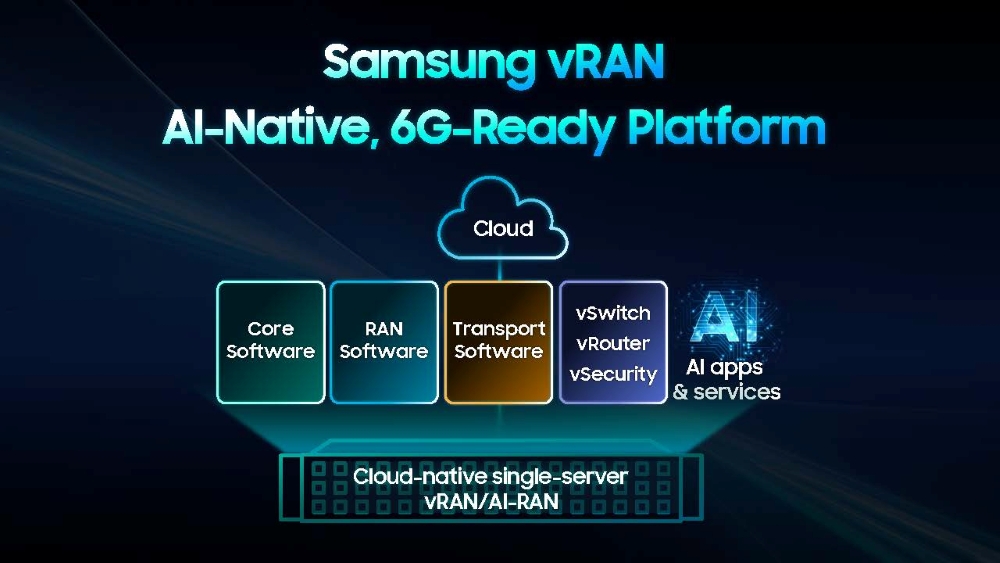
Image Credit: Samsung
“This breakthrough represents a major leap forward in network virtualization and efficiency. It confirms the real-world readiness of this latest technology under live network conditions, demonstrating that single-server vRAN deployments can meet the stringent performance and reliability standards required by leading carriers,” said June Moon, Executive Vice President, Head of R&D, Networks Business at Samsung Electronics. “We are not only deploying more sustainable, cost-effective networks, but also laying the foundation to fully utilize AI capabilities more easily and prepare for 6G with our end-to-end software-driven network solutions.”
Samsung’s vRAN leverages the latest Intel Xeon 6 SoC with Intel Advanced Matrix Extensions (Intel AMX), Intel vRAN Boost and up to 72 cores, delivering significant improvements in AI processing, memory bandwidth and energy efficiency compared to the previous generation.
“With Intel Xeon 6 SoC, featuring higher core counts and built-in acceleration for AI and vRAN, operators get the compute foundation for AI native, future ready networks,” said Cristina Rodriguez, VP and GM, Network & Edge, Intel. “This collaborative achievement with Samsung, HPE and Wind River enables greater consolidation of RAN and AI workloads, lowering power and total cost while speeding innovation.”
Samsung has been leading the deployment of vRAN solutions with major network operators worldwide and has achieved many industry breakthroughs, including the industry’s first call on a commercial network and large-scale deployments utilizing Intel Xeon processors with Intel vRAN Boost. The company continues to push the boundaries of network virtualization, working closely with ecosystem partners like Intel to deliver solutions that help operators build networks that are more efficient and sustainable.
“This successful first call is an important milestone for the industry,” said Daryl Schoolar, Analyst and Director at Recon Analytics. “By demonstrating multiple network functions running on next-generation processing technology, Samsung is showing what future networks look like — more cloud-native, more scalable and significantly more efficient. This achievement moves the industry beyond theoretical performance gains and into practical, deployable innovation that operators around the world can leverage to modernize their networks, accelerate automation and better support AI-driven use cases.”
“With Samsung’s vRAN and Intel’s Xeon 6 SoC running on a single server, Samsung expects enhanced cost savings for operators,” said a Samsung spokesperson via email to Light Reading, when asked what cost impact Granite Rapids would have. “The ability to consolidate multiple network functions including RAN, core, transport and security onto a single, high-performance COTS server reduces hardware footprint, simplifies site design and lowers power consumption.”
Vodafone is one Samsung customer that now expects to benefit from the availability of Granite Rapids. In November, Paco Pignatelli, Vodafone’s head of open RAN, told Light Reading that the new Intel platform offers “much better capacity and efficiency” than its predecessors. That was several weeks after the telco had announced plans to deploy Samsung’s virtual RAN technology in Germany and other European markets, starting in 2026.
…………………………………………………………………………………………………………………………………….
vRAN Market Assessment:
Virtual RAN still accounts for a very small share of the entire market. In 2023, data from Omdia put its market share at just 3% of the total RAN market which generates If vRAN is considered as part of the subsector for baseband RAN, its share was about 10% that year, implying baseband represents about 30% of the total expenditure on RAN products.
Hardware still dominates the RAN equipment business, but there is a rapid shift toward Commercial Off-The-Shelf (COTS) servers, particularly those using Intel’s Xeon 6 processors. Regional Dominance: North America and Asia-Pacific are expected to remain the largest markets in 2026, together accounting for over 70% of global vRAN revenue
- Dell’Oro Group:
- 2026 Stability: Predicts overall RAN revenues will remain “mostly stable” in 2026, but identifies AI-RAN, Cloud RAN, and Open RAN as favorable growth segments within that flat topline.
- Market Share: Expects vRAN to account for 5% to 10% of the total RAN market by 2026.
- Private Wireless: Forecasts that private wireless campus network RAN revenue will surpass USD 1 billion in 2026.
- Omdia:
- Growth Surge: Anticipates a doubling of vRAN’s market share by 2028. Specifically, it expects Open vRAN to reach a 16% share of the total RAN market in 2026, up from 7% in 2022.
- Automation Focus: Forecasts the Service Management and Orchestration (SMO) category to grow at a massive 99% CAGR through 2030 as operators align with O-RAN architectures.
- Research and Markets:
- Estimates the global Open RAN market size will reach between USD 5.0 billion and USD 10.0 billion by 2026, driven by aggressive greenfield deployments.
…………………………………………………………………………………………………………………………
References:
https://www.lightreading.com/5g/intel-and-samsung-add-to-pressure-on-purpose-built-5g
vRAN market disappoints – just like OpenRAN and mobile 5G
RAN silicon rethink – from purpose built products & ASICs to general purpose processors or GPUs for vRAN & AI RAN
LightCounting: Open RAN/vRAN market is pausing and regrouping
Dell’Oro: Private 5G ecosystem is evolving; vRAN gaining momentum; skepticism increasing
Heavy Reading: How network operators will deploy Open RAN and cloud native vRAN
Comparing AI Native mode in 6G (IMT 2030) vs AI Overlay/Add-On status in 5G (IMT 2020)
Executive Summary:
AI integration in 6G specifications (3GPP) and standards (ITU-R IMT 2030) highlights a strategic shift in the telecom industry towards AI-native networks, with telecom industry heavyweights like Huawei, Samsung, Ericsson, and Nokia actively developing foundational technologies. Unlike 5G, where AI and machine learning were limited applications or add-on features over existing architecture, 6G will incorporate AI from the onset with an “AI native” approach where intelligence will allow the network to be smart, agile, and able to learn and adapt according to changing network dynamics.
This transformation is necessary because future 6G networks will be too complex for human operators to manage, requiring AI-empowered and learning-driven networks that can facilitate zero-touch network management through capabilities including learning, reasoning, and decision-making.
- AI-Native Networks: The industry consensus is that 6G will be “AI-native,” meaning artificial intelligence will be built directly into the core functions of network control, resource management, and service orchestration. This moves AI from an optimization layer in 5G to an foundational element in 6G.
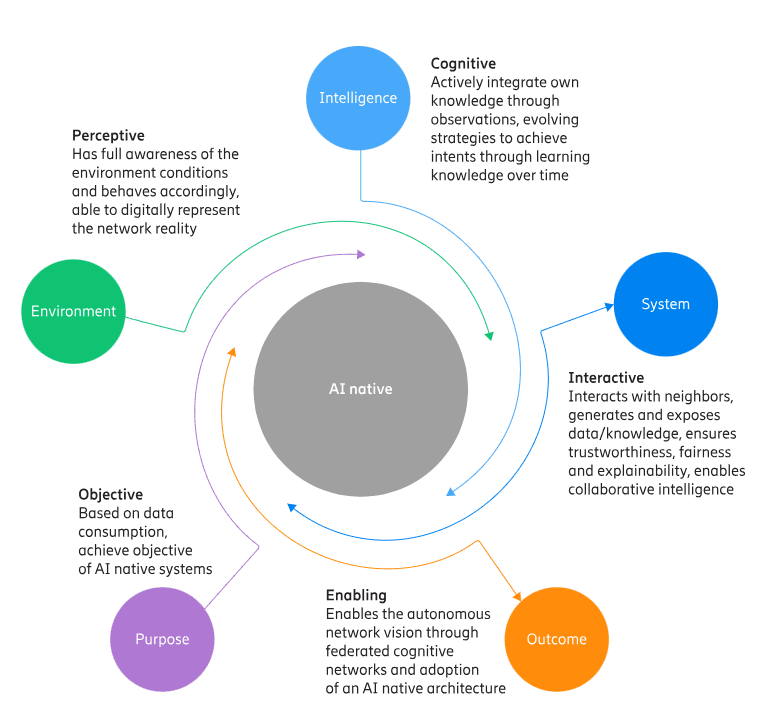
AI Native Image Courtesy of Ericsson
…………………………………………………………………………………………………………………………………………………………………………………………………………………………………………………………………………………………………
- Company Initiatives:
- Huawei is focused on making AI a native element of the network architecture (AI-native 6G) rather than an overlay technology, integrating communication, sensing, computing, and intelligence. This vision, called “Connected Intelligence,” involves two aspects: AI for 6G (network automation) and 6G for AI (AI as a Service, AIaaS). More in Huawei Research Areas below.
- Samsung is a major proponent of AI-RAN (Radio Access Network) technology. The company hosted a summit in November 2025 to showcase working AI-RAN technology that autonomously optimizes network performance and is conducting joint research with SK Telecom (SKT) on AI-supported RAN. Samsung sees vRAN (virtualized RAN) as a key enabler for “AI-native, 6G-ready networks”.
- Ericsson emphasizes the necessity of a strong 5G Standalone (5G SA) foundation for an AI future, using AI to manage and automate current networks in preparation for 6G’s demands. Ericsson is also integrating agentic AI into its platforms for more autonomous network management.
- Nokia is deepening its AI push, licensing software to expand AI use in mobile networks and preparing for early field trials in 2026 by porting baseband software to platforms like NVIDIA’s, which opens the door for more advanced AI use cases.
- Industry Analysis and Trends:
- Standardization: 2026 is crucial as formal 6G specification work begins in earnest within 3GPP with Release 21. In WP5D, the IMT 2030 RIT/SRIT standardization work will commence at the February 2027 meeting with the final deadline for submissions at the February 2029 meeting. More in the ITU-R WP5D section below.
- The AI-RAN Alliance is an industry initiative (not a traditional SDO) focused on accelerating real-world AI applications and integration within the RAN. It works alongside SDOs, providing industry insights and pushing for rapid validation and testing of AI-RAN technologies, with a specific focus on leveraging accelerated computing.
- Automation and Efficiency: AI-native algorithms in 6G are expected to deliver extreme spectrum and energy efficiency, significantly reducing operational costs for telcos while improving reliability and performance.
- Monetization Challenges: Despite the technological promise, analysts caution that 6G remains largely theoretical for now. Some operators are stalling on full 5G SA deployment, waiting to move to 6G-ready cores later in the decade, leading to concerns that 5G SA might become an “odd generation.”
- Infrastructure Constraints: The physical demands of AI infrastructure, particularly energy consumption and construction timelines, are becoming operational realities that may bound the pace of AI growth in 2026, regardless of software advancements.
- ITU-R Working Party (WP) 5D is making AI a native and foundational element of the 6G (IMT-2030) system, rather than the “add-on” or “overlay” status it had in 5G (IMT 2020). This shift is being achieved through the definition of specific AI capabilities and requirements that future 6G technologies must inherently support. In particular:
- Defining AI as a Core Capability: The Recommendation ITU-R M.2160 (“Framework and overall objectives of the future development of IMT for 2030 and Beyond”) officially defines “Artificial Intelligence and Communication” as one of the six major usage scenarios and an overarching design principle for IMT-2030.
- Integrating AI into the Radio Interface: WP 5D is actively developing technical performance requirements (TPRs) and evaluation criteria for proposed 6G radio interface technologies (RITs) that inherently incorporate AI/Machine Learning (ML). This includes work on:
- AI-enabled air interface design: This involves the physical layer, potentially moving towards AI-native physical (PHY) layers that can dynamically adapt waveforms and network parameters in real-time, rather than relying on predefined, static configurations.
- AI-driven resource management: AI/ML algorithms will be crucial for real-time optimization of spectral and energy efficiency, managing complex traffic, and ensuring Quality of Service (QoS).
- Enabling AI-Driven Services: The framework for IMT-2030 is designed to support the full lifecycle of AI components, from data collection and model training to deployment and performance monitoring, enabling new AI-driven services and applications directly within the network infrastructure.
- Establishing a Formal Timeline: WP 5D has established a clear timeline for 6G standardization, with specific stages for vision, requirements, evaluation methodology, and specifications. This structured approach ensures that all proposed RITs/SRITs are evaluated against the new AI-native requirements, promoting global alignment and preventing AI from becoming a fragmented, proprietary solution.
- Stage 1 (Vision): Completed in June 2023.
- Stage 2 (Requirements & Evaluation): Targeted for completion in 2026.
- Stage 3 (Specifications): Expected by the end of 2030.
- Purpose: AI is integral to the entire network lifecycle, from initial design and deployment to autonomous operation and service creation.
- Integration Level: Intelligence is embedded across all layers of the network stack, including the physical layer (air interface), control plane, and data plane.
- Scope: AI enables core functionalities such as real-time self-optimization, self- healing capabilities, and dynamic resource allocation, rather than static, predefined configurations.
- Outcome: The creation of a fully cognitive, self-managing, and highly adaptable “intelligence fabric” capable of supporting advanced use cases like real-time holographic communication, digital twins, and autonomous systems with ultra-low latency.
| Feature | 5G (IMT-2020) | 6G (IMT-2030) |
|---|---|---|
| AI Role | Optimization tool (overlay) | Foundational and native element |
| Network Operation | Manual configuration with AI assistance | Autonomous and self-managing |
| Air Interface | Human-designed with some ML optimization | AI/ML-designed and managed |
| Complexity Management | Relies on standard protocols | Manages complexity through embedded AI/ML |
| Services Supported | Enhanced mobile broadband, basic IoT | Integrated AI & Communication, sensing, holographic comms |
–>By embedding AI into the fundamental design principles and technical requirements of IMT-2030, ITU-R WP 5D is ensuring that 6G is an AI-native network capable of self-management, self-optimization, and supporting a vast ecosystem of AI applications, a significant shift from the supplementary role AI played in 5G.
- Agentic-AI Core (A-Core): Huawei unveiled a blueprint for a 6G core network (which will be specified by 3GPP and NOT ITU) where services are managed by specialized AI agents using a large-scale network AI model called “NetGPT”. This allows the network to program, update, and execute its own control procedures automatically without human intervention, based on natural language instructions.
- Network Architecture Redesign: Huawei proposes the NET4AI system architecture, a service-oriented design that moves beyond the 5G service-based architecture. It introduces a dedicated data plane (DP) to handle the massive volume of data generated by AI and sensing services, enabling flexible and efficient many-to-many data flow for distributed learning and inference.
- Integrated Sensing and Communication (ISAC): A core pillar of Huawei’s 6G work is the native integration of sensing with communication. This allows the network to use radio waves for high-resolution sensing, localization, and imaging, creating a “digital twin” of the physical world. The large volume of data collected from sensing then serves as a source for AI model training and real-time environmental monitoring.
- Distributed Machine Learning: Huawei researches deep-edge architecture to enable massive, distributed, and collaborative machine learning (ML). This includes the development of frameworks like a two-level learning architecture that combines federated learning (FL) and split learning (SL) to optimize computing resources and ensure data privacy by keeping raw data local to devices.
- AI as a Service (AIaaS): The 6G network is designed to provide AI capabilities as a service, allowing the training and inference of large AI models to be distributed across the network (edge and cloud). This offers low-latency performance and access to rich data for AI-driven applications like collaborative robotics and autonomous driving.
- Energy Efficiency and Sustainability: The company is researching how native AI capabilities can improve overall energy efficiency by up to 100 times compared to 5G. This involves smart energy control, dynamic resource scaling, and optimizing communication paths for lower power consumption.
- Standardization and White Papers: Huawei is actively contributing to global 6G discussions and standardization bodies like the ITU-R, sharing its vision through publications such as the book 6G: The Next Horizon – From Connected People and Things to Connected Intelligence and various technical white papers. The goal is to define the technical specifications and use cases for 6G that will drive industry-wide innovation by around 2030.
References:
https://www.ericsson.com/en/reports-and-papers/white-papers/ai-native
Roles of 3GPP and ITU-R WP 5D in the IMT 2030/6G standards process
AI wireless and fiber optic network technologies; IMT 2030 “native AI” concept
ITU-R WP5D IMT 2030 Submission & Evaluation Guidelines vs 6G specs in 3GPP Release 20 & 21
ITU-R WP 5D Timeline for submission, evaluation process & consensus building for IMT-2030 (6G) RITs/SRITs
ITU-R WP 5D reports on: IMT-2030 (“6G”) Minimum Technology Performance Requirements; Evaluation Criteria & Methodology
AI wireless and fiber optic network technologies; IMT 2030 “native AI” concept
Highlights of 3GPP Stage 1 Workshop on IMT 2030 (6G) Use Cases
Should Peak Data Rates be specified for 5G (IMT 2020) and 6G (IMT 2030) networks?
GSMA Vision 2040 study identifies spectrum needs during the peak 6G era of 2035–2040
Highlights and Summary of the 2025 Brooklyn 6G Summit
NGMN: 6G Key Messages from a network operator point of view
Nokia and Rohde & Schwarz collaborate on AI-powered 6G receiver years before IMT 2030 RIT submissions to ITU-R WP5D
Verizon’s 6G Innovation Forum joins a crowded list of 6G efforts that may conflict with 3GPP and ITU-R IMT-2030 work
Nokia Bell Labs and KDDI Research partner for 6G energy efficiency and network resiliency
Deutsche Telekom: successful completion of the 6G-TakeOff project with “3D networks”
Market research firms Omdia and Dell’Oro: impact of 6G and AI investments on telcos
Qualcomm CEO: expect “pre-commercial” 6G devices by 2028
Ericsson and e& (UAE) sign MoU for 6G collaboration vs ITU-R IMT-2030 framework
KT and LG Electronics to cooperate on 6G technologies and standards, especially full-duplex communications
Highlights of Nokia’s Smart Factory in Oulu, Finland for 5G and 6G innovation
Nokia sees new types of 6G connected devices facilitated by a “3 layer technology stack”
Rakuten Symphony exec: “5G is a failure; breaking the bank; to the extent 6G may not be affordable”
India’s TRAI releases Recommendations on use of Tera Hertz Spectrum for 6G
New ITU report in progress: Technical feasibility of IMT in bands above 100 GHz (92 GHz and 400 GHz)
Keysight Technologies Demonstrates 3GPP Rel-19 NR-NTN Connectivity in Band n252
Keysight Technologies, Inc. has demonstrated the first end-to-end New Radio Non-Terrestrial Network (NR-NTN) connection in 3GPP band n252 under Release 19 specifications, achieved in collaboration with Samsung Electronics using Samsung’s next-generation commercial NR modem chipset (part number not stated). The live trial, conducted at CES 2026 in Las Vegas, validated satellite-to-satellite (SAT-to-SAT) mobility and cross-vendor interoperability, establishing a key milestone for direct-to-cell (D2C) satellite communications and NTN commercialization.
The successful validation of band n252 marks the first public confirmation of this spectrum band in an operational NTN system. Band n252 is expected to be a foundational component for upcoming low Earth orbit (LEO) constellations targeting global broadband and IoT coverage. This result demonstrates tangible progress toward large-scale NTN integration supporting ubiquitous, standards-based connectivity for consumers, connected vehicles, IoT devices, and critical communications.
Together with earlier demonstrations in bands n255 and n256, Keysight and Samsung have now validated all major NR-NTN FR1 frequency bands end-to-end. This consolidation enables ecosystem participants—including modem vendors, satellite network operators, and device manufacturers—to analyze cross-band mobility, inter-satellite handovers, and radio performance under consistent, controlled NTN emulation conditions.

The demonstration leveraged Keysight’s NTN Network Emulator Solutions to replicate multi-orbit LEO scenarios, emulate SAT-to-SAT mobility, and execute complete end-to-end routing while supporting live user traffic over the NTN link. When paired with Samsung’s chipset, the setup verified standards compliance, user throughput performance, and multi-vendor interoperability, providing a high-fidelity validation environment that accelerates system testing and time-to-market for NR-NTN deployments targeted for global scaling in 2026.
This integration underscores the readiness of 3GPP Release 19-compliant NTN technologies to transition from proof-of-concept trials to operational field testing, supporting the broader industry goal of realizing seamless terrestrial–non-terrestrial 5G networks within the Rel-19 framework and paving the way for future 6G NTN evolution.
For network operators, device OEMs, and satellite providers, this consolidation of NTN FR1 coverage provides a reference environment to evaluate cross‑band handovers, inter‑satellite mobility, and multi‑vendor interoperability before field deployment. By moving live NR‑NTN testing with commercial‑grade silicon into an emulated LEO constellation environment, the solution is positioned to reduce integration risk, compress trial timelines, and accelerate commercialization of direct‑to‑cell NTN services anticipated to scale from 2026.
Peng Cao, Vice President and General Manager of Keysight’s Wireless Test Group, Keysight, said:
“Together with Samsung’s System LSI Business, we are demonstrating the live NTN connection in 3GPP band n252 using commercial-grade modem silicon with true SAT-to-SAT mobility. With n252, n255, and n256 now validated across NTN, the ecosystem is clearly accelerating toward bringing direct-to-cell satellite connectivity to mass-market devices. Keysight’s NTN emulation environment enables chipset and device makers a controlled way to prove multi-satellite mobility, interoperability, and user-level performance, helping the industry move from concept to commercialization.”
Resources:
About Keysight Technologies:
At Keysight (NYSE: KEYS), we inspire and empower innovators to bring world-changing technologies to life. As an S&P 500 company, we’re delivering market-leading design, emulation, and test solutions to help engineers develop and deploy faster, with less risk, throughout the entire product life cycle. We’re a global innovation partner enabling customers in communications, industrial automation, aerospace and defense, automotive, semiconductor, and general electronics markets to accelerate innovation to connect and secure the world. Learn more at Keysight Newsroom and www.keysight.com.
………………………………………………………………………………………………………………………………………….
References:
https://www.telecoms.com/satellite/samsung-and-keysight-show-off-continuous-ntn-connectivity
Marvell shrinking share of the RAN custom silicon market & acquisition of XConn Technologies for AI data center connectivity
Samsung and Nokia currently use Marvell’s OCTEON Fusion baseband processors and OCTEON Data Processing Units (DPUs) in their 5G Radio Access Network (RAN) equipment.
- OCTEON Fusion Processors: Samsung uses these baseband processors in its 5G base stations, particularly for massive MIMO (Multiple-Input Multiple-Output) deployments that require significant compute power for complex beamforming algorithms.
- OCTEON and OCTEON Fusion Families: Samsung has leveraged multiple generations of these processors for baseband and transport processing solutions.
- Customized OCTEON Silicon: Nokia uses customized Marvell OCTEON silicon across key applications, including multi-RAT (Radio Access Technology) RAN and transport.
- OCTEON Fusion Processors: These are used for baseband processing in Nokia’s 5G products.
- OCTEON TX2 and OCTEON 10 Families: These infrastructure processors are used for demanding tasks like packet processing, security, and edge inferencing within Nokia’s 5G infrastructure.
- OCTEON 10 Fusion: Nokia is working with the latest generation of this 5nm baseband platform, which supports use cases from radio units (RU) to distributed units (DU) for both traditional and Open RAN architectures.
……………………………………………………………………………………………………………………………………………………………………………….
Meanwhile, the total global RAN market has been declining for years as network operators slash investment in network equipment and cut jobs. According to Omdia (owned by Informa):
- Global RAN equipment sales fell from $45 billion in 2022 to $40 billion in 2023 and just $35 billion in 2024. Nokia’s mobile networks business group suffered an operating loss of €64 million (US$75 million) on sales of €5.3 billion ($6.2 billion) for the first nine months of 2025.
- For its 2023 fiscal year (ending in January 2023), Marvell’s carrier division made almost $1.1 billion in revenues, more than 18% of total company sales. Two years later, annual revenues had slumped to just $338.2 million, less than 6% of turnover.
- Marvell’s carrier sales have also recently improved in fiscal 2026, rising 88% year-over-year for the first nine months, to $436.3 billion. However, that’s still half as much as Marvell made during the first nine months of fiscal 2024, and interest in the RAN has seemingly evaporated.
- Samsung’s share of the shrinking RAN market has declined. Amid contraction of the entire addressable market, revenues generated by Samsung Networks fell from 5.39 trillion South Korean won ($3.74 billion) in 2022 to just KRW2.82 trillion ($1.95 billion) in 2024. For the first nine months of 2025, Samsung reported network sales of KRW2.1 trillion ($1.46 billion). But it has also lost market share, which dipped from 6.1% in 2023 to 4.8% in 2024, according to Omdia.
- Ericsson has two development tracks – one for purpose-built RAN products based partly on its own custom RAN silicon and the other for an Intel-based virtual RAN. In contrast to Samsung, the purpose-built RAN silicon portfolio today accounts for nearly all of the company’s sales.
- Ericsson’s senior managers increasingly talk about virtualization as a means of developing one set of software for multiple hardware platforms. The hope is that software originally designed for use with Intel’s processors could be redeployed on CPUs from AMD or licensees from ARM Ltd. with minimal coding changes. Such optionality combined with the narrowing of the performance gap between CPUs and purpose built RAN silicon would make it hard for Ericsson to justify investment in its own custom silicon.
…………………………………………………………………………………………………………………………………………………………………………….
Today, Marvell announced it will acquire XConn Technologies for $540 million to boost AI/data center connectivity. In late 2025, the company announced the acquisition of Celestial AI for up to $5.5 billion to expand its optical interconnects for next-gen data centers, solidifying its position in infrastructure semiconductors.
Adding XConn’s PCIe and CXL switching technology (see illustrations below), fills gaps in Marvell’s silicon portfolio and enables the company to expand into higher-speed interconnects (like PCIe Gen 6).

XConn Technologies XC 50256 chip: 256 lanes with total 2,048GB/s switching capacity
…………………………………………………………………………………………………………………………………….

XC50256 CXL 2.0 Switch Chip
……………………………………………………………………………………………………………………………………………………………
As AI workloads scale, data center system design is evolving from single-rack deployments to larger, multi-rack configurations. These next-generation platforms increasingly require a high-bandwidth, ultra-low latency scale-up fabric such as UALink to efficiently connect large numbers of XPUs and enable more flexible resource sharing across the system.
UALink is a new open industry standard purpose-built for scale-up connectivity, enabling efficient, high-speed communication so multiple accelerators can operate together as a single, larger system. UALink builds on decades of PCIe ecosystem innovation and incorporates proven high-speed I/O techniques to meet the bandwidth, latency, and reach requirements of next-generation accelerated infrastructure.
Together, Marvell and XConn will bring together a significantly larger, integrated team to fully address the rapidly emerging opportunity in UALink switching as well as comprehensively support the growing list of customers and partners who want to work with Marvell in evolving their next generation AI platforms.
About Marvell:
To deliver the data infrastructure technology that connects the world, we’re building solutions on the most powerful foundation: our partnerships with our customers. Trusted by the world’s leading technology companies for over 30 years, we move, store, process and secure the world’s data with semiconductor solutions designed for our customers’ current needs and future ambitions. Through a process of deep collaboration and transparency, we’re ultimately changing the way tomorrow’s enterprise, cloud and carrier architectures transform—for the better.
About XConn Technologies:
XConn is the innovation leader in next-generation interconnect technology for high-performance computing and AI applications. The company is the industry’s first to deliver a hybrid switch supporting both CXL and PCIe on a single chip. Privately funded, XConn is setting the benchmark for data center interconnect with scalability, flexibility, and performance. For more information visit: https://www.xconn-tech.com
……………………………………………………………………………………………………………………………………………………………
References:
https://www.lightreading.com/5g/fragile-samsung-deal-with-marvell-shows-challenge-for-ran-chipmakers
RAN silicon rethink – from purpose built products & ASICs to general purpose processors or GPUs for vRAN & AI RAN
Dell’Oro: Analysis of the Nokia-NVIDIA-partnership on AI RAN
Intel FlexRAN™ gets boost from AT&T; faces competition from Marvel, Qualcomm, and EdgeQ for Open RAN silicon
Analysis: Nokia and Marvell partnership to develop 5G RAN silicon technology + other Nokia moves
Samsung and Marvell develop SoC for Massive MIMO and Advanced Radios
China gaining on U.S. in AI technology arms race- silicon, models and research
Omdia on resurgence of Huawei: #1 RAN vendor in 3 out of 5 regions; RAN market has bottomed
Huawei to Double Output of Ascend AI chips in 2026; OpenAI orders HBM chips from SK Hynix & Samsung for Stargate UAE project
With sales of Nvidia AI chips restricted in China, Huawei Technologies Inc. plans to make about 600,000 of its 910C Ascend chips next year, roughly double this year’s output, people familiar with the matter told Bloomberg. The China tech behemoth will increase its Ascend product line in 2026 to as many as 1.6 million dies – the basic silicon component that’s packaged as a chip.
Huawei had struggled to get those products to potential customers for much of 2025, because of U.S. sanctions. Yet if Huawei and its partner Semiconductor Manufacturing International Corp. (SMIC) can hit that ambitious AI chip manufacturing target, it suggest self sufficiency which will remove some of the bottlenecks that’ve hindered not just its AI business.
The projections for 2025 and 2026 include dies that Huawei has in inventory, as well as internal estimates of yields or the rate of failure during production, the people said. Shares in SMIC and rival chipmaker Hua Hong Semiconductor Ltd. gained more than 4% in Hong Kong Tuesday, while the broader market stayed largely unchanged.

Huawei Ascend branding at a trade show i China. Photographer: Ying Tang/Getty Images
Chinese AI companies from Alibaba Group Holding Ltd. to DeepSeek need millions of AI chips to develop and operate AI services. Nvidia alone was estimated to have sold a million H20 chips in 2024.
What Bloomberg Economics Says:
Huawei’s reported plan to double AI-chip output over the next year suggests China is making real progress in working around US export controls. Yet the plan also exposes the limitations imposed by US controls: Node development remains stuck at 7 nanometers, and Huawei will continue to rely on stockpiles of foreign high-bandwidth memory amid a lack of domestic production.
From Beijing’s perspective, Huawei’s production expansion represents another move in an ongoing back-and-forth with the West over semiconductor access and self-sufficiency. The priority remains accelerating indigenization of critical technologies while steadily pushing back against Western controls.
– Michael Deng, analyst
While Huawei’s new AI silicon promises massive performance gains it has several shortcomings, especially the lack of a developer community comparable to Nvidia’s CUDA ecosystem. A Chinese tech executive said Nvidia’s biggest advantage wasn’t its advanced chips but the ecosystem built around CUDA, its parallel computing architecture and programming model. The exec called for the creation of a Chinese version of CUDA that can be used worldwide.
Also, Huawei is playing catchup by progressively going open source. It announced last month that its Ascend and AI training toolkit CANN, its Mind development environment and Pangu models would all be open source by year-end.
Huawei chairman Eric Xu said in an interview the company had given the “ecosystem issue” a great deal of thought and regarded the transition to open source as a long-term project. “Why keep it hidden? If it’s widely used, an ecosystem will emerge; if it’s used less, the ecosystem will disappear,” he said.
………………………………………………………………………………………………………………………………………………………………………
At its customer event in Shanghai last month, Huawei revealed that it planned to spend 15 billion Chinese yuan (US$2.1 billion) annually over the next five years on ecosystem development and open source computing.
Xu announced a series of new Ascend chips – the 950, 960 and 970 – to be rolled out over the next three years. He foreshadowed a new series of massive Atlas SuperPoD clusters – each one a single logical machine made up of multiple physical devices that can work together – and also announced Huawei’s unified bus interconnect protocol, which allows customers to stitch together compute power across multiple data centers.
Xu acknowledged that Huawei’s single Ascend chips could not match Nvidia’s, but said the SuperPoDs were currently the world’s most powerful and will remain so “for years to come.” But the scale of its SuperPOD architecture points to its other shortcoming – the power consumption of these giant compute arrays.
………………………………………………………………………………………………………………………………………………………………………….
Separately, OpenAI has made huge memory chip agreements with South Korea’s SK Hynix and Samsung, the world’s two biggest semiconductor memory manufacturers. The partnership, aimed at locking up HBM ((High Bandwidth Memory) [1.] chip supply for the $400 billion Stargate AI infrastructure project, is estimated to be worth more than 100 trillion Korean won (US$71.3 billion) for the Korean chipmakers over the next four years. The two companies say they are targeting 900,000 DRAM wafer starts per month – more than double the current global HBM capacity.
Note 1. HBM is a specialized type of DRAM that uses a unique 3D vertical stacking architecture and Through-Silicon Via (TSV) technology to achieve significantly higher bandwidth and performance than traditional, flat DRAM configurations. HBM uses standard DRAM “dies” stacked vertically, connected by TSVs, to create a more densely packed, high-performance memory solution for demanding applications like AI and high-performance computing.
…………………………………………………………………………………………………………………………………………………………………………….
“These partnerships will focus on increasing the supply of advanced memory chips essential for next-generation AI and expanding data center capacity in Korea, positioning Samsung and SK as key contributors to global AI infrastructure and supporting Korea’s ambition to become a top-three global AI nation.” OpenAI said.
The announcement followed a meeting between President Lee Jae-myung, Samsung Electronics Executive Chairman Jay Y. Lee, SK Chairman Chey Tae-won, and OpenAI CEO Sam Altman at the Presidential Office in Seoul.
Through these partnerships, Samsung Electronics and SK hynix plan to scale up production of advanced memory chips, targeting 900,000 DRAM wafer starts per month at an accelerated capacity rollout, critical for powering OpenAI’s advanced AI models.
OpenAI also signed a series of agreements today to explore developing next-generation AI data centers in Korea. These include a Memorandum of Understanding (MoU) with the Korean Ministry of Science and ICT (MSIT) specifically to evaluate opportunities for building AI data centers outside the Seoul Metropolitan Area, supporting balanced regional economic growth and job creation across the country.
The agreements signed today also include a separate partnership with SK Telecom to explore building an AI data center in Korea, as well as an agreement with Samsung C&T, Samsung Heavy Industries, and Samsung SDS to assess opportunities for additional data center capacity in the country.
References:
https://www.lightreading.com/ai-machine-learning/huawei-sets-itself-as-china-s-go-to-for-ai-tech
OpenAI orders $71B in Korean memory chips
AI Data Center Boom Carries Huge Default and Demand Risks
U.S. export controls on Nvidia H20 AI chips enables Huawei’s 910C GPU to be favored by AI tech giants in China
Huawei launches CloudMatrix 384 AI System to rival Nvidia’s most advanced AI system
China gaining on U.S. in AI technology arms race- silicon, models and research
Will billions of dollars big tech is spending on Gen AI data centers produce a decent ROI?
Can the debt fueling the new wave of AI infrastructure buildouts ever be repaid?
Despite U.S. sanctions, Huawei has come “roaring back,” due to massive China government support and policies
SKT-Samsung Electronics to Optimize 5G Base Station Performance using AI
SK Telecom (SKT) has partnered with Samsung Electronics to use AI to improve the performance of its 5G base stations in order to upgrade its wireless network. Specifically, they will use AI-based 5G base station quality optimization technology (AI-RAN Parameter Recommender) to commercial 5G networks.
The two companies have been working throughout the year to learn from past mobile network operation experiences using AI and deep learning, and recently completed the development of technology that automatically recommends optimal parameters for each base station environment. When applied to SKT’s commercial network, the new technology was able to bring out the potential performance of 5G base stations and improve the customer experience.
Mobile base stations are affected by different wireless environments depending on their geographical location and surrounding facilities. For the same reason, there can be significant differences in the quality of 5G mobile communication services in different areas using the same standard equipment.
Accordingly, SKT utilized deep learning, which analyzes and learns the correlation between statistical data accumulated in existing wireless networks and AI operating parameters, to predict various wireless environments and service characteristics and successfully automatically derive optimal parameters for improving perceived quality.
Samsung Electronics’ ‘Network Parameter Optimization AI Model’ used in this demonstration improves the efficiency of resources invested in optimizing the wireless network environment and performance, and enables optimal management of mobile communication networks extensively organized in cluster units.
The two companies are conducting additional learning and verification by diversifying the parameters applied to the optimized AI model and expanding the application to subways where traffic patterns change frequently.
SKT is pursuing advancements in the method of improving quality by automatically adjusting the output of base station radio waves or resetting the range of radio retransmission allowance when radio signals are weak or data transmission errors occur due to interference.
In addition, we plan to continuously improve the perfection of the technology by expanding the scope of targets that can be optimized with AI, such as parameters related to future beamforming*, and developing real-time application functions.
* Beamforming: A technology that focuses the signal received through the antenna toward a specific receiving device to transmit and receive the signal strongly.
SKT is expanding the application of AI technology to various areas of the telecommunications network, including ‘Telco Edge AI’, network power saving, spam blocking, and operation automation, including this base station quality improvement. In particular, AI-based network power saving technology was recently selected as an excellent technology at the world-renowned ‘Network X Award 2024’.
Ryu Tak-ki, head of SK Telecom’s infrastructure technology division, said, “This is a meaningful achievement that has confirmed that the potential performance of individual base stations can be maximized by incorporating AI,” and emphasized, “We will accelerate the evolution into an AI-Native Network that provides differentiated customer experiences through the convergence of telecommunications and AI technologies.”
“AI is a key technology for innovation in various industrial fields, and it is also playing a decisive role in the evolution to next-generation networks,” said Choi Sung-hyun, head of the advanced development team at Samsung Electronics’ network business division. “Samsung Electronics will continue to take the lead in developing intelligent and automated technologies for AI-based next-generation networks.”
 SK Telecom and Samsung Electronics researchers discussing verification of AI-based 5G base station quality optimization technology.
 SK Telecom and Samsung Electronics researchers discussing verification of AI-based 5G base station quality optimization technology.
…………………………………………………………………………………………………………………………………….
SKT said it is expanding the use of AI to various areas of its communications network, such as “Telco Edge AI,” network power reduction, spam blocking and operation automation, including basestation quality improvement.
…………………………………………………………………………………………………………………………………….
References:
SK Telecom (SKT) and Nokia to work on AI assisted “fiber sensing”
South Korea has 30 million 5G users, but did not meet expectations; KT and SKT AI initiatives
SKT Develops Technology for Integration of Heterogeneous Quantum Cryptography Communication Networks
India Mobile Congress 2024 dominated by AI with over 750 use cases
IDC: Worldwide Smartphone Shipment +7.8% YoY; Samsung regains #1 position
According to preliminary data from the International Data Corporation (IDC) Worldwide Quarterly Mobile Phone Tracker, global smartphone shipments increased 7.8% year over year to 289.4 million units in the first quarter of 2024 (1Q24). This marks the third consecutive quarter of smartphone shipment growth, a strong indicator that a recovery is well underway.
“As expected, smartphone recovery continues to move forward with market optimism slowly building among the top brands,” said Ryan Reith, group vice president with IDC’s Worldwide Mobility and Consumer Device Trackers. “While Apple managed to capture the top spot at the end of 2023, Samsung successfully reasserted itself as the leading smartphone provider in the first quarter. While IDC expects these two companies to maintain their hold on the high end of the market, the resurgence of Huawei in China, as well as notable gains from Xiaomi, Transsion, OPPO/OnePlus, and vivo will likely have both OEMs looking for areas to expand and diversify. As the recovery progresses, we’re likely to see the top companies gain share as the smaller brands struggle for positioning.”
“The smartphone market is emerging from the turbulence of the last two years both stronger and changed,” said Nabila Popal, research director with IDC’s Worldwide Tracker team. “Firstly, we continue to see growth in value and average selling prices (ASPs) as consumers opt for more expensive devices knowing they will hold onto their devices longer. Secondly, there is a shift in power among the Top 5 companies, which will likely continue as market players adjust their strategies in a post-recovery world. Xiaomi is coming back strong from the large declines experienced over the past two years and Transsion is becoming a stable presence in the Top 5 with aggressive growth in international markets. In contrast, while the Top 2 players both saw negative growth in the first quarter, it seems Samsung is in a stronger position overall than they were in recent quarters.”
| Top 5 Companies, Worldwide Smartphone Shipments, Market Share, and Year-Over-Year Growth, Q1 2024 (Preliminary results, shipments in millions of units) | |||||
| Company | 1Q24 Shipments | 1Q24 Market Share | 1Q23 Shipments | 1Q23 Market Share | Year-Over-Year Change |
| 1. Samsung | 60.1 | 20.8% | 60.5 | 22.5% | -0.7% |
| 2. Apple | 50.1 | 17.3% | 55.4 | 20.7% | -9.6% |
| 3. Xiaomi | 40.8 | 14.1% | 30.5 | 11.4% | 33.8% |
| 4.Transsion | 28.5 | 9.9% | 15.4 | 5.7% | 84.9% |
| 5. OPPO | 25.2 | 8.7% | 27.6 | 10.3% | -8.5% |
| Others | 84.7 | 29.3% | 79.0 | 29.4% | 7.2% |
| Total | 289.4 | 100.0% | 268.5 | 100.0% | 7.8% |
| Source: IDC Quarterly Mobile Phone Tracker, April 15, 2024 | |||||

Notes:
• Data are preliminary and subject to change.
- Company shipments are branded device shipments and exclude OEM sales for all vendors.
- The “Company” represents the current parent company (or holding company) for all brands owned and operated as a subsidiary.
- Figures represent new shipments only and exclude refurbished units.
References:
https://www.idc.com/getdoc.jsp?containerId=prUS52032524
AST SpaceMobile: “5G” Connectivity from Space to Everyday Smartphones
Huawei reports 1% YoY revenue growth in 3Q-2023; smartphone sales increase in China
Samsung and VMware Collaborate to Advance 5G SA Core & Telco Cloud
Samsung and VMware are continuing their collaboration to offer a powerful and comprehensive 5G solution—combining Samsung 5G Core and VMware Telco Cloud Platform 5G [1.]. This partnership makes it easier for telecom operators using the VMware platform to deploy Samsung’s 5G components. The validation supports Samsung’s ongoing attempts to boost its 5G core market share and further enhances VMware’s telecom efforts.
Note 1. VMware’sTelco cloud is a next-generation network architecture that combines software-defined networking, network functions virtualization, and cloud native technology into a distributed computing network. Since the network and the computing resources are distributed across sites and clouds, automation and orchestration are required.
………………………………………………………………………………………………………………………..
Joining Samsung’s expertise in 5G Core with the power of the VMware Telco Cloud, the combined 5G solution improves the performance and reliability of core networks. In addition, the collaboration offers increased agility and scalability for network infrastructure, enabling operators to rapidly adapt to changing market conditions and customer demands.
The companies have been involved in continuous testing, certification and validation efforts to ensure that Samsung’s 5G Core network functions are fully compatible with VMware Telco Cloud Platform 5G. After validation, Samsung received certification for its 5G Core network functions by the VMware Ready for Telco Cloud program, ensuring compatibility and reliability with VMware technology.
VMware Ready for Telco Cloud certification has been granted to Samsung’s Core network functions, including UPF, NSSF, SMF, AMF, and NRF. The Ready for Telco Cloud certification ensures that network functions are ready for deployment and lifecycle operations with VMware technology. These certified network functions will deliver improved performance, enhanced security features and increased agility and scalability for core networks.
VMware initially rolled out its overarching Telco Cloud Platform in early 2021, which itself was an expansion of its reorganized and repacked stack of technologies for network operators. It has since updated that specific platform as well as expanded its reach into other 5G markets like private 5G and mobile edge compute.
Specific to its work with Samsung, VMware began those efforts in late 2020. That move called for Samsung to integrate its network core, edge, and radio access network (RAN) offerings with VMware and for Samsung to extend its support for cloud-native architecture by adapting its suite of products for containerized network functions (CNFs) and virtual network functions (VNFs) on VMware’s software stack and network automation services.
earlier this year announced the first commercial collaboration with Samsung, which involved integrating Samsung’s virtualized RAN (vRAN) with VMware’s Telco Cloud Platform as part of Dish Network’s ongoing 5G network deployment.
That work built on Dish Network’s plan to deploy 24,000 Samsung open RAN-compliant radios and 5G vRAN software systems running on VMware’s platform that underlines Dish Network’s nascent 5G network.
The companies’ continued collaboration will accelerate the advancement of 5G Core networks and help operators to introduce innovative services that will lead to revenue growth and enhanced customer experiences.
References:
https://www.vmware.com/in/topics/glossary/content/telco-cloud.html
Samsung-Mediatek 5G uplink trial with 3 transmit antennas
Samsung Electronics and MediaTek have successfully conducted 5G standalone (SA) uplink tests, using three transmit (3Tx) antennas instead of the typical two, to demonstrate the potential for improved upload experiences with current smartphones and customer premise equipment (CPE).
Until recently, most talk about 5G SA industry firsts have focused on the downlink. However, the demands on uplink performance are increasing with the rise of live streaming, multi-player gaming and video conferences. Upload speeds determine how fast your device can send data to gaming servers or transmit high-resolution videos to the cloud. As more consumers seek to document and share their experiences with the world in real-time, enhanced uplink experiences provide an opportunity to use the network to improve how they map out their route home, check player stats online and upload videos and selfies to share with friends and followers.
While current smartphones and customer premise equipment (CPEs) can only support 2Tx antennas, this industry-first demonstration validated the enhanced mobile capability of 3Tx antenna support. This approach not only improves upload speeds but also enhances spectrum and data transmission efficiency, as well as overall network performance.
The test was conducted in Samsung’s lab, based in Suwon, Korea. Samsung provided its industry-leading 5G network solutions, including its C-Band Massive MIMO radios, virtualized Distributed Unit (vDU) and core. The MediaTek test device featuring its new M80-based CPE chipset began with one uplink channel apiece at 1,900MHz and 3.7GHz, but added an extra uplink flow using MIMO on 3.7GHz. Both companies achieved a peak throughput rate of 363Mbps, an uplink speed that is near theoretical peak using 3Tx antennas.

Source: ZTE
“We are excited to have successfully achieved this industry breakthrough with MediaTek, bringing greater efficiency and performance to consumer devices,” said Dongwoo Lee, Head of Technology Solution Group, Networks Business at Samsung Electronics. “Faster uplink speeds bring new possibilities and have the potential to transform user experiences. This milestone further demonstrates our commitment to improving our customers’ networks using the most advanced technology available.”
“Enhancing uplink performance using groundbreaking tri-antenna and 5G UL infrastructure technologies will ensure next-generation 5G experiences continue to impress users globally,” said HC Hwang, General Manager of Wireless Communication System and Partnership at MediaTek. “Our collaboration with Samsung has proved our combined technical capabilities to overcome previous limits, enhancing network performance and efficiency, opening up new possibilities for service providers and consumers to enjoy faster and more reliable 5G data connectivity.”
“With demands on mobile networks rising, enhancing upload performance is essential to improving consumer and enterprise connectivity, as well as application experiences,” said Will Townsend, VP & Principal Analyst at Moor Insights & Strategy. “Samsung and MediaTek have achieved an important 5G Standalone milestone in a demonstration which underscores a tangible network benefit and does so in a way that can help operators maximize efficiency.”
Samsung has pioneered the successful delivery of 5G end-to-end solutions, including chipsets, radios and core. Through ongoing research and development, Samsung drives the industry to advance 5G networks with its market-leading product portfolio, from virtualized RAN and Core to private network solutions and AI-powered automation tools. The company currently provides network solutions to mobile operators that deliver connectivity to hundreds of millions of users worldwide.
References:
Ericsson and MediaTek set new 5G uplink speed record using Uplink Carrier Aggregation
Nokia achieves extended range mmWave 5G speed record in Finland
Huawei and China Telecom Jointly Release 5G Super Uplink Innovation Solution
https://www.telecomhall.net/t/5g-uplink-enhancement-technology-by-zte-white-paper/20183