

Will Google Cloud’s AI and data analytics revenue +TPU IP licensing income offset huge AI CAPEX to produce a decent ROI?
An April 24th Investors Business Daily (IBD) article asserts that Google’s AI position is strong, but the real test will be monetization. Specifically, can Gemini translate technical lead and user scale into durable profits for parent company Alphabet? The company has benefited from AI enthusiasm and Google Cloud momentum, but investors are now focused on whether heavy AI spending will generate sufficient revenues to justify the enormous capex ramp up. The article highlights Gemini’s growing traction, Google Cloud’s rapid expansion, and a very large backlog as signs of demand, but it also stresses that those positives must offset rising infrastructure costs.
With its Gemini family, Google continues to push its AI technology across the “stack,” (see quote below) deploying it to Google Maps, enterprise Workplace productivity tools, and YouTube’s content and ad platforms. AI technology is even making Google’s autonomous vehicle company, Waymo, better and safer amid its large market expansion.
A key theme is that Google has multiple ways to earn revenue from AI, including consumer subscriptions, enterprise software, and cloud services. The article points to Gemini Advanced as an example of paid AI packaging, while also implying that the larger opportunity is converting AI usage into higher-value cloud and platform revenue rather than just user growth. However, Alphabet is planning very large AI infrastructure spending (much more below), and the article questions whether the company can turn that investment into sustainable high-margin revenue fast enough to satisfy investors.
Google has also ventured into AI semiconductors with its AI accelerator Tensor Processing Unit, known as TPU, co-developed with Broadcom and manufactured by TSMC (Taiwan Semiconductor Manufacturing Company). Google is shifting future TPU generation designs to include MediaTek for design support, with TSMC continuing as the primary fabrication partner for advanced 2nm, 3nm, and 5nm nodes.
Google has recently introduced the 7th-gen “Ironwood“ TPU and revealed plans for the 8th-gen TPU 8t (Sunfish) and TPU 8i (Zebrafish) for 2027. Long time colleague Amin Vadat, PhD wrote in a blog post, “We are introducing the eighth generation of Google’s custom Tensor Processor Unit (TPU), coming soon with two distinct, purpose-built architectures for training and inference: TPU 8t and TPU 8i. These two chips are designed to power our custom-built supercomputers, to drive everything from cutting-edge model training and agent development, to massive inference workloads. TPUs have been powering leading foundation models, including Gemini, for years. These 8th generation TPUs together will deliver scale, efficiency and capabilities across training, serving and agentic workloads.”

Image credit: Google.
Indeed, Google’s TPUs have emerged as a threat to Nvidia’s dominance in the AI chip market. Anthropic has licensed Google’s TPU accelerators for use in data centers. Broadcom will modify the TPUs for Anthropic before the customized chips are made by TSMC. Wells Fargo estimates that Google could bring in over $10 billion in high-margin intellectual property (IP) licensing fees from TPUs in 2026 and 2027.
“What stands out about Google is that they’ve been investing up and down the technology stack, from silicon to the AI models,” said Daniel Flax, managing director at investment management firm Neuberger Berman. “While competition is fierce, they’ve been able to innovate. What we’re focused on is (Google’s) ability to execute on their product road map from one generation of AI models to the next.”
………………………………………………………………………………………………………………………………………………………………………………………………………………………………………….
AI Competition from OpenAI and Anthropic:
Google faces lots of AI competition from other hyperscalers (Amazon, Microsoft, Meta, etc) and especially from two private AI companies:.
- OpenAI remains a major AI player, powered by the rapid advance of ChatGPT, which launched in 2022. In its latest funding round, OpenAI landed $122 billion in capital commitments, which values the company at $852 billion. OpenAI’s GPT-6 is its next-generation AI model, as soon as late 2026. GPT-6 is expected to include new memory features that support the personalization of AI chatbots. It’ll also offer more support for autonomous AI agents that perform tasks over the internet.
- Anthropic’s Claude AI model family has grabbed the spotlight this year. With Claude-based coding and other AI tools, Anthropic shook up the enterprise software market. Anthropic is preparing a next-generation, more powerful AI model called Mythos. Anthropic recently raised $30 billion in a funding round that valued the AI company at $380 billion.
………………………………………………………………………………………………………………………………………………………………………………………………………………………………………….
AI Cloud Competition:
Google’s cloud computing business is one area that should benefit from the company’s AI spending. The unit has excellent momentum. Cloud revenue climbed 47% to over $16 billion in the December quarter, up from 34% growth in the previous quarter. And Google’s cloud computing sales backlog grew 55% to $240 billion from the September quarter. AWS still has the largest cloud market share, with Azure second and Google Cloud third. Google Cloud’s edge is AI and data analytics, especially through Vertex AI, Gemini-related services, and TPU-based infrastructure. The company has developed AI Gemini models targeting specific industries, such as financial services and pharmaceutical companies. With the recent $32 billion purchase of Wiz, Google plans to offer AI-based cybersecurity threat detection tools.
Google Cloud is growing faster than AWS on an AI-driven basis, but it still trails Azure in the most AI-sensitive growth comparisons and remains third in overall cloud share. The broad pattern is: AWS leads in scale, Azure leads in AI momentum and enterprise pull, and Google Cloud is the strongest “AI-first” challenger with faster growth than AWS but a smaller base. Recent comparisons show AWS revenue growth around 18% year over year, while Google Cloud grew about 32%, and Azure’s estimated growth was about 39% in the same period.
Microsoft reported Intelligent Cloud segment growth was also faster than AWS. The rough share split cited in recent coverage is AWS about 30%, Azure about 20%, and Google Cloud about 13%. Azure’s edge is enterprise distribution and the Azure OpenAI ecosystem, while AWS offers the broadest infrastructure catalog and strong AI tooling but is less clearly identified as the AI growth leader. Investor takeaway For investors, Google Cloud looks like the fastest-improving AI cloud franchise relative to its size, but not the biggest one. The real question is whether Google’sAI-led growth can stay above AWS while also narrowing the gap with Azure’s enterprise AI momentum.
Monetization is a Major Issue:
Many analyst say it’s unclear how many consumers will pay for AI. Only about 5% of ChatGPT’s user base is paid. “Consumer AI is becoming a distribution channel and brand builder, while enterprise agents are where the high-margin, sticky revenue is actually getting locked in,” Ben Lorica, editor of the Gradient Flow AI newsletter, told IBD in an interview. “Widespread platform promiscuity across ChatGPT, Gemini and Claude signals low switching costs and thin margins, which is not a great recipe for durable revenue.”
“Cloud, AI revenues have to scale fast enough for people to say, ‘OK, this is actually working,'” said Michael Landsberg, chief executive of Landsberg Bennett Private Wealth Management. “With Google, a lot of things are going very well, but when is it going to translate into money in the pocket? Gemini is doing really well gaining market share from ChatGPT. But there’s no money yet,” Landsberg added. “The big issue around Google search is, ‘Are they going to be able to put advertising in Gemini?'”
“I think most people want free AI because we’ve been trained that free is how we do this computer thing,” said Kimberly Forrest, Bokeh Capital Partners’ chief investment officer. “Facebook, Instagram — it’s all free now. There might be some people willing to spend $20 monthly on AI, but probably not enough to generate the income that these models need to be continually improved.”
Alphabet has historically monetized consumer products through advertising rather than subscriptions. “I think the average consumer doesn’t want to pay for AI, and if they do, they certainly don’t want to pay much for AI,” said Tim Ghriskey, senior portfolio strategist at Ingalls & Snyder.
Editor’s Note: I regularly use Gemini for Home on my Google Smart Speaker and Gemini on PCs. There’s a huge difference in performance with the former making many more mistakes and “AI Hallucinations” than the latter.
……………………………………………………………………………………………………………………………………………………….
Google/Alphabet’s Surging CAPEX and ROI:
Alphabet said its 2026 capex will be $175 billion to $185 billion, and management has framed the spending as overwhelmingly AI/infrastructure-related which will support revenue growth in Google Cloud, Gemini, and AI-enhanced Search.
The clearest breakdown disclosed to date is roughly 60% to servers and 40% to data centers and networking equipment. Using the company’s forward guidance ranges:
-
AI Compute Servers: about $105 billion to $111 billion.
-
Data centers and networking equipment: about $70 billion to $74 billion.
That means most of the spend is going into fast-depreciating compute hardware, with the rest funding the physical and network buildout needed to host AI workloads. Google says the investment is meant to expand AI compute, support Google Cloud demand, and scale Gemini and enterprise AI offerings.
The company also pointed to a $240 billion cloud backlog and strong cloud revenue growth as signs that the spending is tied to real demand rather than just speculative buildout. The key issue for investors is whether this capital intensity converts into enough cloud and AI revenue to justify the return profile. Alphabet has not given a specific ROI number for its 2026 AI investments. What it has said, and what analysts infer, is that the return should come from faster cloud growth, higher AI-related search usage, and paid enterprise adoption rather than a near-term accounting yield.
In conclusion, 2026 is an AI scale-up year for Google, but the ROI question is still open.
………………………………………………………………………………………………………………………………………………………..
References:
https://www.investors.com/news/technology/google-stock-artificial-intelligence-ai-models-gemini/
Will billions of dollars big tech is spending on Gen AI data centers produce a decent ROI?
Big tech spending on AI data centers and infrastructure vs the fiber optic buildout during the dot-com boom (& bust)
AI infrastructure spending boom: a path towards AGI or speculative bubble?
Expose: AI is more than a bubble; it’s a data center debt bomb
China vs U.S.: Race to Generate Power for AI Data Centers as Electricity Demand Soars
Anthropic’s Project Glasswing aims to reshape IT cybersecurity
IDC Survey of Networking Leaders: Enterprise AI progress stalls despite ambitious goals
Will “AI at the Edge” transform telecom or be yet another telco monetization failure?
Nvidia Survey Reveals How Telcos Plan to Use AI; Quantifying ROI is a Challenge
Analysis: Cisco, HPE/Juniper, and Nvidia network equipment for AI data centers
Networking chips and modules for AI data centers: Infiniband, Ultra Ethernet, Optical Connections
Analysis: Nokia’s strong growth in Optical Networks and AI network infrastructure
Executive Summary:
While Nokia’s first-quarter profitability improved across all reported metrics, year-over-year comparisons were significantly affected by a €120 million ($140 million) non-recurring charge recorded in the Mobile Networks business in the prior-year period. On a comparable basis, net profit increased 93% to approximately €295 million ($345 million). Despite ongoing cost restructuring initiatives, the company’s comparable operating margin remained at 6.2%, well below the ~11% levels observed in the corresponding quarters of 2021 and 2022, indicating continued margin compression relative to earlier cycle peaks.
Optical networking has emerged as Nokia’s primary growth engine, significantly outpacing the company’s overall performance. At the group level, Nokia reported first-quarter comparable revenue growth of 3% year-over-year (4% in constant currency) to €4.5 billion ($5.3 billion). The acquisition of Infinera, which was completed in March last year, surely helped. As did massive investments by AI data center companies because Nokia’s optical gear is used for both intra and inter data center connectivity.
The company said Thursday that first-quarter sales of optical network infrastructure rose 12% on year, driven by demand from AI and cloud customers in the Americas. It booked 1 billion euros ($1.17 billion) of orders from AI & Cloud customers in the quarter and now sees overall sales in the network infrastructure business growing 12%-14% this year, having previously expected 6%-8%. The company had previously announced it was investing in additional manufacturing capacity to support growth and maximize the opportunity in this accelerating market.
When Nokia held its capital markets day last November, the company expecting hyperscalers to invest about $540 billion in total capital expenditure this year. That number has now been raised to more than $700 billion, Nokia CEO Justin Hotard told reporters. As part of that flows into Nokia’s order book, first-quarter optical sales grew 56% year-over-year, to €821 million (US$959 million).
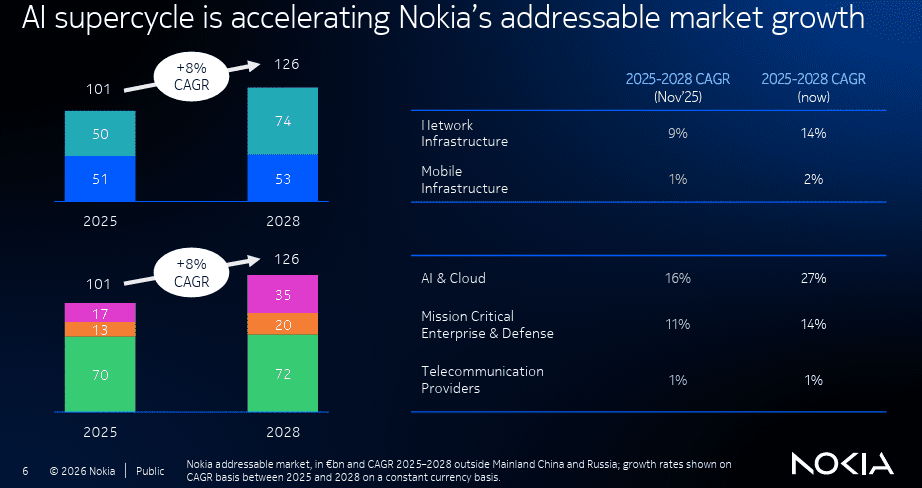
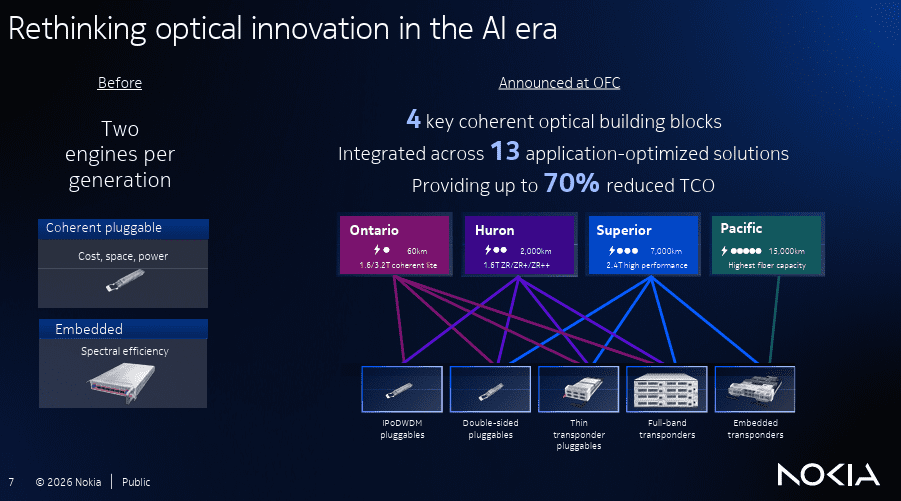
Image Credits: NOKIA
……………………………………………………………………………………………………………………………………………………………………………………………………….
Performance across segments remains uneven. Key drags included the fixed broadband segment within Network Infrastructure (NI)—which also encompasses optical—as well as the Mobile Networks (MN) radio access business. Despite these headwinds, CEO Justin Hotard is positioning NI, particularly its optical and IP routing units, as the core drivers of near-term growth. The company has raised its full-year NI growth outlook to 12–14%, up from the 6–8% range communicated in January, reflecting stronger momentum in high-capacity transport and IP networking demand.
Nokia is also guiding for full-year comparable operating profit in the range of €2.0–2.5 billion ($2.3–2.9 billion). At the midpoint, this would represent approximately 11% year-over-year growth relative to 2025, indicating improving operational leverage as higher-growth segments scale. The strongest momentum remains in optical and IP networking, while the legacy radio access business is still working through margin pressure, mix shifts, and the higher capital intensity of next-generation RAN evolution.
Within this context, the Mobile Infrastructure (MI) segment remains the principal source of performance uncertainty. Following internal reorganization, the “radio networks” unit—comprising the majority of the former Mobile Networks business—accounts for 63% of MI revenue. While constant-currency performance was broadly stable, reported radio networks revenue declined 5% year-over-year to €1.58 billion ($1.85 billion), contributing to a 3% decline in total MI revenue to approximately €2.5 billion.
Segment-level profitability metrics require careful normalization. MI reported operating profit of €222 million ($259 million), representing a 68% year-over-year increase. However, adjusting for the absence of the prior-year €120 million charge, operating profit would have declined by approximately 12%. On a normalized basis, operating margin would have decreased from ~9.8% to ~8.9%, rather than increasing from the reported 5.1%, indicating underlying margin pressure in the radio access portfolio.
Additional analytical complexity arises from the inclusion of Nokia Technologies within MI reporting. This licensing-driven business has historically exhibited operating margins exceeding 70%. Assuming a comparable margin profile in the current quarter, its implied operating contribution (~€270 million / $316 million) exceeds the total reported MI operating profit. This suggests that the combined radio networks and associated software activities may be operating at or near breakeven when disaggregated from licensing revenues, highlighting the importance of segment-level transparency in assessing the underlying economic performance of Nokia’s RAN portfolio.
A restructuring program, initiated under Pekka Lundmark and continued by CEO Justin Hotard, is designed to deliver approximately €1.2 billion ($1.4 billion) in annualized cost savings by the end of 2026. This is primarily driven by a planned reduction of approximately 14,000 positions from a September 2023 baseline of ~84,000 employees (excluding subsequently divested businesses). As of year-end 2025, Nokia reported 74,100 employees, excluding Infinera, implying that the majority of targeted reductions have been completed and that approximately 4,000 additional reductions remain. Management has indicated that future efficiency gains are expected to be incremental rather than driven by further large-scale restructuring.
…………………………………………………………………………………………………………………………………………………………………………………………
Analysis:
From a systems perspective, the key signal is that transport and aggregation layers are gaining strategic weight relative to the traditional macro-RAN hardware layer. Optical growth reflects the continued densification of metro and backbone networks, driven by higher east-west traffic, AI and cloud interconnect demand, and the need for lower-latency transport to support distributed radio and edge workloads. That makes optical and IP less of a “supporting cast” and more of the enabling fabric for cloudified telecom architectures.
The RAN market is moving toward software-defined, cloud-native, and increasingly AI-assisted architectures, which raises the bar for vendor differentiation. Nokia has been emphasizing AI-RAN and anyRAN work with NVIDIA and operators including BT, NTT Docomo, T-Mobile, and others, positioning itself around AI-for-RAN, AI-on-RAN, and AI-and-RAN use cases. Architecturally, this suggests the company is trying to move beyond a pure radio-box supplier model toward a compute-centric platform strategy tied to 5G-Advanced and AI-native 6G.
This transition intensifies competition with vendors pursuing virtualized RAN, Open RAN, and multi-vendor disaggregation strategies. In that environment, the critical battleground shifts from integrated proprietary base stations to software portability, orchestration, open interfaces, cloud infrastructure integration, and accelerator support. For Nokia, the commercial challenge is that the economics of vRAN and AI-RAN depend not only on technical readiness, but also on whether operators can justify new compute and orchestration layers without eroding total cost of ownership.
The broader networking trend is convergence between mobile, optical, IP, and cloud infrastructure. The same traffic growth that pressures RAN capacity also increases demand for optical transport, IP routing, and security-aware automation across the transport and service layers. In that sense, Nokia’s segment mix highlights a wider industry direction: radio access is becoming only one part of a larger distributed compute and transport system, rather than the dominant center of gravity.
In conclusion, Nokia is benefiting as telecom architecture is becoming more horizontal and software-driven, while still facing friction in the vertically integrated legacy RAN model. Optical and IP are scaling nicely with increased high speed data center traffic; RAN is being redefined by cloud (vRAN), AI, and disaggregation; and the vendor that can best align silicon, software, orchestration, and transport will be better positioned for 5G-Advanced and early 6G/IMT 2030 transitions.
…………………………………………………………………………………………………………………………………………………………………………………………
References:
https://www.nokia.com/about-us/investors/results-reports/
Nokia in major pivot from traditional telecom to AI, cloud infrastructure, data center networking and 6G
Nokia’s AI Applications Study: “Physical AI” may require RAN redesign to support high‑volume, low‑latency uplink traffic
Nokia to showcase agentic AI network slicing; Ericsson partners with Ookla to measure 5G network slicing performance
Australia’s NBN and Nokia demonstrate multi-generation optical technologies concurrently over existing FTTP infrastructure
China’s telecom industry rapid growth in 2025 eludes Nokia and Ericsson as sales collapse
Dell’Oro: Analysis of the Nokia-NVIDIA-partnership on AI RAN
Indosat Ooredoo Hutchison, Nokia and Nvidia AI-RAN research center in Indonesia amongst telco skepticism
Nokia Bell Labs and KDDI Research partner for 6G energy efficiency and network resiliency
Analysis: AT&T 1Q-2026 results: increased fiber penetration, FWA momentum, D2D deals, and mobile/home internet bundles
AT&T reported first-quarter results today, achieving its fastest-ever year-over-year organic growth in its advanced connectivity convergence rate, with nearly 45% of advanced home internet subscribers also choosing AT&T wireless. Customers are increasingly purchasing their internet and wireless together from AT&T, highlighting the strength of the company’s differentiated, investment-led strategy to drive converged advanced connectivity at scale.
“We saw our best first quarter ever for Advanced Connectivity internet customer net additions, demonstrating the solid foundation of assets we have built,” said John Stankey, AT&T Chairman and CEO. “We’re uniquely positioned to deliver more of what customers want — fiber and 5G all from one provider on the nation’s largest advanced converged network, backed by the AT&T Guarantee. The actions we’ve taken this quarter are evidence of how we are improving the customer value proposition, scaling faster, and accelerating growth.”
AT&T reported $31.5 billion in consolidated operating revenues, representing a 2.9% year-over-year (YoY) increase and outperforming Street estimates of $31.22 billion. This growth was largely driven by the Advanced Connectivity segment, which generated $22.15 billion in consumer revenues, up from $20.97 billion in the prior-year period.
- Wireless Performance: Mobility services posted mostly flat $16.94 billion in revenue, compared to $16.65 billion in Q1 2025.
- Legacy Decommissioning: Legacy revenues fell 25.3% YoY to $1.8 billion. The aggressive copper-to-fiber migration continues, with 85% of wire centers now approved for legacy service cessation.
- Strategic Sunsetting: 30% of these wire centers are slated for total decommissioning by late 2026, coinciding with the loss of 270,000 DSL subscribers this quarter.
The shift toward high-speed, durable connectivity is evidenced by the growth of AT&T’s Fiber and Fixed Wireless Access (FWA) portfolios.
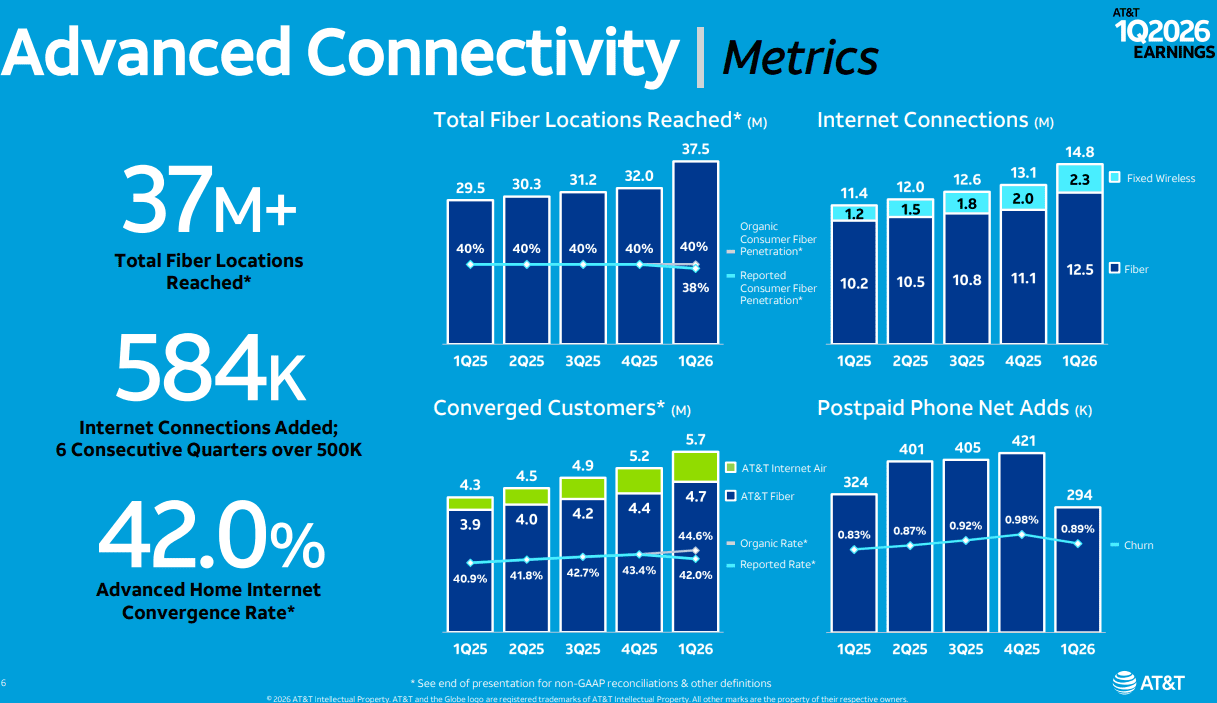
- Fiber Penetration: AT&T recorded 292,000 fiber net additions, bringing the total subscriber base to 12.5 million. The current passings stand at 37.5 million locations, with 32.7 million owned/operated and 4.8 million via joint ventures (JVs).
- FWA Momentum: AT&T Internet Air added 239,000 customers in the quarter (up from 181,000 in Q1 2025), reaching a total of 1.73 million subscribers.
- Roadmap to 60 Million: AT&T remains on track to reach 60 million fiber locations by 2030 through organic expansion, the Gigapower JV, and open-access agreements.
AT&T is evolving its “NetworkCo” model to optimize capital intensity and market reach.
- Lumen Asset Integration: Recently acquired fiber assets from Lumen will be transferred into a JV structure. CFO Pascal Desroches expects to finalize an agreement with an equity partner for these assets in 2H 2026.
- Convergence and “One Connect”: The “One Connect” platform is the cornerstone of AT&T’s converged strategy.
- Bundle Adoption: 42% of advanced home internet customers (5.68 million) also subscribe to mobile services.
- Fiber-Mobile Synergy: Among fiber-specific customers, the mobility bundle penetration rate is 40.2% (4.74 million).
- The “One Connect” Roadmap: CEO John Stankey views the platform as an iterative engine, beginning with BYOD (Bring Your Own Device) and eventually expanding into tailored family plans.
“We made further progress at positioning AT&T as the preferred provider for connecting consumers and businesses to the internet. We closed our transaction with Lumen, ahead of schedule, adding 1.1 million fiber customers, and over 4 million fiber locations. We’re pleased with the progress we’re making as we integrate these assets in several major metro areas and position the business for faster growth. Early indicators are positive. We now offer fiber services throughout our distribution channels in these areas, which has driven sales activity well above pre-transaction trends. We’re executing the steps to scale engineering, construction and service delivery in the acquired geographies, expected as we move into the back half of the year, will achieve steady improvement in fiber and wireless customer growth in these areas. When we focus on customers needs and invest in the experience and products they want, we find success, and in the first quarter, we gave customers more reasons to choose AT&T. We expanded the AT&T guarantee to cover internet Air and launched a new flagship app to deliver a simple digital-first experience to customers.
We also launched AT&T OneConnect, which enables customers to easily connect all their eligible devices at home and on the go, and eliminates the need to buy internet access twice. We refreshed our Unlimited Your Way plans to deliver more value. All these moves are based on a consistent set of principles that drive our approach to serving customers the way they want to be served, with offers that deliver simplicity, value and choice and converged connectivity.
After years of industry-leading investments in our fiber and wireless network, we believe that we have now established a structural advantage that others will not catch. We reached more than 90 million customer locations across the country with our advanced internet services, over either fiber or 5G. We believe this provides us with more scalable reach and converged connectivity than any of our peers, including a meaningful scale and performance advantage in fiber. This is an advantage we’re growing as we ramp our deployment at a faster pace than anyone else. Today, we reach over 37 million customer locations with fiber, and we’re on track to reach 60 million plus locations by the end of the decade.”
NTNs and D2D:
Regarding its choice of AST SpaceMobile for direct-to-device (D2D) connectivity for its smartphones, Stankey said, “I think it’s natural that we work with LEO partners that have the capabilities to solve that problem, to integrate those offerings into our services,” Stankey said Tuesday on AT&T’s Q1 2026 earnings call. “My goal would be that I have a good, strong wholesale relationship, and it may not just be with one of them. It may be with more than one of them.”
Besides AST SpaceMobile, Stankey said he expects SpaceX/Starlink to have a “robust direct-to-device capability,” as well as Amazon Leo and potentially a fourth NTN satellite internet company. SpaceX is developing a next-generation D2D offering with spectrum it’s acquiring from EchoStar, and Amazon plans to introduce a new D2D offering in 2028 amid its recent deal to acquire Globalstar. AT&T has a deal with Amazon Leo to connect business customers that are out of reach of terrestrial wireless and wireline networks, but it has not yet signed a D2D-specific deal with Amazon’s satellite and services unit.

Market Analysis – The Fiber Coverage Gap:
Despite strong growth, analysts remain cautious regarding AT&T’s convergence ceiling. With fiber currently available in only about 20% of the U.S., the primary concern is whether AT&T can maintain competitive parity in non-fiber regions.
- Potential Underperformance Risk: In markets where AT&T relies on legacy copper or wholesale third-party access, it may struggle to match the churn reduction and ARPU (Average Revenue Per User) lift seen in its “Fiber + Wireless” footprint.
- Mitigation Strategy: The success of the “60-million-locations fiber by 2030” roadmap which is the primary driver of AT&Ts increased spending. Also, the scaling of Internet Air as a “bridge” technology will be critical in preventing regional underperformance.
- 2026 Milestone: AT&T expects to exceed 40 million total fiber locations by the end of 2026.
- Build Cadence: The company is targeting an organic deployment pace of 4 million new locations per year by the end of 2026. After 2026, this rate is projected to increase to approximately 5 million additional spots annually.
- Funding Mechanism: To support this acceleration, AT&T plans to reinvest $3.5 billion in cost savings specifically into the fiber build-out over the 2026–2027 period.
- “There’s no path for AT&T to have a fiber footprint that will cover more than a third of the country. Will AT&T be consigned to losing share in the other two thirds?” MoffettNathanson analyst Craig Moffett asked in a research note to clients posted after AT&T’s earnings call.
Despite the high CapEx, AT&T CFO Pascal Desroches reaffirmed that the company remains on track to deliver $18 billion+ in free cash flow (FCF) for 2026.
………………………………………………………………………………………………………………………………………………………………………
References:
https://www.lightreading.com/satellite/at-t-might-look-beyond-ast-spacemobile-for-d2d
Analysis: AT&T’s $250B network investment to advance U.S. connectivity
AT&T and AWS to deliver last mile connectivity for AI workloads; AT&T Geo Modeler™ AI simulation tool
AT&T and Ericsson boost Cloud RAN performance with AI-native software running on Intel Xeon 6 SoC
AT&T’s convergence strategy is working as per its 3Q 2025 earnings report
AT&T deploys nationwide 5G SA while Verizon lags and T-Mobile leads
AT&T to buy spectrum licenses from EchoStar for $23 billion
AT&T grows fiber revenue 19%, 261K net fiber adds and 29.5M locations passed by its fiber optic network
Ookla: D2D satellite connectivity surged 24.5% during last 9 months; Starlink’s footprint expansion leads the way
Introduction:
Direct-to-device (D2D) satellite connectivity, primarily driven by Starlink deployments, continues to accelerate despite nascent market maturity. Ookla’s latest analysis reveals that while global D2D connections surged 24.5% from July 2025 to March 2026—spurred by Starlink’s expansion into Chile, Ukraine, Peru, and the UK—penetration among mobile subscribers remains under 1.5% in leading markets.
Starlink dominates D2D traffic, accounting for the bulk of connections alongside contributions from Skylo and Lynk Global. Initial use cases center on non-terrestrial network (NTN) extensions for SMS and geolocation in coverage gaps, with next-gen systems eyeing 5G NR integration via acquired spectrum like EchoStar’s holdings. Regional growth offset US/Canada dips, potentially tied to T-Mobile and Rogers introducing D2D surcharges amid seasonal patterns.

Image Credit: Ookla
Market Share Breakdown:

Adoption Barriers:
Terrestrial networks already blanket 96% of the global population per GSMA Intelligence, curbing urgency for D2D beyond edge cases. Low awareness and constrained throughput—versus 5G benchmarks—further limit uptake, though link budgets and multi-orbit architectures promise evolution.
Future Outlook:
Based on the February GSA (Global mobile Suppliers Association) report, Direct-to-Device (D2D) services have achieved commercial launch in 15 markets, with 61 countries currently in the evaluation, testing, or deployment phases of Non-Terrestrial Network (NTN) partnerships. Starlink dominates the landscape with 59 partnerships, followed by AST SpaceMobile at 28. In China—a market excluded from GSA data—ABI Research indicates that China Unicom and China Telecom are already leveraging the Tiantong GEO system for D2D. China Mobile is utilizing the BeiDou constellation while planning integrations with emerging LEO networks. To evolve from narrowband emergency services to full mobile broadband, all three Tier-1 operators are aligning with state-backed LEO mega-constellations, specifically Project Guowang and G60 Qianfan (Spacesail).
For Mobile Network Operators (MNOs), D2D integration significantly alters CAPEX/OPEX strategies. In rural or remote areas, MNOs must now run a cost-benefit analysis: deploy traditional macro sites or utilize satellite-based coverage to eliminate dead zones. While Starlink argues that D2D allows MNOs to reduce terrestrial investment, the technology is largely limited to outdoor environments. Given that approximately 80% of mobile traffic is generated indoors—where satellite link budgets typically fail—terrestrial densification remains critical.
From a regulatory standpoint, the rise of NTN-D2D complicates Universal Service Fund (USF) allocations. In the U.S., the FCC is currently assessing how the $9 billion 5G Fund for Rural America should account for D2D capabilities. Ultimately, while D2D may solve the “dead zone” problem for outdoor mobility, it serves as a complement to, rather than a replacement for, high-capacity terrestrial infrastructure. Enhanced spectrum harmonization and handset chipsets could pivot D2D from supplemental to resilient 5G NTN layer, challenging capex models for rural densification. Network operators must navigate billing handoffs and QoS parity to unlock scale.
References:
https://www.ookla.com/articles/measuring-the-direct-to-device-d2d-marketplace-2026
US Mobile’s new bundle combines its multi-network mobile service with Starlink residential internet
Analysis: Amazon <- Globalstar – a strategic move for D2D and spectrum parity
GSA: 5G Non Terrestrial Networks, 5G SA and 5G Advanced gain momentum
Direct-to-Device (D2D) satellite network comparison: Starlink V2 (Starlink Mobile) vs “Satellite Connect Europe”
Standards are the key requirement for telco/satellite integration: D2D and satellite-based mobile backhaul
Deutsche Telekom selects Iridium for NB-IoT direct-to-device (D2D) connectivity
MTN Consulting: Satellite network operators to focus on Direct-to-device (D2D), Internet of Things (IoT), and cloud-based services
Blue Origin announces TeraWave – satellite internet rival for Starlink and Amazon Leo
China ITU filing to put ~200K satellites in low earth orbit while FCC authorizes 7.5K additional Starlink LEO satellites
Starlink doubles subscriber base; expands to to 42 new countries, territories & markets
Amazon Leo (formerly Project Kuiper) unveils satellite broadband for enterprises; Competitive analysis with Starlink
STL Partners webinar: Agentic AI needed for RAN autonomy & efficiency
Yesterday, a STL Partners webinar titled “Turning autonomy into margin: Agentic AI and the autonomous RAN,” suggested agentic AI is the missing layer that can turn RAN autonomy from a technical goal into a direct profit margin booster. It argues that operators should prioritize autonomy use cases by business impact, not just by how much automation coverage they add, and that the right roadmap can move autonomy from an engineering KPI to a commercial advantage.
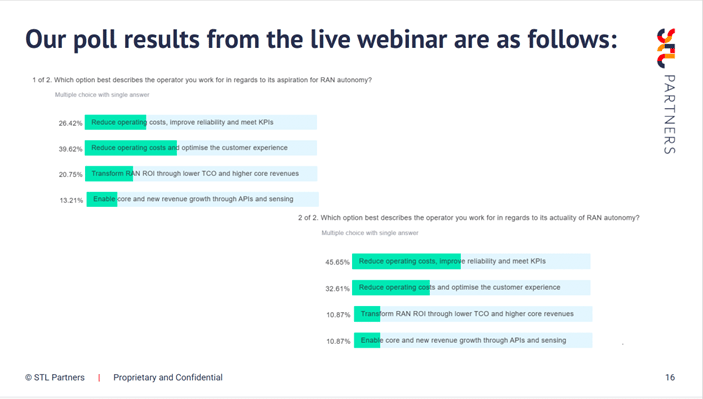
The central message was that autonomy only matters if it improves economics (see poll results below). The webinar revealed that network operators need a dual-axis framework that combines the usual autonomous-network maturity view with a value-creation lens, so they can focus on the capabilities that scale into measurable business outcomes.
Agentic AI is presented as the practical enabler for moving beyond human-in-the-loop operations. In this framing, agents help orchestrate tasks, make decisions, and coordinate network actions in ways that support more closed-loop automation than traditional workflows can deliver.
The results of an “actuality” poll relating to RAN autonomy revealed that controlling costs and reliability were most important, with the enablement of new revenue growth through APIs and sensing only scoring 10.87% of respondents. Similarly, results for an “aspirations” poll for RAN autonomy were also fairly evenly spread between reducing costs and optimizing the customer experience, with just 13.21% citing new revenue growth.
Source: STL Partners
Terje Jensen, SVP, global business security officer and head of network and cloud technology strategy at Telenor, said that he had expected to see network operators’ aspirations shift more clearly towards improving customer experience and even revenue generation, not just efficiency.
Darwin Janz, strategic technology planner at SaskTel, also thought network operators’ ambitions would be higher, but he noted that they still struggle to identify concrete, monetizable use cases. Without that, there’s a real risk of building technical solutions in search of a problem, rather than starting from clear enterprise needs and value, Darwin noted. “We really need to see those use cases and enterprise customer needs,” he added.
……………………………………………………………………………………………………………………….
The webinar was built around four practical questions:
- Which use cases create real commercial impact?
- How to shift from autonomy as an engineering metric to a margin driver?
- Where agentic does AI add value today?
- What data, orchestration, and organizational foundations are needed to scale beyond pilots.
For network operators, the implication is that autonomous RAN strategy should be tied to P&L outcomes such as lower operating cost, better resource utilization, and faster optimization cycles. The webinar’s message is that autonomy becomes strategically important only when it is deployed in a way that compounds across the network and business.
…………………………………………………………………………………………………………………..
References:
The Financial Trap of Autonomous Networks: Scaling Agentic AI in the Telecom Core
Nokia to showcase agentic AI network slicing; Ericsson partners with Ookla to measure 5G network slicing performance
T-Mobile US announces new broadband wireless and fiber targets, 5G-A with agentic AI and live voice call translation
Telecom operators investing in Agentic AI while Self Organizing Network AI market set for rapid growth
Omdia: Global telecom connectivity market hit $333 billion in Q4 2025 for 5% YoY growth
Market research firm Omdia (owned by Informa) reports the global telecom connectivity market reached reached $333 billion in Q4 2025, representing a 5% year-on-year (YoY) growth. Full year revenues came in at $1.3 trillion in 2025, representing a 4% YoY growth.
5G connections exceeded 3 billion and and growing 34% YoY, with Asia being the largest market, accounting for 69% of global 5G connections. By comparison 4G stands at 8.3 billion connections. Asia remains the largest 5G market, accounting for 69% of all global 5G connections.
Fixed broadband connections reached 1.6bn in 2025, with FTTx broadband continuing to dominate as the leading technology, surpassing 1.169bn connections, and growing 7% annually. In Q4 2025 India overtook the United States to become the leading 5G FWA market in the world, with 14.5m connections compared to 13.9m in the United States.
The report surmises the results highlight ongoing challenges for the telecom industry, in that it “remains reliant on a slow growing core business while still working to establish new revenue streams.” While 5G FWA in India and IoT growth offer new opportunities, operators face challenges due to reliance on slow-growing core revenue streams.
“Overall, the 2025 results show that the telecom industry’s core business remains highly relevant, but is facing strong headwinds, including slow growth, while the sector has yet to realize meaningful returns from investments in new technologies,” said Ari Lopes, Omdia Practice Leader for Service Provider Markets.

Omdia says the global ranking of telecom operators by connectivity revenues continues to be dominated by operators from the United States and China, which together account for eight out of the top ten positions. The remaining two operators are based in Japan. According to Perplexity.ai, these are the top 10 telecom operators by revenue:
Top 10 by revenue
Note that Perplexity.ai’s top 10 ranking differs from Omdia’s which states China and the U.S. account for eight telcos (which we assume are: China Mobile, China Telecom, China Unicom, Verizon, AT&T, Comcast, T-Mobile US, Charter Communications) with Japan at two telcos (which we assume are: NTT and Softbank).
References:
https://www.telecoms.com/5g-6g/5g-surpasses-3-billion-connections
Telco investments in mobile core networks surge 83% in 2025-Q4, but what about ROI?
Dell’Oro: RAN Market Stabilized in 2025 with 1% CAG forecast over next 5 years; Opinion on AI RAN, 5G Advanced, 6G RAN/Core risks
Dell’Oro: Mobile Core Networks +15% in 2025; Ookla: Global Reality Check on 5G SA and 5G Advanced in 2026
China’s telecom industry rapid growth in 2025 eludes Nokia and Ericsson as sales collapse
Dell’Oro: Fixed Wireless Access revenues +10% in 2025 & will continue to grow 10% annually through 2029
OpenSignal: real world 5G deployment in India, market status & what happened to 5Gi?
South Korea’s top 3 telcos reinvent themselves as “AI Companies;” growth strategies revealed
Overview:
South Korea’s telecommunications industry is rapidly shifting its center of gravity to AI, with SK Telecom, KT and LG Uplus all declaring their transformation into AI companies. Industry officials describe this as a restructuring process.
- SK Telecom is pushing a full-stack AI strategy spanning infrastructure, models and services.
- KT is accelerating a B2B-focused push to become an “AX” platform company.
- LG Uplus is positioning itself as an AI software company through its ixi-O agent, stressing safety and security. Industry officials say the next test is profitability.
Ryu Jong-heon, SKT’s CEO, wrote in a letter sent to shareholders ahead of last month’s annual general meeting, “If our AI business so far was about incubating various areas, we will now focus more on businesses where SKT can be competitive and secure sustainability in AI competition that is expanding without limit.”
- Next-Gen Compute: Strategic collaboration with Arm and Rebellions for AI CPU/NPU innovation.
- Infrastructure & Power: Agreements with Supermicro and Schneider Electric to optimize AIDC efficiency and server density.
- Model Scaling: With A.X K1 outperforming benchmarks like DeepSeek V3.1, SKT plans to transition to multimodal capabilities and trillion-parameter scaling to secure market dominance across B2B and B2C segments.
2. KT Corporation – Transitioning to an AX Platform Operator:
Under the leadership of CEO Yun-young Park, KT is accelerating its AX (AI Transformation) strategy with a sharp focus on the B2B sector. Following a structural reorganization that established the AX Future Technology Institute and the AX Business Division, KT is positioning itself as a platform enabler rather than a mere solution provider. Despite perceived lags in proprietary model development (e.g., the mi-deum LLM), KT is pursuing a pragmatic “practical gains” strategy. By partnering with Microsoft, KT is adopting a “detour” approach to rapidly integrate global-standard AI capabilities into its existing corporate customer base. CEO Yun-young Park explained, “If AI services are actors on a theatre stage, we are an AX platform company that builds that stage.”
3. LG Uplus -Move to AI-Driven Software and Security:
LG Uplus, led by CEO Beom-sik Hong, is leveraging security and reliability as its primary competitive differentiators. The company is transitioning into an AI-centric software (SW) company, focusing on high-margin service architectures over raw infrastructure. The cornerstone of this strategy is ixi-O, a voice AI agent. The upcoming ixi-O Pro will feature advanced behavioral analytics, including tone and emotional state detection, to provide proactive customer engagement. Hong stated, “We will become an AI-centred software (SW) company that leads solutions in telecommunications and AX technology,” signaling a two-track global expansion strategy involving both service exports and technology stack licensing.
References:
SKT 6G ATHENA White Paper: a mid-to-long term network evolution strategy for the AI era
SK Group and AWS to build Korea’s largest AI data center in Ulsan
South Korea has 30 million 5G users, but did not meet expectations; KT and SKT AI initiatives
McKinsey: AI infrastructure opportunity for telcos? AI developments in the telecom sector
WSJ: 5G in South Korea has not lived up to expectations
South Korea government fines mobile carriers $25M for exaggerating 5G speeds; KT says 5G vision not met
KT and LG Electronics to cooperate on 6G technologies and standards, especially full-duplex communications
SK Telecom (SKT) and Nokia to work on AI assisted “fiber sensing”
SKT Develops Technology for Integration of Heterogeneous Quantum Cryptography Communication Networks
SKT with Global Telcos to Expand Metaverse Platform in US, Europe and Southeast Asia
South Korean telcos to double 5G network bandwidth with massive MIMO; Private 5G
Omdia: ARPU declining or flat for South Korean 5G network operators
3 South Korean mobile operators to share 5G networks in remote areas
LG U+ first to deploy 600G backbone network in Korea with Ciena’s ROADM equipment
Ericsson reports 10% drop in 1st quarter sales; targets network growth
Executive Summary:
Ericsson reported mixed first-quarter 2026 results, characterized by continued resilience in its Networks segment despite regional demand variability and emerging supply-side cost pressures. The Swedish company recorded 7% year-over-year organic growth in its Networks business, supported by sustained network modernization programs and ongoing 5G deployments across Europe, the Middle East, and Africa (EMEA), as well as increased delivery volumes in India and Japan. This growth offset a decline in North American sales, which followed a period of elevated operator investment in 2025 and reflects a near-term reallocation of capital expenditure by key customers. However, Ericsson reported a 10% total sales drop to 49.33 billion kronor in the first quarter, with EBITA falling to 1.44 billion kronor.
Ericsson reiterated its expectation of a broadly flat global RAN market in 2026 but expressed confidence in its ability to outperform the overall sector. The Networks segment maintained a robust adjusted gross margin of 50.4%, within its guided 49–51% range, with similar margin performance anticipated in the second quarter. Sequential revenue growth is projected to align with typical seasonal trends, approximating a 4% increase.
Despite these operational strengths, Ericsson highlighted increasing uncertainty in the macroeconomic and geopolitical environment. Of particular concern is the rising cost of components—especially semiconductors—driven in part by global AI-related demand. The company indicated that while semiconductors represent a relatively limited portion of its total cost base, sustained price increases are expected to create headwinds.
To mitigate these pressures, Ericsson is pursuing a combination of supply chain optimization, product substitution strategies, operational efficiencies, and selective cost-sharing mechanisms with customers. The company emphasized that its prior investments in supply chain diversification have enhanced resilience, although it acknowledged that it remains exposed to broader market disruptions affecting pricing and component availability.
Geopolitical factors have also introduced operational challenges. Ongoing conflict in the Middle East has necessitated adjustments to logistics and transportation routes, resulting in incremental costs. Ericsson noted that its regional distribution infrastructure has been impacted but that supply continuity has been maintained through flexible supply chain management.
From a financial perspective, Ericsson reported first-quarter EBIT of SEK 1.44 billion, a significant decline from SEK 5.93 billion in the prior year, reflecting restructuring charges and adverse currency movements. Group revenue decreased 10% year-over-year to SEK 49.33 billion, below market expectations, while gross margin contracted to 47.2% from 48.2%.

Image Credit: lars schroder/Agence France-Presse/Getty Images
…………………………………………………………………………………………………………………………………………
Börje Ekholm, Ericsson President and CEO, said:
“Our Q1 results demonstrate continued resilience in a dynamic environment, with organic sales growth of 6%. Our healthy gross margins and strong cash flow reflect the progress we have made in recent years, reducing reliance on geographic mix and strengthening our foundations globally. Our multi-year investments in building a resilient, diversified, supply chain have enabled us to deliver consistently for customers amidst geopolitical and macroeconomic uncertainties. We are facing increasing input costs, especially in semiconductors, caused in part by AI demand. Our ambition is to offset these challenges, by working closely with customers and suppliers, and through product substitution and efficiency actions. Looking ahead, while we continue to expect a flattish RAN market, our focused strategy, leading portfolio, and strengthened positions in mission critical and Enterprise give us confidence in our ability to grow faster than the mobile networks market and drive long-term success.”
Overall, the results underscore a transitional phase for Ericsson, with strong execution in global 5G and modernization programs partially offset by cyclical demand softness in North America and emerging cost inflation in critical technology inputs. The company recorded 7% year-over-year organic growth in its Networks business, supported by sustained network modernization programs and ongoing 5G deployments across Europe, the Middle East, and Africa (EMEA), as well as increased delivery volumes in India and Japan. This growth offset a decline in North American sales, which followed a period of elevated operator investment in 2025 and reflects a near-term reallocation of capital expenditure by key customers.
Ericsson’s quarter reinforces a broader industry pattern: the global RAN market is stabilizing after the 5G deployment peak, but not re-entering a meaningful growth phase. Until 6G capex begins to scale later in the decade, vendor performance will depend more on regional share gains, modernization cycles, and margin discipline than on total market expansion. After the 5G buildout peak, network operators are largely shifting from coverage expansion to optimization, monetization, and cost efficiency, which limits near-term revenue upside for vendors even when unit shipments remain healthy.
………………………………………………………………………………………………………………………………………………
RAN Market dynamics:
The key issue is that RAN demand is no longer being driven by broad-based new macro rollouts. Instead, spending is being concentrated on targeted modernization, selective capacity adds, and feature upgrades, while legacy LTE revenue continues to decline and offsets much of the remaining 5G activity.
That helps explain why vendors can still post pockets of growth in regions like EMEA, India, and Japan while North America softens after a prior wave of heavy investment. In other words, regional growth is becoming more cyclical and more dependent on operators’ capex timing than on a sustained global upgrade super-cycle.
Why RAN growth stays muted:
The structural problem is that RAN is maturing into a low-growth infrastructure market. Dell’Oro’s latest forecast points to only about 1% CAGR over the next five years, with the broader market remaining largely flat until 6G-related capex begins to ramp late in the decade.
That means the industry is effectively living through a long gap between the end of the 5G peak and the start of the 6G investment cycle. During that gap, vendors compete less on market expansion and more on mix, efficiency, software attach, and share gains, which is why financial performance can diverge from headline market growth.
What this means for Ericsson:
For Ericsson, the implication is that beating the market may matter more than the market itself. If the underlying RAN market is flat to low-single-digit growth, then Ericsson’s ability to sustain margin through supply-chain discipline, pricing, and product mix becomes more important than chasing top-line expansion alone.
This is also why component inflation matters now. When market growth is weak, cost pressure from semiconductors, logistics, and geopolitics has a larger effect on earnings quality, because vendors have fewer natural volume tailwinds to absorb it.
6G/IMT 2030 timing risk:
The big strategic uncertainty is timing. If meaningful telco 6G capex does not begin until around 2030–2031 (which seems highly likely), then the wireless telecom industry faces several years of subdued RAN revenue. That creates pressure on vendors to extract value from 5G Advanced, automation, private networks, and software-led differentiation before the next technology cycle arrives.
This is why “no real growth till 6G in 2031” is a reasonable framing. It captures the reality that the market can remain technically active while still being economically stagnant, with limited aggregate revenue growth even as networks become more capable and more software-defined.
From Sebastian Barros:
“Ericsson’s Q1 results are a masterclass in structural paradox. Pulling a 6% organic growth rate in a dead-flat global RAN market is a massive operational flex for a 150-year-old heavyweight. But look under the hood. Reported sales took a 10% hit due to brutal FX headwinds, and their supply chain is under intense pressure as global AI data centers hoard 3nm semiconductor capacity. Their historic dominance in custom ASIC silicon and radio frequency is exactly what makes them structurally vulnerable today. Being functionally addicted to a $35 billion RAN market that accounts for over 60% of their portfolio is a massive liability, as that profit pool is being actively dismantled by x86/GPU disaggregation, open architectures, and geopolitical hardware wars…”
………………………………………………………………………………………………………………………………………………………………….
References:
Ericsson and Forschungszentrum Jülich MoU for neuromorphic computing use in 5G and 6G
AT&T and Ericsson boost Cloud RAN performance with AI-native software running on Intel Xeon 6 SoC
Ericsson and Intel collaborate to accelerate AI-Native 6G; other AI-Native 6G advancements at MWC 2026
Ericsson goes with custom silicon (rather than Nvidia GPUs) for AI RAN
China’s telecom industry rapid growth in 2025 eludes Nokia and Ericsson as sales collapse
SoftBank and Ericsson-Japan achieve 24% 5G throughput improvement using AI-optimized Massive MIMO
Huawei, Qualcomm, Samsung, and Ericsson Leading Patent Race in $15 Billion 5G Licensing Market
Ericsson announces capability for 5G Advanced location based services in Q1-2026
Highlights of Ericsson’s Mobility Report – November 2025
Ericsson’s revenue drops, profits soar; deal with Vodafone and partnership with Export Development Canada look promising
GSA: 5G Non Terrestrial Networks, 5G SA and 5G Advanced gain momentum
5G NTNs:
During an April 16th webinar titled “GSA Snapshot: 5G networks, spectrum & devices,” Joe Gardiner, market analyst at CCS Insight and a member of the GSA research team, said GSA data through March 31st reveal that 97 operators in 70 countries have announced they are investing in LEO satellite D2D technology.
“There’s a lot of interest in this area, but there’s also a lot of interest and movement towards 3GPP standards (see Note below), and the convergence of the terrestrial and the non-terrestrial standards map” starting with 3GPP Release 17, Gardiner observed.
Skylo, for example, is following a standards-based approach and already has D2D partnerships with operators such as Orange in France, Verizon and Vodafone IoT.
“Other players are [also] looking to use the standards-based approach, and looking to purchase the spectrum that’s compatible with the standards,” Gardiner said.
Note that 3GPP is not a SDO- it depends on ETSI and ITU-R to rubber stamp its specs and transpose them into official standards.
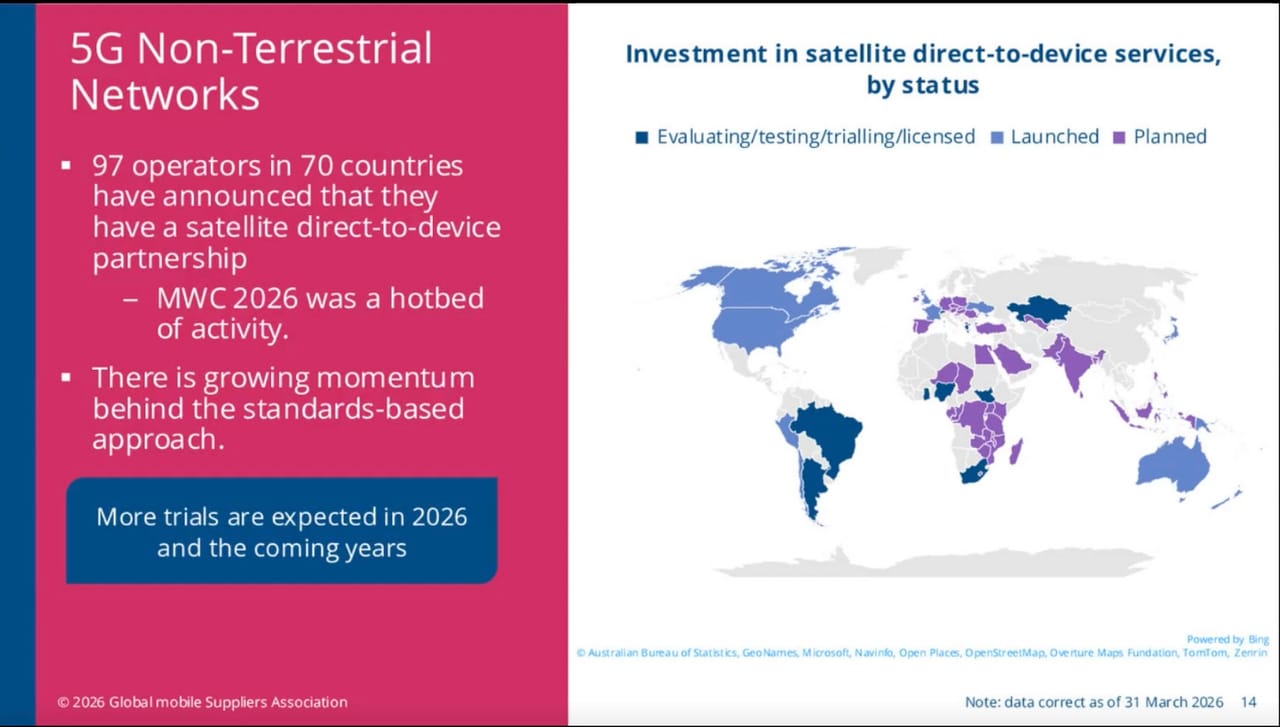
Image credit: GSA
He said that “Part of the reason Amazon is acquiring satellite Globalstar, was because of the spectrum assets that Globalstar has.” Gardiner added that a “lot of trials are taking place that are looking at the next stage of the standards, Release 18 with 5G NR NTN services.”
Gardiner referenced the trial announced by the European Space Agency (ESA), together with Airbus Defence and Space, Eutelsat OneWeb, and industry partners in November 2025.
In addition, Spain’s Sateliot is following the standards-based approach and has launched a Series C financing round to raise €100 million (US$117 million) to help fund the deployment its IoT-focused 5G satellite constellation. “We expect more trials like this to take place over the next few months and years,” Gardiner said. There is a “movement towards using mobile satellite services (MSS) spectrum,” although the drawback with this spectrum is the current lack of compatible mobile devices on the market.
……………………………………………………………………………………………………………………..
5G SA and 5G Advanced:
Ian Fogg, a research director at CCS Insight, who also works within the research team at the GSA, talked up the move towards 5G standalone (SA) and 5G Advanced networks.
“Globally, we have 184 operators in 74 countries investing in 5G standalone. This is publicly. 28.5% of all 5G networks are now 5G standalone. So there’s real momentum happening here,” Fogg said.
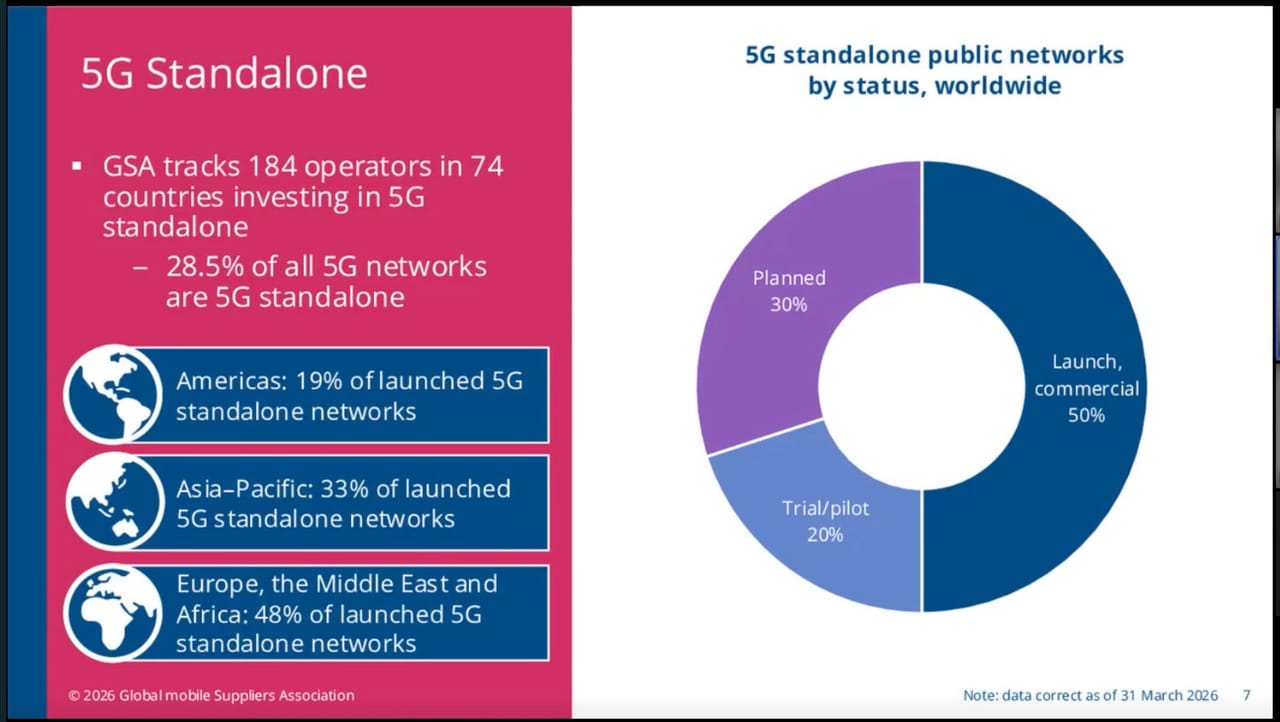
Source: GSA
5G Advanced “is something that’s happening at the moment. We have 36 operators globally publicly saying they’re investing in 5G Advanced. We’ve seen eleven 5G Advanced networks commercially launched,” Fogg said, citing activity in China, Canada, Japan, Kuwait and Vietnam.
“I think what will happen in the next few years is we’ll see the gap between an operator adopting 5G standalone and 5G Advanced narrowing, because if you go to 5G standalone, it’s a natural thing to move fairly quickly on to 5G Advanced, if possible, because you get a lot more capabilities once you’re on a 5G advanced network,” he added.
………………………………………………………………………………………………………………
References:
https://gsacom.com/webinar/5g-networks-spectrum-devices/
Orange set to claim European satellite first
Skylo’s trajectory toward the ‘standardized sky’ looks to include multiple orbits
MWC2026: Skylo makes universal connectivity a reality; Vodafone IoT teams with Skylo for satellite connectivity
Non-Terrestrial Networks (NTNs): market, specifications & standards in 3GPP and ITU-R
ITU-R recommendation IMT-2020-SAT.SPECS from ITU-R WP 5B to be based on 3GPP 5G NR-NTN and IoT-NTN (from Release 17 & 18)
Analysis: Amazon <- Globalstar – a strategic move for D2D and spectrum parity
Enterprise IoT and the Transformation of UK Telecom Business Models – Part 1
From LPWAN to Hybrid Networks: Satellite and NTN as Enablers of Enterprise IoT – Part 2
Keysight Technologies Demonstrates 3GPP Rel-19 NR-NTN Connectivity in Band n252
Telecoms.com’s survey: 5G NTNs to highlight service reliability and network redundancy
Dell’Oro: Mobile Core Networks +15% in 2025; Ookla: Global Reality Check on 5G SA and 5G Advanced in 2026
Dell’Oro: RAN Market Stabilized in 2025 with 1% CAG forecast over next 5 years; Opinion on AI RAN, 5G Advanced, 6G RAN/Core risks
Dell’Oro: RAN market stable, Mobile Core Network market +14% Y/Y with 72 5G SA core networks deployed
AT&T deploys nationwide 5G SA while Verizon lags and T-Mobile leads
Analysis: Amazon <- Globalstar - a strategic move for D2D and spectrum parity
Overview:
Amazon said today that it will acquire Globalstar in an $11.57 billion deal, bolstering its fledgling satellite internet business as it tries to catch up with Elon Musk’s Starlink.
Amazon is accelerating its Project Kuiper deployment, aiming to launch approximately 3,200 Low Earth Orbit (LEO) satellites by 2029. To meet regulatory milestones, nearly 50% of the constellation must be operational by the July deadline, with commercial satellite broadband services slated for a soft launch later this year.
The acquisition of Globalstar augments Amazon’s Direct-to-Device (D2D) connectivity offerings. Globalstar’s current architecture is optimized for low-bandwidth, high-reliability mobile links that bypass traditional terrestrial RAN infrastructure. This capability is vital for ubiquitous emergency services and IoT connectivity in non-terrestrial network (NTN) white spaces. Through this deal, Amazon expects to operationalize its own D2D offerings by 2028.
IMPORTANT: It should be noted that ONLY 3GPP is developing the standards for NTNs – ITU-R and ETSI SDOs are simply rubber stamp SDOs for 3GPP NTN specs.
“There are billions of customers out there living, traveling, and operating in places beyond the reach of existing networks, and we started Amazon Leo to help bridge that divide,” said Panos Panay, Senior Vice President of Devices & Services, Amazon. “By combining Globalstar’s proven expertise and strong foundation with Amazon’s customer-obsession and innovation, customers can expect faster, more reliable service in more places—keeping them connected to the people and things that matter most. We’re excited to support Apple users through the Leo D2D system, and look forward to working with mobile network partners to help extend coverage to every corner of the planet,” Panay added.

The Competitive Landscape: Starlink vs. Kuiper:
SpaceX’s Starlink currently maintains a significant lead with over 9 million global subscribers. While Starlink’s core business remains high-throughput fixed wireless via proprietary user terminals, it is aggressively pursuing D2D through spectrum-sharing partnerships with Mobile Network Operators (MNOs) like T-Mobile.
Industry analysts suggest that acquiring Globalstar is a “spectrum play.” Armand Musey of Summit Ridge Group noted that the deal allows Amazon to secure a critical spectrum position and potentially leapfrog Starlink in D2D deployment timelines. Furthermore, Amazon’s proposed data center constellation is engineered for a massive scaling of network capacity, intended to exceed current LEO benchmarks.
“Amazon has been falling behind Starlink on satellite broadband. Acquiring Globalstar allows them to catch up on their D2D spectrum position, and leap ahead on D2D deployment,” said Armand Musey, president & founder of Summit Ridge Group.
Amazon LEO’s proposed data center constellation would dwarf Starlink’s current network by several magnitudes:

The Apple-Globalstar Ecosystem:
Crucially, Globalstar’s existing partnership with Apple remains intact. Globalstar currently provides the L-band connectivity powering Apple’s Emergency SOS and Find My features. Amazon has confirmed it will honor these agreements, maintaining the 2024 framework where Apple invested $1.5 billion for a 20% equity stake to expand the constellation to 54 satellites. See References below.
Market Consolidation and Valuations:
The move follows a broader trend of sector consolidation as players seek the scale required to compete with SpaceX’s vertical integration and launch frequency.
- Deal Metrics: Amazon’s acquisition values Globalstar at approximately $10.8 billion ($90/share), representing a 31% premium over the pre-announcement close.
- Regulatory Path: The merger is expected to close in 2025, pending FCC approval and the achievement of specific deployment KPIs. FCC Chair Brendan Carr indicated the agency remains “open-minded” regarding the consolidation.
Author’s Opinion & Analysis (aided by perplexity.ai):
Amazon’s Globalstar acquisition is a strong strategic move towards D2D, but it is more a spectrum-and-regulatory shortcut than a pure technology leap. The telecom significance is that Amazon is buying not just satellites, but licensed Mobile Satellite Spectrum (MSS), operational know-how, and an immediate path into direct-to-device connectivity that would otherwise take years to assemble.
From a telecom perspective, the key asset is spectrum parity. Globalstar holds licensed MSS spectrum in the L/S-band ranges used for satellite mobile services, and that spectrum is hard to replicate because the FCC has previously rejected or constrained new entrants in those bands. That makes the deal valuable less as a fleet expansion play and more as a way to secure a legally usable radio layer for D2D, which is not at all guaranteed.
Amazon’s stated plan is to combine Globalstar’s spectrum and MSS operations with Amazon Leo to deliver D2D services beginning in 2028, with claims of higher spectrum efficiency than legacy direct-to-cell systems. In telecom terms, that implies Amazon wants to move from “coverage extension” into a more integrated NTN architecture that can support voice, text, and eventually data services at scale. That’s certainly a tall order!
Against Starlink, this is a defensive and offensive move all at the same time. Starlink already has a lead in satellite scale and has commercialized carrier partnerships like T-Mobile’s direct-to-cell offering, so Amazon’s problem has been less launch capacity than spectrum and service readiness. Buying Globalstar narrows that gap by giving Amazon a ready-made regulatory and spectrum base instead of forcing it to negotiate every D2D pathway from scratch.
Against carriers, the move is more nuanced. Amazon is not simply disintermediating mobile operators; its own materials describe D2D as a way to help MNOs extend voice, text, and data beyond terrestrial reach. That suggests a wholesale or partner model, but the long-term competitive risk is obvious: if Amazon owns the satellite layer and the device/service stack, carriers may become optional distribution partners rather than network gatekeepers.
The phrase “spectrum parity” is the real strategic clue. In telecom, constellation size matters, but spectrum rights determine whether a constellation can actually deliver service with usable link budgets, device compatibility, and regulatory clearance. Globalstar’s spectrum therefore acts like a license to compete, not just a frequency block.
This also helps explain why the deal is strategically defensive for Amazon. Without Globalstar, Amazon would face a slower, less certain path through band planning, interference disputes, and NTNspecific regulatory work, especially in crowded MSS allocations. In that sense, the acquisition is a classic telecom play: buy scarce spectrum, then scale the network around it.
The biggest near-term risk to this deal is regulatory. The transaction will need FCC and likely antitrust review, and Amazon will also have to navigate the Apple/Globalstar relationship because Globalstar powers Apple’s Emergency SOS service. That creates both transition risk and potential bargaining leverage for Apple, which could complicate service continuity and deal terms.
Technically, D2D is still constrained by small link budgets, handset antenna limits, and the need to prioritize messaging and emergency services before richer data use cases. Even if Amazon claims better spectrum efficiency, the first commercially meaningful services will likely remain low-throughput, coverage-oriented offerings rather than full terrestrial substitutes. So the real competition is not “satellite internet for phones” in the consumer broadband sense, but who controls the premium coverage layer for dead zones, emergency service, enterprise continuity, and carrier augmentation.
In conclusion, Amazon is making a category-defining infrastructure purchase, not just a corporate acquisition. If approved, it gives Amazon a credible D2D spectrum position, reduces its regulatory latency, and turns Amazon Leo into a more complete and highly competitive NTN platform and D2D service provider.
……………………………………………………………………………………………………………………….
References:
https://www.aboutamazon.com/news/company-news/amazon-globalstar-apple
Amazon Leo (formerly Project Kuiper) unveils satellite broadband for enterprises; Competitive analysis with Starlink
Blue Origin announces TeraWave – satellite internet rival for Starlink and Amazon Leo
NBN selects Amazon Project Kuiper over Starlink for LEO satellite internet service in Australia
Amazon launches first Project Kuiper satellites in direct competition with SpaceX/Starlink
Emergency SOS: Apple iPhones to be able to send/receive texts via Globalstar LEO satellites in November
FCC proposes regulatory framework for space-mobile network operator collaboration
AT&T deal with AST SpaceMobile to provide wireless service from space
Starlink Direct to Cell service (via Entel) is coming to Chile and Peru be end of 2024
Starlink’s Direct to Cell service for existing LTE phones “wherever you can see the sky”